
Disclosure: As an Amazon Associate, I earn from qualifying purchases. If you buy through links on this page, we may earn a small commission at no extra cost to you.
Searching for a 230v espresso machine in usa marketplaces—or stumbling onto an unexpectedly discounted European model while browsing Amazon US—can turn a dream espresso setup into an unusable countertop paperweight. Cross-border marketplace fulfillment allows third-party sellers to list 220–240V / 50Hz European, UK, and international espresso units alongside official North American 120V / 60Hz hardware, often using identical product photography and copied marketing text.
As part of our broader buying espresso gear on Amazon buyer-protection hub, this investigative audit dissects the exact electrical, mechanical, safety, and warranty traps hidden inside 230V import listings on Amazon US. Whether you are evaluating a European dual-boiler unit, verifying a Swiss or Italian semi-automatic SKU, or cross-checking Amazon Renewed espresso machines for missing US compliance labels, auditing voltage and seller provenance before checkout saves hundreds of dollars in non-refundable mistakes.
Urgent Buyer Alert — 4 Pre-Checkout Import Red Flags:
- 120V vs. 230V Voltage & Plug Lockout (
CR-ESP-SYS-01): A 230V/50Hz machine with a Type F (Schuko) or Type G (UK) plug is a HARD compatibility fail in standard US 120V/60Hz kitchens. Passive plug adapters do not convert voltage, and undersized step-up transformers pose heat and circuit hazards. - Sold/Shipped By & North American Warranty Boundaries: Gray-market 230V imports sold by unverified third-party cross-border resellers routinely void official US brand warranties (Breville, De’Longhi, Solis, Rancilio, Gaggia, Philips) and often lack UL or ETL North American listing marks.
- 230V Spec Bleed & Dual-Boiler Priority Logic (
CR-ESP-SYS-07): Third-party sellers frequently paste European 230V wattage and heat-up numbers onto 120V US listings. Real 120V dual boilers run boiler-priority logic to stay under 15A/20A circuit ceilings, altering steam recovery versus European reviews. - Merged Variants & Dealer-Only Brand Traps: Multi-colorway Amazon pages sometimes merge 120V US and 230V export SKUs under pooled reviews, while European prosumer brands absent from authorized Amazon US stock (such as Lelit, Profitec, ECM, and La Marzocco) appear intermittently via suspicious third-party listings.
In This Marketplace Audit
- Amazon Listing Inspection Matrix: Red Flags vs. Clean Alternatives
- Voltage, Frequency, NEMA Plugs & Why Adapters Fail (CR-ESP-SYS-01)
- 120V vs. 230V Wattage, Heat-Up & Boiler Priority (CR-ESP-SYS-07)
- Seller Provenance, Pooled Variants, 20-Bar Claims & Safety Marks
- 60-Second Pre-Checkout Audit Checklist
- Verified Trap-Free 120V Amazon US Espresso Alternatives
- Disqualified Listing Archetypes & Dealer-Only Exclusions
- Authoritative Electrical & Manufacturer Citations
- Frequently Asked Questions
Amazon Listing Inspection Matrix: Red Flags vs. Clean Alternatives
Before diving into the physics and marketplace mechanics behind a 230v espresso machine in usa listing, compare the eight highest-frequency listing red flags documented across Amazon US appliance pages against the exact compatibility rule and verified 120V alternative.
| Listing Red Flag | What Happens on Your Bench | CR-* Rule or Audit Check | Verified Clean Alternative |
|---|---|---|---|
| “220–240V / 50Hz” or Type F / Type G Plug in Specs | Passive plug adapter drops resistive heater wattage to ~25%; machine stalls, under-heats, or fails thermal safety checks. | CR-ESP-SYS-01 (HARD FAIL): Require 110–127V / 60Hz native input. | Solis Barista Perfetta Plus (120V) |
International Twin SKU (e.g., Sage SES* vs. Breville BES*) | 230V UK/EU Sage unit arrives with UK/EU cord; Breville USA refuses warranty parts and service claims. | Axis 1 & 3 (Identity & Brand Warranty): Confirm US-market BES* SKU and Breville Store byline. | Breville Barista Express BES870BSXL |
| 230V Wattage / Heat-Up Claims Copied Onto US Pages | Buyer expects European simultaneous dual-boiler speed, but 120V unit alternates boiler power to stay under 15A. | CR-ESP-SYS-07 (Boiler Priority): Audit US manual wattage rather than EU reviews. | Meraki Dual Boiler (120V US) |
| Suspicious Third-Party Listing for Dealer-Only EU Brands | Lelit, Profitec, ECM, or La Marzocco listings via unknown sellers are often unavailable, unverified gray imports, or 230V stock. | Axis 3 & Catalog Audit: Exclude Amazon-absent dealer brands from Amazon buy-intent carts. | Authorized specialty US dealers (for Lelit/Profitec) or Meraki 120V Dual Boiler |
| NEMA 5-20P (20A) High-Draw Listing Confused With 15A | Horizontal blade on 5-20P plug physically will not seat in standard 15A NEMA 5-15R kitchen outlets. | CR-ESP-SYS-01 & CR-ESP-SYS-02: Confirm 5-15R vs. electrician-verified 5-20R circuit. | Standard 1,350W–1,750W NEMA 5-15P machines |
| CE-Only Marking With Zero UL / ETL / CSA US Listing | Import lacks North American electrical safety certification required for 120V kitchen thermal cutoffs and cords. | Axis 10 (Safety Marks, G-17): Verify UL or ETL listing for US/Canada. | De’Longhi La Specialista Opera (120V) |
| Pooled Multi-Variant Page Mixing EU & US Revisions | Positive reviews belong to an older or 120V variant while one color/seller option ships a 230V import or stripped bundle. | Axis 4, 7 & 9 (Variants & Bundles): Audit exact seller and spec sheet per selected ASIN. | Single-ASIN verified 120V listings |
| “20-Bar Pump” Headline + Missing Basket Specs | Headline obscures pressurized-only baskets and lack of PID or OPV regulation; shot quality suffers regardless of bar badge. | Axis 6 & CR-ESP-ACC-13 (G-15): Separate dead-head pump rating from ~9 bar brew pressure. | Breville BES870BSXL (single- & dual-wall baskets) |
Voltage, Frequency, NEMA Plugs & Why Adapters Fail (CR-ESP-SYS-01)
The fundamental barrier to running a 230v espresso machine in usa residential kitchens is simple physics. Under North American National Electrical Code (NEC / NFPA) residential wiring standards, standard kitchen countertop receptacles supply nominal 120V AC at 60Hz (typically 110V to 127V at the outlet). European Union, UK, Australian, and many Asian consumer espresso machines are engineered for 220–240V AC at 50Hz.
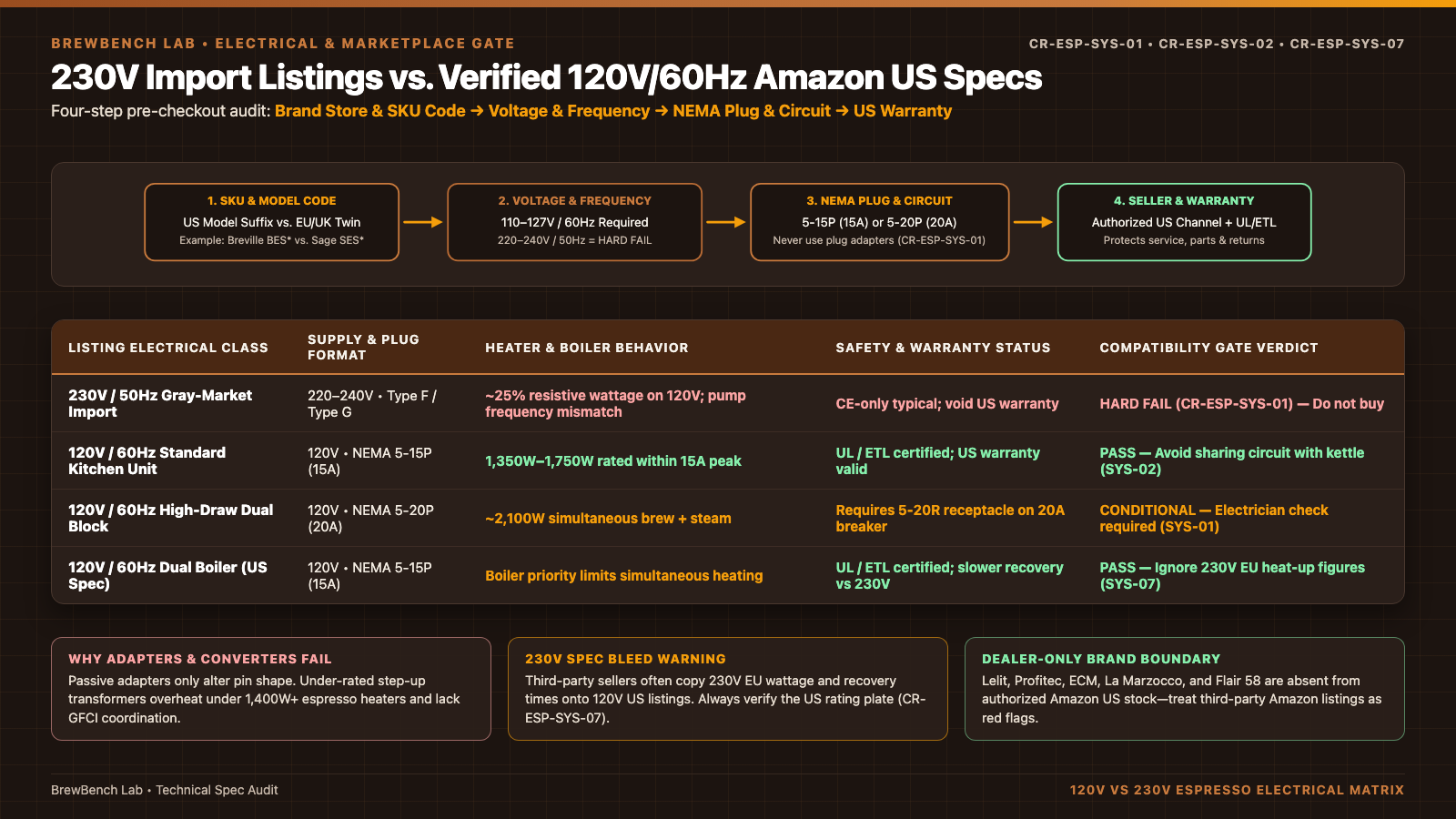
Under BrewBench Lab compatibility rule CR-ESP-SYS-01, any espresso machine rated outside the 110–127V North American range—or fitted with a non-US plug such as a continental European Type F (Schuko) or British Type G three-pin plug—triggers an immediate HARD failure. Here is what happens electrically when buyers attempt workarounds:
1. Why Passive Plug Adapters Do Not Work
A travel plug adapter merely reshapes metal prongs; it performs zero voltage or frequency conversion. Because espresso boilers and thermoblocks are resistive heating elements governed by Ohm’s law (P = V2 / R), halving supply voltage from 230V to 120V reduces heating power by roughly 75%—dropping a 1,600W European thermoblock to roughly 435W. Brew water never reaches stable extraction temperatures (~90–96 °C / 194–205 °F), steam pressure collapses, and digital PID/control boards expecting 230V either fail to boot or trip low-voltage protection faults.
Equally problematic is AC frequency. Most home espresso machines rely on electromagnetic vibratory solenoid pumps (such as Ulka-pattern piston pumps) and 3-way solenoid valves tuned to the line frequency—50 cycles per second in Europe versus 60 cycles per second in the United States. Running a 50Hz-wound solenoid pump or transformer coil on 60Hz alters inductive reactance, piston stroke rhythm, and coil heating behavior.
2. Why Step-Up Voltage Converters Are Poor Kitchen Solutions
Shoppers sometimes ask whether a 120V-to-230V step-up autotransformer rescues a discounted 230V import. In practice, espresso machines are among the worst appliances to pair with countertop voltage converters:
- Severe Continuous Wattage Surges: Espresso heaters draw 1,350W to over 2,400W of resistive load. Transformer manufacturers typically advise sizing continuous resistive heaters with substantial headroom (often 2x to 3x rated load), forcing a heavy, industrial 3,000W–5,000W iron-core transformer onto your kitchen counter.
- Inrush & Breaker Trips: A high-wattage step-up transformer creates its own magnetizing inrush current on startup, compounding the heater draw and tripping standard 15A (1,800W peak / 1,440W continuous) residential kitchen breakers.
- Frequency Remains Unchanged & GFCI Risks: Standard step-up transformers change voltage only—they still output 60Hz to a 50Hz pump—and cheap isolated or autotransformer boxes complicate grounding and kitchen GFCI trip coordination near wet espresso bars.
Consistent with safety-first electrical practice (G-17), never use plug adapters to defeat plug blades, never force a 20A plug onto a 15A receptacle, never defeat ground-fault (GFCI) protection, and never attempt DIY 240V kitchen wiring. If a legitimate 120V North American machine ships with a NEMA 5-20P plug (which has one horizontal blade for 20A circuits, such as 2,100W dual-thermoblock models), have a licensed electrician confirm a dedicated 20A branch circuit and install a matching NEMA 5-20R receptacle.
120V vs. 230V Wattage, Heat-Up & Dual-Boiler Priority Logic (CR-ESP-SYS-07)
Even when a listing sells an authentic 120V/60Hz machine, cross-border information bleed creates a second major trap covered by compatibility rule CR-ESP-SYS-07 and guardrail G-06: European 230V wattage, heat-up, and steam recovery figures do not transfer to 120V US machines.
Under North American residential branch-circuit rules, a 15A 120V circuit caps total capacity at 1,800W (with a continuous 80% load guideline of 1,440W), while a 20A 120V circuit caps at 2,400W (1,920W continuous). By contrast, a standard 230V European wall outlet easily supplies 3,000W to 3,680W. That electrical ceiling forces dual-boiler and prosumer espresso manufacturers to re-engineer how US 120V models allocate power:
- Dual-Boiler Priority Switching (
CR-ESP-SYS-07): Many 120V dual-boiler machines wired for standard NEMA 5-15P outlets use electronic priority logic—heating the brew boiler first or alternating power between the coffee and steam elements rather than energizing both full-wattage elements simultaneously. You still get simultaneous brewing and steaming once preheated, but initial heat-up and back-to-back steam recovery behave differently than 230V European benchmarks suggest. - Reduced Heater Wattage on 120V Twins: Manufacturers frequently ship lower-wattage heating elements inside the 120V US version of a heat-exchanger or dual-boiler chassis compared with its 230V EU twin. Quoting a UK or European reviewer’s heat-up minutes for a US 120V purchase misleads buyers.
- Shared Kitchen Circuit Budgeting (
CR-ESP-SYS-02): Because a 120V espresso machine commonly draws 1,350W to 1,750W during warm-up, running an electric kettle (~1,200W–1,500W) or toaster on the same 15A circuit simultaneously will exceed 1,800W and trip the breaker. Keep high-draw heat appliances on separate circuits or run them sequentially.
Seller Provenance, Pooled Variants, 20-Bar Claims & Safety Marks
Applying BrewBench Lab’s 10-axis Amazon marketplace audit framework reveals how 230V imports and misleading hardware claims slip onto US shopper feeds—even when you search exclusively on Amazon US:
Brand-Name Traps: Breville vs. Sage, De’Longhi & Solis
Several top espresso brands sell under different model prefixes or brand names by electrical region. Breville markets 120V/60Hz North American units under the Breville name with BES* model numbers (such as BES870BSXL or BES878BSS), whereas its 230V/50Hz UK and European sibling sells under the Sage brand with SES* model codes. Similarly, Swiss brand Solis and Italian brand De’Longhi circulate 230V European units internationally under distinct regional part suffixes. Always verify the US model code and confirm explicit 120V / 60Hz specs on the listing.
Seller Identity & North American Warranty Boundaries
On Amazon US, check both the “Visit the <Brand> Store” link below the title and the “Ships from / Sold by” box beside the Buy button. Major manufacturers—including Breville, De’Longhi, Gaggia, Rancilio, and Philips—tie US warranty coverage to authorized US 120V SKUs sold through authorized dealers or Amazon directly. Parallel-imported 230V units sold by overseas marketplace storefronts typically carry zero US manufacturer warranty, no local repair depot support, and expensive international return shipping if the seller requires return to an overseas warehouse.
Pooled Color/Size Variants, Merged Reviews & Renewed Overlap
Amazon’s variation selector frequently combines multiple SKUs, colorways, or seller offers onto a single product URL. One colorway might ship from Amazon.com as a verified 120V US unit, while switching to another color or clicking “Other Sellers” surfaces a third-party international offer with a different voltage or stripped accessory bundle (CR-ESP-ACC-13). Review counts are pooled across every variant on that ASIN family, meaning thousands of positive 120V US reviews can sit above a gray-market 230V third-party offer. The same caution applies to open-box and refurbished units—audit missing portafilter baskets, boiler scale, and voltage plates carefully as detailed in our Amazon Renewed espresso machines audit.
20-Bar Marketing Noise & UL/ETL Safety Marks
Finally, watch out for generic cross-border listings that lead with “20-Bar Italian Pump” while omitting voltage and safety certifications. As covered under guideline G-15, 15-bar and 20-bar figures represent a vibratory pump’s maximum dead-head ceiling against a blocked outlet—not the ~9 bar (~130.5 psi) conventional target at the coffee puck. Worse, uncertified cross-border machines may display only a European CE self-declaration mark without North American UL, ETL, or CSA safety listing for 120V thermal cutoffs, grounded cords, and pressurized thermoblocks (G-17).
60-Second Pre-Checkout Audit Checklist
Run through these six checks on any Amazon US espresso machine page before clicking Add to Cart:
- Verify Brand Store Byline: Click the blue byline beneath the product title to confirm it links to the manufacturer’s official US Store (e.g., Breville Store, De’Longhi Store, Solis Store), not a generic reseller storefront.
- Check Exact US Model Code: Match the title and technical table SKU against the brand’s official US website (
BES*vs.SES*, explicit120Vnotation, or US-market edition suffix). - Confirm 120V / 60Hz & Plug Type (
CR-ESP-SYS-01): Verify “110–120V / 60Hz” in the Technical Details table and confirm whether the cord uses a standardNEMA 5-15P(15A) or requires an electrician-verified 20ANEMA 5-20Rreceptacle. - Inspect “Ships From” and “Sold By”: Favor “Ships from Amazon.com / Sold by Amazon.com” or an established authorized US specialty coffee dealer listed by the manufacturer.
- Audit Q&A and One-Star Reviews for Plug/Voltage Complaints: Filter customer feedback for keywords like “220V”, “230V”, “European plug”, “adapter”, or “warranty denied”—a fast way to catch variant drift on pooled listings.
- Confirm Basket & Grinder Requirements (
CR-ESP-ACC-13,CR-GRD-ESP-01): Check whether both pressurized (dual-wall) and single-wall baskets ship in the US box, and budget for an espresso-capable burr grinder if the machine has no built-in burrs.
Verified Trap-Free 120V Amazon US Espresso Alternatives
If you landed on a suspicious 230V listing while shopping for a European-heritage or dual-boiler machine, each of the four verified 120V/60Hz Amazon US machines below eliminates cross-border voltage traps while covering distinct budget tiers and workflows.
1. Solis Barista Perfetta Plus Espresso Machine, Stainless Steel (120V) — Verified 120V Swiss-Engineered Compact Pick

Quick Specs: 120V / 60Hz North American SKU | Thermoblock with PID temperature control | Low-pressure pre-infusion | Front analog pressure gauge | 54mm portafilter | Price Tier: $200–$500
Solis is a classic Swiss espresso brand whose 230V European units routinely circulate online, making explicit voltage verification mandatory. This dedicated US listing (B08KWLWR5Z) calls out (120V) directly in the SKU title and pairs a brushed stainless steel housing with PID temperature control, low-pressure pre-infusion, and a built-in front pressure gauge—features rarely bundled together in the $200–$500 tier.
Compatibility Gate (CR-ESP-SYS-01 & CR-GRD-ESP-01): Native 120V/60Hz US wiring passes CR-ESP-SYS-01 cleanly. Because there is no built-in grinder, single-wall basket extraction requires pairing with an espresso-capable burr grinder (CR-GRD-ESP-01) and 54mm accessories sized to the Solis basket inner diameter (CR-ESP-ACC-03).
Pros
- Explicitly designated 120V North American listing separates it cleanly from 230V Swiss/EU Solis imports
- PID temperature regulation, low-pressure pre-infusion, and front pressure gauge aid repeatable dialing-in
- Compact brushed stainless steel footprint fits small apartment kitchens (
UC-SMALL-KITCHEN)
Cons
- Single thermoblock operates sequentially between brewing espresso and steaming milk (
CR-DRINK-ESP-03) - Requires budgeting separately for an espresso-capable external burr grinder and 0.1 g scale (
CR-SYS-01/03)
2. Breville Barista Express BES870BSXL (Black Sesame) — Verified 120V US Benchmark (vs. 230V Sage Twins)

Quick Specs: 120V / 60Hz North American SKU (BES870BSXL) | Thermocoil PID heating | Integrated 16-setting conical burr grinder | 54mm Breville group standard | Price Tier: $200–$500
Shoppers researching European videos often encounter the 230V Sage Barista Express (SES875) and risk ordering an international unit by mistake. The authentic North American Breville BES870BSXL ships natively wired for 120V/60Hz US circuits with a standard NEMA 5-15P plug, Breville USA warranty eligibility, and both single-wall and dual-wall 54mm baskets inside the box (CR-ESP-ACC-13).
Compatibility Gate (CR-ESP-SYS-01, CR-ESP-ACC-01 & CR-GRD-ESP-04): Verify the BES* US model prefix at checkout. Uses Breville’s 54mm group standard—aftermarket bottomless portafilters must list Breville 54mm compatibility specifically (CR-ESP-ACC-01).
Pros
- Native 120V/60Hz
BES870BSXLUS specification avoids 230V SageSES*voltage and warranty mismatches - Includes integrated 16-setting conical burr grinder plus single-wall and pressurized 54mm baskets out of the box
- PID-regulated thermocoil and wide US replacement gasket/cartridge availability simplify long-term upkeep
Cons
- Sequential thermocoil requires waiting briefly between pulling espresso and texturing milk (
CR-DRINK-ESP-03) - 16 stepped internal grind increments can feel coarse when dialing in dense light-roast beans (
CR-GRD-ESP-04)
3. De’Longhi La Specialista Opera — Verified 120V Italian-Heritage All-in-One

Quick Specs: 120V / 60Hz North American SKU | Thermoblock + Cold Extraction | Integrated 15-setting burr grinder & Smart Tamping | 51mm De’Longhi group | Price Tier: $500–$1,000
Italian heritage brands generate heavy gray-market confusion when overseas 230V De’Longhi listings surface in US searches. This verified 120V/60Hz North American La Specialista Opera delivers an authorized US power cord, 15-setting built-in burr grinder, mess-free Smart Tamping lever, and cold-extraction presets backed by De’Longhi’s US support channels.
Compatibility Gate (CR-ESP-SYS-01 & CR-ESP-ACC-01): Runs safely on standard 120V/60Hz NEMA 5-15R kitchen outlets. Note that De’Longhi’s 51mm lug geometry varies across model families—buy only 51mm accessories explicitly listing La Specialista compatibility.
Pros
- Genuine 120V/60Hz North American specification eliminates parallel-import voltage and plug failures
- Integrated 15-setting grinder and Smart Tamping lever simplify one-box beginner workflow (
UC-BEGINNER-ONE-BOX) - Adds dedicated cold-extraction presets alongside hot espresso and manual steam wand texturing
Cons
- 51mm De’Longhi group standard has a smaller precision accessory ecosystem than 58mm commercial platforms
- Thermoblock heating handles brew and steam sequentially rather than simultaneously
4. Meraki Semi-Automatic Dual Boiler Espresso Machine (White) — Verified 120V Dual-Boiler Pick

Quick Specs: 120V / 60Hz North American SKU | Dual boiler with PID control | Simultaneous brew & steam | 58mm commercial portafilter | Integrated gravimetric grinder | Price Tier: $1,000+
Many shoppers look for a 230V prosumer dual-boiler import believing they cannot get independent coffee and steam boilers on Amazon US. The verified 120V/60Hz Meraki Semi-Automatic Dual Boiler solves that directly with dedicated brew and steam boilers, PID thermal control, a 58mm portafilter, and a built-in gravimetric grinder engineered specifically for North American household power.
Compatibility Gate (CR-ESP-SYS-07 & CR-ESP-SYS-02): Under 120V/60Hz branch-circuit limits, dual boilers coordinate heater priority between boilers—never rely on 230V European heat-up or steam-recovery expectations. Run on a dedicated 15A/20A circuit free of simultaneous kettles or microwaves.
Pros
- Native 120V/60Hz dual-boiler PID architecture delivers simultaneous brew and steam without voltage converters
- 58mm portafilter diameter supports commercial-style baskets and precision tampers (confirm lug fitment per
CR-ESP-ACC-01) - Integrated gravimetric grinder streamlines dosing repeatability without extra counter clutter
Cons
- 120V power management limits simultaneous dual-element peak draw compared with 230V export systems (
CR-ESP-SYS-07) - Larger dual-boiler chassis requires measuring counter depth and upper-cabinet fill clearance beforehand (
CR-ESP-SYS-04)
Disqualified Listing Archetypes & Dealer-Only Exclusions
During our Amazon US catalog audit (G-22), we excluded three specific listing archetypes that shoppers encounter when hunting for a 230v espresso machine in usa:
- 230V / 50Hz Gray-Market European & UK Twin Listings (e.g., Sage
SES*& EUECAM*Imports): Disqualified underCR-ESP-SYS-01(HARD FAIL). Type F/G plugs and 230V resistive heaters cannot operate safely or at spec wattage on 120V/60Hz North American kitchen receptacles, and US manufacturer warranties are void. - Amazon-Absent Dealer-Only European Prosumer Brands (Lelit, Profitec, ECM, La Marzocco, Flair 58): Disqualified as Amazon buy-intent picks per BrewBench Lab’s marketplace availability audit. Because these brands distribute exclusively through authorized specialty coffee dealers in North America, intermittent third-party Amazon listings—frequently showing “Currently unavailable” or unverified pricing—carry high gray-market and regional voltage risk.
- Uncertified CE-Only Generic Cross-Border Machines: Disqualified under Axis 10 (
G-17). Budget cross-border listings lacking recognizable North American UL, ETL, or CSA safety marks and omitting explicit 120V/60Hz ratings expose buyers to unverified cords, thermal cutoffs, and non-compliant pressurized components.
Authoritative Electrical & Manufacturer Citations
Every electrical compatibility threshold, safety mark boundary, and regional SKU distinction in this marketplace audit draws on authoritative standards and manufacturer documentation:
- National Fire Protection Association (NFPA / National Electrical Code) — North American 120V/60Hz 15A and 20A kitchen small-appliance branch-circuit load ratings and NEMA 5-15 / 5-20 receptacle standards.
- UL Solutions Product Safety Certification — North American appliance electrical safety certification benchmarks compared with European CE self-declarations.
- Breville US Official Support & Specifications — 120V/60Hz North American
BES*machine specifications, thermal architecture, and US warranty terms vs. international 230V SageSES*twins. - De’Longhi US Official Support & Espresso Specifications — Authorized US 120V model identification, warranty boundaries, and manufacturer-specified maintenance rules.
- U.S. Consumer Product Safety Commission (CPSC) — North American electrical appliance compliance oversight and official recall databases.
Continue Your Audit
- Home Espresso Setup Guide 2026: Machine, Grinder and Tools
- Espresso Setup Under $700 2026: Entry Machine and Grinder Plan
- $1,000 Home Espresso Setup 2026: Balanced Machine and Grinder
Frequently Asked Questions: 230V Espresso Machines on Amazon US
Can I run a 230V espresso machine in the USA with a plug adapter?
No. A passive plug adapter only changes prong shape and leaves voltage at 120V, dropping resistive heater wattage by roughly 75% so the machine cannot brew or steam properly. It also creates frequency mismatches on 50Hz vibratory pumps and fails CR-ESP-SYS-01.
Is it safe to use a step-up voltage converter on a 230V espresso machine?
We do not recommend step-up converters for kitchen espresso machines. Resistive heaters draw 1,350W to 2,400W+ continuously, causing undersized transformers to overheat, trip 15A breakers on startup inrush, complicate GFCI protection near water, and still supply 60Hz power to 50Hz pumps.
Why do 120V US dual-boiler espresso machines heat differently than 230V EU models?
Under CR-ESP-SYS-07, North American 120V dual boilers must stay within 15A or 20A branch-circuit limits (1,800W to 2,400W peak). Manufacturers use boiler-priority switching or lower-wattage elements, so steam recovery and heat-up behavior differ from European 230V reviews.
Will Breville, De’Longhi, or Solis honor a US warranty on a 230V gray-market Amazon import?
No. Major espresso manufacturers restrict North American warranty service and replacement support to authentic 120V/60Hz US models purchased through authorized US sellers. Importing a 230V Sage, De’Longhi EU, or Solis EU unit voids regional coverage.
What if a legitimate 120V US machine comes with a NEMA 5-20P 20-amp plug?
A 120V machine with a horizontal-blade NEMA 5-20P plug requires a dedicated 20A circuit and a matching NEMA 5-20R receptacle. Never use a 15A-to-20A plug adapter; consult a licensed electrician to verify your kitchen wiring and install the correct outlet.


