
Disclosure: As an Amazon Associate, I earn from qualifying purchases. If you buy through links on this page, we may earn a small commission at no extra cost to you.
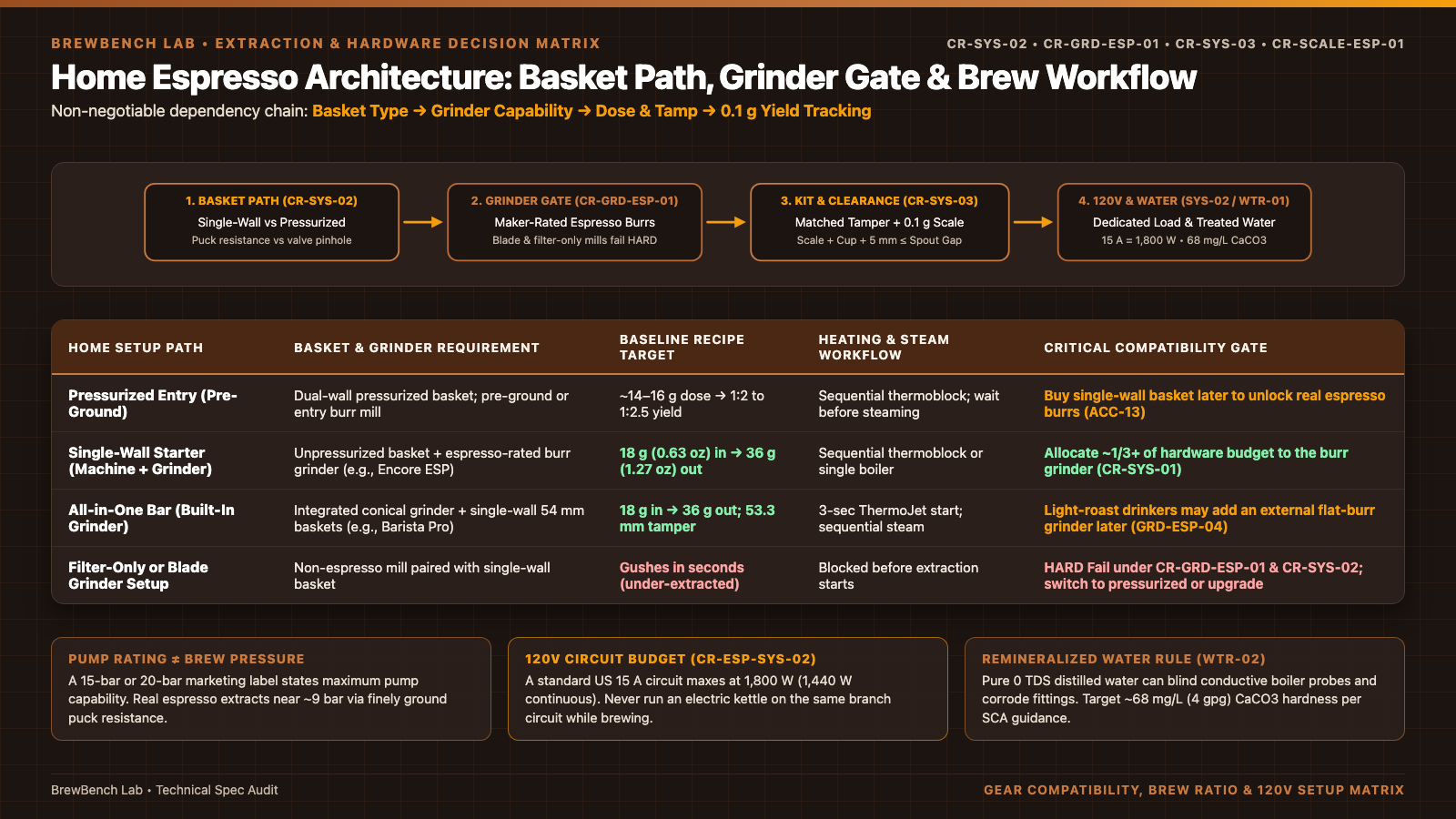
Learning how to make espresso at home comes down to controlling resistance, temperature, and weight rather than buying the highest pump-bar rating on a retail box. True espresso is brewed when pressurized hot water—targeting roughly 9 bar at the coffee puck—passes through a finely ground, evenly tamped bed of roasted coffee inside a metal portafilter basket. When your grinder, basket type, tamper, and digital scale work as one matched system, pulling balanced, syrupy shots becomes a repeatable five-minute morning routine.
Inside our pillar home espresso setup guide, the most common beginner frustration stems from pairing an entry espresso machine with pre-ground coffee or a non-espresso burr grinder inside a single-wall basket. Before you pull your first shot or order your countertop kit, use this technical walkthrough to verify every mechanical rule, brew ratio formula, 120V electrical constraint, and step-by-step extraction move.
Direct Answer: To make espresso at home, pair a 120V espresso machine with an espresso-rated burr grinder (CR-GRD-ESP-01), a single-wall basket, a basket-matched tamper, and a 0.1 g scale (CR-SYS-03). Weigh an 18 g (0.63 oz) starting dose, tamp level, and pull a 1:2 ratio—36 g (1.27 oz) out—in roughly 25–30 seconds, or use a pressurized basket if grinding pre-ground coffee (CR-SYS-02).
In This Guide
- What Makes Espresso Work: Pressure, Brew Ratio & Temperature
- Core Gear Rules: Machine, Grinder, Baskets, Tamper & Scale
- Home Espresso Setup & Compatibility Decision Matrix
- Step-by-Step: How to Make Espresso at Home
- 120V Electrical Budget, Water Hardness & Safe Descaling
- Myth vs. Engineering Reality
- Verified Amazon US Hardware Reference Picks
- Authoritative Manufacturer & Standards Citations
- Frequently Asked Questions
What Makes Espresso Work: Pressure, Brew Ratio & Temperature
Unlike drip coffee or French press—where water relies on gravity or passive immersion over several minutes—espresso forces hot water through a densely compacted coffee puck in roughly half a minute. Three core physics variables separate concentrated, velvety espresso from weak, sour, or scorched coffee.
1. ~9 Bar Brew Pressure vs. Pump Maximum Ratings
Conventionally, espresso extracts around 9 bar of pressure at the coffee bed. That pressure does not come from the water pump pushing against empty air; it is created by hydraulic resistance as water tries to force its way past tightly packed, finely ground coffee particles. When you read “15-bar” or “20-bar” on an entry-level machine carton, that figure represents the vibratory pump’s maximum dead-head capability—not your brew pressure. Good espresso machines regulate or bleed excess pressure toward the ~9 bar target via an over-pressure valve (OPV) or rely on the puck’s own resistance.
2. Dose-to-Yield Brew Ratio (Weight Over Volume)
Crema—the golden foam sitting atop a fresh shot—contains trapped carbon dioxide gas that expands inconsistently depending on roast freshness and bean processing. Measuring espresso output in milliliters or fluid ounces on a shot glass therefore misleads beginners whenever crema volume fluctuates. Instead, modern espresso relies on brew ratio by weight (dose in : liquid yield out):
- Classic 1:2 Baseline Ratio: Start with 18 g (0.63 oz) of dry ground coffee and stop the pump when 36 g (1.27 oz) of liquid espresso lands in the cup, typically in a starting window of roughly 25 to 30 seconds.
- Ristretto (1:1.2 to 1:1.5): Pulling 22–27 g (0.78–0.95 oz) from an 18 g dose concentrates body and sweetness, often suiting medium-dark and dark roasts.
- Lungo / Light-Roast Ratio (1:2.2 to 1:3): Pulling 40–54 g (1.41–1.90 oz) from an 18 g dose uses extra hot water to extract denser, lightly roasted coffees that otherwise taste sharply acidic at 1:2.
3. Brew Temperature by Roast Profile
As editorial guidance rather than a fixed machine spec, target brew water ranges from 90 to 96 °C (194 to 205 °F). Medium and medium-dark roasts extract cleanly around 92–94 °C (198–201 °F), while dense light roasts benefit from higher thermal energy near 93–96 °C (199–205 °F) (CR-DRINK-ESP-01). Dark roasts are more porous and extract quickly, so lowering temperature toward 90–92 °C (194–198 °F) helps avoid harshness (CR-DRINK-ESP-06).
Core Gear Rules: Machine, Grinder, Baskets, Tamper & Scale
Before comparing specific brands, check the four mechanical compatibility gates that govern whether a home espresso station works cleanly. If you want a room-by-room inventory of small tools, cross-reference our home espresso essentials checklist.
The Grinder & Basket Gate (CR-SYS-02 & CR-GRD-ESP-01)
Under compatibility rule CR-SYS-02, your filter basket dictates what grinder you are allowed to use:
- Single-Wall (Unpressurized) Baskets: Have hundreds of open laser-cut holes across the bottom. All brewing resistance comes from the coffee puck itself. Under hard rule
CR-GRD-ESP-01, single-wall baskets require a grinder explicitly rated by its manufacturer as espresso-capable (either a dedicated electric/hand espresso burr grinder or a built-in conical burr grinder inside an all-in-one machine). Blade mills and filter-only burr grinders cannot grind fine or uniform enough, causing shots to gush watery coffee in seconds. - Pressurized (Dual-Wall) Baskets: Feature a false floor that funnels espresso through a single tiny pinhole. That pinhole generates artificial backpressure, letting pre-ground supermarket coffee or entry drip grinders produce foam and decent strength. However, pressurized baskets mask grind adjustments, so if you buy a dedicated espresso grinder later, plan to switch into a matching single-wall basket (
CR-ESP-ACC-13).
When building a separate machine-and-grinder setup for single-wall espresso, follow budget heuristic CR-SYS-01: allocate at least 30% (roughly one-third) of your combined machine-plus-grinder budget to the grinder. A prosumer machine cannot rescue uneven particle distribution from an under-specced grinder. You can explore particle size targets across brew methods in our espresso grind size chart.
Espresso Machine Heating Architectures
Your machine’s heating system determines warm-up speed, temperature stability, and whether you can brew espresso and steam milk simultaneously. If you are shopping for your first unit, compare entry models inside our best espresso machines for beginners guide:
- Thermoblock / ThermoJet / Thermocoil: Heats water on demand through a metal block or coil. Warm-up takes seconds to a couple of minutes, and units usually fit compact 51 mm (2.01 in) or 54 mm (2.13 in) footprints. Brewing and steaming happen sequentially—you pull the shot first, then switch to steam mode and purge excess water before frothing (
CR-DRINK-ESP-03). - Single Boiler: Holds one dedicated water boiler switched between brew and steam temperatures. It offers strong steam pressure once heated, but requires waiting for the boiler to climb to steam temperature after brewing and cooling down again before the next shot.
- Dual Thermoblock, Heat Exchanger (HX) & Dual Boiler: Allow simultaneous brewing and steaming—ideal when preparing two to four milk drinks back to back. Note that 120V US dual boilers often use heater-priority logic to stay inside residential electrical limits (
CR-ESP-SYS-07), and E61 heat exchangers require longer warm-up periods plus brief cooling flushes when idle (CR-ESP-02,CR-ESP-SYS-06).
Portafilter Sizing, Tamper Fit & Scale Clearance (CR-SYS-03)
Under workflow rule CR-SYS-03, every non-tamping-assist setup needs two low-cost tools that matter more than cosmetic upgrades: a metal tamper sized to your basket’s top inner diameter (CR-ESP-ACC-03) and a 0.1 g digital scale with a built-in timer (CR-SCALE-ESP-03). Home machines span three primary nominal portafilter classes:
- 51 mm (2.01 in): Used by De’Longhi Dedica, Stilosa, and many compact thermoblock machines. Pairs with ~51.0 mm tampers; aftermarket handles must match model-specific 2-ear or 3-ear lug patterns (
CR-ESP-ACC-01). - 54 mm (2.13 in): Used across Breville Bambino and Barista series (3 symmetrical ears). Because Breville OEM baskets taper inward near the rim, a 53.3–53.5 mm (2.10 in) tamper slides smoothly without binding.
- 58 mm (2.28 in): Commercial-style standard on Gaggia Classic, Rancilio Silvia, Breville Dual Boiler, and E61 machines. Baskets are broadly interchangeable, pairing with 58.0–58.5 mm tampers, though portafilter ear patterns remain brand-specific.
Before ordering a scale or tall ceramic mug, apply the vertical cup-clearance formula from CR-SCALE-ESP-01: scale_height_mm + cup_height_mm + 5 mm ≤ machine_spout_clearance_mm. For instance, on a machine offering roughly 127 mm (5.0 in) of spout clearance, a 20 mm (0.79 in) tall scale plus a 76 mm (3.0 in) demitasse cup totals 101 mm (3.98 in) with safety margin—leaving plenty of room—whereas a 127 mm (5.0 in) travel tumbler requires removing the drip tray or switching to a bottomless portafilter.
Home Espresso Setup & Compatibility Decision Matrix
Use this matrix to match your coffee habits and gear budget against verified compatibility requirements before purchasing or upgrading components.
| Setup Archetype | Required Hardware & Grinder Spec | Basket & Tamper Rule | Workflow & Scale Reality | Critical Caveat |
|---|---|---|---|---|
| Pressurized Entry Path (Under $200–$400 tier) | 120V thermoblock machine + pre-ground coffee or basic burr mill | Pressurized (dual-wall) basket; ~51 mm metal tamper | Sequential brew then steam; compact scale or timed cup | Must add a single-wall basket if upgrading to an espresso grinder later (CR-ESP-ACC-13) |
| Single-Wall Starter (Under $700 setup tier) | 120V semi-automatic machine + espresso-rated burr grinder (e.g., Baratza Encore ESP) | Single-wall basket + 51 / 53.3 / 58.5 mm matched metal tamper | Weigh 18 g (0.63 oz) dose → 36 g (1.27 oz) yield on 0.1 g timer scale | Filter-only grinders fail HARD under CR-GRD-ESP-01; budget ≥1/3 for the grinder |
| All-in-One Integrated Bar ($500–$1,000 tier) | Built-in conical burr grinder + 54 mm ThermoJet machine (e.g., Barista Pro) | Both single-wall and dual-wall 54 mm baskets; 53.3 mm tamper | Fast 3-sec heat-up; LCD shot timer; sequential steam wand | Built-in burrs handle medium/dark roasts well; light roasts may prompt an external grinder later (CR-GRD-ESP-04) |
| Daily Milk Entertainer ($1,000–$2,500+ tier) | 120V dual thermoblock, HX, or dual boiler + stepless flat/conical grinder | 58 mm single-wall precision basket + 58.5 mm calibrated tamper | Simultaneous brew & steam; 350–600 ml (12–20 oz) pitcher | Check 15 A vs 20 A NEMA 5-20P plug needs before buying (CR-ESP-SYS-01) |
Step-by-Step: How to Make Espresso at Home
Once your machine, espresso-capable grinder, tamper, and 0.1 g scale are aligned, execute these six repeatable steps for a double shot using a single-wall basket. If your first extraction tastes sour or bitter, refine your grind and ratio using our how to dial in espresso troubleshooting playbook.
Step 1: Warm the Machine, Portafilter & Cup
Power on your machine and lock the empty portafilter into the group head while it heats. Even on fast thermoblock or ThermoJet systems that reach water readiness in seconds or a few minutes, cold metal portafilters and ceramic demitasse cups steal heat from your shot. Run a brief 2-to-3-second blank water flush through the empty portafilter into your cup to pre-warm both the basket and your glassware, then wipe the basket completely dry with a clean towel before dosing coffee.
Step 2: Weigh & Grind Your Dose (Match Basket Rating)
Check the capacity stamped or published for your basket—most double baskets are rated for 16 to 20 g (0.56 to 0.71 oz), and keeping your dose within roughly ±1 g of that rating prevents soupy under-dosed pucks or shower-screen imprints from overdosing (CR-ESP-ACC-12). Using an 18.0 g (0.63 oz) starting dose on a 0.1 g scale, weigh whole roasted beans (ideally 7 to 28 days post-roast) and grind them at your grinder’s fine espresso setting directly into a dosing cup or funnel-topped portafilter.
Step 3: Distribute Evenly & Tamp Level
High-pressure water always seeks the path of least resistance—a defect known as channeling. Before compressing the bed, stir the grounds gently with fine 0.3–0.4 mm WDT (Weiss Distribution Technique) needles to break up static clumps and create uniform density across the basket. Tap the portafilter once straight down on a tamping mat to settle the mound, then press straight down with your basket-matched tamper until the coffee bed feels firm and stops compressing. Consistency and a flat, level surface matter far more than excessive downward arm force; wipe any loose grounds off the basket rim so the group gasket seals cleanly.
Step 4: Lock In, Tare the Scale & Pull by Weight
Lock the portafilter snugly into the group head—do not force the handle past horizontal if it feels obstructed—and place your warmed cup atop your 0.1 g scale on the drip tray. Tare the scale to 0.0 g, start the brew cycle and shot timer simultaneously, and watch the flow:
- First Drops (~4–8 seconds): Low-pressure pre-infusion wets the puck before thick, syrupy streams coalesce into dark caramel-colored espresso.
- Stop Slightly Early (~34–35 g): Cut the pump roughly 1 to 2 g before your 36.0 g (1.27 oz) target so residual drips land right on a 1:2 brew ratio inside the 25–30 second baseline window.
- Adjust One Variable Next Shot: If 36 g finishes in under 20 seconds and tastes sharp or sour, grind finer. If it chokes past 40 seconds and tastes dry or bitter, grind coarser.
Step 5: Texture Milk Safely (Optional)
If making a flat white, latte, or cappuccino on a sequential thermoblock or single boiler (CR-DRINK-ESP-03), switch to steam mode after pulling your shot and purge condensation out of the steam wand into the drip tray until dry steam emerges. Pour cold milk into a chilled stainless pitcher sized to your machine’s steam output—around 350 ml (12 oz) works best on compact thermoblocks rather than oversized 600 ml (20 oz) jugs (CR-ESP-ACC-08). Submerge the wand tip just below the milk surface to introduce brief, gentle hissing air for stretching, then sink the tip slightly deeper to spin a glossy vortex until the pitcher feels hot to the touch—around 55–65 °C (130–150 °F) per standard barista practice, while following your machine manual’s steam-wand safety precautions.
Step 6: Purge, Knock Out the Puck & Rinse Immediately
Immediately wipe the hot steam wand with a dedicated damp cloth and fire a 1-second steam purge to clear milk residue from inside the tip. Unlock the portafilter carefully (staying clear of residual hot water if your entry machine lacks a three-way solenoid valve), knock the spent puck into a knock box, run a quick water flush through the group head to rinse coffee oils off the shower screen, and wipe the basket dry.
120V Electrical Budget, Water Hardness & Safe Descaling
Two behind-the-scenes kitchen utilities decide whether a home espresso bar runs reliably for years or trips breakers and clogs boilers.
North American 120V / 60Hz Circuit Math (CR-ESP-SYS-01 & CR-ESP-SYS-02)
Always buy 120V / 60Hz North American models for US kitchens—220–240V European imports fail HARD under CR-ESP-SYS-01. Using the electrical formula Power (W) = Voltage (120 V) × Current (A), a standard 15-amp household circuit supplies 1,800 W peak (1,440 W continuous at 80%), while a 20-amp kitchen small-appliance branch circuit supplies 2,400 W peak (1,920 W continuous). Because many thermoblock and single-boiler espresso machines draw 1,350 W to 1,650 W during heating, avoid running an electric kettle, toaster oven, or microwave on the same circuit while brewing (CR-ESP-SYS-02). If a dual-thermoblock machine ships with a NEMA 5-20P plug (one horizontal blade), never force mismatched plugs into 15 A outlets or defeat GFCI circuit protection—have a licensed electrician confirm a 20 A circuit and matching 5-20R receptacle.
Water Hardness Targets & Boiler Care (CR-WTR-ESP-01 & CR-WTR-ESP-02)
Espresso is roughly 90% water, and mineral balance governs both flavor extraction and internal scale buildup. Under Specialty Coffee Association (SCA) reference targets for equipment longevity and balanced flavor (not drinking-water safety), aim for approximately 68 mg/L as CaCO3 (4 gpg) total hardness (17–85 mg/L acceptable range, using the conversion 1 gpg = 17.1 mg/L CaCO3) and roughly 150 mg/L total dissolved solids (TDS). Check your tap water with aquarium or coffee hardness strips before filling the tank:
- Never run pure 0 TDS distilled water alone: Unremineralized distilled or reverse-osmosis water lacks the dissolved ions needed to trigger conductive boiler water-level probes—causing “fill water” errors on full reservoirs (
CR-WTR-ESP-02)—and can aggressively leach metals over time. If starting from distilled water, add manufacturer-approved remineralization packets or drops. - Use OEM reservoir cartridges where specified: Cartridge shapes are brand-specific (
CR-WTR-ESP-05), and warranty terms often depend on following maker filtration intervals (CR-WTR-ESP-03). - Follow manual-only descaling and backflushing: Never guess DIY vinegar or citric-acid concentrations (
CR-WTR-ESP-06). Citric-based solutions can damage certain aluminum boilers, and machines lacking a three-way solenoid valve should never be backflushed with a blind basket (CR-ESP-ACC-11). Always cool and depressurize per your manual before maintenance.
Myth vs. Engineering Reality: 4 Home Espresso Traps
Myth #1: “A 20-bar espresso machine makes stronger espresso than a 15-bar or 9-bar machine.”
Engineering Reality: Pump ratings (15 bar or 20 bar) state the maximum static pressure a vibratory pump can produce against a blocked line. Proper espresso extracts near ~9 bar at the puck, regulated by OPV valves and coffee grind resistance—higher pump-label numbers do not improve flavor or crema.
Myth #2: “Any burr coffee grinder works for home espresso.”
Engineering Reality: Filter-focused burr grinders lack the fine burr geometry and tight step resolution required to create ~9 bar hydraulic resistance in a single-wall basket (CR-GRD-ESP-01). Unless you use a pressurized dual-wall basket, non-espresso burr mills and blade choppers produce fast, sour gushers.
Myth #3: “Pure 0 TDS distilled water is the healthiest and safest choice for an espresso machine.”
Engineering Reality: Pure distilled water without remineralizing minerals can fail conductive boiler probes (CR-WTR-ESP-02), flatten flavor, and accelerate metal corrosion. Use filtered water within maker hardness limits or remineralized recipe water targeting ~68 mg/L CaCO3 (4 gpg).
Myth #4: “A 54 mm portafilter takes a 54.0 mm tamper.”
Engineering Reality: Tampers fit the filter basket’s working top inner diameter, not the nominal portafilter label (CR-ESP-ACC-03). Because 54 mm Breville baskets taper slightly inward, a 54.0 mm tamper wedges at the rim while a 53.3 mm base compresses cleanly.
Verified Amazon US Hardware Reference Picks
To illustrate how these compatibility rules map to real 120V/60Hz North American hardware, here are four verified Amazon US reference components spanning compact entry machines, integrated one-box bars, espresso-rated burr grinders, and 0.1 g timer scales.
1. De’Longhi Dedica Arte EC885M — Compact 120V Entry Espresso Machine

Quick Specs: 51 mm (2.01 in) portafilter | Rapid thermoblock with 3 temperature settings | 120V / 60Hz US | Commercial-style My LatteArt manual steam wand & included metal tamper | Price Tier: Entry ($200–$500 tier)
Measuring just 5.9 inches wide, the De’Longhi Dedica Arte EC885M solves small-counter constraints (CR-ESP-SYS-04) while fixing the plastic tamper and auto-frother sleeves found on ultra-budget units. Its thermoblock heats rapidly for morning single shots, includes three temperature levels to accommodate medium or darker roasts (CR-DRINK-ESP-06), and features a commercial-style manual steam wand capable of real microfoam texture in a 350 ml (12 oz) pitcher.
Compatibility Gate (CR-ESP-ACC-13 & CR-SCALE-ESP-02): Confirm which baskets ship inside your exact US box—De’Longhi 51 mm pressurized baskets allow pre-ground coffee immediately, while pairing the EC885M with an espresso burr grinder rewards adding an unpressurized 51 mm single-wall basket. Its slim drip tray also favors a compact mini scale rather than wide pour-over platforms.
Pros
- Ultra-slim 5.9-inch width clears tight apartment counters cleanly
- Includes a real metal 51 mm tamper and commercial-style manual steam wand
- Three selectable brew temperatures on a fast 120V thermoblock
Cons
- Sequential brew and steam workflow pauses between shot and frothing
- Narrow drip tray and 51 mm lug pattern require model-verified accessories
2. Breville Barista Pro BES878BSS — All-in-One Built-In Grinder Espresso Bar

Quick Specs: 54 mm (2.13 in) 3-ear Breville portafilter | ThermoJet heating system (Breville-stated 3-second heat-up) | 120V / 60Hz US | Integrated conical burr grinder + LCD grind/shot progress interface | Price Tier: Mid-Range ($500–$1,000 tier)
For beginners who want one box that satisfies CR-SYS-02 out of the gate, the Breville Barista Pro BES878BSS integrates a 54 mm semi-automatic espresso brewer with an onboard conical burr grinder and a crisp LCD progress interface. Breville publishes a 3-second ThermoJet heat-up specification, letting you step up to the counter and pull an 18 g single-wall shot almost immediately, while both single-wall and pressurized 54 mm baskets ship in the kit.
Compatibility Gate (CR-GRD-ESP-04 & CR-ESP-ACC-03): While the built-in grinder handles medium and dark roasts cleanly, light-roast enthusiasts often add a standalone flat-burr grinder later. If upgrading the included tamper, choose a 53.3 mm base matched to Breville 54 mm baskets and verify Breville-specific reservoir water cartridges (CR-WTR-ESP-05).
Pros
- Maker-rated 3-second ThermoJet warm-up avoids long morning boiler waits
- Ships with single-wall and dual-wall 54 mm baskets plus integrated grinder
- LCD screen tracks grind settings and extraction duration clearly
Cons
- Sequential ThermoJet cannot brew espresso and steam milk simultaneously
- Built-in conical burrs offer less extreme light-roast tuning than standalone 64 mm flats
3. Baratza Encore ESP Coffee Grinder ZCG495BLK — Entry Espresso-Rated Burr Grinder

Quick Specs: 40 mm hardened steel M2 conical burrs | 40 stepped settings (1–20 finer espresso range, 21–40 filter range) | Hopper-fed + 54/58 mm dosing cup | 120V US electric | Price Tier: Entry ($100–$200 tier)
Baratza engineered the Encore ESP specifically to pass CR-GRD-ESP-01 for households pairing a standalone grinder with an entry semi-automatic machine. Unlike the standard filter-only Baratza Encore, the Encore ESP dedicates settings 1 through 20 to finer micro-stepped adjustments suitable for single-wall espresso baskets, while settings 21 through 40 remain available for AeroPress, pour-over, or drip coffee (CR-GRD-03). Its included dosing cup fits neatly onto 54 mm and 58 mm portafilter rims for cleaner transfers.
Compatibility Gate (CR-GRD-ESP-03 & L-18): Always verify the exact “Encore ESP” model (ZCG495) rather than the standard Encore—only the ESP covers single-wall espresso. Because settings 1–20 are stepped rather than stepless, fine-tune shot time by adjusting dry dose ±0.5 g when your target flow falls between clicks.
Pros
- Maker-rated for single-wall espresso extraction across settings 1–20
- 40 mm hardened steel M2 conical burrs also cover pour-over and drip (21–40)
- Includes 54 mm and 58 mm portafilter dosing cup compatibility
Cons
- Stepped espresso dial can require 0.5 g dose tweaks between clicks
- Hopper-fed path retains more grounds than bellows single-dose grinders
4. TIMEMORE Black Mirror Basic 2.0 Coffee Scale — 0.1 g Scale with Auto-Timer

Quick Specs: 0.1 g precision | 2,000 g max capacity | Built-in auto-timer & live flow-rate display | 1,600 mAh USB-C rechargeable battery + silicone heat pad | Price Tier: Budget (Under $100 tier)
Closing the loop on CR-SYS-03, the TIMEMORE Black Mirror Basic 2.0 satisfies both dry-bean dosing and liquid yield tracking with 0.1 g resolution and a 2,000 g capacity. Its auto-timer starts counting on the first drops of espresso, while the live flow-rate indicator helps you spot sudden channeling spikes—letting you pull consistent 1:2 ratios across both espresso bars and pour-over carafes.
Compatibility Gate (CR-SCALE-ESP-01 & CR-SCALE-ESP-02): Check your drip tray width and vertical clearance before placing any mid-sized dual-purpose scale under your spouts. While the Basic 2.0 fits spacious 54 mm and 58 mm trays with low demitasse cups, ultra-narrow 51 mm drip trays like the De’Longhi Dedica require a smaller mini scale to avoid overhang.
Pros
- 0.1 g accuracy and auto-timer track 1:2 espresso ratios effortlessly
- Real-time flow-rate readout flags fast channeling shots immediately
- USB-C rechargeable 1,600 mAh battery with protective silicone heat pad
Cons
- Dual-purpose deck footprint overhangs narrow 51 mm machine drip trays
- Requires low demitasse cups or a bottomless handle on compact spouts
Authoritative Manufacturer & Standards Citations
Every electrical load figure, grinder range specification, portafilter tolerance, and water chemistry guideline in this walkthrough is grounded in official manufacturer documentation and industry standards:
- Breville US Official Espresso Machine & Parts Specifications — 120V ThermoJet 3-second heat-up specification, 54 mm 3-ear portafilter compatibility, and dual-wall vs single-wall basket inclusions.
- De’Longhi US Official Manuals & Support — Dedica Arte EC885M 120V specifications, 51 mm basket geometry, manual steam wand operation, and official descaling procedures.
- Baratza Official Grinder Documentation — Encore ESP 40 mm hardened steel M2 burr specifications and 1–20 finer espresso vs 21–40 filter step architecture.
- Specialty Coffee Association (SCA) Water Quality Handbook — ~68 mg/L CaCO3 (4 gpg) target hardness (17–85 mg/L acceptable range) and ~150 mg/L TDS benchmark for equipment care and extraction flavor.
- National Fire Protection Association (NFPA) / NEC Electrical Reference — 120V 15 A (1,800 W peak / 1,440 W continuous) and 20 A (2,400 W peak / 1,920 W continuous) branch-circuit safety limits.
How We Audited This Guide
- Home bar blueprints, upgrade roadmaps, water chemistry guides, and Amazon listing audits were verified against CR-SYS circuit, water-probe, and budget balance rules.
- Every espresso machine, burr grinder, accessory, and scale specification was cross-checked against official manufacturer 120V manuals, SCA water guidance, and verified Amazon US listings.
- Recommendations were evaluated against our weighted espresso-gear scoring rubrics and documented CR-* compatibility rules; we never invent heat-up seconds, PID variance, or micron claims.
Frequently Asked Questions: How to Make Espresso at Home
Can I make espresso at home without buying an expensive grinder?
Yes, if you use your machine’s pressurized (dual-wall) basket with pre-ground coffee under rule CR-SYS-02. However, pulling true single-wall espresso requires a grinder rated for espresso by its maker, such as the Baratza Encore ESP or a quality espresso hand grinder.
What is the best starting recipe for a double shot of espresso?
Start with an 18.0 g (0.63 oz) dose of freshly roasted coffee matched to an 18 g double basket (CR-ESP-ACC-12) and pull 36.0 g (1.27 oz) of liquid espresso in roughly 25 to 30 seconds. Adjust grind fineness up or down based on flavor.
Why does my espresso machine say 15 bar or 20 bar if espresso brews at 9 bar?
Those 15-bar and 20-bar figures state the vibratory pump’s maximum static output rating, not extraction pressure. During brewing, internal over-pressure valves and the resistance of finely ground coffee regulate extraction toward the conventional ~9 bar espresso target.
Do I really need a 0.1 g digital scale to make espresso?
Yes—under workflow rule CR-SYS-03, crema volume fluctuates widely with bean freshness, making shot glasses unreliable. A 0.1 g scale with a timer keeps both dry coffee dose and liquid yield repeatable so you can diagnose sour or bitter shots quickly.
Can I use plain distilled water in my home espresso machine?
No—pure 0 TDS distilled water lacks dissolved minerals, which can prevent conductive boiler probes from sensing water levels (CR-WTR-ESP-02) and accelerate internal corrosion. Use filtered tap water within maker limits or remineralized recipe water near 68 mg/L CaCO3 (4 gpg).
Why does my espresso machine pause before steaming milk?
Thermoblock, ThermoJet, and single-boiler machines heat one water path at a time (CR-DRINK-ESP-03). They must raise heating temperature from ~93 °C (200 °F) brewing up to steam generation temperature sequentially, whereas dual thermoblock, HX, and dual-boiler machines steam simultaneously.


