
Disclosure: As an Amazon Associate, I earn from qualifying purchases. If you buy through links on this page, we may earn a small commission at no extra cost to you.
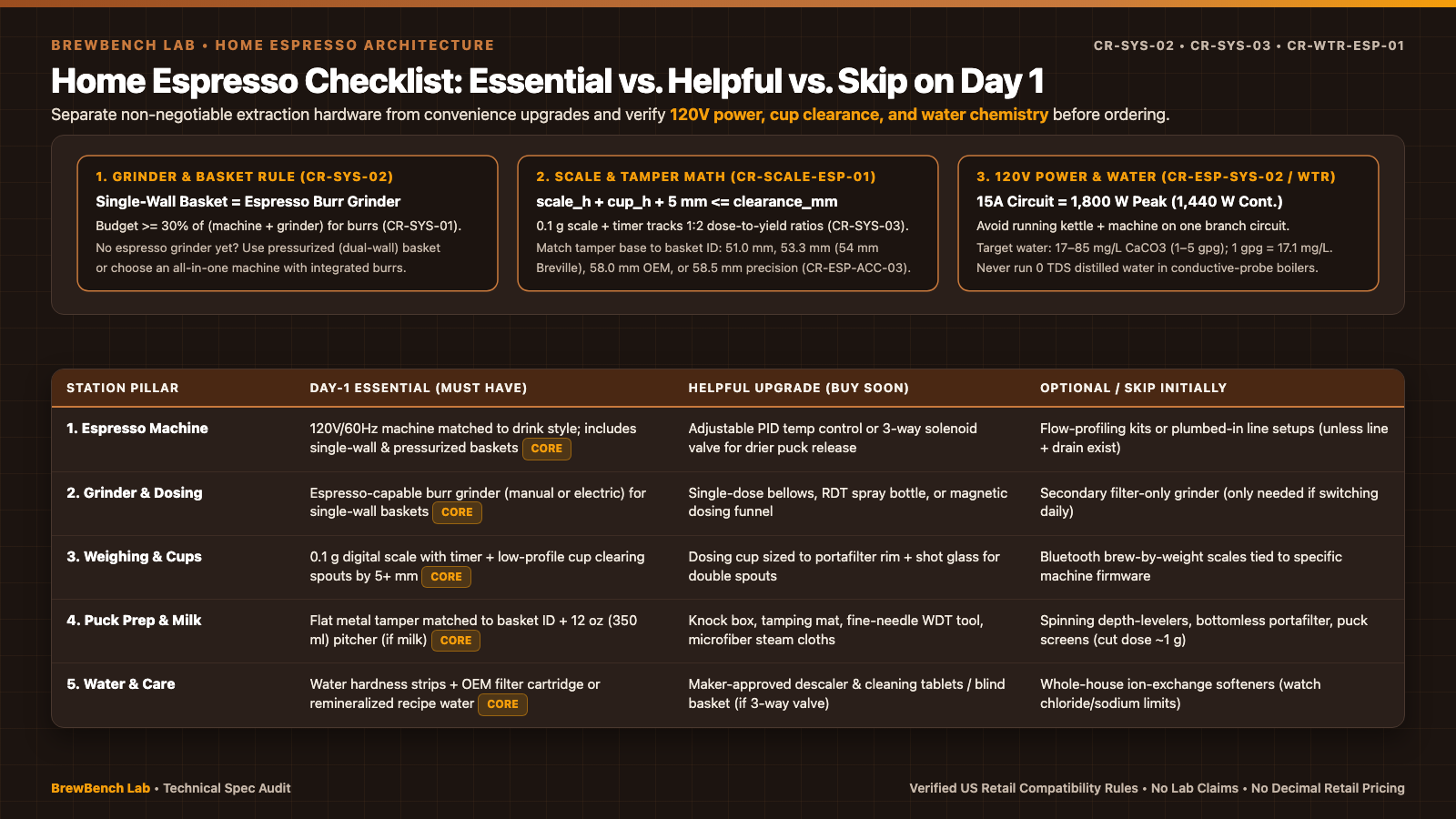
If you are mapping out what do you need for home espresso, the essential hardware list is much shorter than social media bar setups suggest. A functional, repeatable 120V home espresso bar requires five core elements: a capable espresso machine, an espresso-rated burr grinder (unless you start with pressurized baskets or an all-in-one unit), a 0.1 g digital scale with a timer, a flat metal tamper matched to your filter basket’s inner diameter, and hardness-checked water paired with the manufacturer’s descaler.
Inside our home espresso setup guide pillar hub, we organize full builds by total budget tier. This essentials checklist strips away showroom clutter so you know which items are mandatory on Day 1, which tools simplify daily cleanup once you learn how to make espresso at home, and which countertop specs—electrical draw, under-cabinet clearance, and scale height—prevent costly mismatches before you unbox anything.
Quick Answer — What Do You Need for Home Espresso?
At minimum, you need a 120V/60Hz espresso machine, an espresso-capable burr grinder (mandatory for single-wall baskets under rule CR-SYS-02), a 0.1 g timer scale for 1:2 brew ratios, a basket-sized metal tamper, and hardness-checked water (17–85 mg/L CaCO3). Add a 12 oz (350 ml) pitcher for milk drinks.
In This Checklist
- The 5 Non-Negotiable Day-1 Essentials (CR-SYS-02 & CR-SYS-03)
- Master Home Espresso Essentials Matrix: Must-Have vs. Optional
- Clearance, 120V Electrical & Water Hardness Math
- Helpful Workflow Upgrades vs. Skip-for-Now Tools
- Myth vs. Engineering Reality
- Verified Amazon US Essential Gear Picks
- 60-Second Pre-Purchase Verification Checklist
- Frequently Asked Questions
The 5 Non-Negotiable Day-1 Essentials for Home Espresso
Every working home espresso station rests on two governing BrewBench Lab compatibility rules: CR-SYS-02 (the grinder-and-basket dependency) and CR-SYS-03 (the essential workflow kit). When beginners struggle with fast, watery shots or bitter channeling, the root cause is almost always skipping one of these five foundational pieces while overspending on decorative extras.
1. A 120V/60Hz Espresso Machine (Matched to Your Drink Routine)
North American buyers must verify 120V/60Hz UL-listed hardware rather than gray-market 230V imports. Inside that requirement, machines divide into four main architectures:
- Thermoblock / ThermoJet Machines (e.g., Breville Bambino, De’Longhi Dedica Arte): Heat on demand in seconds to a few minutes and sit in the under $200 to $400–$1,000 tiers. They brew and steam sequentially—fine for one or two daily lattes, slower for entertaining groups.
- Single-Boiler Machines (e.g., Gaggia Classic Evo Pro, Rancilio Silvia): Use a dedicated heated boiler (~10–20 minutes warm-up for boiler stability). You brew at espresso temperature (~90–96 °C / 194–205 °F), then raise boiler temperature to steam milk.
- Dual-Thermoblock, Heat-Exchanger (HX), and Dual-Boiler Machines (e.g., Ascaso Steel Duo PID, Breville Dual Boiler, Rancilio Silvia Pro X): Found in the $1,000–$2,500 prosumer tier and above, allowing simultaneous brewing and steaming for back-to-back milk drinks.
- All-in-One Built-In Grinder Machines (e.g., Breville Barista Express, Barista Pro, Oracle Jet, Ninja Luxe Café): Combine machine and conical burrs in a single footprint, satisfying rule CR-SYS-02 out of the box for medium and dark roasts.
Equally critical are the filter baskets inside the box. A pressurized (dual-wall) basket uses a tiny single exit hole to build artificial backpressure, forgiving pre-ground coffee or coarser grinders. A single-wall (non-pressurized) basket has hundreds of open perforations and relies entirely on finely ground, evenly tamped coffee for resistance. Under rule CR-ESP-ACC-13, verify whether your machine ships with both basket styles—such as Breville USA 54 mm consumer espresso machines—or only pressurized baskets that require a separate single-wall upgrade later.
2. An Espresso-Capable Burr Grinder (Rule CR-SYS-02)
If you plan to pull single-wall espresso from fresh whole beans, the grinder is more decisive than the espresso machine’s price tag. Under HARD compatibility rule CR-GRD-ESP-01 and CR-SYS-02, blade mills and filter-only burr grinders cannot produce uniform, sub-millimeter particle distributions fine enough to hold ~9 bar of brew pressure against a single-wall basket. The shot gushes out in under 10 seconds, tasting thin and sour.
Verify that the grinder manufacturer explicitly rates the model for espresso, with either stepless adjustment or fine micro-steps in the espresso band—for example, Baratza’s Encore ESP documentation specifies settings 1 through 20 as its dedicated fine-stepped espresso range, whereas the standard Encore targets filter brewing. As a budget rule of thumb (CR-SYS-01), allocate at least 30% of your combined machine-plus-grinder budget to burrs for a single-wall setup; our espresso grinder vs. machine budget guide breaks down those tier ratios across entry and prosumer builds.
3. A 0.1 g Digital Coffee Scale with Built-In Timer (Rule CR-SYS-03)
Volume-based shot buttons and volumetric shot glasses mislead new home baristas because freshly roasted coffee contains trapped carbon dioxide that inflates crema volume. Under rules CR-SYS-03 and CR-SCALE-ESP-03, a digital scale reading to 0.1 g with an integrated shot timer is mandatory for weighing dry coffee grounds in (dose) and liquid espresso out (yield). A standard kitchen baking scale measuring in 1 g increments is too coarse when a 1.0 g swing in dry dose alters extraction speed noticeably.
4. A Rigid Metal Tamper Matched to Your Basket Inner Diameter
Most entry-level machines under $400 include a lightweight plastic scoop tamper that sits noticeably smaller than the filter basket wall, leaving an uncompacted ring of loose coffee around the perimeter where water channels straight through. Replacing that plastic scoop with a machined stainless steel or anodized aluminum tamper sized to your basket’s actual interior (CR-ESP-ACC-03) is one of the highest-return Day-1 purchases. Do not guess by the nominal portafilter number on the box—check our espresso tamper size guide before ordering, because a 54 mm Breville basket requires a 53.3–53.35 mm (2.10 in) tamper rather than 54.0 mm.
5. Water Hardness Strips, Filtration & Maker-Approved Descaler
Tap water chemistry dictates both flavor clarity and internal boiler longevity (CR-WTR-ESP-01). Before filling your machine’s reservoir, check your tap supply with inexpensive water hardness strips or your local utility’s annual Consumer Confidence Report. Depending on the result, you need either the manufacturer’s shape-locked in-tank filter cartridge (CR-WTR-ESP-05), a pitcher or remineralized recipe water setup, and the descaling solution specified in your machine’s owner manual (CR-WTR-ESP-06).
Master Home Espresso Essentials Matrix: Must-Have vs. Optional
To keep Day-1 spending focused on extraction quality rather than counter clutter, use this five-pillar decision table separating mandatory essentials from later upgrades.
| Station Pillar | Day-1 Essential (Must Have) | Helpful Upgrade (Buy Soon) | Optional / Skip Initially | Governing Rule & Check |
|---|---|---|---|---|
| 1. Espresso Machine | 120V/60Hz machine matched to drink routine; single-wall & pressurized baskets | Adjustable PID temperature control; 3-way solenoid valve for dry pucks | Plumbed-in water line kits or aftermarket E61 flow-control paddles | CR-ESP-SYS-01 / CR-ESP-ACC-13: Confirm 120V plug & included basket type |
| 2. Grinder & Dosing | Espresso-capable burr grinder (manual or electric) for single-wall shots | Magnetic dosing funnel; RDT water mist bottle; single-dose bellows | Secondary dedicated filter grinder (if only brewing espresso) | CR-SYS-02 / CR-GRD-ESP-01: Stepless or fine micro-steps required |
| 3. Scale & Cups | 0.1 g digital scale with timer + low-profile espresso cup | Dosing cup sized to portafilter rim; double-spout demitasse cups | Firmware-paired Bluetooth brew-by-weight scales | CR-SCALE-ESP-01: Verify scale_h + cup_h + 5 mm ≤ clearance |
| 4. Puck Prep & Milk | Flat metal tamper sized to basket ID + 12 oz (350 ml) pitcher (if milk) | Knock box; silicone tamping mat; 0.3–0.4 mm needle WDT tool; microfiber cloths | Bottomless portafilter; sintered puck screens; depth-set spinning levelers | CR-ESP-ACC-03 / CR-ESP-ACC-08: Match basket ID & steam capacity |
| 5. Water & Maintenance | Water hardness strips + OEM filter cartridge or remineralized recipe water | Maker-approved descaler; detergent tablets & blind basket (if 3-way valve) | Whole-house ion-exchange softening (watch chloride/sodium limits) | CR-WTR-ESP-01 / CR-WTR-ESP-02: Target 17–85 mg/L CaCO3; avoid 0 TDS |
Critical Clearance, 120V Power, and Water Chemistry Math
Most first-time setup frustrations are physical or electrical mismatches that happen before a single shot is pulled. Run these four verified equations against your kitchen counter and chosen hardware.
Scale and Cup Clearance Formula (CR-SCALE-ESP-01)
An espresso scale only helps if it fits onto the drip tray with your cup standing underneath the portafilter spouts without tilting or touching the metal spouts mid-extraction. Evaluate vertical clearance using:
required_height_mm = scale_height_mm + cup_height_mm + 5 mm (0.20 in) safety margin ≤ machine_cup_clearance_mm
For illustration, if a compact machine offers roughly 127 mm (5.0 in) under a spouted portafilter, pairing an 18 mm (0.71 in) tall low-profile espresso scale with a 76 mm (3.0 in) espresso cup totals 99 mm (3.9 in) including the 5 mm gap—leaving clean space to watch the flow. By contrast, a tall 127 mm (5.0 in) travel mug brings the stack to 150 mm (5.9 in), failing under the spouts unless you remove the drip-tray grate or switch to a bottomless portafilter. Also check drip-tray width and depth (CR-SCALE-ESP-02) so wide pour-over scales do not overhang narrow consumer drip trays.
North American 120V Electrical Budget & Cabinet Clearance (CR-ESP-SYS-01 / 02)
Standard US kitchen countertop circuits operate at 120V nominal across either 15-amp or 20-amp branch breakers under National Fire Protection Association (NFPA 70 / NEC) residential electrical standards:
- 15A Circuit Budget:
15 A × 120 V = 1,800 W peak capacity(with an 80% continuous load guideline of 1,440 W). - 20A Circuit Budget:
20 A × 120 V = 2,400 W peak capacity(with an 80% continuous load guideline of 1,920 W).
Two safety rules govern your electrical checklist. First, most consumer 120V espresso machines draw between 1,300 W and 1,650 W when heating; never run an electric kettle, toaster, or microwave on the same 15A branch circuit while the espresso heater is active (CR-ESP-SYS-02). Second, verify the machine’s plug blade layout before buying (CR-ESP-SYS-01). Higher-output 120V dual-thermoblock units such as retailer-listed configurations of the Ascaso Steel Duo PID ship with a NEMA 5-20P plug (featuring one horizontal blade) rated for a 20A circuit and a 5-20R wall receptacle. Never use a plug adapter or defeat GFCI outlet protection; consult a licensed electrician if your kitchen lacks a dedicated 5-20R outlet.
Finally, measure vertical counter space beneath upper kitchen cabinets—typically 457 mm (18 in) in US homes. Add at least 50 mm (2.0 in) above top-fill water reservoirs and grinder bean hoppers (CR-ESP-SYS-04 and CR-GRD-SYS-01) so you can lift lids and fill tanks without sliding appliances forward every morning.
Water Hardness & Boiler Protection Math (CR-WTR-ESP-01 / 02 / 06)
Water mineral balance controls calcium carbonate scale accumulation inside narrow thermoblock coils and boiler valves. Across US water reports and strip kits, remember these unit conversions:
1 grain per US gallon (gpg) = 17.1 mg/L (ppm) as CaCO3 | 1 German degree (°dH) = 17.8 mg/L as CaCO3
According to Specialty Coffee Association water quality guidance, balanced espresso brewing targets roughly 68 mg/L (~4.0 gpg) total hardness within a 17–85 mg/L (1–5 gpg) acceptable envelope, ~40 mg/L alkalinity, and ~150 mg/L total dissolved solids (75–250 mg/L range), with zero chlorine and low chloride to limit metal corrosion (CR-WTR-ESP-04). Machine manufacturers publish stricter warranty-specific limits in their manuals, and those manual thresholds always take precedence (CR-WTR-ESP-03).
Just as important: never run pure, un-remineralized distilled or zero-TDS reverse-osmosis water in boiler machines equipped with conductive water-level sensors (CR-WTR-ESP-02). Conductive probes rely on dissolved ions to close an electrical circuit when water touches the sensor tip; near-zero-TDS water can cause false “fill water” errors or boiler overfill. If you start from distilled water to eliminate scale completely, always mix in a dedicated espresso mineral packet or mineral drops per the maker’s recipe. When descaling, follow your machine manual’s exact chemical and cycle instructions (CR-WTR-ESP-06)—arbitrary DIY vinegar or concentrated citric acid ratios can corrode aluminum boiler blocks and void manufacturer coverage.
Helpful Workflow Upgrades vs. Skip-for-Now Accessories
Once your core five essentials are locked in, browse our best espresso accessories hub to separate genuine workflow savers from low-priority gadgets:
- Buy Soon — Stainless Milk Pitcher (12 oz / 350 ml): Under rule CR-ESP-ACC-08, compact thermoblock and single-boiler steam wands texture milk far more reliably in a 12 oz (350 ml) pitcher than in oversized 20 oz (600 ml) jugs built for commercial steam boilers. (If using an auto-froth wand such as the Breville Bambino Plus, stick with the OEM pitcher height and sensor contact.)
- Buy Soon — Knock Box & Tamping Mat: Knocking hot, wet pucks against a plastic trash-can rim cracks portafilter spouts and dents sink drains. A cushioned knock box bar absorbs impact quietly, while a silicone tamping mat protects countertops.
- Buy Soon — Fine-Needle WDT Tool & Magnetic Dosing Funnel: A size-agnostic Weiss Distribution Technique (WDT) tool with 0.3–0.4 mm needles breaks up grinder clumps before tamping, and a portafilter-matched dosing funnel (CR-ESP-ACC-07) keeps grounds inside the basket during stirring.
- Skip Initially — Bottomless Portafilter, Puck Screens & Spinning Levelers: A bottomless portafilter helps diagnose uneven single-wall extractions and boosts cup clearance, but it adds mess with pressurized baskets (CR-ACC-01) and must match your exact group ear/lug geometry (CR-ESP-ACC-01). Likewise, sintered puck screens reduce available headspace so you may need to trim coffee dose by roughly 1 g (CR-ESP-ACC-05), and depth-set spinning levelers require resetting whenever dose or basket depth changes (CR-ACC-02).
Myth vs. Engineering Reality
4 Home Espresso Myths That Cause Wrong Purchases:
- Myth 1: “A 20-bar espresso machine extracts better coffee than a 15-bar machine.”
Engineering Reality: Both 15-bar and 20-bar figures printed on entry-level listings—such as De’Longhi USA pump machine specifications—describe the vibratory pump’s maximum dead-head pressure rating, not brew-group extraction pressure. Properly dialed espresso brews near ~9 bar via an over-pressure valve (OPV) or coffee-puck resistance. - Myth 2: “Any burr coffee grinder works fine for espresso.”
Engineering Reality: Many respected pour-over burr grinders lack the fine thread pitch or burr geometry needed to choke a single-wall espresso basket (CR-GRD-ESP-01). Confirm espresso capability from the grinder manufacturer before buying. - Myth 3: “Pure 0 TDS distilled water is ideal because it has zero scale.”
Engineering Reality: Pure distilled water lacks the mineral ions needed by conductive boiler level probes (CR-WTR-ESP-02) and produces sharp, unbalanced extraction without light alkalinity buffering (CR-DRINK-WTR-01). Use maker-approved filters or remineralized recipe water. - Myth 4: “Any 54 mm or 58 mm accessory fits any 54 mm or 58 mm machine.”
Engineering Reality: Portafilters depend on brand-specific locking lugs (CR-ESP-ACC-01), and tampers must match the filter basket’s inner wall diameter rather than the nominal portafilter number (CR-ESP-ACC-03).
Verified Amazon US Essential Gear Picks
If you are assembling a clean Day-1 starter station from scratch, the four Amazon US items below cover the core hardware checklist—compact 120V machine, espresso-focused burr grinder, 0.1 g timer scale, and cushioned knock box—without forcing premature upgrades.
1. Breville Bambino BES450BSS — Essential #1: Compact 120V Espresso Machine

Verified Specs: 120V / 60Hz US specification | ThermoJet rapid-heat system | 54 mm portafilter ecosystem | Manual steam wand | Ships with single-wall and dual-wall baskets | Budget Tier: $200–$500
The Breville Bambino BES450BSS checks every Day-1 machine box for small US kitchens: standard 120V household plug compatibility, rapid ThermoJet readiness, a real manual steam wand for microfoam practice, and both pressurized dual-wall and single-wall 54 mm baskets inside the box. You can pull forgiving shots immediately while transitioning cleanly to fresh-ground beans once your espresso grinder is dialed in.
Pros
- Includes both single-wall and dual-wall 54 mm baskets out of the box (CR-ESP-ACC-13)
- Rapid ThermoJet heat-up and slim footprint fit tight US apartment counters
- Broad 54 mm Breville accessory ecosystem for 53.3 mm tampers and funnels
Cons
- Sequential ThermoJet operation cannot brew espresso and steam milk simultaneously
- Bundled plastic tamper should be replaced with a machined 53.3–53.35 mm metal tamper
2. 1Zpresso J-Ultra Manual Coffee Grinder — Essential #2: Precision Espresso Burr Grinder

Verified Specs: 48 mm coated conical steel burrs | Manual single-dose operation | 8 microns per click fine external adjustment | Magnetic catch cup | Budget Tier: $100–$200
When a budget electric grinder eats too deeply into a starter budget, an espresso-dedicated hand grinder satisfies rule CR-SYS-02 without compromising dial-in resolution. The 1Zpresso J-Ultra pairs 48 mm conical burrs with 8-micron adjustment clicks on an external numbered ring, giving single-wall baskets the tiny step granularity usually reserved for significantly pricier electric grinders.
Pros
- Ultra-fine 8-micron per-click external ring avoids “stuck between clicks” single-wall issues (CR-GRD-ESP-03)
- 48 mm conical burrs grind espresso doses steadily with magnetic catch-cup alignment
- Zero electrical draw and near-zero counter footprint for compact kitchens
Cons
- Manual cranking adds physical effort when pulling multiple consecutive light-roast shots
- Single-dose workflow requires a 0.1 g scale before grinding every shot (CR-SCALE-GRD-01)
3. TIMEMORE Black Mirror Basic 2.0 Coffee Scale — Essential #3: 0.1 g Scale with Timer

Verified Specs: 0.1 g precision | 2,000 g maximum capacity | Built-in auto-timer + real-time flow-rate readout | 1,600 mAh USB-C rechargeable battery | Budget Tier: Under $100
The TIMEMORE Black Mirror Basic 2.0 delivers the two metrics every beginner needs under rule CR-SCALE-ESP-03: 0.1 g accuracy for weighing beans into a single-dose grinder and an integrated auto-timer for stopping espresso extractions at an exact target yield. Its flow-rate indicator also provides clear visual feedback when dialing in grind coarseness across both espresso and pour-over brews.
Pros
- 0.1 g resolution with auto-timer and live flow-rate display in the Under $100 tier
- 2,000 g capacity handles heavy portafilter dosing as well as pour-over carafes
- 1,600 mAh USB-C rechargeable battery eliminates disposable coin cells
Cons
- Larger platform footprint can overhang ultra-narrow 51 mm drip trays (CR-SCALE-ESP-02)
- Check vertical cup clearance under spouted portafilters when using taller mugs (CR-SCALE-ESP-01)
4. Breville Knock Box Mini BES001XL — Essential #4: Compact Puck Disposal

Verified Specs: Brushed stainless steel housing | Removable rubberized knock bar | 10-puck capacity | Anti-slip base ring | Budget Tier: $60–$100
A dedicated knock box turns messy espresso cleanup into a one-second wrist tap without banging your portafilter rim against hard sink edges or splitting thin plastic trash liners with hot coffee pucks. The Breville Knock Box Mini BES001XL holds up to 10 spent pucks in a compact brushed steel housing designed to tuck beside—or directly atop the drip tray of—small home espresso stations, with a removable knock bar for quick rinsing.
Pros
- Cushioned removable knock bar protects portafilter baskets and spout threads
- Compact 10-puck capacity stays tidy without hogging counter space
- Brushed stainless exterior resists coffee stains and pairs visually with steel machines
Cons
- 10-puck bin fills fast during weekend entertaining, requiring frequent emptying
- Higher budget tier ($60–$100) than generic molded polymer knock boxes
60-Second Pre-Purchase Verification Checklist
Before placing your order, confirm every line item below against your kitchen layout and machine manual:
- Confirm 120V/60Hz North American Spec & Plug: Verify NEMA 5-15P (standard 15A) vs. NEMA 5-20P (20A horizontal blade) and keep kettles or toasters off the same circuit (CR-ESP-SYS-01 / 02).
- Check Upper Cabinet Clearance: Measure your counter-to-cabinet gap and add 50 mm (2.0 in) above top-loading tanks and bean hoppers (CR-ESP-SYS-04).
- Verify Grinder Capability for Your Basket: Single-wall baskets require an espresso-rated burr grinder (CR-SYS-02); pre-ground coffee requires pressurized baskets.
- Check Scale & Cup Height Clearance: Confirm
scale_h + cup_h + 5 mm ≤ spout_clearance_mmand verify drip-tray footprint (CR-SCALE-ESP-01 / 02). - Match Tamper Base to Basket Inner Diameter: Buy 51.0 mm, 53.3–53.35 mm (Breville 54 mm), 58.0 mm (OEM), or 58.5 mm (precision)—never by box label alone (CR-ESP-ACC-03).
- Match Milk Pitcher to Steam Wand Class: Choose a 12 oz (350 ml) pitcher for compact thermoblocks and single boilers (CR-ESP-ACC-08).
- Measure Tap Water Hardness First: Use hardness strips or your utility report to target 17–85 mg/L CaCO3 and avoid 0 TDS water in conductive-probe boilers (CR-WTR-ESP-01 / 02).
- Stock Maker-Approved Consumables: Keep OEM reservoir cartridges, manufacturer-specified descaler, and cleaning discs or tablets on hand (CR-SYS-04 / CR-WTR-ESP-06).
How We Audited This Guide
- Home bar blueprints, upgrade roadmaps, water chemistry guides, and Amazon listing audits were verified against CR-SYS circuit, water-probe, and budget balance rules.
- Every espresso machine, burr grinder, accessory, and scale specification was cross-checked against official manufacturer 120V manuals, SCA water guidance, and verified Amazon US listings.
- Recommendations were evaluated against our weighted espresso-gear scoring rubrics and documented CR-* compatibility rules; we never invent heat-up seconds, PID variance, or micron claims.
Frequently Asked Questions About Home Espresso Essentials
What is the bare minimum you need to make espresso at home?
At minimum, you need a 120V espresso machine, fresh or properly matched ground coffee, a tamper sized to your basket, a 0.1 g timer scale, and filtered water. If you use single-wall baskets with whole beans, an espresso-capable burr grinder is also mandatory under rule CR-SYS-02.
Can I start home espresso without buying a separate grinder?
Yes, provided you either buy an all-in-one machine with built-in burrs or use a machine’s pressurized dual-wall basket with store-bought pre-ground espresso coffee. However, moving to single-wall non-pressurized baskets requires an espresso-capable burr grinder to build proper extraction resistance.
Why do I need a 0.1 g coffee scale for espresso?
Espresso ratios depend on tiny weight differences: a 1.0 g shift in dry ground dose noticeably speeds up or slows down extraction, and crema inflates cup volume unevenly. A 0.1 g scale with a timer keeps both input dose and target 1:2 liquid yield repeatable.
What accessories can I skip when starting out?
You can skip bottomless portafilters, sintered puck screens, spinning depth-set levelers, and Bluetooth brew-by-weight scales on Day 1. Focus first on an espresso-capable grinder, a 0.1 g timer scale, a fitted metal tamper, a knock box, and hardness-checked water before adding diagnostic extras.
Can I use plain distilled water in my home espresso machine?
No—do not run pure, un-remineralized distilled water in boiler machines that use conductive water-level sensors (CR-WTR-ESP-02), because zero-mineral water may fail to trigger fill sensors. Use your machine maker’s filter cartridge or remineralize distilled water with an espresso mineral packet.
How much counter and electrical capacity does a home espresso bar need?
Most compact US espresso setups need roughly 457 mm (18 in) of under-cabinet height plus 50 mm (2 in) of tank-lift clearance, plugged into a dedicated 120V/15A circuit (1,800 W peak, 1,440 W continuous). Avoid running an electric kettle on the same branch circuit simultaneously.


