
Disclosure: As an Amazon Associate, I earn from qualifying purchases. If you buy through links on this page, we may earn a small commission at no extra cost to you.
If you are asking what size tamper do i need, never buy solely from the nominal portafilter number printed on your espresso machine box. A nominal 54 mm Breville portafilter actually requires a 53.3 mm to 53.35 mm tamper base, while a 58 mm portafilter needs either a 58.0 mm or 58.5 mm tamper depending on whether your filter basket has tapered factory walls or straight precision sidewalls. Getting this fraction of a millimeter wrong either wedges the tamper mid-stroke or leaves a ring of loose grounds around the basket wall.
Inside our best espresso accessories hub, a correctly matched metal tamper ranks alongside a capable burr grinder and 0.1 g scale as an essential foundation for repeatable puck preparation. This sizing guide breaks down the exact basket-to-tamper math across 51 mm, 54 mm, and 58 mm ecosystems so you can order the right base diameter once—and pair it cleanly with puck screens and precision baskets.
Quick Answer — What Size Tamper Do You Need?
Match your tamper base to the filter basket’s inner wall diameter, not the portafilter label: use 51.0 mm (2.01 in) for 51 mm De’Longhi and compact baskets, 53.3–53.35 mm (2.10 in) for 54 mm Breville/Sage baskets, 58.0 mm (2.28 in) for tapered stock 58 mm baskets, and 58.4–58.5 mm (2.30 in) for straight-wall 58 mm precision baskets.
In This Guide
- The Core Engineering Rule: Basket ID vs. Nominal Label
- Master Espresso Tamper Sizing Table
- Detailed Breakdown by Basket Class (58 mm, 54 mm, 51 mm)
- How to Measure Your Filter Basket in 60 Seconds
- Puck Screens, Headspace & Spring vs. Depth-Stop Tools
- Myth vs. Engineering Reality
- Verified Amazon US Tamper Picks by Basket Size
- Frequently Asked Questions
The Core Engineering Rule: Basket Inner Diameter Beats Portafilter Labels
Most sizing mistakes happen because espresso manufacturers label portafilters using nominal group classes (51 mm, 54 mm, 58 mm), whereas a tamper travels inside a stamped or precision-drawn stainless steel filter basket. Because metal baskets have wall thickness, stepped upper flanges, and often an inward taper toward the perforated floor, the internal clearance where coffee grounds sit rarely matches the headline number.
Under BrewBench Lab’s compatibility standard CR-ESP-ACC-03, every basket-and-tamper pairing is governed by two mechanical boundaries:
- Maximum Diameter Ceiling (HARD Rule):
tamper_base_mm ≤ basket_inner_diameter_mm. If a tamper face is even 0.1 mm wider than the basket wall at tamp depth, the steel disc binds against the tapered rim or sidewall before fully compressing the coffee bed. - Perimeter Gap Limit (SOFT Rule):
basket_inner_diameter_mm − tamper_base_mm ≤ 1.0 mm (0.04 in). Leaving more than 1.0 mm of total diametrical clearance leaves a ring of loosely compacted grounds around the outer edge, creating an easy low-resistance path for pressurized brew water (“donut extraction”). Ideal precision pairings hold total diametrical clearance between 0.1 mm and 0.5 mm (0.004 to 0.020 in).
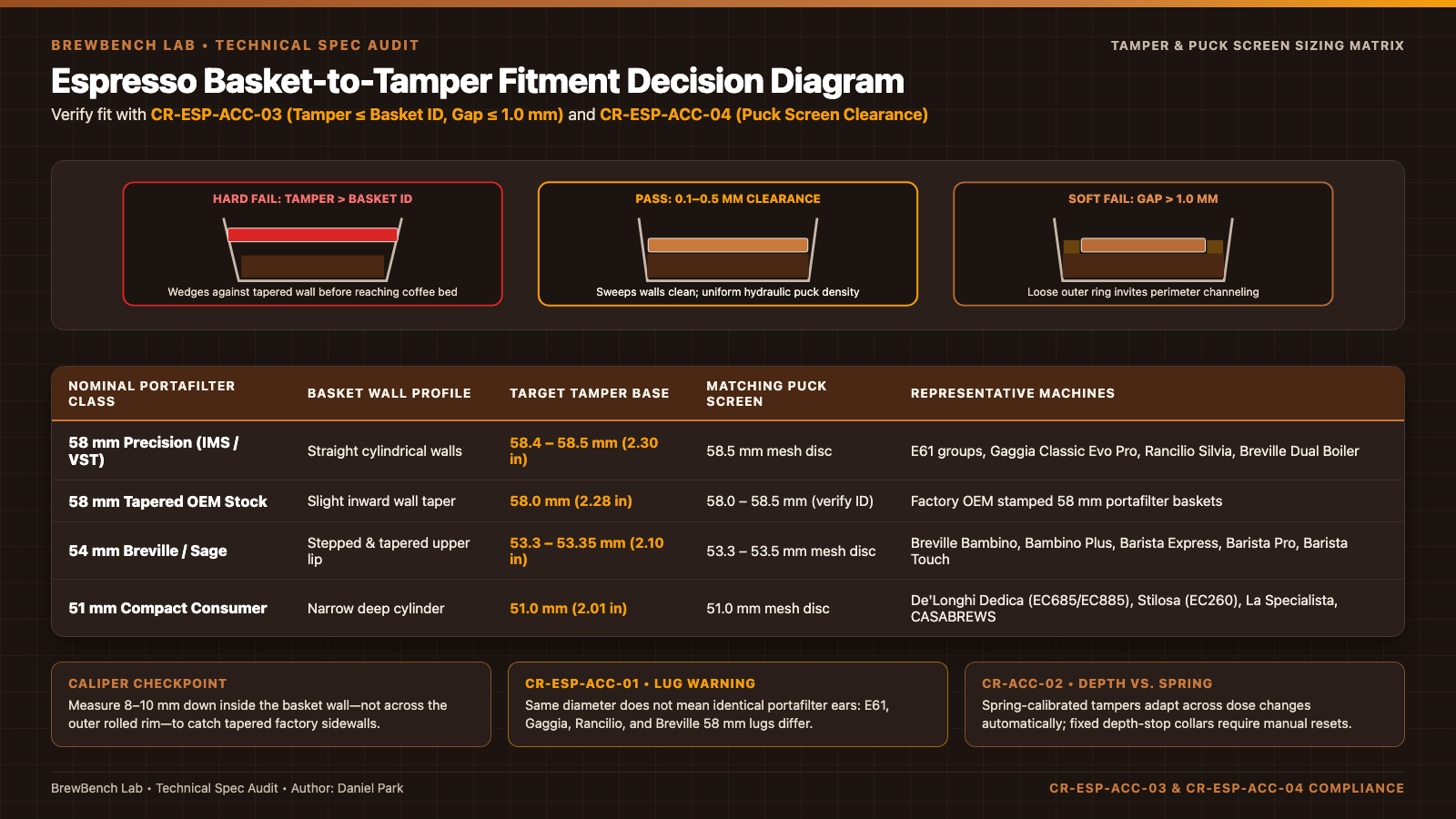
This hydraulic behavior follows fundamental Specialty Coffee Association preparation principles: brew water flows along the path of least resistance. When the outer perimeter of a puck stays fluffy because an undersized plastic scoop tamper cannot reach the wall, water bypasses the dense center and strips sour, under-extracted solubles around the rim while leaving the core under-extracted. Conversely, an oversized base stops short on the basket taper and fails to compress the bed evenly.
Master Espresso Tamper Sizing Table (51 mm, 54 mm, and 58 mm)
Use this cross-compatibility matrix to match your machine’s portafilter class and basket wall profile to the right tamper base and matching puck screen diameter. Need a deeper walkthrough of group ear counts before buying a new handle? Review our espresso portafilter sizes breakdown alongside the chart below.
| Nominal Portafilter Class | Basket Wall Profile | Target Tamper Base (mm / in) | Compatible Machines & Baskets | Critical Fitment Caveat |
|---|---|---|---|---|
| 58 mm Precision | Straight vertical cylindrical walls | 58.4 – 58.5 mm (2.30 in) | IMS / VST precision baskets on E61, Gaggia Classic Evo Pro, Rancilio Silvia, Breville Dual Boiler, Oracle Jet | Do not force 58.5 mm into tapered stock OEM baskets; check wall taper first (CR-ESP-ACC-03). |
| 58 mm Standard OEM | Slightly tapered factory sidewalls | 58.0 mm (2.28 in) | Factory stamped single-wall baskets bundled with commercial & single-boiler 58 mm units | Leaves slightly wider clearance inside straight precision sleeves, but eliminates binding in OEM baskets. |
| 54 mm Breville / Sage | Stepped upper rim with tapered lower wall | 53.3 – 53.35 mm (2.10 in) | Breville Bambino, Bambino Plus, Barista Express, Barista Pro, Barista Touch; Ninja Luxe Café (verify manual) | A literal 54.0 mm base jams against the upper bevel; older deeply tapered baskets may prefer 53.0 mm. |
| 51 mm Compact Consumer | Narrow, deep cylindrical cup | 51.0 mm (2.01 in) | De’Longhi Dedica (EC685 / EC885), Stilosa (EC260), La Specialista line, CASABREWS CM5418 | Replace flexible bundled plastic scoops; verify single-wall vs. pressurized basket taper (CR-ESP-ACC-13). |
| 49 / 53 / 57 mm Legacy | Brand-specific proprietary profiles | Exact basket ID minus 0.2–0.5 mm | Older lever machines, niche European home units, legacy 57 mm groups | Never substitute neighboring diameters (53 mm is not 54 mm; 57 mm is not 58 mm). |
Detailed Breakdown by Basket Class: Why Half-Millimeters Matter
1. The 58 mm Ecosystem: 58.0 mm vs. 58.5 mm
Fifty-eight millimeters is the commercial and prosumer benchmark, shared across Gaggia Classic Evo Pro, Rancilio Silvia, Rancilio Silvia Pro X, Breville Dual Boiler (BES920), Breville Oracle Jet, Ascaso Steel Duo PID, and E61-group machines from brands such as Lelit, Profitec, and ECM (as well as saturated groups like La Marzocco or manual levers like the Flair 58). Note that under rule CR-ESP-ACC-01, portafilters themselves are not cross-compatible across these 58 mm brands because locking ear thickness and angle differ—yet almost all of them accept standard 58 mm filter baskets.
Within those 58 mm baskets, two distinct tamper sizes exist for a practical engineering reason:
- 58.0 mm (2.28 in) Tampers: Built as a universal safe clearance for factory-stamped OEM 58 mm baskets, which often taper subtly from roughly 58.5 mm at the very top rim down toward 58.1–58.3 mm at coffee-bed depth. A 58.0 mm base never binds against stamped sidewalls, though it leaves a noticeable gap inside wider precision sleeves.
- 58.4 mm – 58.5 mm (2.30 in) Tampers: Engineered specifically for straight-wall precision baskets. According to IMS Filtri precision basket specifications, competition-grade cylindrical baskets maintain tight inner wall tolerances near 58.6–58.7 mm all the way down to the bottom radius, calling for a 58.4 mm to 58.5 mm base so grounds are swept cleanly from the perimeter.
If your espresso machine still runs its factory-supplied stock basket and you have no plans to upgrade to a precision sleeve, a 58.0 mm tamper avoids wall wedging. If you already use—or plan to buy—an IMS or VST straight-wall precision basket, step directly to a 58.5 mm base.
2. The 54 mm Breville / Sage Ecosystem: Why 53.3–53.35 mm Is Standard
Owners of the Breville Bambino, Bambino Plus, Barista Express, Barista Express Impress, Barista Pro, and Barista Touch frequently search for a “54 mm tamper” and end up frustrated when a literal 54.0 mm disc refuses to drop past the basket rim. On Breville USA 54 mm espresso machines, 54 mm describes the nominal portafilter housing size rather than the internal basket wall at tamp depth.
Breville 54 mm OEM baskets feature a stepped upper bevel and tapered lower walls. Precision accessory makers machine dedicated 53.3 mm to 53.35 mm (2.10 in) tamper bases specifically to clear that upper ridge while tracking close to the sidewall at normal 16–19 g doses. Notice how tiny changes matter here: a 53.35 mm base rides slightly tighter along the perimeter of single-wall 54 mm double baskets than a 53.0 mm tamper, yet still stops short of the HARD interference zone where a 53.6 mm or 54.0 mm disc would jam. (For newer 54 mm consumer units like the Ninja Luxe Café, confirm your basket inner wall width in the manual before ordering third-party Breville accessories.)
3. The 51 mm De’Longhi & Compact Consumer Ecosystem
Compact thermoblock machines—including the De’Longhi Dedica (EC685 / EC885 Arte), Stilosa (EC260), and La Specialista series, along with budget Amazon-native brands like CASABREWS—rely on 51 mm (2.01 in) portafilters. Nearly every machine in this class ships with a lightweight plastic combination scoop-tamper that measures roughly 48.5–49.5 mm across the base and flexes under hand pressure, violating CR-ESP-ACC-03’s 1.0 mm perimeter gap limit.
Swapping to a solid 51.0 mm stainless steel tamper immediately improves perimeter compaction, provided you check two nuances first:
- Pressurized vs. Single-Wall Basket Geometry (CR-ESP-ACC-13): Many entry 51 mm machines ship primarily with pressurized (dual-wall) baskets whose inner lower walls taper more aggressively than aftermarket 51 mm single-wall baskets. If your shot relies on a pressurized basket with pre-ground coffee, tamp gently and confirm the 51.0 mm base travels freely to your usual 14–16 g dose depth. When upgrading to an espresso-capable burr grinder (CR-GRD-ESP-01), add a true 51 mm single-wall non-pressurized basket so the 51.0 mm tamper works against straighter walls.
- Portafilter Lug Caution (CR-ESP-ACC-01): While a 51.0 mm tamper fits across most 51 mm baskets, replacement 51 mm portafilters do not interchange blindly—De’Longhi Dedica models use 3-ear patterns while some Stilosa or third-party 51 mm groups use 2-ear layouts.
4. Uncommon Sizes (49 mm, 53 mm, and 57 mm)
If you own an older specialty lever machine (such as classic 49 mm groups) or a legacy 53 mm or 57 mm European espresso machine, resist the temptation to “round up or down” to 51 mm, 54 mm, or 58 mm. A 54 mm-labeled 53.3 mm tamper will rattle loosely inside a 54 mm-plus niche basket or jam inside a true 53.0 mm cylinder, while a 58.0 mm tamper physically cannot enter a 57 mm basket. Always verify the exact inner millimeter measurement first.
How to Measure Your Filter Basket in 60 Seconds
When an unbranded machine or third-party replacement basket lacks published inner-diameter specs, you can audit exact clearance in under a minute using basic digital calipers (avoid flexible sewing tapes or wooden rulers, which struggle to read sub-millimeter tolerances).
- Measure Inside the Wall, Never the Rolled Lip: Seat the inside-measuring jaws of digital calipers vertically inside the empty basket, avoiding the flared top rim that rests on the portafilter ledge.
- Measure at Tamp Depth (8–10 mm Down): Slide the caliper jaws roughly 8 to 10 mm (0.31 to 0.39 in) below the top edge—the exact vertical zone where your tamper base stops on a compressed puck. If the reading shrinks compared with the upper mouth, your basket is tapered.
- Take Two Cross-Axis Readings: Rotate the basket 90 degrees and measure again to make sure a dropped or out-of-round basket is not hiding an oval pinch point.
- Apply the Clearance Formula: Subtract 0.15 mm to 0.50 mm from your smallest verified inner-diameter reading at tamp depth. For example, a 58.65 mm precision reading pairs cleanly with a 58.5 mm tamper; a 53.55 mm tapered Breville reading pairs cleanly with a 53.3 mm or 53.35 mm base; and a 51.25 mm reading pairs with a 51.0 mm base.
- Treat Amazon Listing Titles as Unverified Leads (G-21): Generic online listings frequently bundle “fits 51/54/58 mm” claims loosely. Cross-check the manufacturer’s own specification table for exact machined base diameter in millimeters before buying.
Puck Screens, Headspace & Spring vs. Depth-Stop Tools
Sizing your tamper correctly also unlocks accurate sizing for every other disk-shaped tool that enters your filter basket—especially sintered mesh puck screens and top paper filters.
Matching Puck Screens Under CR-ESP-ACC-04 & CR-ESP-ACC-05
Rule CR-ESP-ACC-04 mirrors our tamper rule almost verbatim: a puck screen’s diameter must never exceed the basket’s top inner diameter (screen_mm ≤ basket_id_mm), and keeping the gap within 1.0 mm prevents brew water from jetting around a loose mesh edge. Typically, a 58.5 mm screen pairs with 58 mm precision baskets, a 53.3–53.5 mm screen pairs with 54 mm Breville baskets, and a 51.0 mm screen pairs with 51 mm baskets. Remember rule CR-ESP-ACC-05 as well: a rigid 1.7 mm metal puck screen consumes vertical basket headspace, so you may need to trim your coffee dose by about 1.0 g—or step up to a deeper basket—to keep the screen from pressing against the shower screen bolt before extraction starts. Explore verified mesh dimensions in our best puck screens audit.
Self-Leveling Springs vs. Fixed-Depth Collars (CR-ACC-02)
Once diameter is locked in, choose how the tamper controls tilt and vertical stroke:
- Self-Leveling Calibrated Spring Tampers: As detailed in the Normcore Spring-Loaded Tamper V4 specifications, an outer rim collar rests flat on top of the basket lip while an internal 15 lb, 25 lb, or 30 lb (6.8 kg to 13.6 kg) calibrated spring regulates compression force. Because the spring travels dynamically until target resistance is met, it adapts automatically whether you dose 17 g of a dense light roast or 19 g of a fluffier medium-dark blend.
- Fixed-Depth Palm Tampers & Wedge Levelers (CR-ACC-02): Depth-stop tools lack an active force spring and simply halt at a preset millimeter distance below the basket rim. Under rule CR-ACC-02, you must unthread and reset that depth collar every time you change dose weight, bean roast density, or basket depth—otherwise a shorter light-roast coffee bed receives inadequate compression.
- Flat vs. Ripple Tamper Bases: A flat 304 stainless steel base sweeps clean in one wipe and provides a level landing pad for metal puck screens. Concentric ripple faces paired with low-friction Titanium PVD coatings help shed static-charged fines in dry climates, though neither geometry substitutes for even needle distribution (WDT) prior to tamping.
Myth vs. Engineering Reality: 4 Tamper Sizing Traps
Myth 1: “A 54 mm portafilter needs a 54.0 mm tamper.”
Engineering Reality: Breville’s 54 mm label refers to the nominal portafilter standard, not the tapered internal basket wall. A true 54.0 mm tamper jams at the top lip; 53.3 mm to 53.35 mm bases are engineered to drop past the bevel and seat cleanly at coffee-bed depth.
Myth 2: “Every 58 mm espresso machine takes a 58.5 mm tamper.”
Engineering Reality: Straight-wall competition baskets (IMS / VST) pair with 58.4–58.5 mm tampers, whereas narrower tapered stock 58 mm OEM baskets can bind a 58.5 mm disc before it finishes compressing the puck. Measure your stock basket or opt for 58.0 mm if you keep OEM stamped sleeves.
Myth 3: “A 15-bar or 20-bar pump rating pushes past loose tamper edges automatically.”
Engineering Reality: Pump ratings like 15 bar or 20 bar describe the vibratory pump’s deadhead maximum capability—not brew pressure at the puck, which is regulated near ~9 bar on proper espresso extractions. High pump capability actually punishes an undersized tamper harder by blasting water straight through loose perimeter grounds.
Myth 4: “Set a fixed-depth palm tamper once and forget it.”
Engineering Reality: Under CR-ACC-02, fixed-depth collars measure distance from the rim, not force on the coffee bed. Switching from a dark roast to a denser light roast shrinks puck height by several millimeters, leaving a depth-locked tamper hovering above optimal compaction until you re-adjust the collar.
Verified Amazon US Tamper Picks by Basket Size
Once you confirm your basket’s inner diameter, selecting a calibrated tamper is straightforward. Below are four verified Amazon US options spanning each major basket diameter tier (`58.5 mm`, `58.0 mm`, `53.35 mm` for 54 mm Breville, and `51.0 mm`). For a wider nine-product comparison including walnut V5 twist-dial and ripple-base models, see our full best espresso tamper roundup.
1. Normcore 58.5mm Coffee Tamper V4 — Best for Straight-Wall 58 mm Precision Baskets

Verified Sizing Specs: 58.5 mm (2.30 in) flat 304 stainless steel base | Self-leveling basket rim lip | 15 lb, 25 lb (installed), and 30 lb springs | Anodized aluminum handle + silicone dock | Budget Tier: $30–$60
Built specifically around straight-wall precision 58 mm baskets (IMS, VST, and commercial competition sleeves), the Normcore 58.5mm V4 reduces perimeter wall clearance to roughly 0.1–0.2 mm while using a wide outer lip collar to eliminate angled puck tilt. Because three springs ship in the box, you can tune compression feel without replacing the tool, making it a strong default for Gaggia, Rancilio, Breville Dual Boiler, and E61 setups running precision baskets.
Pros
- Tight 58.5 mm tolerance leaves virtually no uncompacted grounds on straight-wall precision sleeves
- Rim-resting leveling baffle keeps the stainless base parallel to the shower screen
- Bundled 15 / 25 / 30 lb springs and silicone rest cover most espresso recipes
Cons
- Can rub or bind halfway down inside narrower tapered factory OEM 58 mm baskets
- Swapping springs requires unscrewing the handle shaft rather than turning an external dial
2. LuxHaus 58mm Calibrated Level Tamper — Best for Tapered Stock OEM 58 mm Baskets

Verified Sizing Specs: 58.0 mm (2.28 in) 100% flat stainless steel base | Self-leveling collar lip | Calibrated internal spring | Anodized handle | Budget Tier: Under $30
If your 58 mm espresso machine still runs its factory-stamped stock basket—or if caliper checks show your basket tapering near 58.1–58.2 mm at tamp depth—a 58.0 mm base prevents frustrating sidewall jams. The LuxHaus 58mm Calibrated Level Tamper pairs a clean 58.0 mm flat steel face with both a rim-leveling collar and calibrated spring resistance inside the Under $30 tier.
Pros
- 58.0 mm base clears tapered OEM 58 mm sidewalls cleanly without binding
- Combines rim-resting alignment and calibrated spring travel under $30
- Flat stainless base wipes clean easily and pairs cleanly with 58 mm puck screens
Cons
- Single fixed spring tension lacks swappable 15/25/30 lb spring options
- Leaves 0.5 mm wider clearance inside straight-wall precision IMS/VST baskets than a 58.5 mm tamper
3. MHW-3BOMBER 53.35mm Double Spring Self-Leveling Tamper — Best for 54 mm Breville Baskets

Verified Sizing Specs: 53.35 mm (2.10 in) SUS304 stainless steel base | Double-spring vertical guide + rebound | Self-leveling basket rim lip | Budget Tier: Under $30
Sized specifically for Breville 54 mm portafilters (Bambino, Bambino Plus, Barista Express, Barista Pro, Barista Touch), the MHW-3BOMBER 53.35mm tamper trims perimeter edge gaps tighter than standard 53.0 mm alternatives while still clearing Breville’s upper basket taper. Its dual-spring internal assembly maintains vertical pressure consistency and rebounds cleanly off the puck without pulling loose grounds upward.
Pros
- 53.35 mm base diameter fits Breville 54 mm single-wall baskets with minimal edge gap
- Double-spring mechanism adds smooth vertical travel and automatic upward rebound
- Food-grade SUS304 steel base offers durable weight in the Under $30 tier
Cons
- Tighter 53.35 mm tolerance can feel snug in deeply tapered dual-wall pressurized baskets
- Does not include multiple interchangeable spring weights in the package
4. Normcore 51mm Coffee Tamper V4 — Best for 51 mm De’Longhi & Compact Baskets

Verified Sizing Specs: 51.0 mm (2.01 in) flat 304 stainless steel base | Self-leveling basket rim lip | 15 lb, 25 lb, and 30 lb springs | Anodized aluminum handle + stand | Budget Tier: $30–$60
Narrow 51 mm portafilters—like those on De’Longhi Dedica, Stilosa, and La Specialista machines—exaggerate wrist tilt because the coffee bed is taller per gram of dose. The Normcore 51mm V4 solves both diameter and tilt simultaneously: its 51.0 mm flat stainless steel face replaces flimsy stock plastic tampers, while its rim-resting collar holds the piston square inside tight 51 mm single-wall and pressurized baskets.
Pros
- True 51.0 mm machined steel base eliminates flexible plastic-scoop edge gaps
- Self-leveling lip collar prevents tilted pucks on tall, narrow 51 mm doses
- Includes 15 / 25 / 30 lb interchangeable springs and a countertop silicone dock
Cons
- Higher cost tier ($30–$60) relative to entry 51 mm espresso machines
- On narrow 51 mm pressurized baskets with steep bottom tapers, use light pressure so the base does not contact the lower ridge
How We Audited This Guide
- Portafilters, precision baskets, tampers, coffee scales, and water filters were audited for basket inner-diameter matching, drip-tray cup clearance, OEM cartridge locks, and 0.1g accuracy.
- Every espresso machine, burr grinder, accessory, and scale specification was cross-checked against official manufacturer 120V manuals, SCA water guidance, and verified Amazon US listings.
- Recommendations were evaluated against our weighted espresso-gear scoring rubrics and documented CR-* compatibility rules; we never invent heat-up seconds, PID variance, or micron claims.
Continue Your Audit
Frequently Asked Questions About Espresso Tamper Sizing
What size tamper do I need for a Breville 54 mm portafilter?
You need a 53.3 mm or 53.35 mm (2.10 in) tamper for Breville 54 mm machines such as the Bambino, Bambino Plus, Barista Express, and Barista Pro. Although the portafilter housing is labeled 54 mm, the basket walls taper inward, causing literal 54.0 mm bases to wedge.
Should I choose a 58 mm or 58.5 mm tamper?
Choose a 58.5 mm (2.30 in) tamper if you use straight-wall precision baskets like IMS or VST models, and choose a 58.0 mm (2.28 in) tamper if you keep slightly tapered factory OEM baskets. Under rule CR-ESP-ACC-03, matching wall geometry avoids binding while minimizing perimeter gaps.
What size tamper fits a De’Longhi Dedica or Stilosa?
De’Longhi Dedica, Stilosa, and La Specialista portafilters require a 51.0 mm (2.01 in) tamper. Replacing the undersized factory plastic scoop with a machined 51 mm stainless steel tamper closes perimeter edge gaps, especially when paired with a 51 mm single-wall non-pressurized filter basket.
How much gap is acceptable between a tamper and basket wall?
Under BrewBench Lab rule CR-ESP-ACC-03, keep total diametrical clearance at or below 1.0 mm (0.04 in), with 0.1 to 0.5 mm as the practical sweet spot. Wider gaps leave an uncompacted moat of grounds around the basket wall that invites perimeter channeling.
Does a puck screen use the exact same size as my tamper?
Yes. Under rule CR-ESP-ACC-04, sintered mesh puck screens follow the exact same basket inner-diameter limits as tampers: 58.5 mm for precision 58 mm baskets, 53.3–53.5 mm for 54 mm Breville baskets, and 51.0 mm for 51 mm baskets, while trimming coffee dose slightly for headspace.
How hard should I press with a calibrated tamper?
Once coffee grounds are compressed evenly between 15 lb and 30 lb (6.8 to 13.6 kg) to collapse internal air pockets, extra arm force yields diminishing returns. Holding the tamper base completely level against the basket rim matters far more than maximum downward pressure.


