Disclosure: As an Amazon Associate, I earn from qualifying purchases. If you buy through links on this page, we may earn a small commission at no extra cost to you.
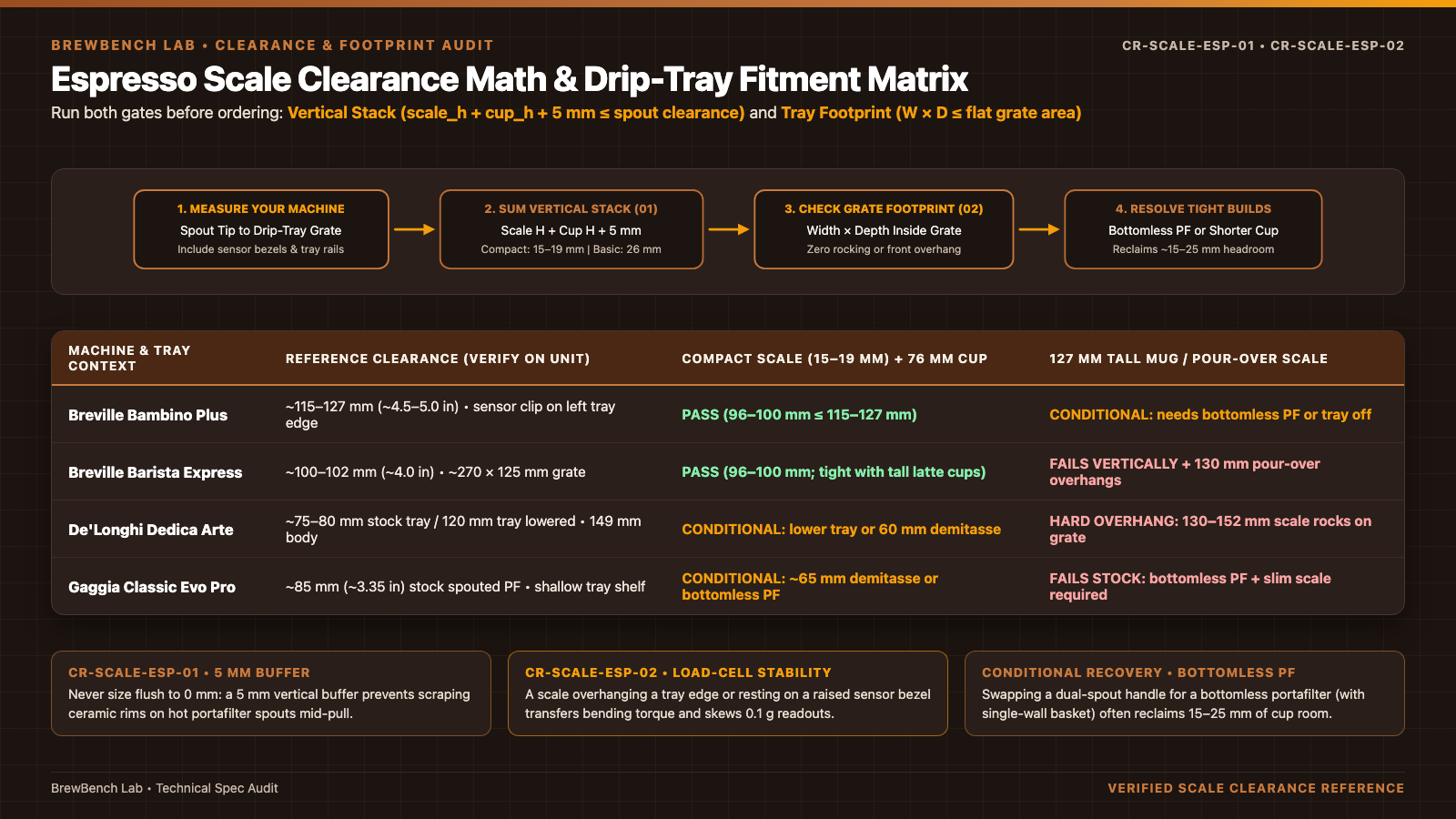
Direct Answer — Will a Scale Fit Under My Espresso Machine? Yes, if your vertical stack passes the formula scale height + cup height + 5 mm (0.20 in) ≤ machine spout clearance (CR-SCALE-ESP-01) and the scale base sits completely inside your flat drip-tray grate without overhang (CR-SCALE-ESP-02). Most home bars require a compact 15–19 mm (0.59–0.75 in) mini scale rather than a 26 mm pour-over platform.
Few buying mistakes frustrate home baristas faster than unwrapping a sleek digital coffee scale only to discover that the portafilter spouts pin your cup rim against the drip tray—or that the scale body rocks awkwardly across a raised stainless trim lip. Answering will a scale fit under my espresso machine takes less than two minutes once you separate vertical height math from horizontal drip-tray footprint rules.
Inside our best espresso scales hub, we classify compact scales by exact millimeter stack height, flat grate width, and load-cell stability rather than generic marketing labels. Below, you will find the two-gate clearance equation used across every BrewBench Lab audit, worked dimensional breakdowns for popular 120V home espresso machines—including the Breville Bambino Plus, Breville Barista Express, De’Longhi Dedica Arte, and Gaggia Classic Evo Pro—plus four verified compact 0.1 g scales engineered for tight drip trays.
In This Guide
The Two-Gate Espresso Scale Clearance Formula
Gravimetric brewing—weighing dry coffee dose in and liquid espresso yield out to the nearest 0.1 g—is the foundation of repeatable extraction under Specialty Coffee Association brewing standards. Yet a scale only helps your workflow if it clears both physical axes of your espresso machine’s brew zone. Every scale fitment check must pass two distinct compatibility gates: CR-SCALE-ESP-01 (vertical height stack) and CR-SCALE-ESP-02 (horizontal drip-tray footprint).
Gate 1: Vertical Clearance Math (CR-SCALE-ESP-01)
Under rule CR-SCALE-ESP-01, vertical fitment is governed by a strict inequality using millimeter (or decimal inch) measurements:
Required Height (mm) = Scale Height (mm) + Cup Height (mm) + 5 mm (0.20 in) Margin
Compare that sum directly against your machine’s available clearance measured from the top surface of the drip-tray grate up to the lowest tip of the locked-in portafilter spouts (or basket bottom if using a bottomless handle):
- PASS:
Required Height ≤ Available Clearancewith your stock spouted portafilter and standard drip tray installed. Your cup glides cleanly onto the scale pad with zero spout scraping. - CONDITIONAL: The stack exceeds stock spouted clearance, so the scale fits only if you switch to a bottomless portafilter, remove or lower a secondary drip-tray insert, or swap to a shorter demitasse cup.
- HARD FAIL: Even with a bottomless portafilter and a low espresso cup, the vertical stack cannot slide under the group head—requiring either a slimmer 15–18 mm scale or brewing without a scale under the cup.
Why include a mandatory 5 mm (0.20 in) safety margin? First, nearly every espresso scale includes a removable silicone thermal mat that adds 1.5–3 mm (0.06–0.12 in) of real operating height above the naked chassis spec; removing that mat leaves delicate acrylic or strain-gauge tops exposed to 90+ °C (194+ °F) ceramic cup bases and vibration. Second, sliding a hot porcelain cup sideways off the scale without tilting requires a few millimeters of finger clearance below the metal spouts. Third, pump vibration during a 9-bar pull can rattle an over-tight rim straight into the spouts, transferring downward force onto the load cell and corrupting weight readings mid-shot.
Gate 2: Drip-Tray Footprint & Load-Cell Stability (CR-SCALE-ESP-02)
Passing the vertical math alone still fails if the scale fails CR-SCALE-ESP-02: Scale Width ≤ Usable Grate Width and Scale Depth ≤ Usable Grate Depth. Most coffee scales rely on a cantilevered aluminum or steel strain-gauge load cell anchored between four tiny rubber feet at the base corners. When a wide pour-over scale—such as the popular TIMEMORE Black Mirror Basic 2 at roughly 152 × 130 × 26 mm (5.98 × 5.12 × 1.02 in)—hangs over the front lip of a shallow drip tray, two problems occur immediately:
- Cantilever Flex & Weight Drift: Unsupported front corners allow the bottom housing to flex unevenly under cup weight, delaying auto-tare settlement or drifting by several tenths of a gram mid-extraction.
- Bezel & Sensor Interference: Machines with raised plastic drip-tray frames or sensor hardware—most notably the automatic milk-temperature sensor clip on the left tray deck of the Breville Bambino Plus per Breville US product documentation—force wider scales to bridge across uneven heights, causing the chassis to rock when bumped.
Worked Clearance Math Across Popular Home Espresso Machines
Manufacturer spec sheets rarely publish exact spout-to-tray clearance numbers in millimeters; most published clearances come from retailer listings or measured owner reports (confidence C) while outer chassis widths come directly from makers (confidence A). Because portafilter spout geometry and basket depth vary slightly by production run, always treat the reference clearances below as planning baselines and confirm on your own machine with a millimeter ruler before ordering.
| Machine Model | Reference Clearance & Grate Envelope | 18 mm Mini Scale + 76 mm (3.0 in) Cup | 18 mm Mini Scale + 115 mm (4.5 in) Latte Mug | Critical Fitment Caveat |
|---|---|---|---|---|
| Breville Bambino Plus (BES500) | ~115–127 mm (~4.5–5.0 in) listed by US retailers; ~150–160 × 100–110 mm usable grate area | 99 mm total → PASS (leaves ~16–28 mm room) | 138 mm total → CONDITIONAL (bottomless PF or tray off) | Avoid overhanging the left-side milk temperature sensor bezel; verify width ≤ 115 mm or depth ≤ 100 mm. |
| Breville Barista Express (BES870) | ~100–102 mm (~4.0 in) under stock spouts per retailer specs; ~270 × 125 mm (~10.6 × 4.9 in) grate | 99 mm total → PASS (Tight) (within 1–3 mm of spouted limit) | 138 mm total → HARD / CONDITIONAL (tray off or bottomless PF) | Wide 270 mm grate handles most rectangular scales side-to-side, but 125 mm depth rejects 130+ mm pour-over squares. |
| De’Longhi Dedica Arte (EC885) | ~75–80 mm stock upper tray; up to 120 mm (4.7 in) with upper tray removed per De’Longhi US; 149 mm (5.87 in) body width | 99 mm total → CONDITIONAL (must remove upper drip tray) | 138 mm total → HARD FAIL (exceeds 120 mm max clearance) | Ultra-narrow housing (~135–140 mm inside legs) forces sub-100 mm mini scales; standard pour-over scales wedge or overhang. |
| Gaggia Classic Evo Pro | ~85 mm (~3.35 in) stock spouted clearance per community measurements; compact shallow tray shelf | 99 mm total → CONDITIONAL (use ~60 mm cup or bottomless PF) | 138 mm total → HARD FAIL (requires bottomless PF + low mug) | Stock dual-spout clearance is among the tightest in 58 mm machines; a 58 mm bottomless portafilter is nearly mandatory for mug workflows. |
| Pour-Over Scale Contrast (e.g., 26 mm Thick, 152 × 130 mm) | 26 mm (1.02 in) height + 130 mm (5.12 in) depth | 107 mm total (fails Barista Express stock spouts & Dedica stock tray) | 146 mm total (exceeds nearly all stock home spouted groups) | Great for pour-over carafes and 2 kg dosing, but too tall and deep for narrow 100–125 mm espresso drip trays. |
Looking closely at the Breville Barista Express line shows why the 5 mm margin matters in real kitchens. A 18 mm (0.71 in) mini scale plus a standard 76 mm (3.0 in) ceramic espresso cup plus the 5 mm (0.20 in) buffer equals 99 mm (3.90 in)—barely clearing ~100–102 mm (~4.0 in) stock spouts. Swap that 76 mm cup for an 85 mm (3.35 in) cappuccino tulip cup, and your required height climbs to 108 mm (4.25 in), colliding straight into the chrome spouts unless you switch to a bottomless portafilter or a 15 mm ultra-slim scale paired with a 65 mm cup.
Similarly, consider the Breville Bambino Plus: US retailer listings cite roughly 5 in (~127 mm) of under-group clearance, which easily swallows a 15.8–19 mm mini scale plus a 76 mm demitasse (96.8–100 mm total). Yet if you pull a morning Americano or latte directly into a 127 mm (5.0 in) tall travel mug, 19 + 127 + 5 = 151 mm (5.94 in)—resulting in a vertical mismatch that forces you either to pull shots into a shorter stainless espresso dosing cup first or to remove the drip tray.
How to Measure Your Espresso Machine in 60 Seconds
Never rely on a product listing’s “universal espresso fit” headline without measuring three surfaces on your own counter. Grab a rigid metric ruler or digital caliper and record these four numbers before shopping:
- Measure Locked-In Spout Clearance: Lock your everyday portafilter firmly to the 6 o’clock position with a basket seated inside. Measure vertically from the flat stainless drip-tray grate up to the lowest point of the spouts (or basket floor if you already pull bottomless). Record this in millimeters (1 inch = 25.4 mm).
- Measure Flat Usable Grate Footprint: Do not measure the machine’s outer cabinet width. Measure only the flat perforated metal grate surface where all four scale feet can rest solidly—subtracting raised plastic lip edges, drip-tray water-level float pins, and the Bambino Plus’s left-side milk temperature sensor clip.
- Measure Your Tallest Daily Cup: Stand your favorite cappuccino bowl, cortado glass, and latte mug on a flat counter and measure rim height. A traditional 2.5–3 oz (75–90 ml) espresso demitasse typically stands 55–70 mm (2.17–2.76 in), whereas 8–12 oz (235–355 ml) latte mugs routinely span 90–120 mm (3.54–4.72 in).
- Check Single-Dose Grinder Dosing Cup Width (
CR-SCALE-GRD-01): If you single-dose beans on a separate burr grinder, confirm your scale’s weighing platter is wide enough to support your grinder dosing cup or portafilter basket without blocking the LCD screen.
4 Mechanical Ways to Reclaim Clearance Without Buying Another Machine
If your current espresso bar lands in the CONDITIONAL zone—meaning a scale fits horizontally on the grate, but your favorite mug rubs the portafilter spouts—you have four clean mechanical solutions ranked from cleanest to last-resort:
- 1. Switch to a Bottomless Portafilter (~15–25 mm Gain): Removing cast dual spouts and the enclosed chamber underneath instantly reclaims vertical height under the group head. Remember rule
CR-ACC-01: bottomless portafilters pair strictly with single-wall non-pressurized baskets and an espresso-capable grinder—running a dual-wall pressurized basket without spouts sprays hot coffee sideways across your counter. - 2. Step Down to an Ultra-Slim 15–19 mm Mini Scale (~7–11 mm Gain): Moving from a 26 mm full-size pour-over chassis down to a 15–18 mm dedicated mini scale immediately frees nearly half an inch of vertical clearance while shrinking depth below 100 mm (3.94 in).
- 3. Pull Shots Into a Low Glass Shot Pitcher or Demitasse (~30–50 mm Gain): Pulling espresso into a 60 mm (2.36 in) double-spouted shot glass or low demitasse on the scale lets you weigh exact 1:2 brew ratios cleanly—then pour into a pre-warmed 12 oz travel tumbler afterward.
- 4. Remove a Two-Piece Drip Tray Only When Designed For It: Machines like the De’Longhi Dedica Arte explicitly incorporate a removable upper cup stand to unlock 120 mm (4.7 in) clearance on the lower tray. On machines lacking a lower catch basin—such as the Gaggia Classic Evo Pro or Breville Barista Express—removing the entire drip tray exposes your counter and scale directly to three-way solenoid valve discharge and purge water, so place a thin waterproof bar mat underneath and never let hot discharge flood a non-waterproof scale housing.
Myth vs. Engineering Reality: Espresso Scale & Clearance Traps
Myth #1: “A 15-bar or 20-bar pump machine forces espresso out too fast unless you buy a heavy-duty kitchen scale.”
Engineering Reality: Under guideline G-15, “15 bar” and “20 bar” printed on machine cartons indicate the vibratory pump’s theoretical maximum dead-head rating—not brewing pressure at the coffee bed, which machines regulate near ~9 bar via over-pressure valves or puck resistance. What matters for your scale is 0.1 g gravimetric resolution and fast display response (CR-SCALE-ESP-03), not load-cell brute capacity. Standard 1 g kitchen scales fail espresso dialing because a 1 g rounding swing hides a 5% brew-ratio shift on a 36 g double shot.
Myth #2: “It is fine if a pour-over scale hangs 15 mm past the front of the drip tray.”
Engineering Reality: Under CR-SCALE-ESP-02, overhanging front rubber feet removes support directly underneath the weighing platform’s strain gauge. Even if the scale does not tip over, the chassis twists subtly as liquid fills the cup, causing sluggish zeroing, sticky flow-rate calculations, and erratic auto-stop triggers.
Myth #3: “Every digital coffee scale with a silicone mat is waterproof enough for drip-tray spills.”
Engineering Reality: Per CR-SCALE-ESP-05, a removable silicone thermal pad protects the top surface against hot cups and stray drops—it does not seal the seam around buttons, the USB-C charging port, or the bottom battery cover. Unless a manufacturer explicitly publishes an ingress rating (such as IP67 on sealed chassis), always wipe standing espresso splatters dry immediately and never rinse scales under a faucet.
4 Verified Low-Profile 0.1 g Scales That Pass Tight Drip-Tray Clearances
Once your ruler check confirms you need a slim footprint under 115 mm (4.53 in) deep and under 20 mm (0.79 in) tall, skip oversized 150 mm pour-over platforms like the classic HARIO V60 Drip Scale or OXO Brew 6 lb scale on espresso trays. Under setup rule CR-SYS-03, a dedicated 0.1 g scale is one of your first two essential purchases alongside a basket-matched tamper. The four compact Amazon US scales below pass strict drip-tray sizing without sacrificing 0.1 g repeatability.
| Compact Espresso Scale | Best Fit Scenario | Approximate Footprint & Height | Key Spec Highlights | Amazon Link |
|---|---|---|---|---|
| TIMEMORE Basic Mini | Best Compact All-Rounder (Espresso + Small Pour-Over) | ~114 × 100 × 15.8 mm (~4.5 × 3.9 × 0.62 in) | 0.1 g / 2,000 g, auto-timer, USB-C, $60–$100 tier | View on Amazon |
| Maestri House S1 Mini | Best Sub-4-Inch Micro Footprint (Dedica & Bambino) | ~95 × 100 × 19 mm (~3.74 × 3.94 × 0.75 in) | 0.1 g / 2,000 g, auto-timer, USB-C, Under $100 tier | View on Amazon |
| WEIGHTMAN 1000g x 0.1g | Best Under-$30 Low-Clearance Pocket Scale | ~121 × 69 × 18 mm (~4.76 × 2.72 × 0.71 in) | 0.1 g / 1,000 g, silicone mat, timer, Under $30 tier | View on Amazon |
| BOOKOO Themis Ultra | Best IP67 Water-Resistant Mini Chassis | ~80 × 80 × 15 mm class (~3.15 × 3.15 × 0.59 in) | 0.1 g, IP67 rated seal, shot timer, Under $100 tier | View on Amazon |
1. TIMEMORE Basic Mini Coffee Scale — Best Compact All-Rounder

Quick Specs: 0.1 g resolution | 2,000 g (4.4 lb) max capacity | ~114 × 100 × 15.8 mm (~4.5 × 3.9 × 0.62 in) chassis | Auto-timer | USB-C rechargeable | Silicone thermal pad | Price Tier: $60–$100 tier
While the standard TIMEMORE Black Mirror Basic 2 measures 152 × 130 × 26 mm and overhangs narrow espresso grates, the TIMEMORE Basic Mini trims thickness to roughly 15.8 mm (0.62 in) and depth to 100 mm (3.94 in). Under CR-SCALE-ESP-01, pairing that 15.8 mm deck with a 76 mm (3.0 in) espresso cup and a 5 mm buffer yields 96.8 mm (3.81 in)—fitting cleanly inside both Breville Bambino Plus and stock Breville Barista Express spout clearances while retaining a full 2,000 g capacity for grinder dosing cups (CR-SCALE-GRD-01).
- Pros: Ultra-thin ~15.8 mm vertical profile maximizes cup headroom; 100 mm depth seats flush on Bambino Plus and Barista Express trays; 2,000 g ceiling covers single-dose cups and small pour-over servers; clean hidden LED readout.
- Cons: 114 mm width sits tight inside ultra-narrow De’Longhi Dedica side trim; splash-resistant silicone pad only—no published IP67 submersion seal, so keep the USB-C port cover dry during steam wand purges.
2. Maestri House S1 Mini Espresso Coffee Scale — Best Sub-4-Inch Micro Footprint

Quick Specs: 0.1 g resolution | 2,000 g max capacity | ~95 × 100 × 19 mm (~3.74 × 3.94 × 0.75 in) footprint | Auto-timer | USB-C rechargeable | Silicone pad | Price Tier: Under $100 tier
Designed expressly for cramped entry drip trays, the Maestri House S1 Mini packs a 2,000 g load cell and auto-timing modes into a sub-4-inch 95 × 100 mm footprint. That narrow 95 mm width leaves generous breathing room next to the Bambino Plus milk-temperature sensor clip and slides comfortably inside the narrow 149 mm chassis of a De’Longhi Dedica Arte without rubbing side rails (CR-SCALE-ESP-02).
- Pros: Sub-4-inch width avoids side-trim interference on narrow machines; 2,000 g capacity handles portafilter taring and dosing cups; built-in auto-timer and USB-C charging eliminate AAA battery swaps.
- Cons: 19 mm height sacrifices ~3–4 mm of vertical room compared with 15 mm mini rivals on stock spouted Gaggia or Barista Express setups; compact 95 mm deck feels cramped under wide multi-cup pour-over carafes.
3. WEIGHTMAN Espresso Scale 1000g x 0.1g — Best Under-$30 Low-Clearance Pick
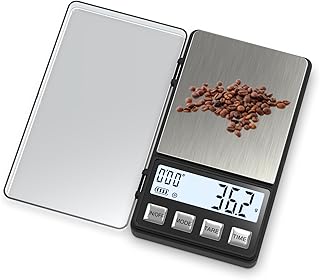
Quick Specs: 0.1 g resolution | 1,000 g max capacity | ~121 × 69 × 18 mm (~4.76 × 2.72 × 0.71 in) pocket chassis | Manual shot timer | Silicone mat | Backlit LCD | Price Tier: Under $30 tier
If your espresso bar sits on a strict budget and every millimeter of tray depth counts, the WEIGHTMAN 1000g x 0.1g solves tight front-to-back clearances that defeat deeper square scales. Its ultra-narrow 69 mm (2.72 in) depth sits completely clear of protruding group housings and water float pins while preserving 0.1 g dose and yield tracking under ~18 mm height.
- Pros: Narrow ~69 mm depth fits shallow drip trays where 100+ mm square scales overhang; crisp backlit LCD remains legible beside dark drip trays; budget-friendly entry into 0.1 g gravimetric ratios.
- Cons: 1,000 g max capacity prevents weighing heavy pour-over kettles or full 58 mm portafilters with dense metal handles; lacks automatic flow-start timing and relies on AAA cells rather than USB-C charging.
4. BOOKOO Themis Ultra 0.1g IP67 Waterproof Scale — Best Water-Resistant Mini

Quick Specs: 0.1 g resolution | Compact square mini footprint (~80 × 80 × 15 mm class) | Published IP67 water-resistant housing | Integrated shot timer | Price Tier: Under $100 tier
Espresso drip trays are wet electronics hazards: steam wand purges, bottomless spritzers, and three-way solenoid discharges routinely pool across the grate. The BOOKOO Themis Ultra stands apart under CR-SCALE-ESP-05 by backing its ultra-compact mini dimensions (~15 mm class height) with a maker-stated IP67 waterproof seal—leaving maximum vertical room for tall cups while resisting accidental tray splashes.
- Pros: Maker-published IP67 water resistance guards against drip-tray spills and steam condensation; ultra-low ~15 mm profile and tiny footprint fit practically every home drip tray; crisp 0.1 g shot timer tracking.
- Cons: Tiny square weighing pad leaves little margin for wide-base ceramic mugs or large single-dose cups; priced above basic under-$30 scales while omitting full pour-over carafe real estate.
How We Audited This Guide
- Portafilters, precision baskets, tampers, coffee scales, and water filters were audited for basket inner-diameter matching, drip-tray cup clearance, OEM cartridge locks, and 0.1g accuracy.
- Every espresso machine, burr grinder, accessory, and scale specification was cross-checked against official manufacturer 120V manuals, SCA water guidance, and verified Amazon US listings.
- Recommendations were evaluated against our weighted espresso-gear scoring rubrics and documented CR-* compatibility rules; we never invent heat-up seconds, PID variance, or micron claims.
Continue Your Audit
- Best Espresso Accessories (2026): Tools Worth Buying, Audited
- Best Bottomless Portafilters for Breville 54 mm 2026: Fit Audited
- Best Espresso Tampers 2026: Sized to Your Basket, Compared
Frequently Asked Questions About Espresso Scale Clearance
How much vertical clearance do I need for an espresso scale and cup?
Add your scale’s height (including its silicone thermal mat) plus your cup’s height plus a 5 mm (0.20 in) safety margin. For example, a 16 mm mini scale plus a 76 mm (3.0 in) espresso cup requires 97 mm (3.82 in) of clear vertical space below your portafilter spouts.
Does a scale have to fit completely inside the drip tray?
Yes—under compatibility rule CR-SCALE-ESP-02, all four base feet should sit flat inside the drip-tray grate. Letting the front corners overhang a lip or balance atop a raised temperature-sensor bezel flexes the internal load cell, leading to drifting weights and delayed auto-tare settlement.
Will a bottomless portafilter let a taller mug fit on my scale?
Often yes—replacing a cast spouted portafilter with a bottomless handle typically reclaims 15 to 25 mm (0.59 to 0.98 in) of vertical cup clearance. Make sure you pair a bottomless handle exclusively with a single-wall non-pressurized basket and an espresso-capable grinder.
Can I put a pour-over coffee scale under an espresso machine?
Only on deep prosumer drip trays with generous spout height. Most pour-over scales measure 130 to 152 mm deep and roughly 26 mm tall, which causes front-edge overhang on compact 100–125 mm espresso grates and crowds ceramic cups against stock spouts.
Is it safe to remove my espresso machine’s drip tray to fit a tall travel mug and scale?
Only if your machine is built with a lower secondary basin, such as the De’Longhi Dedica Arte’s two-stage tray. On machines without a lower basin, removing the tray directs hot three-way solenoid exhaust and purge drips straight onto your counter and scale electronics.


