
Disclosure: As an Amazon Associate, I earn from qualifying purchases. If you buy through links on this page, we may earn a small commission at no extra cost to you.
If you are trying to understand what is wdt espresso puck preparation and why serious home baristas stir ground coffee with ultra-thin needles before tamping, the answer comes down to particle clump physics. WDT stands for the Weiss Distribution Technique—a pre-tamp grooming step using fine 0.23 mm to 0.40 mm (0.009 to 0.016 in) stainless steel needles to break apart static-induced grind clumps and equalize coffee density from the basket floor to the rim.
Within our best espresso accessories hub, a simple needle rake sits near the top of high-value upgrades once you already own an espresso-capable burr grinder and a basket-matched tamper. Below, we break down how WDT works mechanically, why wire diameter separates effective tools from trench-plowing gimmicks, and how compatibility rules govern handheld needles versus size-specific planetary gear distributors.
Quick Answer — What Is WDT in Espresso?
WDT (Weiss Distribution Technique) is the practice of stirring fresh espresso grounds inside a portafilter basket using thin 0.23–0.40 mm (0.009–0.016 in) acupuncture-style needles before tamping. Stirring disperses electrostatic clumps and voids so pressurized brew water encounters uniform hydraulic resistance across a single-wall basket.
In This Guide
- Why Ground Espresso Clumps—and How WDT Fixes Bed Density
- Needle Gauge Math & Compatibility Rules (CR-ESP-ACC-07 & CR-ACC-02)
- Espresso Distribution Methods Compared
- Step-by-Step WDT Workflow: Handheld Rake vs. Planetary Ring
- Myth vs. Engineering Reality
- Verified Amazon US WDT Tool Picks by Workflow
- Frequently Asked Questions
Why Ground Espresso Clumps—and How WDT Fixes Bed Density
Espresso-fine coffee particles behave very differently from coarse pour-over grounds. When roasted coffee beans pass between high-speed conical or flat burrs, mechanical friction shears the brittle cell structure into particles spanning tens to hundreds of microns while generating static electrical charges (triboelectric charging). Simultaneously, fine grounds pack tightly inside narrow grinder exit chutes, declumpers, or sweepers before dropping into your dosing cup or portafilter.
The result inside an untamped portafilter basket is a loose mountain of micro-agglomerates—dense little boulders of compressed coffee surrounded by airy voids—heaped taller in the center than near the steel sidewall. If you drop a flat tamper directly onto that uneven heap, vertical compression locks those density differences into place. A dense clump compresses into an even harder pellet, while an adjacent low-density pocket stays comparatively porous.
Under roughly 9 bar (~130 psi) of brew pressure—the conventional espresso extraction target, distinct from the maximum 15-bar or 20-bar pump ceiling stamped on entry-level consumer boxes—hot water follows fundamental hydraulic principles documented in Specialty Coffee Association preparation standards: fluid takes the path of least resistance. Instead of saturating every gram of coffee at the same pace, water skirts around dense clumps and jets rapidly through loose seams. That uneven flow produces simultaneous sour under-extraction from bypassed zones and harsh astringency from over-extracted channels, an issue we examine in depth in our espresso channeling and puck prep guide.
Introduced by home espresso hobbyist John Weiss on enthusiast forums in 2005, the Weiss Distribution Technique solves this structural unevenness before tamping ever begins. By sweeping slender spring-steel needles in overlapping spirals through the dry coffee bed, WDT shears soft static clumps apart, collapses hidden air pockets near the basket bottom, and redistributes coffee mass evenly from center to rim.
Needle Gauge Math & Compatibility Rules (CR-ESP-ACC-07 & CR-ACC-02)
Not every needle stirrer behaves equally inside a 14 g to 22 g bed of fine espresso grounds. Two engineering variables decide whether a distribution tool improves bed uniformity or actively damages it: wire diameter and portafilter rim geometry.
1. Why 0.23 mm to 0.35 mm Needles Beat Thick Wires
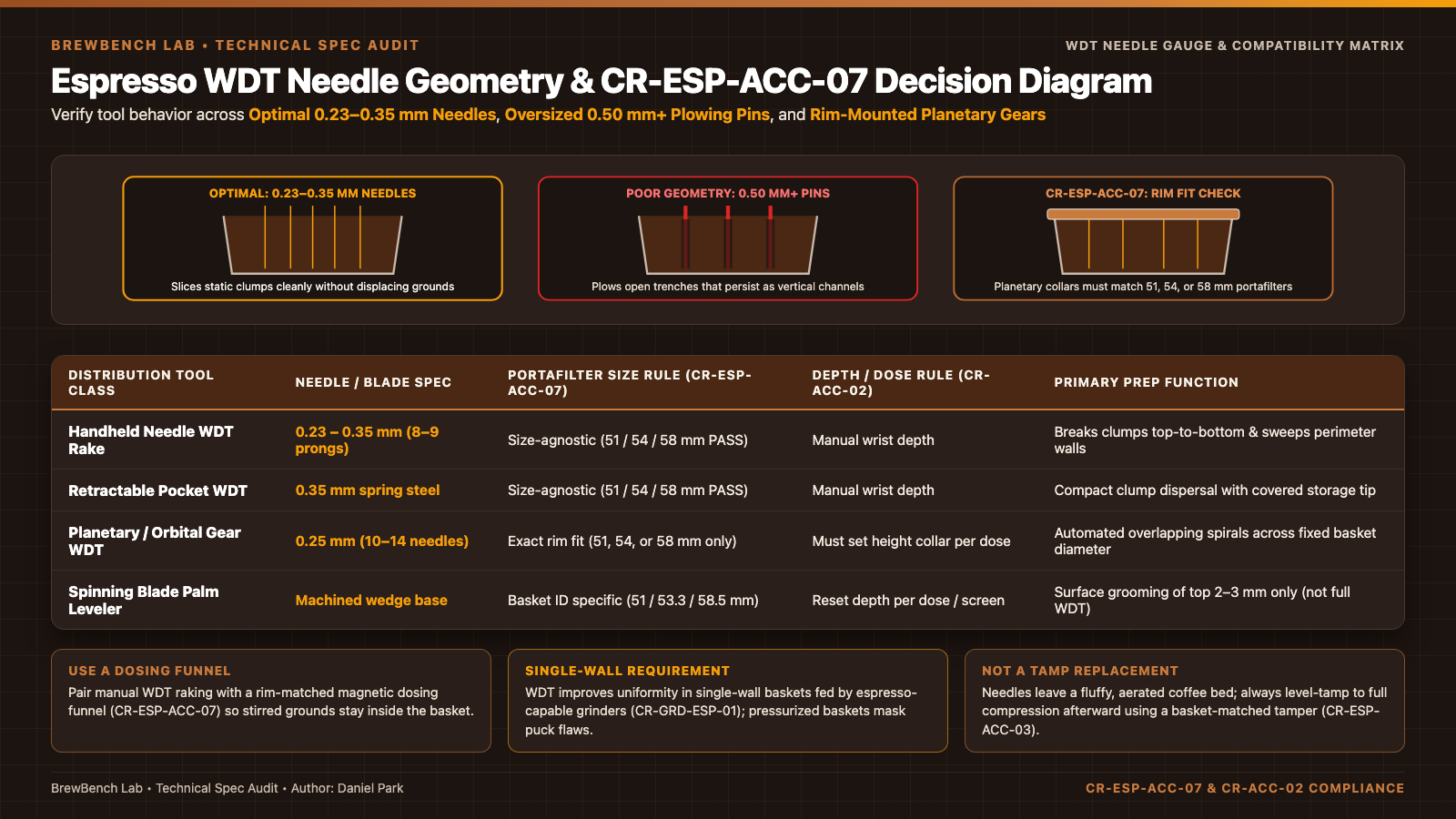
Early DIY distribution tools used straightened paperclips, sewing needles, or wooden toothpicks measuring 0.60 mm to 2.00 mm (0.024 to 0.079 in) thick. Inside ultra-fine espresso grounds, a wire wider than 0.50 mm acts like a tiny snowplow: instead of slicing cleanly through an agglomerate, it shoves coffee aside and leaves an open vertical trench in its wake. When you tamp over plowed trenches, those voids remain lower-density seams.
Modern dedicated WDT tools use flexible 304 stainless steel acupuncture needles ranging from 0.23 mm (0.009 in) to 0.40 mm (0.016 in), with 0.23 mm to 0.35 mm serving as the practical sweet spot. Needles in this gauge flex slightly around dense obstacles, shear clumps apart without dragging horizontal furrows, and let surrounding powder settle smoothly behind each pass.
2. Portafilter Fitment Under Rule CR-ESP-ACC-07
Under BrewBench Lab compatibility rule CR-ESP-ACC-07, distribution accessories split sharply into two fitment categories across 51 mm (2.01 in), 54 mm (2.13 in), and 58 mm (2.28 in) espresso machines:
- Handheld Needle WDT Rakes (Size-Agnostic PASS): Because a handheld wand is guided manually inside the cylinder, standard 8-prong to 9-prong needle rakes pass CR-ESP-ACC-07 by default across 51 mm De’Longhi Dedica/Stilosa baskets, 54 mm Breville/Sage baskets, and 58 mm commercial groups. You simply adjust your circular sweep radius to match the basket wall.
- Planetary / Orbital Gear WDT Tools & Dosing Funnels (Size-Specific HARD Check): Geared planetary distributors seat directly on the portafilter rim via magnetic collars or lipped rings, spinning multiple needles in overlapping epicycloidal paths. Under CR-ESP-ACC-07, a 58 mm planetary housing physically fails on a 54 mm Breville portafilter—and a 54 mm collar drops straight into a 58 mm basket. Always match rim diameter exactly to your machine’s nominal portafilter class.
3. Depth Calibration Under Rule CR-ACC-02 & Basket Prerequisites
Under rule CR-ACC-02, any distribution tool featuring a fixed depth stop—including geared planetary WDT rings and blade-style palm levelers—must be mechanically re-adjusted whenever you change coffee dose weight (for instance, switching from a 16 g dark roast to an 18 g or 20 g light roast), swap basket height, or change burr grind volume. If needles sit too high, bottom-layer clumps remain untouched; if set too low, tips scrape and bend against the perforated steel floor.
Finally, remember the basket prerequisite under CR-GRD-ESP-01 and CR-ESP-ACC-13: WDT delivers meaningful consistency benefits in single-wall (non-pressurized) baskets paired with an espresso-capable burr grinder. If you brew pre-ground coffee inside a factory pressurized (dual-wall) basket, extraction backpressure comes primarily from the restricted exit pinhole rather than uniform puck resistance alone.
Espresso Distribution Methods Compared
Use this matrix to compare handheld WDT rakes against retractable travel tools, geared planetary distributors, wedge surface levelers, and basic countertop tapping.
| Distribution Method | Contact / Wire Spec | Portafilter Rule (CR-ESP-ACC-07) | Depth Control (CR-ACC-02) | Practical Strengths & Limits |
|---|---|---|---|---|
| Handheld Multi-Needle WDT Rake | 8–9 prongs, 0.23–0.35 mm (0.009–0.014 in) stainless steel | Size-agnostic PASS (fits 51, 54, and 58 mm baskets) | Controlled by wrist height | Breaks both deep floor clumps and perimeter pockets; inexpensive; requires 10–15 seconds of manual technique. |
| Retractable Pocket WDT Stirrer | 6–8 prongs, 0.35 mm (0.014 in) spring steel | Size-agnostic PASS (fits 51, 54, and 58 mm baskets) | Controlled by wrist height | Protects exposed tips in drawers or travel kits; slightly narrower prong splay takes a few extra swirls in 58 mm baskets. |
| Planetary / Orbital Gear WDT | 10–14 prongs, 0.25 mm (0.010 in) needles on planetary gears | Size-specific HARD (separate 51, 54, or 58 mm collars) | Must dial collar height per dose & basket | Delivers repeatable overlapping spirals with minimal skill; higher budget tier ($60–$100) and size-locked to one portafilter class. |
| Spinning Blade / Wedge Palm Leveler | Machined stainless spiral or dual-wedge disc | Size-specific HARD/SOFT (51 / 53.3 / 58.5 mm basket ID) | Threaded collar or gravity-adaptive drop | Grooms only the top 2–3 mm surface flat; does not declump deeper grounds below the blade reach. |
| Side-Tapping / Vertical Counter Knock | Hand palm or counter mat impact | Size-agnostic | None | Settles heaped mounds quickly before tamping, but cannot shear electrostatic clumps and can pull compacted puck edges away from the basket wall. |
Step-by-Step WDT Workflow: Handheld Rake vs. Planetary Ring
Effective Weiss Distribution Technique relies on systematic coverage rather than aggressive stirring. Follow this six-step sequence to distribute grounds cleanly without spilling coffee over your counter:
- Weigh and Dose Into a Dry Basket: Measure your target bean or ground dose to 0.1 g accuracy matched to your basket’s rated capacity (within roughly ±1.0 g under CR-ESP-ACC-12). Make sure the basket interior is wiped dry so damp walls do not trap wet grounds during stirring.
- Seat a Rim-Matched Dosing Funnel (Manual WDT): When using a handheld needle rake, place a 51 mm, 54 mm, or 58 mm dosing funnel on top of the portafilter rim (CR-ESP-ACC-07). Fluffed espresso grounds expand well above the basket lip while raking; a magnetic funnel keeps every tenth of a gram inside the basket.
- Rake Deep Spirals Across the Floor First: Lower the needle tips nearly to the perforated bottom plate without scraping hard against the steel holes. Move the handle in tight, overlapping circular loops traveling around the outer perimeter and back through the center for roughly 8 to 12 seconds.
- Lift Gradually to Smooth the Top Bed: As you finish your deep circles, raise the needles slowly toward the upper surface while making two or three lighter, wider sweeps. This levels the coffee cone without leaving a hollow crater in the middle.
- Settle Gently—Skip Hard Side Taps: Lift the funnel straight up. If the bed looks slightly mounded, give at most one light vertical tap onto your tamping mat to collapse excess air, or use a gentle surface sweep. Avoid hard lateral slaps against the side of the portafilter, which can fracture the edge seal before tamping.
- Compress Evenly With a Basket-Sized Tamper: Because WDT leaves grounds fluffy and aerated, compression is mandatory. Follow immediately with a level tamp sized to your basket’s inner diameter under CR-ESP-ACC-03 (such as 51.0 mm, 53.3–53.35 mm for 54 mm Breville, or 58.0–58.5 mm for 58 mm baskets).
If you upgrade to an automated planetary gear WDT tool, replace steps 2 through 4 with rim calibration: per CR-ACC-02, adjust the depth collar until the needle tips hover roughly 1 to 2 mm (0.04 to 0.08 in) above the basket floor at your chosen dose, lock the magnetic housing squarely onto the portafilter rim, rotate smoothly two to three full turns (or trigger a one-press auto-rotation cycle), and lift straight upward before tamping.
Myth vs. Engineering Reality in Espresso Distribution
Myth vs. Engineering Reality: 4 Distribution Claims Audited
- Myth 1: “A WDT tool eliminates channeling and fixes sour or bitter shots by itself.”
Engineering Reality: WDT homogenizes dry grounds, but it cannot fix particle size inconsistency from a blade or filter-only grinder (CR-GRD-ESP-01), an under-dosed basket (CR-ESP-ACC-12), or an undersized tamper leaving a loose edge ring (CR-ESP-ACC-03). Think of WDT as removing preparation noise so your grind setting and brew ratio stay consistent. - Myth 2: “Any thin wire—like a paperclip, safety pin, or bamboo skewer—works identically.”
Engineering Reality: Stiff wires thicker than 0.50 mm (0.020 in) displace coffee horizontally and leave open trenches that survive tamping. Dedicated 0.23 mm to 0.35 mm acupuncture needles slip cleanly around grounds without carving channels. - Myth 3: “A spinning wedge palm distributor replaces needle WDT.”
Engineering Reality: Wedge-base levelers spin across only the top 2 to 3 mm (0.08 to 0.12 in) of the coffee bed, flattening the surface crust while leaving lower grinder clumps intact. They are optional surface groomers, not deep clump-breakers (CR-ACC-02). - Myth 4: “Every espresso machine needs WDT, even with pressurized baskets.”
Engineering Reality: Machines running pressurized (dual-wall) baskets with coarse pre-ground coffee build pressure at a single pinhole outlet rather than across puck density alone (CR-ESP-ACC-13). Save WDT for single-wall non-pressurized baskets paired with fresh burr-ground espresso.
Verified Amazon US WDT Tool Picks by Workflow
If you want to put the Weiss Distribution Technique onto your espresso bar without improvising fragile DIY corks, these four verified Amazon US options cover the core manual, retractable, 58 mm planetary, and 54 mm Breville planetary categories. For a broader nine-model ranking including budget kits and gravity surface levelers, see our dedicated best WDT tools and distributors roundup.
1. Normcore WDT Tool V2.1 with Stand (9-Prong 0.23 mm, Walnut) — Best Universal Manual Rake

Verified Specs: 9 prongs at 0.23 mm (0.009 in) stainless steel | American walnut handle + self-aligning magnetic stand | Includes 16 spare needles | Fits 51 mm, 54 mm, and 58 mm baskets (CR-ESP-ACC-07 PASS) | Budget Tier: Under $30
Per Normcore’s official tool specifications, the V2.1 Walnut edition upgrades from 8 prongs to 9 ultra-fine 0.23 mm acupuncture needles arranged in an asymmetric scatter pattern so successive loops do not retrace identical paths. Because it is handheld and uncollared, it passes CR-ESP-ACC-07 across every standard portafilter diameter—from 51 mm De’Longhi Dedica baskets up to 58 mm commercial groups—and docks securely in its weighted magnetic stand between shots.
Pros
- Ultra-thin 0.23 mm prongs slice clumps cleanly without plowing trenches
- Size-agnostic manual reach works across 51 mm, 54 mm, and 58 mm baskets
- Ships with 16 replacement needles and a self-centering magnetic stand under $30
Cons
- Requires a separate dosing funnel to prevent grounds from spilling over the basket rim
- Fine 0.23 mm needles bend easily if dropped or pressed forcefully against the basket floor
2. Subminimal Flick WDT Espresso Distribution Tool — Best Retractable Compact-Bar Pick

Verified Specs: Spring-retractable anodized aluminum shaft | 0.35 mm (0.014 in) replaceable stainless steel needles | Fits 51 mm, 54 mm, and 58 mm baskets (CR-ESP-ACC-07 PASS) | Budget Tier: Under $30
If exposed acupuncture pins on a crowded kitchen counter feel risky around pets or drawers, the Subminimal Flick encloses its 0.35 mm needles inside a machined aluminum barrel until deployed with a quick downward wrist flick. Slightly stiffer 0.35 mm needles handle dense, oily dark-roast clumps well while remaining universal across 51 mm, 54 mm, and 58 mm portafilters.
Pros
- Retractable barrel shields sharp needles cleanly between shots or in travel kits
- Universal geometry passes CR-ESP-ACC-07 for any 51–58 mm espresso basket
- Durable anodized aluminum housing in the Under $30 tier
Cons
- Narrower internal needle splay requires slightly more manual loops in wide 58 mm baskets
- Internal spring mechanism can collect fine coffee chaff if retracted before brushing needles clean
3. IKAPE 58MM One-Press Planetary WDT Tool — Best Automated 58 mm Distribution Pick

Verified Specs: 14 prongs at 0.25 mm (0.010 in) | One-press spring-return auto-rotation | Adjustable depth dial (CR-ACC-02) | 10-magnet 58 mm only portafilter collar (CR-ESP-ACC-07) | Budget Tier: $60–$100
Built exclusively for 58 mm portafilters (such as Gaggia Classic Evo Pro, Rancilio Silvia, and Breville Dual Boiler 58 mm baskets), the IKAPE 58MM One-Press WDT automates orbital needle coverage with two or three presses of the top cap. Fourteen 0.25 mm prongs trace overlapping planetary spirals across the full basket radius while an external dial adjusts needle drop height cleanly when switching between 18 g and 22 g baskets.
Pros
- 14 fine 0.25 mm needles deliver fast, repeatable spiral coverage across 58 mm beds
- Adjustable height dial satisfies CR-ACC-02 across varying basket depths and doses
- 10-magnet collar seats steadily on 58 mm rims without needing an extra dosing funnel
Cons
- Strictly 58 mm only—HARD incompatible with 54 mm Breville and 51 mm De’Longhi portafilters (CR-ESP-ACC-07)
- Higher $60–$100 price bracket and larger countertop footprint than handheld rakes
4. Normcore 54mm Planetary WDT Tool V3 — Best Automated 54 mm Breville / Sage Pick

Verified Specs: Geared planetary rotation | Anodized aluminum housing | Fine stainless steel needles | Sized exclusively for 54 mm Breville / Sage portafilters (CR-ESP-ACC-07) | Budget Tier: $60–$100
Owners of Breville 54 mm espresso machines—including the Bambino, Bambino Plus, Barista Express, and Barista Pro—cannot mount 58 mm planetary distributors on their narrower portafilter rims. The Normcore 54mm Planetary WDT Tool V3 matches the 54 mm rim diameter directly under rule CR-ESP-ACC-07, spinning fine needles in geared orbital paths for hands-off clump dispersal before you tamp with a 53.3 mm base.
Pros
- Sized specifically for 54 mm Breville and Sage portafilter rims without overhang
- Planetary gear train covers center and perimeter coffee consistently in a few twists
- CNC-machined anodized aluminum body feels solid and resists corrosion
Cons
- Size-locked to 54 mm portafilters; will not fit 51 mm De’Longhi or 58 mm machines if you upgrade later
- Costs substantially more ($60–$100 tier) than a universal handheld needle rake
How We Audited This Guide
- Portafilters, precision baskets, tampers, coffee scales, and water filters were audited for basket inner-diameter matching, drip-tray cup clearance, OEM cartridge locks, and 0.1g accuracy.
- Every espresso machine, burr grinder, accessory, and scale specification was cross-checked against official manufacturer 120V manuals, SCA water guidance, and verified Amazon US listings.
- Recommendations were evaluated against our weighted espresso-gear scoring rubrics and documented CR-* compatibility rules; we never invent heat-up seconds, PID variance, or micron claims.
Continue Your Audit
- Best Bottomless Portafilters for Breville 54 mm 2026: Fit Audited
- Best Espresso Tampers 2026: Sized to Your Basket, Compared
Frequently Asked Questions About WDT in Espresso
What does WDT stand for in espresso?
WDT stands for the Weiss Distribution Technique, named after coffee enthusiast John Weiss who introduced the method in 2005. It uses slender metal needles to stir ground coffee inside the portafilter basket before tamping, breaking electrostatic clumps and leveling bed density.
What needle thickness is best for a WDT tool?
Needles between 0.23 mm and 0.35 mm (0.009 to 0.014 in) work best for espresso distribution. Wires thicker than 0.50 mm—such as paperclips or toothpicks—push grounds sideways and carve open trenches that leave uneven low-density channels even after tamping.
Do handheld WDT tools fit 51 mm, 54 mm, and 58 mm portafilters?
Yes. Under BrewBench Lab rule CR-ESP-ACC-07, handheld needle WDT rakes are size-agnostic and fit 51 mm, 54 mm, and 58 mm baskets by default. However, rim-mounted planetary gear WDT tools and dosing funnels are size-specific and must match your exact portafilter diameter.
Do I still need to tamp after using a WDT tool?
Yes. WDT fluffing aerates the coffee bed and breaks clumps, leaving zero hydraulic resistance if left uncompressed. Always follow WDT with a firm, level tamp using a tamper matched to your filter basket’s inner diameter under compatibility rule CR-ESP-ACC-03.
Is WDT useful for pressurized (dual-wall) espresso baskets?
WDT offers minimal benefit in pressurized (dual-wall) baskets because shot resistance is generated mainly by the basket’s single restricted exit pinhole rather than uniform puck density. Needle distribution matters most when brewing fresh burr-ground coffee in single-wall non-pressurized baskets.
How is a planetary WDT tool different from a spinning palm leveler?
A planetary WDT tool drives fine needles through the full depth of the coffee bed in overlapping spirals to break hidden clumps. A spinning blade palm leveler only grooms the top 2 to 3 mm of grounds flat and cannot homogenize clumps deeper inside the basket.


