
Disclosure: As an Amazon Associate, I earn from qualifying purchases. If you buy through links on this page, we may earn a small commission at no extra cost to you.
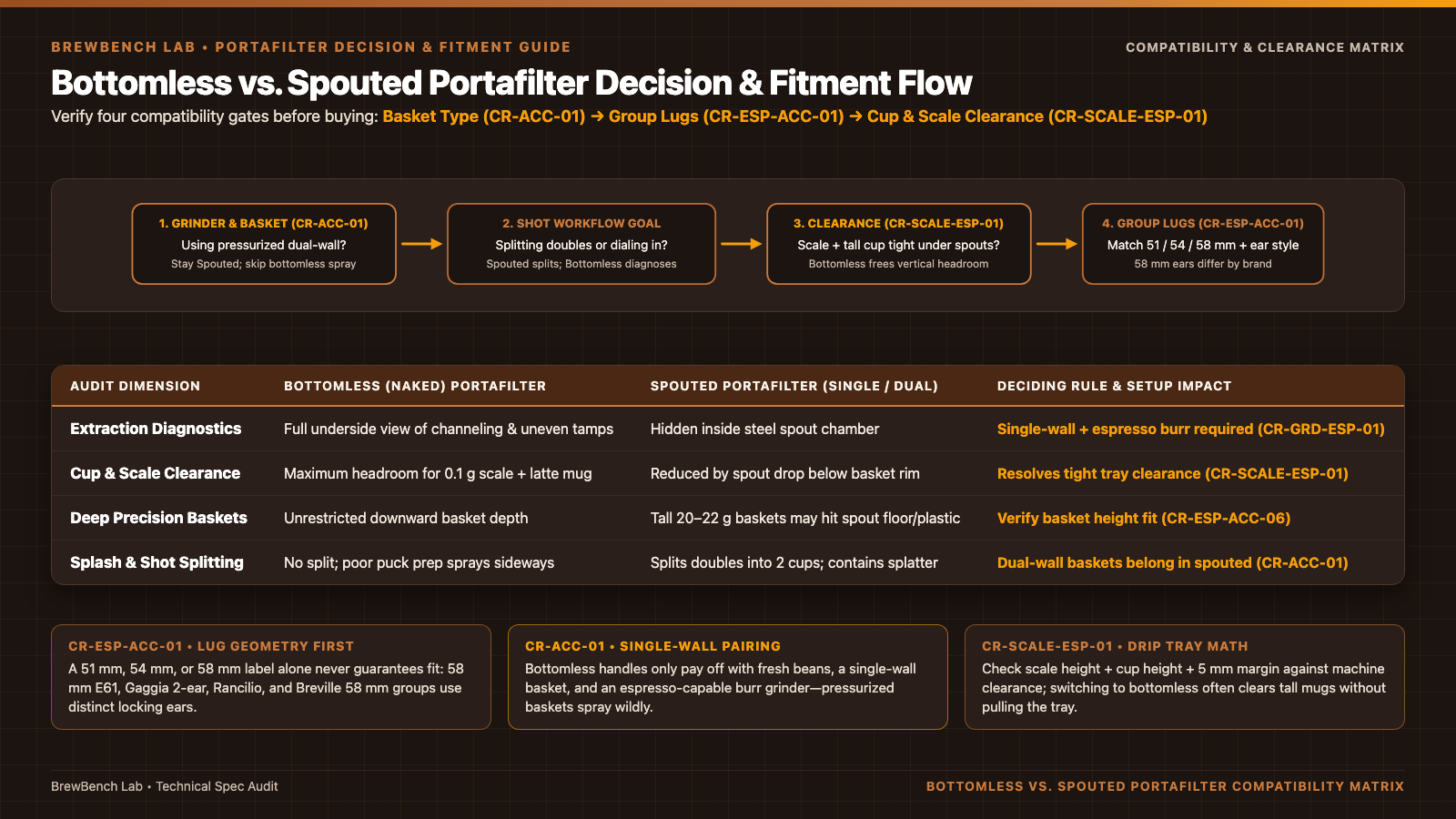
Debating a bottomless vs spouted portafilter comes down to what you value more at the espresso bar: live extraction diagnostics and extra cup clearance, or splash-free convenience and two-cup shot splitting. A bottomless (naked) portafilter removes the closed metal floor and spouts beneath the basket, exposing the entire filter underside so you can spot uneven tamping or channeling and fit taller mugs on top of a 0.1 g coffee scale. A spouted portafilter encloses the basket inside a single- or double-spout chamber, channeling espresso neatly into one or two cups while containing spray from pressurized baskets or rough puck prep.
Inside our best espresso accessories hub, upgrading to an aftermarket portafilter is one of the most popular first purchases for 120V/60Hz US home machines—from 51 mm De’Longhi Dedica and Stilosa units to 54 mm Breville Bambino/Barista models and 58 mm Gaggia or Rancilio platforms. However, buying the wrong style or assuming diameter alone guarantees fit quickly leads to kitchen splatter or a handle that will not lock into your group head. This technical comparison audits both architectures under BrewBench Lab compatibility gates CR-ACC-01, CR-ESP-ACC-01, and CR-SCALE-ESP-01.
In This Comparison
- Winner by Use Case: Quick Verdict Matrix
- Side-by-Side Spec & Compatibility Table
- Battleground 1: Extraction Diagnostics vs. The Channeling Myth
- Battleground 2: Cup & Scale Clearance + Tall Precision Baskets
- Battleground 3: 51 mm, 54 mm & 58 mm Lug Standards
- Battleground 4: Thermal Mass, Shot Splitting & Cleaning
- Choose Bottomless vs. Choose Spouted
- Verified Amazon US Portafilters Compared
- Frequently Asked Questions
Quick Verdict Matrix: Bottomless vs. Spouted by Use Case
A portafilter does not brew coffee by itself; it translates your grinder output, basket geometry, and machine clearance into workflow. Use the matrix below to match each portafilter style to how you actually make espresso each morning.
| Use Case & Kitchen Profile | Recommended Portafilter | Deciding Compatibility Rule | Practical Outcome |
|---|---|---|---|
| Best for Straight Espresso & Light Roasts | Bottomless (Naked) | CR-ACC-01 / CR-GRD-ESP-01 | Exposes channeling, blonding, and uneven flow across single-wall baskets during dial-in. |
| Best for Daily Milk Drinks & Tall Latte Mugs | Bottomless (Naked) | CR-SCALE-ESP-01 | Reclaims vertical clearance under the group head so a 0.1 g scale plus taller milk mug fit comfortably. |
| Best for Pre-Ground Coffee & Dual-Wall Baskets | Spouted (Single or Double) | CR-ACC-01 / CR-SYS-02 | Contains pressurized pinhole jets inside an enclosed chamber, preventing lateral kitchen splatter. |
| Best for Splitting Doubles & Fast Mornings | Double-Spouted | CR-ESP-ACC-01 | Divides one 18–20 g extraction evenly into two demitasse cups with zero spray anxiety. |
| Best Value & Ecosystem Cost | OEM Spouted (Baseline) or 3-in-1 Convertible | CR-SYS-01 / CR-ESP-ACC-02 | Keep your factory spouted handle until you own an espresso burr grinder, or choose a convertible 3-in-1 handle. |
| Best Compact Kitchen Footprint | Bottomless (Shorter Profile) | CR-SCALE-ESP-01 / CR-ESP-SYS-04 | Removes dangling spouts above low drip trays on compact 51 mm and 54 mm thermoblock machines. |
Side-by-Side Spec & Compatibility Table
Mechanically, bottomless, spouted, and convertible modular portafilters diverge across five engineering areas: basket compatibility, downward depth allowance, vertical cup clearance, thermal contact path, and cleaning access.
| Specification / Audit Dimension | Bottomless (Naked) Portafilter | Spouted Portafilter (Single / Double) | Modular 3-in-1 Convertible |
|---|---|---|---|
| Underside Architecture | Open CNC or cast ring; entire basket floor exposed | Closed steel/brass floor feeding 1 or 2 curved spouts | Threaded base ring accepts open insert, 1-spout, or 2-spout attachments |
| Basket Pairing Rule (CR-ACC-01) | Single-wall (non-pressurized) baskets only; poor fit with dual-wall | Compatible with both pressurized dual-wall and single-wall baskets | Matches basket mode by swapping the lower spout attachment |
| Grinder Requirement (CR-GRD-ESP-01) | Strictly requires espresso-capable stepless or fine micro-step burr grinder | Works with pressurized pre-ground or espresso burrs (basket dependent) | Requires espresso burrs in bottomless mode; forgiving in spouted mode |
| Cup & Scale Clearance (CR-SCALE-ESP-01) | Maximum vertical clearance; removes spout drop below basket base | Reduced clearance due to spout drop (often limits tall mugs on scales) | Variable—maximum clearance naked, reduced when spouts are threaded on |
| Tall Precision Basket Fit (CR-ESP-ACC-06) | Unrestricted downward depth for 20–22 g+ deep baskets | Tall baskets may hit internal spout floor or plastic flow insert | Unrestricted in naked mode; check internal clearance with spouts attached |
| Thermal Mass & Preheating | Minimal steel path; espresso drops straight into cup (exact °C delta: no verified data available yet) | Extra spout metal absorbs heat unless thoroughly preheated (exact °C delta: no verified data available yet) | Matches bottomless or spouted mass depending on attached base |
| Lug / Ear Standards (CR-ESP-ACC-01) | Group-specific: 51 mm, 54 mm Breville 3-ear, or specific 58 mm ear styles | Ships OEM-matched to machine; aftermarket units remain group-specific | Sold per group standard (e.g., 54 mm Breville 3-ear) |
| Cleaning & Oil Trap Risk | Very low—no internal chamber to trap stale coffee oils | Moderate to high—coffee oils coat inside hidden spout channels | Easy to disassemble threaded spouts for thorough brushing |
| Typical Budget Tier (TIER-ACC) | Under $30 to $60–$100 (TIER-ACC-BUDGET / PREMIUM) | Included OEM; $30–$60 aftermarket (TIER-ACC-BUDGET / PREMIUM) | $60–$100 (TIER-ACC-PREMIUM) |
Battleground 1: Extraction Diagnostics vs. The Channeling Myth
The primary reason home baristas buy a bottomless portafilter is visual feedback—yet it is also where the biggest misconception lives. Switching to a bottomless portafilter does not fix channeling, increase crema volume, or magically improve shot flavor on its own. Instead, a naked handle acts like a diagnostic mirror: because there is no metal floor or spout hiding the basket underside, you watch every square millimeter of the extraction in real time.
When your coffee dose, grind fineness, distribution, and tamping pressure are uniform, pressurized water at roughly 9 bar (distinct from the 15-bar or 20-bar maximum deadhead pump ratings printed on consumer boxes) wets the puck evenly. Drops bead simultaneously across all perforations, darken from cocoa to warm hazelnut, and coalesce smoothly into a single centered, syrupy cone. Conversely, if water finds a low-density crack along the basket rim or through an un-broken clump, a bottomless portafilter exposes it immediately as pale blonding streaks, off-center streams, or high-pressure pinhole spritzes. Once you spot those patterns, you can apply targeted puck-prep corrections outlined in our espresso channeling fix guide—such as Weiss Distribution Technique (WDT) needle stirring, consistent level tamping, or tightening your grind.
Crucially, this diagnostic advantage triggers two strict compatibility gates: CR-ACC-01 and CR-GRD-ESP-01. Under CR-ACC-01, a bottomless portafilter only makes sense with a non-pressurized single-wall basket and freshly ground coffee. If you drop a pressurized dual-wall basket—which forces all liquid through one tiny outer pinhole—into a bottomless handle, espresso blasts out in a high-velocity jet directly into open air, ricocheting off the cup rim and offering zero insight into puck resistance. Likewise, under CR-GRD-ESP-01 and CR-SYS-02, pairing a single-wall basket in a bottomless portafilter with a blade grinder, pre-ground supermarket coffee, or a filter-only burr mill produces instant, sour gushing across the counter. Keep your factory spouted portafilter until an espresso-capable burr grinder is sitting beside your machine.
Battleground 2: Cup & Scale Clearance + Tall Precision Baskets
Even if you never care about analyzing shot-pull aesthetics, physical geometry often decides the bottomless vs. spouted debate on compact countertops. Under compatibility gate CR-SCALE-ESP-01, a home setup passes full drip-tray fitment only when your scale height plus your cup height plus a 5 mm (0.20 in) pouring clearance margin stays below the machine’s spout clearance.
Consider a real-world US kitchen scenario using our published compatibility formula: compact 120V thermoblock machines often offer around 127 mm (about 5.0 in) of vertical space beneath a spouted portafilter (with exact factory clearances varying by model—always verify your specific machine manual). Pair a low-profile 0.1 g espresso scale standing 15–20 mm (0.59–0.79 in) tall with a classic 76 mm (3.0 in) ceramic espresso cup, and the required stack height is 96–101 mm (3.8–4.0 in), passing cleanly under spouts. Swap that small demitasse for a 127 mm (5.0 in) insulated travel mug or tall latte glass, however, and the stack climbs to 147–152 mm (5.8–6.0 in)—creating a CONDITIONAL clearance failure. Removing the spouts by switching to a bottomless portafilter immediately reclaims the vertical height occupied by the spout neck, letting you weigh extractions directly into taller drinkware without sliding out the drip tray.
A second hardware advantage involves basket depth under CR-ESP-ACC-06 and CR-ESP-ACC-02. Many aftermarket single-wall precision baskets rated for 18–22 g (0.63–0.78 oz) or 20–24 g doses are taller than factory double baskets. Inside OEM spouted portafilters—particularly 54 mm Breville and 51 mm De’Longhi handles that contain a molded internal plastic flow insert—tall 26–28 mm (1.02–1.10 in) precision baskets frequently hit the bottom floor before seating flush. Because a bottomless portafilter has no floor underneath the basket collar, any matching-diameter basket depth hangs freely with zero obstruction. Just check one caveat noted across community quality-control reports (confidence C): certain inexpensive spring-less bottomless handles rely strictly on friction and can let ridgeless baskets slip out when knocking pucks, so look for a machined internal retaining clip wire.
Battleground 3: 51 mm, 54 mm & 58 mm Lug Standards (CR-ESP-ACC-01)
Whether you choose bottomless or spouted, the hardest rule in aftermarket espresso hardware is CR-ESP-ACC-01: diameter alone never guarantees a portafilter will lock into your group head. Every espresso machine uses a specific locking-ear (lug) thickness, ear count, and rotational angle. For a deeper breakdown of millimeter tolerances and basket inner diameters, review our espresso portafilter sizes explained guide and our dedicated bottomless portafilter compatibility checklist.
- 51 mm Ecosystem (STD-PF-51): Dominant across De’Longhi Dedica (EC685, Arte EC885), De’Longhi Stilosa (EC260), La Specialista models, and compact entry machines under $200. Watch out: De’Longhi 51 mm machines use both 2-ear and 3-ear locking patterns depending on series. Under CR-ESP-ACC-01, a 3-ear Dedica handle will never enter a 2-ear bayonet collar.
- 54 mm Ecosystem (STD-PF-54): Standardized across Breville consumer machines—Bambino (BES450), Bambino Plus (BES500), Barista Express (BES870), Barista Express Impress (BES876), Barista Pro (BES878), and Barista Touch (BES880). These use a 3-ear locking pattern with thin tabs. Check out our audited picks in the best bottomless portafilters for Breville 54 mm guide before buying—note that certain aftermarket 54 mm handles explicitly exclude the Bambino Plus or specific tolerances, and Ninja Luxe Café also lists a 54 mm size per brand Q&A that should not be assumed interchangeable with Breville lugs without explicit maker confirmation.
- 58 mm Ecosystem (STD-PF-58): This is where shoppers make the costliest mistake. “58 mm” refers to the internal basket seat, not a universal group head. Gaggia Classic and Classic Pro (58 mm 2-ear angled lugs), Rancilio Silvia (58 mm 2-ear straight tabs), Breville Dual Boiler / Oracle Jet (58 mm Breville pattern), and commercial E61 group heads all require group-specific handles. A 58 mm E61 bottomless portafilter will not lock into a Gaggia Classic group, even though both take 58 mm precision baskets.
Remember BrewBench Lab’s listing-confidence rule (G-21): an Amazon product title claiming “compatible with 58 mm espresso machines” is confidence C until corroborated by the brand’s own model-fit specification chart (confidence A). Also note CR-GRD-ACC-01 if you grind directly into your portafilter: verify that your grinder’s hands-free fork supports your handle diameter and outer ear width, or use a dosing cup and matching dosing funnel (CR-ESP-ACC-07) to prevent grounds from spilling onto the counter.
Battleground 4: Thermal Mass, Shot Splitting & Daily Maintenance
Coffee temperature stability and daily cleanup habits separate the two portafilter designs in subtle but practical ways.
Thermal Path & Preheating Behavior
A heavy spouted portafilter places an extra floor and curved metal spouts directly in the path of hot espresso. If you leave a heavy spouted handle sitting cold on the counter and lock it in right before pulling a shot, that thick metal acts as a heat sink—absorbing warmth from the first few milliliters of coffee. Locking the spouted portafilter into the group head during warm-up (or flushing hot water through it before dosing) minimizes heat loss. By contrast, a bottomless portafilter exposes the basket underside directly to air, eliminating spout metal contact entirely so espresso flows straight from the perforations into your preheated cup. Note that under BrewBench Lab’s anti-fabrication standards, there is no verified data available yet quantifying an exact degree-Celsius shot-temperature delta across specific aftermarket bottomless vs. spouted handle weights under controlled US 120V conditions—treat thermal efficiency as a qualitative preheating workflow difference rather than a guaranteed flavor metric.
Shot Splitting & Counter Cleanliness
When making two single-shot macchiatos or splitting an 18–20 g double extraction across two espresso cups simultaneously, a double-spouted portafilter remains unmatched. You set two pre-warmed cups side by side, engage the pump, and divide the yield cleanly without pouring between vessels or losing crema surface tension. Spouted handles also make busy mornings far less stressful: if a newly opened bag of beans pulls slightly unevenly or someone tamps off-level, the enclosed spout floor contains lateral jets that would otherwise mist your backsplash with coffee droplets from a naked basket.
Cleaning Access & Backflushing Safety (CR-ESP-ACC-11)
From a hygiene standpoint, bottomless portafilters are dramatically easier to keep odor-free. Because espresso never passes through hidden metal tubes, a quick wipe and hot water rinse clear every trace of residue—you can inspect the entire basket floor visually in half a second. Spouted portafilters gradually build dark, sticky coffee oil varnish inside the inner bowl and spout elbows, especially if you brew medium-dark roasts. Periodically soaking the stainless steel head (never wooden walnut or rosewood handles, and never aluminum alloys in harsh espresso detergents) keeps stale oils out of fresh shots.
Follow two essential maintenance boundaries from your machine manual (CR-ESP-ACC-11 and G-17): first, only backflush using a solid blind basket and detergent if your machine explicitly includes a three-way solenoid valve (such as the Gaggia Classic Pro or Rancilio Silvia) or a brand-approved cleaning-disc cycle (such as Breville 54 mm thermoblocks). Never trap pressurized water inside a machine without a pressure-relief valve. Second, never put wood-handled portafilters in a dishwasher, and always descale your machine exclusively with the manufacturer-approved solution and schedule rather than improvised acid mixtures.
Head-to-Head Summary: Bottomless vs. Spouted Portafilter
Choose a Bottomless (Naked) Portafilter If…
- You grind fresh beans with an espresso-capable burr grinder and brew in single-wall baskets (CR-GRD-ESP-01, CR-ACC-01).
- You want instant visual feedback to diagnose channeling, uneven tamping, or grind adjustments.
- You need maximum vertical clearance for a 0.1 g espresso scale plus taller latte mugs (CR-SCALE-ESP-01).
- You use deep 20–22 g precision baskets that hit the floor of OEM spouted handles (CR-ESP-ACC-06).
Choose a Spouted Portafilter If…
- You rely on pre-ground coffee, coarse grinders, or pressurized dual-wall baskets (CR-ACC-01, CR-SYS-02).
- You regularly split double shots cleanly into two separate espresso cups at once.
- You want splash-proof morning workflows where minor puck-prep flaws never spray across your kitchen wall.
- Your cups and 0.1 g scale already clear the factory spouts without removing the drip tray.
Verified Amazon US Bottomless, Spouted & Convertible Portafilters Compared
Ready to upgrade or replace your handle? Below are four verified Amazon US portafilters spanning bottomless, dedicated double-spouted, and modular 3-in-1 convertible designs across 54 mm Breville and 58 mm Gaggia platforms—each audited against lug geometry (CR-ESP-ACC-01), basket compatibility, and material maintenance rules.
1. Normcore 54mm 3-in-1 Portafilter (Fits Breville) — Best Versatile Convertible Pick

Quick Specs: 54 mm Breville 3-ear group (STD-PF-54) | Modular 3-in-1 (bottomless, single-spout, double-spout) | Stainless steel head | Compatible with Breville / Sage 54 mm machines | Price Tier: Mid-range ($60–$100)
Best For: Breville 54 mm owners who cannot decide between bottomless diagnostics and spouted convenience—allowing you to pull naked shots during weekend dial-in and thread on single or double spouts for fast weekday pulls or dual-cup splits.
Skip If: You own a 51 mm De’Longhi or 58 mm group machine (CR-ESP-ACC-01), or you already prefer a dedicated lightweight naked handle and have zero use for spouts.
Pros
- Converts cleanly between bottomless, single-spout, and double-spout setups using one 54 mm stainless steel collar
- Removable lower spout attachments let you scrub inside the discharge path easily without baked-on oil buildup
- Supports both single-wall diagnostics (naked mode) and dual-wall / 2-cup splits (spouted mode) under CR-ACC-01
Cons
- Sits in the $60–$100 TIER-ACC-PREMIUM bracket, costing more than a basic single-mode aftermarket handle
- Threaded spout attachments add extra parts to clean and align if you swap configurations daily
Audit Note: Under CR-ESP-ACC-01, verify your Breville 54 mm model is explicitly listed on Normcore’s fit chart, and size your tamper (53.3 mm typical) to the inner diameter of whichever 54 mm basket you drop in (CR-ESP-ACC-03).
2. Breville BEA204WLW 54mm Naked Portafilter (Walnut) — Best OEM 54 mm Bottomless Reference

Quick Specs: 54 mm Breville OEM 3-ear group (STD-GROUP-BREVILLE-54) | Bottomless (naked) | Stainless steel head / Walnut handle | Fits Breville BES450, BES500, BES870, BES876, BES878, BES880, BES881 | Price Tier: Mid-range ($60–$100)
Best For: Breville Bambino, Bambino Plus, Barista Express, Barista Pro, and Barista Touch owners who want guaranteed confidence-A factory ear geometry, tight group gasket seal, and clear espresso diagnostics.
Skip If: You brew with pressurized dual-wall baskets and pre-ground coffee (CR-ACC-01), or want a synthetic handle you can toss into detergent soaks without caring for natural wood.
Pros
- Genuine Breville OEM 3-ear machining guarantees exact group-head lockup across BES450–BES881 series (CR-ESP-ACC-01)
- Open collar frees vertical cup and scale clearance under compact Bambino and Barista series groups (CR-SCALE-ESP-01)
- Accommodates deeper 54 mm aftermarket precision baskets without internal spout-floor interference (CR-ESP-ACC-06)
Cons
- Natural walnut handle cannot be submerged in detergent soaks or placed in a dishwasher without risking wood swelling
- Strictly single-stream bottomless output—cannot split a double shot into two cups and requires an espresso burr grinder (CR-GRD-ESP-01)
Audit Note: Unlike third-party Amazon handles whose compatibility claims remain confidence C, Breville publishes the exact BES450–BES881 model list on its official accessory spec (confidence A), eliminating group-gasket fit guesswork.
3. Normcore 54mm Double Spout Portafilter (18g Basket Included) — Best Dedicated 54 mm Spouted Upgrade

Quick Specs: 54 mm Breville 3-ear group (STD-PF-54) | Double-spout portafilter | 304 stainless steel head / Anodized aluminum handle | Includes 18 g basket | Fits 54 mm Breville / Sage machines | Price Tier: Value ($30–$60)
Best For: Breville 54 mm owners replacing a worn factory handle or upgrading away from OEM plastic internal spout inserts to a solid stainless steel double-spout path with durable anodized aluminum ergonomics.
Skip If: You want visual channeling diagnostics or maximum drip-tray headroom for tall travel mugs on a scale (CR-SCALE-ESP-01).
Pros
- Solid 304 stainless steel head eliminates the plastic flow inserts found inside stock consumer spouted portafilters
- Twin spouts cleanly split double extractions into two cups while containing splash from pressurized or coarse pulls
- Includes an 18 g starter basket (CR-ESP-ACC-02) and moisture-tolerant anodized aluminum handle
Cons
- Dual spouts reduce vertical clearance above the drip tray compared with a bottomless handle (CR-SCALE-ESP-01)
- Closed bottom hides channeling visually and requires periodic brushing/rinsing inside the spout passages
Audit Note: Always preheat a full-steel spouted head on the group before dosing, and verify your 54 mm machine model appears on Normcore’s supported fitment sheet (CR-ESP-ACC-01).
4. 58mm Double Spout Walnut Portafilter (Fits Gaggia Classic & Pro) — Best 58 mm Gaggia Spouted Pick

Quick Specs: 58 mm Gaggia 2-ear group (STD-GROUP-GAGGIA-58) | Double-spout portafilter | 304 stainless steel head / Walnut handle | Includes 18–20 g basket | Listed for Gaggia Classic & Classic Pro (confidence C retailer listing) | Price Tier: Value ($30–$60)
Best For: Gaggia Classic and Classic Evo Pro owners seeking a 304 stainless steel double-spout spare or walnut aesthetic upgrade that locks cleanly into Gaggia’s unique 58 mm 2-ear bayonet collar.
Skip If: You own an E61, Rancilio, or Breville 58 mm machine—Gaggia’s angled 2-ear lugs will not lock into other 58 mm group heads (CR-ESP-ACC-01).
Pros
- Machined specifically for Gaggia Classic / Classic Pro 58 mm 2-ear group geometry rather than generic E61 ears
- Includes an 18–20 g 58 mm basket (CR-ESP-ACC-02) and splits double shots neatly into two espresso cups
- 304 stainless steel head resists corrosion better than plated brass spouts over years of daily use
Cons
- Walnut handle requires hand wiping only—keep wood away from detergent backflush soaks and dishwashers
- Incompatible with E61, Rancilio, or Breville 58 mm groups, and tightens Gaggia’s already compact tray clearance under CR-SCALE-ESP-01
Audit Note: As a generic third-party Amazon listing (confidence C), verify ear thickness against your Gaggia Classic group gasket on first lockup—if the handle stops short or rotates past 6 o’clock, inspect gasket wear or basket rim height (CR-ESP-ACC-06).
How We Audited This Guide
- Portafilters, precision baskets, tampers, coffee scales, and water filters were audited for basket inner-diameter matching, drip-tray cup clearance, OEM cartridge locks, and 0.1g accuracy.
- Every espresso machine, burr grinder, accessory, and scale specification was cross-checked against official manufacturer 120V manuals, SCA water guidance, and verified Amazon US listings.
- Recommendations were evaluated against our weighted espresso-gear scoring rubrics and documented CR-* compatibility rules; we never invent heat-up seconds, PID variance, or micron claims.
Frequently Asked Questions: Bottomless vs. Spouted Portafilters
Does a bottomless portafilter make espresso taste better than a spouted portafilter?
Not directly—a bottomless portafilter cannot fix grind clumping or uneven tamping by itself. Its flavor benefit is indirect: exposing the basket floor shows channeling immediately so you can adjust grind size, distribution, and tamping to pull sweeter, more balanced single-wall extractions.
Why does my bottomless portafilter spray espresso everywhere?
Sideways spritzing usually happens for two reasons: using a pressurized dual-wall basket inside a bottomless handle (violating CR-ACC-01), or pulling a single-wall basket with coarse, unevenly distributed, or clumped grounds that channel under ~9 bar pressure. Switch to fresh beans, an espresso burr grinder, and WDT prep.
Can I put a pressurized dual-wall basket in a bottomless portafilter?
Under rule CR-ACC-01, avoid pairing pressurized baskets with bottomless portafilters. Because a dual-wall basket forces coffee through one tiny exit pinhole, a naked handle fires a high-velocity jet directly into open air, splashing your counter without revealing any useful puck-prep diagnostics.
How much cup clearance do you gain with a bottomless portafilter?
Removing the lower spout assembly eliminates the vertical drop hanging below your basket rim, which routinely frees enough room under CR-SCALE-ESP-01 to slide a low-profile 0.1 g espresso scale beneath taller latte mugs without removing your machine’s drip tray.
Are all 58 mm bottomless or spouted portafilters interchangeable?
No—under CR-ESP-ACC-01, 58 mm describes the basket seat diameter, not the group-head locking ears. E61 groups, Gaggia Classic 2-ear heads, Rancilio Silvia, and Breville 58 mm machines use different ear thicknesses and angles, so always match the exact machine list.
Should a beginner start with a spouted or bottomless portafilter?
Start with your machine’s included spouted portafilter while learning basic dose, yield, and milk steaming—especially if you still use pressurized baskets. Add a bottomless portafilter once you own an espresso-capable burr grinder and want to refine single-wall puck prep or fit taller mugs on a scale.
Authoritative Technical References
- Breville USA Official 54 mm Naked Portafilter (BEA204WLW) Documentation — Verified OEM 54 mm compatibility list (BES450, BES500, BES870, BES876, BES878, BES880, BES881) and care notes.
- Gaggia Official Classic Series Specifications & Support — Confirmed 58 mm group standard, three-way solenoid backflush capability, and US 120V configuration context.
- De’Longhi US Official Dedica & Stilosa Product Documentation — Verified 51 mm portafilter sizing, model-specific lug differences, and manufacturer cleaning guidance.
- Specialty Coffee Association (SCA) Brewing & Extraction Standards — Reference principles on ~9 bar espresso extraction uniformity, grind particle distribution, and brew ratios.


