
Disclosure: As an Amazon Associate, I earn from qualifying purchases. If you buy through links on this page, we may earn a small commission at no extra cost to you.
Direct Answer — Ideal Water Hardness for an Espresso Machine: Target total hardness of ~68 mg/L (ppm) as CaCO3 (~4.0 gpg) within the Specialty Coffee Association window of 17–85 mg/L (1.0–5.0 gpg), paired with ~40 mg/L (~2.3 gpg) alkalinity and 75–250 mg/L TDS. Above your maker’s limit, calcium scale clogs thermoblocks and valves; near 0 ppm TDS, conductive boiler probes fail to detect water.
Dialing in a home espresso bar goes far beyond grind size and tamp pressure. Roughly 98 percent of an espresso shot—and every milliliter cycling through your pump, three-way solenoid valve, and boiler—is water. Choosing the right water hardness for espresso machine reservoirs protects narrow internal passages from chalky limescale, prevents false low-water lockouts on conductive boiler probes, and preserves bright roast character in the cup without triggering corrosion.
Inside our best water for espresso machines pillar hub, we evaluate filtration cartridges, remineralization packets, and diagnostic kits strictly for appliance longevity and flavor balance—never drinking-water health claims. Below, you will find exact gpg, ppm, and °dH conversion formulas, why a handheld TDS meter cannot measure scale risk on its own, how manufacturer warranty terms override generic targets, and four verified Amazon US measurement and treatment kits.
In This Guide
- Converting gpg, ppm (mg/L CaCO3), and Degrees Hardness
- Total Hardness (GH) vs. Alkalinity (KH) vs. TDS
- SCA Targets vs. Machine Manufacturer Limits & Warranties
- Espresso Water Hardness Decision Matrix
- How to Measure Your Tap Water in 5 Minutes
- Myth vs. Engineering Reality: Scale, Softeners & Distilled Water
- 4 Verified Water Diagnostics & Treatment Kits
- Frequently Asked Questions
Converting gpg, ppm (mg/L CaCO3), and Degrees Hardness
Water quality reports, espresso manuals, and filter cartridges rarely speak the same unit language. US municipal utilities and home softener companies typically publish hardness in grains per US gallon (gpg) or parts per million (ppm), European machine brands often print German degrees (°dH) or French degrees (°fH), and scientific standards like the Specialty Coffee Association (SCA) water standards express mineral targets in milligrams per liter (mg/L) as calcium carbonate (CaCO3).
In practical espresso water chemistry, 1 ppm equals 1 mg/L. Every other hardness unit converts cleanly to mg/L as CaCO3 using fixed multiplication factors:
- Grains per US Gallon (gpg):
1 gpg = 17.1 mg/L (ppm) as CaCO3. Multiply your gpg number by 17.1 to get ppm (for example,4.0 gpg × 17.1 = 68.4 mg/L;5.0 gpg × 17.1 = 85.5 mg/L;10 gpg × 17.1 = 171 mg/L). - German Degrees (°dH):
1 °dH = 17.8 mg/L (ppm) as CaCO3. Multiply °dH by 17.8 (for example,4 °dH × 17.8 = 71.2 mg/L). - French Degrees (°fH):
1 °fH = 10.0 mg/L (ppm) as CaCO3. Multiply °fH by 10 (for example,7 °fH × 10.0 = 70 mg/L). - Milligrams per Liter (mg/L) to gpg: Divide mg/L (or ppm) by
17.1to find grains per gallon (for example,120 mg/L ÷ 17.1 = 7.0 gpg).
Always verify whether a municipality’s water report lists calcium and magnesium individually in elemental mg/L or already converted to “mg/L as CaCO3.” Elemental calcium and magnesium must be converted to CaCO3 equivalents before adding them together, whereas municipal hardness totals labeled “as CaCO3” map directly 1:1 to ppm hardness strips.
Total Hardness (GH) vs. Alkalinity (KH) vs. TDS: Why One Meter Is Not Enough
Home baristas frequently confuse three distinct measurements when troubleshooting slow water flow or muted espresso shots: Total Hardness (GH), Carbonate Hardness / Total Alkalinity (KH), and Total Dissolved Solids (TDS). Understanding how each variable behaves inside a heated espresso circuit prevents costly misdiagnoses.
1. Total Hardness (GH): Calcium and Magnesium Load
General Hardness (GH) measures the combined concentration of divalent calcium (Ca2+) and magnesium (Mg2+) ions dissolved in water. Inside a cold reservoir, those ions sit invisibly in solution. Once pumped into a 93 °C (199 °F) brew heater or a 125–135 °C (257–275 °F) steam boiler, dissolved calcium reacts with carbonate ions to precipitate solid calcium carbonate (limescale) onto heating elements, temperature probes, dispersion screens, and narrow 3-way solenoid orifices. Magnesium contributes slightly to extraction sweetness and clarity while resisting hard carbonate precipitation far better than calcium—which is why magnesium-exchange cartridges like BWT Water+More swap scale-forming calcium ions for magnesium ions.
2. Total Alkalinity / Carbonate Hardness (KH): The Scale & Flavor Buffer
Alkalinity (KH) measures bicarbonate and carbonate buffering capacity as mg/L CaCO3. Under rule CR-DRINK-WTR-01, alkalinity shapes both machine scaling and cup flavor. Chemically, calcium alone does not build hard carbonate scale without carbonate/bicarbonate ions present; water with high GH and high KH lays down dense white crust rapidly. In the cup, elevated alkalinity neutralizes natural coffee organic acids, flattening crisp fruit notes in light and medium-light roasts into a dull, chalky finish. Conversely, near-zero alkalinity leaves shots sharply sour and lowers pH buffering inside metal boilers.
3. Total Dissolved Solids (TDS): Conductivity Without Chemistry
A pocket TDS pen does not measure calcium or bicarbonate directly—it measures electrical conductivity across two metal prongs and applies a mathematical multiplier to estimate total dissolved ions in ppm. That creates a major blind spot: a home equipped with a salt-based ion-exchange water softener strips out calcium and magnesium (dropping GH near 0 gpg) and replaces them with sodium ions, leaving TDS at 250–400 ppm. Meanwhile, water with 130 ppm TDS from calcium bicarbonate builds heavy boiler scale even though its TDS reading looks completely normal inside the 75–250 mg/L SCA window. Use TDS meters to verify reverse osmosis (RO) membranes or remineralized recipe batches—never as a substitute for GH and KH measurement.
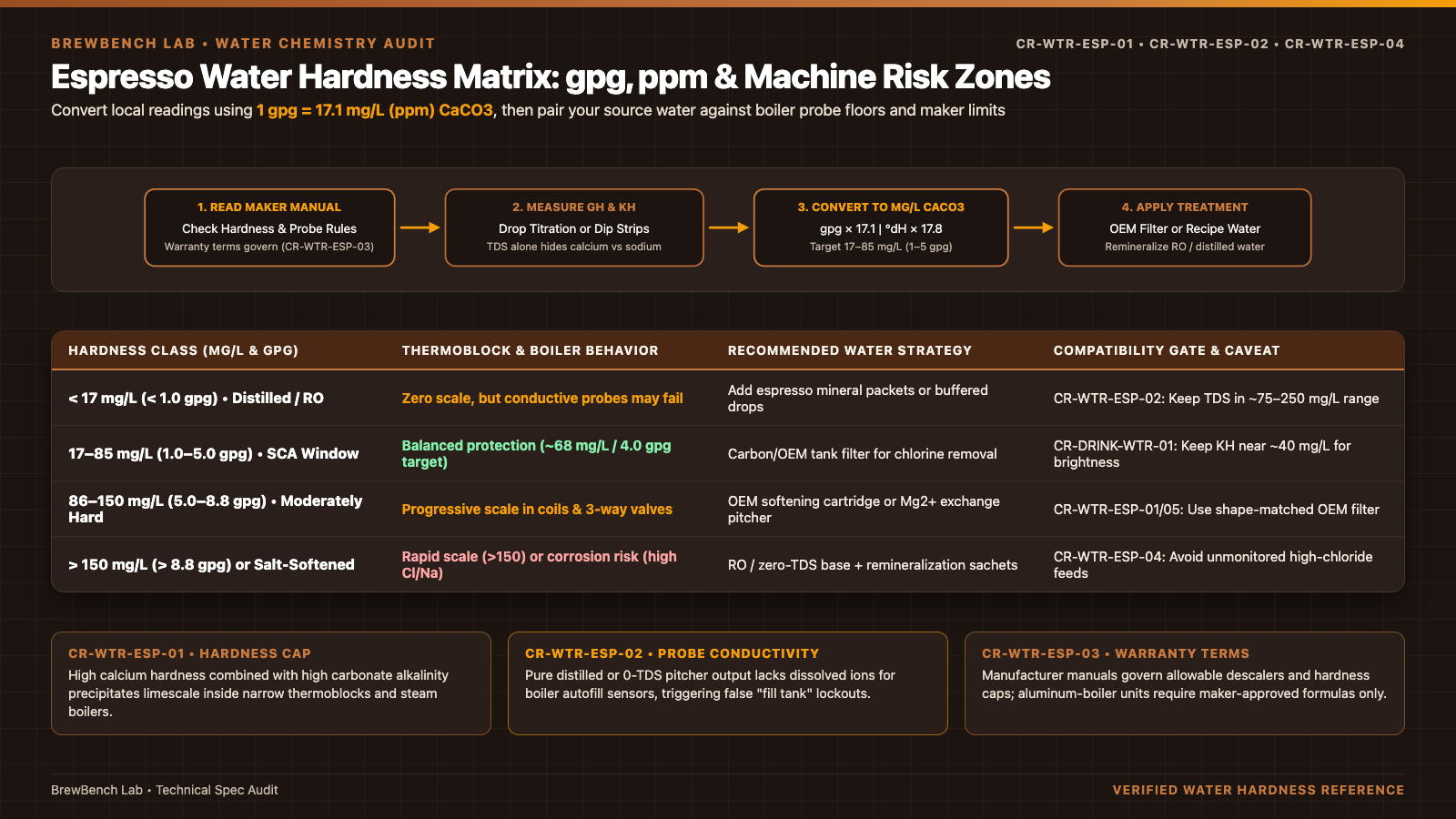
SCA Targets vs. Machine Manufacturer Limits & Warranty Rules
The Specialty Coffee Association (SCA) publishes widely referenced baseline water targets for brewing equipment and sensory balance:
- Total Hardness (as CaCO3): ~68 mg/L (4.0 gpg) target, with an acceptable operating range of 17–85 mg/L (1.0–5.0 gpg).
- Total Alkalinity (as CaCO3): ~40 mg/L (~2.3 gpg) target to balance acidity without fueling heavy carbonate scale.
- Total Dissolved Solids (TDS): ~150 mg/L target, within an acceptable window of 75–250 mg/L.
- Free Chlorine & Chloramines: 0 mg/L (carbon filtration removes chlorine off-flavors and protects seals).
- Sodium & Chloride: ~10 mg/L sodium target and low chloride concentration to avoid pitting or crevice corrosion on stainless steel and brass fittings (
CR-WTR-ESP-04).
However, under compatibility rule CR-WTR-ESP-03, your espresso machine manufacturer’s manual and US warranty terms always override generic industry targets. Heating architectures respond differently to mineral load:
- Thermoblocks & Thermojet Coils: Compact machines from Breville US (Bambino, Barista Express, Barista Pro) and De’Longhi US (Dedica Arte, Stilosa, Magnifica) flash-heat water through narrow metallic channels. Because small-bore passages restrict quickly when scale forms, these machines ship with hardness indicator strips, programmable hardness menus, and shape-locked OEM reservoir cartridges (such as Breville ClaroSwiss-style filters and De’Longhi DLSC cartridges under
CR-WTR-ESP-05). Even though vibratory pumps carry “15-bar” or “20-bar” maximum dead-head ratings on retail cartons—while brewing near ~9 bar at the puck—scale buildup narrows internal check valves and flowmeters long before the pump wears out. - Single-Boiler Machines (Including Aluminum Boilers): Entry single boilers differ sharply by boiler metallurgy. Aluminum boilers require strict adherence to manufacturer-approved descaling fluids because unapproved household acids can pit raw aluminum surfaces (
CR-WTR-ESP-06). Stainless-steel and brass boilers tolerate standard proprietary descalers specified in their manuals, yet still depend on pre-softened input water to protect 3-way solenoid valves. - Heat-Exchanger (HX) & Dual-Boiler Machines: Prosumer boilers frequently use conductive stainless autofill level probes inside the steam boiler and reservoir. Under
CR-WTR-ESP-02, water below the maker’s minimum mineral conductivity—such as pure distilled water or 0-TDS pitcher output—cannot complete the tiny electrical circuit to the probe, causing persistent “fill water” errors or preventing boiler refills. Many dual-boiler and HX manuals also warn owners not to run home descaling cycles through sealed steam boilers, directing service-center descaling instead if scale builds up. - Super-Automatic Espresso Machines: Automated bean-to-cup platforms from De’Longhi, Jura, and Philips/Saeco tie descaling lockout counters directly to user-entered tap hardness and proprietary RFID or chip-recognized tank cartridges (
CR-WTR-ESP-05). Skipping OEM filters or ignoring hardness calibration often triggers warranty exclusions for scale-clogged thermoblocks (CR-WTR-ESP-03).
Espresso Water Hardness Decision Matrix
Once you know your local total hardness (GH) and alkalinity (KH) in mg/L CaCO3 or grains per gallon, use the matrix below to match your water chemistry to the safest treatment strategy and compatibility rules.
| Hardness Class (mg/L & gpg) | Technical Machine & Boiler Impact | Recommended Treatment Path | Critical Compatibility Caveat (CR-*) |
|---|---|---|---|
| Ultra-Soft / Pure (< 17 mg/L | < 1.0 gpg) Distilled, RO, or 0-TDS pitcher | Virtually zero calcium scale, but insufficient conductivity for electronic autofill probes; under-buffered shots taste sharp. | Remineralize with espresso-specific mineral packets or buffered mineral drops to reach ~50–85 mg/L GH and ~30–40 mg/L KH. | CR-WTR-ESP-02: Never run un-remineralized 0-TDS water in conductive-probe boiler machines; verify minimum TDS in your manual. |
| Soft-Ideal (17–50 mg/L | 1.0–3.0 gpg) | Minimal scale accumulation across thermoblocks and brass boilers; preserves crisp roast clarity. | Run a basic activated-carbon filter (or OEM reservoir filter) strictly to strip chlorine and off-odors without over-softening. | CR-WTR-ESP-06: Still track cumulative shot volume and follow the maker’s baseline maintenance schedule. |
| Moderate Target Ceiling (51–85 mg/L | 3.0–5.0 gpg) | Sits at the upper edge of the SCA window; slow gradual scaling occurs in high-temperature steam boilers over months. | Install your machine’s shape-locked OEM tank cartridge or a magnesium-exchange pitcher (e.g., BWT) to hold GH near ~50–68 mg/L. | CR-WTR-ESP-05: OEM reservoir filters are brand-specific; generic “universal” cartridges often bypass or fail to seat. |
| Moderately Hard (86–150 mg/L | 5.0–8.8 gpg) | Exceeds SCA ceiling; accelerates limescale inside 3-way solenoid valves, flowmeters, and thermoblock coils. | Use an ion-exchange magnesium pitcher, dedicated softening pouch/pad (BWT Bestsave), or blended RO + remineralization recipe. | CR-WTR-ESP-01 / CR-SYS-04: Factor recurring cartridge replacement intervals into annual ownership cost; replace on schedule. |
| Hard / Very Hard (> 150 mg/L | > 8.8 gpg) | Severe scale risk; standard activated-carbon pitchers (Brita-class) cannot reduce hardness enough to protect heaters. | Switch to reverse osmosis (RO) or distilled water paired with measured remineralization sachets, or a plumbed multi-stage system (e.g., BWT Bestmax) if supported. | CR-WTR-ESP-07: Plumbed inline filtration requires line pressure within maker specs and installation by a qualified plumber. |
| Salt-Softened / High-Chloride Tap | Low calcium scale, but elevated sodium and chloride ions risk metal corrosion and salty off-notes. | Verify chloride concentration on your utility report; bypass the salt softener onto a remineralized RO tap or use bottled spring water within maker specs. | CR-WTR-ESP-04: Softer does not equal safer—high-chloride water corrodes stainless and brass boilers over time. |
How to Measure Your Tap Water in 5 Minutes
Guessing your water hardness from neighborhood hearsay leads to either premature scale buildup or unnecessary cartridge expenses. Follow this four-step diagnostic sequence using cold tap water before setting up a new machine or calibrating a descaling reminder:
- Pull Your Municipal Water Report: In the US, look up your local utility’s annual Consumer Confidence Report via the US EPA Consumer Confidence Report portal or your city water department website. Note annual averages and seasonal swings for Total Hardness (as CaCO3), Alkalinity, Chloride, and Sulfate.
- Check Point-of-Use Cold Tap Water Directly: Municipal reports reflect water leaving the treatment plant—not water passing through building pipes, under-sink carbon blocks, or whole-house softeners. Run your kitchen cold tap for 30 seconds, collect a clean glass sample, and measure both Total Hardness (GH) and Total Alkalinity (KH) using liquid drop-count titration (most accurate) or multi-parameter dip strips.
- Verify Output After Filtration: Never measure only raw tap water and assume your filter cartridge is still working six months later. Measure filtered pitcher or inline outlet water monthly to catch ion-exchange resin exhaustion before scale starts forming inside the machine (
CR-SYS-04). - Calibrate Your Machine & Descaling Cadence: Enter your verified hardness tier into your machine’s menu (if equipped) and consult our step-by-step espresso machine descaling guide for manufacturer-first cleaning intervals—never skipping OEM instructions.
Myth vs. Engineering Reality: Espresso Water Traps
Myth #1: “Pure 0-TDS distilled water or ZeroWater pitcher output is the safest choice for any espresso machine.”
Engineering Reality: Under compatibility rule CR-WTR-ESP-02, boiler and heat-exchanger machines equipped with conductive water-level probes rely on dissolved ions to sense reservoir and boiler water levels. Feeding 0-ppm distilled or deionized water can trigger chronic “fill water” lockouts, prevent steam-boiler refills, and extract flat, overly sharp espresso. Always remineralize distilled or RO water back into the ~75–250 mg/L TDS window unless your machine manual explicitly approves distilled water.
Myth #2: “A whole-house sodium water softener makes tap water automatically safe for espresso boilers.”
Engineering Reality: Per CR-WTR-ESP-04, conventional salt-based softeners swap calcium and magnesium for sodium ions without lowering carbonate alkalinity or removing corrosive chlorides. While calcium scale drops, high sodium and chloride concentrations increase corrosion stress on brass fittings and stainless boilers—and many commercial/prosumer warranties explicitly exclude unmonitored salt-softened feeds.
Myth #3: “A digital TDS meter tells you whether your water will form limescale.”
Engineering Reality: Handheld TDS pens measure total electrical conductivity, not specific ion chemistry. A 200 ppm TDS reading from sodium chloride carries zero scale risk (but high corrosion risk), whereas a 120 ppm reading dominated by calcium bicarbonate will crust over a thermoblock quickly. Pair TDS checks with real GH and KH drop titration or calibrated indicator strips.
Myth #4: “You can ignore filter limits and simply descale more often with household vinegar or DIY citric acid.”
Engineering Reality: Under CR-WTR-ESP-06 and safety guardrail G-17, unverified DIY acid strengths can pit aluminum boilers, swell silicone gaskets, and leave lingering odors. Always use the exact descaling agent and procedure published in your machine’s manual—and note that several dual-boiler manufacturers instruct owners not to descale sealed steam boilers at home.
4 Verified Water Diagnostics & Treatment Kits on Amazon US
Measuring both total hardness (GH) and carbonate alkalinity (KH) takes less than five minutes and costs far less than replacing a scaled-up solenoid valve or thermoblock. Below are four verified Amazon US diagnostic kits and filtration solutions covering drop-count titration, multi-parameter dip strips, and magnesium ion-exchange treatment.
| Water Kit / Pitcher | Best Use Scenario | Parameters Measured / Treated | Budget Tier | Amazon Link |
|---|---|---|---|---|
| Hach Model 5-B Drop-Count Kit | Best Lab-Grade gpg & mg/L Hardness Accuracy | Total Hardness (1–30 gpg / mg/L CaCO3) | $30–$60 tier | View on Amazon |
| API GH & KH Titration Kit | Best Dual GH Hardness + KH Alkalinity Kit | General Hardness (GH) & Carbonate Hardness (KH) | Under $100 tier | View on Amazon |
| Hach 5-in-1 Water Strips | Best Rapid Dip-Strip Multi-Parameter Check | Hardness, Alkalinity, pH, Free & Total Chlorine | $30–$60 tier | View on Amazon |
| BWT AQUAlizer 2.7L Pitcher | Best Magnesium Pitcher for Hard Tap | Reduces CaCO3 scale via Mg2+ exchange + carbon | Under $100 tier | View on Amazon |
1. Hach Model 5-B Total Hardness Drop-Count Titration Kit (145300) — Best Lab-Grade gpg Accuracy

Quick Specs: Drop-count EDTA titration | Direct readout in grains per gallon (gpg) & mg/L CaCO3 | Reusable mixing bottle, measuring tube & reagent dropper | Price Tier: $30–$60 tier
Color-pad dip strips can feel ambiguous when shades sit halfway between 50 ppm and 120 ppm. The Hach Model 5-B Drop-Count Titration Kit replaces guesswork with crisp chemical titration: add reagent drops one by one until the sample shifts cleanly from pink to blue, giving a direct reading in grains per gallon (1 drop = 1 gpg = 17.1 mg/L CaCO3) to audit raw tap water, residential softeners, or pitcher filter exhaustion under CR-WTR-ESP-01.
- Pros: Unambiguous pink-to-blue color endpoint removes strip-reading guesswork; reads directly in gpg for fast
× 17.1conversion to mg/L CaCO3; rugged portable case holds reagents for dozens of seasonal checks. - Cons: Measures Total Hardness (GH) only—does not measure carbonate alkalinity (KH) or chlorine; takes slightly longer per sample than a quick paper dip strip.
2. API GH & KH Freshwater Water Kit — Best Dual Hardness & Alkalinity Kit

Quick Specs: Liquid drop-titration reagent bottles | Measures both General Hardness (GH) & Carbonate Hardness / Alkalinity (KH) in °dH | Glass sample tubes with caps | Price Tier: Under $100 tier
Because espresso scaling and flavor balance depend on both calcium/magnesium (GH) and bicarbonate buffering (KH) under CR-WTR-ESP-01 and CR-DRINK-WTR-01, measuring hardness alone leaves half the picture blank. The API GH & KH Drop-Titration Kit delivers separate reagent bottles for GH and KH in German degrees (1 °dH = 17.8 mg/L CaCO3), letting you verify custom remineralized RO recipes or check whether a pitcher cartridge is losing alkalinity control.
- Pros: Isolates both GH and KH in one affordable kit—ideal for dialing in espresso mineral recipes; 1-drop (°dH) increments deliver ~17.8 mg/L CaCO3 precision; widely stocked replacement reagents.
- Cons: Reports in German degrees (°dH) rather than US gpg, requiring a quick
× 17.8conversion to mg/L CaCO3; glass sample tubes require careful handling near tiled kitchen counters.
3. Hach 5-in-1 Multi-Parameter Water Quality Strips (2755250) — Best Rapid Strip Check

Quick Specs: Multi-pad colorimetric dip strips | Checks Total Hardness, Total Alkalinity, pH, Free Chlorine & Total Chlorine | Bottle color chart in ppm & gpg | Price Tier: $30–$60 tier
When you want a fast routine audit of municipal tap water, carbon pre-filters, or reservoir cartridges without breaking out titration vials, the Hach 5-in-1 Water Quality Strips check five espresso-critical parameters in a single dip. Beyond hardness and alkalinity, the free and total chlorine pads confirm whether your carbon stage is still stripping chlorine before it reaches your coffee puck or machine seals.
- Pros: Screens hardness, alkalinity, pH, and chlorine simultaneously in under a minute; color chart displays both ppm and gpg scales; convenient for quick monthly filter-exhaustion checks.
- Cons: Stepped color blocks provide broad ranges rather than exact single-gpg resolution; strip pads degrade quickly if the bottle cap is left loose in humid espresso stations.
4. BWT AQUAlizer Home 2.7L Magnesium Filtration Pitcher — Best Pitcher for Hard Tap Water

Quick Specs: 2.7 L (91 oz) total pitcher capacity | BWT Magnesium (Mg2+) ion-exchange + activated carbon cartridge | Electronic cartridge-change indicator | Price Tier: Under $100 tier
If your kitchen tap falls into the moderately hard 86–150 mg/L (5–9 gpg) bracket and your espresso machine lacks a built-in reservoir filter holder—or you want cleaner extraction than basic carbon pitchers provide—the BWT AQUAlizer 2.7L Pitcher exchanges scale-forming calcium ions for magnesium ions while stripping chlorine. Unlike ZeroWater deionizing pitchers, the BWT AQUAlizer keeps dissolved solids safely above conductive-probe minimums (CR-WTR-ESP-02) while reducing limescale risk (CR-WTR-ESP-01).
- Pros: Replaces calcium with magnesium rather than stripping TDS to zero, keeping boiler autofill probes happy; reduces chlorine taste and carbonate hardness simultaneously; works across any reservoir-fed machine.
- Cons: Adds a pitcher-filling step and ongoing cartridge replacement cost (
CR-SYS-04); very hard tap water (> 200 mg/L CaCO3) exhausts ion-exchange resin faster, making remineralized RO water more economical long-term.
How We Audited This Guide
- Home bar blueprints, upgrade roadmaps, water chemistry guides, and Amazon listing audits were verified against CR-SYS circuit, water-probe, and budget balance rules.
- Every espresso machine, burr grinder, accessory, and scale specification was cross-checked against official manufacturer 120V manuals, SCA water guidance, and verified Amazon US listings.
- Recommendations were evaluated against our weighted espresso-gear scoring rubrics and documented CR-* compatibility rules; we never invent heat-up seconds, PID variance, or micron claims.
Continue Your Audit
- Home Espresso Setup Guide 2026: Machine, Grinder and Tools
- Espresso Setup Under $700 2026: Entry Machine and Grinder Plan
- $1,000 Home Espresso Setup 2026: Balanced Machine and Grinder
Frequently Asked Questions About Water Hardness for Espresso Machines
What is the ideal water hardness in ppm and gpg for an espresso machine?
The Specialty Coffee Association recommends ~68 mg/L (ppm) as CaCO3—about 4.0 grains per gallon (gpg)—within an acceptable band of 17–85 mg/L (1.0–5.0 gpg) and ~40 mg/L alkalinity. Always check your machine’s manual first, because maker warranty limits take precedence over general coffee standards.
How do I convert grains per gallon (gpg) to ppm or mg/L?
Multiply grains per gallon (gpg) by 17.1 to get milligrams per liter (mg/L) or parts per million (ppm) as CaCO3. For example, 5 gpg equals roughly 85.5 mg/L (86 ppm), while 10 gpg equals 171 mg/L—well into the scaling zone requiring filtration or remineralized RO water.
Can I use 0-TDS distilled water in my espresso machine to prevent scale?
Do not pour pure 0-TDS distilled or deionized water into boiler machines with conductive water-level probes unless your manual explicitly permits it. Without dissolved minerals, autofill probes cannot sense water, triggering persistent fill errors. Always remineralize distilled or RO water into the ~75–250 mg/L TDS range.
Does a standard Brita pitcher remove enough hardness for an espresso machine?
Standard activated-carbon pitchers reliably strip chlorine taste and odor, but their effect on calcium carbonate hardness is limited and varies by cartridge model. If your tap exceeds ~85 mg/L (5 gpg), verify filtered output with GH/KH drops or upgrade to a magnesium-exchange pitcher or OEM tank cartridge.
Is home water softener water safe for espresso boilers?
Salt-based ion-exchange softeners swap calcium for sodium, which stops limescale but can leave sodium high and does not remove corrosive chlorides. Under rule CR-WTR-ESP-04, verify chloride levels first and avoid unmonitored salt-softened feeds in stainless or brass boilers when warranty exclusions apply.


