
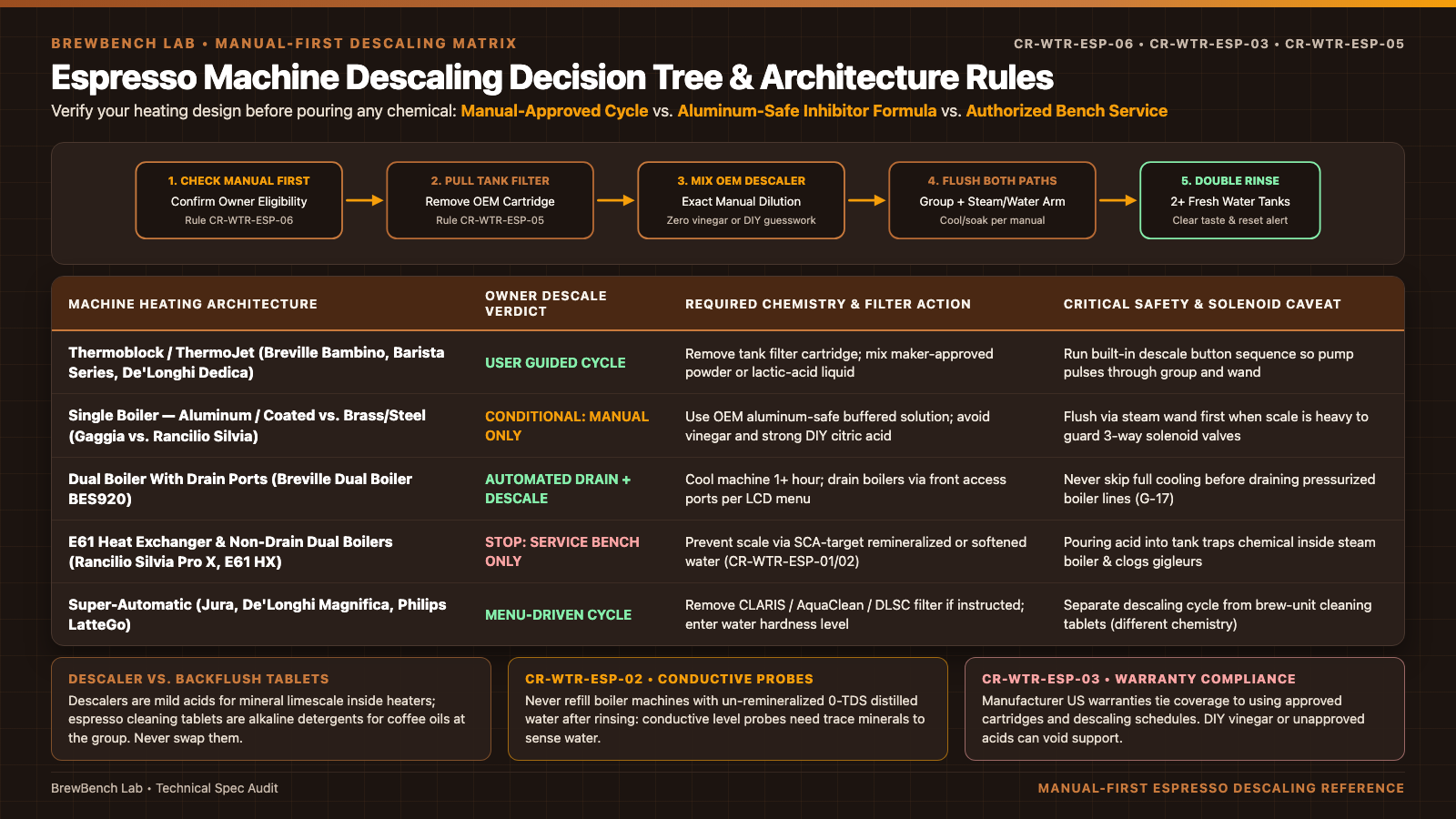
Direct Answer — How to Descale an Espresso Machine Safely: Always check your specific model’s user manual first (CR-WTR-ESP-06) before pouring any acid into the water tank. Thermoblock machines, guided single boilers, and super-automatics follow a structured five-part routine: (1) power down and let heated components cool safely, (2) remove any in-tank water filter cartridge (CR-WTR-ESP-05), (3) mix the exact manufacturer-approved descaler at the printed dilution—never vinegar or unverified DIY acid ratios, (4) flush the solution through both the group head and the steam/hot-water circuit, and (5) rinse the reservoir and flush at least two full tanks (2.0 L+ / 67.6+ fl oz) of fresh water. By contrast, many E61 heat-exchanger and non-drainable dual-boiler machines forbid owner reservoir descaling and require authorized bench service.
Learning how to descale an espresso machine without pitting soft internal metals, clogging delicate three-way solenoid valves, or voiding US warranty coverage starts long before you mix a cleaning packet. Mineral scale—primarily calcium and magnesium carbonate precipitated when hard water is heated—quietly restricts narrow thermoblock passages, insulates boiler heating elements, and causes erratic brew pressure or sputtering steam wands. Because water quality is the upstream driver of every scale cycle, pairing this maintenance playbook with our best water for espresso machines hub is the most effective way to protect your machine over years of daily use.
Safety & Warranty Triage Notice (Read Before Starting): Under BrewBench Lab editorial safety standards, all maintenance follows manufacturer instructions first (CR-WTR-ESP-06) and warranty compliance rules (CR-WTR-ESP-03). Allow pressurized boilers and portafilters to depressurize and cool before removing baskets, gaskets, or drain ports. Unplug the 120V cord before wiping exterior housings or inspecting drip trays, and never open the outer machine casing, bypass thermal cutoffs, or alter internal plumbing. Never use distilled vinegar or guess DIY citric acid strengths on aluminum or coated boilers. If you move your machine to a sink counter, plug only into a properly grounded 120V receptacle matching its NEMA 5-15P or 5-20P plug—never use a 15A-to-20A plug adapter, and contact a licensed electrician if a kitchen GFCI or breaker trips. If your machine’s manual omits consumer descaling or if scale blocks internal flow completely, stop and contact the manufacturer or an authorized service center.
In This Guide
- Machine Architecture & Descaling Eligibility Matrix
- Fast Symptom-to-Root-Cause Descaling Triage
- Step-by-Step Manual-First Descaling Protocol
- Descaling vs. Backflushing: Never Confuse the Two
- Hardness Schedule & Scale Prevention Checklist
- Official Manufacturer & Standards References
- Frequently Asked Questions
First Check: Can Your Espresso Machine Be Descaled at Home?
Not every espresso machine shares the same internal plumbing or metallurgy. Before mixing any descaling solution, identify which heating architecture sits inside your chassis. A procedure that works smoothly on a stainless-lined ThermoJet block can etch an aluminum boiler or trap residual acid inside a sealed steam boiler on a prosumer dual-boiler or heat-exchanger unit.
| Heating Architecture | Representative 120V US Examples | Owner Descaling Eligibility | Approved Chemistry & Filter Action | Critical Engineering Caveat |
|---|---|---|---|---|
| Thermoblock / ThermoJet / Thermocoil | Breville Bambino, Bambino Plus, Barista Express, Barista Pro; De’Longhi Dedica Arte, Stilosa | Yes — Guided Cycle (built-in button sequence) | Remove reservoir filter cartridge (CR-WTR-ESP-05); use maker powder or lactic-acid liquid per manual | Narrow internal coils clog quickly in hard water; run the full automated pulse cycle across both group and steam/hot-water wands. |
| Single Boiler (Aluminum / Coated vs. Brass / Stainless) | Gaggia Classic Evo Pro (verify boiler material by production run), Rancilio Silvia | Conditional — Manual Method Only | Aluminum/coated boilers require OEM corrosion-inhibited descaler; never vinegar or strong unbuffered acid | Flush heavily scaled boilers through the steam wand first so dislodged flakes bypass the narrow three-way solenoid valve orifice. |
| Dual Boiler With Consumer Drain Ports | Breville Dual Boiler (BES920) | Yes — Firmware Drain + Cycle | Cool 1+ hour per manual; drain both boilers via front access ports before running maker-approved descaler | Never open drain valves while pressurized or hot; skipping boiler drains traps diluted acid inside the steam tank. |
| E61 Heat Exchanger (HX) & Non-Drain Dual Boilers | Rancilio Silvia Pro X; Rocket, Profitec, ECM, and Lelit E61 HX/DB classes | No — Authorized Bench Service (unless manual explicitly permits) | Prevent scale upstream via remineralized or softened water within SCA limits (CR-WTR-ESP-01, CR-WTR-ESP-02) | Sucking descaler through the tank fills the steam boiler with acid that cannot be fully rinsed through normal brewing, risking corrosion and sensor fouling. |
| Super-Automatic Bean-to-Cup | De’Longhi Magnifica / Eletta, Philips LatteGo, Jura E-series | Yes — Menu-Driven Cycle | Remove CLARIS, AquaClean, or DLSC filter per prompt; program local water hardness setting | Never drop alkaline brew-group cleaning tablets into the water tank—descaling liquid and coffee-oil tablets treat completely different circuits. |
| Manual Lever (No Boiler) & Capsule Systems | Flair 58 (kettle-fed), Nespresso OriginalLine / VertuoLine | Kettle Only / Maker Descale Mode | No-boiler levers descale the separate electric kettle; capsule machines use maker-branded kits only | Follow the capsule maker’s exact barcode or button sequence; never force pressurized descaler into an unheated manual cylinder. |
Notice the sharp boundary between consumer thermoblock appliances and traditional commercial-style boilers. On a thermoblock or ThermoJet machine, water passes through a continuous narrow channel and exits completely—meaning a thorough fresh-water flush replaces every drop of solution in the path. On a heat-exchanger or dual-boiler machine without external drain valves, the steam boiler stays half-full of standing water during normal operation. Sending descaler into that boiler leaves diluted acid simmering inside brass, copper, or stainless chambers long after you think the rinse is over.
Fast Symptom-to-Root-Cause Descaling Triage
Before assuming sluggish shots automatically mean limescale, evaluate the symptom carefully. Grinding too fine, packing an overly tight dose, or neglecting coffee-oil backflushing can mimic mineral restriction, while using ultra-pure zero-mineral water can trigger false “empty tank” alarms that have nothing to do with scale buildup.
| Observed Symptom | Underlying CR-* or Mechanical Cause | Lowest-Risk First Check |
|---|---|---|
| Descale indicator flashes or stays solid | Shot/liter counter reached programmed threshold based on water hardness setting (CR-WTR-ESP-01) | Check your manual for whether the counter tracks volume or time; confirm hardness setting and run the maker’s cycle to clear the alert. |
| Slow or dripping water from shower screen (even with empty portafilter) | Mineral scale narrowing thermoblock coils, three-way solenoid jet, or brew path; separate from pump max bar rating | Remove and wipe the shower screen first to rule out baked coffee oils; if bare water flow remains restricted, follow manual descaling steps. |
| Weak, wet, or sputtering steam wand output | Scale narrowing steam tip holes or internal steam valve seat | Allow wand to cool, unscrew the steam tip if removable per manual, soak tip separately, and inspect holes with a soft pin before running a full descale. |
| “Fill Water” / low-water warning with a full reservoir | Un-remineralized distilled or zero-TDS pitcher water failing to trip conductive level probes (CR-WTR-ESP-02), or mis-seated tank valve | Verify reservoir seating at the bottom gasket; if using distilled or RO water, switch to a properly remineralized espresso recipe. |
| White chalky flakes exiting hot water tap or steam wand | Active calcium carbonate scale shedding inside boiler or thermoblock | Stop brewing shots into cups immediately; follow your manual’s steam-wand-first descaling and double-tank flush procedure (or service bench if HX/DB). |
| Leaking or hissing around portafilter rim | Hardened or debris-coated group head gasket, or wrong basket height (CR-ESP-ACC-06) | Unplug and cool machine; wipe the group gasket channel with a damp cloth and check basket seating before assuming internal boiler scale. |
Keep pump specifications in perspective when diagnosing weak flow. Many entry espresso machines advertise “15-bar” or “20-bar” vibratory pumps on the box. Those numbers represent the pump’s maximum dead-head rating—not brewing pressure at the coffee puck, which machines regulate near ~9 bar via an over-pressure valve (OPV) and puck resistance. When bare water dribbles weakly out of an empty group head with no portafilter locked in, the pump is encountering internal mineral restriction or a clogged solenoid orifice rather than suddenly losing rated pressure.
How to Descale an Espresso Machine: 6 Manual-First Steps
Once your eligibility check confirms your machine is designed for owner descaling, work sequentially from the lowest-risk preparation steps through full chemical rinsing. Keep roughly 45 to 90 minutes free so you never rush the fresh-water flush stage.
Step 1: Verify Machine Eligibility, Warranty Terms & Cool-Down State
Pull up the exact US 120V manual for your model number—not a generic video for a different generation or a 230V overseas variant. Under CR-WTR-ESP-03, US manufacturers explicitly link warranty coverage to following their stated water filtration and descaling routines. Confirm three details in your booklet before touching any supplies:
- Required Starting Temperature: Thermoblock models such as the Breville Barista Express enter descale mode from an OFF state, whereas dual-boiler machines like the Breville Dual Boiler require at least one full hour of cooling before draining boilers safely. Single-boiler machines with aluminum boilers must never be kept piping hot during an acid soak because heat accelerates chemical attack on aluminum oxide walls.
- Approved Descaler Type: Check whether the maker calls for a lactic-acid liquid (such as De’Longhi EcoDecalk), a buffered sulfamic/citric powder packet (such as Breville Descaler), or a corrosion-inhibited proprietary bottle (such as Gaggia Decalcifier).
- Drain Port or Menu Requirements: Note the exact button combination (for example, holding
1 CUP + POWERor1 CUP + 2 CUP + POWERon specific Breville models) or dial position needed to activate descaling pulses without tripping overheat protection.
Step 2: Remove the Reservoir Filter Cartridge & Empty Catch Trays
Never pour descaling solution into a reservoir that still holds an active carbon or ion-exchange water filter cartridge. Under CR-WTR-ESP-05, OEM reservoir cartridges—such as Breville ClaroSwiss-style filters, De’Longhi DLSC002 cartridges, Philips AquaClean, or Jura CLARIS units—are physically shaped for your tank and engineered to bind minerals and organic compounds. Leaving the cartridge inside during descaling destroys the filter media, neutralizes or traps descaling acid, and risks leaching concentrated residue into future espresso shots.
- Lift out the water reservoir, unclip the filter holder, and set the cartridge aside in a clean cup of cold water (or discard it if it has reached its replacement interval).
- Wash the empty tank with mild dish soap and rinse thoroughly so no biofilm or coffee dust mixes into the descaler.
- Empty and dry the drip tray, then place a heat-safe catch container holding at least 1.5 to 2.0 L (50.7 to 67.6 fl oz) underneath both the group head and the steam/hot-water wand. Remove your portafilter unless your specific manual instructs keeping an empty portafilter locked in during part of the cycle.
- Unscrew and set aside removable shower screens or steam wand tips only if your manual recommends soaking them separately; otherwise leave group hardware intact and wipe away loose coffee grounds with a damp microfiber cloth.
Step 3: Mix Manufacturer-Specified Descaler (Why Vinegar & DIY Acids Fail)
Measure the descaling liquid or powder strictly according to the package and your machine manual—never by guesswork. Most residential cycles dissolve one manufacturer packet or one bottle dose (often ~100 to 125 mL / 3.4 to 4.2 fl oz depending on brand) into roughly 1.0 L (33.8 fl oz) of room-temperature or slightly lukewarm fresh tap water until completely dissolved. Never pour undiluted concentrate or hot boiling water into a plastic reservoir.
Chemical Safety Rule — Skip Vinegar and Unverified DIY Acid Ratios: Under CR-WTR-ESP-06 and safety guardrail G-17, BrewBench Lab never recommends household distilled white vinegar or improvised citric-acid kitchen recipes. Acetic acid in vinegar is harsh on rubber O-rings, silicone seals, and copper/brass fittings, struggles to dissolve dense calcium scale efficiently, and leaves a stubborn sour aroma inside thermoblocks for dozens of shots. Meanwhile, unbuffered pure citric acid mixed too strong or heated in an aluminum boiler can pit internal metal walls and strip protective coatings. Always use a maker-approved, buffered espresso descaler matched to your machine’s internal metals.
Step 4: Run the Controlled Descale Cycle Through Both Group and Steam Paths
Re-seat the filled reservoir firmly on its bottom check valve so no airlock starves the vibratory pump, then execute the sequence specified for your machine class:
- Guided Thermoblock & Super-Automatic Machines: Trigger the automated descale mode per your manual. The machine will pump solution in timed pulses—alternating between the brew group and the steam/hot-water wand, or prompting you to turn the steam knob open and closed at set intervals. Wait for each automated pause rather than turning the power switch off mid-program; those pauses allow the mild acid to soften mineral bonds without overheating the heater block.
- Single-Boiler Machines With Three-Way Solenoid Valves: Power the unit on only long enough to pull descaler into the boiler—opening the steam valve and running the pump until roughly 250–300 mL (8.5–10.1 fl oz) exits the steam wand, followed by a brief 50–100 mL (1.7–3.4 fl oz) purge through the group head—then turn the machine OFF to soak for the manual’s stated window (typically 15 to 20 minutes). Turning the heater off prevents the solution from boiling and concentrating aggressively inside the boiler. When resuming, purge the majority of the tank out of the open steam wand first before finishing through the group head; this reduces the chance of loosened scale flakes jamming the narrow orifice of the three-way solenoid valve.
- Drain-Equipped Dual Boilers: Follow every on-screen prompt sequentially after cooling and draining both boilers. Keep a close eye on the catch container and drip tray so overflowing acid solution never reaches countertop outlets or scale electronics.
Watch the spent solution draining into your catch bowl. A faint blue-green tint or suspended white grit confirms mineral deposits are dissolving and flushing free. Stop immediately if the pump runs dry for more than a few seconds, emits an unusually high-pitched rattle with zero water exiting, or triggers a thermal cutoff—let the unit cool and inspect whether the reservoir check valve is seated properly before trying again.
Step 5: Execute a Full Two-Tank Fresh-Water Rinse (Never 0-TDS Distilled)
Incomplete rinsing is the number one reason espresso tastes sharp, salty, or metallic after maintenance. Once the descaling solution tank finishes, never stop after a single half-tank rinse:
- Remove the reservoir and scrub its interior walls, intake screen, and lid with fresh tap water to clear every trace of residual descaling acid.
- Refill the reservoir to the MAX line with clean, filtered, or properly remineralized water. Under compatibility rule
CR-WTR-ESP-02, never refill a boiler machine with pure, un-remineralized distilled or zero-TDS water—conductive water-level probes rely on trace dissolved minerals to detect tank and boiler fill levels, and zero-TDS water can trigger persistent “fill water” lockouts. - Empty your catch container and run the entire first rinse tank through both the brew group and the steam/hot-water arm (following your manual’s rinse stage if using an automated program).
- Refill the reservoir a second time with fresh water and flush another full tank across both outlets until the exiting water looks completely clear and smells neutral.
- If you use an OEM in-tank filter cartridge, install a fresh cartridge only after all descaling rinse tanks are complete—pre-soaking and flushing the new cartridge per the maker’s instructions before clipping it into the holder. Finally, confirm the descale alert light has reset; some models require completing the full rinse phase without power interruption to clear the counter.
Step 6: Know When to Stop and Call Authorized Service
Descaling restores flow only when mineral buildup is manageable and water still moves through the circuit. Stop home troubleshooting and contact the manufacturer or an authorized espresso repair center if any of the following occur:
- Zero Flow After Soaking: Water refuses to exit either the group head or the steam wand after priming, indicating a completely calcified thermoblock, seized pump, or jammed three-way solenoid valve. Never disassemble sealed boilers, electrical harnesses, or high-pressure fittings yourself.
- E61 Heat-Exchanger or Non-Drain Dual Boiler Scale: If a commercial-style boiler machine begins losing steam pressure, fluctuating wildly in temperature, or shedding grit, schedule a professional bench descale rather than forcing acid through the reservoir.
- Electrical Faults or Leaks: Any water dripping beneath the chassis, tripping GFCI protection, or burning odor requires unplugging the unit immediately and seeking authorized repair (
CR-ESP-SYS-02).
Descaling vs. Backflushing: Two Completely Different Maintenance Cycles
One of the most damaging beginner mix-ups on home espresso bars is confusing mineral descaling with detergent backflushing. Although both cycles clean your machine, they target opposite ends of the water path using opposing pH chemistry—and not every machine supports blind-basket backflushing.
| Maintenance Attribute | Chemical Descaling (CR-WTR-ESP-06) | Detergent Backflushing (CR-ESP-ACC-11) |
|---|---|---|
| Target Residue | Calcium & magnesium mineral scale inside water lines, thermoblocks, and boilers | Rancid coffee oils, fines, and crema residue on the shower screen, dispersion block, and three-way solenoid exhaust |
| Chemical Type | Mild buffered acid (lactic, sulfamic, or inhibited citric blend per maker) | Alkaline espresso cleaning tablet or powder (never poured into the water reservoir) |
| Where It Goes | Mixed in the water tank and pumped through group head and steam/hot-water wand | Placed inside a solid blind basket or OEM silicone cleaning disc locked into the portafilter |
| Machine Eligibility | Thermoblocks, guided single boilers, drainable dual boilers, super-automatics | Only machines equipped with a three-way solenoid valve (or E61 mechanical vent) or an OEM cleaning-disc cycle |
| Typical Cadence | Every 2–6 months depending on water hardness and liters brewed | Water-only backflush weekly; detergent tablet backflush every 1–4 weeks depending on shot volume |
Under rule CR-ESP-ACC-11, never attempt a pressurized blind-basket backflush on an entry pump machine that lacks a three-way solenoid valve (such as basic De’Longhi Stilosa or Dedica-class models) unless its manual specifically provides a cleaning-disc procedure. Without a relief valve to dump pressure into the drip tray when the pump stops, pressure remains trapped above the puck or blind disc, creating a scalding sneeze hazard when you unlock the portafilter. For a breakdown of maker-approved detergent tablets, cleaning discs, and safe maintenance kits, see our guide to the best espresso machine cleaners.
How Water Hardness Determines Your Descaling Schedule
The cleanest way to reduce how often you need to descale—especially if you own a prosumer dual-boiler or heat-exchanger machine—is controlling incoming calcium and magnesium before water ever enters the reservoir. Under Specialty Coffee Association water standards and rule CR-WTR-ESP-01, espresso machines perform reliably and limit mineral scaling when total hardness stays near 68 mg/L as CaCO3 (~4.0 gpg) within an acceptable range of 17–85 mg/L (1.0–5.0 gpg), alongside total alkalinity near 40 mg/L and total dissolved solids (TDS) between 75 and 250 mg/L.
| Water Hardness Tier (Dual Units) | Scale Risk & Conductivity Check | Recommended Prevention Strategy | Typical Descale Verification Window |
|---|---|---|---|
| Near-Zero / Un-Remineralized (< 17 mg/L CaCO3 / < 1.0 gpg) | Minimal scale, but high risk of conductive probe errors (CR-WTR-ESP-02) | Add espresso remineralization packets or drops to reach probe-safe TDS (~75–250 mg/L) | Follow maker calendar check even if mineral scale looks absent |
| Ideal Espresso Target (17–85 mg/L CaCO3 / 1.0–5.0 gpg / ~1.0–4.8 °dH) | Balanced mineral load; minimal boiler scaling and probe-safe conductivity | Maintain OEM reservoir cartridge schedule or remineralized recipe water | Typically every 4–6 months (or whenever the machine’s programmed counter triggers) |
| Moderately Hard Tap (86–170 mg/L CaCO3 / 5.0–9.9 gpg / ~4.8–9.5 °dH) | Gradual calcium carbonate buildup inside thermoblocks and steam tips | Install OEM softening/resin cartridge (CR-WTR-ESP-05) or switch to remineralized water | Every 2–3 months; confirm with hardness strips and utility water report |
| Very Hard Tap (> 170 mg/L CaCO3 / > 10.0 gpg / > 9.5 °dH) | Rapid coil restriction, white flakes, and elevated warranty risk (CR-WTR-ESP-03) | Avoid raw tap water; use bottled low-mineral spring water or RO/distilled base + espresso mineral recipe | Every 1–2 months if tap water was used; follow strict filter replacement |
Remember compatibility rule CR-WTR-ESP-04 before routing your espresso bar straight from a whole-house salt-based water softener: softer is not automatically safer for internal boilers. Traditional sodium ion-exchange softeners swap calcium for sodium ions without reducing total dissolved solids, and water high in chloride can accelerate corrosion on stainless steel and brass boiler fittings over time. Measure your actual tap supply with colorimetric hardness strips or your local utility’s annual Consumer Confidence Report, and review our detailed water hardness for espresso machines guide to convert cleanly between mg/L, gpg, and °dH before programming your machine’s water-hardness menu.
Official Manufacturer & Industry References
All compatibility rules, cartridge removal warnings, and boiler-specific descaling boundaries in this guide are cross-checked against official manufacturer documentation and industry water standards:
- Breville USA Support & Machine Manuals — Official ThermoJet/Thermocoil descale button sequences, ClaroSwiss-style filter removal requirements, and Dual Boiler (BES920) cool-down and front drain-port instructions.
- De’Longhi USA Product Manuals & Maintenance Guidance — Official EcoDecalk lactic-acid dosing rules, water hardness programming menus, and DLSC filter removal steps.
- Gaggia Official Maintenance Documentation — Manufacturer-approved decalcifier chemistry and care boundaries for single-boiler machines.
- Rancilio Group Official Support — Service and preventative water guidance for traditional single-boiler and dual-boiler espresso architectures.
- Specialty Coffee Association (SCA) Water Standards — Reference ranges for total hardness (17–85 mg/L as CaCO3), alkalinity, chloride, and TDS targets for espresso equipment care.
How We Audited This Guide
- Home bar blueprints, upgrade roadmaps, water chemistry guides, and Amazon listing audits were verified against CR-SYS circuit, water-probe, and budget balance rules.
- Every espresso machine, burr grinder, accessory, and scale specification was cross-checked against official manufacturer 120V manuals, SCA water guidance, and verified Amazon US listings.
- Recommendations were evaluated against our weighted espresso-gear scoring rubrics and documented CR-* compatibility rules; we never invent heat-up seconds, PID variance, or micron claims.
Continue Your Audit
- Home Espresso Setup Guide 2026: Machine, Grinder and Tools
- Espresso Setup Under $700 2026: Entry Machine and Grinder Plan
Frequently Asked Questions About Descaling Espresso Machines
Can I use white vinegar to descale my espresso machine?
No—almost every espresso manufacturer advises against white vinegar because acetic acid can degrade rubber seals, attack aluminum and copper components, and leave a sour odor inside internal passages. Always follow your machine manual (CR-WTR-ESP-06) and use the maker-approved lactic, sulfamic, or buffered descaling formula.
Do I need to take the water filter out before descaling?
Yes—under compatibility rule CR-WTR-ESP-05, always remove any in-tank carbon or resin filter cartridge before adding descaler. Leaving the cartridge installed ruins its media, absorbs or blocks the descaling solution from reaching the heater, and can trap chemical residue inside the reservoir filter housing.
What is the difference between descaling solution and espresso cleaning tablets?
Descalers are mild acids poured into the water reservoir to dissolve calcium and magnesium mineral scale inside boilers and thermoblocks. Cleaning tablets are alkaline detergents placed in a blind basket to dissolve coffee oils at the group head and three-way solenoid valve. Never put cleaning tablets in the water tank.
Can I use pure distilled water after descaling so I never get scale again?
No—under CR-WTR-ESP-02, un-remineralized distilled or zero-TDS water lacks the dissolved ions required by conductive water-level probes on many boiler machines, causing false “fill water” errors. If you start with distilled or reverse-osmosis water, add an espresso-specific remineralization packet or mineral drops to reach safe TDS.
Should I descale an E61 heat-exchanger or dual-boiler espresso machine at home?
Check your manual before attempting it. Unless your dual boiler provides dedicated drain ports and a guided descale program—like the Breville Dual Boiler—most E61 heat-exchanger and dual-boiler manuals omit consumer descaling because acid cannot be fully flushed from the steam boiler. Rely on soft recipe water or authorized service.
How many times should I rinse my espresso machine after descaling?
Flush at least two complete reservoirs (typically 2.0 L / 67.6 fl oz or more) of fresh, clean water evenly through both the group head and the steam or hot-water wand after scrubbing the empty tank. Do not pull espresso until the exit water tastes completely neutral and any descale prompt clears.


