
Disclosure: As an Amazon Associate, I earn from qualifying purchases. If you buy through links on this page, we may earn a small commission at no extra cost to you.
Choosing the best water for espresso machine boilers and thermoblocks protects heating paths from limescale while keeping extractions sweet and balanced. Water accounts for more than 98 percent of every shot, yet untreated municipal tap supplies either coat narrow solenoid valves in calcium carbonate or carry enough bicarbonate alkalinity to flatten bright roasts. On the opposite extreme, feeding pure zero-mineral water triggers false empty-tank warnings on conductive level probes and produces hollow, sour shots.
At BrewBench Lab, we audited nine Amazon US water treatment products—spanning chloride-free remineralization recipes, magnesium ion-exchange pitchers, 0-TDS deionizing bases, plumbed inline cartridges, and handheld TDS meters—against Specialty Coffee Association water targets and manufacturer manual limits. Before finalizing your setup, pair this roundup with our guides on water hardness limits for espresso machines, using distilled water safely, and manual-first espresso descaling, or browse our audited home espresso machines hub.
In This Guide
- Quick Picks at a Glance
- Side-by-Side Comparison Table
- Match Your Source Water Scenario
- Detailed Water Treatment Audits (1–9)
- Water Chemistry & Machine Compatibility Reference
- Buying Guide: Choosing Espresso Water & Filters
- Scoring Rubric & Excluded Approaches
- Frequently Asked Questions
- Final Verdict
Quick Picks: Best Water for Espresso Machine Setups
#1 Best Overall & Boiler-Safe Recipe
Third Wave Water Espresso Profile (12-Pack)
Chloride-free magnesium sulfate, calcium citrate, and potassium bicarbonate formula keeps boilers scale-safe and conductive probes reading reliably. (Jump to audit)
#2 Best Countertop Magnesium Pitcher
BWT AQUAlizer Home 2.7L Jug
Magnesium ion-exchange cartridge swaps calcium hardness for flavor-friendly Mg2+ directly from kitchen tap water with zero gallon jugs. (Jump to audit)
#3 Best Plumbed-In Prosumer Filter
BWT Bestmax M 5-Stage Cartridge (3800L)
High-capacity inline decarbonization cartridge with tunable 0–3 bypass control for direct-plumb rotary-pump espresso bars. (Jump to audit)
Side-by-Side Comparison: Best Water Filters & Recipes Audited
| Product & Award | Best For | Treatment Mechanism | Capacity / Key Spec | Amazon Link |
|---|---|---|---|---|
| Third Wave Water Espresso Profile Best Overall & Boiler-Safe Recipe | Zero-scale boiler protection & balanced shots | Chloride-free mineral sticks (for 0-TDS water) | 12 x 1-gal sticks; ~150 ppm TDS | View on Amazon |
| BWT AQUAlizer Home 2.7L Jug Best Countertop Magnesium Pitcher | Moderate tap water (60–120 mg/L) reservoirs | Magnesium ion-exchange + carbon pitcher | 2.7 L jug; 120 L / 4-wk filter | View on Amazon |
| BWT Bestmax M Cartridge (3800L) Best Plumbed-In Prosumer Filter | Direct-plumb rotary-pump espresso bars | 5-stage inline decarbonization + Mg2+ | Up to 3,800 L; 0–3 bypass | View on Amazon |
| COFFEE WATER Mineral Packs (25 Gal) Best Value Remineralization Packs | Budget 1-gal mixing on thermoblock bars | Pre-dosed mineral sachets (for 0-TDS water) | 25 x 1-gal packs (note trace NaCl) | View on Amazon |
| ZeroWater 10-Cup Filter Pitcher Best 0-TDS Base Water Pitcher | Making 0-ppm base water for recipes at home | 5-stage deionizing ion-exchange pitcher | 10-cup jug; ~0 ppm output (remineralize) | View on Amazon |
| Pentair Everpure H-300 (EV927072) Best Under-Sink Carbon Inline Filter | Chlorine & 0.5-micron sediment polishing | Precoat activated carbon + scale inhibitor | 300 gal / 12 mos; 0.5 micron | View on Amazon |
| Brita Large 10-Cup Elite Pitcher Best Carbon Pitcher for Soft Tap | Naturally soft tap (< 60 mg/L) with chlorine | Activated carbon & contaminant reduction | 120 gal / 6-mo filter; 97.4% chlorine | View on Amazon |
| HM Digital TDS-3 Handheld Meter Best TDS Meter for Recipe Batches | Checking RO, ZeroWater & mineral batches | ATC electrical conductivity probe | 0–9,990 ppm; +/- 2% accuracy | View on Amazon |
| BWT Magnesium Filter Cartridges (6-Pack) Best Bulk Magnesium Refill Pack | Six-month supply for BWT oval pitchers | Longlife Mg2+ ion-exchange cartridges | 6 x 120 L (720 L total yield) | View on Amazon |
Match Your Source Water Scenario: Best Espresso Water by Setup
| Buyer & Water Scenario | Best Match | Why & Expected Outcome |
|---|---|---|
| Very hard tap water (> 120 mg/L / 7+ gpg) feeding a dual boiler or thermoblock | Third Wave Water Espresso Profile | Converts 1-gallon distilled or RO water into chloride-free ~150 ppm brew water that protects boilers and triggers conductive probes reliably. |
| Moderate tap water (60–120 mg/L) needing fast pitcher pours with zero jug hauling | BWT AQUAlizer Home 2.7L Jug | Reduces limescale-forming calcium by exchanging it for magnesium ions while stripping chlorine off-flavors right from the kitchen sink. |
| Direct-plumb prosumer E61 or rotary-pump machine on municipal supply | BWT Bestmax M 5-Stage Cartridge | Provides multi-thousand-liter decarbonization and tunable 0–3 bypass alkalinity once paired with a BWT head and pressure regulator. |
| Eliminating grocery-store distilled plastic jugs while keeping recipe consistency | ZeroWater 10-Cup Pitcher + Espresso Profile | Strips municipal minerals to 0 ppm TDS on your counter so you can remineralize fresh 1-gallon batches as needed. |
| Naturally soft municipal water (< 60 mg/L) tainted by chlorine smell | Brita Large 10-Cup Elite Pitcher | Removes 97.4% of chlorine taste over a six-month filter cycle while leaving naturally soft brewing minerals intact. |
| Verifying RO membranes, ZeroWater resin life, and remineralized gallon batches | HM Digital TDS-3 Handheld Meter | Catches resin exhaustion before hard tap minerals slip past your filter and confirms every mineral stick dissolved completely. |
Detailed Audits: Best Water for Espresso Machine Picks (1–9)
1. Third Wave Water Mineral Enhanced Brewing Water, Espresso Profile (12-Pack 1-Gallon Sticks) — Best Overall & Boiler-Safe Recipe

Quick Specs: Pre-measured remineralization packets | Yield: 12 x 1-gallon (3.78 L) batches | Chemistry: Magnesium sulfate, calcium citrate, potassium bicarbonate | Zero added chlorides | Target: ~150 ppm TDS & ~80–94 mg/L alkalinity | Price Tier: TIER-WTR-RECIPE (Under $30 per 12-pack)
Audit Score: 9.5 / 10
- Boiler & Probe Protection Fit (35%): 9.8 / 10
- Filter & Plumbing Compatibility (25%): 9.6 / 10
- Extraction Balance & Alkalinity Control (20%): 9.5 / 10
- Value & Ongoing Consumable Cost (20%): 8.9 / 10
Municipal water varies wildly by ZIP code and season, turning a great espresso machine into a limescale trap or a flat-tasting brewer depending on local rainfall and reservoir sources. According to the Third Wave Water Espresso Profile specification, these single-gallon sticks convert zero-mineral distilled or reverse osmosis (RO) water into a standardized ~150 ppm TDS brewing solution tailored specifically for pressurized espresso extraction. Rather than relying on sodium chloride—which introduces corrosive chloride ions—this formula blends magnesium sulfate, calcium citrate, and potassium bicarbonate to achieve balanced ~80–94 mg/L carbonate alkalinity without temporary scale-forming bicarbonates.
That ingredient swap separates it sharply from both COFFEE WATER Mineral Packs (Rank #4, which include sodium chloride) and Third Wave Water’s own Classic Light Roast packets. Under compatibility rule CR-WTR-ESP-04, omitting chloride salts safeguards stainless steel, copper, and brass boilers against pitting corrosion over years of elevated boiler temperatures. Simultaneously, raising total dissolved solids to ~150 ppm ensures conductive level probes inside heat-exchanger and dual-boiler machines register water reliably under CR-WTR-ESP-02.
Buyer Verification Alert: Check the front pouch label carefully before adding to cart: order the dark-label Espresso Profile rather than the Classic Light Roast Profile. Classic Light Roast contains sodium chloride intended for pour-over coffee and should not sit inside heated metal espresso boilers.
Pros
- Zero-chloride potassium bicarbonate chemistry protects stainless and brass boilers (CR-WTR-ESP-04)
- Delivers repeatable ~150 ppm TDS so conductive autofill probes detect tank and boiler water cleanly
- Balances sharp light- and medium-roast acidity with ~80–94 mg/L buffering capacity
- Pre-dosed 1-gallon sticks remove raw mineral weighing errors and kitchen scale clutter
Cons
- Requires purchasing distilled water jugs or generating 0-TDS base water with a filter or RO unit
- Higher per-gallon consumable cost than countertop pitcher cartridges for heavy multi-drink households
Verdict: Buy it if you want the cleanest, boiler-safe, chloride-free recipe water for any reservoir espresso machine without mixing raw chemistry salts yourself. Skip it if you prefer filtering straight from your faucet via a countertop pitcher or already plumb into a BWT commercial cartridge. Pair these sticks with the ZeroWater 10-Cup Pitcher (Rank #5) and an HM Digital TDS-3 Meter (Rank #8) to produce 0-TDS base water at home without hauling plastic grocery jugs.
2. BWT AQUAlizer Home 2.7L Water Mineralizer & Filtration Jug — Best Countertop Magnesium Pitcher

Quick Specs: Magnesium ion-exchange pitcher | Total Volume: 2.7 L (91 oz) / ~1.4–1.5 L filtered batch | Cartridge Rating: Up to 120 L (31.7 gal) or 4 weeks | Exchanges Ca2+ for Mg2+ | Electronic lid indicator | Price Tier: TIER-WTR-BASIC ($60–$100 tier)
Audit Score: 9.2 / 10
- Boiler & Probe Protection Fit (35%): 9.1 / 10
- Filter & Plumbing Compatibility (25%): 9.5 / 10
- Extraction Balance & Alkalinity Control (20%): 9.3 / 10
- Value & Ongoing Consumable Cost (20%): 8.8 / 10
Many home espresso owners avoid remineralization packets because storing gallon jugs in a compact apartment kitchen feels tedious. Built around BWT’s patented Magnesium Mineralized Water technology, the 2.7 L AQUAlizer jug bridges tap convenience and boiler protection. Instead of relying solely on activated carbon or swapping calcium for sodium like conventional water softeners, BWT’s Longlife Mg2+ resin exchanges scale-forming calcium ions directly for magnesium ions while simultaneously removing chlorine taste and heavy metals.
In coffee chemistry, magnesium binds efficiently to aromatic fruit and sweetness compounds while keeping temporary calcium carbonate scale in check inside thermoblocks and single boilers (CR-WTR-ESP-01). Because filtered batches still retain healthy dissolved minerals, the AQUAlizer poses zero conductive probe detection issues on prosumer boiler machines (CR-WTR-ESP-02). Against the Brita Large 10-Cup Elite Pitcher (Rank #7), the AQUAlizer offers far stronger limescale control in moderate-hardness cities between 60 and 120 mg/L CaCO3, though Brita filters last longer on soft municipal supplies.
Buyer Verification Alert: Always soak and flush each new BWT cartridge per BWT’s priming instructions before pouring water into your espresso machine tank. Skipping the initial rinse can introduce fine black carbon dust into vibratory pumps or intake screens.
Pros
- Swaps scale-forming calcium ions for extraction-enhancing magnesium directly from tap water
- Retains healthy mineral conductivity so boiler autofill probes register reliably (CR-WTR-ESP-02)
- Reduces municipal chlorine odor without generating salty sodium-softened water
- Built-in electronic lid counter reminds you when the 4-week or 120 L window ends
Cons
- Very hard tap water above 150–180 mg/L CaCO3 exhausts 120 L cartridges ahead of four weeks
- Does not strip water to zero TDS, so periodic manual-guided descaling may still be required
Verdict: Buy it if your local tap water sits in the moderate 60–120 mg/L range and you want an effortless countertop pitcher tuned specifically for coffee flavor and limescale reduction. Skip it if your tap water is rock-hard above 180 mg/L—in that case, pair ZeroWater with Third Wave Water Espresso Profile instead. Keep a BWT Magnesium 6-Pack (Rank #9) stocked for scheduled four-week swaps.
3. BWT Bestmax M 5-Stage Espresso Water Filter Cartridge (3800L) — Best Plumbed-In Prosumer Filter

Quick Specs: 5-stage inline decarbonization cartridge | Capacity: Up to 3,800 L (varies by bypass & carbonate hardness) | Bypass Settings: 0–3 on BWT besthead | Orientation: Vertical or horizontal | Scope: Direct-plumb machines only | Price Tier: TIER-WTR-PLUMBED ($100–$200 tier)
Audit Score: 9.1 / 10
- Boiler & Probe Protection Fit (35%): 9.6 / 10
- Filter & Plumbing Compatibility (25%): 8.4 / 10
- Extraction Balance & Alkalinity Control (20%): 9.4 / 10
- Value & Ongoing Consumable Cost (20%): 9.0 / 10
Once you step up to a direct-plumb rotary-pump E61 or dual-boiler espresso machine, pitcher routines quickly become the bottleneck of a multi-drink morning bar. Listed in BWT Water & More’s commercial espresso catalog, the Bestmax M cartridge delivers five-stage inline treatment—combining particle pre-filtration, activated carbon fleece for chlorine removal, and high-capacity ion-exchange decarbonization—capable of processing up to 3,800 liters depending on local carbonate hardness and steam demand.
Unlike single-purpose carbon sticks such as the Pentair Everpure H-300 (Rank #6), the Bestmax M pairs with a BWT besthead FLEX connection head offering adjustable bypass settings (0–3). That mechanical bypass lets a technician dial in exact carbonate hardness blending rather than stripping alkalinity blindly or leaving calcium scale unchecked. Under CR-WTR-ESP-07, direct-plumb filtration must always be paired with a pressure-limiting valve matching your espresso machine’s inlet PSI specification and installed by a qualified plumber.
Buyer Verification Alert: This ASIN covers the replacement cartridge only—it will not connect directly to standard 3/8-inch tubing without a compatible BWT besthead FLEX manifold, shutoff valve, and inlet pressure regulator (CR-WTR-ESP-07). Never attempt to plumb a reservoir-only espresso machine.
Pros
- Five-stage decarbonization targets carbonate scale, chlorine, and fine sediment in one cartridge
- Multi-thousand-liter capacity keeps long-term per-liter cost low on busy home or office bars
- Adjustable 0–3 bypass on compatible BWT heads lets installers fine-tune alkalinity to source water
- Operates cleanly mounted either vertically or horizontally inside under-sink cabinets
Cons
- Requires separate purchase of a BWT connection head, plumbing hoses, and pressure regulator
- Inapplicable to tank-only machines and requires qualified plumber installation (CR-WTR-ESP-07)
Verdict: Buy it if you own a plumbed-in prosumer or commercial espresso machine and want gold-standard decarbonization with tunable bypass alkalinity. Skip it if your machine draws strictly from a removable water tank—choose the BWT AQUAlizer or Third Wave Water Espresso Profile instead. Log installation dates and pair with an inline shutoff for effortless annual swaps.
4. COFFEE WATER Mineral Packs for Making Water for Coffee (Makes 25 Gallons) — Best Value Remineralization Packets

Quick Specs: Single-gallon mineral sachets | Yield: 25 x 1-gallon (94.6 L total) batches | Chemistry: Magnesium sulfate, calcium citrate, sodium bicarbonate, sodium chloride | Base: Distilled, RO, or 0-TDS water | Price Tier: TIER-WTR-RECIPE (Under $30 per 25-pack)
Audit Score: 8.8 / 10
- Boiler & Probe Protection Fit (35%): 8.3 / 10
- Filter & Plumbing Compatibility (25%): 9.1 / 10
- Extraction Balance & Alkalinity Control (20%): 8.9 / 10
- Value & Ongoing Consumable Cost (20%): 9.4 / 10
Remineralization packets make hard tap water irrelevant, yet standard 12-stick packs burn out quickly if you pull two espressos and brew morning pour-overs every day. COFFEE WATER Mineral Packs double the box yield to 25 one-gallon sachets under $30, targeting SCA water standards by blending magnesium sulfate, calcium citrate, sodium bicarbonate, and a small amount of sodium chloride. Dissolving one sachet in a gallon of 0-TDS water raises conductivity comfortably above the minimum needed by reservoir and autofill probes (CR-WTR-ESP-02).
That value advantage comes with an important chemical trade-off compared directly with Third Wave Water Espresso Profile (Rank #1). Because COFFEE WATER includes sodium chloride alongside sodium bicarbonate, it introduces trace chloride ions into your water recipe. Under rule CR-WTR-ESP-04, chloride-bearing water increases pitting corrosion risk inside sustained high-temperature metal boilers over long periods—making these packs far better suited for thermoblock machines and filter brewers than pricey stainless or brass dual boilers.
Buyer Verification Alert: Under rule CR-WTR-ESP-04, verify your espresso machine warranty and boiler metallurgy before running chloride-containing recipes continuously. If you own an E61, brass, or stainless dual-boiler machine, pay the modest step-up for Third Wave Water’s chloride-free Espresso Profile.
Pros
- 25-gallon box yield delivers roughly half the per-gallon cost of 12-stick competitors
- Lifts pure distilled or ZeroWater batches cleanly into conductive probe territory (CR-WTR-ESP-02)
- Balances magnesium clarity and calcium body with sodium bicarbonate buffering
- Compact individually sealed packets keep moisture out during long pantry storage
Cons
- Contains trace sodium chloride, making it less ideal for sustained metal boiler storage (CR-WTR-ESP-04)
- Single all-around formula lacks separate espresso vs. light-roast alkalinity options
Verdict: Buy it if you brew on a quick-heating thermoblock machine or split water batches across pour-over and entry espresso at the lowest per-gallon recipe cost. Skip it if you run a dual-boiler or heat-exchanger machine—step up to Third Wave Water Espresso Profile for strict zero-chloride protection. Verify complete dissolution with a quick stir and TDS meter check before filling your tank.
5. ZeroWater 10-Cup Water Filter Pitcher — Best 0-TDS Base Water Pitcher (Must Remineralize)

Quick Specs: 5-stage deionizing ion-exchange pitcher | Capacity: 10 cups (~2.4 L) | Output: ~0 ppm TDS (99.6% dissolved solids removal) | Certifications: IAPMO/NSF 42 & 53 | Includes starter TDS meter | Price Tier: TIER-WTR-BASIC ($30–$60 tier)
Audit Score: 8.7 / 10
- Boiler & Probe Protection Fit (35%): 8.5 / 10
- Filter & Plumbing Compatibility (25%): 8.9 / 10
- Extraction Balance & Alkalinity Control (20%): 8.4 / 10
- Value & Ongoing Consumable Cost (20%): 9.0 / 10
Recipe mineral packets are remarkably consistent, but buying and recycling single-use 1-gallon distilled water jugs every week adds store runs and plastic waste. According to ZeroWater’s 5-stage ion-exchange specifications, this 10-cup pitcher strips 99.6 percent of dissolved minerals, salts, chlorine, and metals straight from kitchen tap water down to 0 ppm TDS—creating a clean blank canvas on demand for remineralization packets.
Crucially, ZeroWater occupies an entirely different workflow slot than the BWT AQUAlizer (Rank #2) or Brita Elite (Rank #7). Whereas BWT leaves beneficial magnesium inside the filtered water for direct espresso brewing, ZeroWater strips every conductive ion out. Under compatibility rule CR-WTR-ESP-02, pouring raw 0-TDS ZeroWater straight into a boiler machine risks false empty-tank warnings on conductive level probes, sour under-extracted shots, and long-term metal leaching—so treat ZeroWater strictly as step one of a two-step remineralization routine.
Buyer Verification Alert: NEVER run un-remineralized 0-TDS ZeroWater inside a boiler espresso machine (CR-WTR-ESP-02). Always dispense into a 1-gallon jug and dissolve a full Espresso Profile mineral stick before filling your machine reservoir, and replace the filter as soon as the included meter climbs past 006 ppm.
Pros
- Produces 0 ppm TDS base water on the kitchen counter without buying bottled distilled jugs
- Eliminates unknown seasonal tap hardness spikes before mixing mineral recipes
- Ships with a starter digital TDS meter so you spot exhausted resin before scale passes through
- Ready-Pour spigot fills mixing carafes cleanly without lifting a heavy lid
Cons
- Cannot be used standalone for boiler espresso—must be remineralized first (CR-WTR-ESP-02)
- Ultra-hard tap water (> 300 ppm) depletes deionizing cartridges rapidly, raising refill expenses
Verdict: Buy it if you love the boiler safety of Third Wave Water Espresso Profile but want to stop hauling plastic distilled jugs from the supermarket. Skip it if you want a one-step pour-and-brew pitcher (choose the BWT AQUAlizer instead) or if your municipal water exceeds 300+ ppm TDS, where an under-sink RO membrane becomes far more economical.
6. Pentair Everpure H-300 Quick-Change Inline Water Filter Cartridge (EV927072) — Best Under-Sink Carbon & Particulate Filter

Quick Specs: 0.5-micron precoat activated carbon cartridge | Rated Capacity: 300 gal (1,136 L) / 12 months | Flow & Pressure: 0.5 gpm; 10–125 psi | Certifications: NSF/ANSI 42, 53, 401 | Micro-Pure II scale inhibitor | Price Tier: TIER-WTR-PLUMBED ($100–$200 tier)
Audit Score: 8.6 / 10
- Boiler & Probe Protection Fit (35%): 8.1 / 10
- Filter & Plumbing Compatibility (25%): 8.8 / 10
- Extraction Balance & Alkalinity Control (20%): 8.7 / 10
- Value & Ongoing Consumable Cost (20%): 9.0 / 10
For home bars located in soft- or moderate-water cities plagued by aging building pipes, sediment grit, and strong municipal chloramine taste, inline carbon polishing beats pitcher waiting times. Per Pentair Everpure H-300 technical documentation, the EV927072 quick-change cartridge combines 0.5-micron mechanical filtration with precoat activated carbon and Micro-Pure II media, earning NSF/ANSI 42, 53, and 401 certifications for chlorine taste, lead, VOCs, and fine particulates across a 300-gallon annual cycle.
Know its chemical boundary before pairing it with hard water, however: unlike the BWT Bestmax M (Rank #3), which uses ion-exchange resin to reduce carbonate hardness physically, the H-300 relies on a phosphate-style scale inhibitor rather than true hardness removal. That makes Everpure an excellent under-sink prep tap or soft-water inline polish, whereas high-hardness plumbed espresso boilers still need BWT’s decarbonization stage to prevent mineral buildup on heating elements (CR-WTR-ESP-01).
Buyer Verification Alert: Cartridge only—requires a compatible Everpure QL2 or QL3B filter head installed on a cold-water line (35–100 °F) by a qualified plumber. If plumbing directly into an espresso machine, add a pressure regulator matching your machine’s rated inlet PSI (CR-WTR-ESP-07).
Pros
- 0.5-micron filtration stops pipe rust and sediment before it reaches three-way solenoid valves
- NSF/ANSI 42, 53, and 401 rated across a generous 300-gallon (1,136 L) annual service life
- Sanitary twist-on quick-change aluminum canister swaps cleanly without wet sump bowls
- Preserves natural soft-water minerals for conductive probes while eliminating chlorine odor
Cons
- Uses scale-inhibiting chemistry rather than true ion-exchange hardness softening
- Requires dedicated Everpure filter head hardware and professional under-sink installation
Verdict: Buy it if your tap water already sits below 85 mg/L hardness and you want crisp 0.5-micron under-sink carbon filtration for filling espresso reservoirs or soft-water plumbed lines. Skip it if you live in a hard-water region above 120 mg/L—choose the BWT Bestmax M for plumbed boilers or Third Wave Water Espresso Profile for reservoir machines.
7. Brita Large 10-Cup Elite Water Filter Pitcher — Best Carbon Pitcher for Soft Tap Water

Quick Specs: Activated carbon & contaminant-reduction pitcher | Capacity: 10-cup jug; Elite cartridge rated to 120 gal (~6 months) | Chlorine Reduction: 97.4% (NSF/ANSI 42) | Lead Reduction: 99% (NSF/ANSI 53) | Price Tier: TIER-WTR-BASIC ($30–$60 tier)
Audit Score: 8.4 / 10
- Boiler & Probe Protection Fit (35%): 7.6 / 10
- Filter & Plumbing Compatibility (25%): 9.0 / 10
- Extraction Balance & Alkalinity Control (20%): 8.5 / 10
- Value & Ongoing Consumable Cost (20%): 9.3 / 10
Baristas lucky enough to live in naturally soft municipal water zones—such as parts of the Pacific Northwest, New York City’s Catskill supply, or Boston—do not need heavy ion-exchange softening that strips away useful baseline minerals. According to Brita’s WQA and NSF-certified Elite cartridge specifications, the OB06 Elite filter targets the real culprit in soft-water cities: municipal chlorine (97.4 percent reduction under NSF/ANSI 42) alongside 99 percent lead and fine particulate removal across a long 120-gallon, six-month service window.
Because the Brita Elite leaves soft natural calcium and magnesium ions largely untouched, your espresso machine retains conductive mineral balance without slipping toward corrosive 0-TDS extremes (CR-WTR-ESP-02). That exact trait becomes a liability in hard-water cities, however: compared directly against the BWT AQUAlizer (Rank #2), the Brita Elite provides minimal calcium carbonate softening. Always check your city’s Consumer Confidence Report or a hardness strip before trusting any standard carbon pitcher on an espresso boiler (CR-WTR-ESP-01).
Buyer Verification Alert: A Brita Elite pitcher is NOT a water softener. If your tap water exceeds roughly 85 mg/L (5 grains per gallon) total hardness, calcium carbonate will still deposit scale inside espresso thermoblocks and boilers—choose BWT magnesium exchange or remineralized 0-TDS water instead.
Pros
- Strips 97.4% of chlorine off-odors that otherwise mask floral and sweet espresso notes
- Six-month / 120-gallon Elite filter cycle delivers ultra-low annual consumable costs (CR-SYS-04)
- Retains soft-water minerals so boiler conductive level sensors work reliably
- Replacement Elite cartridges are universally stocked across grocery and hardware stores
Cons
- Minimal calcium hardness reduction—unsuitable as sole scale protection in hard-water areas
- Bulky 10-cup refrigerator housing eats up vertical shelf space in compact kitchens
Verdict: Buy it if your local water report confirms naturally soft hardness (< 60 mg/L) and your main enemy is chlorine taste or pipe particles. Skip it if you live in moderate or hard tap water territory—step up to the BWT AQUAlizer or mix Third Wave Water Espresso Profile batches.
8. HM Digital TDS-3 Handheld TDS Meter With Carrying Case, 0-9990 ppm, +/- 2% Accuracy — Best Handheld TDS Meter for Recipe Batches

Quick Specs: Conductivity TDS meter & thermometer | Range: 0–9,990 ppm (+/- 2% accuracy; 1 ppm step < 1,000) | Compensation: Automatic Temperature Compensation (0–80 °C) | Calibration: 342 ppm NaCl factory set | Battery: 2x LR44 (~1,000 hr) | Price Tier: TIER-WTR-BASIC (Under $30)
Audit Score: 8.9 / 10
- Boiler & Probe Protection Fit (35%): 8.8 / 10
- Filter & Plumbing Compatibility (25%): 9.0 / 10
- Extraction Balance & Alkalinity Control (20%): 8.4 / 10
- Value & Ongoing Consumable Cost (20%): 9.5 / 10
Running an RO filter, ZeroWater deionizing pitcher, or remineralization recipe without verifying total dissolved solids leaves you guessing when membranes drift or whether a mineral stick dissolved fully. According to HM Digital’s TDS-3 engineering datasheet, this compact probe measures 0 to 9,990 ppm at +/- 2 percent accuracy with built-in Automatic Temperature Compensation (0–80 °C) and factory calibration at 342 ppm NaCl, ensuring cold tap water and room-temperature brewing jugs read consistently.
Compared with entry meters like HM Digital’s own TDS-EZ (+/- 3% accuracy, no thermometer or carrying pouch), the TDS-3 justifies its minimal under-$30 outlay with tighter accuracy, a built-in Hold lock button for deep water jugs, and a belt-clip carrying pouch. Remember one crucial chemistry rule: a TDS meter reads electrical conductivity from all dissolved ions combined—it confirms 0-TDS base purity and recipe consistency, but never replaces hardness strips or drop-titration checks for separating calcium scale from benign sodium.
Buyer Verification Alert: Never confuse a low TDS reading from a household salt-brine softener with scale-free or safe boiler water—electrical conductivity rises with sodium and chloride too (CR-WTR-ESP-04). Use the TDS-3 to audit RO membranes, ZeroWater resin life, and finished mineral packet batches.
Pros
- Automatic Temperature Compensation (ATC) stabilizes readings across cold tap and warm room jugs
- Hold button locks values cleanly before pulling the meter out of 1-gallon water bottles
- User-recalibratable against standard 342 ppm NaCl reference solutions
- Spots RO membrane wear or ZeroWater exhaustion immediately under $30
Cons
- Measures total conductivity only—cannot separate calcium hardness from carbonate alkalinity
- Integrated thermometer reads exclusively in Celsius rather than toggling to Fahrenheit
Verdict: Buy it if you mix Third Wave Water or COFFEE WATER batches, own an under-sink RO system, or want a reliable backup probe alongside a ZeroWater pitcher. Skip it only if you already have a freshly calibrated digital TDS pen and need a drop-titration GH/KH kit to decode unknown tap water instead.
9. BWT Magnesium Mineralized Water Filter Cartridges (6-Pack) — Best Bulk Magnesium Refill Cartridges

Quick Specs: Longlife Mg2+ pitcher replacement cartridges | Pack Count: 6 sealed filters | Per-Filter Yield: Up to 120 L (~4 weeks) | Total Capacity: Up to 720 L (~6 months) | Fit: BWT AQUAlizer, Vida & oval-seat jugs | Price Tier: TIER-WTR-BASIC ($30–$60 per 6-pack)
Audit Score: 8.9 / 10
- Boiler & Probe Protection Fit (35%): 9.0 / 10
- Filter & Plumbing Compatibility (25%): 8.6 / 10
- Extraction Balance & Alkalinity Control (20%): 9.1 / 10
- Value & Ongoing Consumable Cost (20%): 9.0 / 10
Any countertop filtration strategy fails the moment an exhausted cartridge gets stretched three weeks past its resin capacity, silently passing raw calcium straight back into your espresso machine reservoir. Stocking BWT’s Magnesium Mineralized 6-Pack refills removes that procrastination gap while reducing per-filter shipping costs under total-ownership rule CR-SYS-04.
Each individually sealed cartridge treats up to 120 liters (roughly four weeks of daily espresso and drinking water use), trading scale-forming calcium ions for magnesium ions while stripping chlorine and heavy metals. Under compatibility rule CR-WTR-ESP-05, always confirm physical housing fit before checkout: these oval-base cartridges seat into BWT AQUAlizer, Vida, and compatible oval filter pitchers, whereas Brita Elite and ZeroWater pitchers require their own proprietary cartridge shapes.
Buyer Verification Alert: Shape-locked under CR-WTR-ESP-05—BWT Longlife Mg2+ cartridges do NOT fit standard Brita, PUR, or ZeroWater jugs. Prime each new cartridge under clean tap water for several minutes per BWT’s instructions before pouring into your machine tank.
Pros
- Six-month supply keeps BWT pitcher ion-exchange performance steady without single-cartridge markups
- Individually sealed pouches prevent ion-exchange resin beads from drying out in storage
- Exchanges calcium for magnesium across up to 720 total liters of brew water
- Helps prevent missed filter changes that trigger boiler limescale buildup
Cons
- Shape-locked to BWT and compatible oval filter seats (incompatible with Brita/ZeroWater)
- Real-world filter life shrinks below 120 L when source hardness exceeds 150 mg/L CaCO3
Verdict: Buy it alongside the BWT AQUAlizer 2.7L Jug (Rank #2) to lock in six months of consistent magnesium-mineralized water at a lower cost per filter. Skip it if you use another pitcher brand or rely on bottled distilled water with Third Wave Water Espresso Profile packets.
Water Chemistry & Machine Compatibility Reference
Understanding why one home bar runs trouble-free for five years while another chokes on mineral scale within six months starts with four water metrics defined by the Specialty Coffee Association water standards: total hardness (calcium plus magnesium), carbonate alkalinity (bicarbonate buffering capacity), total dissolved solids (overall mineral conductivity), and chlorine/chloride levels. Because US water reports and filter packages mix units constantly, convert every figure to milligrams per liter as calcium carbonate (mg/L CaCO3, roughly equal to ppm): 1 grain per gallon (gpg) = 17.1 mg/L CaCO3, and 1 German degree (°dH) = 17.8 mg/L CaCO3.
| Water Parameter | SCA / Espresso Target | Dual-Unit Conversion | Machine & Flavor Consequence | Governing Rule |
|---|---|---|---|---|
| Total Hardness (GH) | ~68 mg/L target (50–85 mg/L ideal espresso window) | 3–5 grains per gallon (gpg) / ~3–5 °dH | Above 100–120 mg/L drives rapid limescale; below ~35 mg/L yields thin extractions. | CR-WTR-ESP-01 |
| Carbonate Alkalinity (KH) | ~40 mg/L base; ~40–80 mg/L espresso buffer | ~2.3–4.7 gpg as CaCO3 | Too high neutralizes bright acidity (chalky/flat shots); too low leaves shots sharply sour. | CR-DRINK-WTR-01 |
| Total Dissolved Solids (TDS) | ~150 ppm target (75–250 ppm window) | 1 ppm ≈ 1 mg/L | Near-0 TDS fails conductive level probes on many boilers and pulls hollow shots. | CR-WTR-ESP-02 |
| Chlorine & Chlorides | 0 ppm free/total chlorine; zero or minimal chloride | 0 mg/L Cl2 | Chlorine ruins aroma; dissolved chlorides cause pitting corrosion on stainless and brass boilers. | CR-WTR-ESP-04 |
Equally important is respecting CR-WTR-ESP-05 when buying in-tank reservoir filters. Breville (Claro Swiss style), De’Longhi (DLSC002 class), Jura (CLARIS Smart/Pro), and Philips (AquaClean) each mold proprietary reservoir mounts and bypass gaskets—and some super-automatics read RFID tags inside the cartridge. Generic multi-brand cartridges found online rely on unverified retailer fit claims and risk either jamming inside the reservoir well or bypassing untreated tap water straight into the pump.
Buying Guide: How to Choose the Best Water for Espresso Machine Longevity
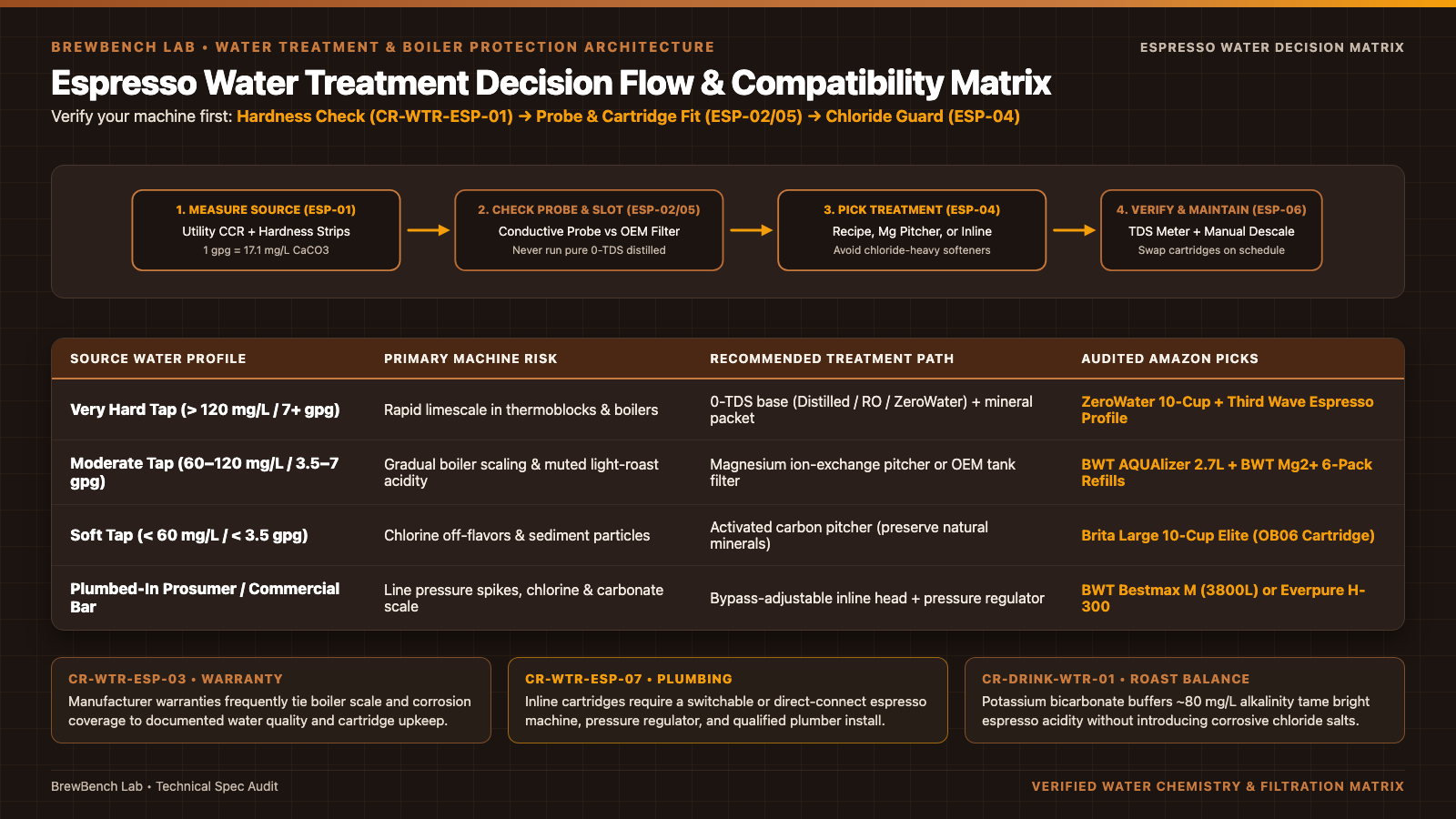
Selecting the best water for espresso machine longevity requires diagnosing your tap supply first rather than buying filters blindly. Follow these five technical steps—built strictly for machine care and flavor balance—before investing in pitchers, mineral sticks, or inline plumbing hardware.
1. Measure Your Tap Hardness and Alkalinity First (CR-WTR-ESP-01)
Pull your city’s annual Consumer Confidence Report (CCR) online or dip a hardness strip and drop-titration GH/KH kit into cold kitchen tap water. Never rely on a handheld TDS meter alone to diagnose tap water: two municipal supplies reading 160 ppm on a TDS-3 meter can behave completely differently if one is rich in calcium bicarbonate (heavy boiler scale) while the other is sodium-softened (low scale, elevated corrosion risk). Once you know your hardness in mg/L CaCO3 or grains per gallon, match your treatment tier accurately: soft water (< 60 mg/L) needs only activated carbon; moderate water (60–120 mg/L) suits a magnesium ion-exchange pitcher; hard water (> 120 mg/L) calls for remineralized 0-TDS base water or plumbed decarbonization.
2. Never Feed Pure Distilled or 0-TDS Water to Conductive Probes (CR-WTR-ESP-02)
Pure distilled water, un-remineralized reverse osmosis permeate, and fresh ZeroWater pitcher output share one seductive benefit—zero scale—and one costly mechanical trap. Many heat-exchanger and dual-boiler espresso machines detect water inside their steam boilers and supply reservoirs using stainless conductive level probes that pass a tiny electrical current through dissolved minerals. At 0 ppm TDS, water acts as an insulator rather than a conductor, causing the machine’s control board to stall on a false empty-tank alert or overfill the boiler. Always remineralize 0-TDS water with balanced mineral packets like Third Wave Water Espresso Profile before pouring it into any machine.
3. Avoid Chloride Corrosion & Unmonitored Salt Softeners (CR-WTR-ESP-04)
Softer water is not automatically safe water for metal espresso internals. Whole-house salt-brine ion-exchange softeners swap calcium and magnesium for high sodium levels while leaving carbonate alkalinity intact and sometimes raising dissolved chloride ratios—creating salty, flat espresso and corrosive boiler chemistry over time. Similarly, non-espresso remineralization packets built for filter coffee often include sodium chloride to brighten light-roast acidity. For metal boiler espresso machines, prioritize chloride-free formulas buffered with potassium bicarbonate and magnesium sulfate.
4. Match Reservoir Pitchers vs. Plumbed Inline Filtration (CR-WTR-ESP-05 & CR-WTR-ESP-07)
If your espresso machine pulls strictly from a lift-out water tank, keep your filtration setup countertop-simple: either run the manufacturer’s OEM reservoir filter cartridge where warranty terms require it, pour from a BWT AQUAlizer magnesium pitcher, or mix remineralized 1-gallon jugs. Reserve inline systems like the BWT Bestmax M or Pentair Everpure H-300 strictly for direct-plumb rotary-pump espresso machines—or dedicated cold-water kitchen prep faucets—installed by a qualified plumber with an inline pressure regulator calibrated to your espresso maker’s inlet pressure specification.
5. Warranty Alignment, Ongoing Costs & Manual-First Descaling (CR-WTR-ESP-03 & CR-WTR-ESP-06)
Before changing your water strategy, read your espresso machine’s US warranty coverage and maintenance section (CR-WTR-ESP-03). Many manufacturers tie boiler and pump warranty claims to documented water hardness limits, OEM reservoir cartridge changes, and scheduled maintenance—and scale damage is routinely excluded as wear-and-tear. Furthermore, water prevention is separate from descaling (CR-WTR-ESP-06): never guess DIY citric or vinegar acid ratios, never descale aluminum-boiler machines with unapproved acids that pit soft aluminum, and follow your owner’s manual verbatim—especially on dual-boiler machines where manufacturers restrict owner descaling in favor of authorized service centers. Budget ongoing consumables honestly under CR-SYS-04: count replacement pitcher cartridges every 4 weeks to 6 months, or mineral sticks plus distilled water per gallon.
Mineral Remineralization Packets vs. Magnesium Ion-Exchange Pitchers
Home baristas most often decide between buying remineralization packets (such as Third Wave Water Espresso Profile) and filtering tap water through a magnesium ion-exchange pitcher (such as the BWT AQUAlizer). Choose remineralization packets if your municipal water exceeds 120–150 mg/L total hardness, fluctuates wildly between seasons, or feeds a multi-thousand-dollar dual boiler where eliminating scale completely matters most. Choose a magnesium ion-exchange pitcher if your tap hardness sits comfortably in the moderate 60–120 mg/L window and you value fast faucet-to-tank refills with zero plastic gallon jugs cluttering your pantry.
Evaluation Methodology, Scoring Rubric & Excluded Approaches
BrewBench Lab evaluates the best water for espresso machine ownership through manufacturer specification verification, SCA chemical target cross-checks, boiler metallurgy rules, and total ownership cost modeling rather than fabricated bench telemetry. Every product scored below passes strict Amazon US availability verification and maps cleanly to our Editorial Evaluation Methodology.
| Evaluation Criterion | Weight | What We Audited |
|---|---|---|
| Boiler & Probe Protection Fit | 35% | Calcium carbonate hardness control (CR-WTR-ESP-01), zero/low chloride metallurgy safety (CR-WTR-ESP-04), and conductive probe reliability (CR-WTR-ESP-02). |
| Filter & Plumbing Compatibility | 25% | Clear reservoir vs. direct-plumb installation scope (CR-WTR-ESP-07), cartridge housing standards (CR-WTR-ESP-05), and warranty alignment (CR-WTR-ESP-03). |
| Extraction Balance & Alkalinity Control | 20% | Proximity to SCA target hardness (~68 mg/L), controlled bicarbonate buffering (CR-DRINK-WTR-01), and activated carbon chlorine removal. |
| Value & Ongoing Consumable Cost | 20% | Predictable per-gallon or per-liter operating costs (CR-SYS-04) across TIER-WTR-BASIC, TIER-WTR-RECIPE, and TIER-WTR-PLUMBED brackets. |
Approaches & Products We Audited & Excluded (And Why)
- Third Wave Water Classic Light Roast Profile (For Metal Espresso Boilers): Excluded as a primary espresso recommendation under CR-WTR-ESP-04 because the Classic Light Roast formula uses sodium chloride for bright pour-over extraction, introducing chloride ions that Third Wave Water’s own Espresso Profile swaps out for potassium bicarbonate.
- Generic Multi-Brand “Universal Compatible” Reservoir Cartridges: Disqualified under CR-WTR-ESP-05 because OEM Breville, De’Longhi, Jura, and Philips tank filters rely on proprietary shapes, seals, or smart chips—generic listings rely strictly on unverified confidence-C fit claims.
- Straight Un-Remineralized Distilled or Reverse Osmosis Water: Disqualified under CR-WTR-ESP-02 because 0-TDS water blinds conductive boiler level probes, triggers false refill errors, and pulls hollow, overly sharp extractions.
- Whole-House Salt-Brine Ion-Exchange Softeners (Unmonitored): Excluded under CR-WTR-ESP-04 because conventional brine softeners elevate sodium without stripping carbonate alkalinity or lowering chloride corrosion potential inside hot espresso boilers.
Continue Your Audit
Frequently Asked Questions About Espresso Machine Water
What is the best water for espresso machine boilers and thermoblocks?
The best water for espresso machine boilers combines 50–85 mg/L total hardness (CaCO3), 40–80 mg/L alkalinity, zero chlorine, and roughly 75–150 ppm TDS. Remineralized recipes like Third Wave Water Espresso Profile or magnesium ion-exchange pitchers hit this window while preventing scale and probe errors.
Can I use pure distilled water in an espresso machine?
No—never run straight 0-TDS distilled or un-remineralized RO water inside a boiler espresso machine. Conductive water-level probes need dissolved minerals to detect tank and boiler levels, and mineral-free water pulls flat, sour shots while accelerating metal leaching over time.
What is the difference between Third Wave Water Espresso Profile and Classic Profile?
Third Wave Water Espresso Profile replaces the sodium chloride found in the Classic Light Roast Profile with potassium bicarbonate. Eliminating chlorides protects stainless steel and brass espresso boilers from pitting corrosion while buffering bright espresso acidity smoothly.
Does a standard Brita pitcher soften hard water enough for espresso?
Standard carbon pitchers like the Brita Elite excel at removing 97%+ of chlorine taste and sediment, but they provide minimal calcium hardness reduction. If your tap water measures above 85 mg/L CaCO3, choose a magnesium ion-exchange pitcher like BWT AQUAlizer or remineralized distilled water.
Do I still need to descale if I use filtered or recipe espresso water?
Follow your espresso machine manufacturer’s manual strictly. Scale-free mineral recipes drastically reduce mineral buildup, yet many thermoblock and single-boiler brands tie warranty coverage to periodic maintenance cycles, while some dual-boiler makers restrict owner descaling altogether.
Why does water alkalinity matter for light-roast espresso?
Carbonate alkalinity buffers coffee acids during extraction. High-alkalinity municipal tap water neutralizes organic acids too aggressively, making bright light-roast espresso taste chalky and flat, whereas controlled 40–80 mg/L buffering preserves sweetness and clean acidity.
Final Verdict: Picking the Best Water for Espresso Machine Reliability
Locking in the best water for espresso machine longevity is one of the highest-return upgrades on any home bar, costing pennies per shot compared with descaling clogged thermoblocks or servicing scaled dual boilers. For maximum boiler safety and repeatable espresso sweetness regardless of ZIP code, Third Wave Water Espresso Profile takes our #1 Overall award thanks to its zero-chloride potassium bicarbonate chemistry and conductive-probe-ready ~150 ppm output—especially when paired with a ZeroWater 10-Cup Pitcher and HM Digital TDS-3 Meter to make 0-TDS base water at home.
If your municipal supply sits in the moderate 60–120 mg/L hardness band and you want effortless countertop pours, pick the BWT AQUAlizer 2.7L Pitcher alongside a BWT Magnesium 6-Pack refill kit. Soft-water households (< 60 mg/L) can rely economically on the Brita Large 10-Cup Elite Pitcher for chlorine removal, while plumbed-in prosumer bars should step up to the BWT Bestmax M or Pentair Everpure H-300 installed by a qualified plumber with proper line pressure regulation.


