Disclosure: As an Amazon Associate, I earn from qualifying purchases. If you buy through links on this page, we may earn a small commission at no extra cost to you.
Finding the best espresso machine for home comes down to matching heating architecture, portafilter ecosystem, and grinder expectations to the drinks you actually pour every morning. Supermarket pump labels brag about 15-bar or 20-bar output, yet those numbers reveal almost nothing about temperature stability, steam recovery, or whether your counter supports a compact thermoblock or a true dual boiler.
For this flagship audit, we evaluated 18 released 120V/60Hz machines actively stocked on Amazon US and narrowed the field to 10 distinct setups spanning from under $200 to over $1,000. Whether you want an integrated grinder in one box or plan to build a modular bar around our home espresso setup guide and dedicated espresso grinder picks, every machine below is verified against North American electrical specs, portafilter standards, and manufacturer care rules.
In This Guide
Quick Picks: Best Espresso Machine for Home at a Glance
#1 Best Overall
Breville Barista Express Impress (BES876BSS)
Integrated 25-step conical grinder, assisted 22 lb lever tamping, PID thermocoil, and 54mm single-wall plus dual-wall baskets in one balanced footprint. (Jump to audit)
#2 Best Compact & Auto-Milk
Breville Bambino Plus (BES500BSS)
Rapid 3-second ThermoJet heat-up, three-way solenoid valve, and hands-free microfoam texturing in a 7.7-inch wide chassis ready for external grinders. (Jump to audit)
#3 Best Prosumer Dual Boiler
Rancilio Silvia Pro X
Independent 0.3 L coffee and 1.0 L steam boilers with dual PIDs, commercial 58mm hardware, and simultaneous steam on a standard 120V plug. (Jump to audit)
Side-by-Side Comparison: Top 10 Home Espresso Machines
| Product & Award | Best For | Heating & Portafilter | 120V Draw & Tier | Link |
|---|---|---|---|---|
| Breville Barista Express Impress (BES876BSS) Best Overall | All-in-one guided home espresso | Thermocoil PID • 54mm | 1,750W (NEMA 5-15P) $500–$1,000 | View on Amazon |
| Breville Bambino Plus (BES500BSS) Best Compact | Small kitchens & daily lattes | ThermoJet • 54mm | 1,560W (NEMA 5-15P) $200–$500 | View on Amazon |
| Rancilio Silvia Pro X Best Prosumer Dual Boiler | Simultaneous steam & light roasts | Dual Boiler + Dual PID • 58mm | 950W–1,000W (NEMA 5-15P) Over $1,000 | View on Amazon |
| Breville Dual Boiler (BES920XL) Best Feature-Rich 58mm | Programmable pre-infusion & PID | Dual Boiler + Heated Group • 58mm | 1,700W (NEMA 5-15P) Over $1,000 | View on Amazon |
| Breville Barista Pro (BES878BSS) Best Fast-Heat All-in-One | 3-second heat-up & 30 grind steps | ThermoJet PID • 54mm | 1,680W (NEMA 5-15P) $500–$1,000 | View on Amazon |
| Gaggia Classic Evo Pro Best Moddable 58mm Entry | Enthusiast modding & repairability | Single Boiler • 58mm | 1,350W–1,425W (NEMA 5-15P) $200–$500 | View on Amazon |
| Ninja Luxe Café Premier (ES601) Best Multi-Brew Beginner | Espresso, drip & cold brew | Thermoblock + Built-In Scale • 53mm | 1,650W (NEMA 5-15P) $200–$500 | View on Amazon |
| De’Longhi La Specialista Maestro Best Dual-Milk Hybrid | Manual wand + auto milk carafe | Dual Heating System • 51mm | 1,450W–1,600W (NEMA 5-15P) $500–$1,000 | View on Amazon |
| De’Longhi La Specialista Touch Best Guided Touchscreen | Visual touchscreen & cold extraction | Thermoblock • 51mm | 1,450W (NEMA 5-15P) $500–$1,000 | View on Amazon |
| De’Longhi Dedica Maestro Best Budget Under $200 | Narrow budget counters | Thermoblock • 51mm | 1,450W (NEMA 5-15P) Under $200 | View on Amazon |
Match Your Use Case: Choosing the Best Espresso Machine for Home Workflow
Before selecting a SKU, map your household drink volume, available counter height, and willingness to dial in a separate grinder. If your shopping focus centers on tight budgets or specialty milk routines, cross-reference our dedicated comparisons of espresso machines under $500, mid-range espresso machines under $1,000, beginner-friendly home machines, and espresso machines built for daily lattes.
| Buyer Scenario | Best Match | Why & Expected Outcome |
|---|---|---|
| First-time one-box home barista | Breville Barista Express Impress | Integrated 25-step grinder, intelligent dosing, and assisted 22 lb lever tamping eliminate countertop mess while teaching puck resistance. |
| Small apartment & daily lattes | Breville Bambino Plus | 7.7-inch footprint heats in seconds and delivers hands-free microfoam once paired with an entry espresso burr grinder. |
| Entertaining & light-roast precision | Rancilio Silvia Pro X | Dual PID boilers brew and steam simultaneously on a 120V 15A outlet with heavy brass/stainless 58mm thermal stability. |
| Hands-on 58mm modding enthusiast | Gaggia Classic Evo Pro | Factory 9-bar US OPV spring, 58mm portafilter, and three-way solenoid valve invite long-term gasket upkeep and PID upgrades. |
| Mixed household (drip, iced & espresso) | Ninja Luxe Café Premier ES601 | Built-in weight scale, 25-setting grinder, and Dual Froth pitcher handle espresso, cold brew, and batch filter style seamlessly without guesswork. |
| Strict starter budget under $200 | De’Longhi Dedica Maestro | Slim 8.15-inch thermoblock fits tight counters and includes both pressurized and single-wall 51mm baskets for gradual upgrades. |
Detailed Audits: 10 Verified 120V Espresso Machines
1. Breville Barista Express Impress (BES876BSS) — Best Overall Home Espresso Machine

Quick Specs: Thermocoil PID (sequential brew/steam) | 54mm Breville-pattern portafilter (single-wall & dual-wall baskets) | 25-step conical burr grinder + assisted lever tamp | 120V/60Hz, 1,680W–1,750W (NEMA 5-15P) | 2.0 L (67 fl oz) reservoir | Price Tier: $500–$1,000
Audit Score: 9.1 / 10
- Thermal & Pressure Stability (35%): 9.0 / 10
- Build & Serviceability (25%): 8.9 / 10
- Steam Power & Workflow (20%): 9.2 / 10
- Value (20%): 9.3 / 10
Rather than forcing beginners to juggle a separate grinder, dosing funnel, and countertop tamper mat, the Breville Barista Express Impress integrates an intelligent dosing and assisted-tamping assembly directly above its 54mm group. Per Breville USA’s BES876 specifications, the lever compresses coffee grounds inside the portafilter with roughly 22 lb (10 kg) of downward force and finishes with a 7-degree twist, automatically recalibrating the next grind dose if the puck height indicator reads low or overfilled.
Underneath that convenience sits a PID-controlled thermocoil heating block, low-pressure pre-infusion, an analog extraction pressure gauge, and a three-way solenoid valve that relieves residual water pressure cleanly after each shot. While the pump carries a standard 15-bar ceiling rating, the internal over-pressure valve regulates brew delivery near the conventional 9-bar espresso zone. Compared with the Breville Barista Pro (BES878BSS), the Express Impress takes slightly longer to switch from brewing to steaming and uses 25 grind steps instead of 30, but wins back points for beginners with its analog gauge and zero-mess tamping workflow.
Buyer Verification Alert: Confirm the listing explicitly states BES876 (Express Impress) rather than the older BES870XL (Barista Express). Although both share a 54mm Breville lug standard (incompatible with 58mm tools), the BES870XL lacks assisted lever tamping and uses coarser 16-step external grinder clicks.
Pros
- Assisted 22 lb Impress tamping and auto-dose feedback keep counters clean and puck prep consistent
- PID thermocoil, three-way solenoid valve, and analog brew gauge provide reliable diagnostic feedback
- Includes both single-wall and pressurized 1-cup/2-cup 54mm baskets plus Claro Swiss reservoir filter support
Cons
- Sequential thermocoil cannot brew and steam simultaneously for multi-guest latte sessions
- Built-in 25-step conical grinder restricts ultra-light roast dialing compared with standalone flat-burr grinders
- Roughly 4.0-inch (102 mm) under-spout cup clearance requires a compact 0.1 g scale for espresso mugs
Verdict: Buy it if you want a low-mess, guided all-in-one espresso machine with PID control and manual microfoam texture. Skip it if you drink dense Nordic light roasts or entertain groups demanding simultaneous steam. Keep the 2.0 L reservoir fitted with Breville water filters and add a compact 0.1 g espresso scale for yield tracking.
2. Breville Bambino Plus (BES500BSS) — Best Compact Espresso Machine

Quick Specs: ThermoJet (maker states ~3-second heat-up; sequential brew/steam) | 54mm Breville-pattern portafilter (single-wall & dual-wall) | Auto-froth & manual steam wand | 120V/60Hz, 1,560W–1,600W (NEMA 5-15P) | 1.9 L (64 fl oz) tank | Price Tier: $200–$500
Audit Score: 9.0 / 10
- Thermal & Pressure Stability (35%): 8.7 / 10
- Build & Serviceability (25%): 8.6 / 10
- Steam Power & Workflow (20%): 9.4 / 10
- Value (20%): 9.3 / 10
At just 7.7 inches wide and 12.5 inches deep, the Breville Bambino Plus reclaims counter space without sacrificing daily latte convenience. As outlined on Breville’s US BES500 product page, the proprietary ThermoJet heater reaches extraction readiness in roughly three seconds, executes automated low-pressure pre-infusion, and vents spent puck moisture through a three-way solenoid valve so knocking out pucks stays tidy.
Its standout feature for milk drinkers is the temperature-sensing automatic steam wand, offering three milk temperatures and three foam textures hands-free—or full manual control whenever you want to practice free-pour latte art. Against the De’Longhi Dedica Maestro, the Bambino Plus steams dramatically faster and avoids wet, dripping pucks thanks to that solenoid valve. Because no grinder sits on board, pairing the included single-wall baskets with an espresso-capable burr grinder (setting aside roughly one-third of your setup budget) is mandatory for real crema and resistance.
Buyer Verification Alert: Do not mix up the Bambino Plus (BES500) with the entry Bambino (BES450). Only the BES500 adds the automatic milk-frothing temperature sensor, three-way solenoid valve, and larger 1.9 L reservoir.
Pros
- Narrow 7.7-inch footprint and near-instant ThermoJet startup suit small kitchens and busy mornings
- Hands-free auto-froth wand purges automatically and produces consistent microfoam in the supplied 16 oz stainless jug
- Three-way solenoid valve and generous ~5.0-inch (127 mm) under-spout cup clearance accommodate scales cleanly
Cons
- Requires an external espresso burr grinder to unlock the included single-wall 54mm baskets
- Fixed PID brew temperature prevents raising heat for high-density light roasts
- Light chassis slides unless you brace the top frame when locking the 54mm portafilter
Verdict: Buy it if you want effortless daily milk drinks in minimal counter space and plan to pair a dedicated grinder. Skip it if you prefer manual light-roast temperature adjustments or pull four lattes concurrently. Upgrade early with a 53.3mm/54mm calibrated metal tamper to replace the light stock tamper.
3. Rancilio Silvia Pro X — Best Prosumer Dual-Boiler Espresso Machine

Quick Specs: Dual Boiler (0.3 L coffee + 1.0 L steam) + Dual PID + Soft Pre-Infusion | 58mm Rancilio commercial portafilter | Simultaneous brew & steam + hot-water tap | 120V/60Hz, 950W–1,000W US spec (NEMA 5-15P) | 2.0 L tank | Price Tier: Over $1,000
Audit Score: 9.2 / 10
- Thermal & Pressure Stability (35%): 9.6 / 10
- Build & Serviceability (25%): 9.5 / 10
- Steam Power & Workflow (20%): 9.2 / 10
- Value (20%): 8.4 / 10
Among prosumer machines available on Amazon US, the Rancilio Silvia Pro X sets the benchmark for mechanical durability and genuine commercial thermal stability. Per Rancilio Group’s official North American specifications, this compact dual-boiler couples an insulated 0.3 L coffee boiler with a 1.0 L stainless-steel steam boiler, each regulated by independent PID controllers so you can pull temperature-sensitive light roasts while texturing milk in a 20 oz pitcher concurrently.
Rancilio also solves classic Silvia complaints by integrating an analog pump pressure gauge, an adjustable 0–6 second soft pre-infusion cycle, a digital shot timer, and a wake-up scheduler that warms the heavy 58mm brass group before your alarm. Unlike the Breville Dual Boiler (BES920XL), the Silvia Pro X strips away menu-heavy electronics in favor of service-friendly Italian plumbing and commercial gaskets, running cleanly at 950W–1,000W on a standard 120V/60Hz NEMA 5-15P 15-amp residential outlet without tripping kitchen breakers.
Buyer Verification Alert: The steam boiler uses conductive autofill probes to detect water level. Never feed pure distilled or near-zero-TDS reverse osmosis water into the 2.0 L reservoir—always use SCA-balanced remineralized water or filtered tap water within maker mineral ranges.
Pros
- True simultaneous brewing and heavy dry steam on standard 120V/15A circuits (950W–1,000W US draw)
- Independent PID controls, soft pre-infusion (0–6 s), brew pressure gauge, and programmable wake-up timer
- Heavy stainless chassis and commercial 58mm Rancilio brass group built for decades of gasket/part servicing
Cons
- Boiler heat-up takes far longer than ThermoJet models and uses a top-access tank requiring cabinet clearance
- Ships with single-wall commercial baskets only and demands a prosumer 64mm+ burr grinder to match its group stability
- Tight under-spout clearance above a shallow drip tray requires a slim espresso scale or bottomless portafilter
Verdict: Buy it if you want commercial longevity, simultaneous entertaining steam power, and dual-PID precision on a standard 15A US outlet. Skip it if you want instant morning heat-up or an integrated grinder. Pair it with a 58.5mm calibrated tamper, a low-profile 0.1 g scale, and a single-dose flat-burr grinder.
4. Breville Dual Boiler (BES920XL) — Best Feature-Rich 58mm Dual Boiler

Quick Specs: Dual Stainless Boilers + Heated 58mm Group + PID | 58mm Breville-pattern portafilter (Breville 58mm lug pattern) | Simultaneous brew & steam + hot-water tap | 120V/60Hz, 1,700W (NEMA 5-15P) | 2.5 L front/top-fill tank | Price Tier: Over $1,000
Audit Score: 9.0 / 10
- Thermal & Pressure Stability (35%): 9.5 / 10
- Build & Serviceability (25%): 8.3 / 10
- Steam Power & Workflow (20%): 9.3 / 10
- Value (20%): 9.0 / 10
For espresso tinkerers who judge machines by extraction control per dollar rather than chrome E61 aesthetics, the Breville Dual Boiler remains uniquely capable. According to Breville USA’s BES920 specifications, it combines an actively PID-heated 58mm group head with dedicated stainless brew and 950 ml (32 fl oz) steam boilers, letting you adjust shot temperature, programmable low-pressure pre-infusion duration and percentage, and timed or volumetric outputs simultaneously.
Daily kitchen ergonomics also outshine traditional Italian prosumers. A front-accessible fill funnel lets you top up the 2.5 L (84 fl oz) tank beneath 18-inch US upper cabinets without dragging the machine out, and a drop-down rear swivel foot eases counter movement. Compared with the Rancilio Silvia Pro X, the BES920XL gives you deeper pre-infusion programmability and a larger tank, though Rancilio counters with simpler internal electronics and heavier commercial metalwork. Note that at 1,700W on 120V, avoid operating an electric kettle or toaster on the same 15A circuit.
Buyer Verification Alert: A 58mm diameter label alone does not guarantee compatibility. The BES920XL uses Breville’s proprietary 58mm ear geometry and will NOT lock into standard E61 bottomless portafilters—buy only 58mm portafilters explicitly listed for Breville Dual Boiler/Oracle models.
Pros
- Three-zone PID regulation (brew boiler, 950 ml steam boiler, and heated 58mm group) plus programmable pre-infusion
- Front water fill port, 2.5 L capacity, dedicated hot-water spout, and built-in auto-start timer ease morning routines
- Simultaneous steaming and extraction on a standard 120V NEMA 5-15P plug without a 20A circuit upgrade
Cons
- Proprietary Breville 58mm portafilter ears reject standard E61 bottomless handles
- 1,700W 120V load leaves little headroom for kettles or toasters on the same kitchen circuit
- Complex internal O-rings, steam probes, and descale procedures require careful adherence to Breville’s 2-year warranty manual
Verdict: Buy it if you want maximum digital pre-infusion tuning, simultaneous steam, and a front-fillable 58mm dual boiler without E61 warm-up waits. Skip it if you want universal E61 portafilter sharing or purely mechanical switches. Pair it with a 64mm flat-burr grinder and Breville reservoir water filters.
5. Breville Barista Pro (BES878BSS) — Best Fast-Heat Integrated-Grinder Machine

Quick Specs: ThermoJet PID (maker states ~3-second heat-up; sequential) | 54mm Breville portafilter (single-wall & dual-wall) | 30-step conical burr grinder + LCD display | 120V/60Hz, 1,680W (NEMA 5-15P) | 2.0 L tank + hot-water spout | Price Tier: $500–$1,000
Audit Score: 8.9 / 10
- Thermal & Pressure Stability (35%): 8.9 / 10
- Build & Serviceability (25%): 8.7 / 10
- Steam Power & Workflow (20%): 9.1 / 10
- Value (20%): 8.9 / 10
For impatient weekday mornings when waiting on a traditional boiler or even a standard thermocoil feels sluggish, the Breville Barista Pro upgrades Breville’s mid-tier all-in-one platform to a 3-second ThermoJet heater and a crisp LCD progress screen. According to Breville’s BES878 specifications, the digital PID supports 2 °F / 1 °C temperature adjustments, while the integrated conical grinder expands external adjustment granularity to 30 settings alongside an adjustable inner upper burr.
Compared directly against the Breville Barista Express Impress (BES876BSS), the Barista Pro delivers faster brew-to-steam transitions, a stronger 4-hole steam wand tip, and an extra five grind settings for dialing in medium-light blends. In exchange, you forfeit assisted lever tamping and the analog brew pressure needle, relying instead on manual puck prep and timed LCD shot tracking. Like every built-in-grinder unit, keeping beans fresh by weighing single doses into the hopper dramatically improves consistency.
Buyer Verification Alert: Newer US production runs of the BES878BSS incorporate Baratza-designed M2 conical burrs rather than earlier 6-point Breville burrs, while exterior styling stays identical. Check seller manufacturing batch notes if burr revision matters to you.
Pros
- Three-second ThermoJet startup and near-zero wait switching between espresso extraction and 4-hole steaming
- 30 external grind steps plus internal upper-burr adjustment offer finer dialing control than the BES876BSS
- Dedicated hot-water spout and 2 °F digital PID offset steps accommodate Americanos and medium-light roasts
Cons
- Lacks an analog extraction pressure gauge and requires manual tamping with a light stock tamper
- Sequential ThermoJet cannot steam and pull espresso simultaneously for larger rounds
- Dosing directly from the built-in chute spills easily without adding a 54mm dosing funnel
Verdict: Buy it if speed, 30-step grinding, and faster 4-hole milk steaming matter more to you than assisted tamping. Skip it if you want a mechanical pressure gauge or guided lever tamping. Add a magnetic 54mm dosing funnel and a 53.3mm/54mm spring tamper on day one.
6. Gaggia Classic Evo Pro (Jungle Green) — Best Moddable 58mm Single-Boiler Classic

Quick Specs: Single Boiler (thermostat control; sequential brew/steam) | 58mm Gaggia stainless portafilter (single-wall & pressurized) | 9-bar US OPV spring + 3-way solenoid | 120V/60Hz, 1,350W–1,425W (NEMA 5-15P) | 2.1 L tank | Price Tier: $200–$500
Audit Score: 8.5 / 10
- Thermal & Pressure Stability (35%): 7.9 / 10
- Build & Serviceability (25%): 9.2 / 10
- Steam Power & Workflow (20%): 8.0 / 10
- Value (20%): 9.1 / 10
When buyers ask for a machine under $500 built like an entry-level Italian café workhorse rather than a sealed consumer appliance, the Gaggia Classic Evo Pro remains the standout mechanical choice. Its powder-coated stainless body, commercial 58mm stainless-steel portafilter, brass group head, three-way solenoid valve, and factory-calibrated 9-bar US over-pressure valve spring deliver authentic extraction mechanics and straight-forward gasket servicing for owners willing to learn manual temperature surfing.
Still, transparency matters here. Compared with the Breville Bambino Plus, the Classic Evo Pro lacks digital PID stability out of the box and requires preheating plus careful brew-to-steam boiler toggling. More critically, early 2023 Classic Evo Pro batches experienced interior PTFE-style boiler coating flaking—widely dubbed “Boilergate”—before Gaggia transitioned subsequent production (the E24 update) to an uncoated lead-free brass boiler. According to Gaggia North America’s warranty and support policies, authorized US buyers with affected coated boilers received replacement units or brass boiler warranty kits, and owners of aluminum-boiler units must use only Gaggia-approved descaler rather than generic citric acid.
Buyer Verification Alert: Check Amazon seller batch details and serial labels to confirm whether the unit is an updated uncoated brass-boiler E24 revision or carries Gaggia North America authorized warranty coverage. Also verify 58mm accessories list Gaggia 2-ear lugs (Gaggia 2-ear 58mm pattern), not E61 portafilters.
Pros
- True 58mm stainless portafilter, US 9-bar OPV calibration, and three-way solenoid valve allow blind-basket backflushing
- Compact 8.0-inch wide stainless chassis and rocker-switch simplicity make routine service and PID mods accessible
- 2-hole commercial steam wand builds genuine microfoam once you learn single-boiler steam timing
Cons
- Thermostat-based single boiler swings in temperature without temperature surfing or an aftermarket PID kit
- Documented coated-boiler flaking history on early Evo Pro batches demands seller verification and strict OEM descaler adherence
- Limited steam capacity drops off during larger 12+ oz milk pitchers and delays sequential lattes
Verdict: Buy it if you want a mechanical 58mm Italian platform you can maintain, modify, and pair with an espresso grinder for years. Skip it if you want instant push-button PID stability or automated steaming. Budget immediately for a capable espresso burr grinder, a 58.5mm tamper, and Gaggia-approved descaling solution.
7. Ninja Luxe Café Premier 3-in-1 (ES601) — Best Guided Multi-Brew Beginner System

Quick Specs: Thermoblock with preset temp profiles (sequential) | 53mm proprietary Ninja portafilter (Single, Double & Luxe single-wall baskets) | Built-in scale + 25-step conical burr grinder | 120V/60Hz, 1,650W (NEMA 5-15P) | 70 fl oz (2.07 L) tank | Price Tier: $200–$500
Audit Score: 8.7 / 10
- Thermal & Pressure Stability (35%): 8.4 / 10
- Build & Serviceability (25%): 8.2 / 10
- Steam Power & Workflow (20%): 9.1 / 10
- Value (20%): 9.3 / 10
Few machines under $500 remove as much early espresso guesswork as the Ninja Luxe Café Premier ES601. Rather than shipping fake-crema pressurized baskets, SharkNinja packs three genuine single-wall baskets (Single, Double, and an extra-deep Luxe basket) alongside Barista Assist technology that tracks extraction speed and recommends exact adjustments across its 25-step conical burr grinder, while an internal scale weighs every ground dose straight into the portafilter.
Beyond 9-bar espresso shots, the ES601 bridges drip coffee and rapid cold-pressed cold brew inside one 1,650W 120V countertop chassis, and its Dual Froth System integrates a magnetic whisk inside the milk pitcher for effortless hot or cold microfoam. Compared with the Breville Barista Express Impress, Ninja wins on price tier, built-in weighing, and iced-drink versatility, whereas Breville offers superior manual steam wand control for pouring latte art and access to universal 54mm third-party accessories.
Buyer Verification Alert: Despite some third-party accessory ads rounding it to 54mm, the Ninja Luxe Café uses a proprietary 53mm basket and lug geometry—54mm Breville portafilters and puck screens will not lock properly. Also distinguish the ES601 Premier (3-in-1) from the pricier ES701 Pro (4-in-1 with integrated lever tamper).
Pros
- Integrated weight scale and Barista Assist grind recommendations automate dosing without buying an external scale first
- Includes Single, Double, and XL Luxe single-wall baskets plus rapid cold brew and batch drip profiles
- Dual Froth pitcher textures dairy and plant milks hands-free for both hot lattes and cold foam drinks
Cons
- Proprietary 53mm group standard locks out Breville 54mm and commercial 58mm bottomless portafilters
- Whisk-assisted Dual Froth pitcher prioritizes thick foam consistency over fine manual free-pour latte art texture
- Preset temperature steps and 25-click grinder limit light-roast experimentation compared with dual-boiler PID rigs
Verdict: Buy it if your household drinks espresso, iced cold brew, and drip coffee and wants built-in weight dosing under $500. Skip it if you love free-pour manual steaming or aftermarket 54mm/58mm modding. Keep the 70 fl oz reservoir supplied with filtered water to protect the thermoblock.
8. De’Longhi La Specialista Maestro — Best Dual-Milk & Cold Extraction Hybrid

Quick Specs: Dual Heating System (brew + dedicated steam) | 51mm 3-ear De’Longhi portafilter (single-wall) | 8-step grinder + Smart Tamping lever | My LatteArt wand + LatteCrema Hot carafe | 120V/60Hz, 1,450W–1,600W (NEMA 5-15P) | 2.5 L (84.5 fl oz) tank | Price Tier: $500–$1,000
Audit Score: 8.6 / 10
- Thermal & Pressure Stability (35%): 8.5 / 10
- Build & Serviceability (25%): 8.4 / 10
- Steam Power & Workflow (20%): 9.1 / 10
- Value (20%): 8.3 / 10
Most home espresso machines force households to choose between an automatic milk carafe and a manual steam wand. The De’Longhi La Specialista Maestro solves that household split by bundling both: you can snap on the LatteCrema Hot carafe for push-button cappuccinos on rushed weekdays, or swing out the My LatteArt manual steam wand on weekends—powered by a dedicated dual heating circuit that shortens transition pauses and adds sub-5-minute Cold Extraction recipes per De’Longhi US documentation.
Smart Tamping compresses each 51mm single-wall basket inside the grinding cradle using a side-mounted lever, eliminating loose coffee dust around the counter. Compared with the De’Longhi La Specialista Touch, the Maestro gains a huge 2.5 L reservoir, dual heating, and the clip-on milk carafe, though its 8-step grinder dial offers wider jumps between clicks than the Touch’s 15-step burrs or Breville’s 25-step Impress dial.
Buyer Verification Alert: Measure your upper cabinet gap before ordering. At approximately 16.5 inches wide and 18.5 inches tall with its bean hopper installed, the La Specialista Maestro exceeds typical 18-inch US upper wall-cabinet clearance.
Pros
- Includes both a manual My LatteArt steam wand and an automated LatteCrema Hot milk carafe for mixed preferences
- Smart Tamping lever keeps puck compression uniform and mess-free alongside a 2.5 L (84.5 fl oz) water tank
- Cold Extraction mode brews low-pressure cold brew drinks in under five minutes alongside five active temp profiles
Cons
- 8-step conical burr dial leaves noticeably wider gaps between espresso settings than 25–30 step rivals
- Tall 18.5-inch profile with bean hopper crowds standard 18-inch US kitchen wall cabinets
- 51mm 3-ear portafilter restricts third-party precision basket upgrades compared with 54mm and 58mm ecosystems
Verdict: Buy it if your household wants both push-button milk carafe ease and manual steaming with cold brew capability. Skip it if you have low upper cabinets or want fine micro-stepped dialing for light roasts. Stick to dry-surface medium or dark beans in the hopper and follow De’Longhi’s EcoDecalk schedule.
9. De’Longhi La Specialista Touch — Best Guided Touchscreen Espresso Machine

Quick Specs: Thermoblock with 4 temp settings (sequential) | 51mm 3-ear De’Longhi portafilter (single-wall) | 15-step conical burr grinder + 3.5-in Bean Adapt touchscreen | Auto LatteArt wand | 120V/60Hz, 1,450W (NEMA 5-15P) | 57.5 fl oz (1.7 L) tank | Price Tier: $500–$1,000
Audit Score: 8.4 / 10
- Thermal & Pressure Stability (35%): 8.3 / 10
- Build & Serviceability (25%): 8.1 / 10
- Steam Power & Workflow (20%): 8.8 / 10
- Value (20%): 8.5 / 10
Designed specifically for beginners intimidated by analog dials and manual steaming, the De’Longhi La Specialista Touch pairs a 3.5-inch color touchscreen with interactive Bean Adapt guidance. After selecting roast level on screen, the interface walks you step by step through recommended grind setting (across 15 integrated burr steps), dose level, pre-infusion timing, and brew temperature, covering 10 preset hot and cold-extracted beverages.
Its Auto LatteArt steam wand automates milk temperature and foam density with a temperature sensor tucked inside the base, yet switches gracefully to manual positioning when you want direct control. Compared with the La Specialista Maestro, the Touch trims countertop width down to 11.22 inches—fitting comfortably beneath standard cabinets—and doubles grinder resolution from 8 steps to 15, while stepping down from dual heating and a clip-on carafe to a single 1,450W thermoblock.
Buyer Verification Alert: Check regional spec sheets carefully: European reviews of the EC9455.M frequently cite metric 1.8 L tanks and 230V heat timing, whereas the US 120V/60Hz model is rated at 1,450W with a 57.5 fl oz (1.7 L) reservoir. Also ensure aftermarket accessories match 51mm 3-ear De’Longhi lugs.
Pros
- 3.5-inch touchscreen and Bean Adapt coaching simplify dialing across 10 hot and cold-extraction presets
- 15-step conical burr grinder doubles the adjustment steps of the 8-step Maestro and ships with single-wall baskets
- Auto LatteArt steam wand delivers hands-free microfoam in a narrower 11.2-inch wide chassis
Cons
- Single thermoblock heats sequentially between espresso and milk steaming, slowing multi-cup rounds
- 51mm 3-ear portafilter standard offers fewer third-party precision baskets than 54mm or 58mm ecosystems
- Touchscreen electronics offer less user-serviceable longevity than mechanical switches on single-boiler rivals
Verdict: Buy it if you learn visually and want touchscreen coaching, cold-brew options, and automated steaming in a mid-sized counter footprint. Skip it if you prefer tactile switches or 54mm/58mm accessory upgrades. Register for De’Longhi’s US warranty coverage and run descaling cycles strictly per screen prompts.
10. De’Longhi Dedica Maestro — Best Budget Compact Under $200

Quick Specs: Thermoblock with 3 temperature settings (sequential) | 51mm 3-ear stainless portafilter (single-wall & dual-wall baskets) | Manual barista steam wand | 120V/60Hz, 1,450W (NEMA 5-15P) | 54 fl oz (1.6 L) tank | Price Tier: Under $200
Audit Score: 8.2 / 10
- Thermal & Pressure Stability (35%): 7.9 / 10
- Build & Serviceability (25%): 7.8 / 10
- Steam Power & Workflow (20%): 8.0 / 10
- Value (20%): 9.3 / 10
Most espresso machines under $200 ship exclusively with pressurized dual-wall baskets and single-thermostat heating that locks buyers out of genuine specialty extraction. The De’Longhi Dedica Maestro breaks out of that budget trap: US retail boxes supply both dual-wall pressurized baskets for pre-ground supermarket coffee and real single-wall baskets ready for when you upgrade to a dedicated espresso burr grinder, backed by three selectable brew temperature profiles inside an 8.15-inch wide body.
With a 54 fl oz (1.6 L) rear tank, manual barista-style steam wand, and up to 5.0 inches (127 mm) of cup clearance, it comfortably accommodates tall mugs or a low-profile 0.1 g scale on a dorm or studio counter. Compared with the Breville Bambino Plus, the Dedica Maestro drops automated milk texturing, 3-second ThermoJet speed, and a three-way solenoid valve, leaving wet pucks that need a moment to depressurize before unlocking—an expected trade-off at less than half the price tier.
Buyer Verification Alert: Check lug count before ordering aftermarket portafilters. The Dedica Maestro uses a 51mm 3-ear group shared with compact La Specialista machines—older 2-ear 51mm De’Longhi Stilosa or ECP portafilters will not lock into this head.
Pros
- US kits include both pressurized and single-wall 51mm baskets, smoothing the upgrade path from pre-ground coffee
- Three temperature settings and compact 8.15-inch width deliver exceptional capability under $200
- Generous 5.0-inch (127 mm) cup clearance and 1.6 L tank suit taller mugs without constant refills
Cons
- No three-way solenoid valve, leaving soupy pucks and disallowing blind-basket backflushing
- Single-wall baskets require adding an espresso-capable burr grinder
- Sequential thermoblock and narrow 51mm drip tray make steaming for multiple guests slow
Verdict: Buy it if you want a legitimate starter espresso machine under $200 that grows with you once you add a burr grinder. Skip it if you want dry solenoid pucks, automated milk frothing, or commercial 58mm parts. Upgrade with a fitted 51mm metal tamper before switching to the single-wall basket.
Buying Guide: How to Choose the Best Espresso Machine for Home
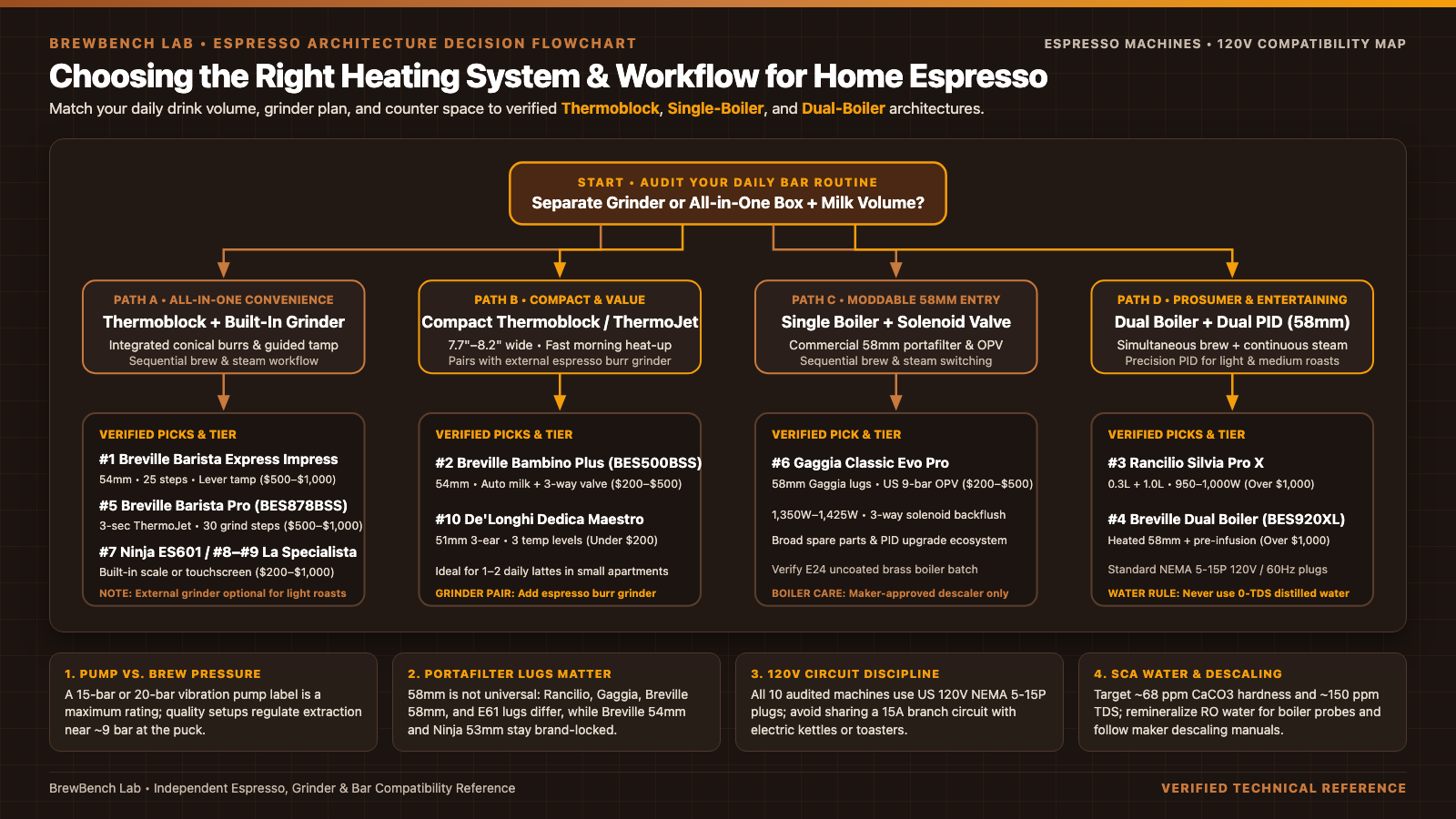
Marketing copy on Amazon espresso listings routinely obscures the engineering choices that actually dictate espresso sweetness, steam power, and long-term maintenance costs. Use the six technical checkpoints below to verify compatibility across your kitchen circuit, grinder, water chemistry, and daily drink schedule before clicking checkout.
1. Heating Architecture: Thermoblock vs. Single Boiler vs. Dual Boiler
A machine’s heating system determines how fast it reaches brew temperature, how consistently it holds thermal stability during extraction, and whether you can pull espresso and steam milk at the same time:
- Thermoblock & ThermoJet (Bambino Plus, Barista Express Impress, Barista Pro, Ninja ES601, Dedica Maestro): Water heats on demand as it flows through a heated aluminum block or thin-film coil. Startup takes seconds to a couple of minutes, making thermoblocks ideal for one or two daily milk drinks. Because one heater serves both tasks, brewing and steaming happen sequentially.
- Single Boiler (Gaggia Classic Evo Pro): One insulated metal vessel heats water to ~93 °C (200 °F) for espresso, then raises temperature past boiling (~130–145 °C) when you flip the steam switch. Single boilers offer strong dry steam and mechanical durability once warm, but require waiting between brewing and steaming and manual cooling before pulling another shot.
- Dual Boiler (Rancilio Silvia Pro X, Breville Dual Boiler BES920XL): Separate PID-regulated coffee and steam boilers operate independently. You pull shots at exact temperatures while steaming milk simultaneously—essential for households entertaining four or more guests or dialing light roasts back-to-back.
2. Pump Bar Ratings vs. ~9 Bar Extraction & Pre-Infusion
Ignore “15-bar” and “20-bar” headline claims when comparing an espresso machine. Those numbers reflect the theoretical dead-head pressure ceiling of an inexpensive vibration pump—never optimal extraction force. Conventional espresso extracts around 9 bar at the coffee puck, regulated by an over-pressure valve (OPV) like the factory US spring inside the Gaggia Classic Evo Pro or electronic PID pump regulation inside Breville and Rancilio rigs. Equally valuable is gentle low-pressure pre-infusion, which wets dry grounds evenly before full 9-bar pressure hits the puck to reduce channeling.
3. Portafilter Standards (51mm, 53mm, 54mm, 58mm) & Grinder Budget
A portafilter diameter measurement alone does not guarantee accessory fit. Inside the 58mm tier, Rancilio, Gaggia, Breville 58mm (BES920XL), and traditional E61 groups all use distinct ear thicknesses and angles. Breville’s 54mm machines share their own lug pattern, De’Longhi’s Dedica Maestro and La Specialista lines use 51mm 3-ear lugs (different from 2-ear Stilosa models), and Ninja’s Luxe Café uses a proprietary 53mm standard.
Basket geometry matters just as much as lug width. Pressurized (dual-wall) baskets build artificial backpressure through a pinhole exit so coarse pre-ground coffee produces foam, whereas single-wall (non-pressurized) baskets rely entirely on finely ground espresso resistance. If you buy a grinderless machine like the Bambino Plus, Gaggia Classic Evo Pro, Silvia Pro X, or BES920XL to use single-wall baskets, compatibility rules require pairing it with an espresso-rated burr grinder (allocating roughly one-third or more of your combined budget in our best espresso grinders audit).
4. US 120V Electrical Draw, NEMA Plugs & Counter Clearance
Every model in this 10-machine audit ships configured for 120V / 60Hz North American power with a standard three-prong NEMA 5-15P plug rated for 15-amp residential circuits. Never compare 230V European heat-up times or wattage figures to 120V US units, and never purchase 220–240V imports intending to use voltage converters. While units drawing 1,450W–1,750W (such as the BES876BSS or BES920XL) run safely on 15A receptacles, avoid plugging a 1,500W electric kettle or toaster into the same branch circuit while heating. If a future commercial machine ships with a horizontal-blade NEMA 5-20P plug, hire a licensed electrician to install a dedicated 20-amp NEMA 5-20R receptacle—never force or adapt a 20A plug onto a 15A circuit.
Also measure vertical space beneath wall cabinets before ordering. Standard US kitchen uppers hang roughly 18 inches above the counter. Tall integrated-grinder machines like the De’Longhi La Specialista Maestro (18.5 inches) or top-fill reservoirs like the Rancilio Silvia Pro X require pulling the chassis forward unless you opt for front-fill convenience like the Breville Dual Boiler. Finally, check under-spout cup clearance so your espresso mug plus a 0.1 g scale and 5 mm clearance margin fit cleanly without forcing you to pull shots onto a bare drip tray.
5. Water Hardness, Boiler Probes & Manufacturer Descaling Compliance
Tap water chemistry silently determines both extraction flavor and boiler lifespan. Following Specialty Coffee Association (SCA) water standards, espresso water targets roughly 68 ppm (mg/L as CaCO3, about 4 grains per gallon) total hardness, 40 ppm alkalinity, 150 ppm TDS (75–250 ppm acceptable range), zero chlorine, and minimal chloride (<30 ppm) to avoid pitting brass and stainless boilers. Measure tap hardness using simple hardness strips or your local US utility’s annual water quality report.
Avoid pouring pure distilled or zero-TDS reverse osmosis water directly into boiler machines fitted with conductive level probes (such as the Rancilio Silvia Pro X or Breville Dual Boiler)—sensors need dissolved minerals to read fill height. Instead, use manufacturer-matched tank cartridges (shape-locked to each brand) or properly remineralized distilled/RO water recipes. When descaling, follow each owner’s manual strictly: aluminum-boiler Gaggia machines must never receive DIY vinegar or unapproved citric acid concentrations that etch metal, and Breville Dual Boiler units specify precise descaling protocols tied to their 2-year limited warranty.
6. Upgrade Roadmap & Hidden Ownership Costs
Budget beyond the box price for essential bench accessories and routine consumables:
- Dedicated Espresso Burr Grinder (Grinderless Setups): Expect to allocate around $200–$500 for an espresso-capable stepped or stepless conical/flat burr grinder if buying the Bambino Plus, Classic Evo Pro, Dedica Maestro, or a dual boiler.
- 0.1 g Digital Scale & Fitted Tamper: A low-profile espresso scale (entry tier under $60) and a calibrated metal tamper matched to your exact basket inner diameter (51mm, 54mm, or 58.5mm) improve shot repeatability far more than cosmetic accessories.
- Ongoing Maintenance Supplies: Factor in shape-matched OEM water filter cartridges every two to three months, espresso cleaning tablets for three-way solenoid backflushing, manufacturer-approved descaling solution, and annual silicone group-head gaskets.
Methodology, Weighted Scoring Rubric & Excluded Models
Every ranking in this roundup reflects a structured 120V specification and compatibility audit rather than sponsored placement or fabricated lab numbers. Daniel Park and the BrewBench Lab editorial desk cross-check official North American user manuals, rated electrical plugs, portafilter lug geometries, included basket kits, US warranty policies, and documented manufacturer engineering updates across all active Amazon US SKUs. Because Breville manufactures four structurally distinct US hardware tiers with no internal overlap (compact machine-only ThermoJet, thermocoil Impress all-in-one, LCD ThermoJet all-in-one, and 58mm Dual Boiler), including four Breville picks alongside three De’Longhi tiers, Rancilio, Gaggia, and Ninja ensures every major Amazon US architecture is honestly represented. Full scoring rules live on our Editorial Evaluation Methodology page.
| Evaluation Criterion | Weight | What We Audited |
|---|---|---|
| Thermal & Pressure Stability | 35% | Heating architecture (thermoblock, ThermoJet, single boiler, dual boiler), PID temperature regulation, pre-infusion behavior, and ~9 bar OPV brew delivery. |
| Build & Serviceability | 25% | Portafilter lug standard (51mm/53mm/54mm/58mm), internal boiler or thermoblock metallurgy, three-way solenoid valve, and US warranty/parts support. |
| Steam Power & Workflow | 20% | Simultaneous vs. sequential brew/steam operation, manual vs. auto-froth wand control, tank size, cup clearance, and built-in grinder ergonomics. |
| Value | 20% | Hardware performance within its Amazon US budget tier, included single-wall and pressurized baskets, and ongoing consumable or grinder costs. |
Models We Audited & Excluded
Models We Audited & Excluded (And Why)
- Lelit Mara X (PL62X): Excluded as an Amazon buy-intent pick because Lelit operates through specialized US espresso dealers with no active official Amazon US retail catalog offer.
- Profitec GO: Disqualified from Amazon roundup slots because this popular PID 58mm single boiler sells strictly via off-Amazon authorized specialty dealers rather than verified Amazon US stock.
- Flair 58: Excluded both due to absent Amazon US primary inventory and because a boilerless manual lever setup requires purchasing an external temperature-controlled kettle and separate milk frother.
- ECM Classika PID: Excluded as a dealer-only E61 single-boiler machine lacking verified Amazon US fulfillment and carrying long E61 thermosiphon warm-up waits.
- Generic “20-Bar” Pressurized-Only Amazon Units & 230V Gray-Market Listings: Disqualified because 20-bar pump claims mislead beginners, pressurized-only kits hamper fresh espresso dialing, and 220–240V EU/UK imports fail US 120V electrical standards.
Authoritative Manufacturer & Technical References
- Breville USA — Barista Express Impress (BES876) Specifications (120V rating, 25 grind steps, assisted Impress tamp)
- Breville USA — Dual Boiler (BES920) Specifications (dual stainless boilers, 950 ml steam capacity, heated 58mm group)
- Rancilio Group — Silvia Pro X Official Specifications (120V/60Hz 950W–1,000W North American dual-boiler data)
- Gaggia North America — Policies, Warranty & Service Procedures (US warranty scope and boiler maintenance compliance)
- De’Longhi US — Official Product Manuals & Support Portal (120V specs, basket kits, and EcoDecalk procedures)
- Specialty Coffee Association (SCA) — Water Quality Standards (hardness, alkalinity, TDS, and chloride thresholds)
Frequently Asked Questions About Home Espresso Machines
What is the best espresso machine for home for most beginners?
The Breville Barista Express Impress (BES876BSS) is the strongest all-around starter choice because it combines an integrated 25-step conical grinder, guided dose correction, assisted 22 lb lever tamping, PID temperature control, and manual steaming in one countertop footprint. If you already own an espresso burr grinder, choose the compact Breville Bambino Plus instead.
Does a 15-bar or 20-bar pump rating make better espresso than 9 bar?
No—15-bar and 20-bar figures state a vibration pump’s maximum dead-head pressure ceiling, not brew quality. Classic espresso brews near 9 bar at the coffee puck, regulated by an over-pressure valve (OPV). Higher pump ratings never compensate for unstable brew temperature, missing solenoid valves, or coarse coffee grinding.
Do I need a separate coffee grinder if I buy an espresso machine under $500?
Yes whenever you brew with a single-wall (non-pressurized) basket. Grinderless machines like the Breville Bambino Plus, Gaggia Classic Evo Pro, and De’Longhi Dedica Maestro require an espresso-capable burr grinder to build puck resistance. Pressurized dual-wall baskets work temporarily with pre-ground coffee until you add a dedicated burr grinder.
What is the difference between a 54mm and 58mm portafilter?
A 58mm portafilter matches commercial cafe width, whereas 54mm Breville baskets create slightly deeper coffee pucks. Remember that 58mm diameter alone does not guarantee fit across brands: Rancilio, Gaggia, Breville 58mm (BES920XL), and E61 portafilters use incompatible lug ears, so verify exact model compatibility before ordering upgrades.
Can I run pure distilled water in a home espresso machine?
No—avoid un-remineralized distilled or zero-TDS water in espresso boilers with conductive level probes. Machines such as the Rancilio Silvia Pro X and Breville Dual Boiler rely on dissolved minerals to sense reservoir and boiler water levels accurately. Use manufacturer tank filters or SCA-balanced remineralized water instead.
Do 120V dual-boiler espresso machines require a special 20-amp outlet?
Most mainstream Amazon US 120V dual boilers—including the Rancilio Silvia Pro X and Breville Dual Boiler—use standard NEMA 5-15P plugs. They run safely on standard 15-amp household outlets as long as you do not share the same circuit simultaneously with high-draw kettles or toasters. Never use adapters if another appliance ships with a NEMA 5-20P plug.
Final Verdict: Which Best Espresso Machine for Home Should You Buy?
Selecting the best espresso machine for home comes down to matching workflow friction against long-term upgrade freedom. For most households wanting one countertop unit with low mess and consistent daily lattes, the Breville Barista Express Impress (BES876BSS) remains the clear #1 overall pick, while the Breville Bambino Plus delivers unmatched 3-second ThermoJet speed in tight apartments when paired with an external grinder. Enthusiasts seeking commercial 58mm simultaneous steaming should step up to the Rancilio Silvia Pro X or feature-packed Breville Dual Boiler, tinkerers under $500 gain a moddable classic in the Gaggia Classic Evo Pro, and strict budget buyers under $200 get an honest single-wall upgrade path with the De’Longhi Dedica Maestro.


