
Disclosure: As an Amazon Associate, I earn from qualifying purchases. If you buy through links on this page, we may earn a small commission at no extra cost to you.
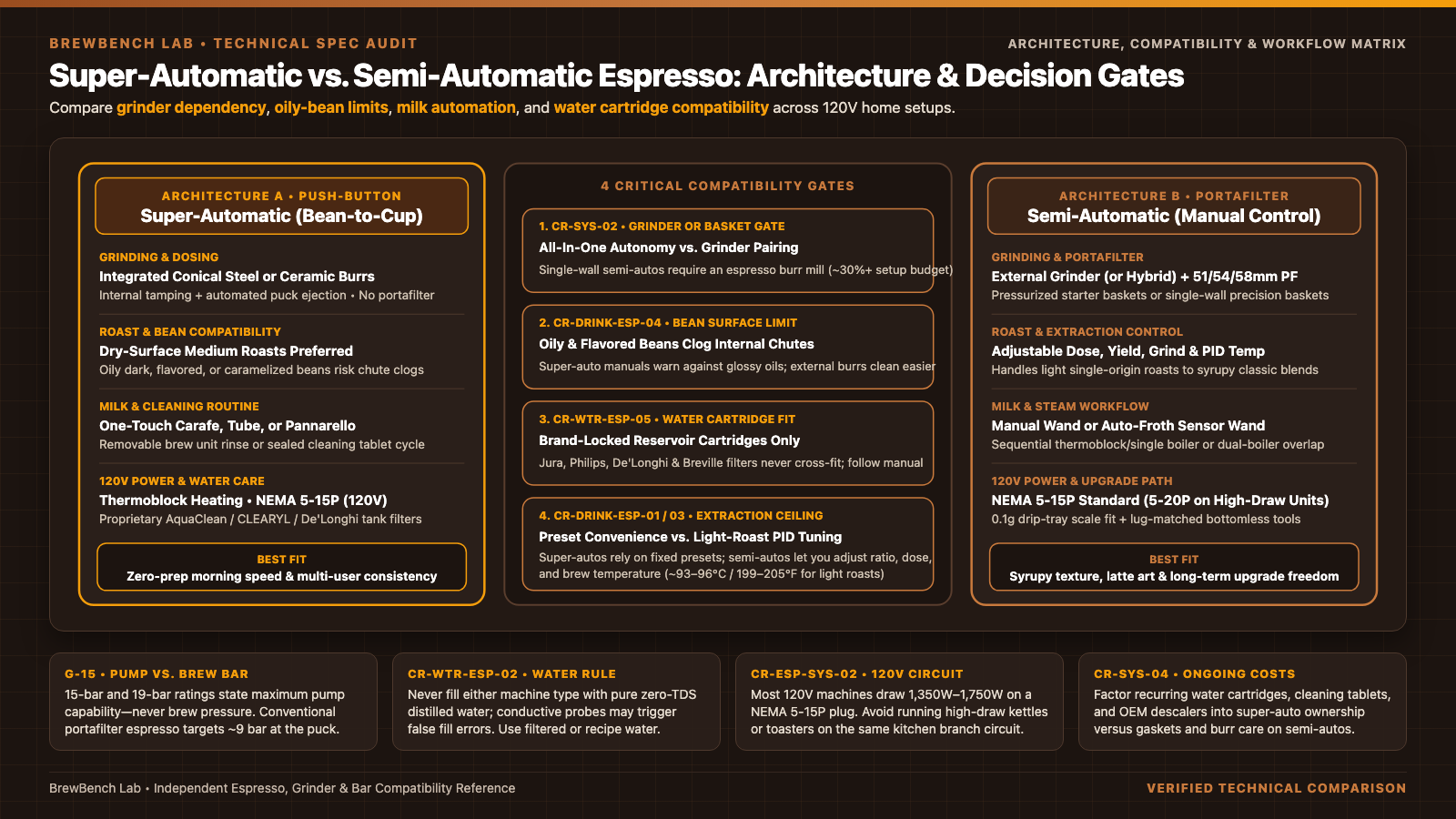
Deciding between a super automatic vs semi automatic espresso machine comes down to whether you want an integrated appliance to handle grinding, tamping, and brewing behind a push-button menu, or a hands-on portafilter system where you control grind size, dry dose, extraction ratio, and steam texture yourself. A super-automatic machine grinds whole beans internally, compresses the puck automatically, brews espresso at the press of a button, and ejects spent pucks into an internal bin. A semi-automatic machine hands you a removable 51 mm, 54 mm, or 58 mm portafilter, letting you pair a dedicated burr grinder (or integrated grinder module) with direct control over shot timing and milk microfoam.
Inside our broader best espresso machines for home hub, no hardware fork creates more buyer regret than picking the wrong automation tier. Buyers who crave morning speed sometimes grow frustrated by portafilter cleanup and grinder dialing, while hobbyists who buy an expensive bean-to-cup unit expecting syrupy light-roast shots hit a hard mechanical ceiling. This technical head-to-head audit compares both architectures under 120V/60Hz North American specifications, evaluating workflow speed, bean-oil restrictions (CR-DRINK-ESP-04), grinder dependency (CR-SYS-02), and proprietary water cartridge costs (CR-WTR-ESP-05).
In This Comparison
- Winner by Use Case: Quick Verdict Matrix
- Side-by-Side Spec & Compatibility Table
- Battleground 1: Grinding, Dosing & Puck Control (CR-SYS-02)
- Battleground 2: Oily Beans, Roast Flexibility & Pump Pressure (CR-DRINK-ESP-04)
- Battleground 3: Heating Systems & Milk Steaming Workflow
- Battleground 4: Reservoir Cartridges, Descaling & Upkeep Costs (CR-WTR-ESP-05)
- Battleground 5: 120V Electrical Draw, Footprint & Upgrade Path
- Choose Super-Automatic vs. Choose Semi-Automatic
- Verified Amazon US Super-Automatic Benchmarks Compared
- Excluded & Off-Amazon Models Note
- Frequently Asked Questions
Quick Verdict Matrix: Super-Automatic vs. Semi-Automatic by Use Case
Both machine classes brew pressurized hot-water extractions from freshly ground whole beans, yet they optimize for opposite priorities. Use the matrix below to match your daily routine, drink menu, and countertop budget to the architecture that fits cleanly.
| Home Kitchen Scenario | Architecture Winner | Deciding Compatibility Rule | Practical Daily Outcome |
|---|---|---|---|
| Best for Daily Milk Drinks (Zero Skill Required) | Super-Automatic (with Carafe/Tube) | CR-DRINK-ESP-02 / CR-SYS-02 | One-button cappuccinos and lattes with no tamping, knocking out wet pucks, or wand rolling. |
| Best for Straight Espresso & Light Roasts | Semi-Automatic (PID + Burr Grinder) | CR-DRINK-ESP-01 / CR-GRD-ESP-01 | Adjustable brew temperature, higher ~1:2.2–1:3 ratios, and precision flat or conical burrs extract clarity. |
| Best Value & Total Ecosystem Cost | Semi-Automatic (Entry + Burr Mill) | CR-SYS-01 / CR-SYS-04 | Lower upfront entry under $500 and minimal proprietary consumables compared with super-auto filter/tablet cycles. |
| Best Compact Kitchen Footprint | Tie (Depends on Grinder Choice) | CR-ESP-SYS-04 / CR-GRD-SYS-01 | A narrow 5.9–7.7 in semi-auto plus mini grinder rivals mid-size bean-to-cup units; all-in-one autos save one plug. |
| Best for Multi-Person Busy Households | Super-Automatic (User Profiles) | CR-DRINK-ESP-04 / CR-WTR-ESP-05 | Repeatable strength presets let non-hobbyists pull identical americanos or milk drinks every morning. |
Side-by-Side Verified Spec & Compatibility Comparison
Before comparing individual models, look closely at how a typical 120V super-automatic machine stacks up mechanically against consumer and prosumer semi-automatic platforms across heating, portafilter standards, grinder architecture, and ownership supplies.
| Technical Audit Dimension | Super-Automatic (Bean-to-Cup) | Semi-Automatic (Standalone + Grinder) | Hybrid Semi-Auto (Built-In Grinder) |
|---|---|---|---|
| Heating Architecture | Thermoblock (single or dual-circuit depending on model) | Thermoblock/ThermoJet, single boiler, HX, or dual boiler | Thermoblock or thermocoil with PID control |
| Portafilter & Lug Standard | None (internal mechanical brew chamber) | 51 mm (De’Longhi), 54 mm (Breville), or 58 mm (E61/Gaggia/Rancilio/Breville) | 51 mm, 53/54 mm, or 58 mm brand-matched group |
| Included Basket Types | None (internal perforated piston chamber) | Pressurized dual-wall (entry) or single-wall + dual-wall (Breville 54 mm) | Typically both single-wall and pressurized baskets |
| Grinder Geometry & Adjustment | Internal stepped steel or ceramic conical burrs (fixed steps) | External stepless or micro-step espresso grinder (~30%+ budget share) | Integrated 25–45 step conical burr grinder (CR-GRD-ESP-04) |
| Bean Surface Tolerance | Dry medium roasts only; oily/flavored beans risk clogs (CR-DRINK-ESP-04) | Tolerates dark/oily roasts cleanly; flavored beans still leave residue | External burr access cleans easier than sealed auto chutes |
| Milk Steaming Hardware | Auto carafe (LatteGo / LatteCrema), tube, or manual pannarello | Manual bare steam wand or sensor-guided auto-froth wand | Manual bare wand or sensor-guided Auto MilQ wand |
| 120V US Electrical & Plug | 120V / 60Hz, standard NEMA 5-15P plug | 120V / 60Hz NEMA 5-15P (NEMA 5-20P on select 20A dual-thermoblock units) | 120V / 60Hz, standard NEMA 5-15P plug |
| Water Cartridge Standard | Brand-locked (Philips AquaClean, Jura CLEARYL, De’Longhi filter) | Brand-locked tank cartridges or external SCA-balanced pitcher/recipe water | Brand-locked tank filter (e.g., Breville Claro Swiss) |
| Typical US Budget Band | $200–$500 (entry) to $1,000+ (flagship) | Under $200 to $2,500+ (plus external grinder under $200–$500+) | $500–$1,000 to $1,000–$2,500 |
Battleground 1: Grinding, Dosing & Puck Control (CR-SYS-02)
The clearest engineering divide between these two categories sits in compatibility rule CR-SYS-02: an espresso setup must include an espresso-capable grinder, rely on a built-in grinder, operate as a super-automatic, or use pressurized baskets. A super-automatic satisfies CR-SYS-02 automatically out of the box. Pour whole beans into the top hopper, select a strength level, and the internal conical burrs grind a timed dose straight into a motorized plastic or metal brew chamber, tamp it mechanically, extract the shot, and drop the puck into an internal waste bin.
That convenience carries a deliberate trade-off in particle control. Most super-automatics use stepped adjustment collars with relatively wide increments—often five to twelve coarse steps—and dose roughly 7 to 16 grams depending on the brand’s internal chamber geometry. You cannot inspect the ground bed, perform WDT distribution, weigh exact dry grams in and liquid grams out on a 0.1 g scale during brewing, or swap in a precision single-wall basket. If a shot runs slightly fast or weak, your adjustments are limited to nudging the hopper dial a click finer (always while the grinder is running, per manufacturer manuals) and altering water volume.
By contrast, a semi-automatic setup separates the grinder from the brew group—or pairs an external portafilter with a built-in burr grinder. Under CR-GRD-ESP-01, if you want to use a non-pressurized single-wall basket, you must pair your semi-automatic machine with a grinder whose manufacturer explicitly rates it for espresso (blade grinders and filter-only burr mills fail immediately because shots gush out sour in seconds). Following rule CR-SYS-01, buyers building a single-wall semi-automatic setup should allocate roughly a third or more of their combined machine-and-grinder budget toward the grinder. In return, stepless or micro-stepped burrs let you lock in a 18 g dry dose to 36 g liquid yield (1:2 ratio) with far tighter repeatability and richer texture.
If you like the single-appliance footprint of a super-automatic but want genuine portafilter control, a built-in-grinder semi-automatic bridges both worlds. As we detail in our guide to espresso machines with built-in grinders, models with assisted lever tamping and integrated burr mills remove loose-ground mess while keeping real 54 mm or 58 mm baskets in play—though rule CR-GRD-ESP-04 notes that built-in grinders still prioritize medium and dark roasts and can limit dense light roasts later.
Battleground 2: Oily Beans, Roast Flexibility & Pump Pressure (CR-DRINK-ESP-04)
If your household loves glossy, dark-roasted French roast blends or vanilla-coated flavored coffee beans, pay close attention to rule CR-DRINK-ESP-04 before ordering a super-automatic. Inside a bean-to-cup machine, coffee grounds travel down an enclosed chute from the top burrs directly into an internal brew unit. Glossy surface oils, sugar glazes, and sticky flavorings coat the burrs, clump inside the chute, and glue fines to the internal brew piston. Major super-automatic manufacturers explicitly warn against oily, caramelized, or flavored beans in their user manuals because chute clogs require disassembly or authorized service intervention.
A semi-automatic setup handles dark and oily roasts with far less stress. Because the portafilter and basket come out of the machine after every shot and an external grinder sits independently on the counter, routine burr brushing and basket rinsing keep oily dark roasts running cleanly (though flavored beans still leave lingering aroma residue on external burrs under CR-DRINK-GRD-02). At the opposite end of the roast spectrum, dense Nordic-style light roasts favor semi-automatics as well: under CR-DRINK-ESP-01, light roasts benefit from higher adjustable PID brew temperatures—often targeting roughly 93–96 °C (199–205 °F)—and longer 1:2.2 to 1:3 brew ratios, parameters that fixed-preset super-automatics cannot easily replicate.
Shoppers comparing spec sheets also run into aggressive pump claims on both sides—”15-bar” on entry semi-automatics and “15-bar” or “19-bar” on bean-to-cup units. Never confuse a pump’s maximum pressure ceiling with actual extraction pressure. Those ratings describe the peak deadhead force of the vibration pump, whereas balanced espresso brews near roughly 9 bar at the coffee bed. A super-automatic’s crema relies heavily on mechanical valving inside the brew unit and fine-enough internal grinding, while a semi-automatic builds natural resistance through a compacted puck in a single-wall basket—or through a restricted pinhole in a starter pressurized basket (CR-ESP-ACC-13).
Battleground 3: Heating Systems, Steam Texture & Milk Workflow
Under CR-DRINK-ESP-02 and CR-DRINK-ESP-03, milk-drink lovers must evaluate two separate questions: how much hands-on control you want over milk texture, and how fast the heating system switches between brewing and steaming.
Most home super-automatics rely on fast-heating thermoblocks paired with one of three milk systems:
- Integrated Auto Carafes (De’Longhi LatteCrema, Philips LatteGo): Press “Cappuccino” or “Latte Macchiato,” and the machine pulls espresso and dispenses frothed milk directly into your mug. You give up silky microfoam capable of rosetta latte art—expect thicker, airier layered foam—but gain effortless push-button speed.
- Siphon Milk Tubes (Jura Fine Foam Frother): A slim silicone tube drops directly into a milk carton or glass chiller, pulls milk through a venturi frother at the spout, and triggers an automated milk-system rinse afterward.
- Manual Pannarello Wands (Gaggia Anima, entry bean-to-cup units): Bridges push-button espresso with hands-on pitcher steaming, though plastic pannarello sleeves inject large air bubbles automatically rather than rolling tight microfoam.
Semi-automatic machines invert that priority. Entry and mid-tier semi-automatics use thermoblocks, ThermoJets, or single boilers that brew and steam sequentially (CR-DRINK-ESP-03), while prosumer dual-thermoblock, heat-exchanger, and dual-boiler models brew and steam simultaneously for back-to-back entertaining. Note under CR-ESP-SYS-07 that some North American 120V dual-boiler units prioritize one heater at a time to stay within household circuit limits, making steam recovery slightly slower than 230V overseas equivalents. With a bare commercial-style stainless steam wand—or a sensor-guided auto-froth wand on select starter units covered in our best espresso machines for beginners guide—paired with a properly sized 12 oz (350 ml) pitcher (CR-ESP-ACC-08), a semi-automatic produces glossy microfoam that folds cleanly into espresso.
Battleground 4: Water Cartridges, Cleaning & Running Costs (CR-WTR-ESP-05)
Water care and ongoing maintenance separate long-term ownership satisfaction far more than buyers expect. Both super-automatics and semi-automatics share the same core water chemistry constraints:
- Strict Cartridge Lock-In (CR-WTR-ESP-05): Reservoir filters are never universal across brands. Philips machines take AquaClean cartridges, Jura machines require CLEARYL/Claris cartridges (often RFID-paired on newer models), De’Longhi uses its dedicated reservoir filter, and Breville 54 mm/58 mm machines use Claro Swiss cartridges. Installing the wrong cartridge fails physically and leaves thermoblocks unprotected.
- Hardness & Zero-TDS Distilled Caution (CR-WTR-ESP-01 / CR-WTR-ESP-02): Follow SCA guidance (~68 mg/L total hardness as CaCO3, ~40 mg/L alkalinity, 75–250 mg/L TDS) or your manufacturer’s maximum hardness threshold. Never fill either machine type with pure, unremineralized distilled water: machines using conductive water-level probes may fail to detect water in the tank and flash false “Fill Water” errors, and warranty terms (CR-WTR-ESP-03) tie scale damage directly to approved water treatment.
- Manufacturer-First Descaling (CR-WTR-ESP-06): Always descale strictly with the chemical formula and cycle specified in your manual—never improvise DIY vinegar or unapproved citric acid concentrations that can pit aluminum or brass internals.
Where daily cleanup diverges is inside the brew path. Super-automatics automate startup and shutdown rinses, which fills the drip tray surprisingly quickly. Models with removable brew units (De’Longhi, Philips, Gaggia) require sliding out the mechanical brew group weekly for warm-water rinsing and periodic food-grade silicone lubrication. Sealed-chamber machines (Jura) cannot be removed by the owner and depend entirely on automated two-phase cleaning tablets—and remember under safety rules never to open sealed internal housings yourself. Conversely, semi-automatics trade daily portafilter knocking and steam-wand wiping for simpler internal hygiene: machines equipped with a three-way solenoid valve allow manual-approved cleaning-disc backflushing (CR-ESP-ACC-11), while thermoblocks without a three-way valve follow simple descaling cycles. Under CR-SYS-04, factor ongoing water filters, milk-system cleaner, and cleaning tablets into a super-automatic’s recurring budget.
Battleground 5: 120V Electrical Draw, Footprint & Upgrade Path
Every North American super-automatic benchmark in this guide runs on standard 120V/60Hz power with a grounded NEMA 5-15P plug, keeping installation plug-and-play in standard kitchen outlets (CR-ESP-SYS-01). Entry and mid-range semi-automatics also use 120V NEMA 5-15P plugs—typically drawing 1,350 W to 1,750 W—though select high-wattage dual-thermoblock prosumer semi-automatics ship with a 20 A NEMA 5-20P plug requiring a matching 5-20R receptacle installed by a licensed electrician (never use plug adapters). On any shared 15 A or 20 A branch circuit, avoid running an electric kettle or toaster simultaneously while heating espresso gear (CR-ESP-SYS-02). Also remember CR-ESP-SYS-04: measure your under-cabinet clearance (typically ~18 in / 457 mm) so top-loading bean hoppers and top-lift water tanks slide out cleanly.
Finally, consider upgrade longevity. A super-automatic is a closed ecosystem—there is no portafilter standard, no aftermarket precision basket upgrade, and no way to drop a 0.1 g espresso scale under a portafilter to dial in extraction speed. A semi-automatic opens a modular ecosystem governed by portafilter group standards (CR-ESP-ACC-01)—whether 51 mm, 54 mm, or 58 mm—letting you upgrade your burr grinder first, add a low-profile 0.1 g scale (CR-SCALE-ESP-01, CR-SYS-03), and replace gaskets or baskets independently for years.
Final Verdict: Choose Super-Automatic vs. Choose Semi-Automatic
Choose a Super-Automatic Espresso Machine If…
- You want fresh-ground espresso, americanos, or milk drinks at the press of one button with minimal morning effort.
- Multiple family members share the counter and want repeatable strength presets without learning dialing-in or manual steaming.
- You primarily drink dry-surface medium roasts and do not mind buying brand-specific water cartridges and cleaning tablets (CR-DRINK-ESP-04, CR-WTR-ESP-05).
- You prefer one self-contained appliance over pairing a machine, separate espresso grinder, tamper, and 0.1 g scale (CR-SYS-02).
Choose a Semi-Automatic Espresso Machine If…
- You want thicker, syrupy espresso body, sweeter microfoam for latte art, and higher extraction quality per dollar.
- You enjoy light-roast single origins or oily dark roasts that push past super-automatic temperature and chute limits (CR-DRINK-ESP-01, CR-DRINK-ESP-04).
- You are willing to pair an espresso-capable burr grinder (or built-in grinder hybrid) and a 0.1 g scale for single-wall extraction (CR-GRD-ESP-01, CR-SYS-03).
- You want modular serviceability where portafilters, baskets, gaskets, and grinders can be upgraded separately over time.
Verified Amazon US Super-Automatic Benchmarks Compared
If your routine clearly points toward bean-to-cup convenience, these four verified 120V/60Hz super-automatic machines currently stocked on Amazon US represent each major engineering approach—from tubeless entry milk carafes to manual pannarello bridges, swappable hoppers, and sealed Swiss extraction systems. For a full lineup of push-button contenders, see our best super-automatic espresso machines roundup.
1. Philips 3300 Series LatteGo (EP3326/90) — Best Entry-Tier Milk Cleanup

Quick Specs: Thermoblock heating | SilentBrew ceramic burr grinder | Two-piece tubeless LatteGo carafe | Removable side brew group | AquaClean filter compatibility | 120V / 60Hz (NEMA 5-15P) | Price Tier: $200–$500
Best For: First-time bean-to-cup buyers who drink daily lattes or iced coffee and want the fastest milk-system cleanup on the market without scrubbing narrow silicone hoses.
Skip If: You want fine cafe-style microfoam for pouring latte art or plan to pull bright, light-roast straight espresso shots.
Pros
- Two-piece tubeless LatteGo carafe snaps apart and rinses clean under tap water in seconds
- SilentBrew ceramic burr system reduces grinding clamor compared with older entry bean-to-cup units
- Removable brew unit slides out cleanly for weekly warm-water rinsing and AquaClean cartridge protection (CR-WTR-ESP-05)
Cons
- Steam-mixed LatteGo foam is visibly airier than hand-textured microfoam from a semi-automatic wand
- Internal grinder chute strictly prefers dry medium-roast beans over glossy oily or flavored blends (CR-DRINK-ESP-04)
- Limited temperature and grind granularity compared with a 54 mm PID semi-automatic plus external burr mill
Audit Note: Always seat a genuine Philips AquaClean cartridge before initial priming if your municipal water exceeds mild hardness, and descale strictly per Philips instructions once prompted.
2. Gaggia Anima Super-Automatic (Black) — Best Push-Button & Wand Bridge
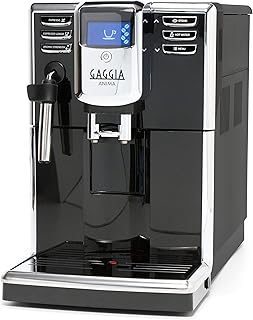
Quick Specs: Rapid-heat thermoblock | Integrated ceramic burr grinder | Programmable espresso buttons + pre-infusion | Manual pannarello steam wand | Removable brew group | 120V / 60Hz (NEMA 5-15P) | Price Tier: $500–$1,000
Best For: Buyers torn between convenience and craft who want push-button grinding and brewing while keeping a manual steam wand and pitcher on the counter.
Skip If: You want hands-free one-touch milk drinks without holding a pitcher, or you expect fine microfoam without modifying/removing a pannarello sleeve.
Pros
- Pairs automated whole-bean espresso extraction with manual milk steaming control and hot-water dispensing
- Ceramic burrs and pre-infusion cycle provide dependable everyday espresso and lungo consistency
- Removable Gaggia brew unit simplifies weekly warm-water rinsing and preventative seal lubrication
Cons
- Factory pannarello attachment injects coarse foam quickly rather than delivering bare-wand microfoam texture
- No automatic milk carafe means milk drinks still require manual pitcher holding and wand wiping
- Internal chute remains vulnerable to clumping if fed glossy dark-roast or flavored beans (CR-DRINK-ESP-04)
Audit Note: Because the Gaggia Anima omits milk carafes and internal milk tubing, daily cleanup is substantially lighter than full-auto milk systems—just purge and wipe the steam wand immediately after frothing.
3. De’Longhi Rivelia Automatic — Best Mid-Tier Swappable Hopper Design

Quick Specs: Thermoblock heating | Interchangeable Bean Switch hoppers + Bean Adapt prompts | LatteCrema automatic milk carafe | Color touchscreen | 120V / 60Hz (NEMA 5-15P) | Price Tier: $500–$1,000
Best For: Two-coffee households switching daily between caffeinated morning espresso and afternoon decaf—solving the biggest limitation of single-hopper super-automatics.
Skip If: You expect zero-gram single-dose retention between beans or want manual 58 mm portafilter pressure control.
Pros
- Twist-off interchangeable hoppers let you switch between regular and decaf beans without scooping a fixed bin
- Bean Adapt software suggests grind and temperature adjustments tailored to the roast loaded in the hopper
- Compact silhouette tucks easily under standard US upper kitchen cabinets (CR-ESP-SYS-04)
Cons
- Purging residual grounds inside the burr throat during hopper swaps consumes a small amount of coffee
- LatteCrema carafe requires periodic disassembly and dishwasher/warm-soak cleaning beyond quick steam purging
- Requires proprietary De’Longhi reservoir filters and EcoDecalk descaling solution per manual (CR-WTR-ESP-05/06)
Audit Note: The Rivelia addresses one area where semi-automatics with single-dose external grinders normally dominate—multi-bean flexibility—while keeping push-button milk automation intact.
4. Jura E8 Automatic Espresso Machine — Best Premium Bean-to-Cup Extraction

Quick Specs: Thermoblock with Pulse Extraction Process (P.E.P.) | P.A.G.2 grinder | Sealed non-removable brew unit | One-touch milk cleaning | CLEARYL Smart cartridge detection | 120V / 60Hz (NEMA 5-15P) | Price Tier: $1,000+
Best For: Busy households wanting the closest possible super-automatic espresso body to a semi-automatic shot, backed by Swiss build quality and automated milk-line hygiene.
Skip If: You prefer manually removing and scrubbing the brew unit yourself, dislike recurring proprietary filter/tablet expenses, or want prosumer dual-boiler portafilter tuning in the same price bracket.
Pros
- Pulse Extraction Process (P.E.P.) pulses hot water in short intervals to improve short-shot body and crema density
- P.A.G.2 burr grinder resets between drinks and delivers quieter, more uniform particle distribution than entry units
- Automated one-touch milk-system cleaning cycle simplifies daily sanitation compared with multi-part carafes
Cons
- Sealed internal brew unit cannot be removed for hand inspection or rinsing, relying solely on Jura cleaning tablet cycles
- Highest ongoing consumable demand—CLEARYL Smart filters, two-phase cleaning tabs, and milk cleaner add recurring cost (CR-SYS-04)
- Sits in the $1,000+ prosumer semi-automatic tier while still excluding oily beans and fine ratio profiling (CR-DRINK-ESP-04)
Audit Note: Jura’s sealed brew unit relies heavily on dry-surface medium-roast beans and disciplined tablet cycles—never attempt to open the chassis yourself, and stick exclusively to Jura CLEARYL cartridges (CR-WTR-ESP-05).
Excluded & Off-Amazon Models Note
To keep our buying benchmarks strictly compliant with North American 120V/60Hz safety and primary Amazon US storefront fulfillment, several popular models were excluded from buy-intent picks:
- Specialty Dealer-Only Semi-Automatics (Lelit, Profitec, ECM, La Marzocco, Flair 58, Niche Zero): Excluded as Amazon buy-intent picks because these manufacturers sell primarily through independent specialty espresso dealers rather than direct primary Amazon US listings.
- 230V / 50Hz European Gray-Market Imports: Disqualified under CR-ESP-SYS-01 because overseas voltage configurations do not match US 120V outlets, void factory US warranties, and must never be paired with makeshift travel adapters.
- Pod & Capsule Brewers (Nespresso OriginalLine / VertuoLine): Excluded under CR-DRINK-ESP-07 as convenience alternatives rather than direct equivalents to fresh-ground portafilter or bean-to-cup machines.
How We Audited This Guide
- Espresso machines were audited across heating architecture, simultaneous brew and steam flow, 51mm/54mm/58mm portafilter lugs, NEMA 5-15P/5-20P circuit draw, and US warranty terms.
- Every espresso machine, burr grinder, accessory, and scale specification was cross-checked against official manufacturer 120V manuals, SCA water guidance, and verified Amazon US listings.
- Recommendations were evaluated against our weighted espresso-gear scoring rubrics and documented CR-* compatibility rules; we never invent heat-up seconds, PID variance, or micron claims.
Continue Your Audit
Frequently Asked Questions: Super-Automatic vs. Semi-Automatic
Does a super-automatic espresso machine make espresso as good as a semi-automatic?
A premium super-automatic brews clean, consistent daily espresso and milk drinks, yet a dialed-in semi-automatic with an espresso burr grinder produces thicker body, sweeter crema, and clearer origin flavor. Larger 54 mm or 58 mm baskets and flexible brew ratios give semi-automatics a higher flavor ceiling.
Can I put oily dark-roast or flavored beans in a super-automatic espresso machine?
No—under compatibility rule CR-DRINK-ESP-04, glossy dark-roast, flavored, or caramelized beans coat internal burrs and clog the enclosed grounds chute. Manufacturer manuals warn against them, whereas semi-automatic external grinders and removable portafilters clean easily after oily roasts.
Which type costs less to maintain over five years: super-automatic or semi-automatic?
Semi-automatics generally cost less in recurring supplies because they rely mainly on group gaskets, descaler, and optional cleaning tablets. Super-automatics consume brand-specific reservoir filters, two-phase brew-unit cleaning tablets, milk-system solutions, and periodic O-ring maintenance (CR-SYS-04, CR-WTR-ESP-05).
Do I need to buy a separate grinder for a semi-automatic espresso machine?
Under CR-SYS-02, you need an espresso-capable burr grinder (or built-in grinder model) to brew with non-pressurized single-wall baskets. If you only use pre-ground coffee at first, pressurized dual-wall baskets work safely as a starter bridge until you add a dedicated burr mill.
Is a 19-bar super-automatic stronger or better than a 15-bar semi-automatic?
No—15-bar, 19-bar, and 20-bar figures list a vibration pump’s maximum pressure ceiling rather than brewing pressure. Balanced espresso extracts around ~9 bar at the puck, so grind consistency, temperature control, and water quality matter far more than pump-bar stickers.
Can I use zero-TDS distilled water to prevent scale in either machine?
No—never run pure unremineralized distilled water in either machine (CR-WTR-ESP-02). Machines equipped with conductive water-level sensors may fail to detect zero-mineral water, triggering false fill warnings. Use filtered water or SCA-balanced remineralized recipes alongside your manufacturer’s approved tank cartridge.
Authoritative Technical References
- Philips USA Official Coffee & AquaClean Documentation — Verified 120V LatteGo specifications, ceramic burr care, removable brew group rinsing, and AquaClean cartridge intervals.
- De’Longhi USA Official Manuals Portal — Confirmed 120V thermoblock ratings, Bean Adapt hopper workflows, De’Longhi filter cartridge fitment, and EcoDecalk descaling procedures.
- Jura USA Official Specifications & Care Guides — Verified 120V P.E.P. extraction mechanics, sealed brew unit tablet cleaning schedules, and CLEARYL Smart water cartridge rules.
- Specialty Coffee Association (SCA) Water & Brewing Standards — Baseline total hardness (~68 mg/L CaCO3), alkalinity (~40 mg/L), and ~9 bar extraction mechanics.


