Disclosure: As an Amazon Associate, I earn from qualifying purchases. If you buy through links on this page, we may earn a small commission at no extra cost to you.
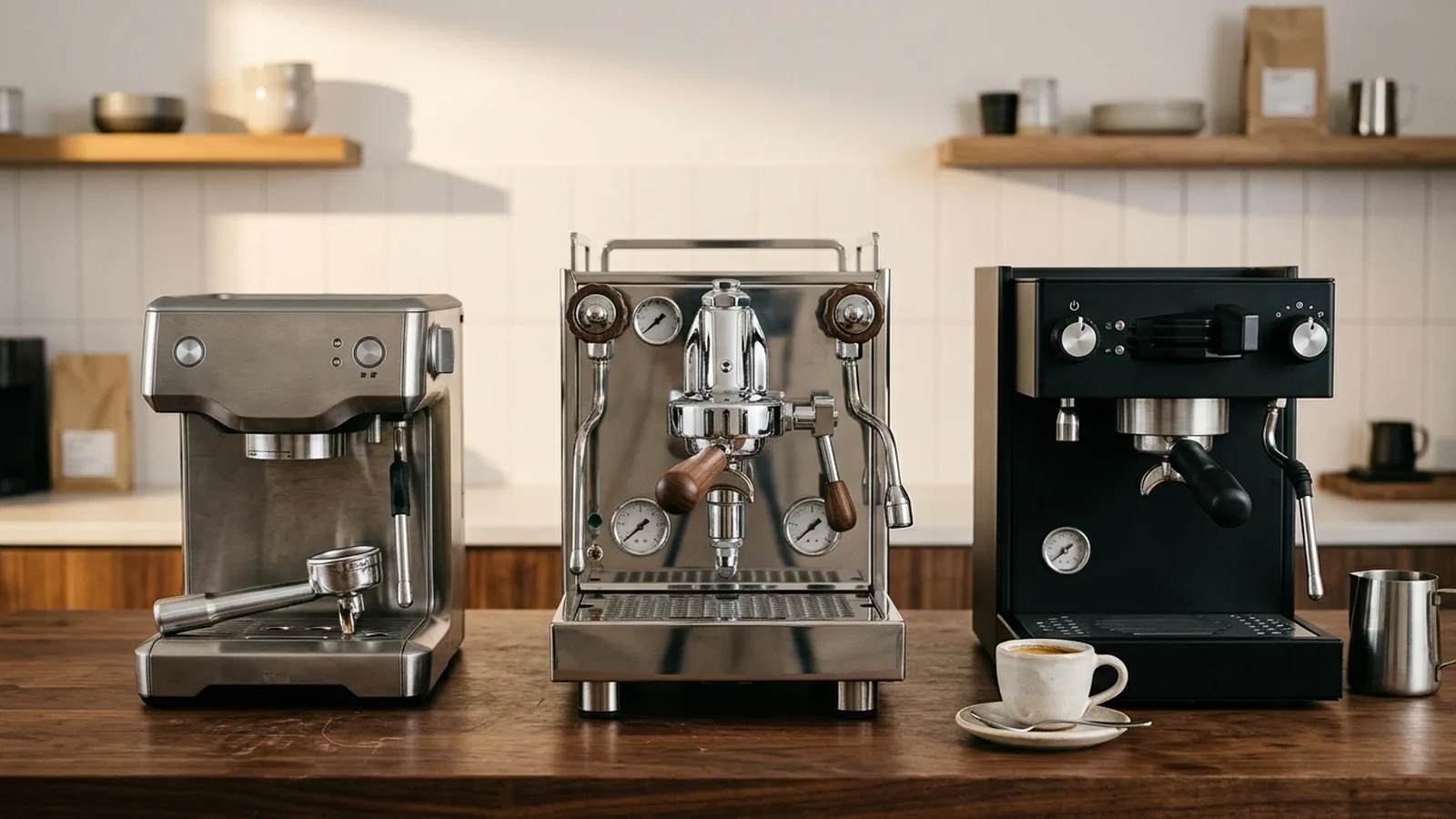
Direct Answer — Types of Espresso Machines: Home espresso makers fall into nine engineering categories defined by heating system and automation level: manual levers, thermoblocks, dual thermoblocks, single boilers, heat exchangers, dual boilers, built-in-grinder hybrids, super-automatics, and capsule alternatives. Heating architecture dictates warm-up speed, thermal stability, and whether you brew and steam sequentially or simultaneously (CR-DRINK-ESP-03).
Shopping for your first espresso setup—or upgrading past an entry-level countertop brewer—can feel overwhelming when retailers lump manual piston presses, flash-heated thermoblocks, heavy brass heat exchangers, and push-button bean-to-cup machines onto the same shelf. Understanding the nine distinct types of espresso machines comes down to separating exterior styling from two core mechanical realities: how the machine heats water, and how much manual control it hands to the user.
Inside our best espresso machines for home pillar guide, every North American 120V/60Hz pick is audited against BrewBench Lab’s heating, portafilter, water, and circuit rules before evaluating drink workflow. This guide breaks down every category, explains the math behind 120V outlet limits and sequential steaming, exposes common pump-pressure myths, and profiles six verified 120V Amazon US archetypes alongside clearly labeled off-Amazon reference models.
In This Guide
- What Every Espresso Machine Must Do (and Key Engineering Formulas)
- All 9 Types of Espresso Machines Explained
- Category Decision Matrix: Heating, Workflow, Plug & Tier
- Myth vs. Engineering Reality: 4 Costly Buyer Traps
- 6 Verified 120V Amazon US Archetypes by Category
- Ownership, Water Chemistry & Manufacturer-First Safety Checklist
- Authoritative Manufacturer & Standards Citations
- Frequently Asked Questions
What Every Espresso Machine Must Do (and Key Engineering Formulas)
A traditional portafilter espresso machine forces heated water—conventionally around ~9 bar at the coffee puck and roughly 90–96 °C (194–205 °F) depending on roast level—through a compacted bed of finely ground coffee inside a metal basket. While marketing labels tout “15-bar” or “20-bar” pumps, those figures represent maximum dead-head pump capability against a blocked line rather than actual extraction pressure at the group head.
Across all machine classes, four engineering rules govern real-world kitchen compatibility and shot repeatability:
- 120V US Electrical Budget (
CR-ESP-SYS-01,CR-ESP-SYS-02): North American branch circuits followP = V × A. A standard 15A circuit at 120V delivers 1,800 W peak (1,440 W under continuous 80% NEC sizing), while a 20A circuit delivers 2,400 W peak (1,920 W continuous). Combined load—Espresso Machine (W) + Grinder (W) + Shared Kettle/Toaster (W)—must stay below breaker capacity, and a machine fitted with a horizontal-bladeNEMA 5-20Pplug requires a trueNEMA 5-20Routlet installed by a licensed electrician. - Portafilter Lug & Basket Fit (
CR-ESP-ACC-01,CR-ESP-ACC-03): Machines use 51 mm (2.01 in), 54 mm (2.13 in), or 58 mm (2.28 in) portafilters, yet diameter alone never guarantees locking fit. E61, Gaggia, Rancilio, and Breville 58 mm groups use distinct locking ear geometries. Meanwhile, tampers and puck screens size to the basket’s inner diameter, not nominal marketing size. - Brew Ratio & Under-Spout Clearance (
CR-SCALE-ESP-01,CR-SCALE-ESP-03): Espresso repeatability relies on weighingdose : yieldby mass (for example, an18 gdry dose yielding36 gliquid espresso for a classic1:2ratio). Under the portafilter spouts, ensurescale_height_mm + cup_height_mm + 5 mm ≤ machine_clearance_mmbefore choosing tall latte mugs. - Water Hardness Conversion (
CR-WTR-ESP-01): Calcium and magnesium scale damages narrow thermoblock passages and boilers. Water hardness converts at1 gpg = 17.1 mg/L CaCO3, with Specialty Coffee Association (SCA) targets sitting near ~17–85 mg/L CaCO3 total hardness and ~40 mg/L alkalinity, matched to the machine manufacturer’s cartridge specification (CR-WTR-ESP-05).
All 9 Types of Espresso Machines Explained
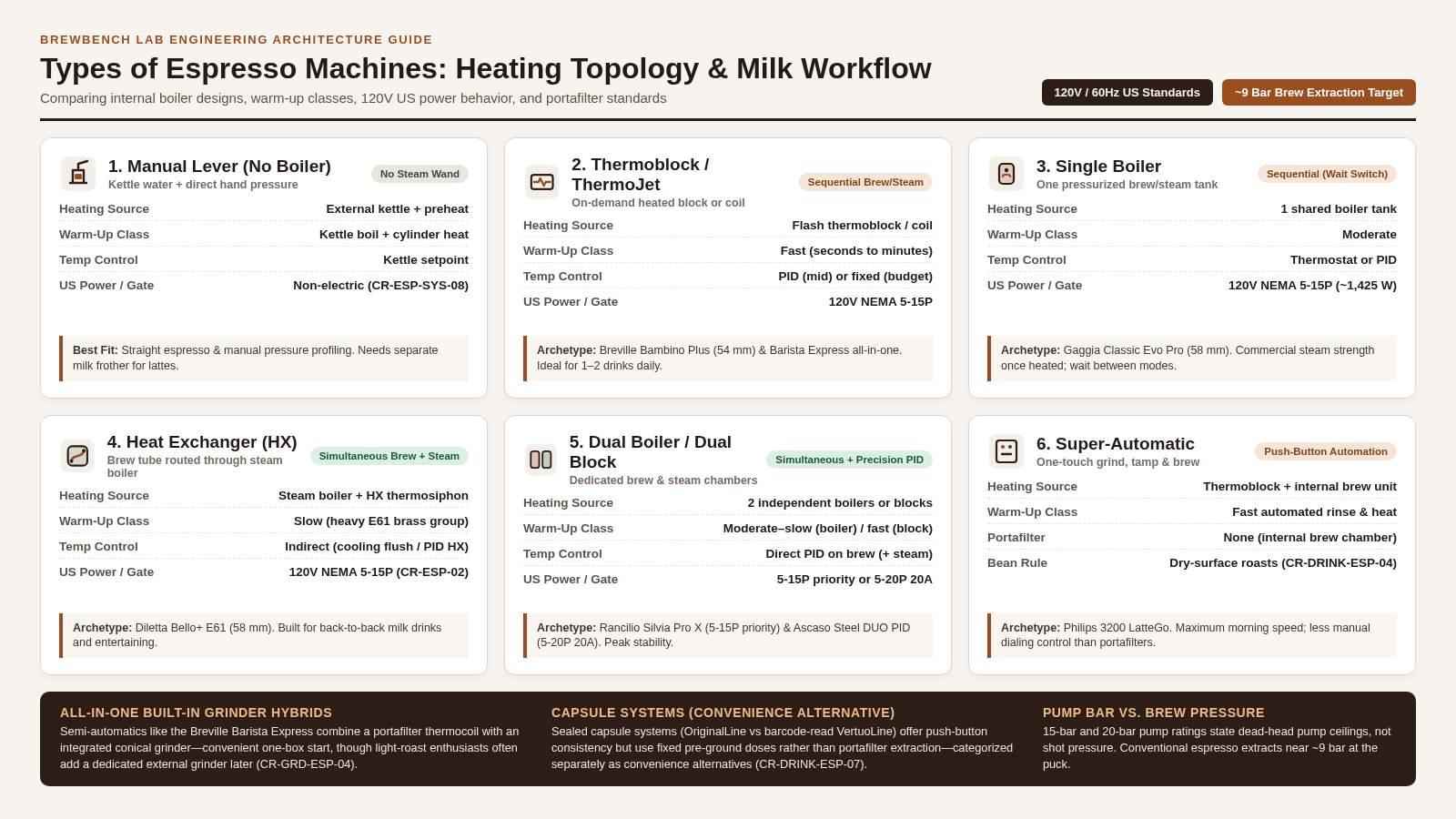
Every consumer coffee appliance billed as an espresso maker falls into one of the nine structural classes below. Reading them side by side clarifies why a quick weekday latte drinker needs completely different hardware than a host pulling six back-to-back cappuccinos or a straight-espresso purist chasing light-roast clarity.
1. Manual Lever Espresso Machines (No Boiler)
Manual lever espresso makers eliminate internal boilers, vibratory pumps, and solenoid valves altogether. You preheat a metal brew cylinder, fill it with near-boiling water from an external kettle, and pull a long mechanical lever by hand to generate ~6–9 bar across the coffee puck. Because no boiler exists, compatibility rule CR-ESP-SYS-08 dictates pairing the press with a dedicated temperature-controlled kettle—and under CR-DRINK-ESP-02, you must budget for a standalone milk frother if you drink lattes or cappuccinos.
Verified Examples & Trade-Offs: Compact Amazon-sold levers such as the Flair 49 PRO and Flair Classic pack direct tactile pressure feedback into small travel cases, while the electric-preheated Flair 58 and Cafelat Robot (both dealer-distributed and not sold on Amazon) serve dedicated home straight-espresso setups. Real limitations include multi-piece cleanup after every shot, no built-in steam wand, and extra kettle/thermal-management steps between consecutive shots.
2. Thermoblock & ThermoJet Semi-Automatic Machines
Instead of maintaining a tank of pressurized hot water, a thermoblock (also marketed in proprietary variants as Breville’s ThermoJet or thermocoil) pumps room-temperature water from a reservoir through a heated metal block or coiled stainless tube on demand. Warm-up is exceptionally rapid—spanning seconds to a couple of minutes depending on the design—and power draw fits comfortably on standard 120V NEMA 5-15P household outlets.
Workflow & Trade-Offs: Single-thermoblock machines operate sequentially (CR-DRINK-ESP-03): you pull your shot, purge brief water/steam transition moisture, texture milk for one or two cups, and then purge back down before brewing again. Steam pressure is modest compared to pressurized steam boilers, making smaller pitchers around 12 oz (355 ml) easier to texture cleanly than 20 oz jugs (CR-ESP-ACC-08). Entry budget units under $200 (like the 51 mm De’Longhi Stilosa or Dedica lines) rely on fixed thermostats and frequently ship with pressurized baskets, while mid-tier units like the Breville Bambino Plus add PID temperature regulation, single-wall plus pressurized baskets, and a three-way solenoid valve.
3. Dual-Thermoblock Espresso Machines
A dual-thermoblock machine installs two separate on-demand heating blocks inside one chassis: one calibrated exclusively for espresso extraction and a second dedicated to continuous dry steam. That architecture delivers simultaneous brewing and milk steaming alongside rapid startup without waiting for large copper or stainless boilers to reach thermal equilibrium.
US 120V Electrical Gate: Firing two high-output heating blocks simultaneously changes residential wiring requirements under CR-ESP-SYS-01. Retailer and US specification listings for the 120V Ascaso Steel DUO PID list peak power near ~2,100 W at 20A with a horizontal-blade NEMA 5-20P plug. Buyers must confirm a listed NEMA 5-20R T-slot GFCI receptacle on a 20A circuit with a licensed electrician—never force a 20A plug onto a 15A line with adapters (G-17). Review our 230V vs 120V espresso machine voltage audit before ordering high-wattage or unfamiliar listings.
4. Single-Boiler Semi-Automatic Machines
Classic single-boiler machines house one insulated brass or stainless steel boiler that holds pressurized water for both brewing and steaming—never at the same instant. During espresso extraction, a thermostat or electronic PID holds boiler water around 90–96 °C (194–205 °F). Flipping the steam switch then heats that same boiler past 125–140 °C (257–284 °F) to generate forceful dry steam.
Workflow & Trade-Offs: Under CR-DRINK-ESP-03, single boilers excel for straight espresso drinkers or households making one or two morning lattes, because commercial-style 58 mm portafilters and boiler steam dry out microfoam nicely once up to temperature. However, pulling multiple back-to-back milk drinks requires waiting for steam heat-up and then bleeding hot water through the wand or group to cool the boiler back down to brew temperature before the next espresso shot. Classic thermostat models like the Gaggia Classic Evo Pro (~1,425 W on 120V per retailer listings) offer strong 58 mm value, whereas PID-equipped single boilers such as the Profitec Go (dealer-distributed and not sold on Amazon) eliminate manual temperature surfing for light-roast beans (CR-DRINK-ESP-01).
5. Heat-Exchanger (HX) Machines
A heat-exchanger (HX) machine solves the single-boiler wait using one large pressurized steam boiler (kept continuously at steaming temperature) with a sealed copper or stainless brew-water tube routed straight through its center. Cold pump water flows through that internal heat-exchange tube, rapidly warming to espresso temperature on its way to a heavy thermosiphon-heated group head—most famously the classic 58 mm E61 group (CR-ESP-03)—while full steam power remains ready at the twist of a valve.
Workflow & Trade-Offs: HX machines are built for UC-ENTERTAINER workflows, brewing espresso and texturing a 20 oz (590 ml) milk pitcher at the exact same moment. The trade-offs reflect physics: heavy brass E61 groups require long warm-up periods and stay hot to the touch externally, and because brew water sits inside a hotter steam boiler, many HX machines require a short pre-shot cooling flush to purge overheated water unless fitted with tuned thermosiphon restrictors or HX-calibrated PID control (CR-ESP-02). On Amazon US, the Diletta Bello+ represents PID-assisted E61 HX hardware, whereas enthusiast rivals such as the Lelit Mara X V2 and Profitec Pro 500 are dealer-only lines (not sold on Amazon). Dive deeper in our single boiler vs dual boiler vs heat exchanger comparison.
6. Dual-Boiler Espresso Machines
Dual-boiler machines separate espresso extraction and milk steaming completely into two independent tanks—typically a smaller PID-regulated coffee boiler dedicated to brew temperature precision and a larger high-capacity steam boiler dedicated to continuous wand pressure and hot-water dispensing (CR-DRINK-ESP-05). You gain direct digital brew temperature adjustment for light roasts (CR-DRINK-ESP-01) alongside zero cooling-flush guesswork and simultaneous steaming.
US 120V Boiler-Priority Nuance (CR-ESP-SYS-07): Because 230V European circuits supply ~3,000+ W whereas standard US 15A outlets cap at 1,800 W peak, 120V dual boilers sold on Amazon US—like the Rancilio Silvia Pro X and Breville Dual Boiler BES920XL—use smart power-management firmware (such as brew-boiler priority) so both elements do not overload a NEMA 5-15P circuit. Both still brew and steam simultaneously from stored boiler thermal mass once hot, though multi-drink steam recovery differs from 230V overseas twins (G-06). Iconic saturated-group and E61 dual boilers such as the La Marzocco Linea Micra, Lelit Bianca V3, Profitec Pro 600, and ECM Synchronika remain dealer-channel models (not sold on Amazon).
7. Semi-Automatic Machines With Built-In Grinders (All-in-One Hybrids)
All-in-one portafilter hybrids integrate a conical burr grinder directly into a thermoblock or thermocoil semi-automatic chassis—popularized by the Breville Barista Express, Barista Express Impress, Barista Touch, and Ninja Luxe Café Premier. For UC-BEGINNER-ONE-BOX shoppers, they eliminate separate appliance footprints and streamline single-box startup compatibility (CR-SYS-02), with assisted-tamping variants even covering the tamper half of CR-SYS-03.
Trade-Offs (CR-GRD-ESP-04): Integrating grinder and heater introduces two compromises: if either subsystem fails out of warranty, the whole unit requires service, and built-in stepped conical grinders target medium-to-dark roasts cleanly rather than dense Nordic light roasts. Many enthusiasts eventually leave the built-in hopper empty and pair a standalone flat-burr grinder beside the machine; explore those upgrade paths in our built-in vs separate espresso grinders analysis.
8. Super-Automatic (Bean-to-Cup) Espresso Machines
A super-automatic machine automates every barista step behind a front touchscreen or push-button panel: an internal grinder mills whole beans per drink, doses an internal plastic/metal brew chamber, tamps mechanically, extracts espresso through a thermoblock, ejects the spent puck into an internal waste bin, and optionally froths milk via an automatic carafe or tube.
Workflow & Bean Rules: Built for UC-CONVENIENCE-PUSH-BUTTON kitchens, models like the Philips 3200 Series LatteGo or De’Longhi Magnifica series trade away external 58 mm portafilter control—you cannot swap precision baskets, adjust extraction pressure manually, or pull syrupy competition-style ristrettos. Crucially, under CR-DRINK-ESP-04, super-automatics perform smoothly with dry-surface medium roasts, whereas oily dark roasts, flavored beans, or caramelized beans can clog internal grinder chutes and brew-unit seals. Compare automation trade-offs directly in our super-automatic vs semi-automatic espresso machines guide.
9. Capsule Machines (Labeled Convenience Alternative)
Capsule brewers—most visibly Nespresso OriginalLine (STD-CAP-NESPRESSO-OL) and barcode-read VertuoLine (STD-CAP-NESPRESSO-VERTUO)—sit in a separate category altogether under CR-DRINK-ESP-07 and BrewBench Lab editorial rules (G-21). Rather than compacting fresh grounds in an open portafilter under ~9 bar pressure, capsules lock buyers into pre-ground factory servings—and Vertuo systems extract via high-speed centrifugal spinning rather than pump-driven espresso percolation. Furthermore, under CR-ESP-ACC-09, OriginalLine and VertuoLine pods are strictly incompatible across systems, and recurring per-cup capsule costs remain markedly higher than whole-bean brewing over several years (CR-SYS-04).
Category Decision Matrix: Heating, Workflow, Plug & Tier
Use this structural comparison table to match each category against your daily drink volume, roast preference, counter clearance, and US budget band (TIER-ESP-* brackets reflect Amazon US hardware positioning without hardcoded retail pricing).
| Machine Category | Heating & Temp Control | Brew + Steam Workflow | 120V US Electrical & Gear Needs | Typical TIER Band | Best For & Critical Caveat |
|---|---|---|---|---|---|
| 1. Manual Lever (No Boiler) | External kettle + preheat cylinder; kettle setpoint | No built-in steam wand (CR-DRINK-ESP-02) | Non-electric (kettle uses 120V outlet, CR-ESP-SYS-08) | TIER-ESP-ENTRY / MID ($200–$1,000) | Straight espresso & tactile pressure control. Slow multi-shot reset; needs kettle + separate frother. |
| 2. Thermoblock / ThermoJet | On-demand block/coil; PID on mid models, fixed on budget | Sequential brew & steam (CR-DRINK-ESP-03) | NEMA 5-15P; pairs with 51 mm or 54 mm gear | TIER-ESP-BUDGET / ENTRY / MID (<$200–$1,000) | Fast weekday 1–2 milk drinks or small kitchens. Modest steam capacity; pressurized-only traps on cheap units. |
| 3. Dual Thermoblock | Two separate heated blocks; direct PID brew | Simultaneous brew + steam | Select 120V models require NEMA 5-20P (20A / ~2,100 W, CR-ESP-SYS-01) | TIER-ESP-MID / PROSUMER ($400–$2,500) | Fast heat-up + simultaneous steaming without boilers. Verify 5-20R 20A wiring with an electrician first. |
| 4. Single Boiler | One shared brass or stainless tank; thermostat or PID | Sequential (wait between brew & steam temps) | NEMA 5-15P (~1,425 W class); 58 mm accessories | TIER-ESP-MID ($400–$1,000) | Classic 58 mm straight espresso & 1–2 lattes with crisp steam. Slow workflow for 4+ milk drinks. |
| 5. Heat Exchanger (HX) | Steam boiler + HX tube; indirect/PID-HX (CR-ESP-02) | Simultaneous brew + steam | NEMA 5-15P; heavy E61 brass group (CR-ESP-03) | TIER-ESP-PROSUMER ($1,000–$2,500) | Hosting 4+ back-to-back milk drinks. Slow warm-up, hot exposed group, cooling flush routine on classic HX. |
| 6. Dual Boiler | Separate brew & steam boilers; PID brew (+ steam) | Simultaneous brew + steam | NEMA 5-15P with 120V boiler priority (CR-ESP-SYS-07) | TIER-ESP-PROSUMER / HIGHEND ($1,000–$2,500+) | Light roasts & high-volume entertaining. Large counter footprint, higher water-chemistry sensitivity. |
| 7. Built-In Grinder Hybrid | Thermoblock/thermocoil + integrated conical grinder | Sequential brew & steam (most models) | NEMA 5-15P; all-in-one startup (CR-SYS-02) | TIER-ESP-MID / PROSUMER ($400–$2,000) | One-box beginner convenience. Fixed grinder limits light-roast range (CR-GRD-ESP-04). |
| 8. Super-Automatic | Internal thermoblock + automated brew chamber | One-touch automated brew & milk carafe | NEMA 5-15P; OEM filter lock (CR-WTR-ESP-05) | TIER-ESP-MID / HIGHEND ($400–$2,500+) | Push-button convenience. Less body/control than portafilters; avoid oily/flavored beans (CR-DRINK-ESP-04). |
| 9. Capsule Alternative | Compact flash heater + sealed pod chamber | Push-button convenience (separate frother) | NEMA 5-15P; proprietary capsule lock (CR-ESP-ACC-09) | TIER-ESP-BUDGET / ENTRY (<$200–$400) | Labeled convenience alternative only (CR-DRINK-ESP-07). Fixed grind/dose; highest long-term cost per cup. |
Myth vs. Engineering Reality: 4 Costly Buyer Traps
Myth #1: “A 20-bar espresso machine extracts richer espresso than a 15-bar or 9-bar machine.”
Engineering Reality: False (G-15). Marketing badges reading “15 bar” or “20 bar” quote the vibration pump’s maximum dead-head ceiling against a blocked outlet—not the pressure applied to your coffee puck. Conventional espresso extracts near ~9 bar, controlled either by an over-pressure valve (OPV) in prosumer and mid-tier machines or by grind fineness and pressurized basket resistance on entry models. Never pick a machine category by pump bar rating.
Myth #2: “Buying any 58 mm portafilter machine means all 58 mm portafilters and tampers fit.”
Engineering Reality: False under CR-ESP-ACC-01 and CR-ESP-ACC-03. A “58 mm” label describes nominal basket seating diameter only—portafilter ear thickness and locking lug angles differ among E61, Gaggia, Rancilio, and Breville 58 mm groups. Check our 51mm vs 54mm vs 58mm portafilter sizes breakdown before ordering aftermarket bottomless portafilters, and always match tamper diameters to the basket’s inner top rim.
Myth #3: “Pure distilled water is the cleanest, safest choice for every espresso boiler.”
Engineering Reality: Misleading and a common source of false error lockouts (CR-WTR-ESP-02). Many heat-exchanger and dual-boiler espresso machines use a conductive water-level probe inside the reservoir or boiler that relies on dissolved minerals to complete a tiny sensing circuit. Zero-TDS distilled or unremineralized RO water can trick the sensor into locking out the heater with a persistent “fill water” warning—and can unbalance flavor or metal passivity. Check hardness first and use OEM cartridges or properly remineralized recipe water per your water hardness and reservoir filter treatment guide.
Myth #4: “You can skip buying an espresso grinder if you pick a semi-automatic portafilter machine.”
Engineering Reality: Only half true—and governed by CR-SYS-02 and CR-GRD-ESP-01. Semi-automatic machines shipped with pressurized (dual-wall) baskets can pull foamy shots from store-bought pre-ground coffee because a tiny pinhole generates artificial pressure. However, stepping up to traditional single-wall baskets requires an espresso-capable burr grinder (or built-in grinder hybrid); running coarse drip grounds or blade-ground coffee in a single-wall basket causes rapid gushing under-extraction (CR-SYS-01 recommends allocating roughly one-third of a single-wall setup budget to the grinder).
6 Verified 120V Amazon US Archetypes by Category
Below are six verified 120V/60Hz Amazon US machines representing each core electric household category—thermoblock, built-in-grinder hybrid, single boiler, heat exchanger, dual boiler, and push-button super-automatic (labeled separately as an automated convenience class). Every link below points exclusively to verified 120V North American listings.
| Verified Archetype | Category Class | Heating & Portafilter | 120V US Plug & Tier | Amazon Link |
|---|---|---|---|---|
| Breville Bambino Plus (BES500BST) | Thermoblock | ThermoJet · 54 mm (2.13 in) | 120V / 60Hz 5-15P · TIER-ESP-ENTRY/MID | View on Amazon |
| Breville Barista Express (BES870BTR) | Built-In Grinder Hybrid | Thermocoil PID · 54 mm (2.13 in) | 120V / 60Hz 5-15P · TIER-ESP-MID | View on Amazon |
| Gaggia Classic Evo Pro (RI9380/48) | Single Boiler | Single Boiler · 58 mm (2.28 in) | 120V / 60Hz 5-15P · TIER-ESP-MID | View on Amazon |
| Diletta Bello+ (White) | Heat Exchanger (HX) | HX + PID · 58 mm E61 (2.28 in) | 120V / 60Hz 5-15P · TIER-ESP-PROSUMER | View on Amazon |
| Rancilio Silvia Pro X (Black) | Dual Boiler | Dual Boiler + Dual PID · 58 mm (2.28 in) | 120V / 60Hz 5-15P · TIER-ESP-PROSUMER | View on Amazon |
| Philips 3200 Series LatteGo (EP3241/54) | Super-Automatic (Convenience Alt.) | Thermoblock · Internal Brew Unit | 120V / 60Hz 5-15P · TIER-ESP-MID | View on Amazon |
1. Breville Bambino Plus BES500BST — Thermoblock Archetype

Quick Specs: ThermoJet on-demand heating (rapid seconds-level startup per Breville) | 54 mm (2.13 in) STD-GROUP-BREVILLE-54 portafilter | Single-wall & pressurized baskets included | Three-way solenoid valve | Hands-free auto-froth steam wand | ~5 in (~127 mm) spout clearance per US retailer listing (confidence C) | 120V / 60Hz (~1,560 W per US retailer listing; NEMA 5-15P) | Tier: $200-$500
The Breville Bambino Plus exemplifies why modern PID-managed thermoblocks dominate compact home espresso setups. Instead of heating a standing boiler for 15 minutes, its ThermoJet block transitions quickly from ready-to-brew to steam and back, pairing a three-way solenoid valve (for dry spent pucks) with automatic milk texturing tuned around the supplied jug (CR-ESP-ACC-08).
Compatibility Gate (CR-GRD-ESP-01, CR-DRINK-ESP-03, CR-ESP-ACC-01): Uses Breville-pattern 54 mm accessories—do not buy generic 51 mm or 58 mm parts. Sequential brew-then-steam handles 1–2 milk drinks well, and using the included single-wall baskets requires an external espresso-capable burr grinder.
Pros
- Fast ThermoJet heat-up and three-way solenoid valve fit small kitchens and weekday schedules (
UC-SMALL-KITCHEN) - Ships with both single-wall and dual-wall pressurized baskets plus automatic milk temperature/texture wand
Cons
- Sequential workflow and light body restrict back-to-back entertaining (
CR-DRINK-ESP-03) - No user-adjustable brew temperature profile for dense light roasts (
CR-DRINK-ESP-01) and no dedicated hot-water tap (CR-DRINK-ESP-05)
Choose if / Skip if: Ideal for UC-MILK-DRINKS-DAILY and compact counters when paired with an external espresso grinder. Skip if you host groups or chase Nordic light roasts.
2. Breville Barista Express BES870BTR — Built-In Grinder Hybrid Archetype
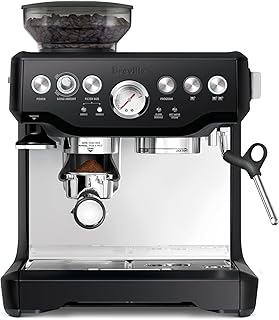
Quick Specs: Thermocoil PID heater | Integrated conical burr grinder | 54 mm (2.13 in) STD-GROUP-BREVILLE-54 portafilter | Manual steam wand | Dedicated hot-water outlet | 120V / 60Hz (NEMA 5-15P) | Tier: $200-$500 / TIER-ESP-MID
The Breville Barista Express BES870BTR demonstrates the appeal of all-in-one portafilter machines. Combining an integrated conical burr grinder with a PID thermocoil, pressure gauge, and dedicated hot-water spout eliminates the guesswork of buying a separate grinder for UC-BEGINNER-ONE-BOX shoppers focused on classic medium- and dark-roast espresso or Americanos.
Built-In Grinder Note (CR-GRD-ESP-04, CR-ESP-SYS-04): The integrated stepped grinder handles medium and dark roasts cleanly, but light-roast drinkers frequently outgrow its step spacing and add an external flat-burr grinder later. Also measure under-cabinet height for top bean-hopper lid access.
Pros
- All-in-one chassis satisfies single-wall grinding requirements out of the box (
CR-SYS-02) - Includes hot-water dispenser for Americanos (
CR-DRINK-ESP-05) and both pressurized and single-wall baskets
Cons
- Sequential thermocoil requires switching modes between brewing and manual steaming (
CR-DRINK-ESP-03) - Stepped built-in conical grinder limits micro-adjustments on dense light-roast beans (
CR-GRD-ESP-03)
Choose if / Skip if: Strong fit for UC-BEGINNER-ONE-BOX buyers wanting tactile portafilter brewing in one footprint. Skip if you switch coffees daily or prioritize fast consecutive lattes.
3. Gaggia Classic Evo Pro (RI9380/48) — Single-Boiler Archetype

Quick Specs: Single boiler with thermostat control | 58 mm (2.28 in) STD-GROUP-GAGGIA-58 commercial-style group | Three-way solenoid valve | Manual commercial-style steam wand | 120V / 60Hz (~1,425 W per US retailer listings; NEMA 5-15P) | Tier: $500-$1,000
The Gaggia Classic Evo Pro anchors the classic single-boiler category. Its heavy 58 mm brass group and commercial-style steam wand produce dry steam texture and clean puck knockouts via a three-way solenoid valve, while simple rocker switches appeal to buyers seeking mechanical longevity over touchscreens.
Compatibility & Spec Caveat (CR-ESP-ACC-01, CR-DRINK-ESP-01, G-12): Gaggia uses its own 58 mm lug geometry—confirm exact model compatibility before buying 58 mm bottomless portafilters rather than assuming E61 fit. Note also that boiler material/coating specifications vary across retail listings on Classic Evo Pro revisions, and thermostat control limits repeatable light-roast precision compared to PID single boilers.
Pros
- Commercial-diameter 58 mm group and three-way solenoid valve built for tactile straight espresso
- Latching mechanical power switch works cleanly when paired with an appropriately rated smart plug (
CR-ESP-SYS-05)
Cons
- Thermostat control (no factory PID) causes wider brew-temperature swings than PID-equipped rivals (
CR-DRINK-ESP-01) - Single-boiler sequential wait between brewing and steaming slows multi-latte sessions (
CR-DRINK-ESP-03)
Choose if / Skip if: Ideal for hands-on UC-STRAIGHT-ESPRESSO learners who already own an espresso grinder. Skip if you make 3+ milk drinks daily or want automatic PID precision out of the box.
4. Diletta Bello+ Heat Exchanger (White) — HX E61 Archetype

Quick Specs: Heat-exchanger boiler with PID regulation | 58 mm (2.28 in) STD-GROUP-E61 thermosiphon group | Simultaneous brew & steam | Programmable pre-infusion & shot timer | Hot-water dispenser | 120V / 60Hz (NEMA 5-15P) | Tier: $1,000+ (TIER-ESP-PROSUMER)
The Diletta Bello+ brings traditional E61 thermosiphon architecture onto Amazon US with a practical modern upgrade: PID control managing the heat-exchanger boiler alongside programmable pre-infusion. Because brew water passes through an internal exchanger tube inside the continuously pressurized steam boiler, hosts can pull espresso and texture milk simultaneously for back-to-back guests.
E61 & Water Gate (CR-ESP-02, CR-ESP-03, CR-WTR-ESP-02): Even with PID-assisted HX management, brew water temperature remains coupled indirectly to the steam boiler—expect a brief flush after long idle periods. Exposed E61 brass chrome gets hot during operation, requires longer warm-up times, and needs mineral-balanced water (never zero-TDS distilled water) to satisfy conductive level probes.
Pros
- True simultaneous brewing and high-capacity steaming suited to
UC-ENTERTAINERhouseholds (CR-DRINK-ESP-03) - Authentic E61 58 mm group unlocks broad aftermarket baskets, screens, and flow-control kits (
CR-ESP-01)
Cons
- Significantly slower cold warm-up than thermoblocks and hot exposed E61 exterior (
CR-ESP-03) - Indirect HX brew temperature lacks the split independent precision of dual boilers (
CR-ESP-02)
Choose if / Skip if: Excellent for UC-ENTERTAINER milk-drink hosts who love classic stainless E61 styling. Skip if you rush out the door in five minutes or switch light-roast temperatures constantly.
5. Rancilio Silvia Pro X Dual Boiler (Black) — Dual-Boiler Archetype
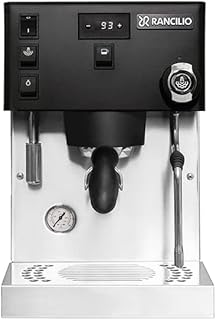
Quick Specs: Independent dual stainless steel boilers | Dual PID temperature controllers + programmable soft infusion | 58 mm (2.28 in) STD-GROUP-RANCILIO-58 portafilter | Brew pressure gauge & hot-water spout | 120V / 60Hz (~950–1,000 W nominal per distributor spec sheets using brew-boiler priority; NEMA 5-15P) | Tier: $1,000+ (TIER-ESP-PROSUMER)
The Rancilio Silvia Pro X demonstrates why dedicated dual boilers sit atop enthusiast wishlists. With independent PID regulation isolating the coffee boiler from the steam boiler, you can adjust extraction temperatures accurately for light roasts (CR-DRINK-ESP-01) while pulling shots and steaming milk simultaneously without temperature overshoot or cooling flushes.
120V Priority & Lug Alert (CR-ESP-SYS-07, CR-ESP-ACC-01, CR-WTR-ESP-02): On 120V US lines, Rancilio uses brew-boiler priority firmware so both heaters stay inside standard 15A circuit limits—making steam recovery behavior different from 230V overseas specs (G-06). Remember Rancilio 58 mm lug geometry differs from E61 portafilters, and avoid 0 TDS distilled water due to conductive probe requirements.
Pros
- True dual-boiler thermal isolation with dual PIDs excels for
UC-LIGHT-ROAST-ENTHUSIASTandUC-ENTERTAINERsetups - 120V boiler-priority logic runs cleanly on standard
NEMA 5-15Routlets without 20A rewiring (CR-ESP-SYS-07)
Cons
- Substantial footprint and weight plus high entry cost inside
TIER-ESP-PROSUMER - No manual flow-profiling paddle out of the box and requires a capable standalone prosumer grinder (
CR-SYS-01)
Choose if / Skip if: Ideal for serious home baristas dialing light-to-medium roasts alongside frequent milk drinks. Skip if budget or counter depth favors a compact thermoblock.
6. Philips 3200 Series LatteGo (EP3241/54) — Super-Automatic Alternative
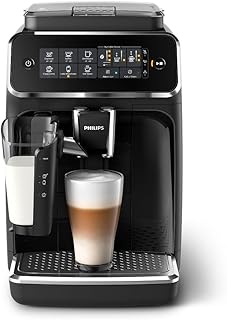
Quick Specs: Automated internal brew group + thermoblock | Integrated ceramic grinder | Tubeless LatteGo milk carafe | 5 one-touch drink presets | AquaClean reservoir filter slot | 120V / 60Hz (NEMA 5-15P) | Tier: $500-$1,000
Categorized explicitly as a convenience alternative (CR-DRINK-ESP-07), the Philips 3200 Series LatteGo shows what super-automatic ownership looks like in practice: pour whole beans up top, press one drink icon, and let the machine grind, tamp, brew, and froth milk into your mug with a two-piece tubeless carafe that rinses cleanly under a faucet.
Bean & Filter Lock Gates (CR-DRINK-ESP-04, CR-WTR-ESP-05): Super-automatics perform reliably only with dry-surface beans—avoid oily dark roasts, flavored coffees, or caramelized blends that gum up internal chutes. Use manufacturer-matched AquaClean water filters per the manual to stay within maintenance schedules.
Pros
- True push-button convenience from whole bean to milk drink with zero tamping skill required (
UC-CONVENIENCE-PUSH-BUTTON) - Tubeless LatteGo milk system avoids narrow internal hoses that trap dairy residue
Cons
- Produces lighter-bodied shots than traditional 58 mm portafilter setups with no custom basket swaps
- Requires weekly internal brew-group rinsing and strict avoidance of oily beans (
CR-DRINK-ESP-04)
Choose if / Skip if: Best for busy households prioritizing push-button mornings over barista craft. Skip if you enjoy dialing specialty single-origin espresso by weight.
Ownership, Water Chemistry & Manufacturer-First Safety Checklist
Choosing among espresso machine types also locks in ongoing maintenance categories (CR-SYS-04) and household safety routines. Before plugging in any 120V appliance, verify these five manufacturer-first steps:
- Check Your 120V Plug & Circuit First: Confirm your machine carries a
110–120V / 60HzUS rating plate. Never use gray-market 230V imports with step-up transformers, never use 15A-to-20A plug adapters, and hire a licensed electrician if installing aNEMA 5-20Rreceptacle (CR-ESP-SYS-01,G-17). - Budget for Recurring Consumables (
CR-SYS-04): Every machine category carries recurring supplies—OEM reservoir water cartridges (CR-WTR-ESP-05), backflush cleaning tablets (only for machines whose manuals authorize blind-basket backflushing underCR-ESP-ACC-11), manufacturer-approved descaling solutions, group gaskets, or recurring capsules for pod brewers. - Follow Your Maker’s Descaling Method (
CR-WTR-ESP-06): Never guess DIY vinegar or citric acid strengths. Some dual boilers warn explicitly against owner descaling due to trapped solution pockets, whereas thermoblocks rely on periodic cycles with maker-approved descaler to protect aluminum or stainless passages. - Respect Pressurized Steam & Boiler Boundaries: Wait for boilers to depressurize and cool completely per the user manual before servicing shower screens or seals, never defeat thermal cutoffs or GFCI outlets, and engage a qualified plumber with inline filtration and pressure regulation for any switchable plumb-in setup (
CR-WTR-ESP-07,CR-ESP-SYS-03). - Verify Water Hardness Before Filling: Use local municipal reports, hardness strips, or titration drops to verify water sits inside your machine manual’s CaCO3 target—protecting boiler heating elements and espresso flavor alike without over-relying on pure zero-TDS water where conductive level probes require trace minerals (
CR-WTR-ESP-01,CR-WTR-ESP-02).
Authoritative Manufacturer & Standards Citations
- Breville USA Official Product Manuals & Specifications — 120V ThermoJet/thermocoil architecture, 54 mm & 58 mm portafilter kits, and dual-boiler circuit specs.
- Rancilio Group Official Technical Specifications — Dual-boiler Silvia Pro X PID architecture and 120V US specification details.
- Gaggia Milano Official Espresso Machine Documentation — Single-boiler 58 mm group and solenoid maintenance procedures.
- Specialty Coffee Association (SCA) Coffee Water Standards — Target mineral hardness, total alkalinity, and TDS benchmarks for coffee equipment care.
- National Fire Protection Association (NFPA / NEC) — North American 120V 15A/20A kitchen small-appliance branch-circuit and GFCI requirements.
How We Audited This Guide
- Espresso machines were audited across heating architecture, simultaneous brew and steam flow, 51mm/54mm/58mm portafilter lugs, NEMA 5-15P/5-20P circuit draw, and US warranty terms.
- Every espresso machine, burr grinder, accessory, and scale specification was cross-checked against official manufacturer 120V manuals, SCA water guidance, and verified Amazon US listings.
- Recommendations were evaluated against our weighted espresso-gear scoring rubrics and documented CR-* compatibility rules; we never invent heat-up seconds, PID variance, or micron claims.
Frequently Asked Questions: Types of Espresso Machines
What is the best type of espresso machine for beginners at home?
Beginners who want real portafilter espresso without slow boiler waits do best with a PID-controlled thermoblock (like the Breville Bambino Plus) paired with an entry espresso grinder, or an all-in-one built-in-grinder machine (like the Barista Express). Both include pressurized and single-wall baskets for flexible progression.
What is the difference between a thermoblock, single boiler, heat exchanger, and dual boiler?
Thermoblocks heat water on demand in seconds and switch sequentially between brewing and steaming. Single boilers hold one pressurized tank and also work sequentially. Heat exchangers route a brew tube through one steam boiler for simultaneous workflow, while dual boilers dedicate separate PID-regulated tanks to each task.
Are 20-bar espresso machines better than 15-bar or 9-bar machines?
No. Labels claiming 15 bar or 20 bar describe the vibration pump’s maximum dead-head ceiling, not extraction pressure at the coffee bed. Conventional espresso brews around ~9 bar using an internal over-pressure valve (OPV) or grind resistance—never choose an espresso machine category based on pump bar numbers.
Do super-automatic espresso machines make the same espresso as semi-automatics?
Not identically. Super-automatic machines automate grinding, dosing, and tamping inside a sealed internal brew chamber for push-button speed, producing lighter-bodied shots than tuned 54 mm or 58 mm portafilters. They also require dry-surface medium roasts rather than oily or flavored coffee beans (CR-DRINK-ESP-04).
Are capsule machines like Nespresso considered real espresso machines?
BrewBench Lab classifies capsule systems separately as convenience alternatives (CR-DRINK-ESP-07). OriginalLine and VertuoLine units use fixed, pre-ground proprietary capsules—and Vertuo uses centrifugal spinning rather than ~9-bar pump percolation—trading away grind dialing and single-wall portafilter extraction for one-button speed and higher per-cup cost.
Can a manual lever espresso machine make milk drinks like lattes?
Manual lever machines have no boiler or steam wand, so they cannot steam milk directly (CR-DRINK-ESP-02). You need an external kettle for brewing water (CR-ESP-SYS-08) plus a standalone handheld or countertop milk frother if you want textured lattes or cappuccinos alongside manual espresso pulls.


