
Disclosure: As an Amazon Associate, I earn from qualifying purchases. If you buy through links on this page, we may earn a small commission at no extra cost to you.
Comparing the gaggia classic evo pro vs rancilio silvia puts two cornerstone Italian 58mm single-boiler espresso machines head-to-head on 120V North American specs. Both machines earn prominent recommendations across our best espresso machines pillar guide and our best espresso machines under $1,000 roundup because each delivers genuine commercial-diameter 58mm portafilters, three-way solenoid valves, and manual steam wands—yet their boiler sizes, internal metallurgy, and upgrade margins target distinct home baristas.
The short verdict: Choose the Gaggia Classic Evo Pro (RI9380)—or better yet, Gaggia’s updated uncoated brass-boiler Classic E24—if you want a compact 8.0-inch footprint, factory-calibrated 9-bar extraction on US models, and lower upfront hardware spending so more of your budget funds an espresso-capable burr grinder. Choose the Rancilio Silvia (M V6) if you want a substantially larger 0.3 L (300 mL) insulated brass boiler, noticeably stronger dry steam endurance for daily lattes, a heavy ~30.8 lb iron-framed chassis, and a metal wood-handled tamper included out of the box.
In This Comparison
- Winner-by-Use-Case Quick Verdict Matrix
- Side-by-Side 120V Spec & Compatibility Table
- Battleground 1: Boiler Metallurgy, Thermal Mass & The Evo Pro Coating Update
- Battleground 2: Temperature Control, Light Roasts & 15-Bar vs. 9-Bar OPV
- Battleground 3: Steam Power & Sequential Single-Boiler Milk Workflow
- Battleground 4: 58mm Portafilter Lugs, Included Baskets & Three-Way Solenoid
- Battleground 5: Grinder Pairing, Budget Math & Drip-Tray Scale Fit
- Battleground 6: US 120V Power, Water Chemistry & Boiler-Safe Descaling
- Choose Gaggia Classic Evo Pro If vs. Choose Rancilio Silvia If
- Verified Amazon US Models & Excluded Alternatives
- Frequently Asked Questions
Quick Verdict Matrix: Which 58mm Single-Boiler Machine Wins by Use Case?
Both machines occupy the TIER-ESP-MID ($400–$1,000) corridor on Amazon US, with the Gaggia Classic Evo Pro sitting comfortably in the lower half of the band and the Rancilio Silvia M V6 anchored near the top edge (while factory-modified PID Silvia units step into the $1,000+ TIER-ESP-PROSUMER bracket). Use the matrix below to match your drink routine and counter constraints before inspecting the detailed specifications.
| Use Case & Drink Profile | Winner | Why It Wins (Verified Spec & Rule Fit) |
|---|---|---|
| Best for Daily Milk Drinks (1–2 lattes or cappuccinos per session) | Rancilio Silvia (M V6) | Insulated 0.3 L (300 mL) brass boiler holds roughly four times the volume of the Evo Pro’s ~75–80 mL boiler, sustaining dry steam pressure cleanly across 12 oz pitchers (CR-DRINK-ESP-03, CR-ESP-ACC-08). |
| Best for Straight Espresso & Light Roasts | Rancilio Silvia w/ PID (Tie on stock thermostats) | Stock Evo Pro and stock Silvia M both rely on bimetallic thermostats requiring temperature surfing under CR-DRINK-ESP-01; a factory-installed PID Silvia locks repeatable 93–96 °C (199–205 °F) brew targets. |
| Best Value / Total Setup Ecosystem Cost | Gaggia Classic Evo Pro / Classic E24 | Lower machine price preserves 30%+ of a $700–$1,800 setup budget for an espresso-rated burr grinder (CR-SYS-01), while US units include a factory 9-bar OPV spring. |
| Best Compact Kitchen Footprint (shallow counters) | Gaggia Classic Evo Pro (RI9380) | At 8.0 in W × 9.5 in D, the Gaggia saves 1.3 in of width and 1.9 in of depth compared with the Silvia’s 9.3 in W × 11.4 in D footprint (CR-ESP-SYS-04). |
| Best Long-Term Boiler Durability (Gaggia Line) | Gaggia Classic E24 (RI9380/46) | Replaces the Evo Pro’s coated aluminum boiler with an uncoated lead-free brass boiler, permanently eliminating internal coating-flaking concerns while keeping Gaggia’s compact chassis. |
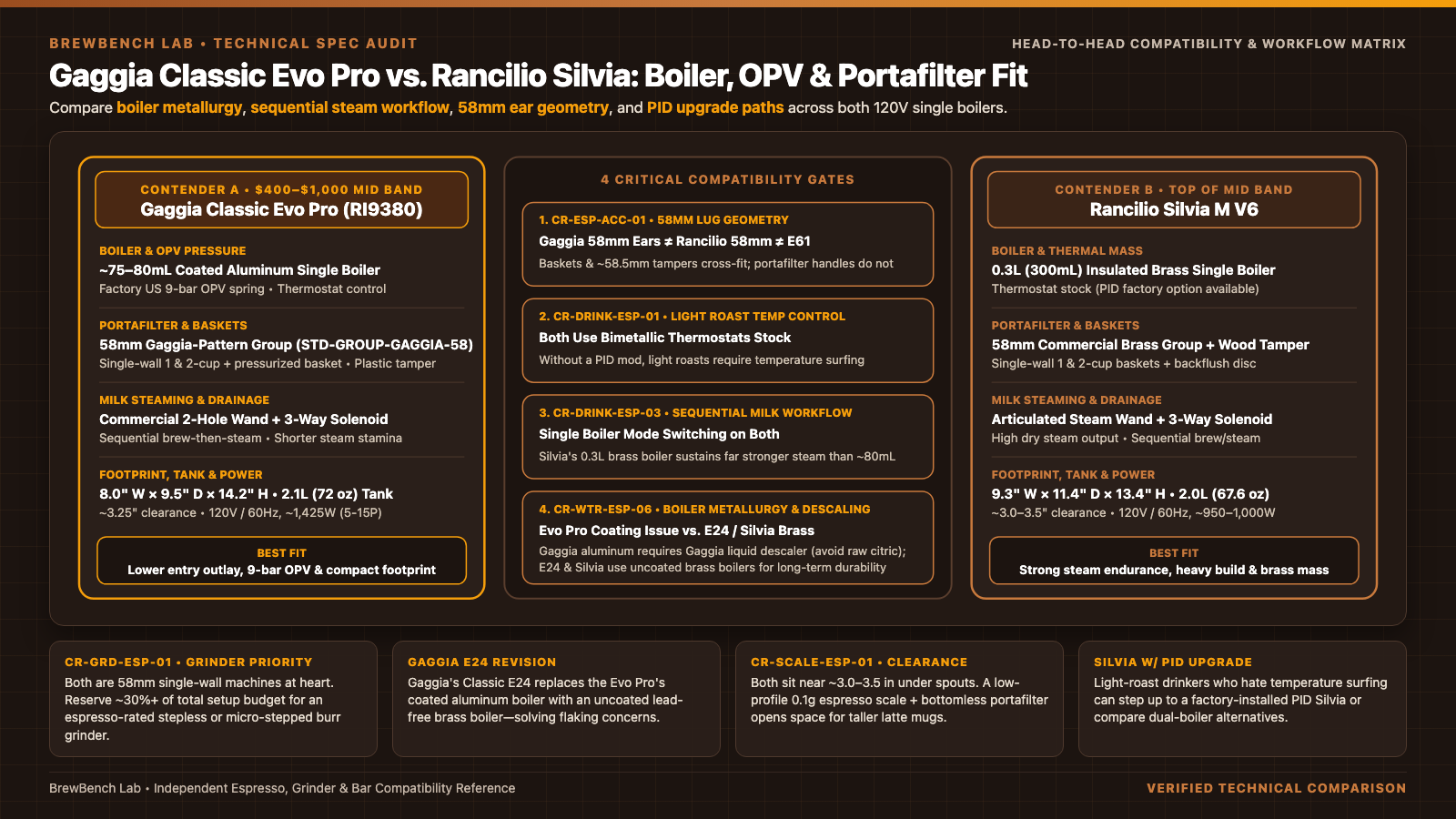
Side-by-Side Verified Spec & Compatibility Table (120V US Models)
Every specification below reflects North American 120V/60Hz retail units rather than 230V/50Hz European or UK equivalents. Region parity is critical here: European Rancilio Silvia “E” models incorporate an EU-mandated 30-minute auto-off module, whereas US “M” models retain a traditional latching mechanical power switch. Where neither manufacturer publishes an exact numeric value—such as isolated thermostat deadband temperatures or exact drip-tray inner millimeter bounds—we note the missing data explicitly.
| Specification / Compatibility Metric | Gaggia Classic Evo Pro (RI9380 US) | Rancilio Silvia (M V6 120V US) |
|---|---|---|
| Heating Architecture | Single boiler (sequential brew then steam) | Single boiler (sequential brew then steam) |
| Boiler Material & Capacity | Non-stick coated aluminum boiler (~75–80 mL / ~2.5 fl oz); Classic E24 update swaps to uncoated brass (~105–109 mL) | Insulated solid brass boiler (0.3 L / 300 mL / ~10.1 fl oz) |
| Temperature Control | Bimetallic brew & steam thermostats (stock °C/°F deadband: no verified data available yet) | Bimetallic thermostats on stock M V6; digital PID available on factory-modified PID variants |
| Pump Rating vs. OPV Brew Pressure | 15-bar vibration pump; factory-calibrated 9-bar OPV on US Evo Pro units | 15-bar vibration pump; adjustable brass OPV tuned near ~9–10 bar extraction |
| Portafilter & Group Standard | 58mm Gaggia-pattern group (STD-GROUP-GAGGIA-58); stainless/chromed brass handle | 58mm Rancilio commercial brass group (STD-GROUP-RANCILIO-58); chrome-plated brass handle |
| Included Filter Baskets (US Box) | 1-cup single-wall, 2-cup single-wall, plus 1 pressurized (crema) basket | 1-cup (~7–9 g) single-wall + 2-cup (~14–18 g) single-wall baskets + blind backflush disc |
| Included Tamper | Lightweight plastic tamper (metal 58mm upgrade strongly advised) | Full-size wood-handled stainless steel tamper (V6 upgrade) |
| Three-Way Solenoid Valve | Yes (dry pucks + supports blind-basket backflushing) | Yes (dry pucks + supports blind-basket backflushing) |
| Steam Wand Architecture | Commercial-style 2-hole stainless steam wand | Articulated commercial stainless steam wand with ball joint |
| Water Reservoir Capacity | ~2.1 L (~72 fl oz) rear removable tank | 2.0 L (~67.6 fl oz) rear removable tank |
| 120V US Power & Plug | 110–120V / 60Hz, ~1,425W (maker range ~1,375–1,425W), NEMA 5-15P | 120V / 60Hz, ~950–1,000W, NEMA 5-15P |
| Power Switch Type | Latching mechanical rocker switches (US 120V) | Latching mechanical rocker switches (M version; no EU auto-off) |
| Cup Clearance (Under Spouts) | ~3.25 in (~83 mm) with standard spouted portafilter & tray | ~3.0–3.5 in (~76–89 mm) with standard spouted portafilter & tray |
| Overall Dimensions (W × D × H) | ~8.0 × 9.5 × 14.2 in (~203 × 241 × 361 mm) | 9.3 × 11.4 × 13.4 in (235 × 290 × 340 mm) |
| Weight | ~20 lbs (~9.1 kg) | ~30.8 lbs (14 kg) |
| US Manufacturer Warranty | 2-year limited parts & labor via authorized US dealers | 1-year limited manufacturer warranty via Rancilio NA |
| Amazon US Budget Tier | $400–$1,000 (TIER-ESP-MID lower-to-mid band) | $400–$1,000 (TIER-ESP-MID upper edge; PID version $1,000+ TIER-ESP-PROSUMER) |
Battleground 1: Boiler Metallurgy, Thermal Mass & The Evo Pro Coating Issue
The fundamental mechanical difference in the gaggia classic evo pro vs rancilio silvia comparison sits directly above each group head. The Gaggia Classic Evo Pro uses a compact aluminum boiler (~75–80 mL / ~2.5 fl oz) heated by twin external elements clamped to the outer walls, paired with a heavy brass group body below. Aluminum conducts heat rapidly, allowing the small boiler to reach initial operating warmth quickly, though enthusiasts still give the brass group and portafilter a generous 10–15 minute soak—or run a quick blank water flush—before pulling a shot.
However, shoppers evaluating the Evo Pro today must understand an important documented hardware issue: early-production 2023 Gaggia Classic Evo Pro units shipped with an industrial non-stick PTFE/Exelia coating inside the aluminum boiler intended to resist scale buildup. Owners widely reported dark coating flakes shedding from the group head and steam wand—a community issue commonly called “Boilergate.” While Gaggia addressed affected units through warranty channels and later introduced the Gaggia Classic E24 featuring an uncoated, lead-free solid brass boiler (~105–109 mL) with zero internal coating to peel, anyone shopping the Evo Pro specifically should check retailer batch disclosures or step directly to the brass-boiler E24 revision.
By contrast, the Rancilio Silvia M V6 requires no revision disclaimer. It builds around an uncoated, wrapped/insulated 0.3 L (300 mL) solid brass single boiler bolted to a heavy commercial brass group inside an iron-framed stainless steel body weighing ~30.8 lbs (14 kg). Because 300 mL of water inside thick brass holds roughly four times the volume of the Evo Pro’s aluminum boiler, the Silvia resists sharp temperature collapse during extraction and retains far greater steam reserve once switched to steam mode. For a deeper dive into single-boiler versus dual-boiler heating trade-offs, review our single boiler vs dual boiler vs heat exchanger architectural guide.
Battleground 2: Temperature Control, Light Roasts & 15-Bar vs. 9-Bar OPV Reality
Both manufacturers specify 15-bar vibration pumps on their technical sheets, yet neither machine brews espresso at 15 bar—nor should it. Under BrewBench Lab standards, 15 bar is the pump’s maximum dead-head ceiling, whereas balanced single-wall espresso extraction targets roughly ~9 bar at the coffee bed. One standout improvement on the North American Gaggia Classic Evo Pro (and Classic E24) over the older Classic Pro is that US-spec units leave the factory with a 9-bar Overpressure Valve (OPV) spring installed out of the box, removing the immediate DIY spring swap older Gaggia buyers used to perform. The Rancilio Silvia pairs its vibration pump with a mechanical brass OPV tuned near the ~9–10 bar commercial window.
Where both stock machines show their age is temperature regulation under compatibility rule CR-DRINK-ESP-01. Neither the standard Gaggia Classic Evo Pro nor the standard Rancilio Silvia M V6 includes a factory digital PID temperature controller. Both rely on mechanical bimetallic thermostats that cycle the heating element on and off across a temperature swing window. For medium-to-dark chocolatey espresso blends, traditional “temperature surfing” (triggering a brief flush until the boiler indicator light cycles back on, then waiting a consistent count before locking in) delivers rich, repeatable shots.
For dense, Nordic-style light roasts requiring tight 93–96 °C (199–205 °F) stability, stock bimetallic thermostats represent a clear soft limitation under CR-DRINK-ESP-01. Here, the Rancilio ecosystem offers a straightforward turnkey path on Amazon US: the factory-modified Rancilio Silvia w/ PID, which integrates a digital PID module right above the drip tray for degree-level brew stability without voiding user safety or tampering with high-voltage wiring yourself. You can also explore how Gaggia’s thermostat workflow compares against fast-heating thermoblocks in our Gaggia Classic Evo Pro vs Breville Bambino Plus breakdown or inspect our standalone Gaggia Classic Evo Pro review.
Battleground 3: Steam Power & Sequential Single-Boiler Milk Workflow
Because both the Gaggia Classic Evo Pro and Rancilio Silvia are true single-boiler machines, compatibility rule CR-DRINK-ESP-03 applies equally to both: neither can brew espresso and steam milk simultaneously. After pulling your shot around ~93 °C (~200 °F), you flip the steam switch, wait for the single boiler to climb past boiling into steam pressure, purge condensation, texture your milk, and then bleed water back through the steam wand or group head to refill and cool the boiler before pulling a second shot. For one or two daily lattes, that sequential rhythm quickly becomes second nature; for hosting four or more guests, it feels noticeably slower than a dual-boiler or heat-exchanger machine.
Once both boilers reach steam temperature, however, the Rancilio Silvia wins milk texturing decisively. Its 300 mL brass boiler and articulated ball-joint commercial wand sustain crisp, dry steam pressure long enough to roll 12 oz (350 mL) and even 16–20 oz milk pitchers into glossy microfoam without stalling mid-pitcher. The Gaggia Classic Evo Pro upgrades over pre-2019 Gaggia models with a solid 2-hole commercial stainless wand (ditching the old plastic panarello), but its ~75–80 mL boiler loses steam head faster. Under rule CR-ESP-ACC-08, Gaggia owners get the best vortex using compact 12 oz (350 mL) pitchers and starting steam slightly before the thermostat light shuts off so the element stays active throughout texturing. Note also under CR-DRINK-ESP-05 that neither machine has a dedicated hot-water tap—Americano drinkers either dispense hot water via the steam wand valve or use a separate kettle.
Battleground 4: 58mm Portafilter Lugs, Included Baskets & Three-Way Solenoid
Shoppers often assume every “58mm commercial” espresso machine accepts the exact same aftermarket portafilter. Under hard compatibility rule CR-ESP-ACC-01, diameter alone does not guarantee fit—locking ear (lug) thickness, angle, and wing placement differ across brands:
- Gaggia vs. Rancilio vs. E61 Portafilter Ears (
CR-ESP-ACC-01): The Gaggia Classic Evo Pro uses Gaggia’s proprietary 58mm group pattern (STD-GROUP-GAGGIA-58), with locking ears positioned differently than Rancilio’s 58mm commercial group (STD-GROUP-RANCILIO-58) and standard Italian E61 groups. Never buy a generic “58mm E61 bottomless portafilter” for either machine; confirm the listing explicitly specifies Gaggia Classic or Rancilio Silvia. - Baskets & Tampers Cross-Fit by Inner Diameter (
CR-ESP-ACC-02,CR-ESP-ACC-03): While the portafilter handles do not swap between machines, standard 58mm ridgeless precision baskets (such as 18 g or 20 g IMS/VST baskets) seat inside both handles when matching basket height (CR-ESP-ACC-06). Stock baskets taper slightly, so an aftermarket 58.4–58.5mm flat metal tamper fits precision baskets far more cleanly than Gaggia’s undersized stock plastic tamper. Rancilio wins out of the box by bundling a heavy wood-handled stainless metal tamper with V6 units. - Included Baskets & Three-Way Solenoid Valves (
CR-ESP-ACC-13,CR-ESP-ACC-11): Both machines include 1-cup and 2-cup single-wall baskets for fresh burr-ground coffee (Gaggia also tosses in a pressurized “crema” basket for temporary pre-ground use). Both machines also feature commercial three-way solenoid valves that instantly vent puck pressure into the drip tray when the brew switch stops, producing dry, clean pucks and enabling detergent backflushing with a blind basket per each maker’s manual.
Battleground 5: Grinder Pairing, Budget Math & Drip-Tray Scale Fit
Neither the Gaggia Classic Evo Pro nor the Rancilio Silvia includes a grinder, and both are built primarily for single-wall 58mm extraction. Under hard compatibility rule CR-GRD-ESP-01, pairing either machine with a blade grinder or a filter-only burr mill (such as a standard Baratza Encore or stock Fellow Ode Gen 2) guarantees rapid, sour, under-extracted gushers in a single-wall basket. Under rule CR-GRD-ESP-03, stepless or micro-stepped espresso grinders make dialing in 58mm pucks far less frustrating than coarse stepped mills.
Budget allocation rule CR-SYS-01 also explains why the Gaggia Classic Evo Pro remains so popular: reserving roughly one-third or more of your total machine-plus-grinder budget for the grinder is much easier when your machine sits in the middle of TIER-ESP-MID rather than at the ~top edge where the Rancilio Silvia resides. If buying a Rancilio Silvia forces you onto an inadequate grinder, a Gaggia Classic E24 or Evo Pro paired with a dedicated 64mm flat-burr or espresso conical grinder will produce sweeter, more consistent espresso every morning.
On the counter, watch cup clearance and drip-tray dimensions carefully (CR-SCALE-ESP-01, CR-SCALE-ESP-02). Both machines sit tightly at roughly 3.0 to 3.5 inches (76–89 mm) between the double-spouted portafilter tips and the drip tray grate. Placing a 20 mm 0.1 g espresso scale plus a 75 mm ceramic latte mug underneath leaves zero margin with spouts attached. Upgrading to a brand-matched 58mm bottomless portafilter recovers nearly an inch of vertical clearance on both machines while exposing extraction channeling, and a low-profile mini 0.1 g espresso scale seats cleanly on either drip tray without overhanging the front edge. Under CR-ESP-SYS-04, note that both rear-mounted ~2.0–2.1 L reservoirs lift out from the top—check that your upper kitchen cabinets leave comfortable clearance above the 13.4 in (Silvia) or 14.2 in (Gaggia) machine heights.
Battleground 6: US 120V Power, Water Chemistry & Boiler-Safe Descaling
Both 120V/60Hz North American units terminate in standard NEMA 5-15P plugs for ordinary 15A or 20A kitchen receptacles (CR-ESP-SYS-01). The Gaggia Classic Evo Pro draws roughly 1,425W (~12A), while the 120V Rancilio Silvia draws ~950–1,000W (~8–8.5A). Because the Gaggia approaches the 1,440W continuous threshold of a 15A circuit (CR-ESP-SYS-02), avoid running an electric kettle or toaster on the exact same circuit while heating either espresso machine. Also, because both machines use latching mechanical switches (CR-ESP-SYS-05), readers sometimes pair them with heavy-duty UL-listed smart plugs rated for 15A/1,800W+ loads—just verify your switch rating carefully, plug directly into a grounded 120V GFCI-protected receptacle, and never use plug adapters.
Water quality and descaling chemistry separate these two boilers sharply under rules CR-WTR-ESP-01, CR-WTR-ESP-02, and CR-WTR-ESP-06:
- Never Use Pure Un-Remineralized Distilled Water or Household Vinegar: Both machines benefit from balanced SCA-range water (~68 mg/L CaCO3 target hardness, 17–85 mg/L acceptable window, 75–250 mg/L TDS) using remineralized RO/distilled recipes or in-tank ion-exchange pouches. Pure un-remineralized water tastes flat and can accelerate metal wear over time.
- Aluminum-Boiler Descaling Caution (Gaggia Evo Pro): Reactive aluminum boilers require Gaggia’s official liquid decalcifier (a lactic/citric blend formulated with corrosion inhibitors). Unbuffered DIY citric acid concentrations or vinegar can etch bare aluminum alloys and turn rinse water gray—follow Gaggia’s North American manual strictly, and never open a hot or pressurized boiler.
- Brass-Boiler Descaling (Rancilio Silvia & Gaggia E24): Uncoated brass boilers tolerate commercial espresso descalers approved in each maker’s manual without non-stick coating degradation, though flushing multiple full tanks of fresh water through both the group and steam wand remains mandatory to protect brass seals and taste.
Head-to-Head Decision Summary: Choose Gaggia or Choose Rancilio?
Choose the Gaggia Classic Evo Pro (or E24) if…
- You want true 58mm single-boiler espresso at a lower price tier so you can allocate 30%+ of your total setup budget to an espresso burr grinder (
CR-SYS-01). - You have a shallow kitchen counter (
UC-SMALL-KITCHEN) where an 8.0 × 9.5 in footprint fits cleanly under upper cabinets. - You want factory-calibrated 9-bar OPV extraction out of the box without touching internal springs, and plan to upgrade to the uncoated brass Classic E24 if avoiding coated aluminum boilers.
- You mostly drink straight espresso, Americanos, or one small 12 oz milk drink per session (
UC-STRAIGHT-ESPRESSO).
Choose the Rancilio Silvia (M V6 or PID) if…
- You steam milk daily for lattes or cappuccinos (
UC-MILK-DRINKS-DAILY/DRINK-MILK-MEDIUM-ROAST) and want a 0.3 L brass boiler with noticeably stronger dry steam endurance. - You prefer heavy commercial-feeling ~30.8 lb iron-and-stainless construction, an articulated ball-joint steam wand, and an uncoated brass boiler from day one.
- You want a proper wood-handled metal tamper and commercial 58mm chrome-plated brass portafilter included in the box.
- You brew light-to-medium roasts (
UC-LIGHT-ROAST-ENTHUSIAST) and want the option to purchase a factory-installed PID Silvia model without DIY wiring.
Verified Amazon US Models & Key Revision Upgrades
All four listings below represent verified 120V/60Hz North American SKUs available on Amazon US. Alongside the two headline contenders, we include the uncoated brass-boiler Gaggia Classic E24 (the essential Gaggia update addressing Evo Pro boiler-coating reports) and the factory-modified Rancilio Silvia w/ PID for light-roast enthusiasts seeking exact digital temperature control.
1. Gaggia Classic Evo Pro (RI9380/50) — Value & Compact Footprint Winner

Quick Specs: Single coated aluminum boiler (~75–80 mL) + bimetallic thermostats | Factory 9-bar US OPV spring | 58mm Gaggia-pattern portafilter (1 & 2-cup single-wall + pressurized basket) | Commercial 2-hole steam wand | Three-way solenoid valve | 2.1 L tank | 120V/60Hz, ~1,425W (NEMA 5-15P) | ~8.0 in W × 9.5 in D × 14.2 in H | Price Tier: $500–$1,000
Pros
- US Evo Pro units ship factory-calibrated with a 9-bar OPV spring for immediate single-wall espresso extraction
- Compact 8.0 × 9.5 in footprint fits shallow counters while accommodating a generous 2.1 L water reservoir
- Lower entry price tier leaves meaningful budget room for an espresso-rated burr grinder and 58.5mm metal tamper
Cons
- Coated aluminum boiler carries documented internal coating-flaking reports on early Evo Pro units (check Classic E24 below)
- Smaller ~75–80 mL boiler loses steam stamina faster on large milk pitchers and requires surfing without a PID mod
- Ships with a lightweight plastic tamper and uses Gaggia-specific 58mm portafilter ears incompatible with E61 handles
2. Rancilio Silvia M V6 — Build Quality & Steam Endurance Winner

Quick Specs: 0.3 L (300 mL) insulated solid brass single boiler | Bimetallic thermostats + mechanical latching switch (M model) | 58mm Rancilio commercial brass portafilter (1 & 2-cup single-wall baskets + blind disc + wood/metal tamper) | Articulated steam wand | Three-way solenoid valve | 2.0 L tank | 120V/60Hz, ~950–1,000W (NEMA 5-15P) | 9.3 in W × 11.4 in D × 13.4 in H (~30.8 lbs) | Price Tier: $500–$1,000
Pros
- Large 0.3 L insulated brass boiler and heavy ~30.8 lb iron-framed body provide superior thermal inertia and strong dry steam
- Articulated commercial steam wand and heavy chrome-plated brass 58mm group deliver durable cafe-style ergonomics
- V6 M model bundles a quality wood-handled stainless metal tamper and avoids forced 30-minute EU auto-off timers
Cons
- Stock unit lacks a digital PID, requiring manual temperature surfing to hit narrow light-roast targets consistently
- Sits near the top of the $400–$1,000 TIER-ESP-MID bracket while still switching sequentially between brew and steam
- Tight ~3.0–3.5 in spout clearance limits taller latte mugs unless paired with a bottomless portafilter and slim scale
3. Key Gaggia Revision: Gaggia Classic E24 (RI9380/46) — Uncoated Brass Boiler Update

Quick Specs: Single uncoated lead-free brass boiler | Factory 9-bar US OPV spring | 58mm Gaggia-pattern portafilter | Commercial 2-hole steam wand + three-way solenoid valve | 2.1 L tank | 120V/60Hz (NEMA 5-15P) | Price Tier: $200–$500 / $500–$1,000 boundary
If you prefer Gaggia’s compact footprint and pricing over the Rancilio Silvia yet want zero exposure to coated-aluminum boiler flaking, the Gaggia Classic E24 is the single smartest Gaggia SKU to buy. It retains the 9-bar OPV, three-way solenoid valve, and 58mm Gaggia accessory ecosystem while upgrading the boiler core to uncoated lead-free brass with greater thermal mass. Like the Evo Pro, it still relies on stock thermostats rather than a factory PID and uses sequential single-boiler mode switching.
4. Light-Roast Upgrade: Rancilio Silvia w/ PID — Factory-Installed Digital Control

Quick Specs: 0.3 L insulated brass single boiler + digital PID temperature controller | 58mm Rancilio commercial portafilter | Articulated steam wand + three-way solenoid | 2.0 L tank | 120V/60Hz (NEMA 5-15P) | Price Tier: $1,000+ (TIER-ESP-PROSUMER)
For light-roast drinkers (CR-DRINK-ESP-01) who love the Silvia’s 0.3 L brass boiler and heavy-gauge build but dislike manual temperature surfing, this factory-modified PID edition adds degree-level digital brew stability right out of the box. Just weigh its $1,000+ positioning carefully: at this price tier, you still switch sequentially between brewing and steaming on a single boiler, whereas prosumer dual-boiler machines in the same bracket unlock simultaneous extraction and milk texturing.
Alternatives Excluded From This Amazon US Comparison
- Profitec GO & Lelit Anna (PL41TEM): Excluded as Amazon buy-intent picks because Profitec and Lelit distribute exclusively through specialty espresso dealers without primary Amazon US storefront fulfillment.
- Flair 58 Manual Lever: Excluded due to absent primary Amazon US storefront availability and no integrated steam wand for milk-drink workflows under
CR-DRINK-ESP-02. - 230V / 50Hz European & UK Gray-Market Imports: Disqualified under
CR-ESP-SYS-01; 230V units (including EU-only Silvia E auto-off variants) cannot run safely on US 120V receptacles without voltage conversion and lack North American warranty support.
Authoritative Technical References
- Gaggia North America — Classic Pro / Evo / E24 Official Manuals (120V/60Hz electrical specs, priming instructions, three-way solenoid backflushing, and Gaggia descaling rules).
- Rancilio Group — Official Silvia Homeline Specifications (120V/60Hz 950W–1,000W rating, 0.3 L brass boiler, 2.0 L tank, 235 × 290 × 340 mm dimensions, and 14 kg weight).
- Rancilio Group North America — Homeline Documentation & Warranty (1-year US limited warranty terms, scale exclusions, and Silvia M manual-switch notes).
- Specialty Coffee Association (SCA) — Water Quality Standards (Target hardness, alkalinity, and TDS windows for espresso machine longevity and balanced extraction).
How We Audited This Guide
- Espresso machines were audited across heating architecture, simultaneous brew and steam flow, 51mm/54mm/58mm portafilter lugs, NEMA 5-15P/5-20P circuit draw, and US warranty terms.
- Every espresso machine, burr grinder, accessory, and scale specification was cross-checked against official manufacturer 120V manuals, SCA water guidance, and verified Amazon US listings.
- Recommendations were evaluated against our weighted espresso-gear scoring rubrics and documented CR-* compatibility rules; we never invent heat-up seconds, PID variance, or micron claims.
Frequently Asked Questions
Which makes better espresso: Gaggia Classic Evo Pro or Rancilio Silvia?
With an espresso-rated burr grinder and good temperature surfing, both pull rich ~9 bar 58mm espresso. The Rancilio Silvia offers greater thermal mass from its 0.3 L brass boiler and stronger steam power, while US Gaggia Classic Evo Pro units ship factory-calibrated at 9 bar OPV out of the box.
Should I buy the Gaggia Classic Evo Pro or the Gaggia Classic E24?
Most buyers should choose the Gaggia Classic E24 over the coated-aluminum Evo Pro. The E24 replaces the Evo Pro’s coated aluminum boiler—which faced community coating-flaking reports—with an uncoated lead-free brass boiler while keeping the same compact chassis, 9-bar OPV, and 58mm group.
Do Gaggia Classic and Rancilio Silvia share the same 58mm portafilters?
No—under rule CR-ESP-ACC-01, their 58mm portafilter handles do not cross-fit. Gaggia and Rancilio use distinct locking ear geometries, and neither matches standard E61 handles. However, standard 58mm ridgeless baskets and ~58.5mm precision tampers generally fit inside both brands’ portafilters.
Can either machine brew espresso and steam milk at the same time?
No—both are single-boiler machines that operate sequentially under rule CR-DRINK-ESP-03. You pull your espresso shot first, switch the boiler up to steam temperature, texture milk, and then bleed water to cool and refill the boiler before pulling another shot.
Do I need a separate PID controller for light-roast espresso?
Stock bimetallic thermostats on both machines require temperature surfing for light roasts. Under rule CR-DRINK-ESP-01, light-roast drinkers seeking repeatable 93–96 °C (199–205 °F) brew stability without surfing should consider the factory-modified Rancilio Silvia w/ PID or a PID dual-boiler upgrade.
Can I use pure distilled water or raw citric acid to descale both boilers?
No—follow each maker’s manual strictly. Use balanced remineralized or filtered water rather than un-remineralized distilled water. For aluminum-boiler Evo Pro units, use Gaggia’s corrosion-inhibited liquid descaler rather than vinegar or unbuffered DIY citric acid; brass-boiler Silvia and E24 units tolerate manual-approved descalers.


