
Disclosure: As an Amazon Associate, I earn from qualifying purchases. If you buy through links on this page, we may earn a small commission at no extra cost to you.
Finding the best espresso machine under $1000 puts buyers at the central crossroads of home espresso hardware: choosing between a guided all-in-one unit with built-in burrs and a dedicated 58mm PID boiler machine paired with a separate grinder. Above the entry tier, inflated “15-bar” or “20-bar” pump claims give way to real differentiators—PID thermal loops, three-way solenoid valves, over-pressure valves (OPVs) set near ~9 bar, and whether a machine supports light-roast dialing.
As part of our broader guide to the best espresso machines for home, we audited 18 active 120V/60Hz Amazon US listings priced in the $500–$1,000 bracket (plus high-value $200–$500 platforms that leave room for a standalone grinder). Whether you want one box on the counter or plan to map out a full home espresso setup under $1,000, the 10 verified picks below span every major workflow without off-Amazon dealer gaps.
In This Guide
Quick Picks: Best Espresso Machine Under $1000 at a Glance
#1 Best Overall
Breville Barista Express Impress (BES876BSS)
Guided 25-step conical burr grinder, assisted 22 lb lever tamping, PID thermocoil, and 54mm single-wall plus dual-wall baskets in one clean workflow. (Jump to audit)
#2 Best 58mm All-in-One
KitchenAid Semi-Automatic with Grinder (KES6551)
Flat-base 58mm portafilter, Dual Thermocoil with smart temperature sensors, 15-step conical burrs, and a 2.5 L reservoir under 15.4 inches tall. (Jump to audit)
#3 Best Value 58mm PID
Turin Legato V2 PID 58mm
550 ml PID brew boiler plus dedicated steam thermoblock, external OPV, and shot timer in the $200–$500 band—leaving room for a standalone burr grinder. (Jump to audit)
Side-by-Side Comparison: Top 10 Mid-Range Machines Under $1,000
| Product & Award | Best For | Heating & Portafilter | 120V Draw & Tier | Link |
|---|---|---|---|---|
| Breville Barista Express Impress (BES876BSS) Best Overall | Guided one-box home espresso | Thermocoil PID • 54mm | 1,680W–1,750W (5-15P) $500–$1,000 | View on Amazon |
| KitchenAid Semi-Automatic (KES6551) Best 58mm All-in-One | Commercial-width tamping in one box | Dual Thermocoil PID • 58mm | 1,500W (5-15P) $500–$1,000 | View on Amazon |
| Turin Legato V2 PID 58mm Best Value 58mm PID | Light roasts + external burr grinder | 550ml PID Boiler + Steam Block • 58mm | 1,500W (5-15P) $200–$500 | View on Amazon |
| Breville Barista Pro (BES878BSS) Best Fast-Heat All-in-One | 3-second heat-up & 30 grind steps | ThermoJet PID • 54mm | 1,680W (5-15P) $500–$1,000 | View on Amazon |
| Gaggia Classic Evo Pro Best Moddable 58mm Single Boiler | Long-term DIY parts & 58mm upgrades | Single Boiler • 58mm | 1,350W–1,425W (5-15P) $500–$1,000 | View on Amazon |
| Ninja Luxe Café Pro 4-in-1 (ES701) Best Multi-Brew Workflow | Auto-scale, cold brew & drip hybrid | Thermoblock + Scale • 53mm | 1,650W (5-15P) $500–$1,000 | View on Amazon |
| Breville Barista Touch (BES880BSS) Best Touchscreen Semi-Auto | Hands-free microfoam & 8 profiles | ThermoJet PID • 54mm | 1,680W (5-15P) $500–$1,000 | View on Amazon |
| De’Longhi La Specialista Maestro Best Dual-Milk Hybrid | Manual wand + LatteCrema carafe | Dual Heating + Cold • 51mm | 1,450W–1,600W (5-15P) $500–$1,000 | View on Amazon |
| De’Longhi La Specialista Opera Best 15-Step Smart-Tamp | Cold Extraction + finer 51mm dial | Thermoblock + Cold • 51mm | 1,550W (5-15P) $500–$1,000 | View on Amazon |
| KitchenAid KF6 (KES8556) Convenience Alternative (Super-Auto) | Quiet push-button multi-user bar | Super-Automatic • Internal Brew Unit | 1,450W (5-15P) $500–$1,000 | View on Amazon |
Match Your Use Case: Pairing Mid-Range Machines With Your Roast & Grinder Plan
In the $500–$1,000 tier, your roast preference and grinder strategy determine satisfaction more than chassis styling. If you prefer saving money on a simpler entry thermoblock, check our roundup of espresso machines under $500; if you drink back-to-back milk rounds for guests, compare true dual boilers in our prosumer espresso machines audit.
| Buyer Scenario | Best Match | Why & Expected Outcome |
|---|---|---|
| Balanced one-box daily espresso & lattes | Breville Barista Express Impress | 25-step grinder, auto-correcting dose lever, and assisted 22 lb tamp minimize counter cleanup while delivering PID thermal control. |
| 58mm all-in-one with flat-base tamping | KitchenAid KES6551 | Commercial 58mm portafilter, 2.5 L reservoir, and Dual Thermocoil heat-up suit households wanting wide baskets without a separate grinder. |
| Light-roast single origins + separate grinder | Turin Legato V2 PID 58mm | Adjustable PID brew boiler, programmable pre-infusion, and external OPV leave ample budget under $1,000 for an espresso-rated burr grinder. |
| Speedy weekday Americanos & milk drinks | Breville Barista Pro (BES878BSS) | 3-second ThermoJet startup, 30 external burr steps, and dedicated hot-water tap keep morning prep rapid. |
| Mixed household (espresso, cold brew & drip) | Ninja Luxe Café Pro (ES701) | Integrated scale, lever tamp, and XL Dual Froth system handle single-wall espresso, drip coffee, and cold brew effortlessly. |
| Quiet one-touch convenience alternative | KitchenAid KF6 (KES8556) | Quiet Mark certified super-automatic brews 15 one-touch drinks across 4 user profiles with zero manual tamping or portafilter cleanup. |
Detailed Audits: Best Espresso Machines Under $1,000 (120V Verified)
1. Breville Barista Express Impress (BES876BSS) — Best Overall Espresso Machine Under $1,000

Quick Specs: Thermocoil PID (sequential brew/steam) | 54mm Breville stainless portafilter (single-wall & pressurized baskets) | 25-step built-in conical burr grinder + assisted 22 lb lever tamp | 120V/60Hz, 1,680W–1,750W (NEMA 5-15P) | 2.0 L (67 fl oz) reservoir | Price Tier: $500–$1,000
Audit Score: 9.1 / 10
- Thermal & Pressure Control (35%): 9.0 / 10
- Grinder & Portafilter Ecosystem (25%): 8.9 / 10
- Milk Steaming & Daily Workflow (20%): 9.2 / 10
- Build Quality & Tier Value (20%): 9.3 / 10
Built around solving the biggest pain points of integrated-grinder machines—spilled grounds, tilted tamps, and inconsistent dose heights—the Breville Barista Express Impress earns the top rank under $1,000 by pairing proven PID thermocoil extraction with clean mechanical puck prep. According to Breville USA’s official BES876 specifications, the side-mounted Impress lever applies roughly 22 lb (10 kg) of downward pressure with a 7-degree barista twist inside the 54mm portafilter, then records puck height to adjust the next grind dose automatically.
Underneath that convenience sits a PID-controlled thermocoil block, low-pressure pre-infusion, an analog extraction gauge, and a three-way solenoid valve that leaves dry pucks in the basket. Expanding the external grind dial from 16 to 25 steps (with an adjustable inner upper burr) makes dialing single-wall medium and medium-dark roasts far smoother than on the older BES870XL, as detailed in our Barista Express vs. Barista Express Impress comparison. Compared with the Breville Barista Pro (BES878BSS), the BES876BSS takes slightly longer to swap from brewing to steaming and has five fewer grind clicks, but beats it for low-mess consistency and analog gauge diagnostics.
Buyer Verification Alert: Check the Amazon title and model number to confirm you are ordering BES876 (Express Impress) rather than the older BES870XL. Black Truffle listings (BES876BTR) match BES876BSS mechanically, while both use Breville’s proprietary 54mm lug ears (incompatible with 58mm portafilters).
Pros
- Assisted 22 lb lever tamping and intelligent dose correction eliminate counter clutter and uneven pucks
- PID thermocoil, analog brew pressure gauge, and three-way solenoid valve deliver repeatable medium-roast extractions
- 25 external grind steps plus inner burr adjustment outperform older 16-step Barista Express dials
- Includes both single-wall and pressurized 54mm baskets, Razor dose tool, stainless pitcher, and Claro Swiss filter holder
Cons
- Single thermocoil switches sequentially between brewing and steaming rather than operating both concurrently
- Built-in conical burrs limit extraction clarity on dense light roasts compared with standalone flat-burr grinders
- Roughly 4.0-inch (102 mm) under-spout cup clearance leaves tight room for tall mugs plus a digital scale
Verdict: Buy it if you want the cleanest, lowest-friction one-box espresso station under $1,000 for daily medium and dark roast lattes. Skip it if you chase ultra-light roasts or host large milk-drink crowds. Pair a compact 0.1 g espresso scale to verify 1:2 ratios and replace Claro Swiss water filters on schedule.
2. KitchenAid Semi-Automatic Espresso Machine with Grinder (KES6551) — Best 58mm All-in-One Under $1,000

Quick Specs: Dual Thermocoil with dual smart PID sensors (Low/Med/High) | 58mm commercial-grade flat-base portafilter (single-wall & dual-wall baskets) | 15-step conical burr grinder + adjustable upper burr (Smart Dosing) | 120V/60Hz, 1,500W (NEMA 5-15P) | 2.5 L (84.5 fl oz) reservoir | Price Tier: $500–$1,000
Audit Score: 8.9 / 10
- Thermal & Pressure Control (35%): 8.9 / 10
- Grinder & Portafilter Ecosystem (25%): 8.8 / 10
- Milk Steaming & Daily Workflow (20%): 9.0 / 10
- Build Quality & Tier Value (20%): 8.9 / 10
Most integrated-grinder machines lock buyers into narrower 51mm or 54mm baskets, but the KitchenAid KES6551 brings a full 58mm commercial-diameter portafilter directly into an all-in-one chassis under $1,000. Per KitchenAid’s US KES6551 specifications, the flat-base recessed-spout portafilter rests level on any kitchen counter without tipping during manual tamping, while dual smart temperature sensors and a Dual Thermocoil heating system step across Low, Medium, and High brew targets (~189–205 °F / 87–96 °C) with minimal wait before steaming.
A standout 2.5 L (84.5 fl oz) removable reservoir stretches refill intervals well past smaller 1.7–2.0 L tanks, and its 15.4-inch height slips beneath standard 18-inch US wall cabinets more comfortably than tall De’Longhi hoppers. Compared directly with the #1 Breville Barista Express Impress, KitchenAid provides wider 58mm puck geometry and larger water capacity, though Breville wins on grinder granularity (25 external steps vs. KitchenAid’s 15) and cleaner lever-assisted tamping.
Buyer Verification Alert: Standard 58.5mm flat tampers and precision 58mm baskets seat cleanly in the KES6551, but KitchenAid’s portafilter locking ears differ from E61, Rancilio, and Gaggia lug patterns—confirm explicit KitchenAid 58mm compatibility before buying a bottomless portafilter.
Pros
- 58mm commercial-width portafilter with recessed spouts sits flat on the counter for stable, level tamping
- Dual Thermocoil and dual smart temperature sensors support three selectable roast-matched temperature tiers
- Massive 2.5 L (84.5 fl oz) reservoir and 15.4-inch cabinet clearance fit standard US kitchens effortlessly
- Integrated conical burrs pair 15 external clicks with an adjustable upper burr (factory setting 8) for finer dialing
Cons
- 15 external grinder steps create larger particle-size jumps than Breville’s 25-step or 30-step dials
- Smart Dosing relies on timed burr run rather than weight-based load-cell dosing
- Proprietary KitchenAid 58mm lug geometry limits third-party bottomless portafilter options compared with E61
Verdict: Buy it if you want a 58mm portafilter, huge 2.5 L tank, and low cabinet height in a single stainless machine under $1,000. Skip it if you want stepless micro-adjustment or E61 accessory interchangeability. Keep a 58.5mm calibrated tamper handy and adjust the internal upper burr finer if fresh light-medium beans pull fast.
3. Turin Legato V2 PID 58mm Espresso Machine — Best Value 58mm PID Enthusiast Machine

Quick Specs: 550 ml stainless PID brew boiler + dedicated steam thermoblock | 58mm commercial-style portafilter, external OPV & flow adjustment | No built-in grinder (external espresso burr grinder required) | 120V/60Hz, 1,500W (NEMA 5-15P) | 1.7 L (57.5 fl oz) reservoir | Price Tier: $200–$500
Audit Score: 8.9 / 10
- Thermal & Pressure Control (35%): 9.3 / 10
- Grinder & Portafilter Ecosystem (25%): 8.5 / 10
- Milk Steaming & Daily Workflow (20%): 8.4 / 10
- Build Quality & Tier Value (20%): 9.4 / 10
For espresso enthusiasts willing to pair a dedicated grinder, the Turin Legato V2 delivers thermal and pressure hardware usually reserved for over $1,000 prosumer rigs while sitting cleanly in the $200–$500 bracket. Per Turin’s official Legato V2 specifications, it combines a 550 ml stainless steel PID brew boiler with a separate steam thermoblock, giving you degree-accurate brew temperature selection alongside rapid steam switchover without waiting for a single boiler to climb past boiling.
Equally important for light-roast dialing, the V2 revision adds an externally adjustable over-pressure valve (set near ~9 bar out of the box), a brew-flow adjustment screw, programmable pre-infusion timing, and an integrated digital shot timer. Put head-to-head against the #5 Gaggia Classic Evo Pro, the Legato V2 includes PID temperature control, flow regulation, and a shot timer from the factory—saving hundreds in DIY mods and leaving half of an overall budget under $1,000 available for a 64mm flat-burr grinder.
Buyer Verification Alert: Confirm the Amazon listing explicitly reads “V2” (with externally adjustable OPV and updated pre-infusion programming) rather than leftover V1 stock. Because there is no built-in grinder, an espresso-capable burr grinder is mandatory before pulling single-wall shots.
Pros
- 550 ml stainless steel PID brew boiler holds degree-level targets ideal for medium and light roasts
- Independent steam thermoblock eliminates lengthy single-boiler steam warm-up delays
- Externally adjustable OPV, flow-control screw, programmable pre-infusion, and shot timer ship standard
- Slim 8.75-inch width and $200–$500 price tier pair effortlessly with a dedicated $200–$500 grinder under $1,000 total
Cons
- Requires buying a separate espresso-rated burr grinder and 0.1 g scale to operate
- Flow rate adjusts via a screw rather than an on-the-fly manual E61 profiling paddle
- Shorter North American independent repair track record than long-established Italian single boilers
Verdict: Buy it if you want maximum extraction control and light-roast PID tuning in a modular sub-$1,000 setup alongside a dedicated grinder. Skip it if you want an all-in-one countertop box or automatic milk frothing. Budget one-third or more of your combined setup spend for an espresso burr grinder and 58.5mm flat tamper.
4. Breville Barista Pro (BES878BSS) — Best Fast-Heat All-in-One (3-Second ThermoJet)

Quick Specs: ThermoJet PID (~3-second heat-up; sequential brew/steam + hot water) | 54mm Breville stainless portafilter (single-wall & dual-wall baskets) | 30-step conical burr grinder + adjustable inner burr | 120V/60Hz, 1,680W (NEMA 5-15P) | 2.0 L (67 fl oz) reservoir | Price Tier: $500–$1,000
Audit Score: 8.8 / 10
- Thermal & Pressure Control (35%): 9.0 / 10
- Grinder & Portafilter Ecosystem (25%): 8.7 / 10
- Milk Steaming & Daily Workflow (20%): 8.9 / 10
- Build Quality & Tier Value (20%): 8.6 / 10
Where the thermocoil inside the Barista Express Impress needs brief warm-up and steam-transition pauses, the Breville Barista Pro replaces it with a thin-film ThermoJet heater that reaches brew temperature in roughly 3 seconds. According to Breville USA’s Barista Pro specifications, the BES878BSS also steps up to an intuitive LCD screen tracking grind duration and shot extraction time alongside 30 external burr steps and a 4-hole manual steam wand.
A dedicated hot-water spout beside the group head makes weekday Americanos effortless without running water through old coffee oils in the shower screen. Compared with the #1 Barista Express Impress, the Barista Pro wins for morning speed and finer 30-step burr adjustments, though it drops both the analog pressure gauge and assisted lever tamping—meaning grounds easily spill over a 54mm rim unless you add a dosing funnel.
Buyer Verification Alert: Confirm the listing specifies 120V/60Hz US BES878BSS rather than 230V UK/EU Sage variants or older BES870XL models. Always pair a 54mm Breville-pattern magnetic dosing funnel when grinding directly into the portafilter.
Pros
- 3-second ThermoJet startup and near-instant brew-to-steam turnaround accelerate busy morning routines
- 30 external grind steps plus an adjustable inner burr offer tighter dialing resolution than the 25-step Express Impress
- LCD screen clearly displays grind time, extraction timer, and programmable PID temperature increments
- Dedicated hot-water tap and upgraded 4-hole steam tip improve Americano and microfoam workflows
Cons
- Manual tamping with the light stock tamper creates counter mess unless you buy a 54mm dosing funnel
- Lacks the analog brew-pressure gauge helpful for spotting channeling on early shots
- Single ThermoJet still alternates sequentially between espresso extraction and steaming
Verdict: Buy it if you want near-instant morning startup, 30 integrated grind steps, and manual microfoam control in one 54mm chassis. Skip it if you dislike manual puck prep and prefer assisted lever tamping. Add a 54mm magnetic funnel and a weighted 53.3mm/53.4mm tamper on day one.
5. Gaggia Classic Evo Pro (Polar White RI9380/48) — Best Moddable 58mm Single Boiler

Quick Specs: Single boiler with thermostat control (sequential brew/steam; 3-way solenoid) | 58mm Gaggia stainless portafilter + US 9-bar OPV spring (pressurized & single-wall baskets) | No built-in grinder | 120V/60Hz, 1,350W–1,425W (NEMA 5-15P) | 2.1 L (72 fl oz) reservoir | Price Tier: $500–$1,000
Audit Score: 8.5 / 10
- Thermal & Pressure Control (35%): 7.9 / 10
- Grinder & Portafilter Ecosystem (25%): 9.1 / 10
- Milk Steaming & Daily Workflow (20%): 8.0 / 10
- Build Quality & Tier Value (20%): 9.0 / 10
For espresso tinkerers who value repairable rocker switches, a heavy brass group, and decades of spare-parts support over touchscreens, the Gaggia Classic Evo Pro remains an icon in the 58mm single-boiler class. North American units ship calibrated with a factory 9-bar over-pressure valve (OPV) spring, a three-way solenoid valve for clean blind-basket backflushing, and a commercial-style stainless steel 58mm portafilter—delivering rich body on medium and dark roasts once paired with a capable burr grinder.
However, buyers must weigh its real-world limitations honestly. Unlike the #3 Turin Legato V2 PID, the stock Classic Evo Pro uses mechanical thermostats rather than a digital PID controller, causing temperature swings unless you learn temperature-surfing routines or install a PID kit. Its compact single boiler also loses steam momentum on large milk pitchers compared with Rancilio’s heavier brass boiler—a trade-off we examine in detail in our Gaggia Classic Evo Pro vs. Rancilio Silvia breakdown. Just as critically, per Gaggia North America’s policies and warranty portal, earlier Evo Pro runs experienced coated aluminum boiler flaking (“Boilergate”), prompting a transition toward uncoated brass E24 boilers and strict adherence to Gaggia-approved descaler solutions.
Buyer Verification Alert: Check Amazon seller stock notes for updated E24 brass-boiler revisions versus older coated aluminum Evo Pro batches. Never descale aluminum-boiler Gaggia models with DIY vinegar or unapproved citric acid mixtures—follow Gaggia’s official descaler instructions strictly to protect boiler metal and warranty coverage.
Pros
- True 58mm commercial-style stainless portafilter, US 9-bar OPV spring, and three-way solenoid valve
- Simple mechanical switches and massive aftermarket ecosystem for gaskets, low-profile trays, and PID kits
- Compact 9.5-inch width fits easily beside an external single-dose burr grinder
Cons
- Thermostat-only temperature regulation trails PID machines for light-roast repeatability
- Small single boiler drops steam pressure partway through large pitchers and delays back-to-back lattes
- Requires buying a separate espresso burr grinder and verifying boiler revision/descaling compliance
Verdict: Buy it if you love hands-on maintenance, classic 58mm Italian build quality, and future PID modding. Skip it if you want PID stability out of the box or light-roast precision without tinkering (choose the Turin Legato V2 instead). Budget for a $200–$500 espresso grinder and a 58.5mm tamper.
6. Ninja Luxe Café Pro 4-in-1 (ES701) — Best Automated Multi-Brew Workflow Under $1,000
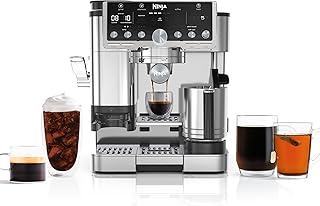
Quick Specs: Thermoblock with Barista Assist presets, hot water & Cold Extraction | 53mm Ninja portafilter (Single, Double & XL single-wall baskets) + integrated lever tamp | 25-setting conical burr grinder + built-in weight scale | 120V/60Hz, 1,650W (NEMA 5-15P) | 70 fl oz (~2.0 L) reservoir | Price Tier: $500–$1,000
Audit Score: 8.7 / 10
- Thermal & Pressure Control (35%): 8.4 / 10
- Grinder & Portafilter Ecosystem (25%): 8.5 / 10
- Milk Steaming & Daily Workflow (20%): 9.2 / 10
- Build Quality & Tier Value (20%): 8.8 / 10
Building directly on the Premier ES601’s formula, the Ninja Luxe Café Pro 4-in-1 (ES701) solves the two biggest omissions on the base unit by adding an integrated lever tamper and a dedicated hot-water dispenser for Americanos, alongside an XL hands-free Dual Froth pitcher. Its built-in weight scale measures coffee grounds directly into the portafilter rather than relying on blind timers, while Barista Assist tracks shot behavior and recommends exact grind adjustments across 25 burr clicks.
Notably, Ninja ships genuine single-wall baskets (Single, Double, and XL Luxe) capable of brewing espresso, drip-style coffee, and rapid cold-pressed drinks from one station. Compared with the #1 Breville Barista Express Impress, the ES701 automates dosing by weight and eliminates manual milk steaming skill, whereas Breville offers superior manual steam wand texture for latte art and a broader 54mm aftermarket parts ecosystem.
Buyer Verification Alert: Ninja’s 53mm basket and portafilter ears are proprietary—54mm Breville puck screens, funnels, and bottomless portafilters will NOT lock into the ES701 group head. Verify the ES701 Pro SKU if you want the integrated lever tamper and hot-water spout.
Pros
- Built-in weight scale doses by mass rather than seconds, while Barista Assist suggests exact grind changes
- ES701 Pro adds integrated lever tamping, a dedicated hot-water tap, and an XL Dual Froth pitcher
- Ships with three real single-wall baskets covering espresso, drip coffee, and cold brew
Cons
- Proprietary 53mm portafilter excludes 54mm Breville and 58mm commercial accessories
- Motorized Dual Froth whisk produces thick, consistent foam rather than silky free-pour latte art microfoam
- Preset temperature profiles offer less granular light-roast manipulation than PID single boilers
Verdict: Buy it if your household splits between espresso, iced cold brew, and regular drip coffee and values automated weighing and tamping. Skip it if you want free-pour latte art control or standard 54mm/58mm aftermarket accessories. Keep dry-surface medium roasts stocked and follow Ninja’s cleaning-cycle prompts.
7. Breville Barista Touch (BES880BSS) — Best Touchscreen & Auto-Microfoam Semi-Auto

Quick Specs: ThermoJet PID (~3-second heat-up) + Auto MilQ automatic steam wand | 54mm Breville stainless portafilter (single-wall & dual-wall baskets) | 30-step conical burr grinder | 120V/60Hz, 1,680W (NEMA 5-15P) | ~2.0 L (67–68 fl oz) reservoir | Price Tier: $500–$1,000
Audit Score: 8.7 / 10
- Thermal & Pressure Control (35%): 8.9 / 10
- Grinder & Portafilter Ecosystem (25%): 8.6 / 10
- Milk Steaming & Daily Workflow (20%): 9.1 / 10
- Build Quality & Tier Value (20%): 8.3 / 10
If your household loves the 3-second ThermoJet speed and 30-step conical burr grinder of the Barista Pro but wants automated milk texturing for multiple family members, the Breville Barista Touch (BES880BSS) adds a full color touchscreen and hands-free Auto MilQ steam wand. An ambient temperature sensor beneath the drip-tray grate monitors pitcher temperature continuously, shutting off steam at your exact target degree and selected microfoam texture level.
Up to eight custom drink icons let each morning drinker save personalized shot volume, milk heat, and foam density without re-programming buttons. Unlike the newer BES881 Touch Impress, however, the BES880BSS uses manual dosing and tamping rather than a side-mounted Impress lever—making a 54mm dosing funnel a smart day-one addition to keep counters clean.
Buyer Verification Alert: Check Amazon finish and revision labels carefully: BES880BSS (Brushed Stainless) and BES880BTR (Black Truffle) share identical 120V/60Hz specs, whereas the BES881 Touch Impress sits in a higher price bracket. Always use the included Breville stainless milk jug with the tray temperature sensor.
Pros
- Automated hands-free steam wand delivers silky latte microfoam to custom temperature and texture targets
- 3-second ThermoJet startup and 30-step conical burr grinder mirror the Barista Pro’s fast core
- Touchscreen saves 8 personalized recipes for multi-user kitchens while keeping manual override available
Cons
- No assisted Impress lever tamping; manual grinding into 54mm baskets requires a funnel to avoid spills
- Touchscreen display adds electronic complexity compared with physical dials on the Barista Express Impress
- Auto-milk temperature sensing works reliably only with flat-bottomed metal pitchers matching OEM dimensions
Verdict: Buy it if multiple people share the espresso bar and want hands-free, café-style microfoam plus 3-second heat-up under $1,000. Skip it if you prefer mechanical switches or want lever-assisted tamping. Add a 54mm dosing funnel and keep the auto-purge steam tip wiped clean after every drink.
8. De’Longhi La Specialista Maestro — Best Dual-Milk & Cold Extraction Hybrid

Quick Specs: Dual Heating System + Cold Extraction technology | 51mm 3-ear De’Longhi portafilter + Smart Tamping lever | 8-step conical burr grinder + Bean Adapt presets | 120V/60Hz, 1,450W–1,600W (NEMA 5-15P) | 2.5 L (84.5 fl oz) reservoir | Price Tier: $500–$1,000
Audit Score: 8.4 / 10
- Thermal & Pressure Control (35%): 8.4 / 10
- Grinder & Portafilter Ecosystem (25%): 7.9 / 10
- Milk Steaming & Daily Workflow (20%): 9.1 / 10
- Build Quality & Tier Value (20%): 8.2 / 10
Few semi-automatic machines serve both a weekend latte-art hobbyist and a weekday one-touch cappuccino drinker as cleanly as the De’Longhi La Specialista Maestro. Per De’Longhi US product documentation, it pairs a manual My LatteArt steam wand with a detachable LatteCrema Hot automatic milk carafe, backed by dual heating elements that shorten recovery between extraction and milk texturing alongside rapid Cold Extraction recipes.
Its sealed Smart Tamping lever compresses grounds neatly inside the 51mm portafilter without coffee dust escaping onto the drip tray. Still, compared with the #1 Breville Barista Express Impress or De’Longhi’s own #9 La Specialista Opera, the Maestro’s 8-step grinder dial leaves wider gaps between settings—and its 18.5-inch height requires measuring beneath standard 18-inch US upper kitchen cabinets before buying.
Buyer Verification Alert: Check vertical cabinet clearance carefully (16.5 in W × 14.0 in D × 18.5 in H) so you do not have to slide the unit out to refill beans. Also confirm any aftermarket 51mm parts explicitly specify 3-ear La Specialista compatibility rather than 2-ear Stilosa lugs.
Pros
- Dual milk architecture includes both a manual barista steam wand and a one-touch LatteCrema Hot carafe
- Cold Extraction mode brews low-temperature cold-brew coffee and espresso-cool drinks in minutes
- Smart Tamping lever seals grounds inside the grinding cradle for zero countertop mess
Cons
- Only 8 numbered grind steps leave wider adjustment gaps than 15-step or 25-step rivals
- 18.5-inch total height exceeds standard 18-inch US counter-to-cabinet clearance
- 51mm 3-ear portafilter narrows third-party precision basket options compared with 54mm or 58mm setups
Verdict: Buy it if your household wants both manual steam artistry and push-button LatteCrema milk drinks plus cold brew on an open counter. Skip it if you have low upper cabinets or prioritize fine 25–30 step burr dialing. Keep a 0.1 g scale handy to fine-tune dose weight between the 8 grind clicks.
9. De’Longhi La Specialista Opera (EC9555M) — Best 15-Setting Smart-Tamp & Cold Brew Machine

Quick Specs: Thermoblock with 3 infusion temperature profiles + Cold Extraction | 51mm 3-ear stainless portafilter + Smart Tamping lever | 15-setting conical burr grinder | 120V/60Hz, 1,550W (NEMA 5-15P) | 2.0 L (67.6 fl oz) reservoir | Price Tier: $500–$1,000
Audit Score: 8.4 / 10
- Thermal & Pressure Control (35%): 8.3 / 10
- Grinder & Portafilter Ecosystem (25%): 8.3 / 10
- Milk Steaming & Daily Workflow (20%): 8.4 / 10
- Build Quality & Tier Value (20%): 8.6 / 10
Wait-free Cold Extraction and De’Longhi’s signature sealed Smart Tamping lever are no longer locked behind the Maestro’s tall chassis and coarse 8-click grinder. The De’Longhi La Specialista Opera (EC9555M) trims height to 17.5 inches to slip under standard 18-inch US upper cabinets while upgrading the built-in conical burr grinder to 15 settings—nearly doubling dialing precision for single-wall espresso shots.
Compared with the #8 La Specialista Maestro, the Opera omits the detachable LatteCrema automatic milk carafe and drops to a single thermoblock, focusing squarely on buyers comfortable steaming with the manual My LatteArt wand. Three selectable brew temperature settings give basic roast-matching flexibility, though single-degree PID enthusiasts should look toward the #1 Breville Barista Express Impress or #3 Turin Legato V2.
Buyer Verification Alert: Confirm Amazon replacement filters and any 51mm bottomless portafilter upgrades specifically list EC9555M / 3-ear La Specialista compatibility, as older 2-ear De’Longhi portafilters will not lock into the group.
Pros
- 15 grinder settings provide noticeably smoother dialing than the 8-step La Specialista Maestro
- Cold Extraction mode and 3 hot temperature levels cover iced and traditional espresso drinks cleanly
- 17.5-inch height and 15.0-inch width fit under standard 18-inch wall cabinets better than the Maestro
Cons
- Manual My LatteArt steam wand only—no automatic LatteCrema milk carafe
- Single thermoblock heats sequentially between brewing and milk steaming
- 51mm 3-ear basket ecosystem has fewer third-party precision basket options than 54mm or 58mm
Verdict: Buy it if you want De’Longhi’s mess-free Smart Tamping lever, Cold Extraction recipes, and finer 15-step burrs under 18-inch cabinets. Skip it if you need automatic milk frothing or commercial 58mm portafilters. Follow De’Longhi EcoDecalk maintenance intervals to protect the thermoblock.
10. KitchenAid KF6 Fully Automatic Espresso Machine (KES8556) — Best Quiet Super-Automatic Convenience Alternative

Quick Specs: Super-Automatic Convenience Alternative (Thermoblock + internal brew unit; no portafilter) | Quiet Mark certified burr grinder + removable bean hopper | 15 preset recipes & 4 user profiles | 120V/60Hz, 1,450W (NEMA 5-15P) | 2.2 L (74 fl oz) side-access tank | Price Tier: $500–$1,000
Audit Score: 8.3 / 10
- Thermal & Pressure Control (35%): 7.9 / 10
- Grinder & Portafilter Ecosystem (25%): 7.8 / 10
- Milk Steaming & Daily Workflow (20%): 9.3 / 10
- Build Quality & Tier Value (20%): 8.4 / 10
Included specifically as a labeled super-automatic convenience alternative rather than a manual portafilter machine, the KitchenAid KF6 (KES8556) serves households that want one-touch lattes, flat whites, and Americanos without locking a portafilter or purging a steam wand. Its Quiet Mark sound certification keeps early-morning grinding noticeably calmer than typical bean-to-cup units, while a removable bean hopper lets you twist out caffeinated beans and swap in decaf effortlessly.
Across daily usability, four user profiles, 15 drink presets, and a side-access 2.2 L water reservoir keep maintenance convenient under 14.3-inch height clearance. Compared with any of the nine semi-automatic machines above—such as the #1 Breville Barista Express Impress or #2 KitchenAid KES6551—the KF6 produces milder crema texture and offers far less extraction tuning, making it strictly a push-button convenience trade-off.
Buyer Verification Alert: Super-automatic machines have no external 54mm or 58mm portafilter and require strict bean discipline: use dry-surface medium or medium-dark whole beans only—avoid glossy oily dark roasts and flavored beans that clog internal grinder chutes and brew units.
Pros
- Quiet Mark certified drive and grinder cut early-morning kitchen noise substantially
- Removable bean hopper simplifies swapping between regular and decaf whole beans
- 15 one-touch recipes, 4 user profiles, and side-pull 2.2 L tank keep operation effortless
Cons
- Thinner espresso body and less flavor separation than 54mm or 58mm semi-automatic portafilters
- Cannot handle oily dark roasts or flavored beans without risking internal chute jams
- Deep 18.5-inch front-to-back footprint demands generous counter depth
Verdict: Buy it if convenience and quiet push-button drinks outweigh manual espresso craft in a busy household. Skip it if you enjoy dialing single-wall shots or pulling syrupy straight espresso. Use dry-surface beans, OEM water filters, and scheduled brew-unit cleaning tablets.
Mid-Range Buying Guide: Choosing the Best Espresso Machine Under $1000
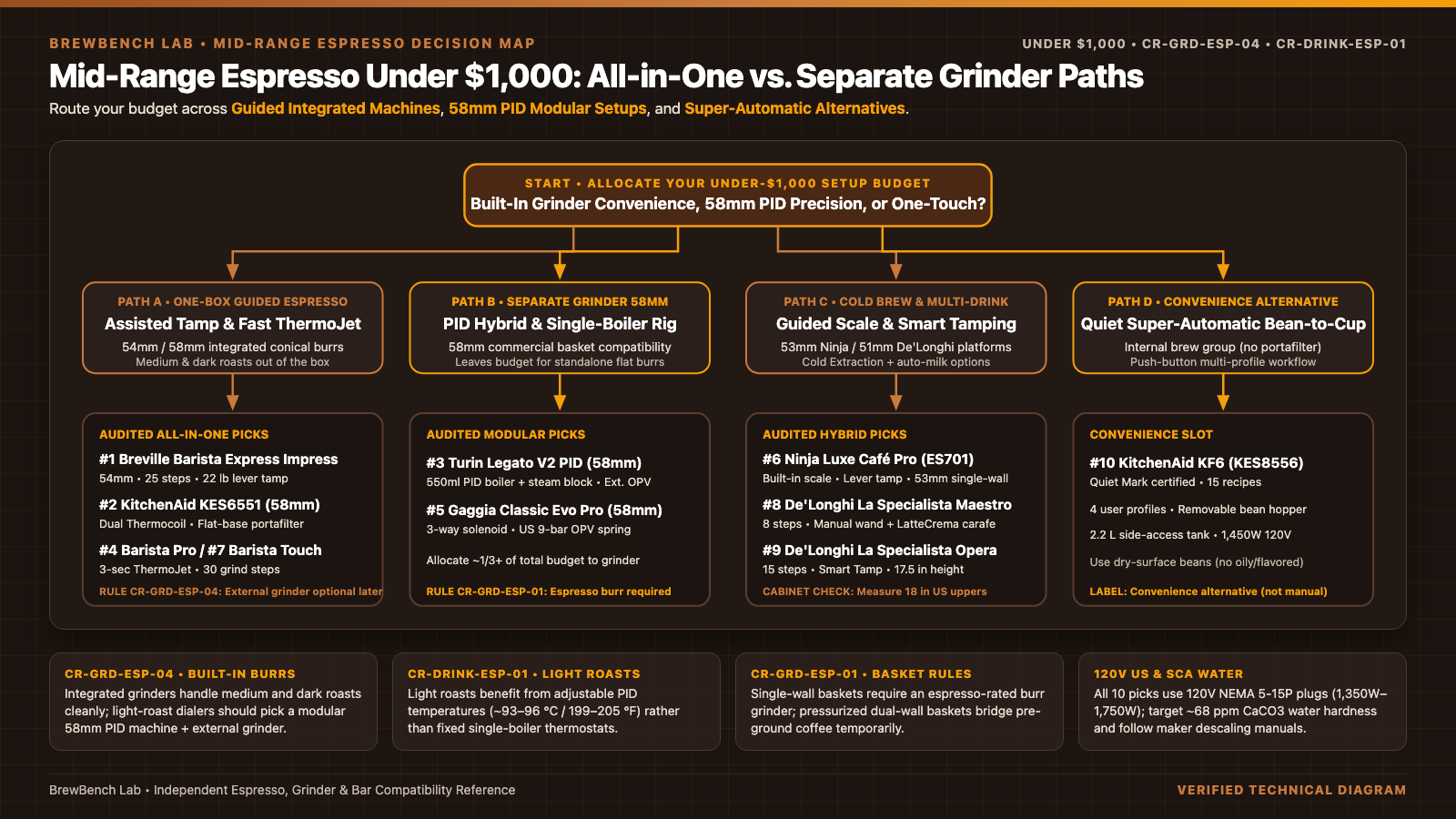
1. Built-In Conical Grinder vs. Separate Espresso Grinder (CR-GRD-ESP-04 & CR-GRD-ESP-01)
Under $1,000, the single biggest architectural choice is whether your grinder lives inside the espresso chassis. Machines with built-in conical burr grinders—such as the Breville Barista Express Impress (25 steps), Barista Pro (30 steps), KitchenAid KES6551 (15 steps + inner adjustment), Ninja ES701 (25 steps with weight scale), and De’Longhi Opera (15 steps)—cover medium and dark roasts cleanly in one footprint. However, compatibility rule CR-GRD-ESP-04 highlights their ceiling: if you gravitate toward dense light-roast single origins, fixed stepped adjustments and smaller conical burrs eventually become the bottleneck, prompting many enthusiasts to add a dedicated external espresso grinder later.
By contrast, grinderless machines like the Turin Legato V2 PID and Gaggia Classic Evo Pro enforce rule CR-GRD-ESP-01: single-wall (non-pressurized) baskets will gush sour espresso in seconds unless paired with a grinder explicitly rated by its maker for espresso resistance. Budget roughly one-third or more of your combined machine-plus-grinder spend toward an espresso-capable burr grinder so the machine’s 9-bar OPV can extract evenly.
2. PID Temperature Control & Light-Roast Capability (CR-DRINK-ESP-01)
Light and Nordic-style espresso roasts demand stable, elevated brew temperatures—typically around 93–96 °C (199–205 °F) at the puck—to extract sweetness without harsh sourness. Under CR-DRINK-ESP-01, thermostat-controlled single boilers like the stock Gaggia Classic Evo Pro swing across wide heating hysteresis bands unless you surf the brew light or wire an aftermarket PID controller. True PID systems—like the Turin Legato V2’s 550 ml stainless brew boiler, Breville’s PID thermocoil/ThermoJet loops, and KitchenAid’s dual smart temperature sensors—deliver far steadier thermal repeatability across morning pulls.
3. Pump Pressure Ratings vs. ~9 Bar Brew Delivery & Three-Way Solenoids
Never judge a mid-range espresso machine by “15-bar” or “20-bar” vibration pump badges. Those numbers reflect the pump’s theoretical maximum dead-head pressure ceiling—not ideal extraction pressure. Espresso brews around ~9 bar at the coffee puck via an over-pressure valve (OPV), such as the externally adjustable OPV on the Turin Legato V2 or the factory US 9-bar spring inside the Gaggia Classic Evo Pro. Equally practical is a three-way solenoid valve (standard on Breville, KitchenAid KES6551, Turin Legato V2, and Gaggia Classic Evo Pro), which vents residual pressure into the drip tray when the shot stops so pucks knock out dry rather than dripping across your counter.
4. Portafilter Standards (51mm, 53mm, 54mm, 58mm) & Basket Compatibility
Do not assume a millimeter diameter guarantees accessory interchangeability. Inside the 58mm category, Gaggia Classic Evo Pro, KitchenAid KES6551, Turin Legato V2, and commercial E61 machines use distinct ear thicknesses and locking angles—always verify model-specific lug compatibility before purchasing an aftermarket bottomless portafilter. Breville’s 54mm portafilters create slightly deeper coffee beds that forgive minor dosing variations and enjoy massive third-party tamper/funnel support, whereas Ninja’s 53mm and De’Longhi’s 51mm 3-ear groups offer narrower aftermarket basket ecosystems. Remember also that pressurized (dual-wall) baskets assist pre-ground coffee temporarily, while single-wall baskets reward fresh whole beans and espresso-grade burrs.
5. US 120V Electrical Safety, Cabinet Clearance & SCA Water Chemistry
All ten 120V/60Hz North American models reviewed here draw between 1,350W and 1,750W through standard three-prong NEMA 5-15P plugs designed for 15-amp household circuits. Never import 220–240V European models expecting identical wattage or heat-up behavior, never share a 15A branch circuit simultaneously with an electric kettle or toaster, and never force a 20-amp NEMA 5-20P appliance onto a 15A outlet using adapters (hire a licensed electrician if a future prosumer rig requires a 20A circuit). Also measure your kitchen’s under-cabinet height against standard 18-inch US wall clearances: the 18.5-inch De’Longhi La Specialista Maestro requires sliding forward to fill beans, whereas the 14.6-inch Turin Legato V2 and 15.4-inch KitchenAid KES6551 tuck underneath cleanly, leaving room for a compact 0.1 g scale within under-spout cup clearance.
Finally, treat your brew water carefully using Specialty Coffee Association (SCA) water guidelines—targeting roughly 68 ppm (mg/L as CaCO3, about 4 grains per gallon) total hardness, 40 ppm alkalinity, and 150 ppm TDS (75–250 ppm acceptable range) with zero chlorine. Never pour pure un-remineralized distilled water into machines relying on conductive water-level sensors, and always follow your owner’s manual strictly when descaling—never substitute DIY vinegar or unapproved citric acid concentrations in aluminum-boiler machines like earlier Gaggia Evo Pro runs.
6. Upgrade Roadmap & Hidden Ownership Costs Under $1,000
Factor these essential accessories and consumables into your first-year espresso budget:
- External Espresso Burr Grinder (for Grinderless Picks): Allocate roughly $200–$500 for a dedicated stepped or flat-burr grinder when choosing the Turin Legato V2 or Gaggia Classic Evo Pro so total setup spend stays under $1,000.
- Low-Profile 0.1 g Espresso Scale & Fitted Tamper: A compact 0.1 g scale with shot timer (under $60 tier) and a metal tamper matched to your exact basket ID (51mm, 53.3/53.4mm for 54mm Breville, or 58.5mm for 58mm baskets) dramatically improve extraction consistency.
- Dosing Funnel & WDT Needle Tool: Essential for Breville Barista Pro and Barista Touch users to eliminate grounds spillover during dosing.
- Consumables & Maintenance: Budget for brand-matched reservoir water filters every 2–3 months, espresso backflush detergent tablets (for three-way solenoid machines), OEM descaling solution, and annual silicone group gaskets.
Methodology, Weighted Scoring Rubric & Excluded Models
Every score in this roundup reflects an independent 120V specification, compatibility-rule, and retail-kit audit conducted by Daniel Park at BrewBench Lab—with zero paid rankings or fabricated lab figures. We cross-checked North American user manuals, rated NEMA 5-15P electrical draws, portafilter lug geometries, included basket sets, US warranty terms, and documented hardware revisions across 18 active Amazon US listings. Full editorial rules live on our Evaluation Methodology page.
| Evaluation Criterion | Weight | What We Audited |
|---|---|---|
| Thermal & Pressure Control | 35% | Heating architecture (PID thermocoil, ThermoJet, dual thermocoil, or PID boiler + steam block), adjustable roast temperature profiles, pre-infusion, and ~9 bar OPV regulation. |
| Grinder & Portafilter Ecosystem | 25% | Built-in conical burr step resolution vs. external grinder requirements, portafilter diameter and lug standard (51mm/53mm/54mm/58mm), and supplied single-wall vs. pressurized baskets. |
| Milk Steaming & Daily Workflow | 20% | Heat-up speed, brew-to-steam turnaround, manual vs. automated microfoam texturing, reservoir volume, and cup clearance for 0.1 g scales. |
| Build Quality & Tier Value | 20% | Three-way solenoid valve presence, chassis and boiler materials, North American 120V support/warranty terms, and value within the under-$1,000 bracket. |
Models We Audited & Excluded
Models We Audited & Excluded (And Why)
- Profitec GO: Excluded as an Amazon buy-intent pick because Profitec distributes through specialized off-Amazon espresso dealers without official Amazon US storefront inventory.
- Lelit Anna PID (PL41TEM) & Lelit Victoria (PL91T): Excluded as Amazon-absent dealer-only machines lacking verified official Amazon US retail fulfillment.
- Flair 58: Excluded both for absent primary Amazon US retail availability and because a boilerless manual lever setup requires purchasing a separate temperature-controlled kettle and milk frother.
- Rancilio Silvia Pro X: Excluded from this under-$1,000 roundup because its dual-boiler architecture sits in the over-$1,000 prosumer bracket.
- 230V EU/UK Gray-Market Listings & Unbranded “20-Bar” Thermoblocks: Disqualified because 230V units violate US 120V NEMA 5-15P standards, while generic 20-bar pressurized-only units lack PID thermal control, three-way solenoids, and 9-bar OPV stability.
Authoritative Manufacturer & Technical References
- Breville USA — Barista Express Impress (BES876) Specifications (120V rating, 25 grind steps, assisted 22 lb Impress tamp)
- Breville USA — Barista Pro (BES878) Specifications (3-second ThermoJet heating, 30 grind steps, 1,680W 120V rating)
- KitchenAid US — Semi-Automatic Espresso Machine (KES6551) Specifications (58mm flat-base portafilter, Dual Thermocoil, 2.5 L tank)
- Turin Grinders — Legato V2 Espresso Machine Specifications (550 ml PID boiler + steam thermoblock, external OPV, pre-infusion)
- Gaggia North America — Policies, Warranty & Service Procedures (US warranty scope and boiler descaling compliance)
- De’Longhi US — Official Product Manuals & Support Portal (120V specs, Smart Tamping, Cold Extraction, and EcoDecalk guidance)
- Specialty Coffee Association (SCA) — Water Quality Standards (hardness, alkalinity, TDS, and chloride targets)
Frequently Asked Questions About Espresso Machines Under $1,000
What is the best espresso machine under $1000 for most beginners?
The Breville Barista Express Impress (BES876BSS) is the strongest overall pick under $1,000 for most beginners. It combines a 25-step conical burr grinder, automatic dose correction, assisted 22 lb lever tamping, PID temperature control, and manual steaming in one tidy machine. Buyers specifically wanting a 58mm portafilter should compare the KitchenAid KES6551.
Should I buy an all-in-one espresso machine or a separate machine and grinder under $1,000?
Choose an all-in-one unit for medium-to-dark roasts and minimal counter clutter, or separates for light roasts and future upgrades. Models like the Barista Express Impress and Barista Pro cover daily lattes cleanly out of the box. Pairing a Turin Legato V2 PID or Gaggia Classic Evo Pro with a standalone burr grinder delivers sharper light-roast extraction.
Can an espresso machine under $1,000 brew light-roast espresso well?
Yes, provided the machine has stable PID thermal control and pairs with an espresso-rated burr grinder. The Turin Legato V2 PID stands out under $1,000 because its 550 ml stainless brew boiler holds elevated brew temperatures and pairs with adjustable pre-infusion and OPV pressure. Non-PID single boilers struggle with light-roast repeatability.
Do 58mm portafilters fit across all 58mm espresso machines under $1,000?
No—matching a 58mm diameter alone never guarantees a portafilter handle will lock into another machine. Gaggia Classic Evo Pro, KitchenAid KES6551, Turin Legato V2, and E61 groups use distinct locking ear thicknesses and angles. Verify exact model compatibility before ordering bottomless portafilters, though 58.5mm flat tampers generally share basket fit.
Do mid-range 120V espresso machines require a special 20-amp kitchen outlet?
No—all ten 120V/60Hz machines in this audit use standard NEMA 5-15P plugs for 15-amp circuits. Drawing between 1,350W and 1,750W, they operate safely on standard kitchen outlets as long as you do not run an electric kettle or toaster on the same branch circuit simultaneously.
What water should I use in a mid-range espresso machine under $1,000?
Use filtered tap water near SCA targets (~68 ppm CaCO3 hardness and ~150 ppm TDS) or properly remineralized water. Avoid pouring pure un-remineralized distilled water into machines with conductive boiler probes, and follow each owner’s manual strictly when descaling—never use unapproved acid mixtures in aluminum-boiler machines.
Final Verdict: Which Best Espresso Machine Under $1000 Fits Your Bar?
Choosing the best espresso machine under $1000 comes down to whether you prefer one cohesive countertop station or modular 58mm control. For most home baristas wanting low-mess daily shots and manual microfoam, the Breville Barista Express Impress (BES876BSS) claims #1 overall, while the KitchenAid KES6551 adds a 58mm flat-base portafilter and huge 2.5 L tank for under-cabinet spaces. Enthusiasts chasing light-roast precision should pair the Turin Legato V2 PID with a standalone espresso burr grinder, speed-focused latte drinkers gain 3-second startup in the Breville Barista Pro or Barista Touch, tinkerers get durable 58mm parts in the Gaggia Classic Evo Pro, multi-brew homes thrive on the Ninja Luxe Café Pro (ES701), and hands-off households get quiet push-button reliability from the KitchenAid KF6.


