
Disclosure: As an Amazon Associate, I earn from qualifying purchases. If you buy through links on this page, we may earn a small commission at no extra cost to you.
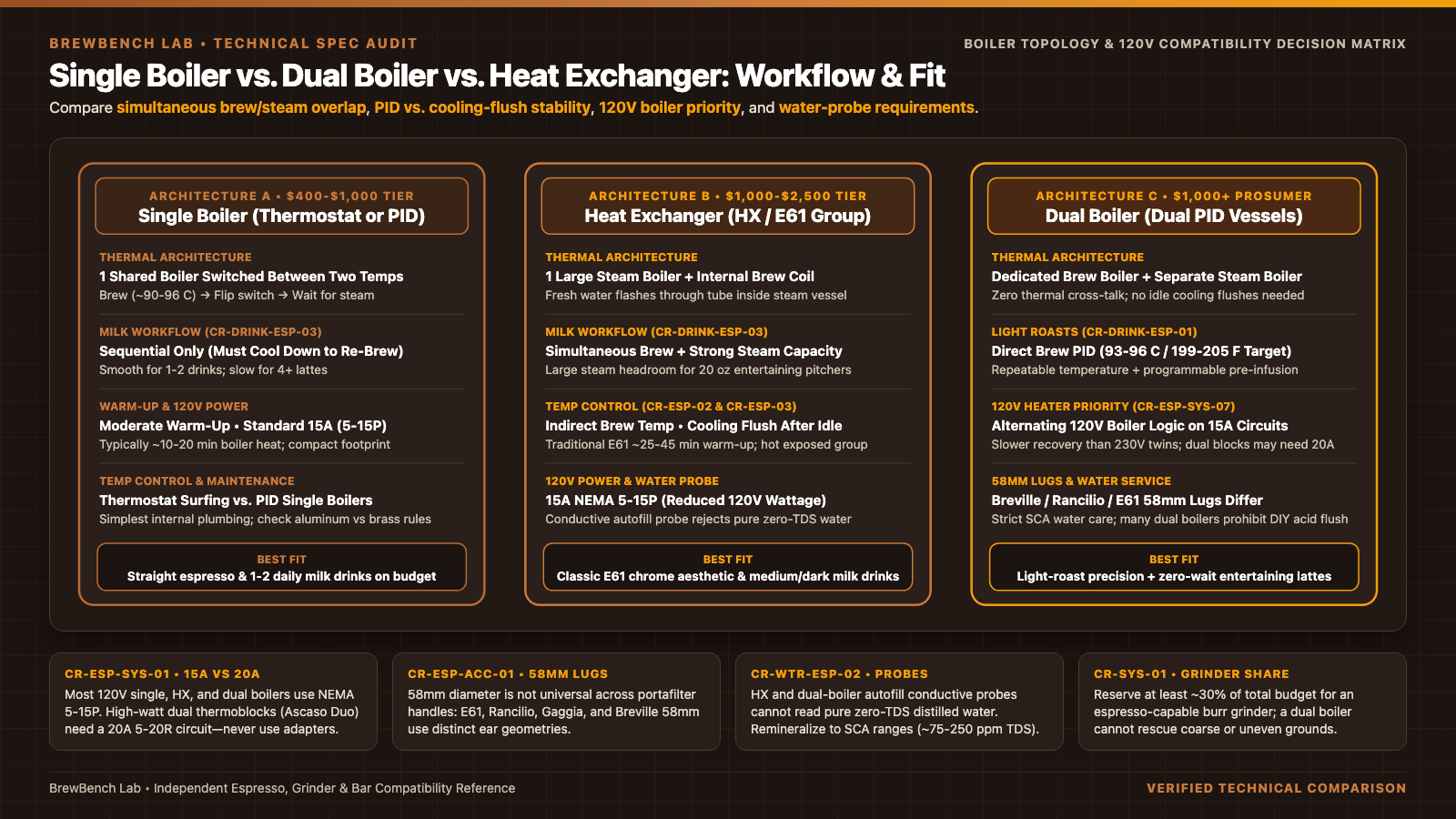
Evaluating a single boiler vs dual boiler vs heat exchanger espresso machine comes down to one core mechanical question: how does the chassis separate 93°C (200°F) espresso extraction from 125°C+ (257°F+) milk-steaming vapor? A single boiler uses one vessel that must flip sequentially between brew and steam temperatures. A heat exchanger (HX) keeps a large steam boiler hot while flashing brew water through an internal copper or stainless coil for simultaneous work. A dual boiler isolates two independent vessels with dedicated PID control for maximum temperature repeatability and concurrent milk texturing.
Within our best espresso machines hub, boiler topology—not marketing bar ratings—is the primary dividing line between entry semi-automatics and true prosumer bars. This technical comparison evaluates all three boiler architectures strictly under North American 120V/60Hz constraints, governed by BrewBench Lab compatibility rules CR-DRINK-ESP-03 (sequential vs. simultaneous workflow), CR-ESP-02 (HX cooling-flush management), and CR-ESP-SYS-07 (120V dual-boiler heater priority logic), alongside verified Amazon US hardware picks.
In This Comparison
- Quick Verdict Matrix: Boiler Topology by Use Case
- Side-by-Side Architecture & 120V Compatibility Table
- Battleground 1: Simultaneous Brew & Steam Workflow (CR-DRINK-ESP-03)
- Battleground 2: Brew Temperature Stability, HX Flushes & Light Roasts (CR-ESP-02)
- Battleground 3: 120V Electrical Reality, Heater Priority & Warm-Up (CR-ESP-SYS-07)
- Battleground 4: 58mm Portafilter Lugs, Grinder Pairing & Water Care
- Dealer-Only & Non-US Disqualifications
- Choose Single Boiler vs. Heat Exchanger vs. Dual Boiler
- Verified Amazon US Simultaneous-Workflow Contenders Compared
- Frequently Asked Questions
Quick Verdict Matrix: Single Boiler vs. Dual Boiler vs. Heat Exchanger by Use Case
More boilers do not automatically make a better espresso shot in isolation. A PID-regulated single boiler pulls straight espresso just as accurately as an expensive multi-boiler unit; you pay extra specifically for zero-wait milk overlap, higher steam capacity, and multi-drink speed.
| Use Case & Drink Volume | Winning Architecture | Deciding Compatibility Rule | Practical Outcome |
|---|---|---|---|
| Best for Daily Milk Drinks & Entertaining (3+ Lattes) | Dual Boiler (or Dual Thermoblock) | CR-DRINK-ESP-03 / CR-ESP-SYS-07 | Concurrent shot pulling and steaming without temperature lag or idle cooling flushes. |
| Best for Straight Espresso & Light Roasts | PID Dual Boiler (or PID Single Boiler) | CR-DRINK-ESP-01 / CR-ESP-02 | Direct brew-boiler PID holds repeatable 93–96°C (199–205°F) targets without HX overheat drift. |
| Best Value / Grinder-First Ecosystem Cost | Single Boiler ($400–$1,000) | CR-SYS-01 / CR-GRD-ESP-01 | Leaves budget for an espresso-capable burr grinder (~30%+ setup share) while keeping strong single-boiler steam. |
| Best Classic Italian Chrome & High Steam Headroom | Heat Exchanger (E61 / HX) | CR-ESP-02 / CR-ESP-03 | Iconic E61 thermosiphon aesthetics and big steam boilers for medium/dark milk drinks, given a ~25–45 min warm-up. |
| Best Compact Kitchen Footprint & Fast Start | Single Boiler or Dual Thermoblock | CR-ESP-SYS-04 / CR-ESP-SYS-06 | Smaller footprints fit shallow counters and 18-inch US upper cabinets far easier than deep E61 HX boxes. |
Side-by-Side Verified Architecture & 120V Compatibility Table
Before comparing individual machines, review how each boiler topology behaves structurally on North American 120V/60Hz circuits—including dual thermoblocks, which deliver dual-boiler workflow without traditional stored boiler mass.
| Audit Dimension | Single Boiler | Heat Exchanger (HX) | Dual Boiler | Dual Thermoblock (Alternative) |
|---|---|---|---|---|
| Internal Heating Layout | 1 shared boiler switching between brew & steam temps | 1 large steam boiler + internal brew-water heat tube | 2 isolated boilers (dedicated brew + dedicated steam) | 2 independent flash-heating blocks (1 brew + 1 steam) |
| Simultaneous Brew & Steam (CR-DRINK-ESP-03) | No (sequential: brew, flip switch, wait, steam, cool down) | Yes (continuous steam boiler feeds both paths) | Yes (independent vessels; 120V priority may throttle steam recovery) | Yes (dedicated steam block runs concurrently) |
| Brew Temp Control (CR-DRINK-ESP-01) | Thermostat (temp surfing) or PID on single-boiler PID models | Indirect (steam pressurestat or HX PID); cooling flush often needed (CR-ESP-02) | Direct digital PID on brew boiler (+ heated group on select SKUs) | Direct PID on brew thermoblock |
| Qualitative Warm-Up Class (CR-ESP-SYS-06) | Moderate (~10–20 min typical boiler warm-up; verify per manual) | Slow (~25–45 min typical for heavy brass E61 thermosiphon) | Moderate to slow (model dependent; faster than E61 on compact boilers) | Fast (a few minutes per maker spec) |
| 120V US Electrical & Plug (CR-ESP-SYS-01) | 120V / 60Hz, typically ~1,200–1,450W, NEMA 5-15P | 120V / 60Hz, reduced element wattage (~1,200–1,500W), NEMA 5-15P | 120V / 60Hz, ~950–1,700W NEMA 5-15P with heater-priority logic (CR-ESP-SYS-07) | High draw: e.g., Ascaso Duo listed at 2,100W / 20A NEMA 5-20P (C) |
| Portafilter Standard (CR-ESP-ACC-01) | Usually 58mm brand-specific (Gaggia, Rancilio) or 51/54mm on thermoblock entry units | Mostly 58mm true E61 group (STD-GROUP-E61) | 58mm (Rancilio, Breville 58mm, or E61—lugs not cross-compatible) | 58mm Ascaso or brand-specific pattern |
| Conductive Water Probe Sensitivity (CR-WTR-ESP-02) | Typically float/sensorless fill (manual steam bleed after steaming) | High (autofill probe requires remineralized water; rejects zero-TDS distilled) | High (steam boiler probe requires remineralized water) | Low (flow-through block; still requires SCA water hardness care) |
| Typical Amazon US Budget Band (TIER) | $400–$1,000 (TIER-ESP-MID) | $1,000–$2,500 (TIER-ESP-PROSUMER) | $1,000–$2,500+ (TIER-ESP-PROSUMER / HIGHEND) | $1,000–$2,500 (or Under $200 entry HiBREW) |
Battleground 1: Simultaneous Brew & Steam Workflow (CR-DRINK-ESP-03)
Daily drink count is the sharpest separator in any single boiler vs dual boiler vs heat exchanger audit. Under BrewBench Lab rule CR-DRINK-ESP-03, any machine without simultaneous brew and steam capability imposes a sequential wait loop every time you steam milk—making it completely comfortable for one or two lattes, yet noticeably slower when hosting brunch or pulling four drinks back to back.
On a classic single boiler—such as a Gaggia Classic Evo Pro or Rancilio Silvia—one internal chamber holds water for both jobs. Brewing requires roughly 90°C to 96°C (194°F to 205°F), whereas generating dry steam requires superheating that same boiler past 125°C (257°F). After you pull your double shot, you flip the steam switch and wait for the boiler to climb up to steam pressure, purge condensation, and texture a smaller 12 oz (350 ml) pitcher (CR-ESP-ACC-08). Once finished, if a guest wants another espresso, you must bleed steam and pump cool water back through the boiler to avoid scorching the next coffee puck.
Both heat exchanger (HX) and dual boiler machines break that bottleneck cleanly. Inside an HX machine, the main boiler sits permanently at steaming temperature (roughly 120°C–126°C / 248°F–259°F depending on pressurestat or PID setting). A sealed tube routes fresh brew water straight through that hot steam tank, flash-heating extraction water on its way to the group head without ever mixing boiler steam water with brew water. A dual boiler takes isolation one step further by giving the brew path its own dedicated, smaller PID-controlled boiler alongside a separate 0.95 L to 1.6 L steam boiler.
In real bar workflow, that means both HX and dual-boiler setups allow you to start texturing a 12 oz or 20 oz pitcher (CR-ESP-ACC-08) the exact second your espresso begins dripping—cutting four-drink entertaining sessions down substantially. Also keep pump marketing numbers in perspective across all three classes: whether a spec sheet advertises a 15-bar vibration pump or a commercial rotary vane pump, balanced espresso extraction still targets roughly ~9 bar at the coffee puck via an over-pressure valve (OPV).
Battleground 2: Brew Temperature Stability, HX Flushes & Light Roasts (CR-ESP-02)
If you drink dense, lightly roasted single-origin espressos, thermal precision separates a dual boiler from a conventional heat exchanger far more than steam power does. Under CR-DRINK-ESP-01, light roasts benefit from repeatable brew water near the upper end of the espresso range—roughly 93°C to 96°C (199°F to 205°F)—to tame bright acidity and achieve balanced sweetness.
A traditional thermostat-controlled single boiler oscillates in a wide temperature band as its mechanical thermostat clicks on and off, pushing owners toward manual “temperature surfing” routines unless upgraded or purchased as a factory PID single boiler. Meanwhile, a classic heat exchanger (CR-ESP-02) manages brew temperature indirectly: because the HX tube sits immersed inside a 125°C+ steam boiler, stagnant water sitting inside that tube during idle periods creeps well above ideal brew temperature. Pulling a shot immediately without running a short cooling flush risks scalding the puck and extracting harsh bitterness—though newer HX designs use restrictor tuning or hybrid PID modes (such as Rocket’s 4-preset TCA control or dealer-only Lelit Mara X brew-priority logic) to calm idle overheat.
A dual boiler eliminates indirect guesswork completely. Because the 0.3 L stainless brew boiler on a Rancilio Silvia Pro X or the three-zone PID loop on a Breville Dual Boiler BES920XL never has to climb to 125°C for steam, a digital PID controller holds the brew water steady at your exact target degree—shot after shot, whether the machine idled for five minutes or forty. Combine that direct PID control with programmable low-pressure pre-infusion, and dual boilers hold an unmistakable edge for light-roast enthusiasts.
Battleground 3: 120V Electrical Reality, Heater Priority & Warm-Up (CR-ESP-SYS-07)
Many North American buyers overlook a critical physics rule documented in CR-ESP-SYS-07 and CR-ESP-SYS-01: a standard US 15-amp kitchen receptacle (NEMA 5-15R at 120V) delivers a peak ceiling of 1,800W and a recommended continuous load limit of 1,440W (80% continuous rule). By contrast, European and UK 230V machines pull far higher combined heater power without tripping breakers. Never apply 230V European heat-up times or steam recovery claims to 120V US espresso machines.
To stay safely within a 120V NEMA 5-15P plug, North American dual boilers use heater-priority logic or staggered wattage ratings. For example, Rancilio specifies its 120V/60Hz Silvia Pro X at 950W–1,000W, prioritizing brew-boiler thermal stability while managing steam-boiler recovery sequentially behind the scenes. Breville rates its 120V Dual Boiler BES920XL up to 1,700W—giving fast dual-vessel response, yet leaving almost zero headroom to share that branch circuit with an electric kettle, toaster, or microwave (CR-ESP-SYS-02).
Dual-thermoblock machines take a different electrical path. Retailer specifications for the 120V Ascaso Steel DUO PID V3 list a 2,100W / 20A rating equipped with a NEMA 5-20P plug (featuring one horizontal blade). Under CR-ESP-SYS-01, a NEMA 5-20P plug only mates with a 20A NEMA 5-20R receptacle on a verified 20-amp circuit. Never use a 15A-to-20A plug adapter or modify a cord; consult a licensed electrician if your kitchen counter lacks a 5-20R outlet.
Warm-up speed and countertop clearance also diverge sharply (CR-ESP-SYS-04, CR-ESP-SYS-06):
- E61 Heat Exchangers (CR-ESP-03): Rely on a heavy brass thermosiphon group head that circulates hot water slowly by convection, requiring roughly 25–45 minutes of warm-up before the brass reaches full thermal equilibrium—and leaving an exposed hot metal exterior on the counter.
- Dual Boilers: Small insulated brew boilers stabilize faster than massive E61 thermosiphon blocks, and models like the Rancilio Silvia Pro X and Breville Dual Boiler integrate programmable wake-up timers rather than relying on third-party smart plugs (which fail on electronic momentary power buttons under CR-ESP-SYS-05).
- Under-Cabinet Access (CR-ESP-SYS-04): Standard US upper cabinets sit roughly 18 inches (457 mm) above the counter. Top-loading prosumer machines (such as the Silvia Pro X or tall E61 HX chassis) require sliding forward to lift water tanks, whereas front-fill (Breville BES920XL) or side-slide reservoirs (Ascaso Steel DUO) clear low cabinets effortlessly.
Battleground 4: 58mm Portafilter Lugs, Grinder Pairing & Water Care
Stepping up from a single boiler to an HX or dual boiler unlocks a rich 58mm accessory world, yet three hidden compatibility rules trip up buyers regularly:
- 58mm Lug Pattern Is Not Universal (CR-ESP-ACC-01): Even though Gaggia Classic, Rancilio Silvia / Silvia Pro X, Breville Dual Boiler, and E61 HX machines all take 58mm baskets and 58.3–58.5mm precision tampers (CR-ESP-ACC-03), their portafilter locking ears differ in thickness and angle. An E61 bottomless portafilter will not lock into a Breville BES920XL or Rancilio Silvia Pro X group head.
- Grinder Budget Balance (CR-GRD-ESP-01 & CR-SYS-01): Single-wall 58mm baskets require an espresso-capable stepless or fine micro-step burr grinder. Plan at least ~30% of your total bar budget for the grinder and a 0.1 g espresso scale sized to clear your drip tray (CR-SCALE-ESP-01); a dual boiler cannot rescue inconsistent grinds.
- Conductive Probes & Manual-First Descaling (CR-WTR-ESP-01 / 02 / 06): Almost every HX and dual boiler uses a metallic conductive probe inside the steam boiler to trigger automatic refilling. Never pour pure, un-remineralized distilled water into these tanks—zero-mineral water is electrically non-conductive, causing the machine to misread boiler levels and fault or overfill. Instead, target Specialty Coffee Association (SCA) remineralized water (~68 mg/L or ~4 gpg CaCO3 hardness, ~40 mg/L alkalinity, 75–250 mg/L TDS) to protect boilers from scale without tripping sensors. When maintenance is due, follow the exact manual procedure: never improvise DIY acid ratios (especially on aluminum single-boiler chambers, which require manufacturer-approved solutions), and check whether your specific dual boiler or HX prohibits owner descaling in favor of preventive water conditioning or authorized service.
Excluded Dealer-Only & Non-US Reference Models
While enthusiast forums frequently cite European-built brands such as Lelit (Mara X, Elizabeth, Bianca V3), Profitec (GO, Pro 500, Pro 600), ECM (Mechanika, Synchronika), and La Marzocco (Linea Micra), those brands distribute through authorized off-Amazon specialty espresso dealers in the United States rather than primary Amazon US storefront fulfillment. Accordingly, we exclude them as Amazon buy-intent picks and focus our verified product audit below on official 120V Amazon US hardware. We also disqualify gray-market 230V/50Hz European imports under CR-ESP-SYS-01.
Head-to-Head Summary: Which Boiler System Should You Buy?
Choose a Single Boiler If…
- You drink straight espresso, Americanos, or at most 1–2 milk drinks per session (CR-DRINK-ESP-03).
- Your machine budget sits in the $400–$1,000 bracket and saving cash lets you buy a stronger 64mm burr grinder (CR-SYS-01).
- You value simpler internal plumbing, lower standby energy use, and compact kitchen counter depth.
Choose a Heat Exchanger (HX) If…
- You love classic Italian E61 chrome aesthetics and want broad E61 portafilter and flow-control kit compatibility (CR-ESP-01).
- You primarily brew medium or dark roasts in lattes and cappuccinos where large steam-boiler pressure shines.
- You leave the machine on a morning schedule (or wait ~25–45 minutes) and do not mind a brief cooling flush after idle (CR-ESP-02).
Choose a Dual Boiler If…
- You want simultaneous brewing and milk steaming plus direct digital brew-boiler PID accuracy with zero cooling flushes.
- You dial in light-to-medium single-origin roasts where repeatable 93–96°C (199–205°F) temperature and soft pre-infusion matter (CR-DRINK-ESP-01).
- Your budget comfortably clears $1,000+ alongside an espresso-capable grinder and remineralized SCA water care.
Ready to compare dedicated multi-vessel machines side by side? Explore our full best dual boiler espresso machines roundup or browse every heating topology across our best prosumer espresso machines audit.
Verified Amazon US Simultaneous-Workflow Contenders Compared
When stepping past single-boiler mode switching on Amazon US, these four verified 120V/60Hz prosumer platforms represent the core dual-boiler and fast-heating dual-thermoblock architectures available today.
1. Rancilio Silvia Pro X — Best Serviceable 120V 15A Dual Boiler Benchmark

Quick Specs: Dual stainless steel boilers (0.3 L coffee + 1.0 L steam) | Dual digital PIDs | 58mm Rancilio commercial group (STD-GROUP-RANCILIO-58) | 0–6s programmable soft pre-infusion, digital shot timer, brew pressure gauge | 120V / 60Hz, 950W–1,000W, NEMA 5-15P | Price Tier: Prosumer ($1,000+)
Best For: Home baristas stepping up from a single boiler who want commercial Italian repairability, rock-steady PID light-roast control, and simultaneous steaming on a standard 15A household circuit.
Skip If: You need rapid sub-five-minute warm-up or front-fill tank convenience under low 18-inch upper cabinets.
Pros
- Dedicated 0.3 L brew and 1.0 L steam stainless boilers with dual PIDs eliminate HX cooling flushes completely (CR-ESP-02)
- Moderate 950W–1,000W 120V draw runs reliably on a standard NEMA 5-15P outlet with a built-in wake-up timer
- Adds 0–6s soft infusion, shot timer, and pressure gauge on a heavy-gauge 58mm commercial frame
Cons
- 120V heater-priority logic yields slower steam recovery than higher-wattage 230V models (CR-ESP-SYS-07)
- Top-loading reservoir requires pulling the machine out from under tight upper cabinets to refill (CR-ESP-SYS-04)
- Rancilio 58mm lug pattern is incompatible with E61 or Breville 58mm aftermarket portafilters (CR-ESP-ACC-01)
Audit Note: Under CR-WTR-ESP-02, always supply SCA-balanced remineralized water so the steam boiler’s conductive level probe registers accurately without mineral scaling.
2. Breville Dual Boiler BES920XL — Best Feature-Rich 58mm Dual Boiler

Quick Specs: Dual stainless steel boilers (300 ml brew + 950 ml steam) + actively heated 58mm PID group | 58mm Breville lug pattern (STD-GROUP-BREVILLE-58) | Programmable pre-infusion pressure & duration, volumetric dosing, hot-water tap, front fill | 120V / 60Hz, 1,700W, NEMA 5-15P | Price Tier: Prosumer ($1,000+)
Best For: Experimenters who want programmable pre-infusion pressure, three-point PID thermal stability, a dedicated hot-water spout for Americanos, and effortless front-access refilling under low cabinets.
Skip If: You want heavy mechanical Italian switches, universal E61 portafilter fitment, or low circuit draw shared with kitchen appliances.
Pros
- Actively heated PID 58mm group head plus dual stainless boilers deliver exceptional shot-to-shot thermal consistency
- Customizable low-pressure pre-infusion duration and pump percentage improve extractions on dense light roasts
- Front water fill port, top-down sight glass, and rear swivel foot solve under-cabinet ergonomics (CR-ESP-SYS-04)
Cons
- Proprietary Breville 58mm portafilter ears reject standard E61 and Rancilio 58mm handles (CR-ESP-ACC-01)
- 1,700W 120V load leaves little circuit margin—keep electric kettles and toasters off the same branch circuit (CR-ESP-SYS-02)
- Dense internal valves and O-ring seals require strict adherence to Breville’s water and descaling manual
Audit Note: Replace Breville’s reservoir filter on schedule and follow Breville’s exact descaling steps (CR-WTR-ESP-06); never substitute pure zero-TDS distilled water.
3. Ascaso Steel DUO PID V3 (120V) — Best Fast-Start Simultaneous Dual Thermoblock

Quick Specs: Dual stainless-lined thermoblocks + digital PID | 58mm portafilter (Ascaso pattern) | Simultaneous brew and steam, volumetric shot programming, external OPV | 120V / 60Hz, listed by US retailers at 2,100W / 20A, NEMA 5-20P (C) | Price Tier: Prosumer ($1,000+)
Best For: Kitchens with a verified 20-amp NEMA 5-20R receptacle seeking simultaneous espresso and steam workflow in minutes without heating large standing boilers.
Skip If: Your counter only has standard 15A NEMA 5-15R outlets (and you do not plan an electrician upgrade) or you regularly steam 20 oz entertaining pitchers.
Pros
- Independent brew and steam thermoblocks achieve simultaneous workflow with rapid morning warm-up and low idle waste
- Stainless-lined thermal paths, digital PID brew control, and side-pull water tank suit modern compact kitchens
Cons
- 120V US model is listed by retailers with a 20A NEMA 5-20P plug requiring a matching 5-20R outlet installed by an electrician—never use a plug adapter (CR-ESP-SYS-01)
- On-demand steam block delivers steadier cadence on 12 oz pitchers than sustained multi-drink 20 oz boiler bursts
Audit Note: Confirm your kitchen wall receptacle face before ordering under CR-ESP-SYS-01; a 5-20P horizontal blade will not plug into a standard 5-15R outlet.
4. Meraki Semi-Automatic Dual Boiler (Black) — Integrated Dual Boiler With Scales & Grinder

Quick Specs: Dual boiler PID | 58mm commercial portafilter | Integrated Timemore burr grinder, dual precision scales (dose-by-weight & brew-by-weight), and rotary pump | 120V / 60Hz | Price Tier: Prosumer ($1,000+)
Best For: Buyers stepping up to a 58mm dual boiler who want simultaneous steaming, quiet rotary-pump extraction, built-in grind-by-weight, and brew-by-weight automation in one footprint.
Skip If: You prefer separating your grinder and espresso machine for future burr swaps or want decades-proven third-party repair parts availability.
Pros
- True dual-boiler PID design supports concurrent brewing and steaming without cooling flushes
- Built-in Timemore burr grinder and dual scales automate dry dose and liquid yield repeatability in one compact bar
- Rotary pump runs quieter than conventional entry vibration pumps while maintaining 58mm basket standards
Cons
- Combining dual boilers, rotary hardware, dual load cells, and an integrated grinder raises long-term electronic service complexity (CR-GRD-ESP-04)
- Exact long-term North American parts ecosystem and independent thermal benchmark logs remain limited (no verified third-party benchmark data available yet)
Audit Note: Avoid oily or flavored beans inside the integrated grinder hopper to prevent chute buildup, and confirm 120V/60Hz US listing parity before checkout.
How We Audited This Guide
- Espresso machines were audited across heating architecture, simultaneous brew and steam flow, 51mm/54mm/58mm portafilter lugs, NEMA 5-15P/5-20P circuit draw, and US warranty terms.
- Every espresso machine, burr grinder, accessory, and scale specification was cross-checked against official manufacturer 120V manuals, SCA water guidance, and verified Amazon US listings.
- Recommendations were evaluated against our weighted espresso-gear scoring rubrics and documented CR-* compatibility rules; we never invent heat-up seconds, PID variance, or micron claims.
Continue Your Audit
- Best Espresso Machines Under $500 2026: Entry Picks Compared
- Best Espresso Machines Under $1,000 2026: Mid-Range Audited
Frequently Asked Questions: Single Boiler vs. Dual Boiler vs. Heat Exchanger
Does a dual boiler make noticeably better espresso than a PID single boiler?
For straight espresso without milk, a quality PID single boiler and a PID dual boiler can achieve comparable shot quality when paired with the same burr grinder. Dual boilers win decisively on workflow speed, simultaneous steaming, and eliminating temperature swings between milk drinks.
Why do heat exchanger espresso machines require a cooling flush?
Under CR-ESP-02, a heat exchanger sits inside a hotter 125°C+ steam boiler. When the machine sits idle, water resting inside the brew tube heats above ideal extraction temperatures, so running a brief flush purges overheated water before locking in the portafilter.
Why do 120V US dual boilers recover steam slower than European reviews suggest?
Under CR-ESP-SYS-07, North American 120V/60Hz outlets limit continuous current compared with 230V European circuits. Many US dual boilers use heater-priority logic that powers one boiler at a time, trading slightly slower steam recovery to avoid tripping 15-amp breakers.
Can I plug a 20-amp dual-thermoblock machine into a 15-amp outlet using an adapter?
No. Under CR-ESP-SYS-01, machines shipping with a NEMA 5-20P plug (such as the 120V Ascaso Steel DUO PID V3) require a dedicated 20-amp NEMA 5-20R receptacle. Never bypass plug geometry with adapters; hire a licensed electrician to verify or install the circuit.
Is distilled water safe for heat-exchanger and dual-boiler espresso machines?
No—never pour un-remineralized distilled water into an HX or dual boiler. Under CR-WTR-ESP-02, steam-boiler conductive level probes rely on dissolved minerals to sense water height; zero-TDS distilled water can cause level-detection faults. Remineralize to SCA targets instead.
Are all 58mm portafilters interchangeable between single, HX, and dual boilers?
No. Under CR-ESP-ACC-01, 58mm baskets and tampers share sizing rules, but portafilter locking lugs vary across E61, Rancilio, Gaggia, and Breville 58mm groups. Always verify exact model compatibility before ordering an aftermarket bottomless portafilter.
Authoritative Technical References
- Rancilio Group — Silvia Pro X Official Specifications — Verified 120V/60Hz 950W–1,000W North American power draw, 0.3 L/1.0 L stainless dual boilers, dual PIDs, and soft pre-infusion.
- Breville USA — Dual Boiler (BES920) Official Product Documentation — Verified dual stainless boiler layout, actively heated 58mm PID group, pre-infusion programming, and front-fill 120V specs.
- Ascaso USA — Steel DUO PID V3 120V Specifications — Verified dual stainless-lined thermoblock architecture, PID controls, and North American 20A electrical considerations.
- Specialty Coffee Association (SCA) — Water & Extraction Standards — Target total hardness (~68 mg/L CaCO3), alkalinity (~40 mg/L), and 75–250 mg/L TDS guidance for boiler protection and conductive probe accuracy.


