
Disclosure: As an Amazon Associate, I earn from qualifying purchases. If you buy through links on this page, we may earn a small commission at no extra cost to you.
Direct Answer — Do You Need an Espresso Machine 20 Amp Outlet? Most 120V home espresso machines ship with a standard 15-amp NEMA 5-15P plug and run on ordinary 15A or 20A household outlets. Only select high-wattage simultaneous-heating machines—most notably the 120V Ascaso Steel DUO PID (~2,100 W)—carry a horizontal-blade NEMA 5-20P plug requiring a listed NEMA 5-20R T-slot receptacle on a dedicated 20A GFCI circuit (CR-ESP-SYS-01).
Few pre-purchase surprises stall a home coffee bar upgrade faster than unboxing a prosumer espresso maker, grabbing the power cord, and realizing one horizontal prong physically refuses to enter your kitchen wall receptacle. Determining whether your next setup needs an espresso machine 20 amp outlet requires separating plug geometry from circuit capacity—two distinct electrical rules that often get confused in North American kitchens.
Inside our best espresso machines hub, every 120V/60Hz recommendation passes BrewBench Lab’s electrical compatibility gates (CR-ESP-SYS-01, CR-ESP-SYS-02, and CR-ESP-SYS-07) before we evaluate espresso quality or steam performance. Below, you will find the exact wattage formulas, NEC kitchen outlet wiring rules, boiler-priority workarounds used by 15A dual boilers, a 60-second kitchen panel check, and four verified 120V Amazon US espresso machines alongside key dealer-only reference models.
In This Guide
- 120V Circuit Math: 15A (1,800 W) vs. 20A (2,400 W) Explained
- NEMA 5-15P vs. NEMA 5-20P: Plugs, T-Slots & Kitchen NEC Rules
- Boiler Priority vs. True Simultaneous Heating on 120V
- Electrical Decision Matrix: 120V Models & Circuit Tiers
- Myth vs. Engineering Reality: 4 Outlet & Adapter Traps
- 60-Second Electrical Verification & Safety Checklist
- Verified 120V Amazon US Espresso Machines by Plug & Load
- Authoritative Manufacturer & Electrical Code Citations
- Frequently Asked Questions
120V Circuit Math: 15A (1,800 W) vs. 20A (2,400 W) Explained
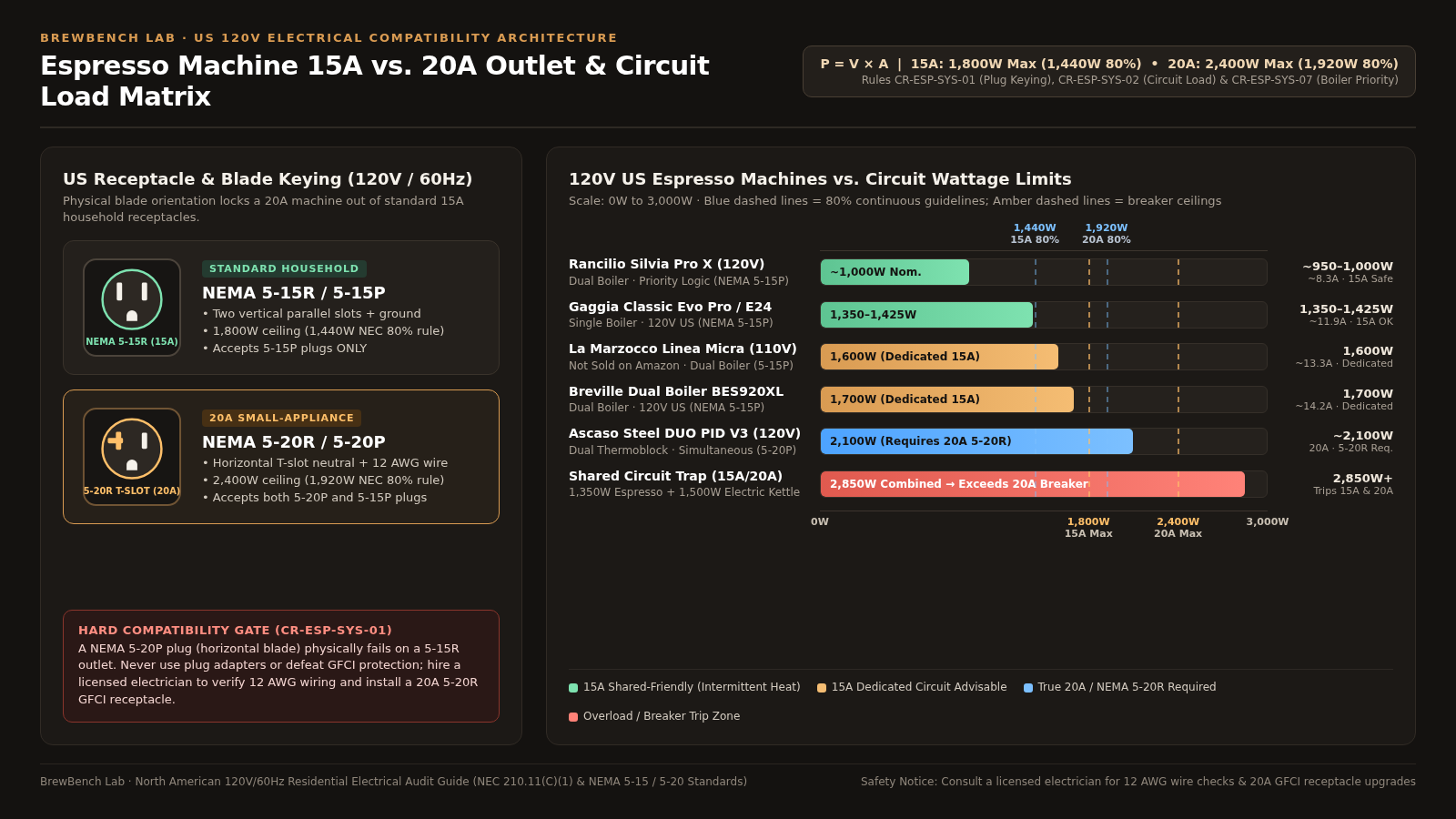
Every North American residential branch circuit starts with one foundational power equation: Power (Watts) = Voltage (Volts) × Current (Amps), or P = V × A. Because standard US household receptacles deliver nominal 120V / 60Hz alternating current (spanning roughly 110V–125V depending on utility load and transformer tap), multiplying voltage by circuit breaker ampacity sets the hard electrical ceiling for your coffee bar.
- 15-Amp Branch Circuit (120V × 15A): Yields 1,800 W theoretical peak capacity. Under National Electrical Code (NEC) continuous-load sizing guidelines—defined as loads operating at maximum current for 3 hours or more—sustained draw should not exceed 80% of breaker capacity, or 1,440 W (12A).
- 20-Amp Branch Circuit (120V × 20A): Yields 2,400 W theoretical peak capacity, with an 80% continuous-load benchmark of 1,920 W (16A).
Understanding why residential espresso machines sit near—and occasionally slightly above—1,440 W on 15A plugs requires distinguishing intermittent cycling from a true continuous load. An espresso boiler or thermoblock draws full rated wattage only during initial cold heat-up and brief recovery bursts after pulling a shot or purging steam. Once the thermal sensor or PID controller reaches setpoint (typically 90–96 °C / 194–205 °F for brewing), the heating element switches on and off intermittently in short pulses rather than pulling maximum current uninterrupted for three straight hours. That intermittent duty cycle is why UL-listed 120V appliances rated at 1,500 W to 1,700 W—including electric kettles, toasters, and the Breville Dual Boiler BES920XL—legally carry standard 15A plugs.
Where homeowners run into trouble is simultaneous startup load under compatibility rule CR-ESP-SYS-02:
Simultaneous Load (W) = Espresso Machine (W) + Grinder (W) + Shared Appliances (W) ≤ Circuit Capacity (W)
An espresso burr grinder typically draws only 150 W to 400 W during short 10-second grinding bursts, which fits easily beside a warm single boiler. However, pair a 1,350 W espresso machine heating from cold with a 1,500 W electric kettle or a 1,200 W microwave on the same kitchen branch circuit, and instantaneous load jumps to 2,550–2,850 W (roughly 21.3A to 23.8A)—tripping both 15A and 20A thermal-magnetic breakers within seconds.
NEMA 5-15P vs. NEMA 5-20P: Plugs, T-Slots & US Kitchen Wiring
Compatibility rule CR-ESP-SYS-01 enforces a strict HARD physical gate: your espresso machine must match North American 110–127V / 60Hz voltage and its cord plug must match your wall receptacle without aftermarket modification. Across 120V residential kitchens, two grounded National Electrical Manufacturers Association (NEMA) configurations matter:
- NEMA 5-15P Plug → NEMA 5-15R Receptacle (15A / 125V): Features two parallel vertical flat blades plus a round grounding pin. A
5-15Pplug inserts cleanly into both standard5-15Routlets and 20A5-20RT-slot outlets. - NEMA 5-20P Plug → NEMA 5-20R Receptacle (20A / 125V): Features one vertical hot blade and one rotated horizontal neutral blade plus a round grounding pin. That horizontal blade physically blocks a
5-20Pplug from entering a5-15Routlet, forcing connection exclusively to a NEMA 5-20R receptacle featuring the sideways T-shaped neutral slot.
Why Many 20-Amp Kitchen Circuits Still Have 15-Amp Faceplates
Here is a crucial National Electrical Code nuance that surprises US homeowners. Under NEC Article 210.11(C)(1), modern US kitchens must include at least two 20-ampere small-appliance branch circuits wired with minimum 12 AWG copper conductors and protected by 20A breakers and Ground-Fault Circuit-Interrupter (GFCI) protection. Yet if you look at your kitchen backsplash today, you probably see standard parallel-slot NEMA 5-15R duplex outlets rather than T-slot NEMA 5-20R outlets.
Why? Because NEC Table 210.21(B)(3) explicitly permits installing 15A-rated duplex receptacles on a 20A branch circuit whenever that circuit feeds two or more receptacle outlets (and every standard duplex wall outlet counts as two receptacles on one yoke). Only a single dedicated simplex outlet on a 20A circuit requires a NEMA 5-20R T-slot device under NEC 210.21(B)(1).
That distinction carries major practical consequences: your kitchen backsplash may already have 20A capacity behind the drywall—or an older home, dining nook, or wet bar might still run 14 AWG wire on a 15A breaker. Because wire gauge, upstream junction splices, and shared refrigerator or microwave feeds cannot be verified safely by reading a breaker handle alone, never swap a 5-15R outlet for a 5-20R receptacle yourself. Always hire a licensed electrician to verify 12 AWG copper wiring, confirm available branch capacity, preserve mandatory kitchen GFCI protection, and install a UL-listed 20A NEMA 5-20R GFCI receptacle.
Boiler Priority vs. True Simultaneous Heating on 120V
If a true European 230V kitchen outlet delivers up to ~3,680 W (16A × 230V), how do US prosumer machines deliver dual-boiler espresso and steaming without forcing every American buyer to rewire their kitchen for 20 amps? Manufacturers solve the 120V bottleneck in one of two engineering ways—a critical distinction governed by rule CR-ESP-SYS-07 and frequently missed when readers copy European benchmarks onto US hardware (G-06).
Strategy 1: Staggered / Boiler-Priority Power Management (NEMA 5-15P)
Most 120V dual-boiler espresso machines sold in the US—such as the Rancilio Silvia Pro X and Breville Dual Boiler BES920XL—ship with a standard NEMA 5-15P plug because their electronics regulate how both heating elements share current. On the 120V Rancilio Silvia Pro X, the machine houses a ~1,000 W coffee boiler element and an ~850 W steam boiler element (1,850 W combined if powered unconditionally at once). To operate cleanly inside standard US 15A circuit boundaries (~950–1,000 W / ~8.3A nominal rating per distributor spec sheets), the controller applies brew-boiler priority: full heat stays locked on the espresso brew boiler first, staggering steam-boiler power until brew temperature stabilizes.
Similarly, Breville’s BES920XL Dual Boiler manages dual stainless steel boilers plus an actively heated 58 mm group within a 1,700 W (~14.2A) 120V ceiling. While both models brew espresso and steam milk simultaneously from stored thermal mass once hot, their 120V heat-up and multi-drink steam recovery behave differently from 230V overseas twin units—and their high peak draw means Breville explicitly specifies a dedicated 15A circuit free from kettles or toasters. Explore how dual boilers stack up thermally in our best dual boiler espresso machines guide and our single boiler vs dual boiler vs heat exchanger breakdown.
Strategy 2: High-Wattage Simultaneous Dual Thermoblocks (NEMA 5-20P)
Unlike stored-water dual boilers, a dual-thermoblock machine has zero large standing steam tank to pre-bank latent thermal energy. To pull espresso through one aluminum/stainless-lined thermoblock while generating dry high-velocity steam continuously through a second dedicated thermoblock at the exact same instant, both blocks must fire together on demand. On the North American 120V Ascaso Steel DUO PID, US listings and official specifications place total draw near 2,000–2,100 W (20A) and fit the machine with a NEMA 5-20P plug. That extra electrical headroom enables rapid warm-up and simultaneous brewing and steaming without boiler-priority pauses—provided your kitchen wall has a true 20A NEMA 5-20R circuit.
Electrical Decision Matrix: 120V Models & Circuit Tiers
Use this compatibility table to match your machine’s heating architecture and US plug type against real-world household circuit capacity. Note that La Marzocco Linea Micra appears strictly as a technical reference benchmark—it is not sold on Amazon and carries no affiliate link on BrewBench Lab.
| Machine / Scenario | 120V Rated Draw & Plug | Circuit Requirement | Critical Caveat & CR Rule |
|---|---|---|---|
| Rancilio Silvia Pro X (120V) Dual Boiler (Amazon US) | ~950–1,000 W nominal (~8.3 A)NEMA 5-15P | Standard 15A or 20A (5-15R / 5-20R) | Uses brew-boiler priority (CR-ESP-SYS-07); easiest dual boiler on older 15A shared kitchen lines, though dedicated use remains best practice. |
| Gaggia Classic Evo Pro / E24 Single Boiler (Amazon US) | 1,350 W UL label / ~1,425 W retail spec (~11.9 A)NEMA 5-15P | Standard 15A or 20A (5-15R / 5-20R) | Stays under 1,440 W 80% 15A benchmark; do not run a 1,500 W kettle on the same circuit during warm-up (CR-ESP-SYS-02). |
| La Marzocco Linea Micra (110V) Dual Boiler (Not Sold on Amazon) | 1,600 W minimum spec at 110V (~13.3 A)NEMA 5-15P | Dedicated 15A circuit recommended by maker | Fits standard 5-15R outlets, but 1,600 W draw leaves almost zero margin for microwaves or toasters on the same breaker. Dealer-only; not sold on Amazon. |
| Breville Dual Boiler BES920XL Dual Boiler (Amazon US) | 1,700 W (~14.2 A)NEMA 5-15P | Dedicated 15A or 20A circuit per Breville manual | Pushes near 1,800 W 15A breaker ceiling; Breville explicitly advises keeping other high-draw appliances off the same circuit (CR-ESP-SYS-02). |
| Ascaso Steel DUO PID V3 (120V) Dual Thermoblock (Amazon US) | ~2,000–2,100 W (20 A)NEMA 5-20P | Dedicated 20A GFCI circuit with NEMA 5-20R T-slot | HARD FAIL on 5-15R outlets (CR-ESP-SYS-01). Requires 12 AWG 20A branch wiring and listed 5-20R outlet installed by an electrician. |
| 220–240V EU/UK Import Unit Overseas Voltage Variant | 220–240 V / 50 Hz (Schuko / UK Type G) | INCOMPATIBLE with 120V US outlets | HARD FAIL (CR-ESP-SYS-01, G-06). Never buy overseas 230V gray-market listings for standard US 120V kitchens. |
Myth vs. Engineering Reality: 4 Outlet & Adapter Traps
Myth #1: “Plugging a 15-amp espresso machine into a 20-amp outlet makes it heat faster or extract higher pressure.”
Engineering Reality: False. Current is drawn by the machine’s heating elements and pump, not pushed by the wall outlet. A 1,425 W Gaggia Classic Evo Pro or 1,700 W Breville Dual Boiler draws the exact same wattage on a 20A 5-20R circuit as on a 15A 5-15R circuit. Likewise, under guardrail G-15, outlet amperage has zero effect on extraction pressure—even budget 15-bar or 20-bar pumps only describe dead-head ceilings, while espresso brews near ~9 bar via OPV regulation or puck resistance. The sole benefit of a 20A circuit for a 5-15P machine is higher headroom against nuisance breaker trips when a grinder shares the line.
Myth #2: “Just put a cheap 15A-to-20A plug adapter on a NEMA 5-20P cord—or bend the horizontal prong—to fit a standard wall outlet.”
Engineering Reality: Strictly unsafe and a direct violation of CR-ESP-SYS-01 and guardrail G-17. A NEMA 5-20P horizontal neutral blade is an intentional UL mechanical safety key preventing a 20A appliance from drawing up to 2,100 W through 14 AWG wiring or 15A receptacles rated for 1,800 W max. Never use unapproved plug adapters, extension cords, or receptacle modifications to force a 20A plug into a 15A socket; always consult a licensed electrician to install a proper 20A circuit and 5-20R GFCI outlet.
Myth #3: “My kitchen breaker says ’20’, so I can definitely plug in a NEMA 5-20P espresso machine right out of the box.”
Engineering Reality: Not without checking the physical faceplate. Because NEC Table 210.21(B)(3) permits 15A NEMA 5-15R duplex outlets on 20A small-appliance kitchen circuits, millions of US homes have 20A breakers feeding standard parallel-slot receptacles. A NEMA 5-20P horizontal blade physically cannot plug into a 5-15R faceplate—so verify the actual T-shaped horizontal slot on the wall and have an electrician confirm 12 AWG wiring before ordering.
Myth #4: “Any Wi-Fi smart plug handles an espresso machine automatically for morning warm-up.”
Engineering Reality: Governed by CR-ESP-SYS-05, a smart plug works only if two conditions hold true: (1) the espresso machine uses a physical latching mechanical power switch (like classic Gaggia or Rancilio rocker switches) rather than an electronic momentary push-button that stays off when power cycles, and (2) the smart plug carries a UL-listed continuous rating matching or exceeding the machine’s amperage (most common smart plugs top out at 15A / 1,800 W resistive load and will overheat or fail on 20A machines). Whenever a machine includes an internal programmable wake-up timer—such as the Breville Dual Boiler—use the built-in schedule instead.
60-Second Electrical Verification & Safety Checklist
Before placing an order or routing cords on your coffee bar—especially when planning a full home espresso setup—walk through these five manufacturer-first electrical checks:
- Check the Specification Plate & Listing Voltage: Confirm 110–120V / 60Hz and the exact plug type (
NEMA 5-15Pvs.NEMA 5-20P) in the US product manual. Avoid gray-market 220–240V imports completely; see our audit of 230V espresso machines on Amazon US for why step-up transformers and overseas voltage ratings create warranty and safety hazards. - Inspect the Wall Receptacle Slots (Power Off / Visual Only): Standard 15A outlets show two vertical parallel slots; true 20A
NEMA 5-20Routlets show a sideways horizontal T-notch extending left from the neutral slot. Verify GFCI protection is present within 6 ft (1.8 m) of any kitchen sink or water line per NEC requirements. - Map Every Appliance on the Same Breaker: Flip the kitchen breaker briefly (with clocks noted) or use a UL-listed circuit breaker finder to map which countertop sockets, microwaves, toaster ovens, and electric kettles share that exact breaker. Remember
CR-ESP-SYS-02: keep total simultaneous load well below 1,800 W (15A) or 2,400 W (20A). - Follow Maker Cord & Water-Proximity Rules: Never route cords across wet drip trays, under hot boiler housings, or through undersized power strips/extension cords. Most espresso manuals prohibit extension cords outright because loose plug tension generates resistive heat at 12–17A draws.
- Call a Licensed Electrician for Any 20A Upgrade: If your chosen machine ships with a
NEMA 5-20Pplug and your wall lacks a5-20Routlet, never perform DIY outlet swaps or defeat ground-fault (GFCI) protection. A licensed electrician confirms 12 AWG copper wire size, breaker capacity, and installs a listed 20A GFCI receptacle safely.
Verified 120V Amazon US Espresso Machines by Plug & Load
The four verified 120V/60Hz Amazon US machines below represent each major residential electrical architecture—spanning true 20A simultaneous dual thermoblocks, high-wattage dedicated 15A dual boilers, boiler-priority 15A dual boilers, and classic single-boiler platforms.
| Verified 120V Machine | Heating Architecture | Plug & Rated Draw | Budget Tier | Amazon Link |
|---|---|---|---|---|
| Ascaso Steel DUO PID V3 | Dual Thermoblock PID (58 mm) | NEMA 5-20P (~2,100 W / 20A) | $1,000+ (TIER-ESP-PROSUMER) | View on Amazon |
| Breville Dual Boiler BES920XL | Dual Stainless Boilers (58 mm) | NEMA 5-15P (1,700 W / ~14.2A) | $1,000+ (TIER-ESP-PROSUMER) | View on Amazon |
| Rancilio Silvia Pro X | Dual Stainless Boilers + Priority (58 mm) | NEMA 5-15P (~950–1,000 W nominal) | $1,000+ (TIER-ESP-PROSUMER) | View on Amazon |
| Gaggia Classic E24 (RI9380/46) | Lead-Free Brass Single Boiler (58 mm) | NEMA 5-15P (1,350 W UL / ~1,425 W spec) | $200–$500 (TIER-ESP-MID) | View on Amazon |
1. Ascaso Steel DUO PID V3 (120V, Black) — True 20A / NEMA 5-20P Reference

Quick Specs: Dual thermoblock PID architecture | 58 mm (2.28 in) portafilter | Volumetric shot programming | 120V / 60Hz | ~2,100 W / 20A per US retailer & Ascaso USA specs | NEMA 5-20P plug | Price Tier: $1,000+ (TIER-ESP-PROSUMER)
The 120V Ascaso Steel DUO PID V3 is the quintessential North American example of why true 20-amp hardware exists. Instead of heating a large tank of standing boiler water ahead of time, Ascaso uses two independent stainless-lined thermoblocks—one dedicated to PID brew stability and one dedicated to continuous steam. Running both thermoblocks simultaneously pushes peak current into the 20A class (~2,000–2,100 W), which is why US units ship with a horizontal-blade NEMA 5-20P plug and demand a dedicated 20A 5-20R receptacle (CR-ESP-SYS-01).
Electrical Gate (CR-ESP-SYS-01 & CR-ESP-SYS-02): Requires a dedicated 20A branch circuit with a listed NEMA 5-20R T-slot GFCI receptacle. Do not operate using unapproved 15A plug adapters; confirm 12 AWG wiring with a licensed electrician before installation.
Pros
- Full 20A headroom supports simultaneous espresso brewing and high-output thermoblock steaming without boiler-priority pauses
- Thermoblock architecture reaches operating temperature substantially faster than traditional heavy E61 boilers
- 58 mm portafilter, volumetric dosing, and PID temperature control serve high-throughput daily workflows (
UC-ENTERTAINER)
Cons
NEMA 5-20Pplug will not fit standard5-15Routlets, potentially adding licensed electrician installation costs- Leaves virtually zero margin for sharing a 20A kitchen circuit with microwaves, toasters, or kettles while heating
2. Breville Dual Boiler BES920XL — High-Draw Dedicated 15A Dual Boiler

Quick Specs: Dual stainless steel boilers + actively heated 58 mm group | Digital PID & programmable pre-infusion | 120V / 60Hz | 1,700 W (~14.2A) | NEMA 5-15P plug | Built-in auto-start timer | Price Tier: $1,000+ (TIER-ESP-PROSUMER)
If your kitchen lacks a T-slot 5-20R receptacle yet you still want simultaneous espresso extraction and steaming, the Breville Dual Boiler BES920XL stays on a standard NEMA 5-15P plug while packing 1,700 W (~14.2A) of heating power across two stainless steel boilers and an actively heated group head. Because 1,700 W consumes nearly 95% of a 15A breaker’s 1,800 W ceiling during full warm-up, Breville’s North American manual explicitly instructs owners to place the BES920XL on its own dedicated grounded circuit away from other heavy appliances (CR-ESP-SYS-02).
Compatibility Gate (CR-ESP-ACC-01 & CR-ESP-SYS-05): Breville’s 58 mm group uses Breville-specific locking ears that are not interchangeable with E61 portafilters. For morning preheating, rely on the BES920XL’s built-in programmable wake-up clock rather than an external smart plug.
Pros
- Plugs into standard 120V
NEMA 5-15Rhousehold outlets without electrical rewiring - Built-in programmable timer eliminates external smart-plug ampacity risks (
CR-ESP-SYS-05) - PID brew boiler, actively heated group, and true simultaneous steaming suit light-roast and milk workflows
Cons
- 1,700 W peak draw leaves virtually zero capacity on a 15A breaker for sharing with a kettle or toaster
- Proprietary Breville 58 mm lug geometry limits E61 portafilter cross-compatibility (
CR-ESP-ACC-01)
3. Rancilio Silvia Pro X Dual Boiler (Black) — 15A Boiler-Priority Dual Boiler
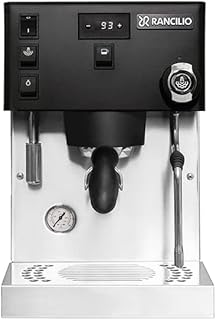
Quick Specs: Dual PID stainless boilers (0.3 L / 10.1 oz brew + 1.0 L / 33.8 oz steam) | 58 mm Rancilio group | Adjustable soft pre-infusion | 120V / 60Hz | ~950–1,000 W (~8.3A) nominal managed draw | NEMA 5-15P plug | Price Tier: $1,000+ (TIER-ESP-PROSUMER)
The 120V Rancilio Silvia Pro X shows how clever boiler-priority firmware (CR-ESP-SYS-07) tames dual-boiler current draw in standard US kitchens. Although its coffee boiler (1,000 W) and steam boiler (850 W) total 1,850 W on paper, Rancilio’s US power-management controller prioritizes the brew boiler so total active draw stays near ~950–1,000 W (~8.3A)—leaving comfortable electrical headroom on standard 15A kitchen lines even alongside an espresso grinder.
Compatibility Gate (CR-ESP-SYS-07 & CR-WTR-ESP-02): Because 120V firmware prioritizes one element at a time during recovery, expect longer initial warm-up or heavy-steam recovery than 230V European specifications report (G-06). Avoid running un-remineralized 0 TDS distilled water that can blind boiler water-level probes.
Pros
- Lowest 120V nominal current (~8.3A) among prosumer dual boilers, reducing breaker-trip headaches on older 15A lines
- Dedicated dual PIDs, brew pressure gauge, shot timer, and adjustable soft pre-infusion support light and medium roasts
- Plugs cleanly into standard
NEMA 5-15Routlets with zero electrical modifications
Cons
- Boiler-priority switching recovers steam slightly slower under heavy back-to-back entertaining loads than 20A or 230V rivals
- Rancilio 58 mm portafilter lugs differ from E61 geometry—verify model compatibility on aftermarket portafilters (
CR-ESP-ACC-01)
4. Gaggia Classic E24 (RI9380/46) — Classic 15A Single-Boiler Reference

Quick Specs: Lead-free brass single boiler | 58 mm Gaggia commercial group & 3-way solenoid | Commercial steam wand | 120V / 60Hz | 1,350 W UL label / ~1,425 W retail spec | NEMA 5-15P plug | Price Tier: $200–$500 to $500–$1,000 (TIER-ESP-MID)
Building directly on the classic lineage audited in our Gaggia Classic Evo Pro review, the updated 120V Gaggia Classic E24 (RI9380/46) swaps in a higher-thermal-mass lead-free brass boiler while maintaining friendly 15A compatibility. Rated at 1,350 W on US UL labels (~1,425 W across promotional specs), it operates right under the 1,440 W 80% 15A threshold on a standard NEMA 5-15P cord—requiring zero electrical upgrades as long as you keep kettles and microwaves off the same circuit during warm-up (CR-ESP-SYS-02).
Compatibility Gate (CR-DRINK-ESP-03 & CR-ESP-ACC-01): Single-boiler heating switches sequentially between ~93 °C (~199 °F) brew water and steam temperature, slowing large multi-latte sessions. Gaggia 58 mm portafilters use Gaggia-specific ear tabs—confirm exact model compatibility rather than assuming generic E61 fit.
Pros
- 1,350–1,425 W 120V draw sits comfortably inside standard 15A kitchen circuits alongside an espresso grinder
- Latching rocker switch design works cleanly with UL-listed 15A timers when operated within maker guidelines (
CR-ESP-SYS-05) - Lead-free brass boiler and 58 mm commercial group deliver solid durability in the mid-range tier
Cons
- Sequential single-boiler workflow requires waiting between pulling espresso and steaming milk
- Thermostat temperature control lacks native digital PID tuning for demanding light-roast single origins (
CR-DRINK-ESP-01)
Authoritative Manufacturer & Electrical Code Citations
All voltage specifications, receptacle keying dimensions, boiler-priority notes, and residential circuit safety guidance in this audit follow published manufacturer manuals and North American electrical standards:
- National Fire Protection Association (NFPA 70 / NEC) — Article 210.11(C)(1) 20A kitchen small-appliance branch circuits, Table 210.21(B)(3) multi-outlet receptacle rules, and 80% continuous-load guidelines.
- UL Solutions (Underwriters Laboratories) — North American appliance cord-set ratings, GFCI safety standards, and NEMA 5-15P / 5-20P blade keying protections.
- Ascaso USA Official Technical Documentation — 120V Steel DUO PID 20A / ~2,000–2,100 W dual-thermoblock ratings and NEMA 5-20P circuit requirements.
- Breville US Official Support & BES920XL Manual — 120V/60Hz 1,700 W Dual Boiler power rating, NEMA 5-15P cord, and dedicated circuit safeguard recommendations.
- Rancilio Group & La Marzocco USA — 120V Silvia Pro X boiler-priority architecture and Linea Micra 110V 1,600 W North American specifications (dealer-only; Linea Micra is not sold on Amazon).
How We Audited This Guide
- Espresso machines were audited across heating architecture, simultaneous brew and steam flow, 51mm/54mm/58mm portafilter lugs, NEMA 5-15P/5-20P circuit draw, and US warranty terms.
- Every espresso machine, burr grinder, accessory, and scale specification was cross-checked against official manufacturer 120V manuals, SCA water guidance, and verified Amazon US listings.
- Recommendations were evaluated against our weighted espresso-gear scoring rubrics and documented CR-* compatibility rules; we never invent heat-up seconds, PID variance, or micron claims.
Frequently Asked Questions: Espresso Machine 20 Amp Outlets
What espresso machines require a 20-amp outlet in the US?
Most 120V home espresso machines plug into standard 15-amp NEMA 5-15R outlets. The primary Amazon-available consumer exception is the 120V Ascaso Steel DUO PID (~2,100 W dual thermoblock), which ships with a horizontal-blade NEMA 5-20P plug requiring a dedicated 20A NEMA 5-20R circuit.
Can I plug a NEMA 5-20P espresso machine into a standard 15-amp outlet with an adapter?
No—never use a plug adapter or modify the cord to fit a 15A NEMA 5-15R receptacle. The horizontal neutral prong prevents overloading 14 AWG wiring and 15A receptacles past 1,800 W. Hire a licensed electrician to verify 12 AWG wiring and install a 20A NEMA 5-20R GFCI outlet.
How do I tell if my kitchen outlet is 15-amp or 20-amp?
Look at the neutral (left) slot on the wall faceplate: a 15-amp NEMA 5-15R outlet has two straight vertical slots, whereas a 20-amp NEMA 5-20R outlet has a sideways horizontal T-slot. Even if your breaker says 20A, always confirm wire gauge and outlet rating with a licensed electrician.
Why do some dual-boiler machines run on 15A while others need 20A?
Dual boilers like the 120V Rancilio Silvia Pro X use boiler-priority firmware to prioritize one heating element at a time inside 15A limits (~1,000 W nominal). Dual-thermoblock designs like the 120V Ascaso Steel DUO PID fire both heaters simultaneously on demand (~2,100 W), requiring 20A capacity.
Can my espresso grinder and espresso machine share the same 15A or 20A outlet?
Usually yes with 1,000–1,425 W machines on a 15A line, because burr grinders draw roughly 150–400 W intermittently. However, high-draw 1,700 W dual boilers or 2,100 W 20A dual thermoblocks leave minimal spare current—so never share that breaker with kettles, toasters, or microwaves.
Is it safe to plug an espresso machine into a smart plug or power strip?
Manufacturers generally advise against power strips and extension cords on high-wattage boilers. Smart plugs work only on machines with mechanical latching switches—never momentary electronic buttons—and only if the UL-listed smart plug’s amperage rating equals or exceeds your machine’s rated current (CR-ESP-SYS-05).


