
Disclosure: As an Amazon Associate, I earn from qualifying purchases. If you buy through links on this page, we may earn a small commission at no extra cost to you.
This gaggia classic evo pro review audits the North American 120V/60Hz RI9380 single-boiler espresso machine from top to bottom—separating verified factory specifications from community myths and documenting the critical boiler-coating revision you must check before ordering. Sitting squarely inside the $400–$1,000 TIER-ESP-MID bracket among our best espresso machines, the Gaggia Classic Evo Pro pairs a compact brushed-steel chassis with a commercial-diameter 58mm portafilter, a three-way solenoid valve, and a factory-calibrated 9-bar Overpressure Valve (OPV) on US units.
The Audit Verdict: The Gaggia Classic Evo Pro (7.8 / 10) remains one of the most mechanically straightforward ways to pull traditional ~9-bar 58mm espresso at home while keeping enough budget in reserve for an espresso-rated burr grinder. However, early coated-aluminum Evo Pro production batches drew widespread community reports of internal PTFE/Exelia coating flaking. Because Gaggia subsequently released the updated Gaggia Classic E24 (RI9380/46) with an uncoated lead-free brass boiler, smart buyers should verify batch provenance or step straight into the Classic E24 while retaining the exact same 58mm ecosystem and 9-bar US OPV behavior.
In This Audit
- Weighted Audit Scorecard (100% Espresso Rubric)
- 120V US Specifications & RI9380 Variant Breakdown
- Real-World Espresso, Milk & Grinder Workflow Analysis
- Compatibility Rules (CR-*), Boiler Coating ISS & Descaling Rules
- Verified Pros, Cons & Who Should Buy or Skip
- Verified Amazon US Models, Alternatives & Rejected Picks
- Authoritative Manufacturer & Standards References
- Frequently Asked Questions
Audit Verdict Summary & Weighted Scorecard
Every machine audited on BrewBench Lab is evaluated against our standardized four-criterion espresso machine rubric summing to 100%, grounded exclusively in 120V North American documentation and cross-compatibility rules rather than invented bench curves. Notice that the Evo Pro scores exceptionally well on portafilter modularity and 120V electrical fit, while losing points for stock bimetallic thermostat swings, sequential single-boiler steam pacing, and the coated-aluminum boiler revision history.
| Audit Criterion | Weight | Score | Verified Rationale |
|---|---|---|---|
| Heating Architecture & Thermal Control | 35% | 7.6 / 10 | Compact ~75–80 mL single boiler warms up promptly and pairs with a heavy brass group, but bimetallic thermostats lack factory PID temperature control and programmable pre-infusion, requiring manual temperature surfing on light roasts (CR-DRINK-ESP-01). |
| Steam Capability & Workflow Ergonomics | 25% | 7.5 / 10 | Commercial 2-hole stainless steam wand textures silky microfoam for 12 oz pitchers, yet single-boiler mode switching slows back-to-back milk drinks (CR-DRINK-ESP-03), and ~3.25 in (~83 mm) cup clearance is tight for tall mugs. |
| Portafilter Standard, Baskets & 120V Fit | 20% | 9.0 / 10 | US units ship with a factory 9-bar OPV spring, three-way solenoid valve, 58mm portafilter (1-cup & 2-cup single-wall + pressurized baskets), and standard NEMA 5-15P 1,425W draw. |
| US Warranty, Build Longevity & Value for Tier | 20% | 7.2 / 10 | Brushed steel chassis and 2-year US dealer warranty are strong for TIER-ESP-MID, but early Evo Pro coated-aluminum flaking reports lower long-term confidence compared with the uncoated brass-boiler Gaggia Classic E24. |
| Overall Weighted Audit Score | 100% | 7.8 / 10 | Strong 58mm mechanical starter; buy the Classic E24 brass revision where available. |
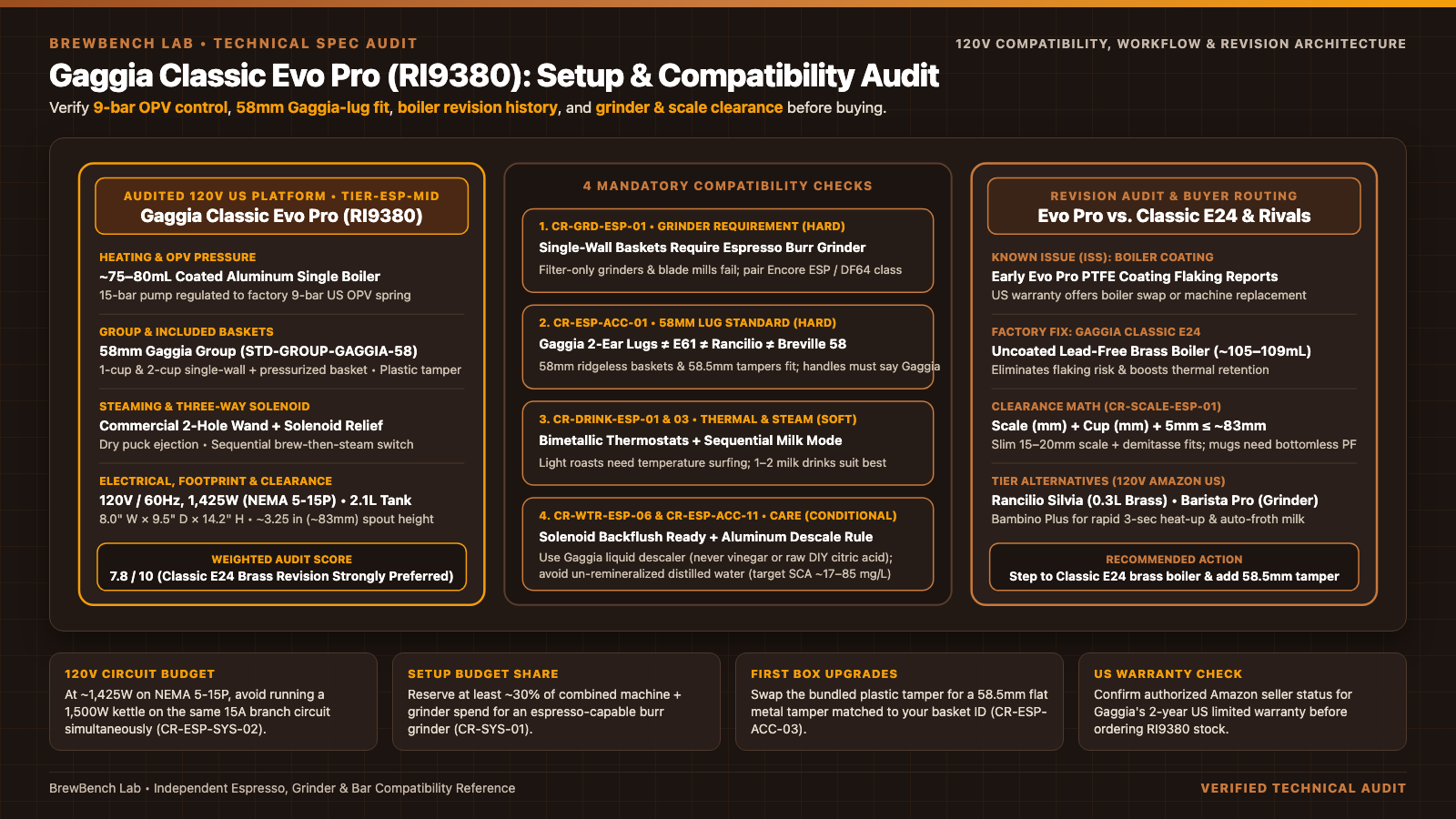
Key 120V US Specifications & RI9380 Variant Breakdown
Before comparing colorways or Amazon bundles, separate the machine family’s shared architecture from SKU-level regional differences. Every North American Gaggia Classic Evo Pro (RI9380) shares the same core frame, 58mm group geometry (STD-GROUP-GAGGIA-58), three-way solenoid valve, and latching rocker switches. Color suffixes—such as RI9380/48 (Polar White), RI9380/50 (Classic Blue), and RI9380/46 (Brushed Stainless Steel / Classic E24 revision)—identify exterior finishes and, critically in the case of the E24, the move from a coated aluminum boiler to an uncoated lead-free brass boiler.
Regional voltage matters strictly here: European 230V/50Hz models integrate an EU energy-saving auto-off board and different heater wattage, whereas 120V/60Hz North American units retain direct latching switches with no forced 20-minute cutoff. Never apply 230V European warm-up or power figures to a US kitchen outlet.
| Specification / Component | Gaggia Classic Evo Pro (120V US RI9380) | Verification & Context Notes |
|---|---|---|
| Heating System & Simultaneous Mode | Single boiler (sequential brew then steam; no simultaneous brew + steam) | Compact ~75–80 mL coated aluminum boiler on Evo Pro; Classic E24 updates to ~105–109 mL uncoated lead-free brass. |
| Temperature Control & Pre-Infusion | Bimetallic brew & steam thermostats (no factory PID or electronic pre-infusion) | Exact factory thermostat deadband in °C/°F: no verified data available yet. |
| Pump Rating vs. Brew Pressure | 15-bar vibration pump; factory-installed 9-bar OPV spring on US Evo Pro | 15 bar is maximum pump dead-head capability; the OPV regulates extraction toward ~9 bar at the puck. |
| Portafilter Standard & Diameter | 58mm Gaggia-pattern 2-ear group (STD-GROUP-GAGGIA-58) | Stainless/chromed brass handle; 58mm Gaggia lugs are not interchangeable with E61, Rancilio, or Breville 58mm lugs. |
| Included Filter Baskets & Tamper | 1-cup & 2-cup single-wall basket + 1-cup pressurized basket + plastic tamper | Includes black plastic crema pin for pressurized basket; upgrade immediately to a ~58.5 mm metal tamper. |
| Three-Way Solenoid Valve | Yes (vents residual group pressure after brew switch turns off) | Produces drier pucks and permits blind-basket backflushing per Gaggia maintenance instructions. |
| Steam Wand Type & Hot Water | Commercial-style 2-hole stainless steel articulated manual wand | Dispenses hot water through the wand when brew + steam switches and steam knob are opened together. |
| Water Reservoir & Filter Standard | 2.1 L (~72 fl oz) top-fill removable tank; no OEM reservoir cartridge slot | Filter water externally via pitcher or remineralized recipe water before pouring into the reservoir. |
| 120V US Power & Plug Standard | 110–120V / 60Hz, ~1,425 W (~11.88 A), standard NEMA 5-15P plug | Latching mechanical rocker switches; avoid running a kettle simultaneously on the same 15A circuit. |
| Cup Clearance (Under Spouts) | ~3.25 in (~83 mm) with stock spouted portafilter & drip tray installed | Exact inner drip-tray width/depth in mm: no verified data available yet. Bottomless portafilter adds clearance. |
| Dimensions & Weight | ~8.0 in W × 9.5 in D × 14.2 in H (~203 × 241 × 361 mm); ~20 lbs (~9.1 kg) | Requires top clearance under 18 in upper cabinets to lift the lid and pour or slide the 2.1 L tank. |
| US Warranty & Amazon Budget Tier | 2-year limited parts & labor via authorized US dealers; TIER-ESP-MID ($400–$1,000) | Verify seller authorization on Amazon US to preserve 2-year Gaggia North America coverage. |
Real-World Workflow Analysis: Espresso, Milk Steaming & Grinder Pairing
Straight Espresso & Light-Roast Temperature Behavior
For straight espresso drinkers pulling classic medium and dark roasts (UC-STRAIGHT-ESPRESSO), the Gaggia Classic Evo Pro excels mechanically where cheap thermoblocks stumble. Because US RI9380 units ship from the factory with a 9-bar OPV spring rather than the older 12–15 bar spring used in prior Classic Pro generations, water hits the compacted coffee puck at traditional espresso pressure without channelling-inducing force spikes. Pairing that regulated pressure with a heavy brass group head and a three-way solenoid valve gives you crisp shot cutoffs and clean, knockable pucks.
Where the Evo Pro shows its budget-tier limits is temperature stability on demanding beans (CR-DRINK-ESP-01). Without digital PID temperature control, the boiler relies on bimetallic thermostats that cycle across a noticeable temperature band. While Gaggia does not publish exact deadband figures in °C or °F (no verified data available yet), practical light-roast enthusiasts (UC-LIGHT-ROAST-ENTHUSIAST) targeting ~93–96 °C (199–205 °F) must practice consistent “temperature surfing”—flushing briefly until the brew indicator light cycles back on and starting the shot at a repeatable delay. Readers who brew dense light roasts daily and dislike manual surfing should look at PID-equipped rivals or compare architectures in our single boiler vs dual boiler vs heat exchanger guide.
Daily Milk Drinks & Sequential Single-Boiler Pacing
If your morning routine centers on one or two lattes or cappuccinos (UC-MILK-DRINKS-DAILY), the Evo Pro’s commercial-style 2-hole stainless steam wand is a genuine upgrade over plastic pannarello auto-frothers. It gives you real rotational control to roll silky microfoam in a 12 oz (350 mL) pitcher (CR-ESP-ACC-08). Because it is a single-boiler machine, however, brewing and steaming happen sequentially under rule CR-DRINK-ESP-03: you pull your espresso shot first, flip the steam rocker switch, wait for the ~75–80 mL boiler to climb to steam pressure, texture your milk, and then bleed water through the steam wand to refill and cool the boiler before pulling another shot.
For one or two drinks, that sequence adds a manageable pause. For four or more back-to-back lattes (UC-ENTERTAINER), the compact boiler loses steam stamina noticeably faster than a 0.3 L brass single boiler—explored in our Gaggia Classic Evo Pro vs Rancilio Silvia showdown—and far slower than a dual boiler or heat exchanger. If fast milk-drink speed and rapid warm-up matter more than 58mm traditional hardware, weigh our Gaggia Classic Evo Pro vs Breville Bambino Plus comparison.
Mandatory Grinder Pairing & Budget Allocation (CR-GRD-ESP-01)
Because Gaggia supplies both 1-cup and 2-cup single-wall baskets alongside a pressurized basket (CR-ESP-ACC-13), your grinder choice directly dictates whether the Evo Pro tastes like a café shot or an under-extracted sour mess. Under rule CR-GRD-ESP-01, running the single-wall baskets requires a grinder explicitly rated by its manufacturer for espresso—such as a Baratza Encore ESP (40 mm conical burrs with finer settings 1–20), DF54, or DF64 Gen 2. Under rule CR-SYS-01, plan to allocate at least ~30% of your combined machine-plus-grinder budget to the grinder. If you only own pre-ground coffee or a filter-only grinder, you must stick to the bundled pressurized basket with its plastic crema pin until you upgrade your grinder.
Drip-Tray Clearance, Scales & 58mm Basket Ecosystem
Space under the spouts is a frequent surprise for first-time Gaggia buyers. With the stock spouted portafilter locked in and the drip tray in place, the Classic Evo Pro leaves roughly ~3.25 in (~83 mm) of vertical cup clearance. Applying our clearance formula under rule CR-SCALE-ESP-01 (scale height + cup height + 5 mm margin ≤ 83 mm), a slim ~16–20 mm espresso scale plus a ~55 mm demitasse cup totals ~76–80 mm and fits comfortably. A standard 95–110 mm ceramic latte mug on top of a scale will exceed 83 mm, triggering the CONDITIONAL workaround: swap to a Gaggia-pattern bottomless portafilter (removing the dual spouts), install a low-profile aftermarket drip tray, or pull your shot into a short glass before pouring into your mug. Because Gaggia does not publish exact drip-tray grate dimensions in millimeters (no verified data available yet), stick to compact espresso-sized 0.1 g scales rather than wide pour-over scales (CR-SCALE-ESP-02).
When upgrading baskets and tools, remember rule CR-ESP-ACC-01: 58mm is not one universal lug standard. Aftermarket bottomless portafilters must specifically list Gaggia 2-ear lugs (STD-GROUP-GAGGIA-58)—E61, Rancilio, and Breville 58mm handles will not lock into the group. However, standard 58mm ridgeless baskets from precision makers generally drop into Gaggia’s portafilter, and replacing the flimsy stock plastic tamper with a 58.5 mm metal tamper matched to your basket’s inner diameter (CR-ESP-ACC-03) improves edge sealing immediately. Explore compatible basket options in our best 58mm precision baskets guide.
Compatibility Audit (CR-*), Boiler Coating ISS & Descaling Rules
Running every applicable rule from the BrewBench Lab cross-compatibility catalog reveals exactly where the Gaggia Classic Evo Pro passes cleanly, where workflow caveats apply, and why water chemistry and descaler selection require strict adherence to Gaggia’s manual.
| Rule ID | Level & Status | Audit Finding for Gaggia Classic Evo Pro (120V US) |
|---|---|---|
CR-GRD-ESP-01 | HARD (Conditional on basket) | Single-wall baskets require an espresso-rated burr grinder; filter-only grinders and blade mills fail and force use of the pressurized basket. |
CR-ESP-ACC-01 | HARD | Uses STD-GROUP-GAGGIA-58 2-ear lugs. Aftermarket portafilters must explicitly specify Gaggia compatibility; E61, Rancilio, and Breville 58mm handles will not lock. |
CR-ESP-ACC-11 | CONDITIONAL (Pass) | Equipped with a three-way solenoid valve, so blind-basket backflushing is supported per Gaggia’s maintenance schedule using aluminum/brass-safe cleaner. |
CR-DRINK-ESP-01 | SOFT | Stock bimetallic thermostats lack PID precision; light-roast shots require consistent temperature surfing to hold ~93–96 °C (199–205 °F). |
CR-DRINK-ESP-03 | SOFT | Sequential single-boiler workflow suits 1–2 milk drinks per session; large group entertaining waits on heat-up and boiler refill cycles. |
CR-SCALE-ESP-01 | CONDITIONAL | ~3.25 in (~83 mm) stock spout clearance fits a slim 0.1 g scale + demitasse; taller latte mugs require a bottomless portafilter or tray adjustment. |
CR-ESP-SYS-01 / 02 | HARD / CONDITIONAL | 120V/60Hz, ~1,425 W, standard NEMA 5-15P plug passes normal US kitchen outlets; avoid running a ~1,500 W electric kettle simultaneously on the same 15A circuit. |
CR-WTR-ESP-05 / 06 | HARD / CONDITIONAL | No OEM reservoir filter cartridge slot; filter water externally and descale aluminum-boiler units strictly with Gaggia’s corrosion-inhibited liquid descaler. |
Known Issue (ISS) Mitigation: Evo Pro Coated Boiler Flaking vs. Classic E24
No honest gaggia classic evo pro review can ignore the documented 2023–2024 boiler-coating issue known widely in the espresso community as “Boilergate.” Gaggia applied an industrial non-stick PTFE/Exelia coating inside the Evo Pro’s aluminum boiler to deter mineral scale. Across early production runs, owners reported the interior coating blistering and shedding dark specks through the group head and steam wand. Gaggia North America and authorized US dealers responded with warranty machine replacements and replacement boiler kits (first uncoated aluminum, and subsequently the brass transition).
To close the issue permanently, Gaggia introduced the Gaggia Classic E24 (RI9380/46), which replaces the coated aluminum boiler with an uncoated, lead-free solid brass boiler (~105–109 mL). That revision eliminates any internal coating that could ever flake while modestly increasing thermal mass and steam stability. Because Evo Pro stock and Classic E24 units sometimes share similar chassis silhouettes on retail listings, always confirm the boiler specification and authorized US dealer warranty coverage before completing checkout.
Water Chemistry, Aluminum-Safe Descaling & Maintenance (CR-WTR-ESP-01/06)
For aluminum-boiler Evo Pro machines, descaler chemistry is non-negotiable under rule CR-WTR-ESP-06: never use household vinegar or raw, unbuffered DIY citric acid, which can pit and corrode bare or compromised aluminum surfaces. Follow Gaggia’s US manual strictly by using Gaggia Liquid Descaling Solution (with protective corrosion inhibitors) on the recommended two-month interval, rinsing thoroughly with two full tanks of fresh water across both the steam wand and group head. Brass-boiler Classic E24 units eliminate aluminum corrosion vulnerability, though following Gaggia’s official descaler guidance remains the safest path for US warranty preservation (CR-WTR-ESP-03).
For daily water supply (CR-WTR-ESP-01 / 02), aim for SCA machine-care and flavor targets—roughly 17–85 mg/L CaCO3 total hardness (~1–5 grains per gallon), ~40 mg/L alkalinity, and ~75–250 mg/L total dissolved solids (TDS). Never pour pure, un-remineralized distilled water or 0 TDS reverse-osmosis water into the reservoir; zero-mineral water lacks buffering for balanced espresso flavor and can accelerate metal wear over time. If your tap water runs hard, check it with a hardness strip and fill the 2.1 L tank from an ion-exchange softening pitcher or remineralized distilled water recipe.
Verified Pros, Cons & Who Should Buy or Skip
Verified Strengths
- Factory 9-Bar US OPV: North American Evo Pro units regulate the 15-bar pump down to ~9 bar right out of the box—no DIY spring swap required.
- True 58mm Commercial Ecosystem & 3-Way Solenoid: Accepts precision 58mm ridgeless baskets, supports blind-basket backflushing, and ejects clean, dry coffee pucks.
- Compact Footprint & Generous 2.1 L Tank: Narrow 8.0 in width fits tight kitchen counters while holding more water than most compact rivals.
- Simple, Repairable Latching Electronics: 120V mechanical switches resist moisture damage, support smart-plug warm-up (with adequately rated plugs), and offer rich long-term parts support.
Verified Limitations & Cons
- Coated-Aluminum Boiler Flaking History: Early Evo Pro units experienced PTFE coating peeling; the uncoated brass-boiler Classic E24 is the far safer Gaggia purchase.
- No Factory PID or Pre-Infusion: Bimetallic thermostats force manual temperature surfing on light roasts unless you invest in aftermarket PID hardware.
- Sequential Single-Boiler Steam Wait: Must heat up for steam and bleed down before pulling another shot; small ~75–80 mL volume limits multi-latte stamina.
- Fluffy Plastic Tamper & Tight Clearance: Included tamper requires immediate replacement, and ~3.25 in spout height crowds taller mugs sitting on a scale.
Buy the Gaggia Classic Evo Pro (or better yet, the Classic E24) if: you want a tactile, repairable 58mm Italian single-boiler espresso machine in the TIER-ESP-MID budget bracket, already budget for an espresso-capable burr grinder, and pull straight medium-roast espresso or one to two milk drinks per morning.
Skip it if: you want 3-second warm-up and automated milk texturing (look at the Breville Bambino Plus), want a one-box integrated grinder (look at the Breville Barista Pro), or regularly steam four or more lattes back-to-back where sequential single-boiler waiting becomes frustrating.
Verified Amazon US Models, Alternatives & Rejected Picks
All four 120V/60Hz North American SKUs below are verified on Amazon US. Alongside two Gaggia Classic Evo Pro colorways, we highlight the uncoated brass-boiler Gaggia Classic E24 as the preferred Gaggia revision and the Breville Barista Pro as the leading integrated-grinder alternative in the same $500–$1,000 tier.
1. Gaggia Classic Evo Pro (Polar White RI9380/48) — Audited 120V Baseline

Quick Specs: Single boiler (~75–80 mL coated aluminum) | Factory 9-bar US OPV spring | 58mm Gaggia-pattern portafilter (1 & 2-cup single-wall + pressurized baskets) | Commercial 2-hole steam wand | Three-way solenoid valve | 2.1 L tank | 120V/60Hz, ~1,425 W (NEMA 5-15P) | Price Tier: $500–$1,000 (TIER-ESP-MID)
The Polar White RI9380/48 delivers the full North American Evo Pro mechanical package in a matte white powder-coated steel housing: commercial 58mm group components, dry solenoid puck ejection, and 9-bar OPV calibration. Check seller authorization to confirm 2-year Gaggia NA warranty eligibility and verify boiler batch status upon delivery.
2. Gaggia Classic Evo Pro (Classic Blue RI9380/50) — Colorway Variant

Quick Specs: Single boiler | 58mm Gaggia-pattern portafilter | Commercial steam wand | Three-way solenoid valve | 2.1 L tank | 120V/60Hz (NEMA 5-15P) | Price Tier: $500–$1,000 (TIER-ESP-MID)
Identical internally to the Polar White model, the Classic Blue RI9380/50 swaps the outer finish to deep Italian blue while preserving the 8.0-inch-wide counter footprint, latching switches, and full compatibility with Gaggia 58mm accessories and precision baskets.
3. Preferred Gaggia Revision: Gaggia Classic E24 (RI9380/46) — Uncoated Brass Boiler

Quick Specs: Uncoated lead-free brass single boiler (~105–109 mL) | Factory 9-bar US OPV | 58mm Gaggia-pattern group | Commercial steam wand & three-way solenoid | 120V/60Hz (NEMA 5-15P) | Price Tier: $200–$500 / $500–$1,000 boundary
For most shoppers, the Gaggia Classic E24 is the smarter buy over coated-aluminum Evo Pro stock. Its solid uncoated lead-free brass boiler permanently removes any risk of internal coating flakes, boosts thermal retention between back-to-back shots, and keeps every 58mm Gaggia portafilter, basket, and 9-bar OPV advantage intact.
4. Integrated-Grinder Alternative: Breville Barista Pro (BES878BSS)

Quick Specs: ThermoJet (3-sec heat-up claim by maker) with PID control | Integrated conical burr grinder + LCD display | 54mm portafilter (Breville 54mm pattern, single-wall + dual-wall baskets) | Manual steam wand | 120V/60Hz (NEMA 5-15P) | Price Tier: $500–$1,000 (TIER-ESP-MID)
If you want a single countertop appliance without buying a separate espresso grinder (UC-BEGINNER-ONE-BOX), the Breville Barista Pro trades Gaggia’s 58mm modularity and repairable brass group for a built-in conical burr grinder, PID temperature control, and near-instant ThermoJet heating.
Rejected Picks & Incompatible Pairings (Technical Audit Exclusions)
- Off-Amazon Dealer-Only Alternatives (Lelit Anna / Profitec Go / La Marzocco Linea Micra / Flair 58): Excluded as Amazon US buy-intent alternatives under BrewBench Lab marketplace hygiene rules because they lack verified new Amazon US retail offers.
- Filter-Only Burr Grinders & Blade Mills (e.g., standard Baratza Encore or stock Fellow Ode Gen 2): Rejected under HARD rule
CR-GRD-ESP-01for Gaggia’s single-wall baskets; they cannot grind fine enough for 9-bar extraction. - Generic “58mm E61” Bottomless Portafilters: Rejected under HARD rule
CR-ESP-ACC-01; E61 locking ears will not engage Gaggia’sSTD-GROUP-GAGGIA-58group geometry. - Entry Pressurized-Only 51mm Thermoblocks (Sub-$200 tier): Excluded for buyers seeking 58mm single-wall progression because they omit three-way solenoid pressure relief (
CR-ESP-ACC-11) and commercial basket geometry.
Authoritative Manufacturer & Standards References
- Gaggia Official International Product & Manual Archive — Official RI9380 Classic Evo Pro / E24 platform overview and maintenance guidance.
- Gaggia North America — 120V/60Hz US specification sheets, 9-bar OPV configuration, and US limited warranty support.
- Specialty Coffee Association (SCA) Water & Brewing Standards — Reference water hardness, alkalinity, and TDS guidelines for espresso extraction and equipment care.
- National Fire Protection Association (NFPA) — North American 120V/15A and 20A branch-circuit load principles for countertop kitchen appliances.
How We Audited This Guide
- Espresso machines were audited across heating architecture, simultaneous brew and steam flow, 51mm/54mm/58mm portafilter lugs, NEMA 5-15P/5-20P circuit draw, and US warranty terms.
- Every espresso machine, burr grinder, accessory, and scale specification was cross-checked against official manufacturer 120V manuals, SCA water guidance, and verified Amazon US listings.
- Recommendations were evaluated against our weighted espresso-gear scoring rubrics and documented CR-* compatibility rules; we never invent heat-up seconds, PID variance, or micron claims.
Frequently Asked Questions
Is the Gaggia Classic Evo Pro worth buying over the Classic E24?
Most shoppers should pick the Gaggia Classic E24 over older coated-aluminum Evo Pro inventory. The E24 replaces the Evo Pro’s coated aluminum boiler—which experienced community coating-flaking reports—with an uncoated lead-free brass boiler while retaining the same 9-bar US OPV, 58mm group, and footprint.
Do US Gaggia Classic Evo Pro machines ship with a 9-bar OPV spring?
Yes. While Gaggia rates the vibration pump at 15 bar maximum dead-head capability, North American 120V Gaggia Classic Evo Pro and Classic E24 units ship from the factory with a calibrated 9-bar OPV spring, removing the aftermarket spring swap required on older Classic Pro models.
Will any 58mm bottomless portafilter fit the Gaggia Classic Evo Pro?
No. Under compatibility rule CR-ESP-ACC-01, 58mm refers only to basket diameter, not group-head ear geometry. You must buy a portafilter explicitly built for Gaggia’s 2-ear standard (STD-GROUP-GAGGIA-58); E61, Rancilio, and Breville 58mm portafilters will not lock into the group.
Can you backflush the Gaggia Classic Evo Pro with a blind basket?
Yes. Because the 120V Gaggia Classic Evo Pro incorporates a three-way solenoid valve, residual group pressure vents cleanly into the drip tray when brewing stops. This supports periodic blind-basket backflushing using an espresso cleaner compatible with Gaggia’s boiler components per the manual.
How should I descale the Gaggia Classic Evo Pro aluminum boiler safely?
Follow Gaggia’s official manual strictly and use Gaggia’s corrosion-inhibited liquid descaling solution rather than vinegar or unbuffered DIY citric acid, which can pit aluminum boilers. Always rinse with two full tanks of balanced, non-distilled water afterward to protect internal metal surfaces.


