
Disclosure: As an Amazon Associate, I earn from qualifying purchases. If you buy through links on this page, we may earn a small commission at no extra cost to you.
Comparing the gaggia classic evo pro vs breville bambino plus puts the two most popular mid-tier home espresso architectures head-to-head: a traditional Italian 58mm single-boiler machine built for hands-on longevity and modification against a compact 54mm ThermoJet powerhouse built for three-second weekday speed and automated milk texturing. Both earn prominent spots in our best espresso machines hub, yet their heating physics, portafilter ecosystems, and maintenance demands serve very different morning habits.
The short verdict: Choose the Breville Bambino Plus (BES500) if you make daily lattes or flat whites and want ~3-second ThermoJet startup, automated temperature-sensing milk texturing with manual override, factory PID control, generous cup clearance, and a complete 54mm starter kit right out of the box. Choose the Gaggia Classic Evo Pro (RI9380)—or better yet, Gaggia’s updated uncoated brass-boiler Classic E24—if you want a commercial-diameter 58mm portafilter, factory-calibrated 9-bar OPV extraction on US models, heavy steel construction, and a mod-friendly platform you can customize for years.
In This Comparison
- Winner-by-Use-Case Quick Verdict Matrix
- Side-by-Side 120V Spec & Compatibility Table
- Battleground 1: Boiler vs. ThermoJet, Temperature Stability & Evo Pro Coating Update
- Battleground 2: Auto-Froth Sensor vs. Manual Commercial Steam
- Battleground 3: 58mm vs. 54mm Portafilters, Baskets & Solenoid Valves
- Battleground 4: Grinder Pairing, Ecosystem Cost & Upgrade Margin
- Battleground 5: Counter Footprint, Cup Clearance & Scale Fit
- Battleground 6: US 120V Power, Smart Plugs, Water & Boiler-Safe Descaling
- Choose Gaggia Classic Evo Pro If vs. Choose Breville Bambino Plus If
- Verified Amazon US Contenders & Excluded Alternatives
- Frequently Asked Questions
Quick Verdict Matrix: Which Mid-Tier Espresso Machine Wins by Use Case?
Both machines sit comfortably within the $200–$500 and $400–$1,000 Amazon US mid-tier corridor (TIER-ESP-MID), meaning your choice rarely comes down to initial checkout price alone. Instead, daily warm-up patience, milk automation preferences, and 58mm versus 54mm accessory plans separate the two platforms cleanly.
| Use Case & Drink Profile | Winner | Why It Wins (Verified Spec & Rule Fit) |
|---|---|---|
| Best for Daily Milk Drinks (1–2 lattes or flat whites every morning) | Breville Bambino Plus (BES500) | Drip-tray temperature sensor automates three milk temperatures and three microfoam densities hands-free with automatic wand purging (CR-DRINK-ESP-02), plus ~3-second steam transitions. |
| Best for Straight Espresso & Light Roasts | Breville Bambino Plus (stock) / Modded Gaggia (long-term) | Out of the box, Breville’s factory PID and automatic pre-infusion outperform stock thermostat temperature swings (CR-DRINK-ESP-01); Gaggia wins only if you add an aftermarket PID controller. |
| Best Value / Out-of-the-Box Kit Completeness | Breville Bambino Plus (BES500) | Includes single-wall and dual-wall baskets, a full-size 54mm metal tamper, Razor dosing tool, and stainless milk pitcher; Gaggia ships with a lightweight plastic tamper and no pitcher. |
| Best Compact Kitchen Footprint & Mug Clearance | Breville Bambino Plus (height) / Gaggia (depth) | Bambino Plus is slightly narrower (7.7 in vs. 8.0 in) and clears ~4.5–5.0 in tall mugs; Gaggia is shallower front-to-back (9.5 in vs. 12.6 in) for narrow-depth counters (CR-ESP-SYS-04). |
| Best 58mm Accessory & Modding Ecosystem | Gaggia Classic Evo Pro / Classic E24 | Accepts standard 58mm precision baskets and 58.5mm tampers, ships with a US 9-bar OPV spring, and supports PID and flow-control upgrades (CR-ESP-ACC-01). |
| Best Long-Term Boiler Durability (Gaggia Line) | Gaggia Classic E24 (RI9380/46) | Swaps the Evo Pro’s coated aluminum boiler for an uncoated lead-free brass boiler, permanently eliminating coating-flaking risk while keeping the Classic chassis. |
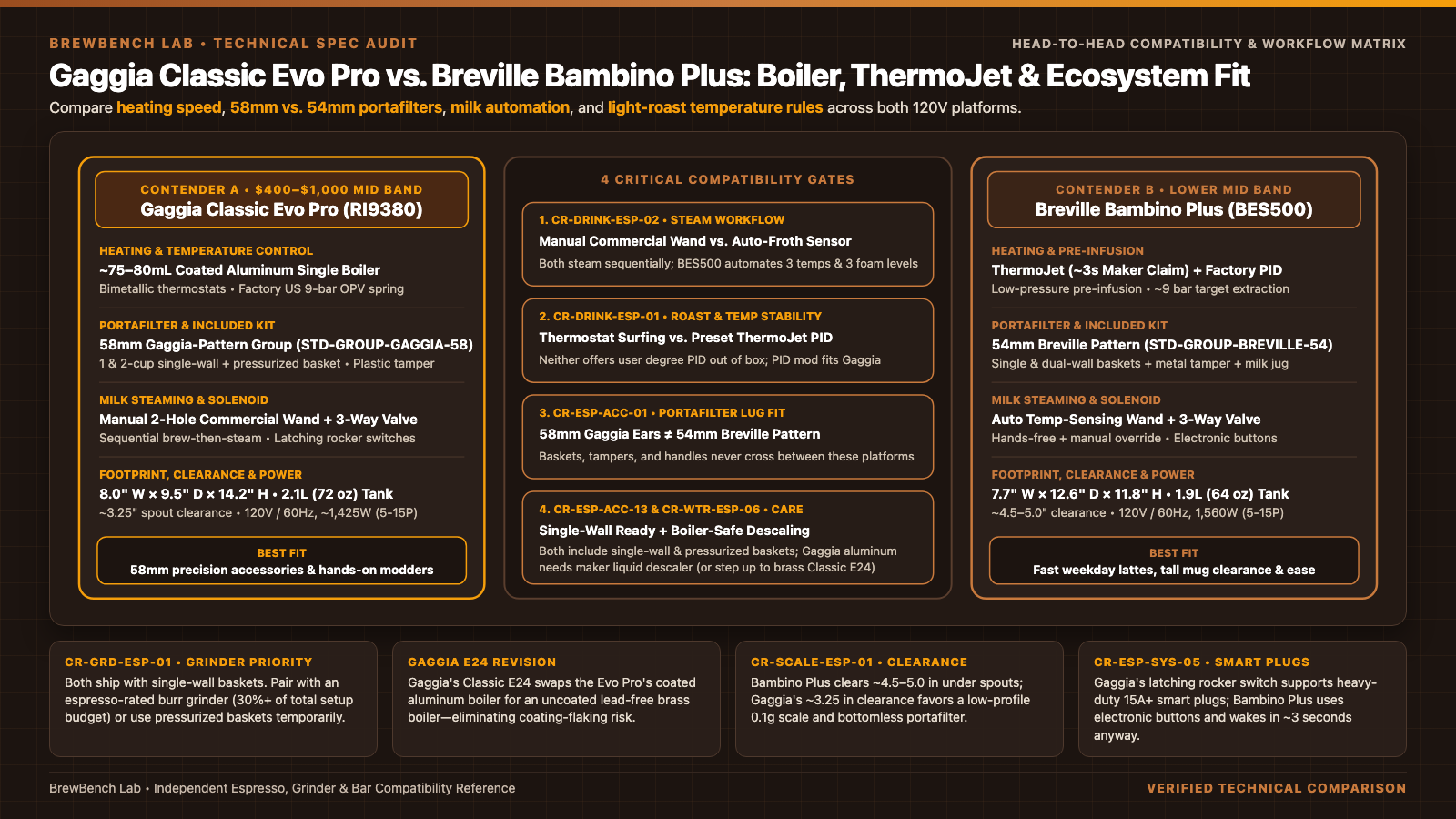
Side-by-Side Verified Spec & Compatibility Table (120V US Models)
All specifications below reflect North American 120V/60Hz retail hardware documented in Gaggia North America and Breville USA manuals. European 230V/50Hz versions differ in wattage, plug termination, and standby timers, so always verify US model identifiers before ordering. Where a manufacturer does not publish an exact metric—such as exact thermostat switching temperatures on the Gaggia or isolated millimeter drip-tray dimensions on the Bambino Plus—we state that gap explicitly instead of guessing.
| Specification / Compatibility Metric | Gaggia Classic Evo Pro (RI9380 120V US) | Breville Bambino Plus (BES500 120V US) |
|---|---|---|
| Heating Architecture | Single boiler (~75–80 mL / ~2.5 fl oz coated aluminum; Classic E24 uses uncoated brass ~105–109 mL) | Proprietary ThermoJet flash heater |
| Maker Heat-Up Claim | Rapid boiler warm-up; brass group soak (~10–15 min workflow recommended; exact sec: no verified data available yet) | Breville states ~3-second startup readiness |
| Simultaneous Brew + Steam | No (sequential switch between brew and steam) | No (sequential brew then steam) |
| Temperature Control | Bimetallic brew & steam thermostats (stock °C/°F deadband: no verified data available yet) | Electronic PID (factory preset; exact °C setpoint not user-adjustable) |
| Pump Rating vs. Extraction Pressure | 15-bar vibration pump; North American Evo Pro ships with factory 9-bar OPV spring | 15-bar vibration pump; low-pressure pre-infusion ramping near ~9 bar extraction |
| Portafilter & Group Standard | 58mm Gaggia-pattern group (STD-GROUP-GAGGIA-58); stainless/chromed brass handle | 54mm Breville-pattern group (STD-GROUP-BREVILLE-54) |
| Included Filter Baskets (US Box) | 1-cup single-wall, 2-cup single-wall, plus 1 pressurized (crema) basket | 1-cup & 2-cup single-wall + 1-cup & 2-cup dual-wall (pressurized) |
| Included Tamper & Pitcher | Lightweight plastic tamper; no milk pitcher included | Full-size 54mm metal tamper + Razor trimming tool + stainless milk pitcher |
| Three-Way Solenoid Valve | Yes (dry pucks + supports blind-basket backflushing) | Yes (dry pucks + supports cleaning-disc tablet cycles) |
| Steam Wand Architecture | Manual commercial-style 2-hole stainless steam wand | Automatic temperature-sensing steam wand (3 temps, 3 foam levels) + manual override |
| Water Tank Capacity | ~2.1 L (~72 fl oz) top-fill / removable rear tank | 64 fl oz (1.9 L) removable rear tank |
| 120V US Power & Plug | 110–120V / 60Hz, ~1,425W (maker range ~1,375–1,425W), NEMA 5-15P | 110–120V / 60Hz, 1,560W, NEMA 5-15P |
| Power Switch Type | Latching mechanical rocker switches (smart-plug compatible if 15A+ rated) | Electronic momentary push buttons (not smart-plug auto-start compatible) |
| Cup Clearance (Under Spouts) | ~3.25 in (~83 mm) with spouted portafilter & tray | ~4.5–5.0 in (114–127 mm) under spouts per retailer specs |
| Overall Dimensions (W × D × H) | ~8.0 × 9.5 × 14.2 in (~203 × 241 × 361 mm) | ~7.7 × 12.6 × 11.8–12.2 in (~195 × 320 × 300–310 mm) |
| Weight | ~20 lbs (~9.1 kg) brushed/painted steel housing | ~10.9 lbs (4.95 kg) stainless housing |
| US Manufacturer Warranty | 2-year limited parts & labor via authorized US dealers | 2-year limited warranty (Breville USA) |
| Amazon US Budget Tier | $200–$500 / $400–$1,000 (TIER-ESP-MID lower half) | $200–$500 / $400–$1,000 (TIER-ESP-MID lower half) |
Battleground 1: Boiler vs. ThermoJet, Temperature Stability & The Evo Pro Coating Update
The clearest mechanical divide in the gaggia classic evo pro vs breville bambino plus matchup sits behind the brew button. The Breville Bambino Plus runs an on-demand ThermoJet flash-heating element regulated by an electronic PID sensor. Breville states that the BES500 reaches extraction readiness in roughly three seconds from standby and transitions to steam temperature almost instantaneously, without waiting for a tank of water to boil. By contrast, the Gaggia Classic Evo Pro uses a traditional ~75–80 mL (~2.5 fl oz) aluminum single boiler wrapped with twin external heating elements bolted onto a heavy brass group head. While the small boiler warms quickly, the dense brass group and heavy 58mm portafilter still benefit from a 10–15 minute soak—or blank water flushes—so the metal path doesn’t steal heat from your shot.
Before selecting the Evo Pro specifically, however, buyers must factor in a well-documented hardware caveat. Early-production 2023 Gaggia Classic Evo Pro units used an internal non-stick PTFE/Exelia coating inside the aluminum boiler to reduce scale adhesion. Owners reported dark coating flecks flaking into group water and steam wands—an issue widely termed “Boilergate” in espresso communities. Gaggia supported warranty claims on affected units and subsequently released the Gaggia Classic E24, which replaces the coated aluminum boiler with an uncoated, lead-free solid brass boiler (~105–109 mL). Unless you confirm an Evo Pro unit comes from a verified uncoated revision or plan to maintain strict water chemistry, stepping to the brass-boiler Classic E24 eliminates coating-flaking concerns permanently. Read our dedicated Gaggia Classic Evo Pro review for full revision history.
Under compatibility rule CR-DRINK-ESP-01, temperature regulation also differs sharply. Neither machine provides user-editable degree-by-degree PID adjustments from the factory, yet Breville’s preset electronic PID combined with automated low-pressure pre-infusion holds medium-roast extraction temperatures far more consistently shot-to-shot than Gaggia’s mechanical bimetallic thermostats. On a stock Gaggia Classic Evo Pro, owners rely on “temperature surfing” (flushing water until the brew indicator light cycles on, then counting a repeatable pause) to avoid wide thermostat swings. For dense, Nordic-style light roasts wanting 93–96 °C (199–205 °F) precision, Breville wins out of the box—though the Gaggia becomes a far more capable light-roast platform if you later install an aftermarket PID kit as outlined in our Gaggia Classic Evo Pro upgrades roadmap.
Finally, ignore “15-bar” marketing comparisons between these two units. Both machines use 15-bar vibration pumps, which represent maximum dead-head pump capacity rather than actual brewing pressure. Balanced single-wall espresso targets roughly ~9 bar at the puck. North American Gaggia Classic Evo Pro and E24 units notably ship with a factory 9-bar Overpressure Valve (OPV) spring installed, while the Bambino Plus uses pre-infusion and internal relief modulation around the 9-bar window.
Battleground 2: Auto-Froth Temperature Sensor vs. Manual Commercial Steam
Under compatibility rule CR-DRINK-ESP-02, both machines deliver genuine steam capability for lattes, cappuccinos, and flat whites—eliminating the need for a separate countertop frother—yet their daily workflows feel worlds apart. The Breville Bambino Plus places an automatic stainless temperature sensor directly beneath its articulated wand on the drip tray. You pour cold milk into the supplied stainless jug, pick one of three temperature settings and one of three foam textures, press the steam button, and walk away while the machine textures silky microfoam and automatically purges residual milk back into the tray upon lowering the wand. Whenever you want to practice manual latte art rolling, simply pull the wand forward out of its cradle to override automation. See our Breville Bambino Plus review for deeper auto-froth workflow notes.
The Gaggia Classic Evo Pro relies strictly on a manual 2-hole commercial stainless steel steam wand (a substantial upgrade over pre-2019 plastic panarello attachments). After pulling your espresso shot, you flip the steam rocker switch, wait for the ~75–80 mL boiler to climb to steam pressure, purge condensation into a towel or cup, and manually introduce air and roll the vortex. Because the Evo Pro’s aluminum boiler has limited thermal volume, starting steam slightly before the thermostat light turns off keeps the heating element energized longer—and under rule CR-ESP-ACC-08, pairing the Gaggia with a compact 12 oz (350 mL) pitcher yields much stronger swirl than oversized 20 oz jugs.
Keep compatibility rule CR-DRINK-ESP-03 in mind for both machines: neither can brew espresso and steam milk simultaneously. On the Bambino Plus, switching from shot to steam takes only seconds via the ThermoJet. On the Gaggia, you wait for the boiler to heat up to steam mode and then bleed water back down through the wand or group head before pulling a second espresso shot. Both handle one or two daily lattes comfortably, while the Bambino Plus pulls well ahead for quick weekday mornings. Also note under rule CR-DRINK-ESP-05 that neither machine provides a dedicated hot-water tap—Americano drinkers either dispense hot water through the steam wand valve or boil a separate kettle (though never run a kettle simultaneously on the same 15A circuit under CR-ESP-SYS-02).
Battleground 3: 58mm vs. 54mm Portafilters, Baskets & Three-Way Solenoid Valves
Portafilter geometry separates these machines into two completely incompatible accessory ecosystems under hard rule CR-ESP-ACC-01:
- 58mm Gaggia Group vs. 54mm Breville Group (
CR-ESP-ACC-01): The Gaggia Classic Evo Pro uses Gaggia’s commercial-diameter 58mm lug pattern (STD-GROUP-GAGGIA-58), which differs in locking ear placement from Italian E61 and Rancilio 58mm handles. The Breville Bambino Plus uses Breville’s proprietary 54mm pattern (STD-GROUP-BREVILLE-54). Portafilters, baskets, puck screens, dosing funnels, and tampers cannot swap between the two platforms. - Out-of-the-Box Baskets & Tampers (
CR-ESP-ACC-13,CR-ESP-ACC-03,CR-SYS-03): Both US retail machines pass ruleCR-ESP-ACC-13cleanly by shipping with single-wall (non-pressurized) and dual-wall (pressurized) baskets in the box—so neither locks you into pressurized extraction like entry budget units (compare how the Bambino Plus beats pressurized-only rivals in our Breville Bambino Plus vs De’Longhi Dedica Arte audit). Where Breville pulls ahead on day one is accessory quality: the BES500 includes a solid metal 54mm tamper, stainless milk jug, and Razor leveler, whereas the Gaggia Classic Evo Pro ships with an undersized plastic tamper that begs for an immediate 58.4–58.5mm metal upgrade. - Three-Way Solenoid Valves on Both (
CR-ESP-ACC-11): Unlike the cheaper base Bambino (BES450BSS), the Bambino Plus includes a three-way solenoid valve just like the Gaggia Classic Evo Pro. Both machines depressurize the puck instantly into the drip tray when extraction stops, leaving dry, cleanly knockable pucks and supporting chemical cleaning cycles (blind-basket detergent backflushing on the Gaggia; cleaning-disc tablet cycles on the Bambino Plus per each maker’s manual).
Battleground 4: Grinder Pairing, Total Ecosystem Cost & Upgrade Margin
Neither machine includes a built-in grinder, and both rely on single-wall baskets to shine. Under hard compatibility rule CR-GRD-ESP-01, pairing either machine with a blade grinder or a filter-only burr mill guarantees rapid, sour, under-extracted gushers in a single-wall basket. Both require an espresso-rated burr grinder—ideally a stepless or micro-stepped model under rule CR-GRD-ESP-03—so you can dial in 18 g doses within a 25–30 second extraction window.
Budget balance rule CR-SYS-01 recommends reserving at least one-third of your combined machine-plus-grinder budget for the grinder. Because both the Gaggia Classic Evo Pro and Breville Bambino Plus sit in the lower half of TIER-ESP-MID, both pair naturally with $200–$500 single-dose flat-burr or espresso conical grinders inside a complete $700–$1,800 (TIER-SETUP-MID) coffee bar. Keep hidden kit additions in mind, though: with the Gaggia Classic Evo Pro, you will immediately add a 58.5mm flat metal tamper, a 12 oz milk pitcher, and likely a low-profile 0.1 g espresso scale (CR-SYS-03). With the Breville Bambino Plus, your out-of-the-box hardware kit only needs an espresso grinder and a compact 0.1 g scale to start pulling balanced lattes on day one.
Battleground 5: Counter Footprint, Cup Clearance & Drip-Tray Scale Fit
Kitchen counter geometry often decides this comparison faster than internal heating specs under rules CR-ESP-SYS-04, CR-SCALE-ESP-01, and CR-SCALE-ESP-02:
- Width vs. Depth Footprint (
CR-ESP-SYS-04): The Breville Bambino Plus is slimmer laterally (~7.7 in wide) and shorter vertically (~11.8–12.2 in tall), making it easier to tuck beneath low upper cabinets, though it stretches ~12.6 in deep. The Gaggia Classic Evo Pro is compact front-to-back (~9.5 in deep × 8.0 in wide) for shallow apartment ledges, yet stands 14.2 in tall and requires top clearance to pour water into its ~2.1 L reservoir unless you slide the tank out forward or pull the machine out from under cabinets. - Weight & Portafilter Locking Ergonomics: Weighing ~20 lbs (~9.1 kg) with a steel chassis, the Gaggia stays planted when twisting its 58mm handle into the group gasket. At ~10.9 lbs (4.95 kg), the Bambino Plus often slides across smooth stone countertops unless you brace the top housing with your free hand while locking the 54mm portafilter.
- Cup & Scale Clearance (
CR-SCALE-ESP-01,CR-SCALE-ESP-02): Breville wins vertical space decisively. The Bambino Plus offers roughly 4.5–5.0 inches (114–127 mm) under the spouts, accommodating a 20 mm 0.1 g mini scale plus a standard 3.5-inch latte mug without removing the tray. The Gaggia Classic Evo Pro leaves only ~3.25 inches (~83 mm) under its double spouts; fitting a 0.1 g espresso scale plus a standard latte cup usually requires upgrading to a 58mm Gaggia-pattern bottomless portafilter to reclaim ~0.8–1.0 in of clearance.
Battleground 6: US 120V Power, Smart Plugs, Water Chemistry & Boiler-Safe Descaling
Both 120V/60Hz North American models terminate in standard grounded NEMA 5-15P plugs rated for 15A or 20A kitchen receptacles (CR-ESP-SYS-01). The Gaggia draws roughly ~1,425W (~12A), and the Breville draws 1,560W (~13A). Because both sit right around the continuous load ceiling of a 15A branch circuit (CR-ESP-SYS-02), avoid running an electric kettle, toaster, or microwave on the exact same circuit at the same time—and never defeat grounding or use plug adapters. Where electrical workflow diverges is morning automation under rule CR-ESP-SYS-05: the Gaggia’s mechanical latching rocker switches allow pairing with a UL-listed 15A/1,800W+ smart plug for scheduled morning preheating, whereas the Bambino Plus uses electronic push buttons that ignore smart-plug power restoration (though its ~3-second ThermoJet startup makes preheating unnecessary).
Water chemistry and descaling protocols demand close attention under rules CR-WTR-ESP-01, CR-WTR-ESP-02, and CR-WTR-ESP-06:
- Avoid Pure Un-Remineralized Distilled Water: Both machines need balanced mineral content near SCA guidelines (~68 mg/L CaCO3 target hardness within a 17–85 mg/L acceptable window, 75–250 mg/L TDS) using remineralized RO/distilled recipes or appropriate tank softening. Pure un-remineralized distilled water yields flat shots and can cause erratic level sensing or accelerated metal corrosion over time.
- Shape-Locked Tank Filters (
CR-WTR-ESP-05): The Bambino Plus accepts Breville’s proprietary charcoal tank filter holder inside its 64 fl oz reservoir, whereas the Gaggia uses a standard intake silicone tube compatible with in-tank ion-exchange softening pouches. - Aluminum vs. ThermoJet Descaling Caution (
CR-WTR-ESP-06,CR-WTR-ESP-03): Follow each manufacturer’s North American manual strictly rather than mixing DIY acid ratios or household vinegar. Specifically, Gaggia’s Evo Pro aluminum boiler requires Gaggia’s official liquid decalcifier (formulated with corrosion inhibitors); unbuffered raw citric acid powder can etch aluminum alloys and discolor rinse water. Breville specifies Breville descaling powder alongside periodic cleaning-tablet cycles under its 2-year US limited warranty. Always depressurize and let boilers cool per manual instructions before any maintenance—never open a hot or pressurized boiler.
Head-to-Head Decision Summary: Choose Gaggia or Choose Breville?
Choose the Gaggia Classic Evo Pro (or E24) if…
- You want a commercial-standard 58mm portafilter compatible with precision ridgeless baskets, 58.5mm tampers, and long-term upgrades like PID temperature controllers (
CR-ESP-ACC-01). - You prefer heavy ~20 lb metal construction, latching mechanical rocker switches (
CR-ESP-SYS-05), and factory-calibrated 9-bar US OPV extraction. - You enjoy hands-on temperature surfing, manual steam rolling with a 2-hole commercial wand, and a shallower 9.5-inch counter depth.
- You plan to buy the uncoated brass-boiler Gaggia Classic E24 revision for maximum thermal inertia and zero internal boiler-coating risk.
Choose the Breville Bambino Plus (BES500) if…
- You drink 1–2 lattes, cappuccinos, or flat whites daily (
UC-MILK-DRINKS-DAILY) and want hands-free temperature-sensing microfoam with automatic wand purging (CR-DRINK-ESP-02). - You want ~3-second ThermoJet startup readiness, factory PID brew stability, and automated low-pressure pre-infusion without waiting 10–15 minutes to preheat.
- You want single-wall and dual-wall baskets, a solid 54mm metal tamper, a stainless pitcher, and a three-way solenoid valve included out of the box (
CR-ESP-ACC-13). - You need ~4.5–5.0 inches of spout clearance so taller mugs and a 0.1 g espresso scale fit underneath without swapping portafilters (
CR-SCALE-ESP-01).
Verified Amazon US Contenders & Key Platform Alternatives
Every model listed below represents a verified 120V/60Hz North American SKU sold on Amazon US. Alongside the two headline contenders, we highlight the uncoated brass-boiler Gaggia Classic E24 (for shoppers avoiding coated aluminum Evo Pro batches) and the lower-cost Breville Bambino (BES450BSS) for buyers who want ThermoJet speed with manual steaming. If you are still cross-shopping heavier single-boiler steel machines, check our Gaggia Classic Evo Pro vs Rancilio Silvia comparison.
1. Breville Bambino Plus (BES500BSS) — Convenience & Daily Latte Winner

Quick Specs: ThermoJet (~3s maker startup claim) + factory PID + pre-infusion | 54mm Breville-pattern portafilter (single-wall & dual-wall 1/2-cup baskets) | Auto-froth temp sensor + manual steam | Three-way solenoid valve | 64 fl oz (1.9 L) tank | 120V/60Hz, 1,560W (NEMA 5-15P) | ~7.7 in W × 12.6 in D × 11.8 in H | Price Tier: $200–$500
Pros
- Three-second ThermoJet startup claim and instant mode transitions eliminate weekday warm-up waits
- Hands-free drip-tray temperature sensor automates three milk temperatures and three microfoam levels with full manual override
- Ships complete with single-wall and pressurized 54mm baskets, metal tamper, Razor tool, stainless pitcher, and 3-way solenoid valve
Cons
- Factory-preset PID temperature lacks user-selectable degree adjustments for dense light roasts
- Proprietary 54mm Breville-pattern portafilter is incompatible with commercial 58mm precision baskets and accessories
- Electronic momentary buttons prevent automatic startup via a wall smart plug, and ~10.9 lb chassis benefits from bracing when locking the portafilter
2. Gaggia Classic Evo Pro (Jungle Green) — 58mm Enthusiast & Modder Winner

Quick Specs: Single coated aluminum boiler (~75–80 mL) + bimetallic thermostats | Factory US 9-bar OPV spring | 58mm Gaggia-pattern portafilter (1 & 2-cup single-wall + pressurized basket) | Commercial 2-hole steam wand | Three-way solenoid valve | 2.1 L tank | 120V/60Hz, ~1,425W (NEMA 5-15P) | ~8.0 in W × 9.5 in D × 14.2 in H | Price Tier: $200–$500
Pros
- Commercial-diameter 58mm portafilter opens up VST/IMS precision baskets, 58.5mm calibrated tampers, and deep aftermarket mod support
- North American Evo Pro units arrive factory-calibrated with a 9-bar OPV spring and a heavy ~20 lb steel housing
- Latching mechanical rocker switches work cleanly with heavy-duty 15A+ UL-listed smart plugs for morning preheating
Cons
- Early coated aluminum Evo Pro boilers carried documented internal coating-flaking reports (consider the uncoated brass Classic E24 below)
- Bimetallic thermostats lack factory digital PID regulation, requiring temperature surfing or aftermarket PID installation for light roasts
- Tight ~3.25-inch spout clearance limits taller latte mugs unless upgraded to a bottomless portafilter, and bundled plastic tamper needs replacement
3. Key Hardware Revision: Gaggia Classic E24 (RI9380/46) — Uncoated Brass Boiler

Quick Specs: Single uncoated lead-free brass boiler (~105–109 mL) | Factory 9-bar US OPV spring | 58mm Gaggia-pattern portafilter | Commercial 2-hole steam wand | Three-way solenoid valve | 2.1 L tank | 120V/60Hz, ~1,425W (NEMA 5-15P) | ~8.0 in W × 9.5 in D × 14.2 in H | Price Tier: $200–$500
If you like Gaggia’s 58mm single-boiler platform but want zero exposure to coated aluminum boiler flaking, the Gaggia Classic E24 (RI9380/46) is the direct factory solution. Swapping to an uncoated lead-free brass boiler raises internal thermal mass for steadier back-to-back extractions and stronger steam recovery while keeping full 58mm Gaggia accessory and PID-mod compatibility.
4. Budget ThermoJet Option: Breville Bambino (BES450BSS) — Manual Steam Sibling

Quick Specs: ThermoJet (~3s maker startup claim) + factory PID | 54mm Breville-pattern portafilter | Manual steam wand (no auto-froth sensor) | No three-way solenoid valve | 47 fl oz (1.4 L) tank | 120V/60Hz, 1,560W (NEMA 5-15P) | Price Tier: $200–$500
Prefer Breville’s ~3-second ThermoJet speed and PID stability without paying for automated milk texturing? The standard Breville Bambino (BES450BSS) delivers the same core 54mm extraction hardware at a lower entry tier, freeing budget for a dedicated espresso burr grinder (CR-SYS-01). Just note the two core compromises: it omits the Bambino Plus’s three-way solenoid valve (leaving wetter pucks) and drops tank size to 47 fl oz (1.4 L).
Alternatives Excluded From This Amazon US Comparison
- Off-Amazon Specialty Dealer Brands (Lelit Anna, Profitec GO, Flair 58): Excluded as Amazon buy-intent picks because Lelit, Profitec, and Flair 58 distribute through specialty espresso dealers without primary Amazon US storefront fulfillment (and the Flair 58 omits steam capability under
CR-DRINK-ESP-02). - 230V / 50Hz European & UK Gray-Market Listings: Disqualified under
CR-ESP-SYS-01and US 120V/60Hz safety compliance; 230V hardware cannot connect safely to standard US 120V outlets without step-up transformers and forfeits North American warranty coverage. - Unbranded Sub-$100 “20-Bar” Pressurized-Only Machines: Disqualified because “20-bar” labels advertise dead-head pump capacity rather than ~9 bar extraction control, and proprietary portafilters frequently lack verified single-wall upgrade paths.
Authoritative Technical References
- Breville USA — Bambino Plus (BES500) Official Specifications & Manual (120V/60Hz ThermoJet specs, 54mm basket kit, automatic milk texturing, and 2-year US limited warranty).
- Gaggia North America — Classic Pro / Evo / E24 Manuals & Support (120V/60Hz electrical specs, 9-bar US OPV, three-way solenoid backflushing, and Gaggia liquid descaling guidance).
- Specialty Coffee Association (SCA) — Water Quality Standards (Target hardness, alkalinity, and TDS guidelines for boiler protection and balanced espresso flavor).
How We Audited This Guide
- Espresso machines were audited across heating architecture, simultaneous brew and steam flow, 51mm/54mm/58mm portafilter lugs, NEMA 5-15P/5-20P circuit draw, and US warranty terms.
- Every espresso machine, burr grinder, accessory, and scale specification was cross-checked against official manufacturer 120V manuals, SCA water guidance, and verified Amazon US listings.
- Recommendations were evaluated against our weighted espresso-gear scoring rubrics and documented CR-* compatibility rules; we never invent heat-up seconds, PID variance, or micron claims.
Frequently Asked Questions
Which pulls more consistent espresso out of the box: Gaggia Classic Evo Pro or Breville Bambino Plus?
The Breville Bambino Plus delivers steadier shot-to-shot temperature consistency out of the box thanks to its electronic PID and automated low-pressure pre-infusion. A stock Gaggia Classic Evo Pro relies on mechanical bimetallic thermostats that require temperature surfing until you add an aftermarket PID controller.
Should I buy the Gaggia Classic Evo Pro or step up to the Classic E24?
If budget allows, choose the Gaggia Classic E24. Early 2023 Evo Pro units shipped with a PTFE-coated aluminum boiler linked to flaking reports. The Classic E24 replaces it with an uncoated lead-free brass boiler, eliminating flaking risks while adding thermal mass and keeping all 58mm Gaggia compatibility.
Can I use 58mm Gaggia portafilters or baskets on the Breville Bambino Plus?
No—under compatibility rule CR-ESP-ACC-01, 58mm and 54mm ecosystems never cross-fit. The Gaggia Classic Evo Pro uses Gaggia-pattern 58mm ears and baskets, whereas the Bambino Plus requires Breville-pattern 54mm portafilters, 54mm baskets, and ~53.3–53.5mm tampers and puck screens.
Do both machines ship with non-pressurized single-wall baskets?
Yes—both US retail packages include single-wall and pressurized baskets (CR-ESP-ACC-13). You can pull fresh burr-ground espresso immediately on day one using an espresso-capable grinder, or use the pressurized baskets temporarily with pre-ground coffee until adding a dedicated espresso grinder.
Can a smart plug turn on either the Gaggia Classic Evo Pro or Bambino Plus automatically?
Only the Gaggia Classic Evo Pro supports smart-plug scheduling (CR-ESP-SYS-05). Because Gaggia uses latching mechanical rocker switches, a heavy-duty UL-listed 15A+ smart plug can preheat it before you wake up. The Bambino Plus uses electronic push buttons, though its ~3-second ThermoJet startup needs no preheating.
How should I descale the Gaggia Classic Evo Pro versus the Breville Bambino Plus?
Follow each manufacturer’s North American manual strictly (CR-WTR-ESP-06). Use Gaggia’s official liquid decalcifier on the Evo Pro’s aluminum boiler—never raw citric acid or household vinegar, which can etch aluminum. On the Bambino Plus, use Breville descaling powder alongside periodic cleaning-tablet cycles.


