
Disclosure: As an Amazon Associate, I earn from qualifying purchases. If you buy through links on this page, we may earn a small commission at no extra cost to you.
Shopping for the best espresso machine under $500 means navigating a crowded shelf of inflated “20-bar” pump claims, plastic pressurized-only portafilters, and compact thermoblocks that leave beginners stranded without a capable grinder. Across our broader best espresso machines audit, the sub-$500 bracket proved to be the most technically deceptive tier on Amazon US because two machines sitting in the same price band can have completely opposite upgrade ceilings.
For this focused evaluation, we audited 18 released 120V/60Hz North American listings on Amazon US and narrowed the field to 9 distinct setups spanning 51mm, 53mm, 54mm, and 58mm portafilter ecosystems. Whether you want rapid three-second milk drinks, a dual-PID 58mm boiler hybrid, or a one-box integrated grinder, every pick below is verified against manufacturer manuals, basket specifications, and real North American electrical standards.
In This Guide
Quick Picks: Best Espresso Machine Under $500 at a Glance
#1 Best Overall
Breville Bambino Plus (BES500BSS)
Three-second ThermoJet startup, three-way solenoid valve, and hands-free auto milk texturing in a 7.7-inch 54mm body built for an external grinder. (Jump to audit)
#2 Best 58mm Enthusiast Pick
Turin Legato V2 PID 58mm
Pairs a 550 ml stainless PID brew boiler with a dedicated steam thermoblock, adjustable OPV, shot timer, and commercial 58mm portafilter. (Jump to audit)
#3 Best Built-In Grinder System
Ninja Luxe Café Premier 3-in-1
Integrates a 25-step conical grinder, weight-based dosing scale, single-wall 53mm baskets, and Dual Froth pitcher into one automated station. (Jump to audit)
Side-by-Side Comparison: 9 Verified Espresso Machines Under $500
| Product & Award | Best For | Heating & Portafilter | 120V Draw & Tier | Link |
|---|---|---|---|---|
| Breville Bambino Plus (BES500BSS) Best Overall | Daily lattes & tight counters | ThermoJet • 54mm | 1,560W (NEMA 5-15P) $200–$500 | View on Amazon |
| Turin Legato V2 PID 58mm Best 58mm Enthusiast | PID tuning & fast steam | 550ml Boiler + Steam Block • 58mm | 1,500W (NEMA 5-15P) $200–$500 | View on Amazon |
| Ninja Luxe Café Premier 3-in-1 Best All-in-One | Espresso, drip & cold-press | Thermoblock + Grinder • 53mm | 1,650W (NEMA 5-15P) $200–$500 | View on Amazon |
| Breville Infuser (BES840BSXL) Best Gauge & Hot Water | Manual steaming & gauge feedback | Thermocoil PID • 54mm | 1,600W (NEMA 5-15P) $200–$500 | View on Amazon |
| De’Longhi Dedica Arte (EC885M) Best Slim Manual | 5.9-inch apartment counters | Thermoblock (3 Temps) • 51mm | 1,300W–1,450W (NEMA 5-15P) $200–$500 | View on Amazon |
| HiBREW H10Plus 58mm Best Value 58mm PID | Programmable shots & solenoid | Thermoblock Dual PID • 58mm | 1,350W–1,450W (NEMA 5-15P) $200–$500 | View on Amazon |
| De’Longhi Dedica Maestro Plus (EC950M) Best Auto-Steam Slim | Hands-free milk & 54 oz tank | Thermoblock (3 Temps) • 51mm | 1,450W (NEMA 5-15P) $200–$500 | View on Amazon |
| KitchenAid Metal (KES6503) Best Metal-Clad 58mm | Die-cast metal & flat PF | Thermocoil Dual Sensors • 58mm | 1,460W (NEMA 5-15P) $200–$500 | View on Amazon |
| HiBREW H10 Customizable 58mm Best Under $200 58mm | Leaving budget for a grinder | Thermoblock • 58mm | 1,350W (NEMA 5-15P) Under $200 | View on Amazon |
Match Your Use Case: Choosing a Sub-$500 Setup
Before ordering an entry espresso machine, decide whether you want an integrated grinder in one box or plan to split your budget between a grinderless machine and a dedicated burr mill. Readers balancing a total benchtop budget can pair our recommendations below with our espresso setup under $700 blueprint and entry espresso grinders under $200 audit—or, if you want dual-boiler power or assisted tamping, compare step-up options in our mid-range espresso machines under $1,000 guide.
| Buyer Scenario | Best Match | Why & Expected Outcome |
|---|---|---|
| Busy weekday lattes with external grinder | Breville Bambino Plus BES500BSS | Three-second ThermoJet startup, dry solenoid pucks, and auto-froth temperature sensing handle 1–2 daily milk drinks effortlessly. |
| Hands-on 58mm PID & multi-drink workflow | Turin Legato V2 PID 58mm | 550 ml PID brew boiler plus dedicated steam block removes single-boiler lag while accepting standard 58mm precision baskets. |
| One-box espresso, iced & drip household | Ninja Luxe Café Premier 3-in-1 | Built-in weight scale, 25-step grinder, and Dual Froth pitcher remove separate grinder shopping out of the box. |
| Analog brew pressure feedback on 54mm | Breville Infuser BES840BSXL | Front extraction gauge, dedicated hot-water spout, and PID thermocoil pair cleanly with an entry espresso grinder. |
| Ultra-narrow 6-inch studio counter | De’Longhi Dedica Arte EC885M | Slim 5.9-inch stainless body with a manual My LatteArt steam wand saves space beside a compact conical grinder. |
| Strict machine budget under $200 | HiBREW H10 Customizable 58mm | Low hardware entry leaves maximum cash for an espresso-capable grinder, unlocking single-wall extraction immediately. |
Detailed Audits: 9 Verified Espresso Machines Under $500
1. Breville Bambino Plus (BES500BSS) — Best Overall Espresso Machine Under $500

Quick Specs: ThermoJet heating (~3-second readiness; sequential brew/steam) | 54mm Breville-pattern portafilter (single-wall & dual-wall 1-cup/2-cup baskets) | Auto-froth temperature sensor wand + manual steam | 120V/60Hz, 1,560W–1,600W (NEMA 5-15P) | 64 fl oz (1.9 L) rear tank | 7.7 in W × 12.6 in D × 11.8 in H | Price Tier: $200–$500
Audit Score: 9.2 / 10
- Thermal & Pressure Stability (35%): 8.9 / 10
- Build & Serviceability (25%): 9.0 / 10
- Steam Power & Workflow (20%): 9.5 / 10
- Value (20%): 9.4 / 10
Few compact home appliances execute everyday morning milk drinks as reliably as the Breville Bambino Plus. According to Breville USA’s official BES500 specifications, the proprietary ThermoJet heater reaches extraction readiness in roughly three seconds, executes automated low-pressure pre-infusion before ramping near ~9 bar, and drops residual puck pressure through a three-way solenoid valve so knocking out spent grounds never sprays slurry across your drip tray.
Its signature advantage in this tier is the integrated milk temperature sensor inside the drip tray paired with an articulated automatic steam wand. Drop the supplied stainless steel pitcher onto the sensor, select from three temperatures and three microfoam textures, and the wand textures and purges automatically—or flip to manual control whenever you want to practice free-pour latte art. Compared side-by-side with De’Longhi’s slimline lineup in our Breville Bambino Plus vs. De’Longhi Dedica Arte comparison, Breville heats dramatically faster and eliminates wet pucks via that solenoid valve. Remember that because no grinder sits inside the 7.7-inch body, unlocking the included single-wall baskets requires pairing it with an espresso-rated burr grinder under rule CR-GRD-ESP-01.
Buyer Verification Alert: Do not confuse the Bambino Plus (BES500) with the entry Bambino (BES450)—check our Breville Bambino vs. Bambino Plus breakdown before checkout. Only the BES500 adds the automatic milk-frothing temperature sensor, three-way solenoid valve, and larger 64 fl oz (1.9 L) reservoir.
Pros
- Three-second ThermoJet startup and fast mode switching cut morning espresso prep down to minutes
- Hands-free auto-froth wand delivers repeatable latte microfoam while preserving full manual steaming capability
- Ships with both pressurized and single-wall 54mm baskets plus a three-way solenoid valve for clean puck knock-out
Cons
- Requires buying a separate espresso-capable burr grinder to brew with the single-wall baskets
- Factory-calibrated ~93 °C (200 °F) PID target cannot be stepped upward manually for very light roasts
- Lightweight chassis requires bracing with your free hand when locking in the 54mm portafilter
Verdict: Buy it if you want the fastest, cleanest 1–2 cup daily latte machine under $500 and already own (or plan to buy) an entry espresso burr grinder. Skip it if you demand single-degree PID adjustments for light roasts or prefer one machine with an integrated grinder. Pair it with a compact 0.1 g espresso scale (about 5 inches of under-spout clearance) and a calibrated 53.3mm/54mm metal tamper.
2. Turin Legato V2 PID 58mm Espresso Machine — Best 58mm Enthusiast Machine Under $500

Quick Specs: Hybrid 550 ml stainless PID brew boiler + dedicated steam thermoblock | 58mm commercial-size stainless portafilter | Dual PID, programmable pre-infusion, shot timer & externally adjustable OPV | 120V/60Hz, 1,500W (NEMA 5-15P) | 57.5 fl oz (1.7 L) tank | ~8.75 in W × 12.5 in D × 14.6 in H | Price Tier: $200–$500
Audit Score: 9.1 / 10
- Thermal & Pressure Stability (35%): 9.3 / 10
- Build & Serviceability (25%): 8.9 / 10
- Steam Power & Workflow (20%): 9.0 / 10
- Value (20%): 9.2 / 10
Enthusiasts shopping under $500 usually have to choose between thermostat-driven single boilers with sluggish steam recovery or consumer thermoblocks lacking adjustable temperature control. As detailed on Turin Grinders’ official hardware catalog, the Turin Legato V2 breaks that stalemate by combining a 550 ml stainless-steel PID-controlled brew boiler with an independent steam thermoblock—eliminating the tedious boiler heat-and-cool cycle that plagues conventional single boilers during multi-latte mornings.
On the brew side, the V2 revision adds dual PID temperature readouts for both coffee and steam, a built-in digital shot timer, programmable pre-infusion and bloom delay, and an externally accessible over-pressure valve (OPV) set near ~9 bar out of the box. Compared with the Breville Bambino Plus, the Legato V2 demands a few minutes of initial warm-up and manual milk steaming, yet wins hands down on commercial 58mm basket compatibility, light-roast temperature tuning, and rapid multi-drink workflow. Like any boiler-equipped setup, pair it with a dedicated espresso burr grinder and SCA-balanced remineralized water rather than zero-TDS distilled water.
Buyer Verification Alert: Confirm the listing specifically names the updated V2 revision (which adds independent steam PID control and pre-infusion delay programming) and verifies 120V/60Hz North American NEMA 5-15P power.
Pros
- Hybrid 550 ml stainless brew boiler + separate steam thermoblock avoids single-boiler cooldown delays
- Dual PID temperature control, programmable pre-infusion, shot timer, and externally adjustable ~9 bar OPV
- Commercial 58mm stainless portafilter supports precision aftermarket baskets and 58.5mm tampers
Cons
- 550 ml brew boiler needs several minutes to reach full thermal equilibrium compared with 3-second ThermoJet units
- Taller 14.6-inch chassis sits close to standard 18-inch US upper wall cabinets when refilling the top tank
- Manual steaming and grinderless design require both an external espresso grinder and basic barista practice
Verdict: Buy it if you want true 58mm precision, adjustable PID temperature for light or medium roasts, and faster multi-drink steaming without crossing into over $1,000 dual-boiler territory. Skip it if you want hands-free automated milk frothing or instant three-second startup. Budget for a 58.5mm flat tamper, a 0.1 g scale, and an espresso-rated burr grinder.
3. Ninja Luxe Café Premier 3-in-1 — Best All-in-One With Built-In Grinder Under $500

Quick Specs: Thermoblock heating (sequential espresso/froth) | Proprietary 53mm portafilter (Single, Double & XL Luxe single-wall baskets) | Built-in 25-setting conical burr grinder + integrated weight scale | Dual Froth System auto frother | 120V/60Hz, 1,650W (NEMA 5-15P) | 70 fl oz (2.07 L) tank | ~13.4 in W × 13.0 in D × 14.6 in H | Price Tier: $200–$500
Audit Score: 8.9 / 10
- Thermal & Pressure Stability (35%): 8.5 / 10
- Build & Serviceability (25%): 8.4 / 10
- Steam Power & Workflow (20%): 9.3 / 10
- Value (20%): 9.4 / 10
Buying a separate grinder alongside a machine pushes many starter rigs close to $600–$700, which makes the Ninja Luxe Café Premier 3-in-1 uniquely compelling when your entire hardware budget must stay under $500. Instead of relying on blind time-based dosing or pressurized baskets, Ninja builds a weight-based scale directly beneath the portafilter cradle and pairs it with a 25-step conical burr grinder. Its Barista Assist software tracks extraction flow and tells you exactly which grind number to dial next, shipping strictly with genuine single-wall baskets (Single, Double, and XL Luxe).
Beyond espresso, the machine handles rapid cold-pressed drinks and classic drip styles while the Dual Froth pitcher blends steam with a gentle mechanical whisk for hot or cold foam. Compared with the Breville Bambino Plus, Ninja eliminates the separate grinder purchase and brews iced or filter coffee, though Breville wins on counter footprint (7.7 inches vs. 13.4 inches), manual latte-art steam control, and broader 54mm accessory options. As noted under CR-GRD-ESP-04, the 25-step integrated grinder works best with medium and dark roasts; light-roast fans may eventually add a dedicated external grinder.
Buyer Verification Alert: Ninja’s 53mm portafilter and basket geometry are proprietary—54mm Breville tampers, dosing funnels, and bottomless handles will NOT fit this group head.
Pros
- Built-in weight scale, 25-step burr grinder, and Barista Assist prompts remove separate grinder shopping
- Ships with authentic single-wall baskets and a generous 70 fl oz (2.07 L) removable water tank
- Dual Froth pitcher automates both hot microfoam and cold foam alongside drip and cold-brew modes
Cons
- Proprietary 53mm basket and lug standard excludes standard 54mm and 58mm aftermarket accessories
- Mechanical whisk-assisted Dual Froth pitcher offers less manual microfoam nuance for free-pour latte art
- Wide 13.4-inch footprint and 25 stepped grind intervals leave tighter limits on dense specialty light roasts
Verdict: Buy it if you want one complete machine under $500 with an integrated grinder, weight-based dosing, and automated milk or cold-brew options for a mixed household. Skip it if you want a compact machine under 8 inches wide or commercial 58mm accessory freedom. Keep the funnel and integrated tamper clean after oily dark-roast sessions.
4. Breville Infuser (BES840BSXL) — Best Grinderless Breville With Pressure Gauge
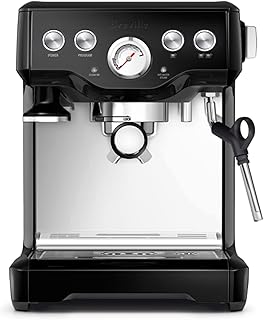
Quick Specs: 1,600W Thermocoil with PID temperature control (sequential brew/steam) | 54mm Breville-pattern stainless portafilter (single-wall & dual-wall baskets) | Manual articulated steam wand + dedicated hot-water spout | 120V/60Hz, 1,600W (NEMA 5-15P) | 61 fl oz (1.8 L) tank | ~12.5 in W × 10.2 in D × 13.2 in H | Price Tier: $200–$500
Audit Score: 8.7 / 10
- Thermal & Pressure Stability (35%): 8.9 / 10
- Build & Serviceability (25%): 8.8 / 10
- Steam Power & Workflow (20%): 8.4 / 10
- Value (20%): 8.6 / 10
Before Breville introduced the compact Bambino series, the Breville Infuser served as the dedicated espresso-only chassis of the Barista Express—and for hands-on baristas who want tactile analog feedback, it remains deeply relevant. Per Breville USA’s official BES840 documentation, the 1,600W stainless-steel thermocoil pairs digital PID temperature regulation (adjustable in small increments around its factory target) with gentle low-pressure pre-infusion, programmable 1-cup/2-cup volumetric buttons, and a three-way solenoid valve.
What separates the Infuser from the Bambino Plus is its front-mounted extraction pressure gauge and dedicated hot-water spout. Watching the needle climb into the optimal ~9 bar zone gives immediate visual confirmation while dialing an external burr grinder, and the hot-water outlet pours Americanos without running water through the group head. The trade-off is physical size and transition speed: at 12.5 inches wide, it occupies more bench width and takes longer to heat and switch to steam than ThermoJet rigs.
Buyer Verification Alert: Confirm the listing states 120V North American BES840BSXL (Black Sesame) or BES840XL and includes Breville’s four 54mm baskets (1-cup and 2-cup in both single-wall and dual-wall designs).
Pros
- Front analog brew pressure gauge makes external grinder dial-in immediately intuitive for visual learners
- Dedicated hot-water spout simplifies Americano prep and pre-warming ceramic espresso cups
- PID thermocoil allows slight temperature nudges plus three-way solenoid puck drying and Claro Swiss filter support
Cons
- Slower thermocoil startup and ~30–45 second steam transition than 3-second ThermoJet machines
- Wide 12.5-inch stainless footprint claims as much space as an all-in-one without including a built-in grinder
- Requires an espresso-capable external burr grinder to unlock single-wall 54mm basket extraction
Verdict: Buy it if you already own a capable espresso burr grinder and prefer a heavier stainless chassis, analog pressure needle, and dedicated hot-water tap over auto-frothing. Skip it if counter width is tight or you want instant three-second mornings. Add a 53.3mm/54mm metal tamper and replace Breville tank filters every two to three months.
5. De’Longhi Dedica Arte (EC885M) — Best Slim Manual Steamer Under $500

Quick Specs: Thermoblock with 3 temperature settings (sequential brew/steam) | 51mm De’Longhi portafilter (pressurized + single-wall per US kit) + metal tamper | Manual My LatteArt steam wand | 120V/60Hz, 1,300W–1,450W (NEMA 5-15P) | 35 fl oz (1.1 L) rear tank | 5.9 in W × 13.0 in D × 12.0 in H | Price Tier: $200–$500
Audit Score: 8.5 / 10
- Thermal & Pressure Stability (35%): 8.2 / 10
- Build & Serviceability (25%): 8.3 / 10
- Steam Power & Workflow (20%): 8.6 / 10
- Value (20%): 8.9 / 10
When apartment galley kitchens leave barely half a foot beside a toaster or grinder, the 5.9-inch-wide De’Longhi Dedica Arte EC885M solves spatial constraints few machines can touch. Unlike older Dedica EC680/EC685 units fitted with stubby plastic panarello frothing sleeves, the EC885M upgrades to De’Longhi’s commercial-style manual My LatteArt steam wand, packs a real metal tamper and milk pitcher in the box, and adds three selectable brew temperature levels per De’Longhi US official manuals.
In workflow terms, the Dedica Arte hits brew temperature rapidly via its compact thermoblock and handles single daily milk drinks smoothly, though its lack of a three-way solenoid valve means you should wait several seconds after pulling a shot before unlocking the 51mm portafilter so excess water drains cleanly. Compared with the De’Longhi Dedica Maestro Plus (EC950M), the Arte is over two inches narrower and gives hands-on baristas full manual steam control, while trading away the Maestro Plus’s 54 oz tank and automated frothing.
Buyer Verification Alert: Under CR-ESP-ACC-01 and CR-ESP-ACC-13, confirm the exact US basket contents in your EC885M box and verify whether an aftermarket 51mm bottomless portafilter lists 2-ear or 3-ear Dedica compatibility before purchasing.
Pros
- Ultra-narrow 5.9-inch stainless chassis fits cramped apartments alongside a compact burr grinder
- Manual My LatteArt steam wand enables genuine microfoam rolling rather than coarse bubble foam
- Three temperature presets and included metal tamper elevate consistency over bare-bones sub-$200 pumps
Cons
- No three-way solenoid valve leaves wet pucks that require pausing before portafilter removal
- Compact 35 fl oz (1.1 L) reservoir and narrow drip tray limit both tank intervals and large scale fit
- Requires an espresso-capable external burr grinder when upgrading to unpressurized 51mm baskets
Verdict: Buy it if counter width is your #1 constraint and you enjoy learning manual steam control on a budget. Skip it if you want dry solenoid pucks, automatic milk frothing, or 54mm/58mm baskets. Pair it with a narrow mini 0.1 g espresso scale that seats cleanly on its slim drip tray.
6. HiBREW H10Plus Programmable 58mm Espresso Machine — Best Feature-Packed 58mm PID Value

Quick Specs: Thermoblock/thermocoil with dual PID control + cold-shot mode (sequential brew/steam) | 58mm stainless portafilter | Three-way solenoid valve, shot timer, pressure gauge & programmable cup volume | 120V/60Hz, 1,350W–1,450W (NEMA 5-15P) | 61 fl oz (1.8 L) tank | Price Tier: $200–$500
Audit Score: 8.5 / 10
- Thermal & Pressure Stability (35%): 8.5 / 10
- Build & Serviceability (25%): 8.1 / 10
- Steam Power & Workflow (20%): 8.4 / 10
- Value (20%): 9.1 / 10
HiBREW’s H10Plus packs an unusually deep feature checklist into the sub-$500 bracket for shoppers who want commercial 58mm basket geometry without sacrificing digital telemetry. Building on HiBREW’s official 58mm H10 series platform, the H10Plus upgrades from the base H10/H10A with a crucial three-way solenoid valve for clean puck release, a refined heating system for steadier thermal delivery, selectable pressure profiles, and a built-in shot timer paired with an analog pressure gauge.
Adjustable brew temperature lets users tailor extraction heat across medium, dark, or cold-extraction profiles (~25 °C), while the 61 fl oz (1.8 L) removable water tank cuts down frequent refills. Against the #2 Turin Legato V2, the H10Plus relies on a sequential single thermoblock rather than a dedicated 550 ml brew boiler plus steam thermoblock, so back-to-back milk drinks take longer and long-term thermal mass is lighter. Still, for single-user 58mm experimentation at a friendlier tier, it punches well above typical department-store machines.
Buyer Verification Alert: Confirm the Amazon US listing explicitly states 110–120V / 60Hz North American power (HiBREW sells 220–240V international SKUs globally), and verify HiBREW-specific 58mm ear thickness before ordering aftermarket E61 portafilters.
Pros
- Adds a three-way solenoid valve, cold-shot mode, and improved steam wand over earlier H10 revisions
- Digital PID temperature tuning, live shot timer, and pressure gauge aid diagnostic espresso dialing
- 58mm stainless portafilter and 61 fl oz (1.8 L) reservoir simplify daily workflow
Cons
- Sequential thermoblock pauses between extraction and steaming, slowing multi-guest latte rounds
- US parts distribution and warranty support lag behind established brands like Breville and KitchenAid
- 58mm single-wall baskets require pairing with a capable espresso burr grinder to prevent channeling
Verdict: Buy it if you want programmable PID temperature, a shot timer, solenoid puck relief, and 58mm baskets without paying for a hybrid boiler. Skip it if you want heavy cast-metal longevity or domestic big-box service centers. Add a 58mm WDT tool and dosing funnel alongside an entry espresso grinder.
7. De’Longhi Dedica Maestro Plus (EC950M) — Best Compact Auto-Steam Under $500

Quick Specs: Thermoblock with Active Temperature Control (3 temperature levels; sequential brew/steam) | 51mm 3-ear stainless portafilter (single-wall & dual-wall baskets) | Auto LatteArt hands-free steam wand (3 milk temps & 3 foam textures) | 120V/60Hz, 1,450W (NEMA 5-15P) | 54 fl oz (1.6 L) tank | ~8.15 in W × 13.6 in D × 12.9 in H | Price Tier: $200–$500
Audit Score: 8.4 / 10
- Thermal & Pressure Stability (35%): 8.3 / 10
- Build & Serviceability (25%): 8.1 / 10
- Steam Power & Workflow (20%): 8.8 / 10
- Value (20%): 8.6 / 10
The De’Longhi Dedica Maestro Plus (EC950M) bridges the gap between basic manual thermoblocks and pricier automated milk systems. Carrying a 1,450W North American thermoblock with Active Temperature Control and three selectable infusion temperature profiles, it upgrades substantially over the narrow Dedica Arte by adding a 54 fl oz (1.6 L) reservoir and De’Longhi’s Auto LatteArt steam wand, which senses pitcher heat and texts milk hands-free across three foam densities and three temperature settings.
North American buyers also receive both pressurized and single-wall 51mm baskets alongside a stainless tamper, allowing you to start with pre-ground coffee temporarily and step up to burr-ground espresso later without buying extra OEM baskets. Compared directly against the #1 Breville Bambino Plus, the Dedica Maestro Plus often undercuts Breville’s tier pricing while clearing tall 5-inch mugs under its spouts, though Breville retains faster three-second ThermoJet startup, a dry-puck three-way solenoid valve, and deeper 54mm aftermarket support.
Buyer Verification Alert: The EC950M uses a 51mm 3-ear portafilter lug pattern matching De’Longhi’s La Specialista family—older 2-ear 51mm Stilosa or Dedica EC685/EC885 aftermarket portafilters will not lock into this group head.
Pros
- Auto LatteArt steam wand automates milk temperature and texture reliably for hands-free morning lattes
- Large 54 fl oz (1.6 L) tank and 5-inch under-spout cup clearance accommodate tall travel mugs
- Ships with both pressurized and single-wall 51mm baskets plus weighted stainless tamper
Cons
- Omits a three-way solenoid valve, leaving wet coffee pucks that drip slightly if removed immediately
- 51mm 3-ear lug standard offers narrower precision basket choices than 54mm or 58mm ecosystems
- Sequential thermoblock heating adds brief waiting between brewing and steaming for back-to-back drinks
Verdict: Buy it if you want automatic hands-free milk texturing and tall-cup clearance in a sleek stainless footprint while leaving room in your budget for an external grinder. Skip it if you want a three-way solenoid valve or instant three-second startup. Wipe and purge the Auto LatteArt wand immediately after every milk drink and descale strictly with EcoDecalk per De’Longhi’s manual.
8. KitchenAid Metal Semi-Automatic (KES6503) — Best Metal-Clad 58mm Classic

Quick Specs: Fast-heating Thermocoil with Dual Smart Temperature Sensors (sequential brew/steam) | Commercial-grade 58mm flat-base portafilter | Manual steam & hot-water wand | Die-cast metal housing | 120V/60Hz, 1,460W (NEMA 5-15P) | ~47 fl oz (1.4 L) tank | ~6.4 in W × 13.2 in D × 15.6 in H | Price Tier: $200–$500
Audit Score: 8.3 / 10
- Thermal & Pressure Stability (35%): 8.3 / 10
- Build & Serviceability (25%): 8.7 / 10
- Steam Power & Workflow (20%): 8.1 / 10
- Value (20%): 8.1 / 10
Most slim machines under $500 rely on 51mm or 54mm handles wrapped in thin sheet metal or plastic cladding, which makes the KitchenAid Metal Semi-Automatic (KES6503) stand out immediately on the bench. Measuring roughly 6.4 inches wide, its die-cast metal chassis houses a 1,460W thermocoil regulated by Dual Smart Temperature Sensors that reach brew readiness in under 40 seconds while keeping exterior build rigidity high.
Its most practical ergonomic touch is the flat-base, recessed-spout 58mm portafilter, which rests level on any kitchen counter so you can tamp straight down without balancing spouts on a counter edge. Compared with the #2 Turin Legato V2 and #6 HiBREW H10Plus, the KitchenAid KES6503 omits digital PID degree readouts, shot timers, and an external pressure gauge, targeting households that value clean aesthetic integration and major US appliance support over granular shot telemetry.
Buyer Verification Alert: Check the Amazon variant selector carefully before ordering—KitchenAid sells the standalone KES6503 machine alongside grinder bundles (KES6503SX) and automatic milk-frother bundles under closely related listings.
Pros
- Flat-bottom recessed-spout 58mm portafilter rests level on countertops for stable, wobble-free tamping
- Solid die-cast metal construction in a slim ~6.4-inch width resists tipping and feels substantial
- Dual smart temperature sensors and ~40-second thermocoil warm-up keep operation straightforward
Cons
- Lacks a digital PID readout, shot timer, pressure gauge, and programmable pre-infusion menus
- Sequential thermocoil and 47 fl oz (1.4 L) tank slow down multi-drink entertaining
- Requires purchasing a separate espresso burr grinder to unlock single-wall 58mm extraction
Verdict: Buy it if you want die-cast metal durability, a narrow counter profile, and a flat-base 58mm portafilter backed by mainstream US appliance distribution. Skip it if you want PID degree tuning, a three-way solenoid valve, or faster steam recovery. Pair it with a 58.5mm calibrated tamper and an espresso-rated burr grinder.
9. HiBREW H10 Customizable 58mm Espresso Machine — Best 58mm Pick Under $200

Quick Specs: Thermoblock (~5-second brew-to-steam transition; sequential) | 58mm portafilter with one-touch pressure release | Manual steam wand + auto backflush cycle | 120V/60Hz (NEMA 5-15P) | 61 fl oz (1.8 L) removable water tank | Price Tier: Under $200
Audit Score: 8.1 / 10
- Thermal & Pressure Stability (35%): 7.8 / 10
- Build & Serviceability (25%): 7.8 / 10
- Steam Power & Workflow (20%): 8.0 / 10
- Value (20%): 9.1 / 10
Most espresso makers sitting under $200 lock buyers into small 51mm pressurized-only portafilters with bare-bones plastic housings. The HiBREW H10 Customizable 58mm breaks that pattern by bringing a commercial-diameter 58mm portafilter, a generous 61 fl oz (1.8 L) tank, one-touch pressure release, and an automatic backflush cleaning cycle into the entry tier—freeing up real budget headroom for the component that impacts cup flavor most: your grinder.
Under CR-GRD-ESP-01 and CR-SYS-01, pairing an honest sub-$200 58mm machine with an espresso-capable burr grinder under $200 routinely produces sweeter, cleaner espresso than spending around $500 on a machine and feeding it pre-ground supermarket coffee. Compared with the pricier #6 HiBREW H10Plus, this entry H10 drops the digital PID telemetry screen, analog pressure gauge, and upgraded thermocoil heating stability, making it a pragmatic stepping stone rather than a forever prosumer rig.
Buyer Verification Alert: Confirm the selected Amazon US variant lists 120V/60Hz North American power and check whether single-wall and pressurized 58mm baskets are both included in the carton before checking out.
Pros
- Rare 58mm portafilter architecture available under $200, preserving budget for a real burr grinder
- One-touch pressure release and built-in automatic backflush cycle simplify daily cleanup
- Large 61 fl oz (1.8 L) water tank minimizes constant refills compared with 35 oz budget competitors
Cons
- Omits the dual PID display, extraction pressure gauge, and upgraded thermocoil of the H10Plus
- Lighter entry-grade chassis and limited US repair network compared with Breville or De’Longhi
- Requires an espresso-rated burr grinder to brew reliably in 58mm single-wall baskets
Verdict: Buy it if your total hardware budget must cover both machine and grinder while still putting a 58mm portafilter on your counter. Skip it if you want PID temperature control, heavy metal construction, or long-term domestic appliance service. Put the savings straight into an espresso-capable burr grinder and 0.1 g scale.
Buying Guide: How to Choose the Best Espresso Machine Under $500
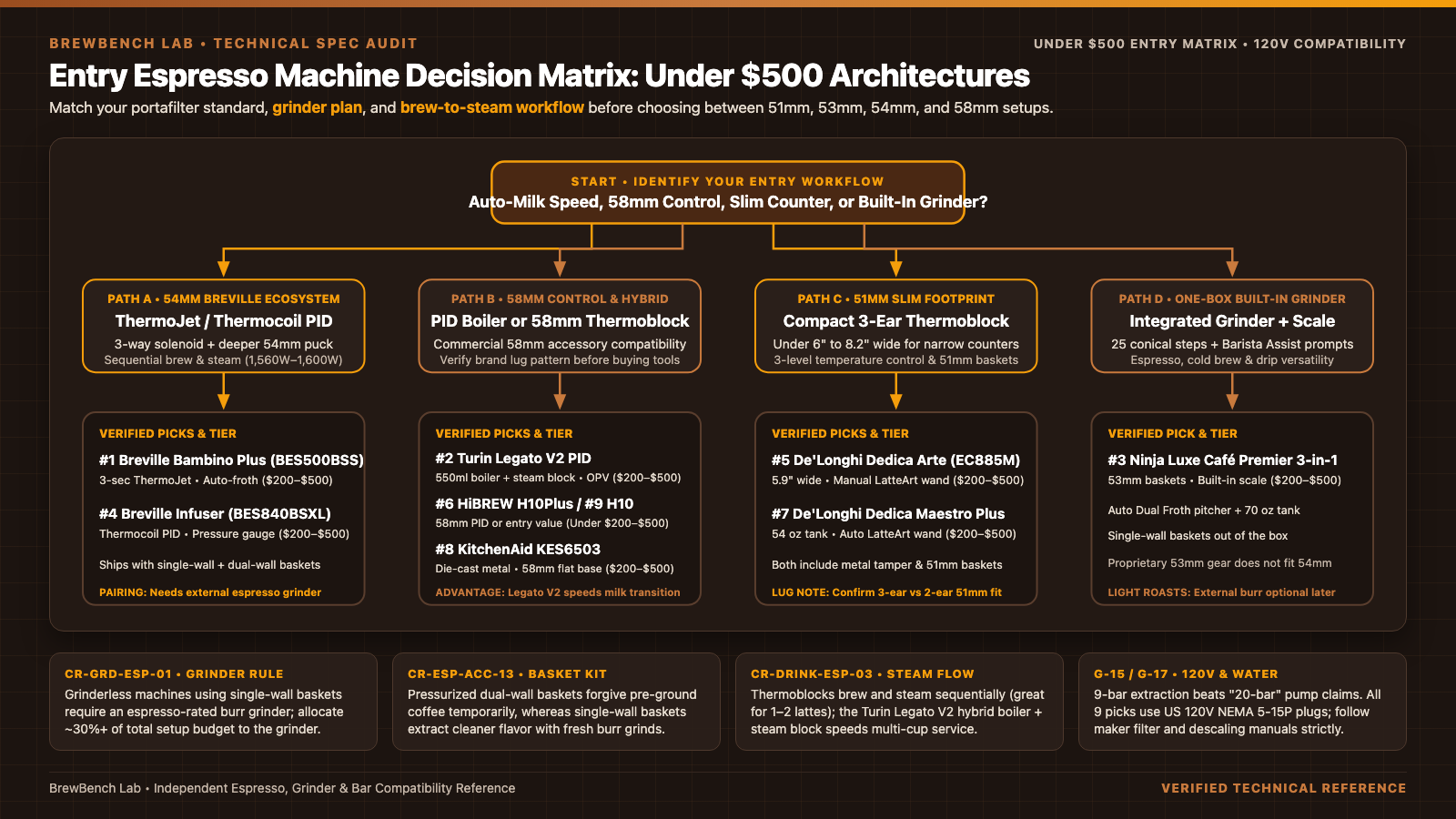
Selecting the best espresso machine under $500 requires looking past glossy exterior panels and marketing bar numbers. Use the technical checkpoints below to verify how your machine handles heat, extraction pressure, grinder pairing, portafilter sizing, North American 120V power, and water care.
1. Heating Architecture & Sequential vs. Simultaneous Steam (CR-DRINK-ESP-03)
Nearly every machine under $500 uses an on-demand thermoblock, ThermoJet, or thermocoil element that heats water as it passes through metal channels. That design delivers rapid startup—from roughly three seconds on the Breville Bambino Plus to around 40 seconds on the Breville Infuser or KitchenAid KES6503—but enforces sequential workflow: you extract espresso first, then wait as the heater climbs to steam temperature before frothing milk. For one or two daily lattes, sequential heating is quick and energy-efficient.
If you routinely make three or four milk drinks back-to-back, waiting through repeated brew-to-steam cycles grows tedious under CR-DRINK-ESP-03. That is why the Turin Legato V2 ranks so highly here: pairing a dedicated 550 ml stainless-steel PID brew boiler with an independent steam thermoblock cuts recovery delays dramatically without requiring a dual-boiler chassis over $1,000.
2. Pump Bar Ratings vs. ~9 Bar Brew Pressure & Solenoid Valves
Do not rank machines by “15-bar” or “20-bar” pump badges. Those labels measure the maximum dead-head rating of a commodity vibration pump when flow is completely blocked, not optimal extraction pressure. Espresso is conventionally brewed near ~9 bar at the coffee puck, regulated by an over-pressure valve (OPV) like the externally tunable valve on the Turin Legato V2 or electronic regulation inside Breville machines.
Just as important for daily counter cleanup is a three-way solenoid valve. Machines equipped with one—including the Breville Bambino Plus, Breville Infuser, Turin Legato V2, Ninja Luxe Café Premier, and HiBREW H10Plus—vent residual pressure into the drip tray the instant extraction ends, leaving dry, knockable pucks. Machines without one (such as the De’Longhi Dedica Arte and Dedica Maestro Plus) require pausing a few seconds before unlocking the portafilter to avoid messy soupy drips.
3. Portafilter Standards (51mm–58mm) & Single-Wall vs. Pressurized Baskets (CR-ESP-ACC-13)
Portafilter diameter dictates both puck geometry and every future accessory purchase. Yet diameter alone never guarantees accessory fit because locking ears (lugs) vary across brands:
- 58mm Commercial Standard (Turin Legato V2, HiBREW H10Plus, HiBREW H10, KitchenAid KES6503): Accepts widely available 58mm precision baskets and 58.5mm tampers, though handle lug patterns still must match each brand’s group head.
- 54mm Breville Ecosystem (Bambino Plus, Infuser): Creates slightly deeper pucks that forgive minor dosing variations and enjoys broad third-party support for 53.3mm/54mm calibrated tampers, funnels, and bottomless handles.
- 53mm Proprietary (Ninja Luxe Café Premier): Engineered specifically for Ninja’s Barista Assist baskets; incompatible with 54mm Breville tools.
- 51mm De’Longhi (Dedica Arte, Dedica Maestro Plus): Enables ultra-narrow machine widths; always confirm 2-ear vs. 3-ear lug compatibility before buying aftermarket handles.
Under compatibility rule CR-ESP-ACC-13, pay close attention to supplied basket walls. Pressurized (dual-wall) baskets force espresso through a single pinhole to manufacture crema from coarse pre-ground coffee, acting as helpful training wheels. Single-wall (non-pressurized) baskets rely purely on finely ground coffee puck resistance for richer sweetness and clarity—and unlocking them requires pairing grinderless machines with an espresso-capable burr grinder.
4. Mandatory Grinder Pairing Math (CR-GRD-ESP-01)
Unless you choose an integrated-grinder machine like the Ninja Luxe Café Premier, the espresso machine itself is only half of your extraction system. Under rule CR-GRD-ESP-01, filter-only grinders (such as the standard non-ESP Baratza Encore, Fellow Ode Gen 2, or any blade grinder) cannot grind fine or consistently enough for single-wall baskets—shots will gush in seconds and taste sharply sour.
Plan to allocate roughly a third or more of your total combined budget toward an espresso-rated burr grinder with fine micro-step or stepless adjustment. For proven sub-$200 options that pair cleanly with the Bambino Plus, Dedica Arte, or HiBREW H10, check our best espresso grinders under $200 audit and complete espresso setup under $700 guide.
5. US 120V Electrical Safety, NEMA Plugs & Cabinet Clearance
Every machine selected in this audit ships configured for 120V / 60Hz North American power using a standard three-prong NEMA 5-15P plug rated for 15-amp household receptacles (drawing between 1,300W and 1,650W). Never purchase cheaper 220–240V European or UK gray-market listings expecting step-up converters to match US timing or warranty coverage, and avoid running a 1,500W electric kettle or toaster simultaneously on the same 15-amp kitchen branch circuit while pulling shots. If you ever upgrade to a heavy 20-amp commercial appliance carrying a horizontal-blade NEMA 5-20P plug, hire a licensed electrician to install a proper 5-20R circuit—never force or adapt plugs.
Before ordering, measure the vertical gap beneath your kitchen wall cabinets (typically 18 inches / 457 mm above US countertops). Taller units like the Turin Legato V2 (14.6 inches) or KitchenAid KES6503 (15.6 inches) sit comfortably under standard cabinets during normal brewing, though top-fill reservoirs require pulling the machine slightly forward to pour water cleanly.
6. Water Chemistry & Manufacturer Descaling Rules
Mineral buildup silently ruins thermoblocks and boilers faster than mechanical wear. According to Specialty Coffee Association (SCA) water quality standards, balanced espresso water targets roughly 68 ppm (mg/L as CaCO3, about 4 grains per gallon) total hardness, ~40 ppm alkalinity, 75–250 ppm TDS, zero chlorine, and low chloride (<30 ppm) to limit metal corrosion.
Never run un-remineralized pure distilled or zero-TDS reverse osmosis water in boiler-equipped machines with conductive level sensors, as sensors need trace minerals to read water height accurately. Use manufacturer-matched reservoir filters (cartridges are brand- and shape-locked) or properly remineralized water recipes, and descale strictly with the chemical formula and schedule specified in your machine’s US owner’s manual—never improvise DIY vinegar or unapproved citric-acid ratios that can etch internal aluminum or brass components.
7. Upgrade Roadmap & Hidden Ownership Costs
Set aside modest post-purchase room in your budget for four essentials that directly improve shot consistency and hardware longevity:
- Espresso Burr Grinder (Grinderless Picks): Budget around $150–$200 for an entry espresso-rated conical or hand burr grinder if buying the Bambino Plus, Infuser, Legato V2, Dedica, KitchenAid, or HiBREW.
- 0.1 g Digital Espresso Scale: Measuring exact bean weight in and liquid yield out (typically a 1:2 starting ratio) stabilizes extraction far faster than guessing cup volume; choose a mini scale narrow enough for 51mm drip trays if buying a Dedica.
- Sized Metal Tamper & WDT Tool: Match tamper diameter precisely to your basket (51mm, 53.3mm/54mm, or 58.5mm) and break up clumps with fine WDT needles before tamping.
- Ongoing Consumables: Factor in shape-matched reservoir filters every two to three months, backflush tablets for three-way solenoid units, maker-approved descaling solution, and yearly silicone group gaskets.
8. Secondary Intent Resolver: Thermoblock vs. Hybrid Boiler & Built-In vs. Separate Grinder
Still torn between architecture paths under $500? Use these two quick tie-breakers:
- Compact ThermoJet vs. Hybrid Boiler: Choose the Breville Bambino Plus if three-second heat-up, automated microfoam, and narrow 7.7-inch counter space define your weekday routine. Choose the Turin Legato V2 if you prioritize manual dual-PID temperature control, 58mm precision baskets, and pulling multiple milk drinks with minimal boiler delay.
- All-in-One Machine vs. Separate Grinder + Machine: Choose the Ninja Luxe Café Premier if your total budget is capped under $500 for your entire coffee bar and you want weight-based dosing plus cold brew out of the box. Choose a grinderless machine like the Bambino Plus or HiBREW H10 paired with a separate burr grinder if you plan to explore light roasts or upgrade either piece independently later.
Methodology, Weighted Scoring Rubric & Excluded Models
Every score and rank in this roundup is anchored to a structured 120V technical specification and compatibility audit conducted by Daniel Park and the BrewBench Lab editorial team—zero paid placements and zero fabricated lab curves. We cross-verify North American voltage and NEMA 5-15P wattage ratings, heating topology, portafilter lug geometry, supplied single-wall vs. pressurized basket kits, three-way solenoid inclusion, and manufacturer warranty/descaling terms across active Amazon US inventory. Two models per brand appears as our maximum ceiling here (two Breville, two De’Longhi, two HiBREW) alongside Turin, Ninja, and KitchenAid so distinct heating and portafilter tiers receive fair coverage. Full standards are published on our Editorial Evaluation Methodology page.
| Evaluation Criterion | Weight | What We Audited |
|---|---|---|
| Thermal & Pressure Stability | 35% | Heating architecture (ThermoJet, thermocoil, thermoblock, or hybrid boiler), PID temperature regulation, pre-infusion, and ~9 bar OPV regulation. |
| Build & Serviceability | 25% | Portafilter lug ecosystem (51mm/53mm/54mm/58mm), chassis metallurgy, three-way solenoid valve inclusion, and US parts/warranty support. |
| Steam Power & Workflow | 20% | Brew-to-steam transition speed, sequential vs. hybrid steam operation, manual vs. automatic texturing, tank size, and cup clearance. |
| Value | 20% | Hardware capability within the sub-$500 bracket, included single-wall vs. pressurized baskets, and required external grinder outlay. |
Models We Audited & Excluded
Models We Audited & Excluded (And Why)
- Lelit Anna (PL41TEM) & Profitec GO: Disqualified as Amazon buy-intent picks because Lelit and Profitec sell strictly through off-Amazon specialty espresso dealers without official Amazon US fulfillment (and generally sit above $500).
- Flair 58: Excluded both for lacking primary official Amazon US retail coverage and because a boilerless manual lever setup forces buyers to budget separately for a temperature-controlled kettle and standalone milk frother.
- 230V / 50Hz European & UK Gray-Market Imports: Excluded under North American 120V electrical compliance rules—230V units require bulky step-up transformers, ship with incompatible plugs, and forfeit US manufacturer warranty coverage.
- Generic Sub-$100 “20-Bar” Pressurized-Only Machines: Disqualified because 20-bar marketing specs exaggerate dead-head pump pressure while pressurized-only baskets prevent progressing to real single-wall espresso extraction.
- Filter-Only Grinders Paired With Single-Wall Baskets (CR-GRD-ESP-01): Explicitly flagged as an incompatible pairing—grinders lacking fine espresso step resolution (like the standard Baratza Encore non-ESP or stock Fellow Ode Gen 2) fail to choke single-wall baskets.
Authoritative Manufacturer & Technical References
- Breville USA — Bambino Plus (BES500) Official Specifications (ThermoJet 3-second readiness, 54mm kit, 1.9 L tank, auto-froth)
- Breville USA — Infuser (BES840) Official Specifications (1,600W Thermocoil PID, pressure gauge, 1.8 L reservoir, 54mm portafilter)
- De’Longhi US — Official Product Manuals Portal (120V/60Hz specs, 51mm basket kits, EcoDecalk descaling procedures)
- Turin Grinders — Official Espresso Hardware Portal (Legato V2 550 ml boiler + steam thermoblock, dual PID, adjustable OPV)
- HiBREW — Official Specifications Portal (58mm H10 series portafilter hardware, PID range, and 120V configurations)
- Specialty Coffee Association (SCA) — Coffee & Water Quality Standards (hardness, alkalinity, TDS, and chloride thresholds)
Frequently Asked Questions: Best Espresso Machine Under $500
What is the best espresso machine under $500 for most buyers?
The Breville Bambino Plus (BES500BSS) is the strongest overall choice under $500 when paired with an external espresso grinder because it combines 3-second ThermoJet startup, a three-way solenoid valve, and automatic or manual microfoam. For commercial 58mm tuning and faster multi-drink steaming, choose the Turin Legato V2.
Do I need a separate coffee grinder with a sub-$500 espresso machine?
Yes whenever you brew with a single-wall (non-pressurized) basket on a grinderless machine. Pressurized dual-wall baskets work temporarily with pre-ground coffee, whereas single-wall baskets require an espresso-rated burr grinder to build puck resistance. If you want one integrated box, pick the Ninja Luxe Café Premier.
Does a 20-bar pump make better espresso than a 15-bar machine under $500?
No—15-bar and 20-bar labels describe a vibration pump’s maximum dead-head ceiling, not optimal extraction pressure. Quality espresso brews near 9 bar at the coffee puck via an over-pressure valve (OPV). Temperature stability, basket type, and grind consistency matter far more than marketing bar numbers.
Should I pick a 51mm, 54mm, or 58mm portafilter machine under $500?
Choose 58mm (Turin Legato V2, HiBREW H10Plus, KitchenAid KES6503) for standard cafe-width precision baskets, verifying brand lug ears first. Choose Breville 54mm (Bambino Plus, Infuser) for deeper, forgiving pucks and broad accessory support, or 51mm (De’Longhi Dedica) when narrow apartment width comes first.
Can machines under $500 brew espresso and steam milk at the same time?
Most machines under $500—including Breville ThermoJet, De’Longhi Dedica, and KitchenAid thermocoil models—operate sequentially, brewing espresso first and steaming milk second. The standout exception is the Turin Legato V2, which pairs a 550 ml brew boiler with a dedicated steam thermoblock for rapid hybrid workflow.
Can I use pure distilled water in an espresso machine under $500?
No—avoid un-remineralized distilled water in espresso boilers and sensor-equipped tanks because ultra-low mineral content can disrupt conductive level probes and produce flat extraction. Use manufacturer tank filter cartridges or SCA-balanced remineralized water, and descale strictly according to your owner’s manual.
Final Verdict: Choosing the Best Espresso Machine Under $500
Picking the best espresso machine under $500 starts with matching your grinder plan and milk-drink routine to the right architecture. For most households pairing a separate espresso burr grinder, the Breville Bambino Plus (BES500BSS) takes #1 overall with three-second ThermoJet startup, dry solenoid pucks, and effortless auto-froth microfoam. Enthusiasts chasing commercial 58mm accessories, dual-PID control, and fast multi-latte steaming should step directly to the Turin Legato V2 PID, while buyers wanting everything in one countertop box get weight-based dosing and single-wall baskets in the Ninja Luxe Café Premier 3-in-1. Need a narrower 5.9-inch body or stricter budget? Choose the De’Longhi Dedica Arte or HiBREW H10 58mm and invest the leftover cash into your grinder.


