
Disclosure: As an Amazon Associate, I earn from qualifying purchases. If you buy through links on this page, we may earn a small commission at no extra cost to you.
Finding the best espresso grinder under $200 is the single smartest step you can take before spending extra money on a fancier espresso machine. When you brew with a non-pressurized single-wall basket, the finely ground coffee puck creates roughly nine bars of extraction resistance—meaning a coarse or uneven grind triggers immediate channeling, sour shots, or ten-second gushers regardless of pump pressure marketing.
To identify which entry grinders genuinely dial in espresso on a tight budget, we audited nine distinct electric, cordless, and manual models actively stocked on Amazon US under $200. Whether you are building a complete espresso setup under $700 or stepping up from our best espresso grinders hub, every pick below passes maker-verified espresso capability (CR-GRD-ESP-01) and North American 120V/60Hz or manual compatibility checks.
In This Guide
- Quick Picks: Best Espresso Grinder Under $200 at a Glance
- Side-by-Side Comparison of All 9 Audited Grinders
- Match Your Use Case: Entry Setup & Workflow Guide
- Detailed Entry Grinder Audits (Ranks #1–#9)
- #1 Baratza Encore ESP (ZCG495BLK) — Best Overall Under $200
- #2 Fellow Opus 2 — Best Stepless Electric Under $200
- #3 1Zpresso J-Ultra — Best Espresso Hand Grinder
- #4 Breville Smart Grinder Pro — Best Cradle & Timed Grinder
- #5 KINGrinder K6 — Best Value All-Purpose Hand Grinder
- #6 64mm Flat Burr Grinder — Best Budget 64mm Flat-Burr Option
- #7 46mm Bellows Grinder — Best Low-Retention Bellows Single-Doser
- #8 Femobook A2 — Best Cordless USB-C Electric Grinder
- #9 KINGrinder K1 — Best Sub-$100 Entry Hand Grinder
- Buying Guide: Choosing an Espresso Grinder Under $200
- Scoring Methodology & Models We Excluded
- Frequently Asked Questions
- Final Verdict
Quick Picks: Best Espresso Grinder Under $200 at a Glance
#1 Best Overall Under $200
Baratza Encore ESP (ZCG495BLK)
40 mm M2 conical burrs with dedicated 1–20 espresso steps and 54/58 mm dosing cup support. (Jump to audit)
#2 Best Stepless Electric
Fellow Opus 2 Conical Burr
Upgraded 48 mm conical burrs, stepless side ring, ionizer, and compact 10.5-inch height. (Jump to audit)
#3 Best Espresso Hand Grinder
1Zpresso J-Ultra Manual
8 microns per click external ring and magnetic catch cup for quiet, high-precision espresso. (Jump to audit)
Side-by-Side Comparison: Best Espresso Grinder Under $200 Picks
| Product & Award | Best For | Burr & Adjustment | Dosing & Power | Link |
|---|---|---|---|---|
| Baratza Encore ESP Best Overall | First single-wall espresso + drip households | 40 mm M2 conical; 40 steps (1–20 espresso) | 300 g hopper + 54/58 mm cup; 70W (120V) | Check Price on Amazon |
| Fellow Opus 2 Best Stepless Electric | Low cabinets & stepless single-dosing | 48 mm steel conical; stepless side dial | 100 g auto-stop bin + magnetic cup; 300W (120V) | Check Price on Amazon |
| 1Zpresso J-Ultra Best Espresso Manual | Maximum espresso click precision | 48 mm Ti-coated conical; 8 μm/click ring | 35–40 g manual + magnetic cup; 0W (manual) | Check Price on Amazon |
| Breville Smart Grinder Pro Best Cradle Convenience | Hands-free 54/58 mm cradles & LCD timer | Stainless conical; 60 steps + upper burr | 450 g hopper + 0.2 s timer; 165W (110–120V) | Check Price on Amazon |
| KINGrinder K6 Best Value Manual | Daily espresso + pour-over switching | 48 mm heptagonal conical; 16 μm/click ring | 30–35 g manual + threaded cup; 0W (manual) | Check Price on Amazon |
| 64mm Flat Burr (100-Step) Best Budget 64mm Flat | Entry metal-body 64 mm flat-burr dialing | 64 mm SUS420 flat; 100 stepped settings | Single-dose + anti-static chute; 120V US | Check Price on Amazon |
| 46mm Bellows Grinder Best Bellows Single-Dose | Air-bellows purging under $200 | 46 mm high-carbon conical; 45 micro-steps | Single-dose + silicone bellows; 120V US | Check Price on Amazon |
| Femobook A2 Cordless Best Cordless Electric | Dorm counters, travel & outlet-free bars | 38 mm 7-core conical; 120+ clicks (~18 μm) | 35 g magnetic cup; dual 18650 USB-C | Check Price on Amazon |
| KINGrinder K1 Best Sub-$100 Manual | Starter espresso setups under $100 | 38 mm steel conical; ~18 μm/click internal | 20–25 g manual + dual bearings; 0W (manual) | Check Price on Amazon |
Match Your Use Case: Which Under-$200 Grinder Fits Your Bar?
| Buyer Scenario | Best Match | Why & Expected Outcome |
|---|---|---|
| First Single-Wall Espresso Setup + Drip Coffee | Baratza Encore ESP | Dedicated 1–20 steps choke 54 mm or 58 mm baskets while steps 21–40 pour drip cleanly without losing espresso calibration. |
| Stepless Dialing Under Low Kitchen Cabinets | Fellow Opus 2 | 10.5-inch height clears low trim while its stepless dial and built-in ionizer cut static clutter during daily single-dosing. |
| Maximum Precision on a Manual Budget | 1Zpresso J-Ultra | 8-micron external ring clicks match stepless electric control for classic straight espresso when you do not mind cranking by hand. |
| Hands-Free Portafilter Cradles for Family Milk Drinks | Breville Smart Grinder Pro | 0.2-second Dosing IQ timer and 54/58 mm cradles eliminate manual dose weighing for households pulling daily lattes. |
| Dual Pour-Over & Weekend Espresso Under $200 | KINGrinder K6 | External numbered 60-click ring moves quickly between pour-over clarity and 16-micron espresso settings at strong manual value. |
| Outlet-Free Travel, Dorm, or Tiny Countertop | Femobook A2 Cordless | USB-C replaceable 18650 batteries and 120+ clicks automate single-dose grinding in a 2.36-inch footprint. |
Detailed Entry Espresso Grinder Audits (Ranks #1–#9)
1. Baratza Encore ESP Coffee Grinder ZCG495BLK — Best Overall Espresso Grinder Under $200

Quick Specs: 40 mm M2 hardened steel conical burrs | 40 stepped settings (1–20 dedicated espresso, 21–40 filter) | 300 g hopper + 54/58 mm dosing cup + 120–142 g bin | 70W (120V/60Hz NEMA 5-15P) | 5.1 x 6.3 x 13.8 in (130 x 160 x 350 mm), 7.0 lbs | Price Tier: Entry-level (between $100 and $200)
Audit Score: 9.1 / 10
- Espresso Dialing Resolution & Burr Capability (35%): 8.9 / 10
- Retention, Dosing Workflow & Static Control (25%): 9.0 / 10
- Build Quality, Footprint & 120V/Manual Ergonomics (20%): 9.0 / 10
- Value Within Entry Tier & Upgrade Path (20%): 9.5 / 10
Most entry grinders force an unhappy compromise between pour-over clarity and espresso resistance, yet the Baratza Encore ESP solves that split cleanly inside the under-$200 bracket. On the Baratza Encore ESP official US spec page, Baratza pairs 40 mm hardened steel M2 conical burrs with a dual-cam 40-step collar: settings 1 through 20 compress vertical burr travel into high-resolution micro-step intervals for single-wall espresso (CR-GRD-ESP-01), while settings 21 through 40 open rapidly for drip and French press. You also get both a standard grounds bin and a 54 mm dosing cup fitted with a 58 mm adapter ring, so it pairs directly with Breville Bambino baskets or 58 mm commercial portafilters (CR-GRD-ACC-01).
Drawing just 70 watts on a standard 120V/60Hz NEMA 5-15P outlet, the Encore ESP adds virtually zero electrical load when sharing a kitchen branch circuit with a thermoblock espresso machine (CR-ESP-SYS-02). Because settings 1–20 remain stepped rather than continuous, CR-GRD-ESP-03 still applies: if one click runs slightly quick and the next chokes your puck, fine-tune extraction speed by adding or subtracting 0.5 to 1 gram of coffee on a 0.1 g scale (CR-SCALE-GRD-01). Compared directly in our Baratza Encore ESP vs Fellow Opus breakdown and Baratza Encore ESP audit, the Encore ESP trails the newer Fellow Opus 2 (#2) on stepless resolution and anti-static ionizer polish, yet wins #1 overall for its generous 300 g hopper option, quick-release ring burr, and unmatched US spare-parts longevity.
Buyer Verification Alert: Confirm the exact SKU ZCG495BLK (Black) or ZCG495WHT (White) before ordering. The classic non-ESP Baratza Encore (ZCG485BLK) looks nearly identical in thumbnails but lacks the fine 1–20 espresso cam and fails CR-GRD-ESP-01.
Pros
- Settings 1–20 deliver true single-wall espresso dialing while 21–40 serve filter coffee
- Includes both a 54 mm / 58 mm espresso dosing cup and a batch grounds bin
- Low 70W 120V draw and tool-free quick-release upper ring burr simplify upkeep
- Industry-leading US replacement parts and burr availability from Baratza
Cons
- Stepped 1–20 clicks occasionally require 0.5–1 g dose tweaks for light or dense roasts
- Lightweight polycarbonate body lets gear noise carry across quiet kitchens
- Lacks an active anti-static ionizer and digital shot timer
Verdict: Buy it if you want the safest, most repairable all-around electric grinder under $200 for a Breville Bambino or 58 mm starter machine. Skip it if you insist on stepless adjustment without dose tweaks or low-height clearance under 11 inches. Pair it with a 0.1 g coffee scale for repeatable single-dosing.
2. Fellow Opus 2 Conical Burr Grinder — Best Stepless Electric Grinder Under $200

Quick Specs: 48 mm stainless steel conical burrs | Stepless external side dial | 100 g auto-stop single-dose bin + 30 g magnetic 54/58 mm cup + ionizer | 300W (120V/60Hz) | 8.1 x 5.1 x 10.5 in (206 x 130 x 267 mm), 5.1 lbs | Price Tier: Entry-level (between $100 and $200)
Audit Score: 9.0 / 10
- Espresso Dialing Resolution & Burr Capability (35%): 9.2 / 10
- Retention, Dosing Workflow & Static Control (25%): 9.1 / 10
- Build Quality, Footprint & 120V/Manual Ergonomics (20%): 8.9 / 10
- Value Within Entry Tier & Upgrade Path (20%): 8.7 / 10
Where the original Fellow Opus forced baristas to reach inside the hopper for an awkward inner micro-ring, the redesigned Opus 2 removes that friction completely. Detailed on the Fellow Opus 2 official specification page, this second-generation burr grinder upgrades to larger 48 mm stainless steel conical burrs paired with a true stepless adjustment side dial spanning fine espresso to cold brew. Removing click detents eliminates the classic between-step dilemma (CR-GRD-ESP-03), letting you nudge shot times by two or three seconds smoothly without altering your dose weight.
Fellow built the Opus 2 explicitly around tidy single-dose countertop workflow (CR-GRD-02). Its 100 g load bin monitors bean completion with automatic shut-off, an integrated anti-static ionizer tames chaff scatter, and the magnetic 30 g espresso dosing cup includes adapters for both 54 mm and 58 mm portafilters (CR-GRD-ACC-01). Standing just 10.5 inches (267 mm) tall, it glides beneath low 18-inch US upper kitchen cabinets with over seven inches of pouring headroom (CR-GRD-SYS-01). Compared to the #1 Baratza Encore ESP, the Opus 2 offers smoother stepless espresso control and quieter, lower-static dosing, while Baratza counters with a larger 300 g hopper option and easier long-term gear/burr part replacements. Like all single-dosers, keep a 0.1 g scale beside it (CR-SCALE-GRD-01).
Buyer Verification Alert: Amazon search results still display both the older 40 mm Gen 1 Fellow Opus (B0BV96VPSR) and the upgraded 48 mm stepless Opus 2 (B0FPCHNSX2). Verify the 48 mm stepless Opus 2 ASIN before adding to cart.
Pros
- True stepless external side dial eliminates between-click espresso compromises
- 48 mm conical burrs and 300W motor handle dense espresso beans smoothly
- Built-in ionizer, auto-stop load bin, and magnetic 54/58 mm cup keep counters clean
- Low 10.5-inch height fits comfortably underneath cramped upper cabinets
Cons
- Proprietary 48 mm conical carrier cannot accept aftermarket 64 mm flat burrs (CR-GRD-01)
- 100 g load bin is geared for single-dosing rather than multi-day hopper storage
- Requires weighing every bean batch on an external 0.1 g scale
Verdict: Buy it if you want true stepless electric espresso dialing, low static, and a compact height under $200. Skip it if you prefer leaving half a pound of beans in a hopper or want Baratza’s long-running modular parts catalog. Add a 54 mm or 58 mm dosing funnel to streamline WDT distribution.
3. 1Zpresso J-Ultra Manual Coffee Grinder — Best Espresso-Focused Hand Grinder

Quick Specs: 48 mm titanium-coated conical burrs | External top ring (100 clicks/rotation, 8 microns/click per maker) | Manual single-dose (35–40 g capacity) + magnetic cup | 0W (manual) | ~2.2 x 7.1 in body (56 x 180 mm), 670 g (23.6 oz) | Price Tier: Entry-level (between $100 and $200)
Audit Score: 8.9 / 10
- Espresso Dialing Resolution & Burr Capability (35%): 9.5 / 10
- Retention, Dosing Workflow & Static Control (25%): 8.6 / 10
- Build Quality, Footprint & 120V/Manual Ergonomics (20%): 8.7 / 10
- Value Within Entry Tier & Upgrade Path (20%): 8.4 / 10
If motor noise, counter space, or budget keeps you away from large electric grinders, the 1Zpresso J-Ultra demonstrates why a purpose-built hand grinder dominates straight espresso precision under $200. According to 1Zpresso’s official J-Ultra specifications, its external numbered adjustment collar packs 100 clicks per full revolution at just 8 microns of vertical burr movement per click—half the step size of standard manual mills and tight enough to rival stepless electric units (CR-GRD-ESP-03). Inside, 48 mm titanium-coated conical burrs are tuned specifically by 1Zpresso for rich, syrupy espresso body (CR-GRD-ESP-01), discharging into a quick-release magnetic catch cup.
Zero electrical draw means zero outlet conflicts on shared 15-amp kitchen circuits (CR-ESP-SYS-02) and near-silent early-morning prep. Still, physical effort is real: grinding 18 grams of dense light-roast coffee at espresso fineness requires steady grip strength and roughly 35 to 50 seconds of cranking, making back-to-back shots for four guests tiring. Against the value-driven KINGrinder K6 (#5), the J-Ultra earns its rank with twice the click resolution (8 vs 16 microns) and faster magnetic cup detachment, while the K6 remains easier to switch between espresso and pour-over daily (CR-GRD-03). Read our dedicated best hand grinders for espresso guide if manual brewing fits your morning routine, and keep a 0.1 g scale handy (CR-SCALE-GRD-01).
Buyer Verification Alert: Confirm the Amazon title specifies J-Ultra (8 microns/click) rather than the all-purpose K-Ultra or filter-only ZP6 Special, which uses different burr geometry and fails CR-GRD-ESP-01 for single-wall espresso.
Pros
- 8 microns per click external dial matches stepless electric fine-tuning
- 48 mm titanium-coated conical burrs built specifically for espresso extraction
- Magnetic catch cup and foldable crank arm speed prep and storage
- Near-silent, zero-watt operation with negligible grind retention
Cons
- Fine espresso settings demand solid arm torque, especially on light roasts
- Slow workflow when pulling three or more consecutive drinks for guests
- Requires an external 0.1 g scale to weigh each manual dose
Verdict: Buy it if you pull one or two straight espresso shots daily and want the tightest dialing resolution under $200 without electric motor noise. Skip it if you entertain groups or dislike manual cranking. Pair with a 0.1 g scale and a portafilter dosing funnel.
4. Breville BCG820BSS Smart Grinder Pro — Best Portafilter Cradle & Timed Grinder

Quick Specs: Stainless steel conical burrs + adjustable upper burr | 60 stepped settings | 450 g (18 oz) hopper + 0.2 s Dosing IQ LCD timer + 50–54 mm & 58 mm cradles | 165W (110–120V/60Hz) | ~6.25 x 8.5 x 15.3 in (160 x 214 x 389 mm) | Price Tier: Entry-level band edge (around $200)
Audit Score: 8.6 / 10
- Espresso Dialing Resolution & Burr Capability (35%): 8.2 / 10
- Retention, Dosing Workflow & Static Control (25%): 8.8 / 10
- Build Quality, Footprint & 120V/Manual Ergonomics (20%): 8.7 / 10
- Value Within Entry Tier & Upgrade Path (20%): 8.8 / 10
Single-dosing is not for everyone—plenty of busy households prefer keeping beans inside a hopper and grinding straight into the portafilter at the touch of a switch. On the Breville Smart Grinder Pro official US spec page, Breville includes dedicated hands-free cradles for both 50–54 mm Breville portafilters and standard 58 mm portafilters (CR-GRD-ACC-01), paired with a backlit LCD showing 0.2-second Dosing IQ timer increments and shot counts. That makes repeating a medium-dark morning latte recipe effortless for multiple family members without weighing beans on a scale every time (CR-GRD-02).
The trade-off sits in fine step spacing and chute grind retention. Its 60 stepped settings span the entire range from Turkish to cold brew rather than concentrating 20 dedicated steps inside espresso like the Baratza Encore ESP (#1)—meaning single-wall dial-ins can occasionally feel one notch shy, though Breville’s internally adjustable upper burr lets you shift the entire calibration finer as burrs wear in. At 15.3 inches (389 mm) tall with the 450 g hopper installed, check clearance under standard 18-inch US upper cabinetry (CR-GRD-SYS-01) before placing it against a backsplash. It operates safely on standard 110–120V/60Hz NEMA 5-15P outlets at 165W.
Buyer Verification Alert: The Smart Grinder Pro sits right around $200 at the entry band edge on Amazon US, and listings split across colorways such as Brushed Stainless (BCG820BSS) and Pomodoro Red (BCG820PMR). Confirm 110–120V US voltage before checkout.
Pros
- Hands-free 50–54 mm and 58 mm portafilter cradles included in the box
- 0.2-second Dosing IQ LCD timer simplifies repeatable household milk-drink prep
- 450 g locking hopper removes cleanly for storage or bean swaps
- Adjustable upper burr extends fine calibration lifespan
Cons
- 60 full-range steps feel coarser inside single-wall espresso than Fellow Opus 2 or Encore ESP
- Horizontal hopper chute retains more older grounds unless purged after adjustments
- 15.3-inch height crowds tight under-cabinet spaces
Verdict: Buy it if hands-free 54 mm or 58 mm cradle grinding and a 0.2-second timed hopper suit your morning routine better than single-dose weighing. Skip it if you rotate light-roast single origins daily. Add a 54 mm or 58 mm magnetic dosing funnel to prevent grounds from spilling over the basket rim inside the cradle.
5. KINGrinder K6 Manual Coffee Grinder — Best Value Dual-Purpose Hand Grinder

Quick Specs: 48 mm heptagonal stainless steel conical burrs | External numbered ring (60 clicks/rotation, 16 microns/click per maker) | Manual single-dose (30–35 g capacity) + threaded aluminum cup | 0W (manual) | ~2.17 x 6.89 in (55 x 175 mm), 630 g (22.2 oz) | Price Tier: Entry-level (between $100 and $200)
Audit Score: 8.5 / 10
- Espresso Dialing Resolution & Burr Capability (35%): 8.4 / 10
- Retention, Dosing Workflow & Static Control (25%): 8.3 / 10
- Build Quality, Footprint & 120V/Manual Ergonomics (20%): 8.6 / 10
- Value Within Entry Tier & Upgrade Path (20%): 8.9 / 10
For home brewers splitting mornings between weekday pour-over and weekend single-wall espresso, the KINGrinder K6 delivers standout burr machining well under $200. Listed on the KINGrinder official product catalog, the K6 runs 48 mm seven-core heptagonal stainless steel burrs controlled by an exterior numbered ring moving 60 clicks per turn at 16 microns per click. Unlike internal bottom-dial hand grinders that make you count clicks back from zero every time you change brew methods, the K6’s visible exterior dial turns range switching into a five-second turn (CR-GRD-03).
Under CR-GRD-ESP-03, its 16-micron step spacing sits twice as wide as the 1Zpresso J-Ultra’s 8-micron ring (#3). On demanding single-wall espresso roasts, that means your target 28-second extraction can occasionally sit halfway between two clicks—a mild caveat easily solved by nudging bean weight up or down by 0.5 to 1 gram on a 0.1 g coffee scale (CR-SCALE-GRD-01). Its screw-on aluminum catch cup also adds a couple of extra twists compared to the J-Ultra’s magnetic cup. Even so, its dual-method versatility and machined metal rigidity easily outperform any sub-$100 electric mill on Amazon US.
Buyer Verification Alert: Check that the Amazon listing specifically carries the 48 mm K6 model (B0GKFDZ725) rather than smaller 38 mm travel models (such as the K1 or P0) if you want faster 48 mm burr crank speed.
Pros
- 48 mm heptagonal burrs produce crisp clarity for both pour-over and espresso
- External numbered 60-click ring simplifies daily brew-method switching
- CNC-machined aluminum body needs zero electricity or counter clearance
- High performance-per-dollar inside the $100–$200 entry bracket
Cons
- 16-micron steps occasionally call for 0.5–1 g dose tweaks in single-wall espresso
- Manual grinding at espresso fineness demands steady grip strength
- Threaded catch cup is slower to detach than the J-Ultra’s magnetic base
Verdict: Buy it if you brew pour-over or AeroPress alongside espresso and want one durable manual mill under $200. Skip it if straight espresso is your sole focus and you want 8-micron clicks (choose the J-Ultra) or electric speed (choose the Baratza Encore ESP). Pair it with a 0.1 g scale for repeatable dose tuning.
6. 64mm Flat Burr Single-Dose Grinder (100 Settings) — Best Budget 64mm Flat-Burr Option

Quick Specs: 64 mm SUS420 stainless steel flat burrs | 100 stepped settings | All-metal housing + anti-static exit chute | 120V US listing (wattage & dimensions: no verified data available yet) | Price Tier: Entry-level (between $100 and $200)
Audit Score: 8.0 / 10
- Espresso Dialing Resolution & Burr Capability (35%): 8.3 / 10
- Retention, Dosing Workflow & Static Control (25%): 8.0 / 10
- Build Quality, Footprint & 120V/Manual Ergonomics (20%): 7.8 / 10
- Value Within Entry Tier & Upgrade Path (20%): 7.8 / 10
Nearly every grinder under $200 relies on conical burrs, making this generic 64 mm flat burrs unit an intriguing wildcard for budget-conscious clarity seekers. Listed by Amazon US retailers with 64 mm SUS420 stainless steel flat burrs, 100 stepped grind settings, an all-metal housing, and an anti-static chute, it brings flat-burr geometry—typically reserved for mid-range $200 to $500 grinders—down into the entry tier. For medium-to-light roasts, flat burrs tend to produce cleaner flavor separation than entry conical sets when alignment holds true.
Transparency matters here: because this is an unbranded OEM Amazon listing, there is no verified data available yet from a primary manufacturer manual covering motor wattage, RPM, or under-cabinet height (CR-GRD-SYS-01). Likewise, do not assume aftermarket SSP 64 mm burrs drop straight in—rule CR-GRD-01 warns that sharing a 64 mm nominal diameter does not guarantee identical screw-hole patterns or carrier thickness without physical verification. Compared to the Baratza Encore ESP (#1) and Fellow Opus 2 (#2), you trade documented US brand warranties and stepless Opus 2 control for a low-cost entry into 64 mm flat-burr tasting. Pair with a 0.1 g scale (CR-SCALE-GRD-01) and check SCA Coffee Standards extraction ratios as you dial in.
Buyer Verification Alert: Generic OEM listings omit full manufacturer technical manuals. Confirm 120V/60Hz North American NEMA 5-15P plug compatibility and Amazon’s standard return window upon delivery before discarding packaging (G-06, G-21).
Pros
- Rare 64 mm SUS420 stainless steel flat-burr architecture under $200
- All-metal housing with 100 stepped settings and anti-static exit chute
- Compact single-dose layout fits minimalist coffee bars cleanly
Cons
- No published maker manual for wattage, RPM, or US service-center parts
- Aftermarket SSP 64 mm burr mount compatibility is not yet verified (CR-GRD-01)
- Flat-burr carrier alignment variance can require manual checking on budget units
Verdict: Buy it if you specifically want to explore 64 mm flat-burr espresso under $200 and accept generic warranty limits. Skip it if you want established US customer service, stepless dialing (choose the Fellow Opus 2), or proven multi-year parts availability (choose the Baratza Encore ESP). Pair with a 0.1 g scale and WDT tool.
7. 46mm Conical Single-Dose Grinder (45 Micro-Steps) — Best Low-Retention Bellows Single-Doser

Quick Specs: 46 mm high-carbon steel conical burrs | 45 micro-adjustment stepped settings | Single-dose hopper with silicone air bellows | 120V US listing (wattage & dimensions: no verified data available yet) | Price Tier: Entry-level (between $100 and $200)
Audit Score: 7.9 / 10
- Espresso Dialing Resolution & Burr Capability (35%): 8.0 / 10
- Retention, Dosing Workflow & Static Control (25%): 8.3 / 10
- Build Quality, Footprint & 120V/Manual Ergonomics (20%): 7.6 / 10
- Value Within Entry Tier & Upgrade Path (20%): 7.6 / 10
Shoppers drawn to bellows-topped single-dosers often find mid-range models sitting well above $200, which is why this 46 mm high-carbon steel conical grinder fills a specific niche. Listed by Amazon US retailers with 45 micro-adjustment steps and a flexible silicone air bellows on top, it lets you pump residual grounds cleanly out of the burr chamber and chute between bean changes (CR-GRD-02)—cutting stale coffee carryover without buying an aftermarket bellows mod.
Like the generic 64 mm unit (#6), verified manufacturer specifications for motor wattage, chassis height, and long-term burr replacement parts are not published (no verified data available yet). Its 45 full-range stepped settings also offer fewer espresso-only detents than the Baratza Encore ESP (#1) or stepless Fellow Opus 2 (#2), so keeping a 0.1 g scale beside your portafilter (CR-SCALE-GRD-01) helps bridge fine shot-time gaps with minor 0.5 g dose adjustments (CR-GRD-ESP-03). Still, for single-dose decaf-and-regular rotation under $200, physical air bellows offer welcome workflow convenience.
Buyer Verification Alert: Check the Amazon listing seller profile, 120V North American plug details, and return policy at checkout, as unbranded grinders lack centralized US repair centers.
Pros
- Included silicone air bellows clears chute retention between bean swaps
- 46 mm high-carbon steel conical burrs offer wider cutting area than 38 mm portables
- 45 micro-adjustment steps cover espresso through filter brewing
Cons
- Omitted wattage, dimensions, and US spare-parts documentation from generic brand
- 45 stepped clicks offer less fine resolution than stepless Opus 2 or 8-micron hand mills
- Requires an external 0.1 g scale for consistent single-dose weighing
Verdict: Buy it if you want a corded bellows single-dose grinder under $200 for rotating regular and decaf beans. Skip it if you prefer established US warranty coverage and stepless dialing—where the Fellow Opus 2 (#2) or Baratza Encore ESP (#1) are stronger long-term investments.
8. Femobook A2 Portable Electric Coffee Grinder — Best Cordless Electric Grinder Under $200
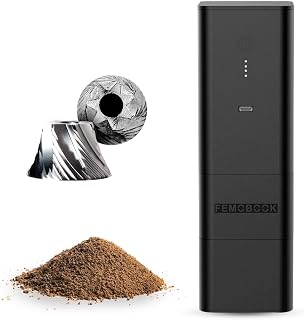
Quick Specs: 38 mm 7-core heptagonal stainless steel conical burrs | Internal metal dial (40 clicks/turn, 120+ settings, ~18 microns/click) | Cordless vertical chute (35 g capacity) + magnetic cup + auto-reverse | Dual replaceable 18650 batteries (4,000 mAh, USB-C) | 2.36 x 2.36 x 8.27 in (60 x 60 x 210 mm), 650 g | Price Tier: Entry-level (between $100 and $200)
Audit Score: 8.2 / 10
- Espresso Dialing Resolution & Burr Capability (35%): 8.2 / 10
- Retention, Dosing Workflow & Static Control (25%): 8.4 / 10
- Build Quality, Footprint & 120V/Manual Ergonomics (20%): 8.4 / 10
- Value Within Entry Tier & Upgrade Path (20%): 7.8 / 10
Not everyone who dislikes cranking a hand grinder has countertop space or free outlets for a full-size plug-in unit. Detailed on the Femobook official product specification page, the Femobook A2 packs 38 mm seven-core stainless steel conical burrs and a slow ~60 RPM geared motor into a 2.36-inch cylindrical chassis weighing 650 grams. Its internal metal click adjuster delivers 40 clicks per turn across more than 120 settings (~18 microns per click), giving you legitimate single-wall espresso adjustment alongside pour-over versatility without manual wrist strain.
What separates the Femobook A2 from disposable battery mills is serviceability: it runs on two user-replaceable 18650 lithium-ion cells (4,000 mAh combined) recharged via USB-C, rated by Femobook for roughly 20 espresso doses or 50–80 pour-over grinds per charge, plus auto-stop and auto-reverse jam protection. A magnetic catch cup and tool-free disassembly keep the straight vertical chute nearly free of grind retention (CR-GRD-02). Compared to the KINGrinder K6 (#5), the A2 trades 48 mm crank speed and an external dial for motorized push-button convenience anywhere—though its ~60 RPM torque takes noticeably longer per 18 g dose than plug-in electrics like the Fellow Opus 2 (#2). Pair with a compact 0.1 g scale (CR-SCALE-GRD-01).
Buyer Verification Alert: Femobook lists Black (B0F28JRPDR) and White (B0F23G8BC6) variants separately on Amazon US. Confirm the A2 model with replaceable 18650 batteries rather than older non-replaceable portable mills.
Pros
- User-replaceable dual 18650 USB-C batteries prevent premature e-waste
- 120+ click metal dial (~18 microns/click) dials entry espresso without arm fatigue
- Magnetic grounds cup, vertical low-retention chute, and auto-reverse jam recovery
- Ultra-slim 2.36-inch footprint travels easily or tucks beside compact machines
Cons
- Slow ~60 RPM motor speed takes longer per espresso shot than AC plug-in mills
- Internal click adjuster requires counting clicks from zero when changing recipes
- Requires USB-C recharging roughly every 20 espresso doses
Verdict: Buy it if you want motorized, outlet-free espresso grinding for a dorm, camper, or tight studio kitchen under $200. Skip it if you pull multiple morning milk drinks back to back—where AC countertop picks like the Baratza Encore ESP (#1) or Fellow Opus 2 (#2) finish doses far faster.
9. KINGrinder K1 Manual Coffee Grinder — Best Sub-$100 Entry Espresso Hand Grinder

Quick Specs: 38 mm stainless steel conical burrs | Internal stepped dial (40 clicks/turn, ~18 microns/click per maker) | Manual single-dose (20–25 g capacity) + dual-bearing shaft | 0W (manual) | 580 g (20.5 oz) | Price Tier: Ultra-budget (under $100)
Audit Score: 7.8 / 10
- Espresso Dialing Resolution & Burr Capability (35%): 7.8 / 10
- Retention, Dosing Workflow & Static Control (25%): 7.6 / 10
- Build Quality, Footprint & 120V/Manual Ergonomics (20%): 7.9 / 10
- Value Within Entry Tier & Upgrade Path (20%): 8.2 / 10
Shoppers starting out with a strict ceiling well under $100 often fall into the trap of buying wobbly ceramic hand mills or spinning blade choppers that cannot hold burr concentricity. The KINGrinder K1 avoids that pitfall by putting 38 mm stainless steel conical burrs on a dual-bearing metal drive shaft inside an aluminum housing, with an internal stepped dial delivering roughly 18 microns per click (40 clicks per rotation). That rigid alignment lets entry baristas pull legitimate shots through a starter 51 mm or 54 mm machine without spending over $100.
Naturally, dropping below $100 introduces clear ergonomic trade-offs compared to the KINGrinder K6 (#5) and 1Zpresso J-Ultra (#3). Smaller 38 mm burrs cut slower per crank revolution than 48 mm burrs, and its 20–25 g bean capacity keeps batches small. Worse, adjusting grind size requires unscrewing the catch cup to count clicks internally from zero (CR-GRD-03), making daily switching between morning drip and afternoon espresso tedious, while ~18-micron steps benefit from small 0.5 g dose adjustments on a 0.1 g scale (CR-GRD-ESP-03, CR-SCALE-GRD-01). Still, as an ultra-budget starter mill, it outclasses cheap plastic hand grinders by a wide margin.
Buyer Verification Alert: Make sure you select the metal-bodied K1 (B0CY1ZFXSS) rather than the ABS-bodied KINGrinder P0 (B0CMPT7J26) if frequent fine espresso cranking is on your schedule.
Pros
- Rigid dual-bearing aluminum chassis and 38 mm steel burrs well under $100
- ~18 microns per click dialing outperforms ceramic travel mills
- Lightweight 580 g body stores in any drawer or travel kit
Cons
- Internal click ring is inconvenient for frequent espresso-to-filter switching
- 38 mm burrs take noticeably longer per 18 g espresso dose than 48 mm hand grinders
- 20–25 g capacity limits large pour-over batches
Verdict: Buy it if you need the most affordable rigid-shaft manual espresso grinder under $100 for single daily shots. Skip it if your budget stretches into the $100–$200 range—stepping up to the KINGrinder K6 (#5) or 1Zpresso J-Ultra (#3) brings faster 48 mm burrs and exterior click dials.
Buying Guide: How to Choose the Best Espresso Grinder Under $200
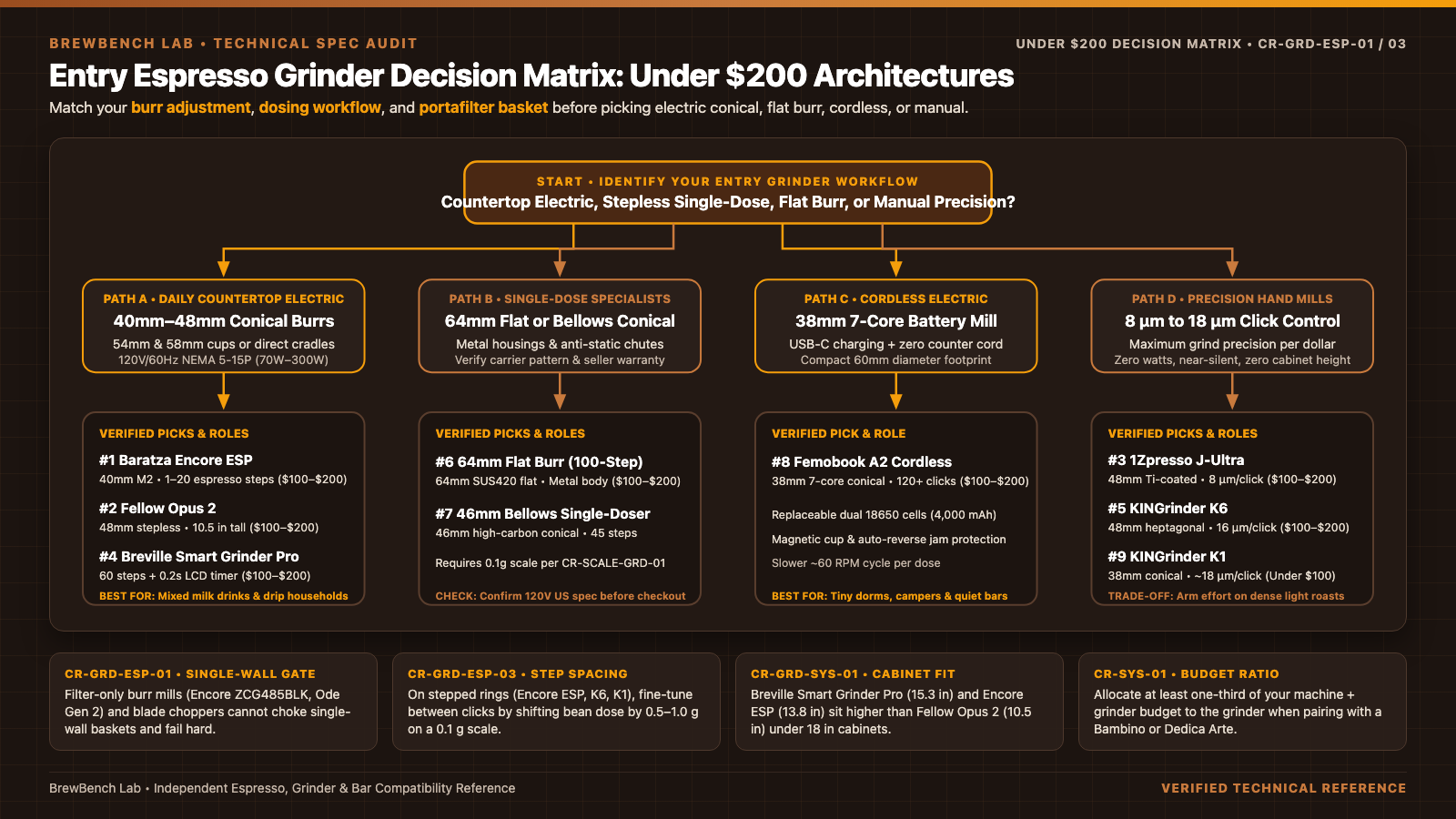
Shopping in the entry bracket means prioritizing burr alignment and fine adjustment resolution over flashy LCDs or oversized hoppers. Before ordering any grinder under $200, run your espresso bar through five technical compatibility checks.
1. Single-Wall vs. Pressurized Baskets (CR-GRD-ESP-01 & CR-SYS-02)
Your espresso machine’s filter basket dictates whether an entry grinder will succeed or fail. A dual-wall pressurized basket forces espresso through a tiny bottom pinhole to create artificial crema from coarse or pre-ground coffee, whereas a non-pressurized single-wall basket relies entirely on uniform, finely milled grounds to build ~9-bar extraction pressure. Blade choppers and filter-only burr mills always fail CR-GRD-ESP-01 in single-wall baskets—as we explain in our burr vs blade coffee grinders breakdown—because uneven boulder-and-dust particles trigger immediate channeling.
2. Stepless Adjustment vs. Micro-Step Clicks (CR-GRD-ESP-03)
Tiny changes in burr gap shift espresso shot times dramatically. A true stepless adjustment mechanism—like the side dial on the Fellow Opus 2—lets you move burrs infinitely without notches to hit an exact 28-second target. By contrast, stepped rings (such as the Baratza Encore ESP’s 1–20 espresso range or the KINGrinder K6’s 16-micron clicks) lock into fixed detents; when your ideal grind lands between two clicks, compensate smoothly by shifting your dry coffee dose up or down by 0.5 to 1.0 gram on a 0.1 g scale.
3. Single-Dose vs. Hopper Workflow & Retention (CR-GRD-02 & CR-GRD-03)
Decide whether daily bean flexibility or push-button hopper speed matters more. Single-dose mills like the Fellow Opus 2, 1Zpresso J-Ultra, and 46 mm bellows grinder keep grind retention minimal so you can swap between regular espresso, decaf, and filter coffee without purging stale grounds—provided you weigh every dose on a 0.1 g scale (CR-SCALE-GRD-01). Hopper units like the Breville Smart Grinder Pro store 450 g of beans for fast timed dosing, though internal chute carryover makes frequent espresso-to-pour-over switching slower (CR-GRD-03).
4. Portafilter Fit, Cabinet Clearance & 120V Power (CR-GRD-ACC-01 & CR-GRD-SYS-01)
Match the grinder’s dosing output to your espresso machine’s portafilter diameter before checkout. Breville 54 mm baskets pair naturally with the Breville Smart Grinder Pro cradles, Baratza Encore ESP dosing cup, and Fellow Opus 2 magnetic cup, whereas 51 mm portafilters benefit from a slim dosing funnel to avoid mess. Also measure vertical clearance below standard 18-inch US upper cabinets: the Breville Smart Grinder Pro stands 15.3 inches tall and the Encore ESP measures 13.8 inches, whereas the 10.5-inch Fellow Opus 2 fits easily under low trim. Every powered pick here runs on standard 110–120V/60Hz NEMA 5-15P outlets (70W to 300W) or USB-C battery power, keeping kitchen branch circuits safe when following maker manuals.
Secondary Intent Resolver: Manual Hand Grinder vs. Electric Under $200
Dollar for dollar, manual mills win pure burr machining quality under $200 because none of your budget pays for an AC motor, gearbox, or plastic housing. If you pull one or two straight espresso shots daily and value quiet mornings, the 1Zpresso J-Ultra (8 microns/click) or KINGrinder K6 (16 microns/click) outperforms budget electrics on adjustment precision. Choose an electric pick like the Baratza Encore ESP or Fellow Opus 2 if you steam milk for multiple drinks daily or crank through dense light roasts where manual effort wears thin.
Upgrade Roadmap & Hidden Ownership Costs (CR-SYS-01)
Rule CR-SYS-01 recommends reserving at least one-third of your combined machine-plus-grinder budget for the grinder on single-wall espresso setups—meaning an entry grinder under $200 pairs proportionally with thermoblock machines in the under-$500 bracket. Beyond the grinder box, set aside modest budget for three practical essentials: a 0.1 g coffee scale (mandatory for single-dosers and hand mills under CR-SCALE-GRD-01), a 51 mm, 54 mm, or 58 mm magnetic dosing funnel + WDT needle tool to eliminate clumps and reduce channeling, and eventual replacement burrs after heavy kilogram use.
How We Audited, Scored & Excluded These Entry Grinders
Every BrewBench Lab guide adheres strictly to our Editorial Evaluation Methodology, cross-referencing official US manufacturer manuals, 120V/60Hz electrical specs, and cross-compatibility rules (CR-GRD-ESP-01, CR-GRD-ESP-03, CR-SYS-01). We never fabricate micron-distribution curves, retention gram claims, or decibel figures when makers do not publish them. Each grinder under $200 is scored out of 10 across four weighted criteria totaling 100%:
| Evaluation Criterion | Weight | What We Audited |
|---|---|---|
| Espresso Dialing Resolution & Burr Capability | 35% | Maker espresso rating (CR-GRD-ESP-01), stepless vs micro-step spacing (CR-GRD-ESP-03), and burr geometry. |
| Retention, Dosing Workflow & Static Control | 25% | Single-dose vs hopper workflow (CR-GRD-02), bellows/ionizers, and 54/58 mm dosing cup or cradle fit (CR-GRD-ACC-01). |
| Build Quality, Footprint & 120V/Manual Ergonomics | 20% | Chassis rigidity, 120V NEMA 5-15P wattage or battery/manual effort, and cabinet height clearance (CR-GRD-SYS-01). |
| Value Within Entry Tier & Upgrade Path | 20% | Performance-per-dollar under $200, US spare-parts support, and budget-share pairing with starter machines (CR-SYS-01). |
Models We Audited & Excluded (And Why)
- Baratza Encore (Standard ZCG485BLK): HARD FAIL on CR-GRD-ESP-01. Baratza positions the non-ESP Encore strictly for drip and pour-over brewing without the ESP’s fine-stepped 1–20 espresso adjustment cam.
- Fellow Ode Gen 2 (Stock 64 mm Flat Burrs): HARD FAIL on CR-GRD-ESP-01. Fellow engineers the stock Ode Gen 2 strictly for filter coffee, so stock burrs cannot grind fine enough to choke single-wall baskets.
- OXO Brew Conical & Generic Blade Grinders: HARD FAIL on CR-GRD-ESP-01. Filter-oriented budget grinders and spinning blade choppers lack fine espresso calibration and trigger rapid shot gushing.
- Baratza Encore ESP Pro (ZCG595BLK): Excluded from this roundup solely because it sits in the $200 to $500 mid-range bracket rather than under $200.
- Niche Zero, Niche Duo & Timemore Sculptor 064: Excluded as off-Amazon dealer-only and direct-sale brands absent from active Amazon US grinder stock.
Frequently Asked Questions: Best Espresso Grinder Under $200
What is the best espresso grinder under $200 for a Breville Bambino?
The Baratza Encore ESP (ZCG495BLK) is the strongest overall match under $200 because it ships with a 54 mm dosing cup built for Breville portafilters and dedicates steps 1–20 to fine single-wall espresso. Choose the Fellow Opus 2 if you want stepless dialing under low cabinets.
Are manual hand grinders better than electric espresso grinders under $200?
Hand grinders win precision per dollar, while electrics win daily convenience. Manual picks like the 1Zpresso J-Ultra (8 microns/click) out-adjust most budget electrics for straight espresso, whereas the Baratza Encore ESP and Fellow Opus 2 save wrist effort when making back-to-back milk drinks.
Can I use a standard Baratza Encore or Fellow Ode Gen 2 for espresso?
No—both filter-only grinders fail CR-GRD-ESP-01 for non-pressurized single-wall espresso baskets. Their burrs and adjustment collars stop too coarse, causing shots to gush in seconds unless you switch back to a dual-wall pressurized basket.
Do I need a stepless grinder under $200 to pull good single-wall espresso?
No, though stepless dialing makes fine-tuning fastest. Stepless mills like the Fellow Opus 2 move continuously without detents, whereas stepped picks like the Encore ESP and KINGrinder K6 dial single-wall shots reliably when you shift coffee dose by 0.5 to 1 gram between clicks.
Is a cheap 64 mm flat-burr grinder under $200 better than a 40 mm conical grinder?
Not automatically. While 64 mm flat burrs emphasize flavor clarity, generic budget housings lack published wattage, US service networks, and verified SSP carrier fit (CR-GRD-01). Established conical grinders like the Baratza Encore ESP and Fellow Opus 2 deliver far safer support under $200.
What accessories do I need with an entry espresso grinder under $200?
Start with a 0.1 g coffee scale (CR-SCALE-GRD-01) so every single-dose or manual batch stays repeatable to the tenth of a gram. Adding a size-matched 51 mm, 54 mm, or 58 mm dosing funnel and a WDT needle tool also minimizes spills and channeling.
Final Verdict: Picking the Best Espresso Grinder Under $200
Choosing the best espresso grinder under $200 comes down to matching burr precision and daily workflow to your portafilter rather than chasing generic horsepower specs. For most beginners building an entry bar, the Baratza Encore ESP (ZCG495BLK) earns #1 overall thanks to its dedicated 1–20 espresso steps, 54/58 mm dosing cup, and proven US repair support. If stepless adjustment, low static, and a 10.5-inch height matter more, pick the Fellow Opus 2.
Prefer zero motor noise and maximum click precision per dollar? The manual 1Zpresso J-Ultra delivers 8-micron espresso steps, while the KINGrinder K6 handles pour-over and espresso effortlessly. Households wanting hands-free 54/58 mm cradles should choose the Breville Smart Grinder Pro, and tiny outlet-free bars get portable convenience from the Femobook A2.


