Disclosure: As an Amazon Associate, I earn from qualifying purchases. If you buy through links on this page, we may earn a small commission at no extra cost to you.
Dialing in the right espresso grind size is the single fastest way to fix sour, watery gushers or choked, bitter drips on any home espresso machine. Unlike gravity-fed pour-over or immersion French press, pressurized espresso relies on a tightly compacted bed of finely milled coffee to resist roughly ~9 bar of hydraulic brew pressure—even on entry machines marketed with 15-bar or 20-bar maximum pump ratings. When your grind particles are too coarse, water blasts through the puck in seconds; when they are too fine, flow stalls completely.
As detailed in our best espresso grinders hub, grind size is never just a single number on a dial. Your optimal setting shifts depending on whether you pull shots through a single-wall or pressurized basket, how finely your grinder spaces its burr steps, your roast density, and your portafilter width. Use this reference chart and mechanical breakdown to pinpoint your starting zone without guesswork.
Direct Answer: For a standard single-wall (unpressurized) espresso basket, grind fine enough that grounds feel slightly finer than fine table salt and clump lightly when pinched between your fingers. Under CR-GRD-ESP-01, this requires a maker-rated espresso burr grinder with micro-step or stepless adjustment (CR-GRD-ESP-03). Pressurized dual-wall baskets work one zone coarser at a free-flowing fine-table-salt texture.
In This Guide
- Why Espresso Grind Size Governs Hydraulic Resistance
- Master Coffee & Espresso Grind Size Reference Chart
- Single-Wall vs. Pressurized Baskets: How Basket Type Shifts Grind
- Stepped vs. Micro-Step vs. Stepless Adjustment (CR-GRD-ESP-03)
- Roast Density, Portafilter Width & Dose Modifiers
- Myth vs. Engineering Reality
- Verified Amazon US Reference Grinders Across Adjustment Tiers
- Authoritative Manufacturer & Standards Citations
- Frequently Asked Questions
Why Espresso Grind Size Governs Hydraulic Resistance
Every brewing method matches particle surface area to contact time, but espresso operates under a completely different physical regime than filter coffee. In a pour-over cone or French press carafe, atmospheric gravity pulls water downward through loosely packed grounds over one to four minutes. In an espresso group head, a vibratory or rotary pump pushes heated water—typically targeted near ~93–96 °C (199–205 °F) for light roasts and slightly lower for medium-dark profiles—into a sealed metal filter basket under ~9 bar of brewing pressure.
Without fine, uniform grounds forming millions of microscopic interstitial channels inside the tamped puck, pressurized water faces almost zero hydraulic resistance. That is why blade choppers and filter-only burr grinders fail hard compatibility rule CR-GRD-ESP-01 for single-wall espresso. Blade mills smash beans into uneven boulders and dust, while filter-focused burr carriers (such as the standard Baratza Encore non-ESP, stock Fellow Ode Gen 2, or OXO Brew Conical) simply cannot close their burr gap tightly or repeatably enough to sustain steady puck backpressure. If you are comparing grinder architectures from scratch, review our burr vs. blade coffee grinder breakdown before pairing a mill with a single-wall basket.
Tactile Check: Why Finger Pinch Beats Arbitrary Micron Charts
Many generic coffee charts assign fixed micron diameters (for example, claiming every espresso sits at a single rigid micron figure) as if all grinders share identical particle distributions. In practice, flat burrs and conical burrs generate different proportions of ultra-fine particles (“fines”) and coarse boulders at the same physical burr gap. Because exact laser-diffraction particle dispersion curves vary by burr geometry, alignment, and bean moisture—and consumer grinder manuals rarely publish verified particle-spread telemetry—there is no verified data available yet for a universal one-size-fits-all micron number across brands.
Instead, combine your grinder’s published espresso setting zone with a quick tactile pinch check and a 0.1 g brew scale (CR-SCALE-ESP-03):
- Too Coarse (Gushing Zone): Grounds feel distinctly gritty like beach sand or standard table salt and scatter cleanly off your fingertips without sticking together.
- Single-Wall Espresso Target Zone: Grounds feel finer than table salt with a soft, powdery grit—not completely smooth like cornstarch or pastry flour—and hold a fragile fingerprint clump when pinched gently before crumbling under light pressure.
- Too Fine (Choking Zone): Grounds pack tightly into dense, flour-like cakes that smear into skin creases and refuse to fall apart when tapped lightly.
Master Coffee & Espresso Grind Size Reference Chart
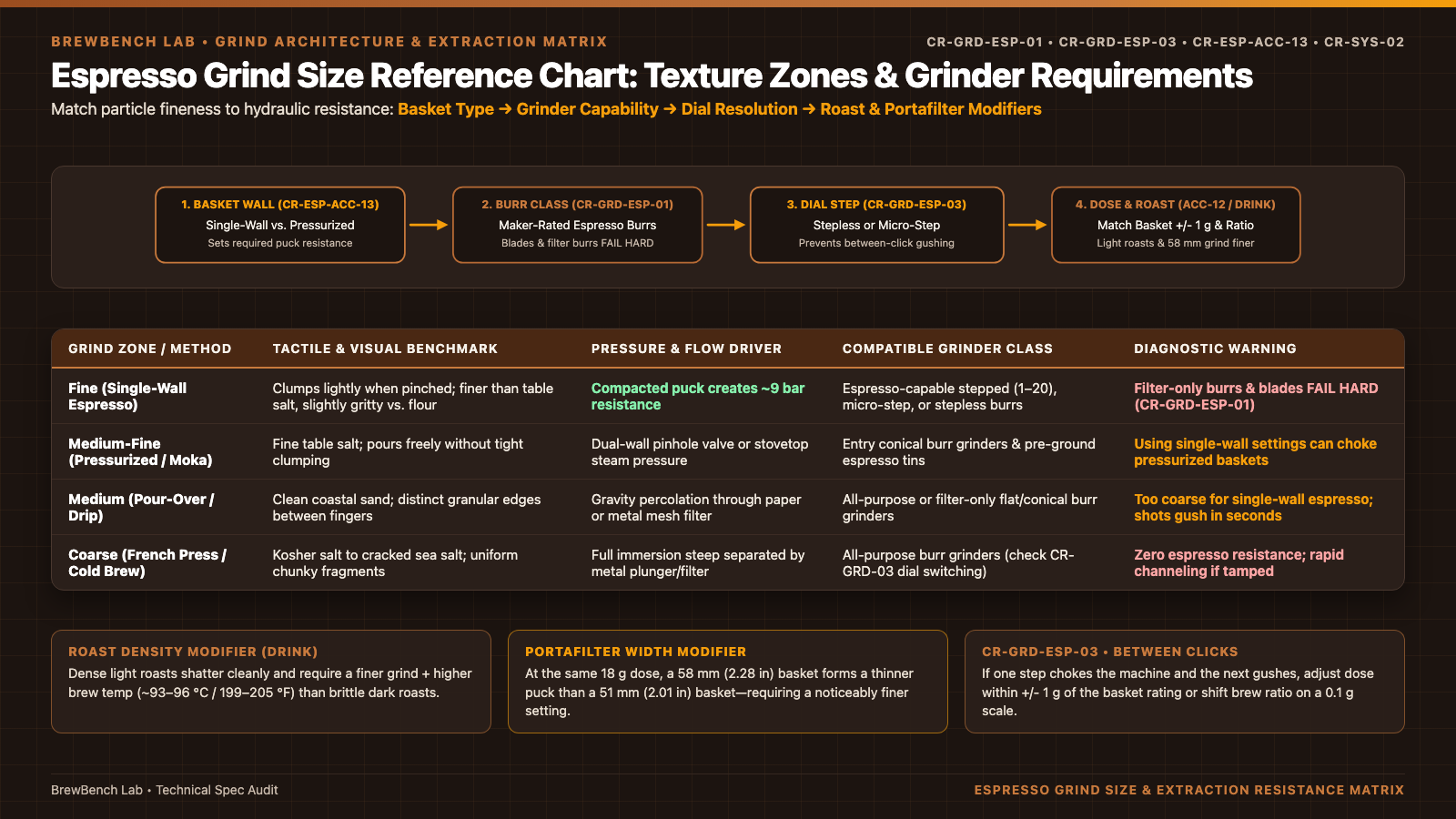
Use the matrix below to map each brew method to its tactile texture, hydraulic driver, compatible grinder class, and primary diagnostic risk. Notice how single-wall espresso and pressurized-basket espresso occupy adjacent—but functionally distinct—tiers on the grind spectrum.
| Brew Method / Zone | Tactile & Visual Benchmark | Hydraulic Driver | Compatible Grinder Class | Critical Compatibility Caveat |
|---|---|---|---|---|
| Extra Fine (Turkish / Ibrik) | Smooth powdery flour; zero discernible grit between fingers | Stovetop simmer suspension (unfiltered decoction) | Specialized Turkish burrs or dedicated micro-step espresso hand grinders | Too fine for pump espresso; completely chokes ~9 bar baskets |
| Fine (Single-Wall Espresso) | Finer than table salt; forms soft pinch clumps that crumble cleanly | Compacted coffee puck creating ~9 bar resistance | Maker-rated espresso burr grinders (stepped 1–20, micro-step, or stepless) | Filter-only burrs & blade choppers FAIL HARD (CR-GRD-ESP-01) |
| Medium-Fine (Pressurized Espresso / Moka) | Fine table salt; free-flowing grains with minimal clumping | Dual-wall basket pinhole valve or stovetop steam pressure | Entry conical burr grinders & pre-ground espresso blends | Single-wall fine settings often choke dual-wall pinholes (CR-ESP-ACC-13) |
| Medium (Pour-Over / Auto Drip) | Clean coastal sand; distinct individual particles | Gravity percolation through paper or cone filter | All-purpose or filter-only flat/conical burr grinders | Produces fast, sour under-extracted gushers in single-wall espresso |
| Medium-Coarse (Chemex / Clever) | Coarse sand to small sea salt crystals | Slow gravity drawdown through thick bonded paper | All-purpose or filter burr grinders | Check dial repeatability when switching back to espresso (CR-GRD-03) |
| Coarse (French Press / Cold Brew) | Kosher salt to cracked sea salt chunks | Full immersion steep with coarse metal mesh filter | All-purpose burr grinders with wide coarse range | Zero pump resistance; causes rapid channeling if tamped |
Single-Wall vs. Pressurized Baskets: How Basket Type Shifts Grind
Before adjusting a single click on your grinder, verify which filter basket sits inside your portafilter. Entry-level home espresso machines—including De’Longhi Dedica, De’Longhi Stilosa, and many sub-$200 thermoblock models—frequently ship with pressurized (dual-wall) baskets, while Breville 54 mm machines (such as the Bambino and Bambino Plus) include both pressurized and single-wall baskets in the box (CR-ESP-ACC-13).
A single-wall (unpressurized) basket features hundreds of tiny holes punched uniformly across its floor. Because water flows freely through those holes, 100% of the extraction resistance must come from your espresso grind size, uniform distribution, and tamped puck density. Under CR-GRD-ESP-01, pairing a single-wall basket with a non-espresso grinder or supermarket pre-ground coffee causes water to race straight through in seconds—a failure pattern covered step-by-step in our guide on fixing an espresso shot running too fast.
A pressurized (dual-wall) basket hides a false floor beneath the perforated bed, funneling the entire shot through a single microscopic pinhole at the bottom. Because that valve artificially generates backpressure regardless of puck density, pressurized baskets run comfortably one step coarser—at a fine table-salt texture—and remain the compliant path under CR-SYS-02 if you use pre-ground coffee or an entry grinder without fine espresso steps. Conversely, packing single-wall flour-fine grounds into a pressurized basket often clogs the tiny exit hole completely.
Stepped vs. Micro-Step vs. Stepless Adjustment (CR-GRD-ESP-03)
Two burr grinders can both grind “espresso fine” yet deliver wildly different dialing experiences depending on how their adjustment collar moves the burrs. Under soft compatibility rule CR-GRD-ESP-03, adjustment granularity inside the espresso window decides whether you can hit a balanced 1:2 brew ratio cleanly or get trapped “between clicks.”
1. Broad Stepped Grinders (12–30 Total Settings)
Entry all-purpose burr grinders that spread 12 to 30 total detents evenly from Turkish to cold brew often allocate only two or three clicks to the entire espresso zone. One click chokes the group head to a trickle; the next click lets the shot spray wildly. When dialing a coarse-stepped grinder with a single-wall basket, you must compensate by adjusting dry coffee dose within ±1 g of your basket’s rated capacity (CR-ESP-ACC-12) or shifting your target yield on a 0.1 g scale.
2. Dual-Zone Stepped & Micro-Step Grinders
Modern espresso-capable stepped grinders solve the coarse-jump bottleneck by compressing their thread pitch or dedicating half the dial specifically to espresso. For example, Baratza’s official manual for the Encore ESP divides 40 total settings into a finer-stepped settings 1–20 espresso range and a wider-stepped 21–40 filter range. Dedicated manual espresso grinders push resolution even tighter: 1Zpresso publishes 8 microns of vertical burr travel per click on the J-Ultra, letting baristas make subtle resistance nudges without touching dose weight.
3. Stepless & Micrometric Worm-Gear Grinders
Stepless collars—such as the stepless dial on the Fellow Opus 2 or the micrometric worm-gear dial on the Gaggia MDF 55—remove physical detents altogether. You can position the burrs at any point along the thread pitch, eliminating between-click compromises. The trade-off comes down to workflow (CR-GRD-03): stepless espresso hoppers like the MDF 55 excel when dedicated exclusively to espresso, whereas switching a stepless multi-purpose grinder back and forth between espresso and coarse pour-over daily requires careful dial logging and purging retained grounds.
Roast Density, Portafilter Width & Dose Modifiers
Even if you never change beans on purpose, three physical variables will force you to adjust your espresso grind size over time. Understanding these modifiers prevents unnecessary frustration when opening a new bag or swapping baskets.
Roast Profile & Bean Age
Dark-roasted beans undergo prolonged thermal development that makes their cellular structure brittle and porous. They fracture easily into a wider spread of fine particles and offer higher solubility, so dark roasts (DRINK-STRAIGHT-MEDIUM-DARK) typically extract well at a slightly coarser espresso setting and lower brew temperatures. Light-roasted beans (DRINK-STRAIGHT-LIGHT-ROAST) remain dense and tough; they produce fewer fines during grinding and resist water penetration, requiring both a noticeably finer grind setting and higher brew temperatures around ~93–96 °C (199–205 °F) at longer ~1:2.2 to 1:3 brew ratios (CR-DRINK-ESP-01, CR-DRINK-GRD-01). Likewise, as roasted coffee ages past three to four weeks and degasses carbon dioxide, natural puck resistance drops—meaning older beans require gradually grinding finer to maintain steady flow.
Portafilter Diameter (51 mm vs. 54 mm vs. 58 mm)
For the exact same 18 g dose of coffee, basket diameter dramatically alters puck thickness:
- 51 mm (2.01 in) Consumer Baskets: Narrow cross-sectional area stacks an 18 g dose into a tall, deep puck. Water must travel farther through packed coffee, so 51 mm single-wall baskets generally require a slightly coarser espresso setting than 58 mm setups to avoid choking.
- 54 mm (2.13 in) Breville Baskets: Offers a balanced middle ground between puck depth and surface area, forgiving minor distribution variance while still responding sharply to single-step grind adjustments.
- 58 mm (2.28 in) Commercial Baskets: Exposes roughly 29% more cross-sectional area than 51 mm baskets, spreading the same 18 g dose into a thinner puck. Thinner pucks provide less vertical resistance and demand a noticeably finer grind size alongside thorough distribution (such as WDT needle stirring) to prevent channeling.
Dose, Headspace & Precision Baskets
Increasing dry dose adds physical puck depth, acting similarly to grinding slightly finer; lowering dose reduces depth, acting like grinding coarser. Keep dry dose within roughly ±1 g of your basket’s rated capacity (CR-ESP-ACC-12) so the puck never presses directly into the shower screen or sits too shallow and turns soupy. If you upgrade from a tapered OEM basket to a laser-cut high-flow precision basket or add a metal puck screen (CR-ESP-ACC-05), expect to grind finer to match the increased open hole area. Pair every dial session with a 0.1 g espresso scale (CR-SCALE-GRD-01) and follow our structured how to dial in espresso workflow to isolate one variable at a time.
US Kitchen Setup Note (CR-ESP-SYS-02 & CR-GRD-SYS-01): All electric grinders in this guide run on standard 120V/60Hz US household circuits (NEMA 5-15P). Remember that total circuit load equals machine wattage plus grinder wattage plus any shared countertop appliances (P = V × A: 1,800 W max on a 15 A circuit, 2,400 W max on a 20 A circuit; never run a high-draw espresso machine and an electric kettle simultaneously on one 15 A branch, and never use plug adapters). For hopper-fed grinders, also measure vertical clearance beneath upper cabinets—typically ~18 in (457 mm) in US kitchens—so you can load beans without pulling the grinder forward.
Myth vs. Engineering Reality: Espresso Grind Size
Myth #1: “20-bar espresso machines require a different grind size than 15-bar or 9-bar machines.”
Engineering Reality: “15 bar” and “20 bar” printed on consumer boxes refer to the maximum static rating of the vibratory pump, not actual brewing pressure at the puck. Conventional espresso extraction still targets ~9 bar via an over-pressure valve (OPV) or pressurized basket restriction. Your grind size is governed by basket type (single-wall vs. dual-wall) and puck thickness—not pump badge hype.
Myth #2: “Any burr grinder can grind for espresso if you turn it all the way to setting 1.”
Engineering Reality: Filter-only burr grinders—including the standard Baratza Encore (non-ESP), OXO Brew Conical, and stock Fellow Ode Gen 2—intentionally machine their burr geometry and carrier stops for pour-over and drip particle uniformity. Even at their tightest factory stop, they fail hard compatibility gate CR-GRD-ESP-01 for single-wall espresso baskets.
Myth #3: “You can copy someone else’s exact dial number—like Setting 12—on the same grinder model.”
Engineering Reality: Two identical grinder units often exhibit slight factory zero-point offset, and bean density varies sharply by roast level, origin, and roast date. Treat published dial numbers purely as starting zones, then calibrate by shot weight, time, and taste.
Myth #4: “Flat burrs always grind finer and better for espresso than conical burrs.”
Engineering Reality: Both flat and conical burr sets easily grind fine enough to choke an espresso machine when built for espresso. Burr diameter and geometry alter particle-size distribution tendencies (clarity vs. texture), not minimum grind fineness—never select a grinder by burr diameter or flat-vs-conical generalizations alone.
Verified Amazon US Reference Grinders Across Adjustment Tiers
To illustrate how stepped dual-zone, stepless conical, micro-step manual, and micrometric flat-burr architectures map onto real-world home setups, here are four verified Amazon US espresso-capable grinders spanning entry through mid-tier budgets:
1. Baratza Encore ESP Coffee Grinder (ZCG495BLK) — Stepped Dual-Zone Reference

Quick Specs: 40 mm hardened steel M2 conical burr | 40 stepped settings (settings 1–20 dedicated espresso zone, 21–40 filter zone) | Includes 54 mm / 58 mm compatible dosing cup | 120V/60Hz electric | Price Tier: Entry ($100–$200 tier)
Baratza engineered the Encore ESP specifically to eliminate the coarse-step limitation of the filter-only Encore. By compressing the thread pitch across settings 1 through 20, it passes CR-GRD-ESP-01 for single-wall baskets while preserving settings 21 through 40 for pour-over and French press. Its included dosing cup also bridges 54 mm Breville and 58 mm commercial portafilters cleanly (CR-GRD-ACC-01).
Compatibility Gate (CR-GRD-ESP-03 & L-18): Confirm the listing explicitly reads Encore ESP rather than the filter-only standard Encore. Inside the 1–20 espresso band, stepped clicks may occasionally require ±0.5–1 g dose tuning on dense light roasts.
Pros
- Dedicated 1–20 fine-step espresso zone covers single-wall and pressurized baskets
- Includes 54 mm / 58 mm dosing cup for cleaner portafilter transfers
- Accessible $100–$200 tier with strong US replacement parts availability
Cons
- Fixed stepped collar can land between clicks on very light roasts
- Higher plastic housing sound resonance than all-metal grinders
2. Fellow Opus 2 Conical Burr Grinder (Matte White) — Stepless 48 mm Conical Reference

Quick Specs: 48 mm stainless steel conical burrs | Stepless grind adjustment dial | Dual magnetic catch cups (54 mm & 58 mm portafilter compatible) | Auto-stop single-dose design | 120V/60Hz electric | Price Tier: Entry ($100–$200 tier)
Fellow’s Opus 2 upgrades to 48 mm stainless steel conical burrs paired with a true stepless grind dial—removing the inner micro-ring complexity of the original Opus while giving single-wall espresso dialers continuous control between settings (CR-GRD-ESP-03). Its dual magnetic catch cups align directly with both 54 mm Breville and 58 mm commercial portafilters.
Compatibility Gate (CR-SCALE-GRD-01 & CR-GRD-03): Because the Opus 2 is built around single-dose weighing rather than a timed hopper, pair it with a 0.1 g coffee scale. If you switch daily between espresso and drip, log your exact dial position carefully.
Pros
- True stepless dial eliminates between-click compromises for single-wall espresso
- Dual magnetic catch cups seat cleanly on 54 mm and 58 mm portafilters
- 48 mm conical burr geometry spans espresso to cold brew under $200
Cons
- Daily switching between espresso and filter requires careful dial tracking
- Requires a 0.1 g scale to weigh each single dose consistently
3. 1Zpresso J-Ultra Manual Coffee Grinder — Micro-Step Manual Reference

Quick Specs: 48 mm conical burr | External numbered adjustment ring (published 8 microns vertical burr movement per click) | Magnetic catch cup | Manual hand crank (0W) | Price Tier: Entry ($100–$200 tier)
For espresso drinkers maximizing grind resolution per dollar, the 1Zpresso J-Ultra demonstrates how micro-stepped manual engineering outperforms coarse entry electric collars. With published 8-micron click increments, a single click produces a predictable, subtle shift in extraction speed across 51 mm, 54 mm, and 58 mm single-wall baskets, while the external numbered ring makes switching back to filter settings repeatable.
Compatibility Gate (UC-ENTERTAINER & CR-SCALE-GRD-01): Manual cranking requires firm wrist effort when grinding dense light roasts at espresso fineness—making it best suited for one or two shots per session paired with a 0.1 g scale rather than high-volume milk-drink entertaining.
Pros
- Published 8-micron click increments enable precise single-wall dialing
- External numbered ring keeps espresso and filter settings repeatable
- Zero electrical draw (0W) and minimal counter footprint
Cons
- Noticeable arm effort required for fine light-roast or back-to-back shots
- Must weigh every dose separately on a 0.1 g scale
4. Gaggia MDF 55 Espresso & Coffee Grinder — Stepless Flat-Burr Hopper Reference

Quick Specs: 55 mm hardened flat steel burrs | Stepless micrometric adjustment dial | Touchscreen timed hopper dosing | 120V/60Hz electric | Price Tier: Prosumer ($500–$1,000 tier)
If your espresso bar runs one daily bean profile for morning lattes or straight shots, the Gaggia MDF 55 showcases how a dedicated espresso hopper grinder simplifies grind stability. Its stepless micrometric knob adjusts burr spacing continuously without losing calibration, while 55 mm flat steel burrs and touchscreen timed dosing dispense straight into a portafilter without weighing every shot on a scale beforehand.
Compatibility Gate (CR-GRD-03 & CR-GRD-SYS-01): Built strictly as a dedicated espresso hopper grinder—changing daily between espresso and coarse pour-over wastes retained grounds inside the chute. Measure upper cabinet height before placing a hopper grinder on the counter.
Pros
- Stepless micrometric dial locks down fine single-wall adjustments cleanly
- 55 mm hardened flat steel burrs and touchscreen timer speed up daily milk drinks
- Dedicated espresso workflow keeps your dial anchored without wide swings
Cons
- Hopper retention makes frequent switching to coarse drip coffee impractical
- Higher $500–$1,000 budget tier and taller hopper profile under low cabinets
Authoritative Manufacturer & Standards Citations
Every grind-adjustment mechanism, burr specification, and extraction principle in this guide is cross-referenced against official manufacturer manuals and specialty coffee standards:
- Baratza Official Support & Encore ESP Documentation — 40 mm M2 conical burr specifications and dual-zone 40-step calibration (settings 1–20 espresso range vs. 21–40 filter range).
- Fellow Official Grinder Specifications — Opus 2 48 mm conical stepless adjustment and 54 mm / 58 mm catch-cup geometry versus filter-only Ode Gen 2 positioning.
- 1Zpresso Official J-Ultra Specifications — 48 mm conical burr engineering and published 8-micron vertical burr adjustment per click.
- Gaggia Official MDF 55 Technical Data — 55 mm hardened flat steel burrs, stepless micrometric adjustment, and timed hopper dosing specifications.
- Specialty Coffee Association (SCA) Extraction Standards — Foundational relationship between particle surface area, brew ratio, and roast-profile thermal extraction targets.
How We Audited This Guide
- Burr grinders were checked for maker-stated espresso adjustment fineness, burr geometry and size, single-dose vs hopper workflow, retention caveats, and kitchen height clearance.
- Every espresso machine, burr grinder, accessory, and scale specification was cross-checked against official manufacturer 120V manuals, SCA water guidance, and verified Amazon US listings.
- Recommendations were evaluated against our weighted espresso-gear scoring rubrics and documented CR-* compatibility rules; we never invent heat-up seconds, PID variance, or micron claims.
Continue Your Audit
Frequently Asked Questions: Espresso Grind Size
How fine should coffee be ground for espresso?
For a single-wall (unpressurized) basket, grind finer than standard table salt so grounds hold a gentle pinch clump before crumbling cleanly—never as smooth as pastry flour. Pressurized dual-wall baskets run slightly coarser, closer to free-flowing fine table salt without tight clumping.
Can I use a standard pour-over burr grinder or blade grinder for espresso?
No for single-wall baskets. Under rule CR-GRD-ESP-01, blade choppers and filter-only burr grinders cannot achieve the fine, repeatable particle resistance needed for ~9 bar extraction. If you do not own an espresso-capable grinder, use pre-ground coffee inside a pressurized dual-wall basket (CR-SYS-02).
Why do I need a finer grind for a 58 mm portafilter than a 51 mm portafilter?
At the same 18 g dry dose, a 58 mm (2.28 in) basket exposes roughly 29% more surface area than a 51 mm (2.01 in) basket, producing a shallower puck. Because water crosses a thinner coffee bed more quickly, 58 mm baskets require a finer grind to preserve extraction resistance.
What do I do if my stepped grinder is too fast on one click and chokes on the next?
When a stepped grinder lands between clicks (CR-GRD-ESP-03), choose the slightly coarser click and increase your dry dose by 0.5–1.0 g within your basket’s rated capacity (CR-ESP-ACC-12), or pick the finer click and trim dose slightly to keep flow balanced.
Do light-roast espresso beans require a different grind size than dark roasts?
Yes. Dense light roasts shatter cleanly with fewer natural fines and resist extraction, requiring a noticeably finer grind setting plus higher brew temperatures (~93–96 °C / 199–205 °F). Brittle dark roasts generate more fines and extract faster, performing better slightly coarser.
Does a 20-bar espresso machine need a finer grind than a 9-bar machine?
No. The “15 bar” or “20 bar” rating on entry machines measures maximum pump output capacity, not actual brewing pressure inside the portafilter. Espresso extraction still relies on ~9 bar at the puck, so grind fineness depends on basket wall style, dose, and roast density.


