
Finding your espresso shot running too fast—gushing pale, sour liquid into the cup in 8 to 14 seconds with thin, disappearing foam—means hot brew water is passing through your portafilter without encountering enough hydraulic resistance. Unlike drip coffee, espresso relies on a tightly packed bed of finely ground coffee (or a restricted dual-wall valve) to hold back water until extraction pressure climbs toward a conventional ~9 bar target. When that resistance fails, water rushes through the puck, stripping sharp organic acids early while leaving sweetness and syrupy body behind.
Inside our home espresso setup guide, fast, under-extracted pulls are the single most common diagnostic bottleneck for new and upgrading owners alike—and almost always trace back to grinder capability, basket pairing, or puck prep rather than a broken pump. Even if your 120V machine advertises a “15-bar” or “20-bar” maximum pump rating, that specification only describes the pump’s deadhead ceiling against a closed block; real brew pressure collapses whenever coarse coffee particles or gaps around the puck let water escape freely. Follow the lowest-risk diagnostic order below to isolate the exact root cause before adjusting or servicing hardware.
Safety & Equipment Notice Before Troubleshooting: Never unlock or twist off a portafilter mid-shot while the group head is pressurized—particularly on entry machines without a three-way solenoid valve—as trapped hot water and grounds can spray forcefully and cause burns. Always stop the pump, wait for pressure to bleed, and unplug and completely cool your machine before inspecting silicone group gaskets, unscrewing shower screens, or opening a grinder burr chamber. Never open internal boiler housings, defeat thermal cutoffs or GFCI protection, rely on 15A-to-20A plug adapters, or guess DIY descaling acid strengths; follow your manufacturer’s manual first.
In This Troubleshooting Playbook
- Fast Symptom → Root Cause → Fix Priority Table
- Step 1: Verify Grinder Capability, Adjustment Steps & Bean Freshness
- Step 2: Audit Basket Wall Type, Dry Dose & Precision Flow
- Step 3: Fix Clumping, Edge Channeling & Tamper Fitment
- Step 4: Inspect Group Gaskets, Shower Screens, Descaling & OPV Behavior
- Step 5: Electrical Boundaries & Authorized Service Escalation
- Prevention & Routine Bar Checklist
- Authoritative Manufacturer & Standards Citations
- Frequently Asked Questions
Fast Symptom → Likely Root Cause → Fix Priority Table
Before changing multiple variables at once, match what you see at the spouts (or bottomless basket underside) and on your scale timer against the diagnostic matrix below. Always start at the top of the risk ladder—grinder, basket, and dose—before assuming a mechanical failure inside the espresso machine.
| Observed Shot Symptom | Underlying CR-* Rule or Dialing Cause | First Lowest-Risk Check | Fallback Adjustment |
|---|---|---|---|
| Shot gushes blonde in under 10 seconds with a single-wall basket | Grinder not espresso-capable (CR-GRD-ESP-01) or grind set far too coarse | Confirm grinder is maker-rated for espresso; dial finer within the espresso range | Switch back to a pressurized dual-wall basket (CR-ESP-ACC-13) if using pre-ground coffee or a filter grinder |
| Runs too fast at one click, chokes to drips one click finer | Coarse stepped adjustment spacing (CR-GRD-ESP-03) | Stay on the coarser click and increase dry dose by 0.5–1.0 g | Keep total dose within ±1 g of the basket’s rated capacity (CR-ESP-ACC-12) |
| Starts normal, then sprays jets and blondes rapidly mid-pull | Puck channeling, clumping, or uneven tamping edge gap (CR-ESP-ACC-03) | Stir grounds with a WDT needle tool and tamp flat to basket inner diameter | Inspect roast date; beans older than 4–6 weeks lose CO2 resistance quickly |
| Fast thin flow immediately after switching to an IMS/precision basket | Higher open perforation area accelerates drainage vs. OEM baskets | Grind noticeably finer than your previous OEM basket setting | Verify basket height and dose rating (CR-ESP-ACC-06, CR-ESP-ACC-12) |
| Water or grounds leak around the portafilter rim during fast flow | Dirty or hardened group gasket, or lug/basket height mismatch (CR-ESP-ACC-01 / 06) | Cool and unplug machine; wipe group gasket and basket rim clean | Confirm OEM or model-listed portafilter lug pattern; replace worn silicone gasket |
| Fast, erratic flow even at finest burr setting with fresh beans | Burr zero-point drift, worn burrs, or machine scale/OPV issue (CR-WTR-ESP-06) | Inspect burr carrier seating and zero calibration per grinder manual | Run maker-approved descaling cycle if erratic; contact authorized US service if unresolved |
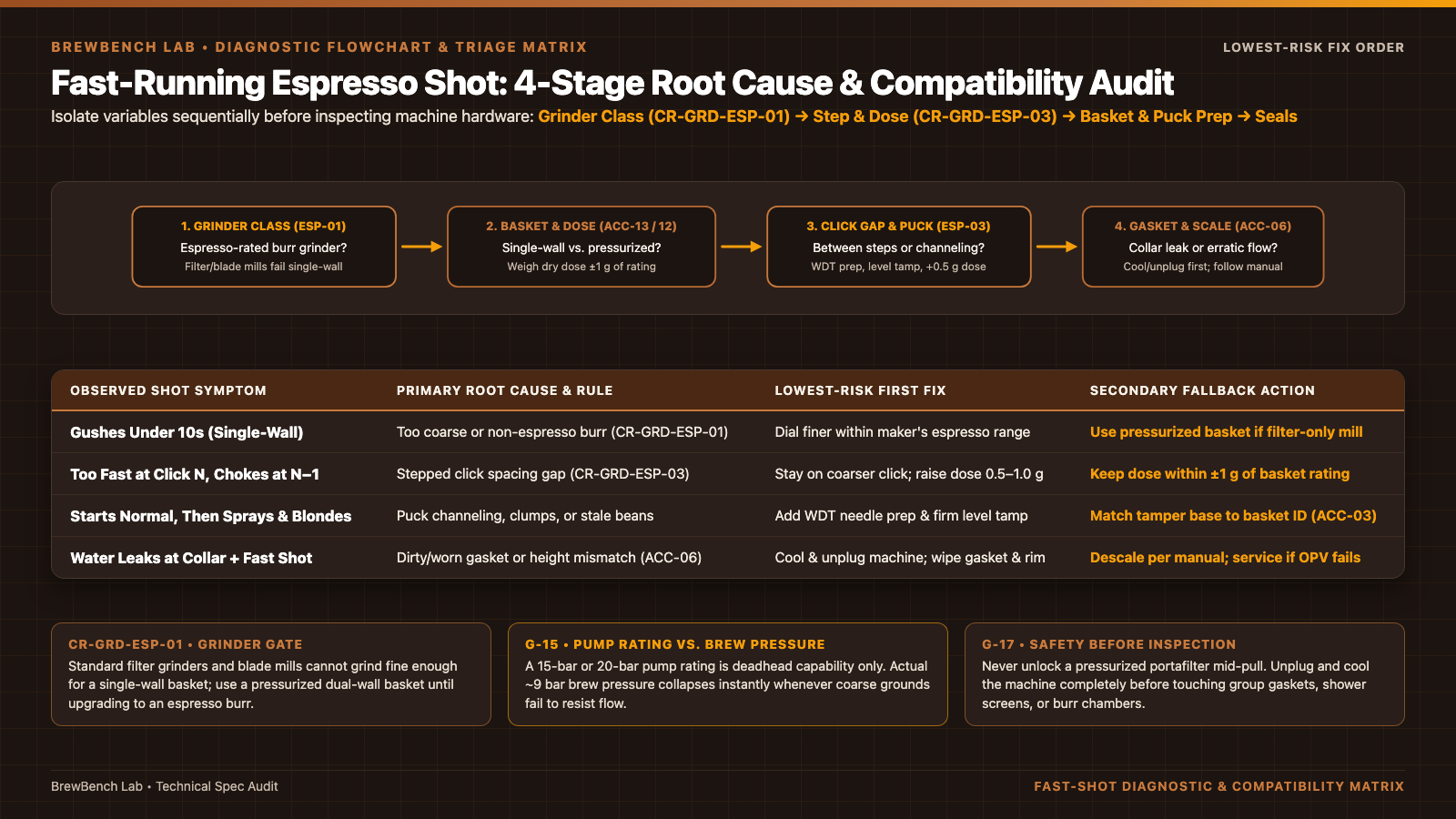
Step 1: Verify Grinder Capability, Adjustment Steps & Bean Freshness
In roughly four out of five fast-shot complaints on single-wall baskets, the espresso machine is operating normally and the bottleneck sits inside the coffee grinder or the coffee beans themselves. Work through three sequential checks on your grinding hardware before touching your portafilter accessories.
1A. Check Manufacturer Espresso Capability (CR-GRD-ESP-01 & CR-SYS-02)
Under hard compatibility gate CR-GRD-ESP-01, a non-pressurized single-wall basket requires a grinder whose manufacturer explicitly rates its burr geometry and minimum clearance for espresso. Blade spice mills chop beans into a chaotic mix of boulders and dust, while filter-only conical or flat burr grinders—such as the standard Baratza Encore (non-ESP), OXO Brew Conical Burr Grinder, or stock Fellow Ode Gen 2—stop their burr travel well short of the fine powder consistency needed to generate ~9 bar of puck resistance.
Mixing up similarly named grinder models is a frequent trap. For example, Baratza’s standard Encore is built strictly for drip and pour-over, whereas the Baratza Encore ESP features an espresso-tuned adjustment mechanism across settings 1 through 20. If you are unsure which chassis sits on your counter, verify the exact model badge in our Baratza Encore vs Encore ESP comparison. Likewise, if you are grinding at home with a filter-only mill or buying grocery-store pre-ground coffee, rule CR-SYS-02 dictates using your machine’s pressurized dual-wall basket until an espresso-capable grinder is in place.
1B. Solve Stepped Grinder Click Gaps & Upper Burr Seating (CR-GRD-ESP-03)
Even with an espresso-capable grinder, stepped adjustment dials can leave you stuck between two adjacent settings: click 12 blasts 40 g (1.41 oz) of espresso out in 14 seconds, while click 11 chokes the pump to a slow drip. Under CR-GRD-ESP-03, stepped entry grinders (such as the Baratza Encore ESP, Breville Smart Grinder Pro, or built-in stepped hoppers on Breville Barista Express or Ninja Luxe Café models) move burrs in fixed mechanical increments rather than infinite stepless threads. Do not force the collar past its factory zero stop, which can bind or damage burr teeth.
Instead, use three clean workarounds when a single click jumps past your target flow:
- Bridge the gap with dry dose weight: Stay on the slightly faster click and increase your dry coffee dose by 0.5 g to 1.0 g (0.02 to 0.04 oz), provided the total weight remains within your basket’s rated capacity and leaves adequate shower-screen headspace.
- Inspect upper burr seating and inner micro-rings: On grinders with removable upper burr carriers—including Breville built-in grinders (which also offer an internal top-burr micro-adjustment setting in the manual) and Baratza Encore ESP ring burrs—a misaligned carrier tab, trapped chaff, or dislodged red/silicone gasket prevents the burrs from closing evenly, causing sudden coarse gushing. Unplug the grinder, vacuum loose chaff, and reseat the carrier flush.
- Use a reference grind starting band: Consult our espresso grind size chart to understand where true espresso texture sits relative to fine table salt and confectioners’ sugar—never guess blind across 40-plus dial steps.
1C. Rule Out Aged, Degassed Coffee Beans
Freshly roasted coffee holds trapped carbon dioxide gas inside its cellular structure. When hot brew water saturates a fresh puck, expanding CO2 creates micro-bubbles and swells the coffee grounds, adding natural hydraulic resistance and producing velvety crema. Beans roasted several months ago—or supermarket bags without a printed “roasted on” date—have largely degassed. Even when ground fine on a capable stepless grinder like a DF64 Gen 2, stale beans offer dramatically lower resistance, causing shots to speed up midway through the pull and pour thin, watery crema. Switching to whole beans roasted roughly 7 to 30 days prior (stored in an opaque, airtight container away from oven heat) often restores normal extraction time without touching the grind dial.
Step 2: Audit Basket Wall Type, Dry Dose Weight & Ratio Controls
If your grinder passes Step 1 and your beans are fresh, inspect the stainless steel filter basket sitting inside your portafilter and measure both dry coffee input and liquid espresso output with a 0.1 g scale (CR-SCALE-ESP-03).
2A. Confirm Single-Wall vs. Pressurized Basket Behavior (CR-ESP-ACC-13)
Hold your clean, empty basket up toward a bright lamp and inspect its bottom face. A non-pressurized (single-wall) basket shows hundreds of open pinpricks of light across the floor, meaning your tamped coffee puck provides 100% of the flow restriction. A pressurized (dual-wall) basket has a sealed outer chamber with only one tiny exit pinhole in the center. If you accidentally swapped a pressurized basket out for the single-wall basket included in a Breville 54 mm box—or bought an aftermarket single-wall upgrade for a 51 mm De’Longhi Dedica or Stilosa—your previous coarse grind will immediately gush in seconds.
Conversely, if you are intentionally using a pressurized basket and shots suddenly run fast and watery, inspect the rubber seal or plastic diffuser inside the spouted portafilter (some 51 mm models use a spring/ball or silicone seat beneath the basket) and verify the dual-wall chamber isn’t cracked or missing an O-ring. Review our pressurized vs non pressurized basket comparison to confirm which basket architecture matches your current grinder.
2B. Weigh Dry Dose to Basket Rating (CR-ESP-ACC-12)
Estimating coffee volume by eye or relying strictly on an uncalibrated hopper timer leads to wide dose swings—especially when switching between dense light-roast beans and bulky dark-roast beans. Under rule CR-ESP-ACC-12, stay within roughly ±1 g of your basket’s manufacturer-rated capacity (typically 16–18 g / 0.56–0.63 oz on 51 mm double baskets, 18–19 g on Breville 54 mm OEM doubles, and 18–20 g on standard 58 mm doubles). Underdosing a deep basket by 2 to 3 grams thins the coffee bed vertically and leaves excessive water headspace above the puck, allowing incoming pump water to churn and erode the bed in seconds.
Just as important: weigh your liquid yield in the cup rather than relying solely on volumetric 1-cup or 2-cup machine buttons. Factory presets on entry thermoblock machines can pump 55–65 g (1.9–2.3 oz) of water by default, making a normal shot look “fast” simply because the machine is pulling a 1:3 lungo rather than a 1:2 espresso. As an editorial starting baseline, weigh a 1:2 ratio (for example, 18 g dry dose in to ~36 g liquid espresso out) over roughly 25 to 30 seconds from pump activation, then follow our structured how to dial in espresso workflow to adjust strictly by taste.
2C. Account for Precision High-Flow Basket Upgrades
Upgrading from a tapered factory basket to a straight-walled precision basket (such as photo-etched or laser-cut IMS 54 mm or 58 mm baskets) changes hydraulic resistance noticeably. Precision baskets feature larger total open hole area and cleaner perforations extending closer to the outer edge. When you drop the same grind size and dose from a stock basket into a high-flow precision basket, shots routinely run several seconds faster. Always dial finer by one or more micro-steps when adopting a precision basket, and verify your puck screen thickness does not crowd shower-screen headspace (CR-ESP-ACC-05).
Step 3: Fix Clumping, Edge Channeling & Tamper Fitment
Sometimes your grind is fine enough on paper, yet a shot starts with slow dark drips for three seconds and then erupts into fast, pale jets. That transition signals channeling—localized cracks or low-density paths where pressurized water punches straight through the puck instead of saturating it uniformly.
3A. Eliminate Clumps & Sidewall Gaps (CR-ESP-ACC-03 & CR-ACC-02)
High-RPM burr grinders generate static electricity that clumps fine coffee grounds into dense marble-sized nodules surrounded by air pockets. Simply leveling the top of a clumpy basket with a spinning palm distributor masks those underlying voids—water tunnels around the dense clumps and blows out the bottom in seconds. Stirring the entire depth of the basket with fine 0.3–0.4 mm WDT needles breaks up clumps and creates uniform bed density before tamping.
Next, inspect your tamper base diameter under rule CR-ESP-ACC-03. Many entry machines ship with lightweight plastic tampers measuring 1 to 2 mm (0.04 to 0.08 in) smaller than the basket’s top inner diameter. An undersized tamper leaves a ring of loose, uncompressed grounds around the outer perimeter wall—the exact path water prefers to travel along the steel sidewall. Pair your basket with a full-size metal or calibrated spring tamper matched to its inner wall (roughly 51 mm for De’Longhi 51 mm baskets, 53.3–53.4 mm for Breville 54 mm baskets, and 58.3–58.5 mm for 58 mm precision baskets). If you use a depth-stop leveler or calibrated palm tamper, remember rule CR-ACC-02: reset its depth collar whenever you change beans, dose weight, or basket depth, or the tamper may bottom out on the basket rim before compressing the puck.
3B. Protect the Tamp Seal Before Locking In
Two subtle habits fracture an otherwise well-prepped puck right before brewing: tapping the side of the portafilter with the tamper handle after compressing the bed (which breaks the puck away from the steel basket wall), and slamming the portafilter carelessly into the group head collar. Tamp firmly once until the coffee stops compressing, gently wipe loose grounds off the basket rim, and lock the portafilter smoothly into the group without jarring it. For deeper visual diagnostics using a naked handle, walk through our espresso channeling fix guide.
Step 4: Inspect Group Gaskets, Shower Screens, Descaling & OPV Behavior
Once grinder capability, bean freshness, basket architecture, dose, and puck prep are all verified, look at the mechanical interface where the portafilter meets the espresso machine. Remember to power off, unplug, and allow the group head and boiler/thermoblock to cool completely before touching metal surfaces or removing seals (G-17).
4A. Group Gasket Wear, Debris & Portafilter Lug Fit (CR-ESP-ACC-01 & CR-ESP-ACC-06)
If water weeps or sprays around the top collar of the portafilter while the shot runs fast and weak, the group gasket is failing to hold ~9 bar against the basket rim. Dried coffee grounds crusted into the gasket groove—or an older rubber gasket that has hardened and cracked from heat cycles—prevent the basket rim from sealing flush. Wipe the gasket channel carefully with a damp microfiber cloth and group brush once cooled. If the portafilter handle turns far past the 6 o’clock center mark (toward 7 or 8 o’clock) or leaks despite a clean rim, replace the gasket with the exact thickness and material (often food-grade silicone) specified by your machine maker.
Also check aftermarket hardware compatibility under CR-ESP-ACC-01 and CR-ESP-ACC-06: a third-party 51 mm or 58 mm portafilter with slightly thinner locking ears, or a “tall” ridgeless precision basket paired with a thin gasket, may not compress tightly enough into the group seal, causing bypass leaks and premature puck washout.
4B. Shower Screen Dispersion & Three-Way Valve Cleaning (CR-ESP-ACC-11)
A shower screen caked with baked-on coffee oils channels incoming brew water into one or two high-velocity streams instead of a gentle rain dispersion, drilling holes straight into the top of your coffee puck. Inspect the screen once cool and wipe it clean; if your manufacturer manual permits removing the central screw for soaking in espresso-machine detergent, follow the torque and reassembly steps carefully.
Follow rule CR-ESP-ACC-11 strictly for backflushing: only machines equipped with a three-way solenoid valve or an explicit manufacturer cleaning-disc cycle should be backflushed with a blind basket. For example, a Gaggia Classic Evo Pro or Rancilio Silvia uses a three-way solenoid valve and supports blind-basket backflushing per its manual, while Breville 54 mm machines ship with a dedicated silicone cleaning disc for their automated flush cycle. Entry thermoblock machines without a three-way valve (such as the De’Longhi Dedica Arte or Stilosa) must never be choked with a blind basket—use only the maker’s rinse procedure.
4C. Water Mineral Scale, Descaling Rules & Level Probes (CR-WTR-ESP-01/02/06)
Mineral scale buildup inside narrow thermoblock passages, pre-infusion restrictors, or the over-pressure valve (OPV) seat can cause unpredictable pressure spikes or erratic flow that mimics channeling. Check your water hardness periodically using hardness strips or your local US utility’s Consumer Confidence Report (CR-WTR-ESP-01), aiming near SCA reference targets (around 68 mg/L or ~4 gpg total hardness as CaCO3, keeping within your machine maker’s stated limits for warranty protection under CR-WTR-ESP-03).
When descaling is due, obey rule CR-WTR-ESP-06 and G-17: use only the descaling solution and cycle specified in your machine’s manual. Never guess DIY vinegar or homemade citric acid ratios—acidic solutions incompatible with aluminum boilers (such as certain aluminum-boiler configurations) or brass fittings can pit internal surfaces or leave off-flavors. Similarly, if your machine uses an autofill boiler with a conductive water-level probe (CR-WTR-ESP-02), avoid running un-remineralized distilled or zero-TDS water, which can cause level-sensor faults and erratic pump cycling; use a balanced remineralized water recipe or the manufacturer’s reservoir filter cartridge.
Step 5: Electrical Boundaries & Authorized Service Escalation
If every consumable and user-serviceable component checks out—fresh whole beans ground fine on an espresso-rated burr grinder, weighed single-wall dose matching basket capacity, WDT and properly sized tamper, clean shower screen, and intact group gasket—yet water still blasts through the group head erratically or pressure drops while the pump sounds strained or unusually loud, stop home troubleshooting. Several internal causes require bench diagnostics:
- Stuck or degraded OPV (Over-Pressure Valve): Debris or mineral scale on the OPV spring seat can cause pressure to swing wildly or fail to regulate pump output cleanly.
- Failing vibratory pump or check valve: Worn internal pump seals or a fatigued three-way solenoid valve can leak pressure back to the drip tray or surge unevenly.
- 120V/60Hz electrical power stability (
CR-ESP-SYS-01/02): Avoid running high-wattage heating appliances (such as electric kettles or toasters) on the same 15A (1,800 W max; 1,440 W continuous) kitchen branch circuit while brewing, and never rely on 15A-to-20A plug adapters or defeat GFCI protection. If a breaker trips or the machine requires a NEMA 5-20R receptacle, consult a licensed electrician.
Do not open the machine’s sealed casing, adjust internal OPV springs without explicit manufacturer instructions, or dismantle pressurized boilers at home. Contact the brand’s US support desk (Breville, Baratza, De’Longhi, Gaggia, or Rancilio USA) or an authorized espresso repair center with your model number, serial code, and exact symptoms.
Prevention & Routine Bar Checklist
Preventing fast, under-extracted shots from creeping back into your morning routine requires simple, repeatable habits rather than constant dial chasing:
- Daily after every pull: Flush the group head briefly with water for 2 seconds after removing the portafilter, wipe the shower screen and basket rim clean, and rinse dual-wall pressurized baskets thoroughly under hot water so stale coffee oils do not dry around the single pinhole.
- Every new bag of beans: Record the roast date, weigh your dry dose to within ±0.1 g of the basket’s rating, and expect to adjust 1 to 3 micro-steps finer as beans age from week one to week four.
- Weekly / Bi-weekly: Run your machine’s manual-approved backflush or cleaning-disc cycle if supported (
CR-ESP-ACC-11), and dry-brush accessible burr chambers per your grinder manual (unplugged) to prevent chaff buildup from shifting burr alignment. - Scheduled intervals per manual: Replace reservoir water filters on time, descale strictly with the manufacturer-approved solution and interval (
CR-WTR-ESP-06), and replace hardened silicone group gaskets before collar leaks develop.
Authoritative Manufacturer & Standards Citations
Every diagnostic step, electrical boundary, water limit, and cleaning warning in this playbook is grounded in manufacturer documentation and recognized coffee engineering standards:
- Baratza Support & Encore ESP Documentation: Baratza Official Support & Grinder Manuals (espresso-range settings 1–20, ring-burr carrier seating, and burr calibration guidance).
- Breville USA Support & Espresso Manuals: Breville US Product Support (54 mm single-wall vs. dual-wall basket specs, upper-burr adjustment, cleaning-disc cycles, and 120V descaling instructions).
- Specialty Coffee Association (SCA): SCA Brewing & Water Quality Standards (target hardness, alkalinity, and TDS ranges for equipment protection and extraction consistency).
- De’Longhi USA Support: De’Longhi US Manuals & Descaling Guidance (51 mm thermoblock maintenance, pressurized basket care, and non-backflush rinse instructions).
- Gaggia Official Support: Gaggia Product Documentation (three-way solenoid valve operation, 58 mm group gasket maintenance, and boiler descaling cautions).
How We Audited This Guide
- Home bar blueprints, upgrade roadmaps, water chemistry guides, and Amazon listing audits were verified against CR-SYS circuit, water-probe, and budget balance rules.
- Every espresso machine, burr grinder, accessory, and scale specification was cross-checked against official manufacturer 120V manuals, SCA water guidance, and verified Amazon US listings.
- Recommendations were evaluated against our weighted espresso-gear scoring rubrics and documented CR-* compatibility rules; we never invent heat-up seconds, PID variance, or micron claims.
Frequently Asked Questions
Why is my espresso shot running too fast even on the finest grind setting?
If your finest setting still gushes, first confirm under CR-GRD-ESP-01 that your grinder is maker-rated for espresso rather than filter-only coffee. Next, unplug the grinder and check whether the upper burr carrier is seated unevenly or clogged with chaff, and confirm your coffee beans are freshly roasted rather than months-old degassed beans.
How fast is too fast for a double espresso shot?
As a practical editorial starting baseline, a 1:2 single-wall double shot typically takes around 25 to 30 seconds from pump activation to reach target yield. Shots finishing in under 15 seconds almost always taste sour, thin, and salty because water moves too quickly to extract balanced sweetness.
Can a stepped grinder cause shots to run too fast on one click and choke on the next?
Yes. Under CR-GRD-ESP-03, stepped grinders move burrs in fixed increments that can straddle the ideal resistance point for a single-wall basket. Stay on the slightly faster click and add 0.5 g to 1.0 g of dry coffee—keeping within ±1 g of your basket’s rated dose—to slow flow cleanly.
Does tamping harder fix an espresso shot running too fast?
Beyond compressing air out of the coffee bed, extra downward muscle force barely slows extraction compared with grind fineness or dose weight. What matters most is a level, consistent tamp using a tamper sized to your basket’s inner diameter (CR-ESP-ACC-03) so water cannot channel down loose perimeter walls.
Why does my 20-bar espresso machine still pull weak, fast shots?
A 15-bar or 20-bar rating indicates the vibratory pump’s maximum deadhead limit against a sealed block, not guaranteed brew pressure. Conventional ~9 bar extraction pressure only builds when finely ground coffee inside a single-wall basket—or the pinhole of a pressurized dual-wall basket—holds back incoming water.
Should I switch to a pressurized basket if my shots keep gushing?
If you rely on pre-ground coffee, a blade mill, or a filter-only burr grinder, switching to a pressurized dual-wall basket inside a spouted portafilter (CR-ESP-ACC-13, CR-SYS-02) is the correct immediate fix. Once you upgrade to an espresso-capable burr grinder, return to a single-wall basket for richer texture and flavor.


