
Disclosure: As an Amazon Associate, I earn from qualifying purchases. If you buy through links on this page, we may earn a small commission at no extra cost to you.
Choosing between a pressurized vs non pressurized basket decides whether your home espresso machine relies on a mechanical pinhole or your coffee grounds to generate brewing pressure. A pressurized (dual-wall) filter basket traps water above a secondary floor with one tiny exit hole, producing reliable crema even from supermarket pre-ground coffee or coarse grinders. A non-pressurized (single-wall) basket opens hundreds of direct perforations across the bottom, forcing finely ground, evenly tamped espresso to build roughly 9 bar of natural resistance—unlocking deeper sweetness and syrupy texture only when paired with an espresso-capable burr grinder.
Inside our best espresso accessories hub, few hardware choices trigger more confusion or wasted money than swapping baskets without checking grinder capability and portafilter fitment. This side-by-side audit evaluates both basket architectures across US 120V machines—from compact 51 mm De’Longhi Dedica and Stilosa units to 54 mm Breville Bambino/Barista lines and 58 mm single-boiler platforms—governed strictly by BrewBench Lab compatibility gates CR-ESP-ACC-13, CR-GRD-ESP-02, and CR-ACC-01.
In This Comparison
- Winner by Use Case: Quick Verdict Matrix
- Side-by-Side Spec & Compatibility Table
- Battleground 1: Hydraulic Pressure & Crema Physics
- Battleground 2: Grinder Pairing & The Upgrade Bottleneck
- Battleground 3: 51 mm, 54 mm & 58 mm Fitment + Bottomless Rules
- Battleground 4: Cleaning, Residue & Maintenance
- Choose Pressurized vs. Choose Non-Pressurized
- Verified Amazon US Baskets Compared
- Frequently Asked Questions
Quick Verdict Matrix: Pressurized vs. Non-Pressurized by Use Case
Neither basket design is universally superior without context. The right choice depends entirely on how you source coffee, whether your grinder can adjust in fine espresso steps, and what you prioritize in the cup.
| Use Case & Kitchen Profile | Recommended Basket | Deciding Compatibility Rule | Practical Outcome |
|---|---|---|---|
| Best for Pre-Ground Coffee & Entry Grinders | Pressurized (Dual-Wall) | CR-SYS-02 / CR-ESP-ACC-13 | Prevents sour gushing when using supermarket grounds, blade mills, or filter-only burrs. |
| Best for Straight Espresso & Light Roasts | Non-Pressurized (Single-Wall) | CR-GRD-ESP-01 / CR-DRINK-GRD-01 | Reveals origin clarity, balanced acidity, and dense natural crema with fine fresh grinds. |
| Best for Daily Milk Drinks (Lattes & Cortados) | Non-Pressurized (with Burr Grinder) | CR-GRD-ESP-03 / CR-ESP-ACC-12 | Rich 1:2 extraction cuts cleanly through steamed milk; use dual-wall only if buying pre-ground. |
| Best Value & Ecosystem Cost | Single-Wall + Entry Espresso Burr | CR-GRD-ESP-02 / CR-SYS-01 | Pressurized saves money upfront, while an entry espresso burr unlocks the full machine ceiling. |
| Best Compact Kitchen Footprint | Tie (Portafilter Dependent) | CR-ESP-SYS-04 / CR-GRD-SYS-01 | Both baskets share identical portafilter dimensions; dual-wall skips counter space for a grinder. |
Side-by-Side Spec & Compatibility Comparison
Before comparing flavor profiles, look closely at how pressurized dual-wall baskets and non-pressurized single-wall (including aftermarket precision) baskets differ mechanically across portafilter sizes, grinder rules, and budget tiers.
| Specification / Audit Dimension | Pressurized (Dual-Wall) Basket | OEM Non-Pressurized (Single-Wall) | Precision Non-Pressurized (IMS / HE) |
|---|---|---|---|
| Floor Architecture | Inner perforated screen + sealed chamber + 1 bottom exit pinhole | Single stamped stainless steel floor with ~300–500+ open holes | Photo-etched or laser-cut flat/convex floor (585–800+ uniform holes) |
| Primary Resistance Source | Restricted single-pinhole outlet valve | Compacted, finely ground fresh coffee puck | Finely ground coffee puck + tighter hole uniformity |
| Pump Rating vs. Brew Pressure | 15–20 bar max pump rating pushes through pinhole at ~8–9 bar chamber pressure | 15–20 bar pump rating reaches ~9 bar only if puck density holds back flow | Same ~9 bar target; faster open-area floor requires slightly finer grind |
| Grinder Requirement (CR-GRD-ESP-01) | None strictly required; handles pre-ground and coarse burrs | Mandatory espresso-capable burr grinder (stepless or fine micro-step) | Fine micro-step or stepless espresso burr + WDT puck prep |
| Bottomless Portafilter Fit (CR-ACC-01) | Poor match—high-velocity single jet sprays sideways without diagnostics | Ideal match—exposes channeling and even extraction convergence | Best-case match—straight walls show edge-to-center extraction clearly |
| Common Diameter Standards | 51 mm (De’Longhi/budget), 54 mm (Breville), rare 58 mm | 51 mm, 54 mm, and 58 mm OEM sizes | 51 mm (IMS DL), 54 mm (IMS B62.5), and wide 58 mm ecosystem |
| Included in US Retail Boxes | Standard on most machines under $400 (sole basket on many 51 mm models) | Included alongside dual-wall on Breville 54 mm & 58 mm machines | Aftermarket upgrade only (Under $30 tier) |
| Cleaning & Oil Trap Risk | High—inner chamber traps stale oils and debris around exit pinhole | Low—direct open perforations rinse clean in seconds | Very low—electropolished or laser-cut holes clear easily |
| Typical Budget Tier (TIER-ACC-BUDGET) | Under $30 (replacement SKU) | Under $30 (OEM replacement SKU) | Under $30 to $30–$60 (TIER-ACC-BUDGET / PREMIUM) |
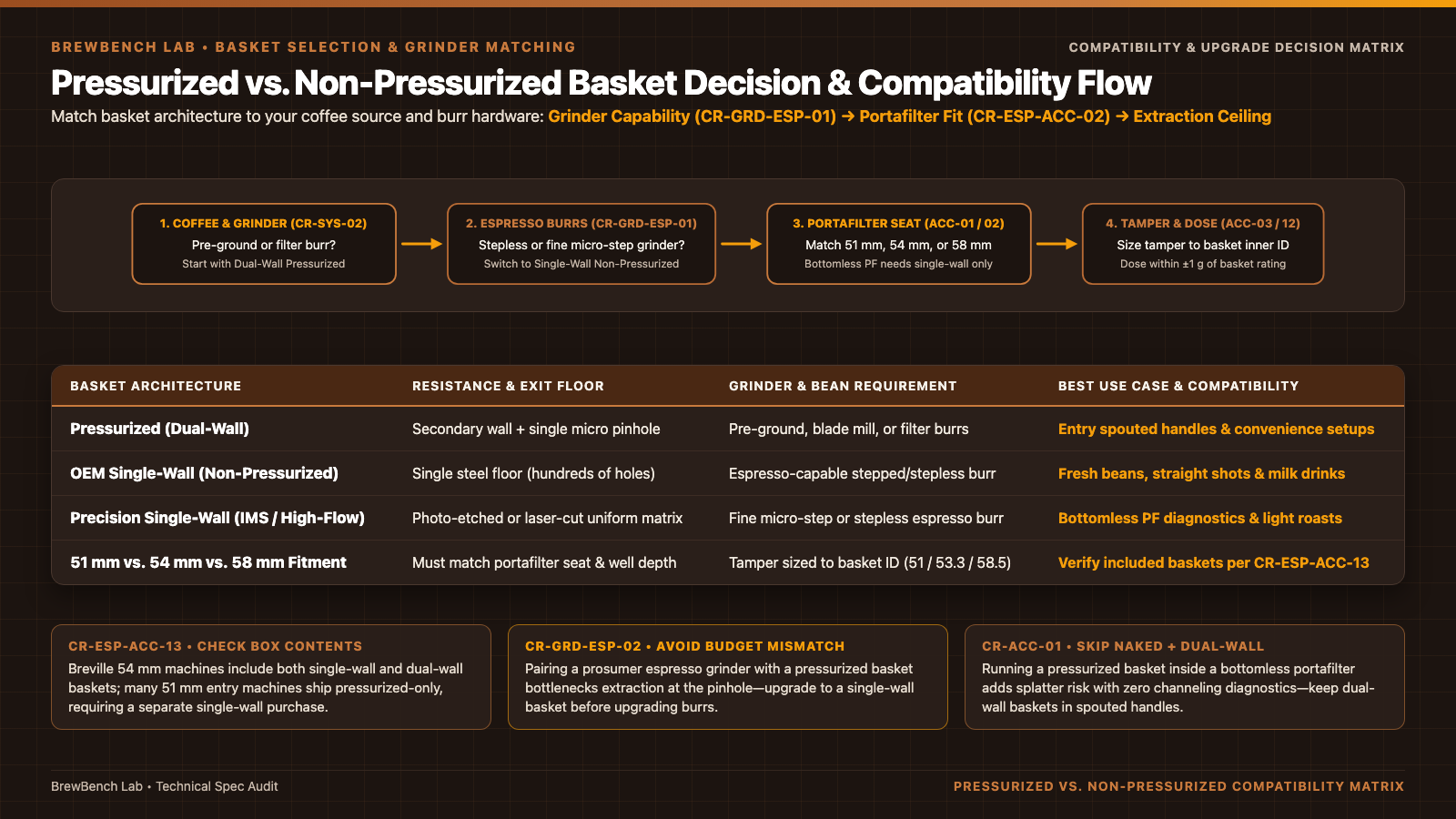
Battleground 1: Hydraulic Pressure, Pump Ratings & Crema Physics
To understand the real gap between a pressurized and non-pressurized filter basket, you first have to separate marketing pump numbers from what actually happens inside the portafilter. Many entry-level machines advertised on Amazon US—especially 51 mm thermoblock units in the under-$200 and $200–$400 classes—promote “15-bar” or “20-bar” vibration pumps. Under our anti-fabrication and physics rules, that 15-bar or 20-bar figure represents the pump’s maximum deadhead capability against a sealed block, not the pressure used to brew espresso. Across modern espresso standards, balanced extraction targets roughly 9 bar of pressure across the coffee bed.
With a non-pressurized single-wall basket, the stainless steel basket itself provides almost zero hydraulic resistance. Water pumped from the group head hits a bed of 16 to 22 grams of finely ground, tamped coffee (roughly 0.6 to 0.8 oz dry dose, sized to the basket rating under CR-ESP-ACC-12). Because those micro-particles pack tightly together, the coffee puck itself holds water back until pressure climbs to roughly 9 bar (or the machine’s over-pressure valve limit). Hot water then dissolves coffee solids and emulsifies natural bean oils into a dense, velvety liquid topped with genuine crema—microscopic carbon dioxide bubbles stabilized by melanoidins and lipids from freshly roasted beans.
A pressurized dual-wall basket bypasses the puck’s need to create resistance. Inside the cup, you see a normal grid of holes where coffee grounds rest. Flip the basket upside down, however, and there is only one tiny pinhole centered in a second outer floor. Brew water passes effortlessly through coarse or pre-ground coffee, hits the solid secondary floor, and backs up inside the sealed chamber until pressure builds enough to jet through that single exit orifice. As coffee shoots out at high velocity through the pinhole, it whips air into the liquid—creating thick, light-colored foam that mimics espresso crema visually even when using stale, pre-ground coffee.
The flavor trade-off is structural, not cosmetic. Because water moves rapidly through coarse particles before pausing above the pinhole, extraction is less uniform: fine bits over-extract slightly while larger chunks under-extract, producing thinner body and a hollower finish compared with a dialed-in single-wall pull. Pressurized foam also tends to have larger, soap-like bubbles that break apart quickly rather than folding smoothly into steamed milk.
Battleground 2: Grinder Pairing & Avoiding the Compatibility Trap
The single most important rule governing any basket swap is CR-GRD-ESP-01 alongside whole-setup gate CR-SYS-02: you cannot run a non-pressurized single-wall basket without an espresso-capable burr grinder. Blade mills chop beans into uneven boulders and dust; filter-only burr grinders—such as the stock Baratza Encore (non-ESP) or Fellow Ode Gen 2—simply cannot bring their burrs close enough together to create puck resistance. Put pre-ground drip coffee or filter-ground beans into a single-wall basket, and the machine’s pump will blast pale, sour water straight through the puck in five seconds flat.
Equally important is the reverse trap flagged by rule CR-GRD-ESP-02: spending money on a prosumer flat-burr or single-dose grinder while leaving a pressurized basket locked in your portafilter. Because the dual-wall pinhole dictates flow speed and pressure regardless of particle uniformity, a high-end burr set cannot express its flavor separation through a pressurized valve. Before investing past an entry grinder tier, make sure your machine either includes or accepts a single-wall basket (CR-ESP-ACC-13).
If you are shopping for your first setup, look closely at how machines under $400 package their baskets. As we detail in our guide to the best espresso machines for beginners, 54 mm machines such as the Breville Bambino and Barista Express ship with both dual-wall and single-wall baskets in the box—letting you start safely with pressurized pulls and switch to single-wall the day you add a capable grinder. By contrast, many 51 mm entry machines (including several De’Longhi Dedica and Stilosa configurations and budget Amazon thermoblocks) ship strictly with pressurized baskets, requiring a separate single-wall basket purchase before an external burr grinder pays off.
When you are ready to leave pressurized baskets behind, you do not need to overspend on massive commercial burrs immediately. Pairing a single-wall basket with one of our audited espresso grinders under $200—such as the Baratza Encore ESP (which Baratza explicitly designs with finer-stepped espresso settings 1 through 20) or an espresso-focused manual burr grinder—satisfies CR-GRD-ESP-01 and lets you taste the immediate jump in sweetness and body. Remember rule CR-GRD-ESP-03 as well: stepped grinders adjust in discrete clicks, so fine-tuning a single-wall shot sometimes involves adjusting your dry coffee dose by 0.5 g when one click runs slightly fast and the next chokes the puck.
Battleground 3: 51 mm, 54 mm & 58 mm Fitment + Bottomless Rules
Even once your grinder passes muster, mechanical compatibility rules determine which replacement basket actually locks into your group head and accepts your tamper.
Match Nominal Basket Seat Diameter (CR-ESP-ACC-02)
Baskets are never cross-compatible across diameter families. Under CR-ESP-ACC-02, the basket’s nominal seat must match your portafilter’s internal basket seat:
- 51 mm (STD-PF-51): Common across De’Longhi Dedica (EC685, Arte EC885), De’Longhi Stilosa (EC260), La Specialista models, and many compact budget machines. Because lug counts vary across 51 mm portafilter handles (CR-ESP-ACC-01), check the basket height and rim lip against your specific handle.
- 54 mm (STD-PF-54): Standard on Breville 54 mm consumer platforms (Bambino, Bambino Plus, Barista Express, Barista Pro, Barista Touch). Breville OEM baskets and IMS B62.5 series upgrades drop directly into the stock 54 mm portafilter or Breville-pattern 3-ear bottomless handles.
- 58 mm (STD-PF-58): Used on Gaggia Classic Evo Pro, Rancilio Silvia, and Breville Dual Boiler / Oracle Jet machines. Almost every prosumer machine runs non-pressurized baskets by default, with deep aftermarket support covered in our 58 mm precision espresso baskets guide.
Why Bottomless Portafilters Reject Pressurized Baskets (CR-ACC-01)
A frequent beginner mistake is snapping a dual-wall pressurized basket into a new bottomless (naked) portafilter hoping to see rich tiger-striping. Under rule CR-ACC-01, pairing a bottomless portafilter with a pressurized basket creates mess risk with zero diagnostic payoff. Instead of coalescing slowly across hundreds of holes into a centered honey-like stream, a pressurized basket fires a high-velocity jet out of a single pinhole directly into open air—often sputtering espresso sideways onto kitchen cabinets. Furthermore, some dual-wall baskets have flared lower profiles or lack compatibility with spring-less bottomless rings. Save your bottomless portafilter exclusively for single-wall non-pressurized baskets, where exposed perforations reveal uneven tamping or channeling immediately.
Tamper Sizing & Dose Discipline (CR-ESP-ACC-03 & CR-ESP-ACC-12)
Pressurized baskets are deliberately forgiving of light tamping because the pinhole handles backpressure. Single-wall baskets have no safety net: under CR-ESP-ACC-03, your tamper base must match the basket’s actual upper inner diameter rather than its nominal portafilter label. For example, 54 mm Breville single-wall and IMS baskets typically pair best with a 53.3 mm or 53.4 mm precision tamper so grounds along the outer wall compress evenly without leaving a soft perimeter ring. Similarly, stay within roughly ±1 g of the basket’s rated dose (CR-ESP-ACC-12): underdosing leaves a wet, soupy puck, while overdosing presses dry coffee into the shower screen—especially if you add a metal puck screen (CR-ESP-ACC-05).
Battleground 4: Cleaning, Clogged Pinholes & Machine Care
Day-to-day maintenance favors non-pressurized baskets decisively. A single-wall basket is a single sheet of stainless steel: hold it up to a kitchen light after rinsing, and you can immediately spot whether every perforation is clear. If coffee oils darken the steel over weeks of pulling medium-dark roasts, soaking an uncoated stainless steel basket per your espresso cleaner’s instructions restores bare metal quickly.
Pressurized dual-wall baskets contain an inaccessible internal cavity sandwiched between the inner screen and outer floor. Micro-fines and rancid coffee oils slowly migrate through the upper holes and bake inside that hidden pocket, leading to bitter off-notes or sudden pinhole blockages where shots choke completely regardless of grind size. Always follow your machine manual’s specific basket cleaning routine—most manufacturers advise running hot water rinses, using the supplied cleaning pin carefully without widening the calibrated exit hole, or following brand-approved cleaning cycles rather than forcing sharp wires into the orifice or submerging coated parts in unapproved harsh chemicals.
Two additional safety and longevity rules apply regardless of which basket sits in your handle: first, under CR-ESP-ACC-11, only perform blind-basket detergent backflushing on machines equipped with a three-way solenoid valve or an explicit manufacturer cleaning-disc cycle—never trap pressure inside a group head that lacks a relief valve. Second, under CR-WTR-ESP-06 and CR-WTR-ESP-02, always descale using the exact solution and schedule specified in your machine’s manual (never improvised DIY acid mixtures), and avoid running pure un-remineralized distilled water in machines that rely on conductive mineral probes or warranty-compliant recipe water.
Head-to-Head Summary: Which Basket Should You Use?
Choose a Pressurized (Dual-Wall) Basket If…
- You buy pre-ground espresso cans, supermarket bags, or grind on a blade or filter-only grinder (CR-SYS-02).
- You want thick, forgiving crema in a spouted portafilter with minimal puck-prep tools or dialing-in steps.
- You occasionally brew older roasted beans past peak freshness that lack enough natural CO2 for single-wall resistance.
- You are staying strictly within an entry starter setup before budgeting for an espresso-capable burr grinder.
Choose a Non-Pressurized (Single-Wall) Basket If…
- You own (or are buying) an espresso-capable stepless or fine micro-step burr grinder (CR-GRD-ESP-01).
- You brew freshly roasted whole beans and want richer body, cleaner sweetness, and real crema that holds in milk drinks.
- You want to use a bottomless portafilter to diagnose channeling and dial in brew ratios with a 0.1 g scale (CR-ACC-01, CR-SYS-03).
- You want easy single-piece rinsing without hidden internal oil chambers to scrub.
If you are planning your transition step by step—figuring out whether to buy a grinder, tamper, scale, or precision basket first—follow our first espresso upgrades roadmap so every dollar eliminates your actual bottleneck instead of stalling behind a dual-wall pinhole.
Verified Amazon US Pressurized & Non-Pressurized Baskets Compared
Need a verified OEM replacement or an immediate single-wall upgrade for a 54 mm Breville or 51 mm De’Longhi machine? Below are four verified Amazon US filter baskets representing both basket architectures—each audited for exact portafilter seat fitment, steel build, and grinder pairing rules.
1. Breville Single Wall Filter Basket 54 mm, 2 Cup — Best OEM 54 mm Non-Pressurized Reference

Quick Specs: 54 mm Breville seat (STD-PF-54) | 2-cup single-wall non-pressurized | Stainless steel | Fits Breville Bambino, Bambino Plus, Barista Express, Barista Pro, Barista Touch | Price Tier: Budget-friendly (Under $30)
Best For: Breville 54 mm owners replacing a misplaced or dented factory single-wall double basket who want guaranteed OEM retaining-spring fitment and predictable factory flow.
Skip If: You rely on pre-ground coffee (choose the dual-wall basket below) or want straight, ridgeless precision walls for higher-extraction light roasts.
Pros
- Genuine Breville OEM 54 mm geometry seats flush inside stock spouted and 3-ear bottomless handles (CR-ESP-ACC-02)
- Single-wall multi-hole floor pairs directly with built-in Barista Express/Pro burrs or entry espresso grinders
- Ridged outer groove locks securely against standard Breville portafilter retaining springs during knockouts
Cons
- Tapered lower walls narrow slightly near the base, limiting extraction area compared with straight-wall IMS precision baskets
- Requires an espresso-capable burr grinder and careful tamping—shots gush sour liquid if fed coarse or pre-ground coffee (CR-GRD-ESP-01)
Audit Note: Breville ships this exact 2-cup single-wall basket in the box with current US 54 mm machines (CR-ESP-ACC-13), making it the cleanest baseline reference before stepping up to precision laser or photo-etched sleeves.
2. BES860XL 54 mm Double Cup Dual-Wall Filter Basket — Best 54 mm Pressurized Replacement

Quick Specs: 54 mm Breville seat (STD-PF-54) | 2-cup dual-wall pressurized (single exit pinhole) | Stainless steel | Listed for Breville BES860XL / BES870XL / Bambino 54 mm portafilters (confidence C retailer compatibility) | Price Tier: Budget-friendly (Under $30)
Best For: Breville 54 mm households sharing a machine between someone using pre-ground coffee and someone using freshly ground beans, or anyone recovering a clogged/lost pressurized basket.
Skip If: You already own a dedicated espresso grinder or brew inside a 54 mm bottomless portafilter (CR-ACC-01).
Pros
- Single-pinhole dual-wall floor builds reliable backpressure with pre-ground espresso or coarse filter grinders (CR-SYS-02)
- Forgiving of uneven tamping and older grocery-store beans
- Affordable Under-$30 spare that lets mixed households switch baskets in seconds
Cons
- Enclosed dual-wall pocket traps fine grounds and coffee oils, risking pinhole clogs if hot rinsing is skipped
- Caps extraction ceiling and produces unstable spray inside bottomless portafilters (CR-ACC-01, CR-GRD-ESP-02)
Audit Note: Exact internal hole count and wall gauge are not published by this third-party seller (no verified data available yet beyond 54 mm Breville fitment claims, confidence C). Keep this strictly inside a spouted portafilter for pre-ground convenience.
3. IMS Precision 18–22g Filter Basket B62.52TH28E (54 mm) — Best 54 mm Non-Pressurized Precision Upgrade

Quick Specs: 54 mm Breville seat (62.5 mm border / 54.5 mm body ID) | 28 mm height | Rated dose: 18–22 g | AISI 304 stainless steel, single-wall precision | Fits Breville Bambino, Bambino Plus, Barista Express, Barista Pro | Price Tier: Budget-friendly (Under $30)
Best For: Breville 54 mm owners already running an espresso-capable grinder (or Barista Express/Pro built-in grinder) who want straighter cylindrical walls, cleaner puck knockouts, and higher dose room than stock Breville baskets.
Skip If: You still brew with a stock shallow spouted Breville portafilter that has the plastic insert in place, or you lack a 53.3–53.4 mm precision tamper and fine grinder control.
Pros
- Italian-made AISI 304 precision hole uniformity reduces localized channeling compared with stamped factory floors
- Straight vertical sidewalls pair cleanly with 53.3–53.4 mm tampers from rim to puck floor (CR-ESP-ACC-03)
- Generous 28 mm depth accommodates 18–22 g doses plus a 53.5 mm puck screen without shower contact (CR-ESP-ACC-05)
Cons
- 28 mm tall profile frequently bottoms out against the black plastic flow insert inside stock Breville spouted portafilters unless removed or paired with a 54 mm bottomless handle (CR-ESP-ACC-06)
- Faster precision hole flow demands dialing several steps finer on stepped grinders (CR-GRD-ESP-03)
Audit Note: Under CR-ESP-ACC-06, always verify vertical portafilter clearance before ordering a 28 mm basket—many Bambino and Barista Express owners pair the B62.52TH28E directly with a 54 mm bottomless portafilter for seamless clearance and visual feedback.
4. IMS Precision 16–18g Filter Basket DL2TH26E (51 mm De’Longhi) — Best 51 mm Non-Pressurized Upgrade

Quick Specs: 51 mm De’Longhi seat (STD-PF-51) | 26 mm height | Rated dose: 16–18 g | AISI 304 stainless steel, single-wall precision | Compatible with De’Longhi Dedica & La Specialista 51 mm portafilters | Price Tier: Budget-friendly (Under $30)
Best For: De’Longhi Dedica and La Specialista owners whose machines shipped exclusively with pressurized dual-wall baskets (CR-ESP-ACC-13) and who have added an espresso-capable burr grinder.
Skip If: You have not upgraded to an espresso-capable grinder yet, or you own a 54 mm Breville or 58 mm portafilter machine (CR-ESP-ACC-02).
Pros
- Unlocks true unpressurized espresso dialing on 51 mm De’Longhi machines limited by stock dual-wall baskets (CR-ESP-ACC-13)
- AISI 304 precision perforations offer consistent flow across a practical 16–18 g double-shot capacity
- Straighter interior walls improve edge compression when paired with a true 51 mm metal tamper
Cons
- 26 mm height can clash with the internal plastic diffuser inside OEM De’Longhi Dedica spouted portafilters unless modified or paired with a 51 mm bottomless portafilter (CR-ESP-ACC-06)
- Strictly requires an espresso-capable grinder—pre-ground coffee will immediately gush through the single-wall floor (CR-GRD-ESP-01)
Audit Note: Remember CR-ESP-ACC-01 when pairing this 51 mm basket with an aftermarket bottomless handle: verify the portafilter listing explicitly matches your exact De’Longhi Dedica or Stilosa ear count (2-ear vs. 3-ear) before checkout.
How We Audited This Guide
- Portafilters, precision baskets, tampers, coffee scales, and water filters were audited for basket inner-diameter matching, drip-tray cup clearance, OEM cartridge locks, and 0.1g accuracy.
- Every espresso machine, burr grinder, accessory, and scale specification was cross-checked against official manufacturer 120V manuals, SCA water guidance, and verified Amazon US listings.
- Recommendations were evaluated against our weighted espresso-gear scoring rubrics and documented CR-* compatibility rules; we never invent heat-up seconds, PID variance, or micron claims.
Frequently Asked Questions: Pressurized vs. Non-Pressurized Baskets
What is the main difference between a pressurized and non-pressurized espresso basket?
A pressurized dual-wall basket uses a secondary outer wall with one tiny exit pinhole to build resistance for coarse or pre-ground coffee. A non-pressurized single-wall basket has hundreds of direct holes, relying entirely on finely ground, tamped coffee to generate ~9 bar brewing pressure.
Can I use pre-ground coffee in a non-pressurized single-wall basket?
No—standard store-bought pre-ground coffee is almost always ground too coarsely and loses volatile gases quickly. Inside a single-wall basket under CR-SYS-02, pre-ground coffee cannot restrict water flow enough, causing shots to gush watery, sour liquid in seconds without real crema.
Does a pressurized basket work inside a bottomless portafilter?
While a matching-diameter pressurized basket may physically drop in, rule CR-ACC-01 advises against it. A dual-wall exit pinhole shoots a pressurized stream erratically into open air without showing channeling across the coffee puck, creating kitchen splatter with zero diagnostic benefit.
How can I tell visually if my espresso basket is pressurized or non-pressurized?
Hold the empty basket up toward a bright light and inspect the underside. A non-pressurized single-wall basket shows hundreds of pinpricks of light across the bottom, whereas a pressurized dual-wall basket reveals a smooth outer floor with only a single tiny exit pinhole.
Why does a pressurized basket produce thicker-looking foam than a single-wall basket?
Pressurized baskets force hot espresso through a single micro-orifice at high velocity, whipping air into an aerated layer of large foam bubbles. A single-wall basket extracts genuine crema directly from dissolved CO2 and coffee oils, creating denser microfoam that lasts longer in milk.
What size single-wall basket upgrade fits a Breville Bambino or De’Longhi Dedica?
Under CR-ESP-ACC-02, Breville Bambino and Barista series machines require 54 mm baskets (such as Breville’s OEM 2-cup single-wall or IMS B62.52TH28E), while De’Longhi Dedica models require 51 mm baskets (such as the IMS DL2TH26E) matched to your portafilter well depth.
Authoritative Technical References
- Breville USA Official Support & 54 mm Filter Basket Documentation — Confirmed OEM inclusion of both dual-wall and single-wall 54 mm baskets across US consumer machines.
- De’Longhi US Official Dedica & Stilosa Product Documentation — Verified 51 mm portafilter sizing, pressurized filter specifications, and manufacturer cleaning instructions.
- IMS Filtri Precision Basket Technical Data Sheets — Verified AISI 304 metallurgy, 28 mm (54 mm B62.52TH28E) and 26 mm (51 mm DL2TH26E) basket heights, and rated dose ranges.
- Specialty Coffee Association (SCA) Brewing & Extraction Standards — Baseline extraction physics, grind uniformity principles, and ~9 bar brewing mechanics.


