
Disclosure: As an Amazon Associate, I earn from qualifying purchases. If you buy through links on this page, we may earn a small commission at no extra cost to you.
Most home baristas buy espresso upgrades backward. They buy a wooden bottomless portafilter, a heavy stainless distributor, and a puck screen before owning a 0.1 g espresso scale or a burr grinder capable of single-wall extraction—only to watch their new bottomless portafilter spray coffee across the backsplash while shots gush out in 11 seconds. Identifying the espresso upgrades worth buying in the right sequence prevents wasted accessory spend, avoids portafilter lock-in mistakes, and targets the actual mechanical bottleneck limiting your cup.
In our broader home espresso setup guide, we outline how machines, grinders, scales, and water chemistry interact as a closed system. This upgrade roadmap translates those system rules into a strict, step-by-step purchase order for North American 120V/60Hz bars—whether you are starting from a pressurized starter machine (UC-BEGINNER-ONE-BOX), dialing straight espresso (UC-STRAIGHT-ESPRESSO), or building a daily milk-drink station (UC-MILK-DRINKS-DAILY).
The 4-Stage Upgrade Order (Never Skip Upstream Gates):
- Stage 1 — Measurement & Compression (
CR-SYS-03, ~5%–10% of Bar Budget): Buy a 0.1 g timer scale and a full-size metal tamper sized to your basket’s inner diameter before touching portafilters or machines. - Stage 2 — Grind Quality & Single-Wall Unlock (
CR-GRD-ESP-01/CR-ESP-ACC-13, ~30%–35%): Upgrade to a manufacturer-rated espresso burr grinder before switching from pressurized (dual-wall) baskets to single-wall baskets. - Stage 3 — Ecosystem Prep, Cupware & Water (
CR-ESP-ACC-01/CR-WTR-ESP-01, ~5%–12%): Add WDT needles, lug-matched bottomless portafilters (only after Stage 2), low-height thermal cupware, and hardness strips plus manual-approved descaler. - Stage 4 — Espresso Machine Step-Up Last (
CR-DRINK-ESP-01/03/CR-ESP-SYS-01, ~45%–60%): Replace the machine only when thermal stability, three-way solenoid cleanup, or simultaneous brew-and-steam capacity becomes your true bottleneck—after confirming 15A vs. 20A 120V circuits.
In This Upgrade Roadmap
- Complete 4-Stage Espresso Upgrade Order Table
- Stage 1: 0.1 g Scale & Basket-Sized Tamper (CR-SYS-03)
- Stage 2: Espresso Grinder & Single-Wall Basket Transition (CR-ESP-ACC-13 & CR-GRD-ESP-02)
- Stage 3: Matched Portafilter Prep, Thermal Cupware & Water Chemistry
- Stage 4: When an Espresso Machine Upgrade Is Actually Worth Buying
- Compatibility Proof Matrix & 120V Circuit Safety Box
- Verified Amazon US Upgrade Picks (8 Audited SKUs)
- Upgrades & Pairings to Skip (Technical Audit)
- Frequently Asked Questions
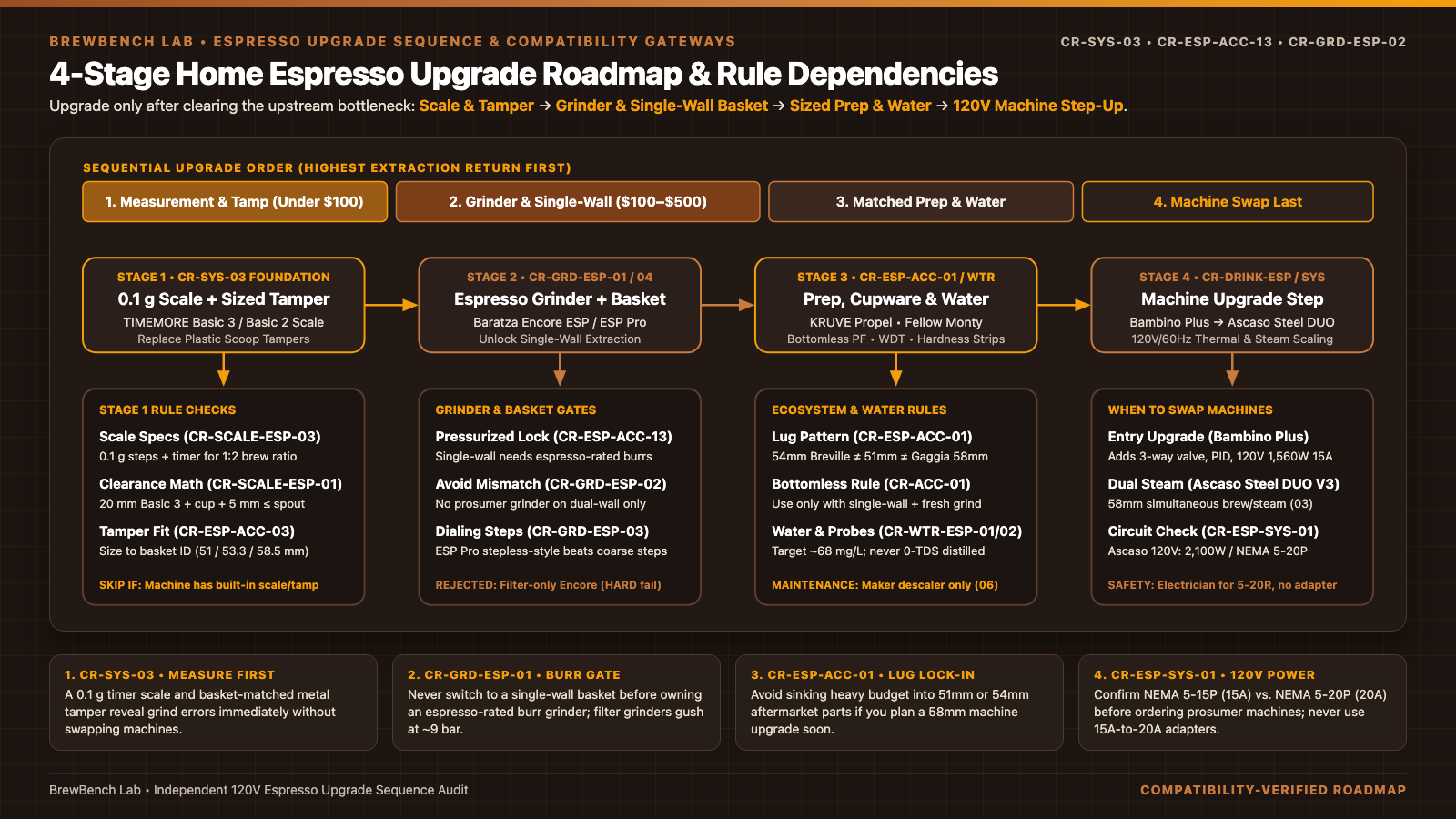
Complete 4-Stage Espresso Upgrade Order Table
Before buying any gear, audit your current bench against this sequential parts table. Every pick below meets North American 120V/60Hz requirements where powered, carries a verified Amazon US ASIN, and resolves a specific rule gate without forcing premature hardware turnover.
| Upgrade Order & Bench Role | Verified Pick | Key Compatibility Spec & Rule | Budget Tier | Amazon Link |
|---|---|---|---|---|
| Stage 1A: 0.1 g Scale (Primary) | TIMEMORE Black Mirror Basic 3 | 0.1 g / 2,000 g • 120 × 140 × 20 mm • Ratio & flow readout (CR-SYS-03 / CR-SCALE-ESP-01) | $30–$60 (TIER-SCALE-ENTRY) | Check Price on Amazon |
| Stage 1B: 0.1 g Scale (Alt) | TIMEMORE Black Mirror Basic 2 | 0.1 g / 2,000 g • 130 × 152 × 26 mm • Physical power switch (CR-SCALE-ESP-03) | $30–$60 (TIER-SCALE-ENTRY) | Check Price on Amazon |
| Stage 1C: Basket-Sized Tamper | Machined Metal Tamper (51 / 53.3 / 58.5 mm) | Matched to basket inner diameter, not portafilter label (CR-ESP-ACC-03) | Under $50 (TIER-ACC-BUDGET) | Match exact basket ID first |
| Stage 2A: Grinder (Entry) | Baratza Encore ESP (ZCG495BLK) | 40mm M2 conical • 20 fine espresso steps • 120V ~70W–80W (CR-GRD-ESP-01) | $100–$200 (TIER-GRD-ENTRY) | Check Price on Amazon |
| Stage 2B: Grinder (Step-Up) | Baratza Encore ESP Pro (ZCG595BLK) | Stepless-style dial • Single Dose + 0.1s timer • 120V ~130W (CR-GRD-ESP-03/04) | $200–$500 (TIER-GRD-MID) | Check Price on Amazon |
| Stage 3A: Straight Shot Cups | KRUVE Propel 2.5 oz Glasses (Set of 2) | Low demitasse height preserves spout clearance above scales (CR-SCALE-ESP-01) | $30–$60 (TIER-ACC-BUDGET) | Check Price on Amazon |
| Stage 3B: Milk Drink Mug | Fellow Monty 6.5 oz Cappuccino Mug | Double-wall ceramic + parabolic latte-art base (size-agnostic workflow) | Under $30 (TIER-ACC-BUDGET) | Check Price on Amazon |
| Stage 3C: Water & Descaler | Hardness Strips + OEM Filter / Recipe + Descaler | Target ~68 mg/L CaCO3 (~4 gpg); manual-only descaler (CR-WTR-ESP-01/02/06) | 1%–5% (TIER-WTR-BASIC) | Follow machine manual schedule |
| Stage 4A: Machine Step-Up | Breville Bambino Plus (BES500BST) | 54mm Breville lugs • ThermoJet PID • 3-way valve • 120V 1,560W NEMA 5-15P | $200–$500 (TIER-ESP-MID) | Check Price on Amazon |
| Stage 4B: Simultaneous Steam | Ascaso Steel DUO PID V3 (120V) | 58mm • Dual Thermoblock PID • 120V 2,100W NEMA 5-20P (20A) (CR-ESP-SYS-01) | $1,000+ (TIER-ESP-PROSUMER) | Check Price on Amazon |
Stage 1: Why the 0.1 g Scale and Sized Tamper Always Come First (CR-SYS-03)
Under system rule CR-SYS-03, any espresso bar lacking a 0.1 g digital scale and a properly sized metal tamper operates blind. Volumetric shot buttons on entry machines are notorious for drifting when roast age, ambient humidity, or coffee density changes. Without measuring exact dry grounds in (for example, 18.0 g) and liquid espresso out (for example, 36.0 g for a classic 1:2 brew ratio), you cannot tell whether a sour cup came from under-dosing, grinding too coarse, or stopping extraction too early.
Scale Resolution, Height & Drip-Tray Clearance Math
Standard 1 g baking scales miss minor dose shifts that swing single-wall shot times by several seconds (CR-SCALE-ESP-03). A dedicated espresso or dual-use coffee scale needs 0.1 g increments, a built-in or auto-start timer, and physical dimensions that clear your machine’s tray and spouts:
- Spout Clearance Formula (
CR-SCALE-ESP-01): Addscale height + cup height + 5 mm margin. On a machine with ~127 mm (~5 in) of clearance like the Breville Bambino Plus, a 20 mm TIMEMORE Black Mirror Basic 3 plus a 75 mm espresso cup equals 100 mm—passing cleanly beneath spouted portafilters. Swap in a 115 mm travel mug and total stack height climbs to 140 mm, shifting the fit toCONDITIONAL(requiring a bottomless portafilter or drip-tray removal). - Drip-Tray Footprint (
CR-SCALE-ESP-02): Large pour-over scales overhang narrow entry drip trays like De’Longhi Dedica grates. Compare our audited picks in the best budget 0.1 g espresso scales guide before ordering if your machine has a sub-110 mm tray depth. - Moisture Care (
CR-SCALE-ESP-05): Even scales with silicone mats—such as the Black Mirror Basic 2 and Basic 3—are splash-protected rather than submersible. Never invent an IP rating that the manufacturer has not published; wipe tray runoff dry after every session.
Replacing Starter Plastic Scoops With a Basket-Matched Tamper
Many starter machines—including entry single boilers and budget thermoblocks—ship with lightweight plastic scoop-tampers that undersize the basket walls, leaving loose grounds around the perimeter where pressurized water channels fastest. Under rule CR-ESP-ACC-03, always size your tamper to the top inner diameter of your actual basket, not the nominal portafilter label: 51 mm baskets typically pair with ~51 mm tampers, Breville 54 mm baskets commonly use 53.3 mm–53.5 mm bases, and 58 mm precision baskets call for 58.3 mm–58.5 mm bases. See our best basket-sized espresso tampers audit for exact diameter tables (and skip this buy only if your machine already has an integrated lever tamper, such as the Breville Barista Express Impress).
Stage 2: Espresso Burr Grinder & Single-Wall Basket Transition (CR-ESP-ACC-13 & CR-GRD-ESP-02)
Once your dosing weight and tamp geometry are repeatable, the single highest-impact purchase among all espresso upgrades worth buying is a dedicated espresso burr grinder paired with a non-pressurized (single-wall) basket. Two interlocking rules govern this stage so you do not waste money or ruin morning shots.
The Pressurized-Basket Value Ceiling (CR-GRD-ESP-02 & CR-ESP-ACC-13)
Budget espresso machines often ship exclusively with pressurized (dual-wall) baskets that force coffee through a single tiny pinhole on the underside to build artificial resistance. Under rule CR-GRD-ESP-02, pairing a prosumer $500+ grinder with a pressurized-only basket wastes burr precision the dual-wall valve masks. Conversely, under rule CR-ESP-ACC-13 and CR-GRD-ESP-01, swapping in a single-wall basket without an espresso-rated burr grinder causes instant gushing shots because filter grinders (like the standard Baratza Encore non-ESP) and blade mills cannot grind fine or uniform enough to generate ~9 bar of puck resistance.
If your current machine only came with dual-wall baskets, verify that a matching single-wall basket exists for your exact portafilter seat (CR-ESP-ACC-02) before ordering a grinder—and dive deeper into how both basket architectures extract in our pressurized vs. non-pressurized espresso baskets comparison.
Built-In Grinders vs. External Upgrades (CR-GRD-ESP-04 & CR-GRD-ESP-03)
Already own an integrated all-in-one machine such as a Breville Barista Express? Rule CR-GRD-ESP-04 notes that built-in grinders cover medium-to-dark roasts well, but owners moving toward lighter roasts or single-dose bean switching often add an external espresso grinder alongside the machine rather than replacing the whole chassis. Stepping from an entry stepped grinder like the Baratza Encore ESP (20 espresso steps) to the stepless-style Baratza Encore ESP Pro resolves CR-GRD-ESP-03 coarse-step dialing frustration—where one click runs too fast and the next click chokes the puck—and cuts stale hopper retention via Single Dose Mode.
Stage 3: Matched Portafilter Prep, Thermal Cupware & Water Chemistry
With measurement (Stage 1) and particle uniformity (Stage 2) solved, Stage 3 targets consistency and equipment longevity. Every accessory here falls into two buckets: size-agnostic upgrades that stay with you forever, and size-locked upgrades that depend on your current machine’s group geometry.
Portafilter Lock-In Rules: WDT vs. Bottomless Portafilters & Puck Screens
- Buy Size-Agnostic Tools Freely: Fine-needle WDT distribution tools (
CR-ESP-ACC-07passes by default), 0.1 g scales, single-dose bean cups, and thermal glassware work identically whether you own a 51 mm De’Longhi, a 54 mm Breville, or a 58 mm dual boiler. - Delay Heavy 51mm/54mm Investments If Planning a 58mm Swap: Under HARD rule
CR-ESP-ACC-01, portafilter diameter alone does not guarantee fit—ears and lug thickness differ across Breville 54 mm (STD-GROUP-BREVILLE-54), De’Longhi 51 mm (varying lug counts), Gaggia 58 mm, Rancilio 58 mm, and E61 58 mm groups. If you currently brew on a compact 54 mm setup and expect to stay there for years, browse our best 54 mm Breville Bambino accessories audit. If a 58 mm upgrade is months away, skip expensive 54 mm bottomless portafilters and dosing funnels for now. - Bottomless Portafilters Require Single-Wall Baskets (
CR-ACC-01): Never put a pressurized basket into a bottomless portafilter—it creates high-velocity spray without revealing channeling diagnostics. - Puck Screens & Headspace (
CR-ESP-ACC-04/05): A 1.7 mm mesh puck screen keeps the shower screen cleaner, but consumes vertical headspace inside the basket. Run a quick coin-imprint headspace check and lower your dry dose by ~1 g if the dry puck presses into the shower screw before brewing.
Thermal Cupware & Water Hardness Discipline
Two low-cost upgrades deliver immediate daily returns without locking you into a portafilter size. First, thin cold ceramic steals heat from a 36 g shot in seconds; switching to double-walled borosilicate espresso glasses like KRUVE Propel (2.5 oz) preserves shot temperature while leaving maximum clearance over your scale, whereas double-wall ceramic mugs like the Fellow Monty (6.5 oz) lift crema for clean cappuccino pours. Second, check your tap water with simple hardness strips or your municipal Consumer Confidence Report (CR-WTR-ESP-01). Aim toward Specialty Coffee Association (SCA) machine-care targets (~68 mg/L CaCO3 / ~4 gpg hardness; ~40 mg/L alkalinity; 75–250 mg/L TDS), avoid pure zero-TDS distilled water in boiler machines with conductive level probes (CR-WTR-ESP-02), and descale strictly with the chemical specified in your machine’s manual (CR-WTR-ESP-06—especially critical on aluminum boilers where unauthorized acids can pit metal).
Stage 4: When an Espresso Machine Upgrade Is Actually Worth Buying
Ignore marketing claims touting “20-bar pumps” over “15-bar pumps”—both figures describe theoretical vibratory pump ceiling pressure rather than the ~9 bar target at your coffee puck regulated by an over-pressure valve (G-15). Upgrade your espresso machine only after Stages 1–3 are complete and you hit one of three real hardware ceilings:
- Upgrade Ceiling 1 — Moving From Entry Pressurized Thermoblocks to PID + 3-Way Valve: If your starter machine lacks a three-way solenoid valve (leaving soggy, soupy pucks) or fluctuates wildly in brew temperature, stepping up to a 120V PID ThermoJet machine like the Breville Bambino Plus (BES500BST) delivers ~3-second heat-up readiness, included single-wall and dual-wall 54 mm baskets, dry-puck solenoid relief, and auto-texturing steam for daily 1–2 drink routines.
- Upgrade Ceiling 2 — Moving From Sequential Steam to Simultaneous Workflow (
CR-DRINK-ESP-03): Single boilers (including moddable 58 mm machines covered in our Gaggia Classic Evo Pro upgrades roadmap) and single thermoblocks must pause between brewing and steaming. Households pulling 3–4+ lattes back-to-back benefit from stepping up to a dual-thermoblock or dual-boiler machine like the Ascaso Steel DUO PID V3 (120V)—provided your kitchen outlet satisfies its 20A circuit requirement. - Upgrade Ceiling 3 — Adjustable PID for Light Roasts (
CR-DRINK-ESP-01): Fixed-thermostat machines struggle to hold ~93–96 °C (199–205 °F) brew targets needed for dense light roasts, making PID-adjustable 58 mm platforms worthwhile once your grinder can keep pace.
Compatibility Proof Matrix & 120V North American Circuit Safety Check:
CR-ESP-SYS-01(HARD — Plug & Receptacle Match): Standard US kitchen outlets use 15A NEMA 5-15R receptacles, which accept the 1,560W Breville Bambino Plus and both Baratza grinders. However, the 120V Ascaso Steel DUO PID V3 (listed at 2,100W / 20A) ships with a horizontal-blade NEMA 5-20P plug requiring a true 5-20R outlet on a 20A circuit. Never use a 15A-to-20A plug adapter; have a licensed electrician verify or install the circuit.CR-ESP-SYS-02(CONDITIONAL — Shared Branch Circuit Load): A 15A 120V circuit maxes out at 1,800W (1,440W continuous 80% rule). Pairing a 1,560W Bambino Plus with a ~130W Encore ESP Pro leaves zero margin for electric kettles, toasters, or microwaves on the same breaker—run heating appliances sequentially.CR-WTR-ESP-02&CR-WTR-ESP-06(Water & Manual Safety): Never pour pure zero-TDS distilled water into boiler machines using conductive level probes, never use DIY vinegar strengths over manufacturer manuals, and never open pressurized or energized housings (G-17).
Verified Amazon US Upgrade Picks (8 Audited SKUs)
Below are the 8 verified Amazon US products mapped across Stages 1 through 4 of this roadmap—every one checked for current 120V/60Hz specs, exact dimensions, and cross-component compatibility.
1. TIMEMORE Black Mirror Basic 3 Coffee Scale — Stage 1 Primary 0.1 g Scale

Quick Specs: 0.1 g resolution | 2,000 g max capacity | ~120 × 140 × 20 mm (~4.72 × 5.51 × 0.79 in) | ~300 g (~10.6 oz) | 3 brewing modes, live flow rate & brew ratio | USB-C rechargeable + silicone pad | Price Tier: $30–$60 (TIER-SCALE-ENTRY)
The TIMEMORE Black Mirror Basic 3 is the highest-value Stage 1 upgrade because it shrinks thickness down to ~20 mm (0.79 in) while adding automatic brew-ratio tracking and real-time g/s flow readout. That slim deck solves CR-SCALE-ESP-01 clearance bottlenecks on mid-height machines like the Breville Bambino Plus while still offering 2,000 g capacity for weighing single-dose grinding cups (CR-SCALE-GRD-01) and pour-over brews.
Pros
- Thinner ~20 mm (0.79 in) profile and trimmed ~120 × 140 mm deck recover spout clearance over older Basic generations under
CR-SCALE-ESP-01 - Automatic brew-ratio calculation, real-time flow-rate readout, and 0.1 g precision turn guesswork into repeatable 1:2 dialing (
CR-SCALE-ESP-03) - 2,000 g capacity handles single-dose bean weighing (
CR-SCALE-GRD-01) and pour-over carafes in one unit
Cons
- 120 × 140 mm footprint still overhangs ultra-narrow sub-100 mm drip trays such as De’Longhi Dedica models (
CR-SCALE-ESP-02) - Silicone pad protects against drips, but the chassis carries no published IP waterproof rating; wipe tray moisture promptly (
CR-SCALE-ESP-05)
2. TIMEMORE Black Mirror Basic 2 Coffee Scale — Stage 1 Classic Scale Alternative

Quick Specs: 0.1 g resolution | 2,000 g max capacity | ~130 × 152 × 26 mm (~5.12 × 5.98 × 1.02 in) | ~380 g (~13.4 oz) | Flow-rate display, auto-timer, physical power switch | 1,600 mAh USB-C battery | Price Tier: $30–$60 (TIER-SCALE-ENTRY)
Prefer a tactile side power switch and a slightly heavier chassis on the counter? The TIMEMORE Black Mirror Basic 2 delivers the same 0.1 g precision, auto-start timer, and g/s flow-rate readout in the same entry bracket. Just account for its ~26 mm (1.02 in) height and ~130 × 152 mm deck under CR-SCALE-ESP-01 and CR-SCALE-ESP-02 if your machine has a shallow drip tray or tight spout clearance.
Pros
- Dedicated side physical power switch prevents phantom battery drain between morning espresso sessions
- 0.1 g resolution, auto-timer, and live g/s flow-rate readout satisfy
CR-SCALE-ESP-03and single-dose weighing (CR-SCALE-GRD-01) - Large 1,600 mAh USB-C battery lasts across weeks of daily espresso shots
Cons
- Taller ~26 mm (1.02 in) height and wider ~130 × 152 mm footprint require more vertical spout clearance than the ~20 mm Basic 3
- Overhangs narrow entry drip trays unless paired with compact demitasse cups or tray modifications (
CR-SCALE-ESP-02)
3. Baratza Encore ESP Coffee Grinder (ZCG495BLK) — Stage 2 Entry Espresso Grinder

Quick Specs: 40mm hardened steel M2 conical burrs | 40 stepped settings (1–20 fine espresso range; 21–40 filter) | 120V/60Hz (~70W–80W, 0.8A) | ~120 × 160 × 350 mm (~4.72 × 6.3 × 13.78 in) | 54mm/58mm dosing cup included | Price Tier: $100–$200 (TIER-GRD-ENTRY)
If you are currently buying pre-ground espresso or fighting a filter-only grinder, the Baratza Encore ESP (ZCG495BLK) is the cleanest entry point into real single-wall extraction. Unlike the standard Encore, Baratza equips the ESP with a finer-stepped 1–20 espresso range explicitly positioned for espresso capability (CR-GRD-ESP-01), while its included dosing cup adapts neatly to 54 mm and 58 mm portafilters (CR-GRD-ACC-01).
Pros
- Maker-rated espresso capability with 20 finer espresso steps (1–20) satisfies HARD rule
CR-GRD-ESP-01for single-wall baskets - Includes 54mm/58mm-compatible dosing cup for clean portafilter transfer across machine sizes (
CR-GRD-ACC-01) - Compact 13.78 in (350 mm) height fits beneath standard 18 in (457 mm) US upper kitchen cabinets (
CR-GRD-SYS-01)
Cons
- Stepped 1–20 adjustment can occasionally fall between ideal single-wall flow rates, requiring small dose tweaks (
CR-GRD-ESP-03) - Not a zero-retention single-dose grinder; hopper workflow retains slightly more stale coffee than bellows-equipped mills
4. Baratza Encore ESP Pro Coffee Grinder (ZCG595BLK) — Stage 2 Stepless-Style Step-Up

Quick Specs: 40mm steel conical burrs | Stepless-style dial adjustment | Single Dose Mode (auto-stop) + 0.1-second digital timer | 120V/60Hz (~130W, 0.8A) | ~130 × 150 × 340 mm (~5.1 × 5.9 × 13.4 in) | Price Tier: $200–$500 (TIER-GRD-MID)
Outgrowing a machine’s built-in grinder (CR-GRD-ESP-04) or tired of adjusting dose weight to bridge fixed clicks on a stepped mill (CR-GRD-ESP-03)? The Baratza Encore ESP Pro (ZCG595BLK) keeps a compact 13.4 in (340 mm) cabinet-friendly silhouette while upgrading to stepless-style fine resolution, single-dose auto-stop convenience, and a 0.1-second digital timer. Just confirm you are already using—or upgrading simultaneously to—a single-wall basket so you do not trip CR-GRD-ESP-02.
Pros
- Stepless-style precision resolves
CR-GRD-ESP-03step gaps when dialing light-to-medium roasts or stepping up from built-in grinders (CR-GRD-ESP-04) - Single Dose Mode with auto-stop and 0.1-second digital timer support both weighed single dosing and hopper convenience
- Compact 13.4 in (340 mm) height leaves generous clearance under standard 18 in (457 mm) US upper cabinets
Cons
- 40mm conical burrs emphasize classic chocolate/body profiles over high-clarity light-roast separation found in larger flat-burr grinders
- Costs roughly double the standard Encore ESP tier, making it overkill if you never leave pressurized baskets (
CR-GRD-ESP-02)
5. KRUVE Propel Espresso Cups (2.5 oz, Set of 2) — Stage 3 Straight-Espresso Glassware

Quick Specs: 2.5 oz (~75 ml) capacity | Hand-blown double-walled borosilicate glass | Integrated aeration fins | Universal 51mm/54mm/58mm compatibility | Price Tier: $30–$60 (TIER-ACC-BUDGET)
Once your shots are dialed in, pulling straight espresso into oversized mugs wastes heat and triggers CR-SCALE-ESP-01 vertical clearance crunches above your scale. The KRUVE Propel 2.5 oz Espresso Cups keep vertical stack height low beneath spouted portafilters while their double-walled borosilicate construction retains heat without pre-warming, and internal fins naturally swirl layered shots cleanly.
Pros
- Short demitasse geometry preserves vital vertical clearance above a 0.1 g espresso scale under low-spout machines (
CR-SCALE-ESP-01) - Double-walled borosilicate glass reduces heat loss into cold counters without needing active cup warming
- Universal 2.5 oz capacity transfers seamlessly across 51mm, 54mm, and 58mm espresso setups
Cons
- 2.5 oz volume limits use strictly to straight espresso, ristretto, and cortado-minus portions—not milk lattes
- Hand-blown glass requires gentler handling on knock-box/sink counters than thick-walled ceramic
6. Fellow Monty Double Wall Cappuccino Mug (6.5 oz) — Stage 3 Milk-Drink Upgrade

Quick Specs: 6.5 oz (~192 ml) capacity | Double-wall matte white ceramic with copper bottom | Hidden parabolic interior slope | Size-agnostic portafilter compatibility | Price Tier: Under $30 (TIER-ACC-BUDGET)
For daily cappuccino and flat-white drinkers (UC-MILK-DRINKS-DAILY), the Fellow Monty 6.5 oz Mug pairs effortlessly with a 12 oz (~350 ml) steaming pitcher (CR-ESP-ACC-08). Its hidden parabolic interior base lifts espresso crema smoothly toward the surface during milk pouring rather than trapping it in sharp cup corners, and because it is completely independent of portafilter diameter, it stays on your bar through every future machine upgrade.
Pros
- Hidden parabolic interior curve lifts espresso crema cleanly during milk pours for repeatable latte art
- Double-wall ceramic keeps 6.5 oz cappuccinos and flat whites hot while remaining comfortable to hold without a handle
- Completely portafilter-agnostic upgrade that retains full value if you swap machines later
Cons
- Copper-accented base is hand-wash only rather than dishwasher safe
- 6.5 oz capacity suits cappuccinos and cortados rather than oversized 12 oz+ café-style mugs
7. Breville Bambino Plus BES500BST — Stage 4 First Machine Upgrade (120V / 15A)

Quick Specs: ThermoJet heating (3-sec heat-up claim) | 54mm Breville group (STD-GROUP-BREVILLE-54) | 3-way solenoid valve | Auto-froth steam wand | ~195 × 320 × 310 mm (~7.6 × 12.6 × 12.2 in) | ~127 mm (~5 in) spout clearance | 120V/60Hz, 1,560W (NEMA 5-15P) | Price Tier: $200–$500 (TIER-ESP-MID)
When stepping up from a pressurized entry machine without a three-way solenoid valve, the Breville Bambino Plus (BES500BST) resolves three hardware bottlenecks at once: PID-regulated ThermoJet heating, a three-way solenoid valve for clean puck release, and included single-wall plus dual-wall 54 mm baskets (CR-ESP-ACC-13). Its ~5 in (127 mm) spout clearance accommodates a 20 mm TIMEMORE Basic 3 scale beneath everyday espresso cups, while its compact 7.6 in width fits tight apartments (UC-SMALL-KITCHEN).
Pros
- Ships with both single-wall and dual-wall 54mm baskets plus a 3-way solenoid valve for clean, dry pucks (
CR-ESP-ACC-13/CR-ESP-ACC-11) - ThermoJet heating reaches ready state in ~3 seconds per Breville and runs on a standard 120V NEMA 5-15P outlet
- ~5 in (127 mm) spout clearance easily clears a 20 mm TIMEMORE scale plus espresso cup (
CR-SCALE-ESP-01)
Cons
- Sequential brew-and-steam operation slows down 4+ back-to-back milk drinks compared with dual-heater machines (
CR-DRINK-ESP-03) - 54mm Breville-pattern portafilter lugs (
STD-GROUP-BREVILLE-54) are incompatible with 51mm or 58mm accessories (CR-ESP-ACC-01) - High 1,560W draw leaves minimal headroom on a shared 15A 120V kitchen branch circuit (
CR-ESP-SYS-02)
8. Ascaso Steel DUO PID V3 (120V) — Stage 4 Simultaneous Brew & Steam Upgrade

Quick Specs: Dual Thermoblock PID | 58mm portafilter | Simultaneous brew & steam | ~270 × 315 × 360 mm (~10.6 × 12.4 × 15.0 in) | 120V/60Hz, 2,100W (20A NEMA 5-20P plug) | Price Tier: $1,000+ (TIER-ESP-PROSUMER)
Once your grinder, scale, and puck prep are locked in and sequential steaming becomes a daily bottleneck for back-to-back milk drinks (CR-DRINK-ESP-03), the Ascaso Steel DUO PID V3 (120V) delivers simultaneous brew-and-steam performance in a 58 mm platform without 30-minute E61 warm-up waits. Before ordering, verify HARD electrical rule CR-ESP-SYS-01: the 120V 2,100W North American unit ships with a 20A NEMA 5-20P plug requiring a licensed electrician-verified 5-20R receptacle.
Pros
- Independent dual-thermoblock architecture unlocks simultaneous brewing and steaming for households pulling back-to-back lattes (
CR-DRINK-ESP-03) - Adjustable PID temperature control supports light-roast extraction stability (
CR-DRINK-ESP-01) alongside a 58mm basket ecosystem - Fast thermoblock warm-up avoids the 25–45 minute preheat delay of heavy E61 boilers (
CR-ESP-SYS-06)
Cons
- HARD electrical check (
CR-ESP-SYS-01): 120V 2,100W North American configuration ships with a 20A NEMA 5-20P plug requiring an electrician-verified 5-20R receptacle - Over-$1,000 investment delivers poor value unless paired with a capable espresso grinder and 0.1 g workflow already in place
- Portafilter lug geometry differs across 58mm standards; confirm Ascaso-listed fit before buying aftermarket portafilters (
CR-ESP-ACC-01)
Upgrades & Pairings to Skip (Technical Audit Reasons)
- Baratza Encore (ZCG485BLK Non-ESP) — HARD Fail (
CR-GRD-ESP-01): While visually nearly identical to the Encore ESP, Baratza positions the standard Encore for drip, pour-over, and immersion rather than single-wall espresso. Do not buy the non-ESP Encore as an espresso grinder upgrade. - Bottomless Portafilters Before Owning an Espresso Grinder (
CR-ACC-01): Buying a naked portafilter for a pressurized dual-wall basket sprays coffee out of a single orifice with zero diagnostic value. Clear Stage 2 (grinder + single-wall basket) first. - Generic 15A-to-20A Plug Adapters (
CR-ESP-SYS-01/G-17): Never defeat a NEMA 5-20P plug with an adapter to force a 20A espresso machine onto a 15A receptacle. Hire a licensed electrician to verify wire gauge and install a proper 5-20R outlet. - Off-Amazon Dealer-Only Hardware (Lelit, Profitec, ECM, La Marzocco, Flair 58, Niche Zero, Acaia): Excluded as Amazon US buy-intent picks here because these brands rely on specialty espresso dealers rather than direct Amazon US storefront fulfillment.
Authoritative Technical References
- Breville USA — Bambino Plus (BES500) Specifications & Support (120V/60Hz 1,560W ThermoJet spec, 54mm Breville group standard, included single-wall and dual-wall baskets, and 3-way solenoid maintenance).
- Baratza — Encore ESP & Encore ESP Pro Official Documentation (Distinction between filter-positioned Encore and espresso-rated Encore ESP / ESP Pro burrs and adjustment ranges).
- TIMEMORE — Black Mirror Series Scale Specifications (0.1 g resolution, 2,000 g max load, USB-C power, and Basic 2 vs. Basic 3 dimensions).
- Ascaso USA — Steel DUO PID 120V Technical Sheet (Dual-thermoblock architecture, 58mm portafilter format, and 120V 20A NEMA 5-20P circuit requirements).
- Specialty Coffee Association (SCA) — Water Quality Standards (Target total hardness ~68 mg/L CaCO3, alkalinity ~40 mg/L, and TDS 75–250 mg/L for equipment longevity).
How We Audited This Guide
- Home bar blueprints, upgrade roadmaps, water chemistry guides, and Amazon listing audits were verified against CR-SYS circuit, water-probe, and budget balance rules.
- Every espresso machine, burr grinder, accessory, and scale specification was cross-checked against official manufacturer 120V manuals, SCA water guidance, and verified Amazon US listings.
- Recommendations were evaluated against our weighted espresso-gear scoring rubrics and documented CR-* compatibility rules; we never invent heat-up seconds, PID variance, or micron claims.
Frequently Asked Questions
What is the single best first espresso upgrade worth buying under $60?
A 0.1 g coffee scale with a timer (such as the TIMEMORE Black Mirror Basic 3) paired with a basket-matched metal tamper is the highest-return first upgrade under rule CR-SYS-03. Measuring exact dry dose and liquid yield stops guesswork immediately without altering your machine or grinder.
Should I upgrade my espresso machine or my coffee grinder first?
Upgrade your burr grinder first under rules CR-GRD-ESP-01 and CR-SYS-02. An entry single-wall basket cannot build ~9 bar of extraction resistance without uniform, espresso-fine grounds, whereas a capable grinder like the Baratza Encore ESP or ESP Pro immediately improves flavor clarity on your current machine.
When should I switch from a pressurized basket to a single-wall basket?
Switch to a single-wall basket only after you own an espresso-capable burr grinder and freshly roasted whole beans under rule CR-ESP-ACC-13. Using a single-wall basket with pre-ground coffee or a filter grinder causes fast, watery channeling shots.
Is a bottomless portafilter worth buying early?
Wait until Stage 3—after your grinder and single-wall basket are dialed in—before buying a bottomless portafilter. Under rule CR-ACC-01, bottomless handles create messy spray with pressurized baskets, and under CR-ESP-ACC-01 they lock you into one brand’s lug pattern.
Can I use distilled water or vinegar to protect and descale my machine?
No—avoid un-remineralized zero-TDS distilled water and unauthorized DIY acids under rules CR-WTR-ESP-02 and CR-WTR-ESP-06. Conductive water-level probes can misread pure distilled water, and homemade vinegar mixtures can damage aluminum boilers or void manufacturer warranties.
Will a 120V prosumer upgrade machine plug into my standard kitchen outlet?
Many mid-tier machines like the 1,560W Breville Bambino Plus use a standard 15A NEMA 5-15P plug, but 20A units like the Ascaso Steel DUO PID V3 require a 5-20R receptacle. Under HARD rule CR-ESP-SYS-01, never use a 15A-to-20A plug adapter; consult a licensed electrician first.


