
Disclosure: As an Amazon Associate, I earn from qualifying purchases. If you buy through links on this page, we may earn a small commission at no extra cost to you.
Choosing the best espresso machine for beginners starts with solving two problems before your first morning pull: how your coffee gets ground and whether the machine’s portafilter basket matches that grind. Supermarket boxes splash “15-bar” and “20-bar” labels across the front panel, yet those pump ceilings tell you nothing about temperature stability, steam wand ergonomics, or whether you can actually pull balanced shots without a separate burr grinder sitting beside the machine.
For this beginner-focused roundup inside our broader best espresso machines for home hub, we audited 18 released 120V/60Hz models actively stocked on Amazon US and selected 9 distinct starter setups spanning from under $200 up to $1,000. From zero-mess all-in-ones with assisted tamping to forgiving 51mm pressurized thermoblocks and compact ThermoJet latte makers, every pick below is verified against North American electrical rules, portafilter basket standards, and manufacturer care guidelines.
In This Guide
Quick Picks: Best Espresso Machine for Beginners at a Glance
#1 Best Overall Beginner Pick
Breville Barista Express Impress (BES876BSS)
Built-in 25-step conical grinder, assisted 22 lb lever tamping, PID thermocoil, and both dual-wall and single-wall 54mm baskets in one neat footprint. (Jump to audit)
#2 Best Compact & Auto-Milk
Breville Bambino Plus (BES500BSS)
3-second ThermoJet heat-up, three-way solenoid valve, and hands-free microfoam texturing in a slim frame ready to pair with a dedicated grinder. (Jump to audit)
#3 Best Guided Multi-Brew All-in-One
Ninja Luxe Café Premier 3-in-1 (ES601)
Built-in weight scale, Barista Assist grind prompts, hands-free Dual Froth pitcher, and single-wall baskets spanning espresso, drip, and cold brew. (Jump to audit)
Side-by-Side Comparison: Top 9 Beginner Espresso Machines
| Product & Award | Best For | Heating & Portafilter | Grinder & Baskets | 120V Tier & Link |
|---|---|---|---|---|
| Breville Barista Express Impress (BES876BSS) Best Overall | Guided all-in-one espresso learning | Thermocoil PID • 54mm | 25-step built-in • Single & Dual-wall | $500–$1,000 View on Amazon |
| Breville Bambino Plus (BES500BSS) Best Compact & Auto-Milk | Small kitchens & daily lattes | ThermoJet • 54mm | External needed • Single & Dual-wall | $200–$500 View on Amazon |
| Ninja Luxe Café Premier 3-in-1 (ES601) Best Guided Multi-Brew | Espresso, drip & cold brew homes | Thermoblock • 53mm | 25-step + scale • Single-wall | $200–$500 View on Amazon |
| Breville Barista Touch Impress (BES881BSS) Best Touchscreen Splurge | Visual coaching & oat/almond milk | ThermoJet • 54mm | 30-step Baratza • Single & Dual-wall | $500–$1,000 View on Amazon |
| Calphalon Temp iQ (BVCLECMP1) Best 58mm Budget Entry | 58mm cafe-size tools under $500 | Thermoblock PID • 58mm | External needed • Dual-wall starter | $200–$500 View on Amazon |
| De’Longhi Classic Signature (EM450M) Best Under-$200 Gauge | Trusted budget starter with gauge | Thermoblock • 51mm | Pre-ground ready • Dual-wall | Under $200 View on Amazon |
| CASABREWS 5418 BASIC Stainless Best Compact Under $200 | Dorms & studio counters | Thermoblock PID • 51mm | Pre-ground ready • Dual-wall | Under $200 View on Amazon |
| Chefman CaféMaster Pro Best One-Touch Milk | Push-button lattes under $200 | Thermoblock • 51mm | Pre-ground ready • Dual-wall | Under $200 View on Amazon |
| Neretva 15-Bar With Gauge Best Gauge Value | XL tank & gauge under $200 | Thermoblock • 51mm | Pre-ground ready • Dual-wall | Under $200 View on Amazon |
Match Your Routine: Best Espresso Machine for Beginners by Use Case
Before clicking add to cart, decide whether you want an integrated grinder in one chassis or a smaller machine you can pair with a standalone burr grinder later. Readers comparing strict budget ceilings or all-in-one grinders can also consult our dedicated breakdowns of espresso machines with built-in grinders and audited espresso machines under $500.
| Beginner Scenario | Best Match | Why & Expected Outcome |
|---|---|---|
| Zero-guesswork one-box starter | Breville Barista Express Impress | Integrated 25-step grinder, smart dose feedback, and assisted 22 lb lever tamping remove puck-prep mess while teaching real 54mm extraction. |
| Small counter & automatic milk | Breville Bambino Plus | Slim 7.7-inch ThermoJet machine reaches brew heat in ~3 seconds and textures milk hands-free once paired with a separate espresso grinder. |
| Mixed household (espresso, drip & iced) | Ninja Luxe Café Premier 3-in-1 | Built-in bean scale and Barista Assist automate dosing and grind guidance across espresso, batch drip coffee, and cold brew. |
| Visual touchscreen & plant-milk lattes | Breville Barista Touch Impress | Step-by-step touchscreen guidance and Auto MilQ presets tune steam temperature and aeration for dairy, oat, almond, and soy milk. |
| 58mm cafe-size platform under $500 | Calphalon Temp iQ (BVCLECMP1) | PID-controlled thermoblock and 58mm portafilter let budget buyers start easily and graduate to standard 58mm tampers and baskets. |
| Strict starter budget under $200 | De’Longhi Classic Signature | Visible front pressure gauge, 1.7 L reservoir, and 51mm pressurized baskets extract forgiving crema-topped espresso from pre-ground coffee. |
Detailed Audits: 9 Verified 120V Beginner Espresso Machines
1. Breville Barista Express Impress (BES876BSS) — Best Overall Beginner Espresso Machine

Quick Specs: Thermocoil PID (sequential brew & steam) | 54mm Breville stainless portafilter (single-wall & dual-wall baskets) | 25-step conical burr grinder + assisted ~22 lb Impress tamp | 120V/60Hz, 1,680W–1,750W (NEMA 5-15P) | 2.0 L (67 fl oz) tank | Price Tier: $500–$1,000
Audit Score: 9.2 / 10
- Beginner Workflow & Guidance (30%): 9.4 / 10
- Thermal & Pressure Consistency (30%): 9.1 / 10
- Build, Baskets & Upgrade Path (20%): 9.0 / 10
- Value (20%): 9.2 / 10
Most newcomers struggle less with pressing a brew button than with two messy variables: inconsistent dosing and crooked tamping. The Breville Barista Express Impress solves both directly inside the machine’s grinding cradle. According to Breville USA’s BES876 specifications, pulling the side-mounted Impress lever applies roughly 22 lb (10 kg) of downward force with a 7-degree finishing twist while measuring puck height—automatically nudging the next grind dose up or down if your portafilter comes up short or overfilled.
Beneath that beginner-friendly puck system sits real espresso engineering: a PID-regulated thermocoil, gentle low-pressure pre-infusion, an analog brew pressure gauge that shows when your grind hits the espresso extraction zone near ~9 bar, and a three-way solenoid valve that dries the puck cleanly after every shot. Breville also supplies both 1-cup and 2-cup pressurized dual-wall baskets and single-wall baskets in the box, letting novices graduate at their own pace. Compared with the pricier Breville Barista Touch Impress, the BES876BSS keeps tactile buttons and an analog pressure needle instead of a touchscreen and Auto MilQ wand, delivering better value for buyers willing to learn basic manual steaming.
Buyer Verification Alert: Check that the Amazon listing specifies BES876 (Express Impress) rather than the older BES870XL (Barista Express). While both share Breville’s 54mm lug pattern (incompatible with 58mm tools), the older BES870XL omits the assisted tamping lever and uses coarser 16-step external grind settings. Also note per compatibility rule CR-GRD-ESP-04 that the built-in 25-step conical grinder excels on medium and dark roasts, while ultra-light roasts may eventually warrant an external espresso grinder.
Pros
- Assisted 22 lb Impress tamping and intelligent dose correction eliminate loose grounds on the counter
- PID thermocoil, pre-infusion, three-way solenoid valve, and analog gauge provide clear beginner feedback
- Ships with both dual-wall and single-wall 54mm baskets plus Claro Swiss reservoir filter support
Cons
- Single thermocoil switches sequentially between brewing and steaming, slowing multi-guest latte rounds
- Integrated 25-step conical burrs offer less dialing granularity on dense Nordic light roasts than standalone flat-burr grinders
- Proprietary 54mm lug geometry and ~4.0 in (102 mm) cup clearance require compact 0.1 g scales and Breville-pattern accessories
Verdict: Buy it if you want a tidy, forgiving one-box starter machine that teaches real puck resistance without countertop mess. Skip it if you demand automatic milk texturing or plan to chase light-roast single-origin shots daily. Add a slim 0.1 g espresso scale to weigh your 1:2 shot yield and replace the tank filter every two to three months per Breville’s schedule.
2. Breville Bambino Plus (BES500BSS) — Best Compact & Auto-Milk Beginner Machine

Quick Specs: ThermoJet (maker states ~3-second heat-up; sequential brew & steam) | 54mm Breville portafilter (single-wall & dual-wall baskets) | Auto-froth wand (3 milk temps, 3 foam levels) + manual mode | 120V/60Hz, 1,560W–1,600W (NEMA 5-15P) | 1.9 L (64 fl oz) tank | Price Tier: $200–$500
Audit Score: 9.0 / 10
- Beginner Workflow & Guidance (30%): 9.2 / 10
- Thermal & Pressure Consistency (30%): 8.9 / 10
- Build, Baskets & Upgrade Path (20%): 8.8 / 10
- Value (20%): 9.0 / 10
If countertop width is tight or you simply hate waiting ten minutes for a boiler to warm up before work, the Breville Bambino Plus (BES500BSS) removes nearly every physical barrier for apartment coffee drinkers. Measuring roughly 7.7 inches (195 mm) wide, its ThermoJet heating system reaches extraction readiness in about three seconds per Breville USA’s Bambino Plus specifications, then transitions smoothly to steam without long cooldown waits. Its drip-tray temperature sensor lets you set the included stainless milk pitcher down and texture microfoam hands-free across three temperature targets and three foam densities, or tip the wand outward to steam manually whenever you want to practice latte art.
What elevates the Bambino Plus over sub-$200 starter machines is both its three-way solenoid valve—which releases excess group pressure into the drip tray for tidy, dry pucks—and its complete 54mm basket assortment. Out of the box, you receive pressurized dual-wall baskets that pair comfortably with pre-ground coffee today, plus single-wall baskets ready for fresh whole beans once you add a dedicated espresso burr grinder (CR-SYS-02). Compared with the Breville Barista Express Impress, the Bambino Plus frees you to upgrade your grinder independently without replacing the espresso maker, and you can review the exact hardware gap against its non-Plus sibling in our Breville Bambino vs. Bambino Plus comparison.
Buyer Verification Alert: Check the model number carefully: the Bambino Plus (BES500) includes automatic milk temperature sensing, a 1.9 L tank, and the three-way solenoid valve, whereas the lower-cost standard Bambino (BES450) drops all three. Also remember that using the single-wall baskets requires an espresso-capable burr grinder—filter-only grinders and blade grinders will cause fast, sour gushers.
Pros
- Maker-rated 3-second ThermoJet startup and three-way solenoid valve keep weekday mornings fast and clean
- Hands-free auto-froth wand delivers repeatable latte microfoam with three temperature and texture presets
- Slim 7.7-inch body with ~5.0-inch (127 mm) cup clearance and both dual-wall and single-wall 54mm baskets
Cons
- No integrated grinder—budgeting for a separate espresso burr grinder pushes total setup spending into the $500–$1,000 range
- Factory-fixed brew temperature cannot be adjusted for ultra-light roasts, and ThermoJet heats sequentially
- Compact lightweight chassis slides slightly on slick counters unless held steady while locking the portafilter
Verdict: Buy it if you want effortless daily lattes on a narrow counter and prefer pairing your own burr grinder. Skip it if you want an all-in-one hopper machine or manual PID temperature offsets. Use the pressurized dual-wall basket temporarily if you do not own an espresso grinder yet, then pair an espresso-rated conical or flat-burr grinder before moving to single-wall pulls.
3. Ninja Luxe Café Premier 3-in-1 (ES601) — Best Guided Multi-Brew All-in-One

Quick Specs: Thermoblock (sequential brew & steam) | 53mm Ninja proprietary portafilter (Single, Double & XL Luxe single-wall baskets) | 25-step conical burr grinder + built-in weight scale + Barista Assist | Dual Froth pitcher | 120V/60Hz, 1,650W (NEMA 5-15P) | 70 fl oz (~2.0 L) tank | Price Tier: $200–$500
Audit Score: 8.8 / 10
- Beginner Workflow & Guidance (30%): 9.3 / 10
- Thermal & Pressure Consistency (30%): 8.5 / 10
- Build, Baskets & Upgrade Path (20%): 8.2 / 10
- Value (20%): 9.2 / 10
Many first-time espresso shoppers hesitate to spend several hundred dollars on a dedicated espresso machine because someone else in the house still drinks iced coffee or morning drip mugs. The Ninja Luxe Café Premier 3-in-1 (ES601) addresses that exact household split while automating the hardest beginner step: weighing coffee beans. Per SharkNinja USA’s ES601 specifications, a built-in scale weighs grounds directly as the 25-step conical grinder dispenses into the 53mm portafilter, and Barista Assist tracks shot flow to recommend exact grind dial adjustments on screen.
Unlike budget machines hiding behind pressurized inserts, the ES601 ships exclusively with real single-wall baskets (Single, Double, and XL Luxe) paired with a calibrated spring tamper and funnel that store neatly on the chassis. Its Dual Froth System pairs a steam wand with a whisk inside the milk jug for effortless hot or cold foam. Compared with the Breville Barista Express Impress, the Ninja Luxe Café Premier lands inside the $200–$500 bracket with built-in scale dosing and cold-brew versatility, though it trades away Breville’s manual steam wand control and widely supported 54mm portafilter accessory market.
Buyer Verification Alert: Ninja’s 53mm portafilter and basket lug pattern are proprietary—do NOT buy Breville 54mm or De’Longhi 51mm tampers, dosing funnels, or bottomless portafilters expecting a fit. Also avoid loading dark oily or flavored beans into the integrated hopper, as oil residue gums up conical burrs quickly.
Pros
- Integrated weight scale and Barista Assist automate bean dosing and dial-in coaching across 25 grind settings
- Includes genuine single-wall baskets alongside drip coffee and cold-pressed iced coffee modes in one $200–$500 rig
- Hands-free Dual Froth pitcher creates consistent hot or cold foam with minimal cleanup
Cons
- Proprietary 53mm portafilter standard locks out third-party 54mm and 58mm precision baskets
- Whisk-assisted milk frothing limits manual microfoam texture control for traditional latte art
- 25 stepped grind clicks and preset temperatures restrict fine tuning on dense light-roast beans (CR-GRD-ESP-04)
Verdict: Buy it if your household drinks a mix of espresso, iced cold brew, and drip coffee and wants weight-based guidance under $500. Skip it if you want a traditional manual steam wand or aftermarket 54mm/58mm portafilter upgrades. Stick to fresh medium-roast beans and rinse the Dual Froth whisk immediately after every session.
4. Breville Barista Touch Impress (BES881BSS) — Best Guided Touchscreen Beginner Splurge

Quick Specs: ThermoJet (maker states ~3-second heat-up; sequential brew & steam) | 54mm Breville stainless portafilter (single-wall & dual-wall baskets) | 30-step Baratza European Precision burrs + Impress lever tamp + touchscreen | Auto MilQ wand | 120V/60Hz, 1,680W (NEMA 5-15P) | 67.6 fl oz (2.0 L) tank | Price Tier: $500–$1,000
Audit Score: 8.7 / 10
- Beginner Workflow & Guidance (30%): 9.5 / 10
- Thermal & Pressure Consistency (30%): 8.9 / 10
- Build, Baskets & Upgrade Path (20%): 8.5 / 10
- Value (20%): 7.8 / 10
For beginners who prefer visual on-screen step-by-step coaching over memorizing button sequences or reading pressure needles, the Breville Barista Touch Impress (BES881BSS) combines Breville’s fastest consumer heating block with assisted tamping and plant-milk calibration. Its full-color touchscreen walks you through bean dosing, tells you explicitly whether to click the 30-step Baratza-made conical burrs finer or coarser after a slow or fast pull, and tracks intelligent puck correction via the side-mounted Impress tamping lever.
The standout upgrade for non-dairy households is Breville’s Auto MilQ steam system, which adjusts milk temperature targets and aeration speed separately for dairy, oat, almond, and soy milks to reduce scorching or separation. Compared with the Breville Barista Express Impress, the Touch Impress gains 3-second ThermoJet startup, 5 extra grind steps (30 vs. 25), and automated milk texturing—though it sits near the ceiling of the $500–$1,000 tier and still heats sequentially rather than brewing and steaming simultaneously.
Buyer Verification Alert: Check Amazon variant selectors to ensure the SKU reads BES881 (Touch Impress with assisted lever) rather than the older BES880 Barista Touch, which lacks integrated lever tamping. Also verify 54mm Breville lug fit before purchasing aftermarket dosing funnels or bottomless portafilters.
Pros
- On-screen extraction coaching, assisted 22 lb Impress tamp, and 3-second ThermoJet startup lower the beginner learning curve
- Auto MilQ steam presets tailor microfoam heat and aeration specifically for oat, almond, soy, and dairy milk
- 30-step Baratza conical burrs and included 54mm single-wall plus dual-wall baskets improve medium-roast dialing
Cons
- Significantly higher price tier than the button-operated Barista Express Impress or Ninja ES601
- Single ThermoJet cannot brew espresso and texture milk concurrently for multi-cup entertaining
- Touchscreen and sensor electronics offer fewer simple out-of-warranty DIY repairs than mechanical machines
Verdict: Buy it if you drink oat or almond milk lattes daily and want visual touchscreen coaching plus assisted tamping in one machine. Skip it if you prefer tactile dials, tighter value under $500, or dual-boiler simultaneous steaming. Keep Claro Swiss water filters fresh on schedule and start directly with the included single-wall 54mm baskets.
5. Calphalon Temp iQ Espresso Machine (BVCLECMP1) — Best 58mm Budget Semi-Automatic

Quick Specs: Thermoblock with PID temperature control + pre-infusion (sequential) | 58mm commercial-sized portafilter | Dial presets for 1-cup, 2-cup & manual steam | 120V/60Hz, 1,350W (NEMA 5-15P) | 2.0 L (67.6 fl oz) tank | Price Tier: $200–$500
Audit Score: 8.3 / 10
- Beginner Workflow & Guidance (30%): 8.0 / 10
- Thermal & Pressure Consistency (30%): 8.4 / 10
- Build, Baskets & Upgrade Path (20%): 8.3 / 10
- Value (20%): 8.5 / 10
Most starter machines priced under $500 shrink portafilters down to 51mm or 54mm dimensions, which can mean replacing your tampers and dosing tools if you ever graduate to a commercial-style 58mm machine. The Calphalon Temp iQ (BVCLECMP1) breaks that convention by combining a 58mm portafilter with PID thermoblock temperature regulation and low-pressure pre-infusion inside the $200–$500 tier. Its 2.0 L (67.6 fl oz) removable reservoir holds more water than almost any compact rival in its bracket, and its straightforward front dial lets beginners toggle effortlessly between single-cup presets, double shots, and manual pour timing.
Still, beginners must read the box contents and upgrade math carefully before buying. Per Calphalon Temp iQ BVCLECMP1 documentation, this model ships without a built-in grinder and commonly bundles pressurized dual-wall baskets for pre-ground coffee. Under compatibility rules CR-ESP-ACC-13 and CR-SYS-02, stepping up to fresh-ground specialty espresso means adding a compatible 58mm single-wall basket alongside an espresso-rated burr grinder. Compared with the Breville Bambino Plus, the Calphalon Temp iQ trades away 3-second ThermoJet speed, automatic milk texturing, and a three-way solenoid valve in exchange for a wider 58mm basket platform and lower entry cost.
Buyer Verification Alert: Confirm the listing states BVCLECMP1 (machine-only) rather than BVCLECMPBM1 (the integrated-grinder sibling). Also remember that “58mm” is not universal across brands—if buying an aftermarket 58mm bottomless portafilter, confirm the seller explicitly lists Calphalon Temp iQ lug compatibility.
Pros
- Commercial-diameter 58mm portafilter plus PID thermoblock stabilization and pre-infusion under $500
- Large 2.0 L (67.6 fl oz) water tank and warmed cup tray reduce refill chores
- Simple rotary dial with 1-shot, 2-shot, and manual stop options suits novice workflows
Cons
- No built-in grinder and typically ships dual-wall baskets—advancing buyers must add an espresso grinder and 58mm single-wall basket
- No three-way solenoid valve or automatic milk frothing mode, leaving wetter pucks and slower sequential steaming
- 58mm lug ear pattern differs from E61, Rancilio, and Gaggia portafilters
Verdict: Buy it if you want a 58mm PID machine under $500 and already plan to pair a standalone burr grinder. Skip it if you want a three-way solenoid valve, dry pucks, or automated milk texturing out of the box. Upgrade the stock scoop/tamper to a weighted 58mm metal tamper and add a compatible 58mm single-wall basket when ready.
6. De’Longhi Classic Signature Espresso Machine (EM450M) — Best Under-$200 Heritage Starter With Gauge

Quick Specs: Rapid Heat-Up Thermoblock (sequential brew & steam) | 51mm De’Longhi portafilter (1-cup & 2-cup pressurized dual-wall baskets) | Front pressure gauge + 2-setting adjustable frother | 120V/60Hz, 1,350W (NEMA 5-15P) | 57.5 fl oz (1.7 L) tank | Price Tier: Under $200
Audit Score: 8.1 / 10
- Beginner Workflow & Guidance (30%): 8.3 / 10
- Thermal & Pressure Consistency (30%): 7.8 / 10
- Build, Baskets & Upgrade Path (20%): 7.9 / 10
- Value (20%): 8.6 / 10
Shoppers shopping strictly under $200 often end up choosing between bare-bones plastic units from unknown brands or machines missing visual extraction feedback. The De’Longhi Classic Signature (EM450M) brings heritage brand documentation, a clean stainless-accented housing, and a front analog pressure gauge to the sub-$200 tier. Powered by a 1,350W rapid-heat thermoblock per De’Longhi US manual documentation, it offers programmable single and double shot buttons, a generous 57.5 fl oz (1.7 L) removable tank, and a double-height drip tray that accommodates taller travel mugs without awkward tilting.
Out of the box, its 51mm pressurized dual-wall baskets create reliable resistance even with pre-ground coffee from the grocery aisle, letting complete beginners pour espresso immediately before buying a grinder. Its adjustable two-setting steam wand lets you switch between airy cappuccino foam and tighter latte texture. Compared with the CASABREWS 5418 BASIC, the De’Longhi Classic Signature adds a much larger 1.7 L reservoir and far broader North American manual and EcoDecalk support, though both machines lack a three-way solenoid valve and require adding a separate 51mm single-wall basket whenever you invest in an espresso grinder.
Buyer Verification Alert: De’Longhi uses different 51mm ear lug counts across its entry lines (2-ear on older Stilosa/ECP models versus 3-ear on newer Dedica Maestro/La Specialista heads). Confirm the exact EM450 / Classic Signature model compatibility before ordering aftermarket 51mm bottomless portafilters.
Pros
- Front analog pressure gauge, 1-shot/2-shot presets, and adjustable milk frother from an established brand under $200
- Large 57.5 fl oz (1.7 L) water tank and two-level drip tray fit taller everyday mugs cleanly
- 51mm pressurized baskets work reliably with pre-ground espresso roast on day one
Cons
- Ships with pressurized baskets only—requires buying a separate 51mm single-wall basket and espresso grinder for specialty upgrades (CR-ESP-ACC-13)
- Lacks a three-way solenoid valve, leaving wet coffee pucks right after extraction
- Sequential thermoblock pauses briefly between pulling shots and steaming milk
Verdict: Buy it if you want a dependable sub-$200 machine with a visible pressure gauge, big tank, and clear US manufacturer support. Skip it if you already own a capable espresso grinder and want single-wall baskets plus a solenoid valve in the box. Replace the included plastic scoop/tamper with a solid 51mm stainless tamper as your first low-cost upgrade.
7. CASABREWS 5418 BASIC Stainless Espresso Machine — Best Compact Stainless Starter Under $200

Quick Specs: Thermoblock with PID & pre-infusion (20-bar rated pump; sequential) | 51mm portafilter (1-cup & 2-cup pressurized baskets) | Top-mounted pressure gauge + push-button presets + manual wand | 120V/60Hz, 1,350W–1,450W (NEMA 5-15P) | 34 fl oz (~1.0 L) tank | Price Tier: Under $200
Audit Score: 7.9 / 10
- Beginner Workflow & Guidance (30%): 8.0 / 10
- Thermal & Pressure Consistency (30%): 7.6 / 10
- Build, Baskets & Upgrade Path (20%): 7.5 / 10
- Value (20%): 8.7 / 10
When dorm desks or tiny studio kitchenettes leave almost zero room beside a microwave, the CASABREWS 5418 BASIC delivers a remarkably compact brushed stainless steel body under $200. Unlike ultra-basic plastic pod alternatives, it includes simple push-button single and double shot presets, a real top-mounted extraction gauge, low-pressure pre-infusion, and a manual articulated steam wand without a bulky panarello sleeve—giving motivated beginners an honest introduction to milk texturing.
Keep the marketing numbers in perspective: CASABREWS advertises a “20-bar” Italian vibratory pump, which describes the pump’s maximum dead-head ceiling rather than superior espresso extraction (conventional shots still target ~9 bar at the puck). Because it ships with pressurized 51mm dual-wall baskets per CASABREWS 5418 manual documentation, pre-ground coffee produces reliable crema immediately. Compared with the De’Longhi Classic Signature, the 5418 BASIC saves money and counter space, though its smaller 34 fl oz (~1.0 L) reservoir needs more frequent refilling.
Buyer Verification Alert: CASABREWS groups several distinct editions under similar Amazon thumbnails (5418 BASIC, CM5418 standard, and 5700Gense all-in-one). Double-check the exact variant title and verify it lists 120V/60Hz North American power before checkout.
Pros
- Compact brushed stainless steel housing with pressure gauge and push-button presets well under $200
- Manual steam wand without bulky plastic sleeves lets beginners practice genuine microfoam
- Pressurized 51mm baskets extract forgiving shots from pre-ground coffee without a grinder purchase
Cons
- Smaller 34 fl oz (~1.0 L) reservoir runs dry faster than 1.7–1.8 L sub-$200 rivals
- No three-way solenoid valve, and switching to single-wall extraction requires buying a separate 51mm basket and espresso grinder
- 20-bar pump rating can mask channeling or overly coarse grinds when paired with pressurized baskets
Verdict: Buy it if you need the smallest stainless starter machine under $200 for a dorm or compact apartment bar. Skip it if you pull several lattes every morning or want a large water tank. Use filtered water to protect the thermoblock and upgrade to a flat-base 51mm metal tamper right away.
8. Chefman CaféMaster Pro Espresso Machine — Best One-Touch Milk Starter Under $200

Quick Specs: Thermoblock (15-bar rated pump; sequential brew & steam) | 51mm portafilter (single & double pressurized baskets) | 6-in-1 one-touch presets + 500 ml detachable automatic milk frother | 120V/60Hz, 1,350W (NEMA 5-15P) | 1.8 L (61 fl oz) tank | Price Tier: Under $200
Audit Score: 7.8 / 10
- Beginner Workflow & Guidance (30%): 8.4 / 10
- Thermal & Pressure Consistency (30%): 7.4 / 10
- Build, Baskets & Upgrade Path (20%): 7.1 / 10
- Value (20%): 8.3 / 10
Not every first-time buyer wants to hold a stainless pitcher at a 45-degree angle listening for paper-tearing steam sounds at 6:30 a.m. The Chefman CaféMaster Pro (RJ54-I-SV-AM) targets convenience-first beginners under $200 with a 500 ml detachable milk carafe and six one-touch presets covering single espresso, double espresso, cappuccino, and latte recipes. According to Chefman’s CaféMaster Pro specifications, it pairs its 1,350W thermoblock with an extra-large 1.8 L (61 fl oz) detachable water tank inside an 8.3-inch wide housing.
That convenience comes with clear mechanical trade-offs compared with manual-wand rivals like the De’Longhi Classic Signature or CASABREWS 5418 BASIC: there is no front extraction pressure gauge, no three-way solenoid valve, and no free-pour steam wand for custom milk texture. Additionally, automatic milk carafes demand disciplined daily rinsing of the internal milk tubes so dried milk proteins never clog the nozzle.
Buyer Verification Alert: Verify the SKU reads RJ54-I-SV-AM (CaféMaster Pro with detachable milk tank) rather than Chefman’s CraftBrew series, which uses a manual steam wand instead of the automatic milk carafe.
Pros
- One-touch cappuccino and latte presets with a 500 ml removable milk reservoir simplify weekday mornings
- Large 1.8 L (61 fl oz) water tank minimizes refill interruptions in a narrow 8.3-inch wide body
- Forgiving 51mm pressurized baskets work directly with store-bought pre-ground coffee
Cons
- Automatic milk reservoir requires consistent post-drink tube rinsing to stay hygienic and clog-free
- Lacks a pressure gauge, three-way solenoid valve, and manual microfoam control for advancing hobbyists
- Pressurized 51mm stock baskets and automated presets limit specialty single-wall espresso tuning
Verdict: Buy it if you want push-button cappuccinos and lattes under $200 without learning manual steaming. Skip it if you want to pull unpressurized specialty shots or practice latte art. Store the detachable milk reservoir in the refrigerator between drinks and run the clean cycle daily.
9. Neretva 15-Bar Espresso Machine with Pressure Gauge — Best Budget Pressure-Gauge Alternative Under $200
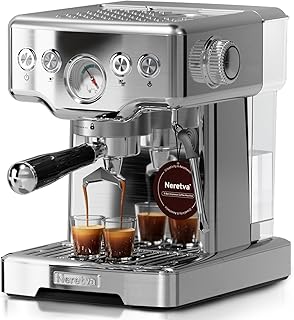
Quick Specs: Thermoblock with pre-infusion (15-bar rated pump; sequential) | 51mm stainless portafilter (pressurized single & double baskets) | Front visible pressure gauge + 360-degree swivel wand | 120V/60Hz, 1,350W–1,450W (NEMA 5-15P) | 1.8 L (61 fl oz) tank | Price Tier: Under $200
Audit Score: 7.6 / 10
- Beginner Workflow & Guidance (30%): 7.9 / 10
- Thermal & Pressure Consistency (30%): 7.5 / 10
- Build, Baskets & Upgrade Path (20%): 7.2 / 10
- Value (20%): 8.0 / 10
Rounding out our sub-$200 options, the Neretva 15-Bar Espresso Machine combines a stainless-steel body, a visible front pressure gauge, low-pressure pre-infusion, and a generous 1.8 L (61 fl oz) transparent reservoir. Its 360-degree swivel steam wand clears small milk pitchers smoothly, and its 51mm stainless portafilter includes single-shot and double-shot pressurized baskets so newcomers can start brewing pre-ground coffee right away.
Compared with the De’Longhi Classic Signature (EM450M), the Neretva 15-Bar delivers a very similar feature set—including a front pressure dial and large tank—usually at a slightly lower entry price inside the under-$200 bracket, while giving up De’Longhi’s deeper North American manual library and replacement-gasket ecosystem. Like every sub-$200 pressurized starter here, it omits a three-way solenoid valve and relies on a separate 51mm single-wall basket plus espresso grinder if you eventually outgrow pre-ground coffee.
Buyer Verification Alert: Confirm the listing states 120V/60Hz US specification and verify seller warranty coverage. Remember that “15-bar” describes the pump’s ceiling capability, not higher brew quality than ~9 bar extraction.
Pros
- Visible front pressure gauge, low-pressure pre-infusion, and large 1.8 L reservoir under $200
- 360-degree swivel steam wand and stainless chassis offer tidy starter bench ergonomics
- Pressurized 51mm dual-wall baskets handle supermarket pre-ground coffee with minimal fuss
Cons
- Smaller US spare-parts and long-term service footprint than Breville or De’Longhi
- No three-way solenoid valve; requires sequential waiting between shots and milk steaming
- Pressurized stock baskets require buying a separate 51mm single-wall basket and burr grinder to unlock fresh whole beans (CR-ESP-ACC-13)
Verdict: Buy it if you want a large-tank, stainless-bodied starter with a pressure gauge under $200 and De’Longhi’s EM450M is out of stock. Skip it if long-term OEM spare parts or single-wall specialty extraction are top priorities. Pair with filtered water and swap the plastic combo scoop for a flat 51mm tamper.
Buying Guide: How to Choose the Best Espresso Machine for Beginners
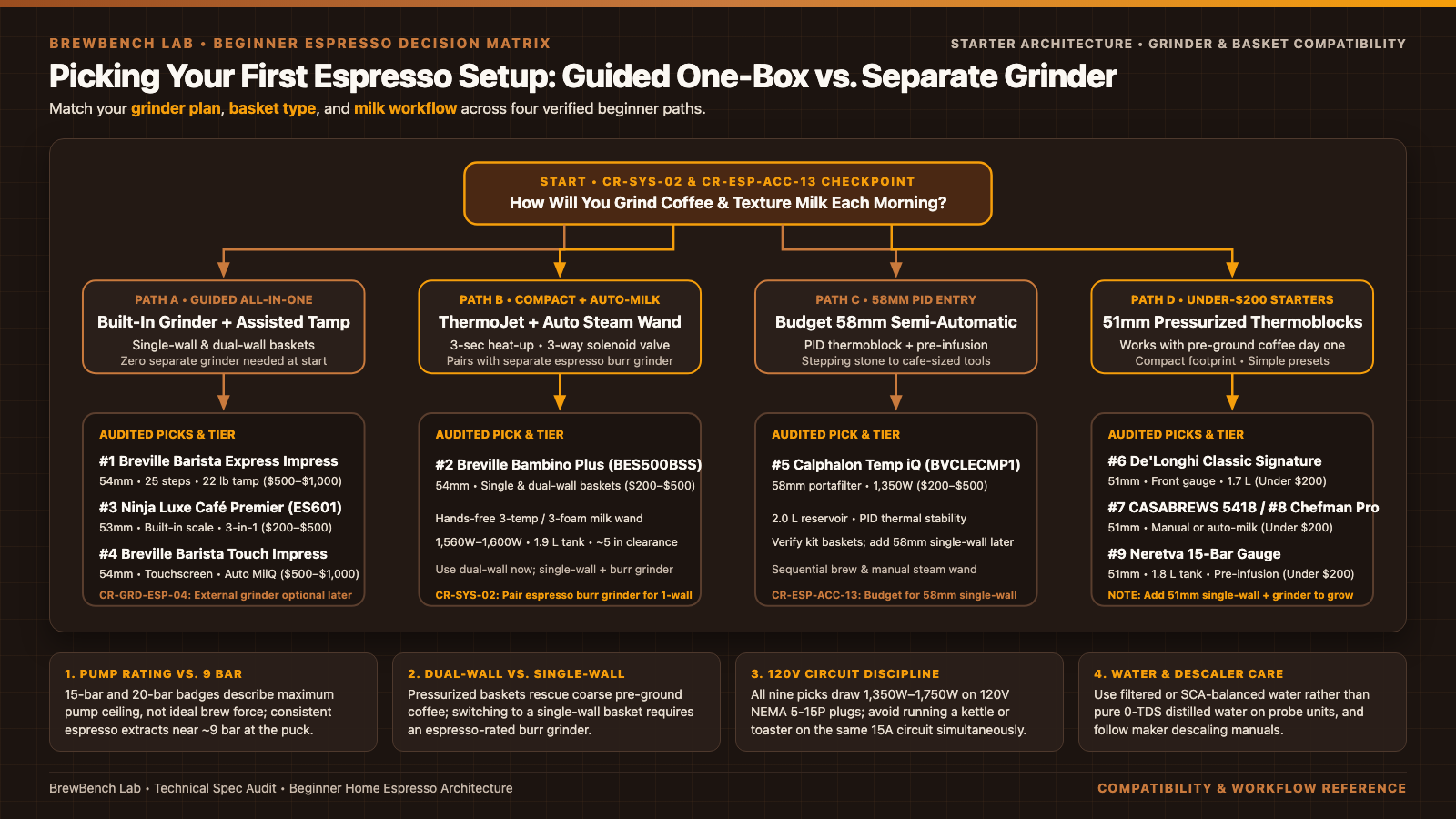
Marketing badges on beginner espresso boxes rarely match what matters in your kitchen at 7:00 a.m. Walk through these six engineering checks so your first espresso setup fits your coffee beans, your counter space, and your electrical circuit without surprise extra purchases.
1. Built-In Grinder vs. Grinderless + Pressurized Baskets (CR-SYS-02 & CR-GRD-ESP-04)
Espresso extraction depends on grinding coffee fine enough that compacted grounds hold back hot pressurized water for roughly 25 to 30 seconds. Under compatibility rule CR-SYS-02, a portafilter machine using a single-wall (non-pressurized) basket must pair with an espresso-capable burr grinder—either built directly into the chassis or sitting beside it on the counter. If you buy a grinderless machine like the Breville Bambino Plus or Calphalon Temp iQ without an espresso grinder yet, rely on pressurized dual-wall baskets with pre-ground coffee until you add a dedicated burr grinder.
Built-in-grinder all-in-ones—such as the Breville Barista Express Impress (25 steps), Breville Barista Touch Impress (30 steps), and Ninja Luxe Café Premier (25 steps plus scale)—remove that second purchase entirely. Under CR-GRD-ESP-04, integrated conical burrs handle medium and dark espresso roasts effortlessly for years; an external grinder only becomes necessary later if you migrate into dense light roasts that demand micro-stepped or stepless flat burrs.
2. Pressurized (Dual-Wall) vs. Single-Wall Baskets (CR-ESP-ACC-13)
Looking inside the portafilter reveals whether a beginner machine grows with you. Pressurized (dual-wall) baskets show many holes on top but funnel coffee through a single tiny pinhole underneath, generating artificial foam and slowing down coarse pre-ground coffee. Single-wall (non-pressurized) baskets feature an open bottom mesh where resistance comes purely from your tamped coffee puck—rewarding fresh burr-ground beans with sweeter, syrupy shots. Explore the trade-offs in depth inside our pressurized vs. non-pressurized basket guide. Breville’s 54mm models ship both basket styles in the box, Ninja ES601 ships single-wall baskets tailored to its built-in grinder, and most sub-$200 51mm machines ship dual-wall only, meaning you will buy a matching 51mm single-wall basket later when adding a burr grinder.
3. Separating 15-Bar / 20-Bar Pump Claims From ~9 Bar Extraction
Ignore “20 bar beats 15 bar” sales banners. Every vibration pump inside consumer home machines can dead-head at 15 or 20 bar when blocked, yet classic espresso extracts near ~9 bar at the coffee puck. Excessive pressure actually compresses the puck too tightly and promotes bitter channeling. Prioritize machines with PID temperature control, gentle low-pressure pre-infusion, and over-pressure valve (OPV) regulation rather than chasing inflated pump bar numbers.
4. Portafilter Sizes (51mm, 53mm, 54mm, 58mm) & Lug Patterns
Portafilter diameter governs every tamper, dosing funnel, puck screen, and precision basket you buy later:
- 51mm (De’Longhi, CASABREWS, Chefman, Neretva): Narrower diameter produces taller coffee pucks; always verify 2-ear vs. 3-ear lug count on De’Longhi models before buying bottomless portafilters.
- 53mm (Ninja Luxe Café Premier): Proprietary Ninja geometry; do not mix with Breville 54mm tools.
- 54mm (Breville Bambino Plus, Express Impress, Touch Impress): Deep, forgiving puck geometry backed by a huge third-party Breville-pattern accessory ecosystem.
- 58mm (Calphalon Temp iQ): Cafe-width baskets accept standard 58mm tampers, though portafilter ear lugs still vary by brand.
5. US 120V Circuits, Water Chemistry & Descaling Safety
All nine audited machines run on standard 120V/60Hz North American power using NEMA 5-15P plugs rated between 1,350W and 1,750W. Never purchase 220–240V European models for US outlets, never use plug adapters, and avoid running an electric kettle or toaster simultaneously on the same 15-amp kitchen branch circuit while brewing. Also check upper cabinet clearance—typically 18 inches above US counters—so top-fill reservoirs and bean hoppers clear cleanly.
For longevity and taste, follow Specialty Coffee Association (SCA) water standards targeting roughly 68 ppm (mg/L as CaCO3, ~4 grains per gallon) total hardness, ~40 ppm alkalinity, 75–250 ppm TDS, and zero chlorine. Avoid running pure zero-TDS distilled water on machines with conductive level sensors, use brand-matched tank cartridges where supported, and follow your owner’s manual strictly for descaling solution type and cycle timing.
6. Beginner Upgrade Roadmap & Hidden Costs
Before finalizing your budget, map out the small essentials covered in our home espresso essentials checklist:
- 0.1 g Digital Coffee Scale (under $50): Weighing 18 g in and ~36 g espresso out fixes 80% of beginner sour or bitter shots—even on machines with volumetric buttons.
- Weighted Metal Tamper & Dosing Funnel: Sub-$200 machines ship with lightweight plastic combo scoops; upgrading to a flat metal tamper matched to your exact basket ID (51mm, 54mm, or 58mm) immediately improves puck levelness.
- External Espresso Burr Grinder ($200–$500 later): If you start with a grinderless machine using pressurized baskets, reserve roughly a third of your long-term setup budget for an espresso-rated burr grinder before switching to single-wall extraction.
Methodology, Weighted Scoring Rubric & Excluded Models
Every score in this beginner audit reflects verified 120V manufacturer specifications, portafilter compatibility rules, and US retail kit checks—never fabricated telemetry or paid placements. To avoid brand skew, we capped Breville to three structurally distinct beginner platforms (Express Impress, Bambino Plus, and Touch Impress) alongside Ninja, Calphalon, De’Longhi, CASABREWS, Chefman, and Neretva. Full editorial rules live on our Editorial Evaluation Methodology page.
| Evaluation Criterion | Weight | What We Audited |
|---|---|---|
| Beginner Workflow & Guidance | 30% | Assisted tamping, volumetric presets, integrated dosing/scale coaching, and manual vs. automatic milk frothing ease. |
| Thermal & Pressure Consistency | 30% | Thermoblock, Thermocoil, or ThermoJet heating stability, PID regulation, pre-infusion, and ~9 bar brew delivery. |
| Build, Baskets & Upgrade Path | 20% | Portafilter size (51mm–58mm), inclusion of single-wall vs. dual-wall baskets (CR-ESP-ACC-13), three-way valve, and US support. |
| Value | 20% | Included tools, reservoir size, and overall capability relative to its Amazon US budget tier. |
Models We Audited & Excluded
Models We Audited & Excluded (And Why)
- Lelit Anna / Lelit Mara X & Profitec GO: Excluded as Amazon buy-intent beginner picks because Lelit and Profitec sell strictly via specialty US dealers with no active official Amazon US storefront inventory, and manual single boilers demand steeper temperature-surfing routines.
- Flair 58 & Boilerless Manual Levers: Disqualified for first-time buyers due to absent Amazon US retail fulfillment on the Flair 58 and the requirement to buy an external temperature-controlled kettle plus separate milk frother.
- Grinderless Single-Wall Setups Paired With Filter-Only Grinders (e.g., Fellow Ode Gen 2): Per compatibility rules CR-GRD-ESP-01 and CR-SYS-02, filter-only grinders cannot grind fine enough for single-wall espresso baskets, causing rapid under-extracted gushers.
- 230V European Imports & Unbranded 20-Bar Clones: Disqualified on US 120V NEMA 5-15P safety compliance and missing replacement gasket or single-wall basket support.
Authoritative Manufacturer & Technical References
- Breville USA — Barista Express Impress (BES876) Specifications (120V specs, 25-step grinder, assisted 22 lb Impress tamp)
- Breville USA — Bambino Plus (BES500) Specifications (ThermoJet 3-second startup, auto-milk presets, 54mm baskets)
- SharkNinja USA — Ninja Luxe Café Premier (ES601) Specifications (1,650W 120V rating, 25 grind steps, built-in scale)
- De’Longhi US — Official Product Manuals Portal (120V thermoblock wattage, 51mm pressurized kits, EcoDecalk care)
- Chefman — CaféMaster Pro Espresso Machine Specifications (120V 1,350W power, 1.8 L water tank, 500 ml milk reservoir)
- Specialty Coffee Association (SCA) — Water Quality Standards (hardness, alkalinity, TDS, and chloride boundaries)
Frequently Asked Questions About Beginner Espresso Machines
What is the best espresso machine for beginners overall?
For most first-time buyers wanting everything in one box, the Breville Barista Express Impress (BES876BSS) is the top overall choice. It pairs an integrated 25-step conical grinder with assisted 22 lb lever tamping, PID temperature control, and both dual-wall and single-wall 54mm baskets. Buyers prioritizing compact width and automatic milk frothing should pick the Breville Bambino Plus.
Should beginners buy an espresso machine with a built-in grinder or a separate grinder?
Built-in-grinder machines simplify your counter and handle medium-to-dark roasts easily, while separate grinders give you long-term upgrade freedom. Integrated units like the Express Impress and Ninja Luxe Café Premier eliminate a second appliance, whereas grinderless machines like the Bambino Plus let you pair a stepless flat-burr grinder later by reserving roughly a third of your total budget for grinding.
What is the difference between pressurized and single-wall baskets for beginners?
Pressurized (dual-wall) baskets build artificial backpressure through a single pinhole, while single-wall baskets rely solely on fine coffee grounds. Dual-wall baskets forgive coarse pre-ground coffee on day one. Switching to a single-wall basket unlocks sweeter crema and nuanced flavor, provided you pair the machine with an espresso-rated burr grinder.
Does a 15-bar or 20-bar pump rating mean better espresso for beginners?
No—15-bar and 20-bar ratings only list a vibration pump’s maximum pressure ceiling, never espresso quality. Conventional espresso extracts near ~9 bar at the coffee puck, regulated by an over-pressure valve (OPV) and grind fineness. High pump-bar stickers never replace PID temperature stability or consistent burr grinding.
Can I use regular pre-ground coffee in a beginner espresso machine?
Yes whenever the machine ships with pressurized (dual-wall) baskets, including the Breville 54mm models and all four sub-$200 picks here. Pre-ground espresso roast works cleanly inside dual-wall baskets without choking or gushing. Machines supplied strictly with single-wall baskets—such as the Ninja Luxe Café Premier—are built around their integrated whole-bean grinder instead.
What water should I put in a beginner espresso machine?
Use filtered tap water or SCA-balanced remineralized water targeting roughly 68 ppm total hardness and zero chlorine. Avoid running pure zero-TDS distilled water in machines with conductive level sensors, install manufacturer tank filters where supported, and descale strictly according to your machine’s manual rather than mixing DIY vinegar solutions.
Final Verdict: Which Best Espresso Machine for Beginners Should You Buy?
Picking the best espresso machine for beginners means matching your morning coffee habits to the right grinder and basket path rather than chasing inflated pump-bar labels. For most shoppers wanting a single tidy countertop station that removes dosing guesswork and teaches real extraction, the Breville Barista Express Impress (BES876BSS) earns our #1 overall recommendation. Apartment drinkers who want 3-second startup and hands-free milk texturing should choose the Breville Bambino Plus paired with a dedicated burr grinder, while mixed espresso-and-drip households under $500 get standout value from the Ninja Luxe Café Premier 3-in-1. On a strict budget under $200, the De’Longhi Classic Signature (EM450M) gives newcomers a pressure gauge, large tank, and clear path to grow.


