
Disclosure: As an Amazon Associate, I earn from qualifying purchases. If you buy through links on this page, we may earn a small commission at no extra cost to you.
Debating the df64 vs df54 matchup comes down to one core engineering question: do you need an open 64 mm flat-burr ecosystem with a 250W motor, or a narrower 54 mm flat-burr footprint that brings stepless espresso capability down to the lower end of the $200–$500 bracket? Across our best espresso grinders compatibility audit, both 120V/60Hz platforms share the exact single-dose philosophy—stepless collar adjustment, a built-in exit-chute plasma generator (ionizer), and blow-out bellows—yet they diverge sharply on aftermarket burr swaps, dosing-cup hardware, motor headroom, and counter depth.
The short verdict: Choose the DF64 Gen 2 (sold on Amazon US by Turin and MiiCoffee) if you want access to mainstream 64 mm aftermarket SSP burrs, prefer a heavier 58 mm metal dosing cup and ~15 lb (~6.8 kg) chassis, or pull back-to-back light-roast shots with a 250W motor. Choose the DF54 if you want true stepless flat-burr dialing for single-wall espresso baskets at a lower $200–$500 entry point, need a shallower ~7.0-inch (~178 mm) counter footprint, and have no plans to swap into 64 mm specialty burrs.
In This Comparison
- Winner-by-Use-Case Quick Verdict Matrix
- Side-by-Side 120V Spec & Compatibility Table
- Battleground 1: Espresso Capability & Stepless Dial Resolution
- Battleground 2: 64 mm vs. 54 mm Flat Burrs, Motor Power & Upgrade Headroom
- Battleground 3: Single-Dose Workflow, Plasma Ionizers, Cups & Scale Fit
- Battleground 4: Daily Espresso-to-Filter Switching & Known Ownership Caveats
- Battleground 5: Amazon US Variant Parity, Counter Space & Budget Allocation
- Choose DF64 Gen 2 If vs. Choose DF54 If
- Verified Amazon US Models & Excluded Alternatives
- Frequently Asked Questions
Quick Verdict Matrix: DF64 Gen 2 vs. DF54 by Home Bar Use Case
Because both grinders sit inside the TIER-GRD-MID ($200–$500) Amazon US tier—with the DF54 anchoring the lower portion of the band and the DF64 Gen 2 sitting higher—neither option is disqualified for single-wall espresso. Instead, the right pick depends on your kitchen depth, upgrade plans, and beverage routine.
| Use Case & Brew Routine | Winner | Why It Wins (Verified Spec & Rule Fit) |
|---|---|---|
Best for Daily Milk Drinks (UC-MILK-DRINKS-DAILY) | Tie (DF54 for Value) | Both dial single-wall medium-roast bases smoothly (CR-GRD-ESP-01, CR-GRD-ESP-03); DF54 leaves extra setup budget for your machine or pitcher. |
Best for Straight Espresso & Light Roasts (UC-STRAIGHT-ESPRESSO / UC-LIGHT-ROAST-ENTHUSIAST) | DF64 Gen 2 | Higher 250W AC motor torque, anti-popcorn collar, DLC burr availability, and open 64 mm SSP burr upgrade support (CR-GRD-01). |
Best Value & Setup Budget Balance (CR-SYS-01) | DF54 | Delivers stepless flat-burr single-dosing at a lower buy-in, keeping combined machine + grinder costs balanced inside TIER-SETUP-MID ($700–$1,800). |
Best Compact Kitchen Footprint (UC-SMALL-KITCHEN) | DF54 | Narrower ~4.5 in (114 mm) width and ~7.0 in (178 mm) depth reclaim ~3 in (76 mm) of counter depth over the DF64 Gen 2. |
Best for Aftermarket Burr Experimentation (CR-GRD-01) | DF64 Gen 2 | Standardized 64 mm DF64 carrier accepts SSP High Uniformity, Multipurpose, and Cast Lab Sweet sets; 54 mm options remain bespoke. |
Best for Espresso + Filter Switching (UC-FILTER-AND-ESPRESSO) | DF64 Gen 2 | Larger ~50 g unbellowed hopper capacity handles larger filter doses more easily, though both share stepless dial-reset routines (CR-GRD-03). |
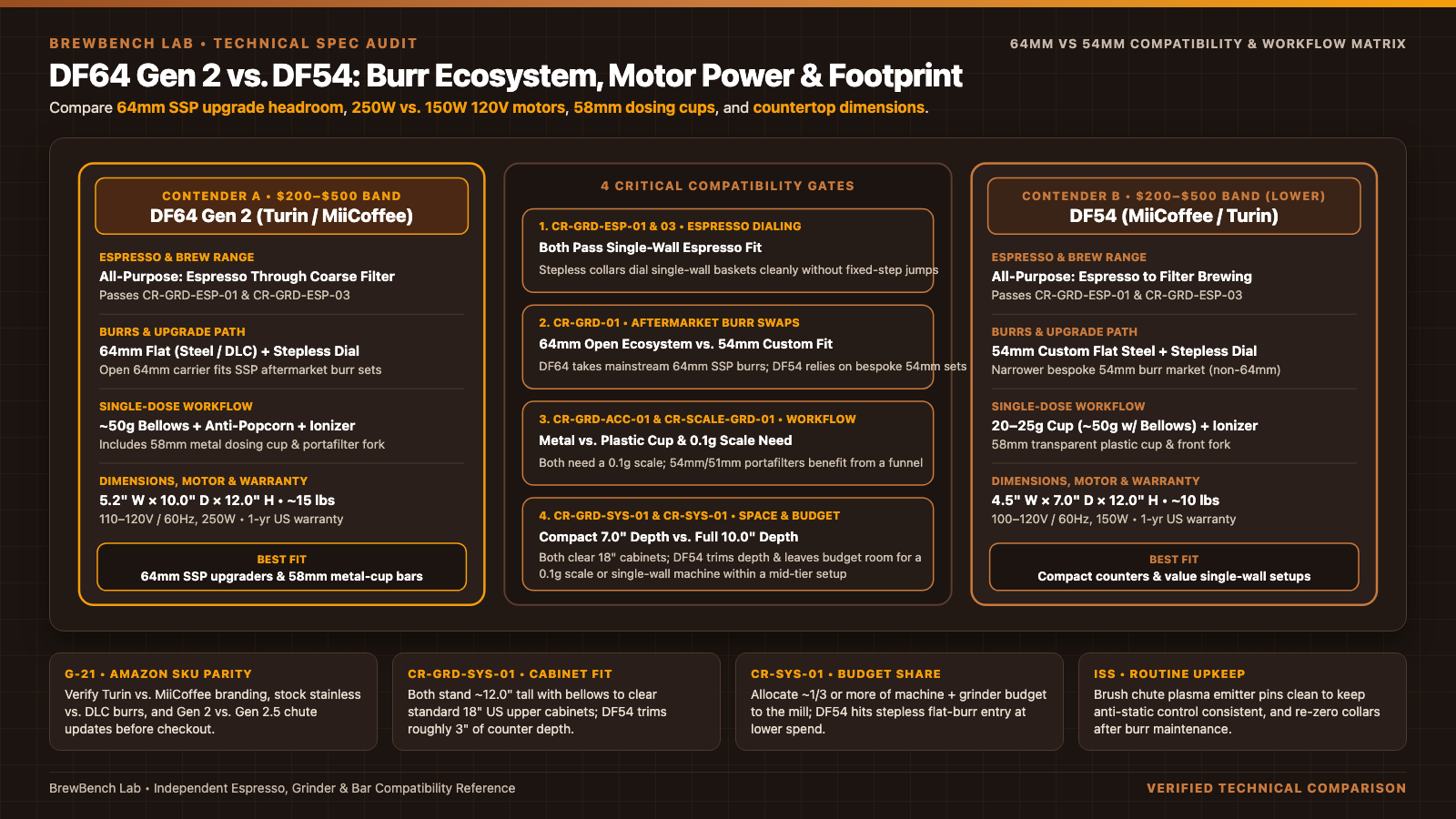
Side-by-Side Verified Spec & Compatibility Table (120V US Models)
The table below compares North American 120V/60Hz specifications documented by US distributors MiiCoffee and Turin (Espresso Outlet). International 220–240V/50Hz exports carry different electrical ratings and plug terminations and are excluded from this US hardware audit (G-06). Where neither brand publishes an independently verified laboratory figure—such as isolated retention grams, acoustic decibel readings, or particle micron distribution curves—we state “no verified data available yet” rather than estimating.
| Specification / Compatibility Metric | DF64 Gen 2 (Turin / MiiCoffee) | DF54 (MiiCoffee / Turin) |
|---|---|---|
Maker Brew Positioning (CR-GRD-ESP-01) | All-purpose (espresso through coarse filter) — Espresso capable | All-purpose (espresso through filter) — Espresso capable |
| Burr Geometry & Nominal Size | 64 mm flat steel burrs (stock stainless or optional DLC-coated steel by SKU) | 54 mm custom flat stainless steel burrs |
Aftermarket Burr Ecosystem (CR-GRD-01) | Broad 64 mm DF64 carrier (SSP HU, MP, Cast Lab Sweet) | Limited bespoke 54 mm carrier (not compatible with 64 mm sets) |
Adjustment Mechanism (CR-GRD-ESP-03) | Stepless collar dial (continuous fine adjustment) | Stepless collar dial (continuous fine adjustment) |
Dosing Style & Bean Hopper (CR-GRD-02) | Single-dose; ~50 g hopper with anti-popcorn collar & silicone bellows | Single-dose; ~20–25 g capacity (~50 g with silicone bellows attached) |
| Anti-Static Hardware | Built-in exit-chute plasma generator (ionizer) | Built-in exit-chute plasma generator (ionizer) |
Dosing Cup & Portafilter Fork (CR-GRD-ACC-01) | 58 mm metal dosing cup + front portafilter fork | 58 mm transparent food-grade plastic dosing cup + front fork |
| 120V US Motor & Plug | 110–120V / 60Hz, 250W AC motor, NEMA 5-15P plug | 100–120V / 60Hz, 150W AC motor (~1,400 RPM listed), NEMA 5-15P |
| Dimensions (W × D × H) | ~5.2 × 10.0 × 12.0 in (~130 × 250 × 300 mm) | ~4.5 × 7.0 × 12.0 in (~114 × 178 × 305 mm) |
| Weight | ~15 lbs (~6.8 kg) metal body | ~10 lbs (~4.5–4.7 kg) metal body |
| Verified Retention Grams / Noise (dB) | No verified data available yet (distributors cite low-retention bellows + ionizer) | No verified data available yet (distributors cite low-retention bellows + ionizer) |
| US Distributor Warranty | 1-year limited warranty (Turin / MiiCoffee) | 1-year limited warranty (MiiCoffee / Turin) |
| Amazon US Budget Tier | $200–$500 (TIER-GRD-MID, upper half) | $200–$500 (TIER-GRD-MID, lower end) |
Battleground 1: Espresso Capability, Stepless Dialing & Single-Wall Fit (CR-GRD-ESP-01 / CR-GRD-ESP-03)
When comparing grinders for a semi-automatic espresso machine equipped with a single-wall (non-pressurized) basket, rule CR-GRD-ESP-01 is the non-negotiable gatekeeper. Single-wall baskets contain no internal pressure valve; instead, resistance comes exclusively from a finely ground, evenly tamped coffee puck capable of holding roughly ~9 bar of brew pressure (regardless of whether an entry machine’s pump is marketed with a 15-bar or 20-bar maximum pump rating). Both the DF64 Gen 2 and the DF54 pass CR-GRD-ESP-01 cleanly because both distributors engineer and position them specifically for single-wall espresso extraction.
Equally important is how finely you can nudge grind size once you enter the espresso zone. Under rule CR-GRD-ESP-03, stepped entry grinders with wider clicks can leave you trapped between one click that gushes in 17 seconds and the next click that chokes the group head—forcing you to compensate by altering dose or brew ratio. Both the DF64 Gen 2 and DF54 use a stepless collar dial. Because the upper burr carrier rotates continuously on fine threads without mechanical detents, you can make hair-width adjustments to bring shot flow into target range on either grinder.
Notice how sharply that separates this matchup from our DF64 Gen 2 vs Fellow Ode Gen 2 comparison, where the Ode Gen 2 fails CR-GRD-ESP-01 HARD for single-wall espresso due to its filter-only burrs and 31-step dial. In the df64 vs df54 debate, both contenders can choke an espresso basket with ease; the difference lies in how much motor power, burr mass, and long-term upgrade flexibility sit behind that stepless ring. Keep in mind rule CR-GRD-ESP-02 as well: if you only intend to use pressurized (dual-wall) baskets with pre-ground or coarsely ground beans, either stepless flat-burr grinder offers far more precision than a pressurized basket can reveal unless you plan to transition to single-wall baskets soon.
Battleground 2: 64 mm vs. 54 mm Flat Burrs, Motor Power & Upgrade Headroom (CR-GRD-01)
Burr diameter is the headline differentiator between these siblings, yet coffee writers often oversimplify it. Under rule CR-DRINK-GRD-01 and our grinder evaluation rubric, larger flat burrs do not automatically guarantee better espresso flavor out of the box—alignment, burr tooth geometry, and roast profile all shape the cup. Where the 64 mm vs. 54 mm divide genuinely matters in 120V home kitchens is motor torque headroom and aftermarket burr availability (CR-GRD-01):
- Open 64 mm Ecosystem vs. Bespoke 54 mm Carrier (
CR-GRD-01): The DF64 Gen 2 uses theSTD-BURR-64-FLATplatform, which has become the de facto standard for home burr upgrades. Owners can drop in DF64-listed 64 mm SSP High Uniformity, SSP Multipurpose, or SSP Cast Lab Sweet burrs to tailor clarity or body as their palate evolves. By contrast, the DF54 uses custom 54 mm flat burrs (STD-BURR-54-FLAT). Even though other brands also advertise 54 mm burrs, nominal diameter alone never guarantees screw-hole pattern or thickness compatibility underCR-GRD-01—meaning 64 mm burrs will not fit the DF54, and aftermarket 54 mm choices are far narrower. Whenever you swap burrs on either grinder, check distributor warranty terms first and plan to re-zero the dial indicator and verify alignment. - 250W vs. 150W 120V Motor Headroom: The DF64 Gen 2 drives its 64 mm burrs with a 250W AC motor, whereas the DF54 uses a smaller 150W AC motor (listed by distributors at ~1,400 RPM) paired with 54 mm burrs. For traditional medium-to-dark milk-drink profiles (
DRINK-MILK-MEDIUM-ROAST, ~1:2 brew ratios), both motors grind single espresso doses smoothly. If you regularly pull dense, lightly roasted Nordic-style coffees (DRINK-STRAIGHT-LIGHT-ROAST, typically brewed around ~1:2.2–1:3 ratios at ~93–96 °C / 199–205 °F on PID machines) at very fine settings or grind multiple double shots consecutively, the DF64 Gen 2’s higher-wattage motor and anti-popcorn collar give you more stall margin. - Stock Burr Coating Choices: Many Amazon US DF64 Gen 2 listings—including the MiiCoffee DF64 II—ship with factory DLC (Diamond-Like Carbon) 64 mm flat burrs, whereas standard DF54 listings ship with custom 54 mm stainless steel flat burrs. Keep in mind rule
CR-DRINK-GRD-02as well: if you brew heavily oiled dark roasts or flavored beans, check the distributor manual before grinding, as oils and flavor coatings cling to flat burr chambers and require more frequent brushing.
If you want a deeper dive into the 64 mm chassis itself, including how its anti-popcorn collar and DLC burr geometry hold up across espresso recipes, read our dedicated DF64 Gen 2 review.
Battleground 3: Single-Dose Workflow, Plasma Ionizers, Cups & Scale Fit
Under rule CR-GRD-02, both the DF64 Gen 2 and DF54 are pure single-dose grinders: you weigh each batch of whole beans, drop them into the top throat with the motor running or right before switching on, grind through the burrs, and compress the silicone bellows to evacuate lingering grounds. Neither machine has a timed bean hopper or integrated load cell, which shapes your daily routine far more than burr diameter alone.
- Plasma Anti-Static Generators on Both Chutes: Earlier first-generation DF64 units became notorious for static-charged chaff spraying across espresso bars unless users misted beans heavily with water (RDT). Both the DF64 Gen 2 and the DF54 build an active plasma generator (ionizer) right into the exit chute to neutralize static charge as grounds exit. Note that distributors still recommend brushing the small ionizer emitter needles inside the chute periodically—always unplugging the grinder first—because built-up coffee dust reduces anti-static performance over time.
- 58 mm Metal vs. Transparent Plastic Dosing Cup (
CR-GRD-ACC-01): Here is an everyday tactile difference that spec sheets sometimes gloss over. The DF64 Gen 2 includes a 58 mm metal dosing cup seated in a front portafilter fork, plus a built-in anti-popcorn collar under the hopper. The DF54 ships with a 58 mm transparent food-grade plastic dosing cup on its front fork. Metal dosing cups dissipate residual charge better and feel weightier when inverting grounds into a 58 mm portafilter basket. Both cups match 58 mm portafilters cleanly; if you use a 54 mm Breville or 51 mm De’Longhi portafilter, add a matching 54 mm or 51 mm magnetic dosing funnel to prevent grounds from spilling over the basket rim during transfer. - Hopper Capacity & Anti-Popcorn Behavior: The DF64 Gen 2’s bellows hopper holds roughly ~50 g of beans and features an internal anti-popcorn disc that keeps the final few beans from dancing above the burrs. The DF54’s standard cup throat holds ~20–25 g without the bellows attached and expands to ~50 g with the bellows in place—plenty for 18–20 g double espresso shots, though tighter if you occasionally weigh 35–45 g batches for large pour-overs.
- Mandatory 0.1 g Scale Workflow (
CR-SCALE-GRD-01): Because single-dosing relies on exact input-to-output weight verification, pair either grinder with a 0.1 g digital coffee scale. Weighing beans before grinding and verifying grounds in the dosing cup catches any stuck fines immediately. See how both stack up against other weigh-and-grind mills in our best single-dose coffee grinders guide.
Battleground 4: Daily Espresso-to-Filter Switching & Known Ownership Issues
Many shoppers considering a single-dose flat-burr grinder plan to pull espresso on weekday mornings and brew V60 pour-overs or AeroPress on weekends (UC-FILTER-AND-ESPRESSO). Under compatibility rule CR-GRD-03, both the DF64 Gen 2 and DF54 can physically cover espresso through filter grinds, yet daily switching carries a workflow tax on stepless collars.
Moving from an espresso setting near 10–15 up to a pour-over setting—and then dialing back down to the exact espresso zero-offset—requires careful tracking of your indicator pointer and running a bellows purge (or sacrificing a gram of coffee) when shifting finer so coarser fragments do not cause your next espresso shot to channel. If you switch brew methods multiple times every single day, keeping a dedicated filter grinder alongside your espresso grinder often preserves sanity better than twisting one stepless collar back and forth.
Before buying either platform, review the three recurring pattern-level ownership caveats (ISS) documented across US retail listings and community reports (G-12):
- Flat-Burr Alignment & Zero-Point Variance: According to community reports (not an officially published manufacturer tolerance), flat-burr grinders in the $200–$500 tier can arrive with minor burr-carrier tilt or an uncalibrated dial pointer. Checking burr wipe with a dry-erase marker and verifying true zero (chirp point) is good practice on either model—and mandatory whenever you remove the upper carrier for deep cleaning or burr swaps.
- Plasma Emitter Dust Buildup & Plastic Cup Static: If static cling returns after a few weeks on either grinder, fine chaff coating the plasma generator pins inside the exit chute is the usual culprit. Unplug the unit from your 120V outlet and gently brush the chute and pins per the MiiCoffee/Turin manual; on the DF54, swapping to a metal 58 mm dosing cup later is also a common workflow upgrade if your kitchen air is very dry.
- Amazon US Generation & Distributor Naming (
G-21): Do not confuse older first-generation DF64 listings (which lacked the plasma ionizer and anti-popcorn collar) with the DF64 Gen 2, MiiCoffee DF64 II, or rolling DF64 Gen 2.5 updates. Always check the seller name, 120V/60Hz North American voltage badge, and exact burr option (stock stainless steel vs. DLC) on the Amazon product page before checkout.
Battleground 5: Amazon US Variant Parity, Counter Fit & Setup Budget (CR-GRD-SYS-01 / CR-SYS-01)
On Amazon US, Turin (distributed via Espresso Outlet) and MiiCoffee act as the two primary North American brand distributors for this manufacturing family. A Turin DF64 Gen 2 and a MiiCoffee DF64 II sit on the same core 120V/60Hz 250W platform, while the Turin DF64 Gen 2.5 introduces incremental factory revisions including updated motor mounting and a refined exit chute. Similarly, the MiiCoffee DF54 and Turin DF54 share the same core 120V/60Hz 150W 54 mm chassis. Your choice between Turin and MiiCoffee listings usually comes down to live Amazon stock, color availability, bundled DLC burrs, and which US distributor’s 1-year warranty support you prefer.
From a physical kitchen integration standpoint (CR-GRD-SYS-01), both grinders stand roughly 12.0 inches (300–305 mm) tall with their silicone bellows fitted—meaning both clear standard 18-inch (457 mm) US upper kitchen cabinets without needing to pull the unit forward to load beans. Where the DF54 earns an edge in tight apartments (UC-SMALL-KITCHEN) is footprint depth and weight: at ~4.5 in wide by ~7.0 in deep (~114 × 178 mm) and ~10 lbs (~4.5 kg), it occupies noticeably less counter space than the DF64 Gen 2’s ~5.2 in by ~10.0 in (~130 × 250 mm) footprint and ~15 lb (~6.8 kg) heft.
Electrically, both use standard 120V/60Hz NEMA 5-15P plugs and draw modest power (250W on the DF64 Gen 2 vs. 150W on the DF54). Under rule CR-ESP-SYS-02, a 15A US kitchen circuit provides 1,800 W peak capacity (1,440 W continuous). While neither grinder threatens a breaker on its own, running a 1,400–1,600 W espresso machine, a grinder, and an electric kettle simultaneously on one 15A circuit can trip it—so stagger high-wattage heating appliances or separate circuits with a licensed electrician rather than using plug adapters.
Finally, look at total system budget balance under rule CR-SYS-01: for single-wall espresso setups, keep at least one-third of your combined machine + grinder spend on the grinder. Pairing the DF54 with a compact thermoblock or entry single-boiler espresso machine inside TIER-SETUP-MID ($700–$1,800) hits that ~1/3+ grinder threshold effortlessly while leaving room for a 0.1 g scale and a properly sized tamper.
Final Decision: Choose DF64 Gen 2 If vs. Choose DF54 If
Choose DF64 Gen 2 If…
- You want full freedom to upgrade into aftermarket 64 mm SSP burrs (High Uniformity, Multipurpose, or Cast Lab Sweet) as your palate develops (
CR-GRD-01). - You drink light-roast straight espresso (
UC-LIGHT-ROAST-ENTHUSIAST) or pull multiple back-to-back shots and want the higher-torque 250W AC motor and anti-popcorn collar. - You prefer a 58 mm metal dosing cup, heavier ~15 lb (~6.8 kg) stability, and factory DLC burr bundle options on Amazon US.
- You have ~10.0 in (250 mm) of counter depth available and want maximum long-term versatility across espresso and filter doses.
Choose DF54 If…
- You want stepless flat-burr dialing for single-wall espresso baskets at the lowest buy-in inside the $200–$500
TIER-GRD-MIDbracket (CR-GRD-ESP-01,CR-GRD-ESP-03). - Your espresso bar is tight on counter space (
UC-SMALL-KITCHEN) and benefits from the DF54’s compact ~4.5 × 7.0 in footprint. - You primarily pull 1–2 medium or dark-roast espresso or milk drinks per session (
UC-MILK-DRINKS-DAILY) and do not intend to swap 64 mm specialty burrs. - You still want a built-in chute plasma ionizer, blow-out bellows, and a 58 mm dosing cup workflow without paying for the larger chassis.
Verified Amazon US Models & Excluded Alternatives
The four 120V/60Hz Amazon US listings below represent verified retail configurations across the DF64 Gen 2, DF54, MiiCoffee DF64 II, and DF64 Gen 2.5 platforms. Always confirm seller fulfillment, 120V North American specification, and burr finish (stock stainless vs. DLC) on the Amazon listing before ordering.
1. Turin DF64 Gen 2 Single Dose Coffee Grinder (Black) — Overall Winner for 64 mm Upgrades

Quick Specs: 64 mm flat burrs (DLC steel / stainless by SKU) | Stepless adjustment collar | Single-dose (~50 g bellows + anti-popcorn collar) | Plasma anti-static generator | 58 mm metal dosing cup & portafilter fork | 110–120V/60Hz, 250W (NEMA 5-15P) | ~5.2 in W × 10.0 in D × 12.0 in H (~15 lbs) | Price Tier: $200–$500 (TIER-GRD-MID)
Pros
- Accepts mainstream 64 mm aftermarket SSP burr sets (High Uniformity, Multipurpose, Cast Lab Sweet) under
CR-GRD-01 - 250W AC motor, anti-popcorn collar, plasma ionizer, and silicone bellows handle dense light roasts and back-to-back shots
- Includes a 58 mm metal dosing cup and portafilter fork in a sturdy ~15 lb (~6.8 kg) metal body
Cons
- Larger ~5.2 × 10.0 in footprint takes noticeably more counter depth than the compact DF54
- Requires a 0.1 g scale for single-dosing (
CR-SCALE-GRD-01) and tracking full collar turns when switching espresso to filter (CR-GRD-03) - Sits higher in the $200–$500 band than the DF54, and burr alignment should be verified if swapping burrs
2. MiiCoffee DF54 Single Dose Coffee Grinder (Black) — Compact & Value Winner

Quick Specs: 54 mm custom stainless flat burrs | Stepless adjustment collar | Single-dose (~20–25 g unbellowed / ~50 g with bellows) | Plasma anti-static generator | 58 mm transparent food-grade plastic dosing cup & front fork | 100–120V/60Hz, 150W (NEMA 5-15P) | ~4.5 in W × 7.0 in D × 12.0 in H (~10 lbs) | Price Tier: $200–$500 (TIER-GRD-MID, lower end)
Pros
- Stepless 54 mm flat-burr architecture passes
CR-GRD-ESP-01andCR-GRD-ESP-03at a lower entry cost insideTIER-GRD-MID - Compact ~4.5 × 7.0 in footprint saves roughly 3 inches of counter depth over the DF64 Gen 2
- Includes built-in chute plasma ionizer, blow-out bellows, and 58 mm dosing cup with front fork
Cons
- Bespoke 54 mm burr carrier lacks the wide 64 mm SSP aftermarket burr ecosystem (
CR-GRD-01) - Ships with a transparent plastic 58 mm dosing cup instead of the DF64 Gen 2’s metal dosing cup
- 150W motor and ~20–25 g unbellowed throat suit 1–2 single-dose drinks better than large filter batches
3. MiiCoffee DF64 II Single Dosing Coffee Grinder (Black) — DLC Burr US Distributor Option

Quick Specs: 64 mm DLC-coated flat burrs | Stepless dial | Single-dose bellows + anti-popcorn collar + plasma ionizer | 58 mm metal dosing cup | 110–120V/60Hz, 250W (NEMA 5-15P) | Price Tier: $200–$500 (TIER-GRD-MID)
The MiiCoffee DF64 II is MiiCoffee’s North American edition of the same 120V DF64 Gen 2 platform, routinely configured on Amazon US with factory-installed DLC 64 mm flat burrs, a 58 mm metal dosing cup, and MiiCoffee’s US manual and 1-year warranty portal. Expect identical stepless espresso dialing and 64 mm burr swap freedom—just verify seller fulfillment and included accessories on the listing before checkout.
- Key Cons: Carries the same 10.0-inch counter depth and single-dose bellows/scale workflow as the Turin DF64 Gen 2, and buyers should verify exact seller warranty terms on the Amazon listing.
4. Turin DF64 Gen 2.5 Single Dose Coffee Grinder — Incremental Factory Revision

Quick Specs: 64 mm flat burrs | Stepless dial | Updated motor mount & refined single-dose chute | Plasma ionizer + bellows | 110–120V/60Hz, 250W (NEMA 5-15P) | Price Tier: $200–$500 (TIER-GRD-MID)
Amazon listings labeled Turin DF64 Gen 2.5 reflect rolling factory refinements to the Gen 2 platform—specifically updated motor mount hardware and a refined single-dose exit chute while keeping the core 250W motor, stepless 64 mm burr carrier, and plasma ionizer intact. Treat it as a welcome production update when cross-shopping new stock rather than a generational overhaul.
- Key Cons: Incremental update rather than a major redesign—confirm whether the specific SKU ships stock stainless steel or DLC burrs, and note that daily espresso-to-filter switching still requires tracking collar turns.
Alternatives Excluded From This Amazon US Comparison
- Niche Zero & Niche Duo: Excluded as Amazon buy-intent picks because Niche distributes direct-to-consumer without primary Amazon US storefront fulfillment.
- Timemore Sculptor 064 / 064S: Excluded as an Amazon buy-intent pick under BrewBench Lab catalog availability rules; covered in informational explainers only.
- Fellow Ode Gen 2 (Stock Brew Burrs): Disqualified for single-wall espresso setups under
CR-GRD-ESP-01because Fellow builds it strictly for filter brewing and voids warranty on espresso grinding. - Standard Baratza Encore (Non-ESP) & Blade Grinders: Disqualified under
CR-GRD-ESP-01for lacking the fine adjustment range required by non-pressurized single-wall espresso baskets.
Authoritative Technical References
- MiiCoffee — Official Grinder Manuals Portal (DF64 II & DF54) (North American 120V/60Hz specifications, stepless dial calibration, chute plasma generator cleaning, and dosing workflow).
- Espresso Outlet / Turin — DF64 Gen 2 Official Product Specifications (110–120V 250W motor, ~50 g bellows capacity, ~5.2 × 10.0 × 12.0 in dimensions, ~15 lb chassis, and DLC burr options).
- Turin Grinders — DF54 Single Dose Flat Burr Specifications (100–120V 150W motor, 54 mm flat steel burrs, 4.5 × 7.0 × 12.0 in footprint, ~10 lb body weight, and 1-year US warranty).
- Specialty Coffee Association (SCA) — Coffee Standards & Water Reference (Baseline extraction and water chemistry guidance for home espresso setups).
How We Audited This Guide
- Burr grinders were checked for maker-stated espresso adjustment fineness, burr geometry and size, single-dose vs hopper workflow, retention caveats, and kitchen height clearance.
- Every espresso machine, burr grinder, accessory, and scale specification was cross-checked against official manufacturer 120V manuals, SCA water guidance, and verified Amazon US listings.
- Recommendations were evaluated against our weighted espresso-gear scoring rubrics and documented CR-* compatibility rules; we never invent heat-up seconds, PID variance, or micron claims.
Continue Your Audit
Frequently Asked Questions
Can both the DF64 Gen 2 and DF54 dial in single-wall espresso baskets?
Yes—both grinders pass CR-GRD-ESP-01 and CR-GRD-ESP-03 cleanly. Each pairs espresso-capable flat steel burrs with a continuous stepless collar dial, allowing fine, detent-free adjustments to dial in single-wall (non-pressurized) espresso shots without jumping between coarse fixed steps.
Can 64 mm SSP burrs fit inside the DF54?
No—under rule CR-GRD-01, 64 mm burrs will not fit the DF54. The DF54 uses a bespoke 54 mm flat-burr carrier, whereas the DF64 Gen 2 uses the mainstream 64 mm carrier standard compatible with DF64-listed SSP High Uniformity, Multipurpose, and Cast Lab Sweet burrs.
What is the main workflow difference between the DF64 Gen 2 and DF54?
Motor wattage, anti-popcorn collar, and dosing cup material separate daily handling. The DF64 Gen 2 brings a 250W motor, an internal anti-popcorn disc, and a 58 mm metal dosing cup, while the DF54 uses a 150W motor and a 58 mm transparent food-grade plastic cup.
Do both the DF64 Gen 2 and DF54 fit under standard US upper kitchen cabinets?
Yes—both stand roughly 12.0 inches tall with bellows attached. Under rule CR-GRD-SYS-01, both clear standard 18-inch US upper cabinets easily, though the DF54’s ~4.5 × 7.0 inch footprint reclaims roughly 3 inches of counter depth compared with the DF64 Gen 2.
What is the difference between Turin and MiiCoffee DF64 / DF54 listings on Amazon US?
They are North American retail distributors of the same core grinder hardware. Both Turin and MiiCoffee offer 120V/60Hz US configurations with 1-year distributor warranties, differing mainly in branding, color stock, and whether stock stainless or DLC-coated burrs are bundled.
Do I need a 0.1 g coffee scale for the DF64 Gen 2 or DF54?
Yes—single-dose grinders rely on weighing every dose. Under rule CR-SCALE-GRD-01, pairing either the DF64 Gen 2 or DF54 with a 0.1 g digital scale ensures consistent bean-in weights and lets you catch any minor grounds holdover before pulling your shot.


