
Disclosure: As an Amazon Associate, I earn from qualifying purchases. If you buy through links on this page, we may earn a small commission at no extra cost to you.
Deciding between a single dose vs hopper grinder comes down to one core daily trade-off on your home espresso bar: maximum bean freshness and roast-switching agility versus push-button morning speed. Under BrewBench Lab compatibility rule CR-GRD-02, your dosing format alters daily workflow far more than it changes inherent cup flavor once burr geometry and alignment are held equal. Before comparing burr diameters in our best espresso grinders hub, you need to match how you weigh, store, and pull coffee to the right grinder architecture.
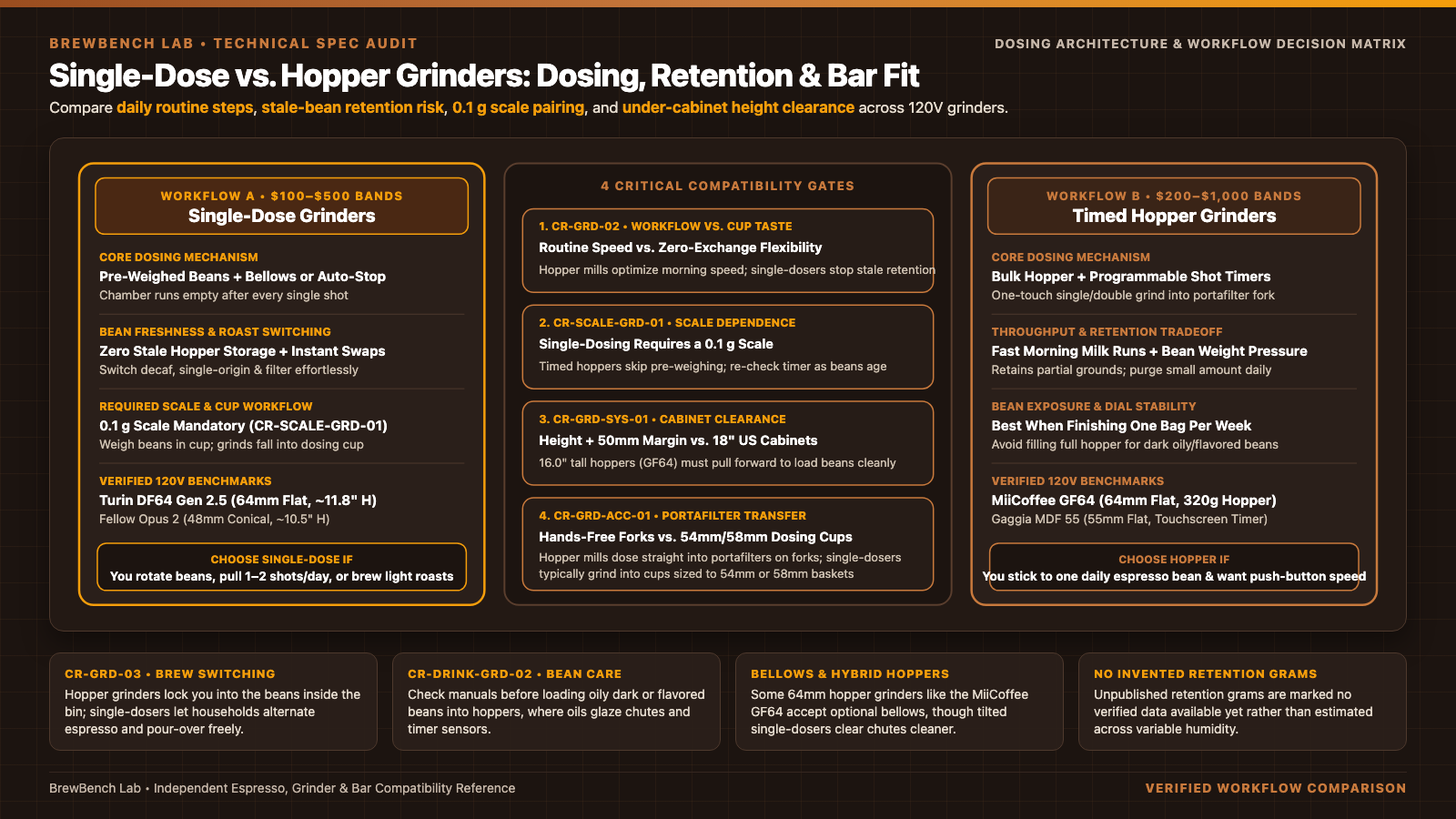
The short verdict: Choose a single-dose grinder (such as the Turin DF64 Gen 2.5 or Fellow Opus 2) if you pull one to two shots per day, rotate between regular espresso, decaf, and pour-over beans, or want compact height beneath low kitchen cabinets. Choose a hopper grinder (such as the MiiCoffee GF64 or Gaggia MDF 55) if you stick to one daily espresso blend, pull consecutive milk drinks every morning, and prefer hands-free timed portafilter dosing over weighing every dose on a 0.1 g scale.
In This Comparison
- Winner-by-Use-Case Quick Verdict Matrix
- Side-by-Side 120V Spec & Compatibility Table
- Battleground 1: Daily Routine Speed & 0.1 g Scale Reliance
- Battleground 2: Grind Retention, Stale Grounds & Bean Exposure
- Battleground 3: Multi-Roast Switching, Oily Beans & Consistency
- Battleground 4: Portafilter Forks, Dosing Cups & Budget Rules
- Battleground 5: Under-Cabinet Clearance, 120V Power & Cleaning
- Choose Single-Dose If vs. Choose Hopper If
- Verified 120V Amazon US Benchmarks Compared
- Grinders Excluded From This Amazon US Comparison
- Frequently Asked Questions
Quick Verdict Matrix: Single-Dose vs. Hopper Grinders by Use Case
Neither dosing design holds a monopoly on espresso extraction quality. Instead, each architecture solves a different kitchen bottleneck—whether that is eliminating stale grounds from yesterday’s shot, saving 30 seconds per latte on a busy weekday morning, or fitting cleanly under 18-inch (457 mm) upper cabinets.
| Home Bar Use Case | Winning Workflow | Why It Wins (Verified Spec & Rule Fit) |
|---|---|---|
| Best for Daily Milk Drinks & Multi-Shot Mornings | Timed Hopper Grinder | Programmable single/double shot timers and portafilter forks (Gaggia MDF 55, MiiCoffee GF64) let you grind straight into the basket in one button press. |
| Best for Straight Espresso & Light Roasts | Single-Dose Grinder | Zero-storage dosing keeps high-density single-origin beans sealed in bags until grinding and prevents stale exchange during dial-in (CR-GRD-02). |
| Best Value & Lowest Ecosystem Cost | Single-Dose Entry (or Dual-Purpose) | Sub-$200 stepless single-dosers like the Fellow Opus 2 include 54mm/58mm catch cups; you only add a compact 0.1 g scale (CR-SCALE-GRD-01). |
| Best for Compact Kitchen Cabinets | Single-Dose Grinder | Bellows and low bins keep heights around 10.5–11.8 in (267–300 mm), clearing 18-inch (457 mm) US upper cabinets without sliding forward (CR-GRD-SYS-01). |
| Best for Decaf + Regular + Filter Rotation | Single-Dose Grinder | Empty chamber after every grind lets you swap roasts or switch brew methods cleanly without purging dozens of grams from a full hopper (CR-GRD-03). |
| Best for Minimalist Morning Prep (No Pre-Weighing) | Timed Hopper Grinder | Load 250–320 g of one house espresso blend once per week and rely on timed dosing rather than weighing whole beans before every shot. |
Side-by-Side Verified Spec & Compatibility Table (120V US Benchmarks)
To keep this comparison concrete and strictly grounded in North American 120V/60Hz specifications, the table below compares four verified Amazon US models representing both philosophies: two dedicated single-dose grinders (Turin DF64 Gen 2.5 and Fellow Opus 2) and two timed hopper grinders (MiiCoffee GF64 and Gaggia MDF 55). Wherever a manufacturer does not publish standardized lab telemetry—such as decibel loudness or laboratory-average retention grams across controlled humidity—we state no verified data available yet rather than guessing.
| Specification / Compatibility Gate | Single-Dose: Turin DF64 Gen 2.5 | Single-Dose: Fellow Opus 2 | Hopper: MiiCoffee GF64 | Hopper: Gaggia MDF 55 |
|---|---|---|---|---|
Dosing Architecture (CR-GRD-02) | Single-dose chute + silicone bellows | Single-dose bin + auto-stop shutoff | Bulk hopper + programmable digital timer | Bulk hopper + touchscreen timed dosing |
Espresso Capability (CR-GRD-ESP-01) | Espresso-capable all-purpose | Espresso-capable all-purpose | Espresso-focused | Espresso-focused |
| Burr Type & Diameter | 64mm flat steel burrs | 48mm stainless steel conical burrs | 64mm flat steel burrs | 55mm hardened flat steel burrs |
Grind Adjustment (CR-GRD-ESP-03) | Stepless micrometric collar | Continuous stepless dial | Stepless adjustment dial | Stepless micrometric rotary knob |
| Hopper / Load Bin Capacity | Single-dose cup + anti-popcorn disc | ~3.5 oz (100 g) single-dose load bin | ~11.3 oz (320 g) bean hopper | ~8.8–10.6 oz (250–300 g) bean hopper |
Portafilter Interface (CR-GRD-ACC-01) | 58mm metal dosing cup | Dual magnetic catch cups (54mm & 58mm) | Metal portafilter holder + 58mm cup | Hands-free portafilter fork |
0.1 g Scale Dependency (CR-SCALE-GRD-01) | Required before grinding (weigh beans in) | Required before grinding (weigh beans in) | Optional (spot-check timed output only) | Optional (spot-check timed output only) |
| Published Retention Grams | No verified data available yet (maker states near-zero with bellows) | No verified data available yet (maker states near-zero retention) | No verified data available yet | No verified data available yet |
| Static Mitigation Tech | Plasma generator (ionizer) + bellows | Integrated anti-static ionizer | Standard chute (optional bellows swap) | Anti-static / mechanical clump breaker |
120V US Power & Plug (CR-ESP-SYS-02) | 100–120V / 60Hz, 250W, NEMA 5-15P | 120V / 60Hz, 300W, NEMA 5-15P | 100–120V / 60Hz, 150W, NEMA 5-15P | 110–120V / 60Hz, 310W, NEMA 5-15P |
Height (Cabinet Fit — CR-GRD-SYS-01) | ~11.8 in (300 mm) | ~10.5 in (267 mm) | ~16.0 in (406 mm) | ~13.4 in (340 mm) |
| Weight | ~15.0 lbs (6.8 kg) | ~5.1 lbs (2.3 kg) | ~6.6 lbs (3.0 kg) | ~12.1 lbs (5.5 kg) |
| Noise Level (dB) | No verified data available yet | No verified data available yet | No verified data available yet | No verified data available yet |
| Amazon US Budget Tier | $200–$500 (TIER-GRD-MID) | $100–$200 (TIER-GRD-ENTRY) | $200–$500 (TIER-GRD-MID) | $500–$1,000 (TIER-GRD-PROSUMER) |
Battleground 1: Daily Routine Speed & 0.1 g Scale Reliance
The clearest dividing line in a single dose vs hopper grinder comparison happens in the 30 seconds before you lock your portafilter into the espresso machine. With a single-dose grinder, the workflow begins at your coffee bag and scale. Under compatibility rule CR-SCALE-GRD-01, single-dosing requires a 0.1 g digital scale whose weighing platform comfortably accommodates your dosing cup. You tare the cup, scoop out exactly 18.0 g of whole beans (or your basket’s rated dose), tip them into the grinder, run the motor until empty, pump the bellows if equipped, and invert the grounds into your portafilter.
By contrast, a timed hopper grinder shifts that weighing step out of the morning rush. On models such as the MiiCoffee GF64 or Gaggia MDF 55, you load a half-pound (227 g to 320 g) bag into the hopper once every few days and dial in a timer—say, 9.2 seconds for an 18 g double shot. Each morning, you rest your portafilter directly on the front fork, tap the double-shot icon, and let the timer stop automatically. If you make two lattes before work, a hopper grinder removes bean-scooping, pre-weighing, and bellows-pumping from every single drink.
However, timed hopper dosing comes with an unavoidable physics caveat: timer accuracy drifts. As the bean column inside the hopper drops from full to nearly empty, downward pressure on the burrs decreases, slightly reducing grams-per-second output. Beans also degas and shift density over two weeks after roasting, and moving the grind collar finer slows throughput for the exact same time duration. Even hopper owners still benefit from keeping a compact 0.1 g scale from our best espresso scales guide on the drip tray to spot-check dry portafilter dose weight and verify extraction yield—especially if your machine lacks built-in volumetric or gravimetric stopping.
Battleground 2: Grind Retention, Stale Grounds & Bean Exposure
Why did single-dose grinders surge past traditional hoppers among straight-espresso enthusiasts? The answer is grind retention and bean oxidation. Every espresso grinder has internal geometry—burr chamber pockets, sweeper arms, and an exit chute—where fine coffee particles can cling or settle instead of dropping immediately into your portafilter.
When a grinder has noticeable internal retention, two things happen:
- Stale First-Shot Exchange: Grounds trapped inside the chute overnight oxidize quickly because finely ground coffee exposes massive surface area to air. On the first shot of the next morning, those stale grounds get pushed into your fresh basket ahead of newly ground coffee. Hopper owners typically counter this by running a short manual purge (wasting 2 g to 4 g of coffee daily) before dosing their morning shot.
- Adjustment Lag During Dial-In: When you turn a hopper grinder finer or coarser to fix a fast or choked shot, the next dose contains a blend of particles ground at your old setting and your new setting unless you purge the chamber between clicks.
Dedicated single-dose grinders like the Turin DF64 Gen 2.5 combat retention mechanically using angled vertical bodies, straight chutes, plasma ionizers (`ISS-GRD-STATIC`), and silicone bellows that force a pulse of air down through the burr chamber at the end of each dose. Entry single-dosers like the Fellow Opus 2 pair a steep vertical feed with an active anti-static ionizer and auto-stop shutoff. Even so, note that standardized retention-gram benchmarks depend heavily on roast level, oil content, and ambient humidity—so absent controlled third-party benchmark data under identical conditions, exact gram figures remain no verified data available yet. What is verifiable from design architecture is that single-dosing eliminates multi-day bean exposure to light and oxygen inside an unsealed plastic hopper.
If static cling causes fine grounds to stick inside a single-dose chute in dry winter kitchens, many baristas lightly mist whole beans (RDT, Ross Droplet Technique) before grinding—though always check your grinder manufacturer’s manual first before introducing moisture near steel burrs or internal electronics, and never submerge burrs in water.
Battleground 3: Multi-Roast Switching, Oily Beans & Consistency
Rule CR-GRD-03 highlights one of the biggest buyer regrets in home espresso: buying a bulk hopper grinder when two people in the household drink different coffees, or when one person drinks espresso in the morning and pour-over in the afternoon.
With a 250 g to 320 g hopper filled with medium-dark espresso beans, switching to an afternoon decaf shot or a light-roast V60 pour-over means closing the hopper gate (if equipped), lifting off the hopper, dumping leftover beans back into a bag, purging the burr chamber empty, and dialing a completely different setting—then repeating everything in reverse the next morning. In practice, hopper owners rarely switch beans mid-bag. A single-dose grinder solves that completely: because the chamber starts and finishes empty on every dose, you can pull a light-roast single-origin espresso at 8:00 AM, brew a coarse pour-over at noon, and pull a decaf cortado at 4:00 PM simply by turning the stepless collar to your logged numbers. Explore more dedicated low-exchange models in our best single-dose coffee grinders guide.
Meanwhile, pay attention to roast profile and bean surface oils under rules CR-DRINK-GRD-01 and CR-DRINK-GRD-02:
- Light-Roast Single-Origin Espresso (
CR-DRINK-GRD-01): High-density light roasts demand tight, repeatable dial-in and fresh-bag rotation. Single-dose flat-burr grinders such as the 64mm Turin DF64 Gen 2.5 excel here because you keep unused beans sealed in airtight bags and avoid wasting costly specialty coffee on daily hopper purges. - Oily Dark & Flavored Beans (
CR-DRINK-GRD-02): Always check your grinder’s manual before loading syrup-flavored or glossy dark-roast beans. Leaving oily beans stacked inside a hopper coats plastic walls, encourages beans to bridge instead of feeding smoothly, and builds sticky residue in chutes and timed-dosing pathways. If you love dark roasts in a hopper grinder, load only one to two days’ worth of beans at a time rather than topping off all 300 grams.
Battleground 4: Portafilter Forks, Dosing Cups & Budget Rules
Dosing format also dictates how grounds reach your basket under rule CR-GRD-ACC-01. Timed hopper grinders like the Gaggia MDF 55 and MiiCoffee GF64 incorporate front portafilter forks or holders so you can rest a 58mm portafilter directly under the exit chute hands-free. The GF64 even includes a 58mm dosing cup if you prefer weighing and WDT stirring in a cup first—and if your espresso machine uses a 54mm Breville or 51mm De’Longhi portafilter whose ears do not match a 58mm fork, grinding into a dosing cup (paired with a matching 54mm or 51mm dosing funnel) prevents messy counter spills.
Single-dose grinders almost universally center around a dosing cup rather than a fork. The Turin DF64 Gen 2.5 uses a tall 58mm metal dosing cup tucked close to the declumper chute to catch static-reduced grinds cleanly, while the Fellow Opus 2 includes dual magnetic catch cups built to transfer smoothly into both 54mm and 58mm portafilters.
Do not overlook two broader system rules before picking a grinder tier:
- Aftermarket Burr Swaps (
CR-GRD-01): Both the single-dose Turin DF64 Gen 2.5 and the hopper-fed MiiCoffee GF64 use standard 64mm flat burrs—meaning burr diameter and geometry can be identical across both workflows. However, nominal 64mm size alone does not guarantee universal screw-pattern fit; always verify that replacement burrs list your exact grinder model, plan to re-zero and check alignment after any swap, and confirm whether opening the burr chamber affects US warranty terms. Proprietary 55mm (Gaggia MDF 55) and 48mm conical (Fellow Opus 2) carriers do not accept generic aftermarket burrs. - Whole-Setup Budget & Basket Pairing (
CR-SYS-01,CR-GRD-ESP-02): Allocate roughly one-third or more of your combined espresso machine-plus-grinder budget to the grinder when pulling single-wall (non-pressurized) baskets. Conversely, if you plan to use pressurized (dual-wall) baskets with pre-ground coffee or entry thermoblock machines rated at 15-bar or 20-bar maximum pump capability (remembering that maximum pump bar ratings differ from ~9 bar actual brew-head pressure), spending $500+ on a prosumer hopper or 64mm single-doser delivers precision the pressurized valve cannot reveal.
Battleground 5: Under-Cabinet Clearance, 120V Power & Cleaning
Physical kitchen ergonomics frequently tip the decision between single-dose and hopper grinders once you measure your actual counter space:
- Under-Cabinet Vertical Clearance (
CR-GRD-SYS-01): Typical North American kitchen wall cabinets sit roughly 18 in (457 mm) above the countertop, and we budget at least ~2 in (50 mm) of overhead hand-access margin to remove a lid and pour beans comfortably. Compact single-dose grinders excel here: the Fellow Opus 2 stands just ~10.5 in (267 mm) tall, and the Turin DF64 Gen 2.5 sits at ~11.8 in (300 mm)—leaving generous overhead clearance even under low apartment cabinets. By contrast, hopper grinders stack a tall funnel on top of the motor body: the Gaggia MDF 55 measures ~13.4 in (340 mm) tall (comfortable under 18-inch cabinets), whereas the MiiCoffee GF64 towers to ~16.0 in (406 mm). With only ~2 in (51 mm) left under an 18-inch cabinet, filling the GF64’s 320 g hopper requires sliding the grinder forward off the wall before lifting the lid. - 120V/60Hz Electrical Load & Plugs (
CR-ESP-SYS-02): All four North American grinders audited here run on standard 110–120V/60Hz NEMA 5-15P household plugs, drawing between 150W (MiiCoffee GF64) and 310W (Gaggia MDF 55) during brief 8-to-15-second grind cycles. On a standard 15A (1,800W peak / 1,440W continuous) or 20A (2,400W peak) US kitchen branch circuit, a grinder adds negligible load compared with electric kettles or dual-heater espresso machines, though avoiding simultaneous operation with high-wattage kettles on shared 15A circuits prevents nuisance breaker trips. Never use plug adapters or defeat grounded NEMA plugs; consult a licensed electrician for dedicated outlets. - Cleaning & Maintenance Cadence: Single-dose grinders accumulate very little old oil residue in the chute if brushed dry regularly, whereas hopper grinders require wiping bean-oil film off the clear plastic hopper wall every few weeks and clearing the throat beneath the hopper gate so grounds do not cake near the timer chute. Always unplug the grinder before opening the upper burr carrier, follow the manufacturer’s dry-brush instructions, and never wash steel burrs in water.
Head-to-Head Verdict: Choose Single-Dose or Hopper?
Choose a Single-Dose Grinder if…
- You drink 1–2 espressos a day and want peak bean freshness without a 250–320 g hopper exposing beans to air and kitchen light.
- You rotate between regular espresso, afternoon decaf, single-origin light roasts, or pour-over (
CR-GRD-03,CR-DRINK-GRD-01). - You already weigh doses on a 0.1 g coffee scale (
CR-SCALE-GRD-01) and want minimal stale grounds left over from yesterday. - You have tight upper kitchen cabinets where a 10.5–11.8 in grinder clears easily without sliding forward (
CR-GRD-SYS-01).
Choose a Hopper Grinder if…
- You stick to one house espresso blend per bag and pull multiple consecutive lattes or cappuccinos every morning.
- You want hands-free timed dosing directly into a portafilter fork without scooping and weighing dry beans before every shot.
- You finish a 250–320 g hopper within 5–7 days so beans stay reasonably fresh while stored above the burrs.
- You have verified 18+ in upper cabinet clearance (or open wall space) for a 13.4–16.0 in grinder chassis (
CR-GRD-SYS-01).
Verified 120V Amazon US Benchmarks Compared
Each model below represents a verified 120V/60Hz North American Amazon US option illustrating how single-dose and hopper workflows perform across entry, mid-tier, and prosumer espresso budgets. Always confirm US 120V listing details and current seller fulfillment before ordering.
1. Turin DF64 Gen 2.5 Single Dose Coffee Grinder — Best 64mm Flat Single-Dose Benchmark

Quick Specs: 64mm flat steel burrs | Stepless micrometric collar | Single-dose bellows + plasma ionizer + 58mm metal dosing cup | 100–120V/60Hz, 250W (NEMA 5-15P) | ~5.1 in W × 8.9 in D × 11.8 in H | ~15.0 lbs | Price Tier: $200–$500 (TIER-GRD-MID)
The Turin DF64 Gen 2.5 embodies why single-dose 64mm flat-burr grinders dominate enthusiast bars. Its tilted body, anti-popcorn feed disc, plasma generator ionizer, and top silicone bellows keep grounds flowing cleanly into the 58mm dosing cup with minimal exchange between shots. Because it stands ~11.8 in (300 mm) tall and accepts standard 64mm flat burrs (CR-GRD-01), it clears kitchen cabinets easily while leaving room to explore specialty light-roast burr geometries later.
Pros
- Tilted 64mm flat-burr single-dose chute with plasma ionizer and bellows keeps bean switching fast and low-waste
- Compact 11.8-inch (300 mm) height fits comfortably underneath 18-inch US upper cabinets (
CR-GRD-SYS-01) - Stepless micrometric collar and 64mm burr platform support both light-roast espresso and filter rotation
Cons
- Mandatory 0.1 g scale pre-weighing and bellows pumping add manual steps to every shot (
CR-SCALE-GRD-01) - Lacks a hands-free portafilter fork or programmable timer for rapid multi-drink rushes
2. MiiCoffee GF64 Coffee Grinder — Best 64mm Flat Timed Hopper Counterpart

Quick Specs: 64mm flat steel burrs | Stepless grind dial | 320 g bean hopper + programmable single/double LED timer + 60s manual mode | Metal portafilter holder + 58mm dosing cup | 100–120V/60Hz, 150W (NEMA 5-15P) | ~6.0 in W × 8.0 in D × 16.0 in H | ~6.6 lbs | Price Tier: $200–$500 (TIER-GRD-MID)
The MiiCoffee GF64 serves as the direct hopper-fed sibling to the 64mm DF64 class inside the same TIER-GRD-MID budget tier. Instead of weighing every dose into a bellows funnel, you load up to 320 g of espresso beans, rest your 58mm portafilter onto the metal holder, and trigger programmable single or double shot timers. It even ships with a 58mm metal dosing cup—and though MiiCoffee supports optional bellows conversions, its 16.0-inch (406 mm) height demands checking upper-cabinet clearance carefully under CR-GRD-SYS-01.
Pros
- Programmable single and double shot LED timers dose directly into a portafilter without pre-weighing beans
- 320 g hopper holds enough coffee for steady week-long espresso routines while retaining 64mm flat-burr geometry
- Includes both a hands-free metal portafilter holder and a 58mm metal dosing cup
Cons
- Tall 16.0-inch (406 mm) stature sits tight beneath standard 18-inch US upper cabinets, requiring sliding forward to refill (
CR-GRD-SYS-01) - Bulk hopper storage slows down switching between decaf, single-origin, and filter roasts (
CR-GRD-03)
3. Fellow Opus 2 Conical Burr Grinder (Black) — Best Sub-$200 Stepless Single-Doser

Quick Specs: 48mm stainless steel conical burrs | Continuous stepless adjustment dial | 100 g single-dose load bin + auto-stop + dual 54mm/58mm magnetic catch cups | Anti-static ionizer | 120V/60Hz, 300W (NEMA 5-15P) | ~5.1 in W × 8.1 in D × 10.5 in H | ~5.1 lbs | Price Tier: $100–$200 (TIER-GRD-ENTRY)
For home baristas entering single-wall espresso inside the TIER-GRD-ENTRY ($100–$200) bracket, the Fellow Opus 2 brings continuous stepless dialing, 48mm conical burrs, and an anti-static ionizer into a tidy 10.5-inch (267 mm) footprint. Auto-stop shutoff saves you from babysitting a toggle switch, while dual magnetic catch cups fit both 54mm Breville and 58mm commercial-style portafilters—making single-dosing accessible without a mid-tier budget.
Pros
- Ultra-low 10.5-inch (267 mm) height clears tight apartment cabinets effortlessly (
CR-GRD-SYS-01) - Continuous stepless dial and 48mm conical burrs avoid between-click frustrations on single-wall baskets (
CR-GRD-ESP-03) - Auto-stop shutoff, anti-static ionizer, and magnetic 54mm/58mm catch cups streamline single-dose prep
Cons
- Requires a 0.1 g scale to weigh each dose before loading into the 100 g single-dose bin (
CR-SCALE-GRD-01) - Proprietary 48mm conical burrs lack aftermarket burr-swap flexibility and omit a hands-free portafilter fork
4. Gaggia MDF 55 Espresso & Coffee Grinder — Best Italian Touchscreen Hopper Grinder

Quick Specs: 55mm hardened flat steel burrs | Stepless micrometric rotary dial | 250–300 g bean hopper + touchscreen single/double timed dosing | Portafilter fork | 110–120V/60Hz, 310W (NEMA 5-15P) | ~5.3 in W × 8.9 in D × 13.4 in H | ~12.1 lbs | Price Tier: $500–$1,000 (TIER-GRD-PROSUMER)
If you want classic Italian café ergonomics at home without a towering 16-inch hopper, the Gaggia MDF 55 combines a 250–300 g bean hopper, responsive touchscreen single/double timers, and stepless micrometric dial control inside a 13.4-inch (340 mm) chassis. Its 55mm hardened flat steel burrs and 12.1-pound weighted housing bring calm, rapid-fire portafilter-fork dosing to traditional medium and dark espresso milk-drink routines.
Pros
- Touchscreen single/double shot timers and portafilter fork deliver effortless hands-free morning dosing
- 55mm hardened flat steel burrs and stepless micrometric knob dial in classic espresso ratios precisely
- 13.4-inch (340 mm) height fits standard 18-inch US upper cabinets far easier than taller 16-inch hopper mills
Cons
- Timed dosing output weight still shifts slightly as hopper fill level and bean age change over the week
- 55mm proprietary flat burrs cannot accept standard 64mm aftermarket burr sets (
CR-GRD-01)
Grinders Excluded From This Amazon US Comparison
- Standard Baratza Encore (Non-ESP, ZCG485): Excluded under
CR-GRD-ESP-01; Baratza positions the standard Encore for filter brewing rather than single-wall espresso baskets (unlike the espresso-capable Encore ESP and Encore ESP Pro). - Fellow Ode Gen 2 (Stock 64mm Burrs): Excluded under
CR-GRD-ESP-01; Fellow markets the stock Ode Gen 2 strictly as a filter-only single-dose grinder. - Generic Blade Grinders: Excluded under
CR-GRD-ESP-01andCR-SYS-02because chopping blades produce wide particle scatter incompatible with single-wall espresso extraction. - Niche Zero & Eureka Mignon Zero: Excluded as Amazon buy-intent picks because neither model maintains primary Amazon US storefront fulfillment (specialty dealer or direct import channels).
- 230V / 50Hz European & UK Imports: Excluded under
CR-ESP-SYS-01and North American 120V/60Hz electrical safety standards; 230V appliances cannot plug safely into 120V US outlets without step-up transformers and forfeit US warranty coverage.
Authoritative Technical References
- Gaggia North America — MDF 55 Espresso Grinder 120V Specifications & Manual (55mm flat steel burrs, stepless micrometric dial, touchscreen timed dosing, 250–300 g hopper, 110–120V/60Hz 310W spec, and 13.4 in height).
- MiiCoffee — GF64 Coffee Grinder Official Specifications (64mm flat steel burrs, 320 g hopper, programmable single/double timed modes plus 60s manual mode, 150W AC motor, and 16.0 in height).
- Turin / DF Grinders — DF64 Gen 2.5 North American 120V Specifications (64mm flat burrs, stepless collar, plasma generator ionizer, bellows single-dose workflow, and 100–120V/60Hz 250W motor).
- Fellow Products — Opus 2 Conical Burr Grinder Official Specifications (48mm conical burrs, continuous stepless dial, 100 g load bin, auto-stop, and 120V/60Hz 300W rating).
- National Fire Protection Association (NFPA) — Residential Kitchen Branch Circuit Context (15A/20A 120V kitchen branch-circuit load planning alongside espresso heaters under
CR-ESP-SYS-02).
How We Audited This Guide
- Burr grinders were checked for maker-stated espresso adjustment fineness, burr geometry and size, single-dose vs hopper workflow, retention caveats, and kitchen height clearance.
- Every espresso machine, burr grinder, accessory, and scale specification was cross-checked against official manufacturer 120V manuals, SCA water guidance, and verified Amazon US listings.
- Recommendations were evaluated against our weighted espresso-gear scoring rubrics and documented CR-* compatibility rules; we never invent heat-up seconds, PID variance, or micron claims.
Continue Your Audit
- Best Espresso Grinders Under $200 2026: Entry Picks Audited
- Best Espresso Grinders Under $500 2026: Mid-Range Compared
Frequently Asked Questions
Do single-dose grinders make better-tasting espresso than hopper grinders?
Not automatically when beans are equally fresh and burrs match. Under rule CR-GRD-02, dosing style changes daily workflow more than inherent flavor. Single-dose grinders protect cup clarity mainly by keeping unused beans sealed in bags and minimizing stale retained grounds between days.
Do you always need a 0.1 g coffee scale with a single-dose grinder?
Yes—weighing each dose on a 0.1 g scale is essential for repeatable single-dosing. Because single-dose grinders run until empty without shot timers, under rule CR-SCALE-GRD-01 your dry bean weight sets the espresso dose directly before grinding into your dosing cup.
How long can espresso beans stay inside a grinder hopper?
Aim to load only what you will brew within three to five days. Whole beans stored inside a clear unsealed hopper lose aromatics faster when exposed to ambient air and kitchen light, and oily dark roasts can glaze plastic walls if left sitting for weeks.
Can a timed hopper grinder switch between espresso and pour-over?
It is cumbersome unless you keep the hopper empty. Under rule CR-GRD-03, switching brew methods on a full hopper requires closing the gate, removing the hopper, and purging the burr chamber—making dedicated single-dose grinders far smoother for dual-method households.
Will a hopper grinder fit underneath standard 18-inch US upper kitchen cabinets?
Some fit cleanly, while taller 16-inch hopper mills sit tight. Under rule CR-GRD-SYS-01, a 13.4-inch grinder like the Gaggia MDF 55 leaves ~4.6 in (117 mm) of overhead clearance under 18-inch cabinets, whereas a 16.0-inch MiiCoffee GF64 must slide forward to load beans.
Can you single-dose using a traditional hopper grinder?
Yes, though internal retention and popcorning vary by model. Dropping one weighed dose into an empty hopper works in a pinch, and some 64mm hopper units accept silicone bellows, yet angled single-dose grinders with anti-popcorn discs feed and clear chutes cleaner.


