
Disclosure: As an Amazon Associate, I earn from qualifying purchases. If you buy through links on this page, we may earn a small commission at no extra cost to you.
Choosing between a flat vs conical burr grinder is one of the highest-impact decisions when building an espresso bar, yet it is also surrounded by persistent coffee-forum myths. At the mechanical level, flat burrs shear roasted coffee beans outward between two parallel serrated discs, while conical burrs pull beans downward by gravity between a central rotating cone and a stationary outer ring. While any precision-machined burr set dramatically outperforms chopping blades—a foundational gap covered in our burr vs. blade coffee grinder comparison—burr shape alone does not determine cup quality inside our best espresso grinders hub.
The short verdict: Choose a flat burr grinder (55mm to 83mm) if you pull straight espresso, brew light-to-medium roasts at longer 1:2.2 to 1:3 ratios where flavor clarity and acidity separation shine, or want to swap 64mm aftermarket burr sets later. Choose a conical burr grinder (40mm to 48mm+) if you drink daily lattes or cappuccinos with medium-to-dark roasts, prefer syrupy body and forgiving dial-in windows, need a compact low-cabinet footprint, or want high espresso capability inside the sub-$200 entry tier.
In This Comparison
- Winner-by-Use-Case Quick Verdict Matrix
- Side-by-Side Architecture, Spec & Compatibility Table
- Battleground 1: Cutting Physics, Particle Distribution & Espresso Capability
- Battleground 2: Roast Profile, Clarity vs. Body & Light-Roast Fit
- Battleground 3: Dialing Granularity, Burr Alignment & Upgrade Swaps
- Battleground 4: Single-Dose vs. Hopper Workflow, Scales & Switching
- Battleground 5: Cabinet Clearance, 120V Power, Budget & Maintenance
- Choose Flat Burrs If vs. Choose Conical Burrs If
- Verified Amazon US Flat & Conical Benchmarks Compared
- Grinders Excluded From This Amazon US Comparison
- Authoritative Technical References
- Frequently Asked Questions
Quick Verdict Matrix: Flat vs. Conical Burrs by Espresso Use Case
Neither burr geometry is universally superior for every home espresso machine or roast style. Use the use-case matrix below to match flat or conical burr architecture to your actual morning drink habits, kitchen geometry, and equipment budget.
| Use Case & Coffee Profile | Recommended Burr Type | Deciding Compatibility Rule & Rationale |
|---|---|---|
| Best for Straight Espresso & Light Roasts | Flat Burrs (64mm+) | CR-DRINK-GRD-01: Tighter primary particle uniformity enhances sweetness and clean origin separation in longer 1:2.2–1:3 extractions. |
| Best for Daily Milk Drinks (Medium-Dark Roasts) | Conical Burrs (40–48mm+) | CR-DRINK-GRD-01: Broader particle spread boosts textured crema and syrupy chocolate body that cuts cleanly through steamed milk. |
| Best Value Under $200 (Single-Wall Entry) | Conical Burrs | CR-SYS-01 / CR-GRD-ESP-01: Entry conical units deliver verified stepless or micro-step espresso capability without alignment headaches. |
| Best for Aftermarket Burr Upgrades | 64mm Flat Burrs | CR-GRD-01: Standardized 64mm flat carriers unlock specialist unimodal or sweet-cast burr swaps from third-party makers. |
| Best Compact Footprint & Low Cabinets | Conical Single-Dose | CR-GRD-SYS-01: Vertical gravity-drop cones require less motor torque and often stand shorter than tall hopper-fed flat grinders. |
| Best for Fast Hopper Grind-by-Weight Dosing | Flat Hopper GBW (64mm) | CR-SCALE-GRD-01: Load-cell hopper flat grinders automate 0.1 g portafilter dosing when single-dosing speed feels tedious. |
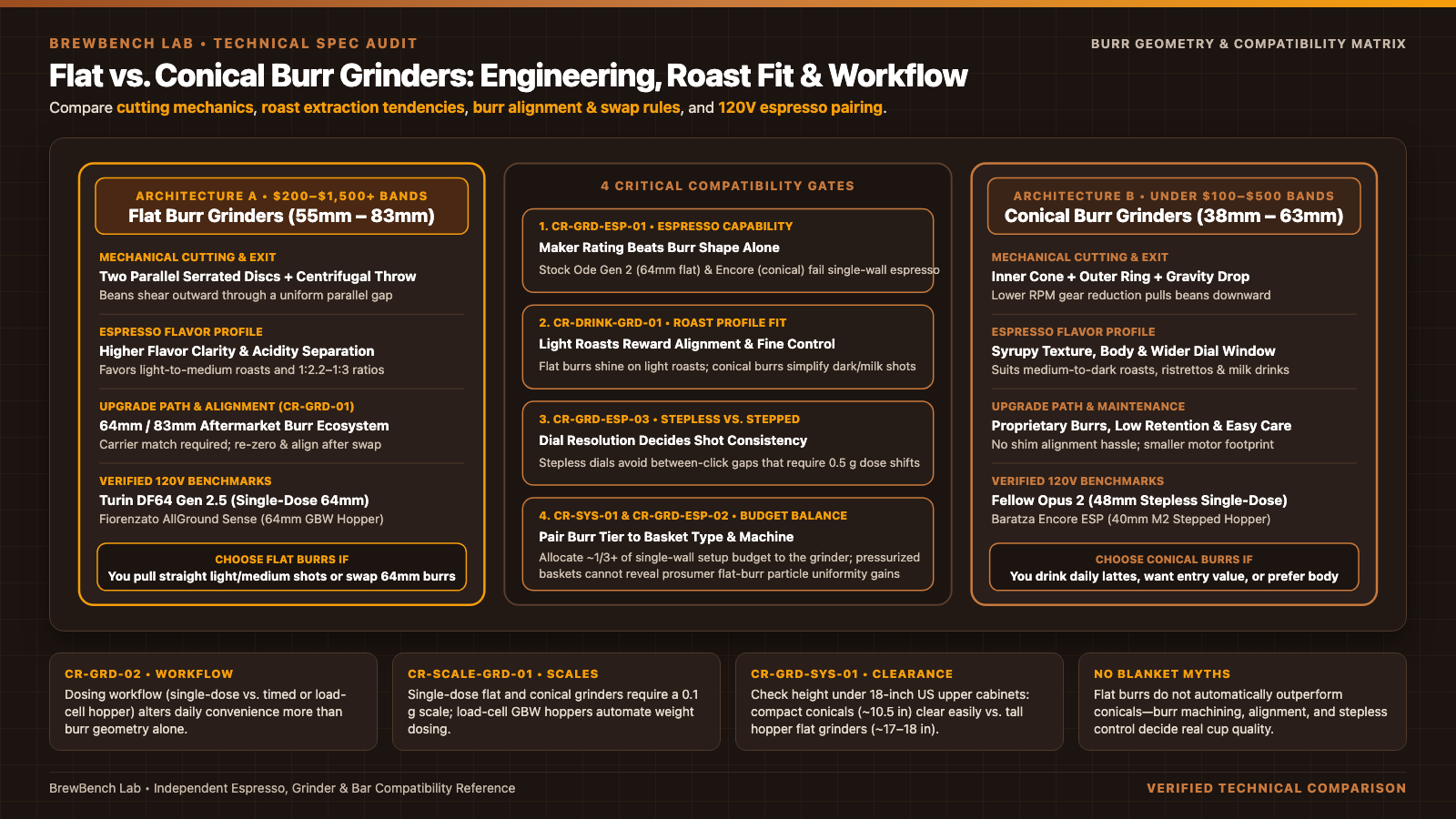
Side-by-Side Architecture, Spec & Compatibility Table
Below is how flat and conical burr architectures compare across verified mechanical attributes and North American 120V/60Hz ownership criteria. Because standardized particle-distribution graphs, micron shifts per step, and retention grams vary heavily by individual SKU, roast density, and third-party instrument setup, generic class-wide numbers are never fabricated—where no single cross-model figure applies, we state no verified data available yet.
| Engineering / Ownership Dimension | Flat Burr Grinders (55mm – 83mm Class) | Conical Burr Grinders (38mm – 63mm Class) |
|---|---|---|
| Mechanical Burr Geometry | Two parallel toothed discs (one stationary, one rotating) | Tapered inner rotating cone nested inside a stationary outer ring |
| Bean Feed & Exit Physics | Horizontal or angled feed; centrifugal force throws grounds radially | Vertical gravity drop downward through narrowing cutting flutes |
| Particle Distribution Tendency | Tends toward a narrower primary peak when precisely aligned (exact spread: no verified data available yet) | Tends toward a slightly broader bimodal spread supporting viscosity (exact spread: no verified data available yet) |
Roast Profile Strength (CR-DRINK-GRD-01) | Excels with light-to-medium roasts, Nordic profiles, and straight shots | Excels with medium-to-dark roasts, classic ristrettos, and milk drinks |
Alignment Sensitivity (CR-GRD-01) | High—upper and lower discs must sit parallel; shimming may be needed | Low—conical geometry self-centers around the central drive shaft |
| Aftermarket Burr Ecosystem | Broad in 64mm and 83mm standards (mount pattern match required) | Mostly proprietary per brand; minimal cross-brand burr swapping |
| Motor Speed & 120V Power Draw | Typically higher-RPM direct drive or variable-speed brushless (~250W–400W; NEMA 5-15P) | Often gear-reduced lower RPM electric (~70W–300W; NEMA 5-15P) or manual hand drive |
| Blanket Grind Retention (g) | No verified data available yet (chute design & ionizer matter more than burr shape) | No verified data available yet (single-dose vs. hopper path decides retention) |
| Noise Level Under Load (dB) | No verified data available yet (varies by housing insulation & RPM) | No verified data available yet (varies by gear reduction vs. direct drive) |
| Entry-to-Prosumer Budget Tiers | $200–$500 (TIER-GRD-MID) to $500+ (TIER-GRD-PROSUMER) for true espresso models | Under $100 to $200–$500 (TIER-GRD-ENTRY to TIER-GRD-MID) |
| Verified 120V Amazon US Benchmarks | Turin DF64 Gen 2.5 (single-dose), Fiorenzato AllGround Sense (GBW) | Fellow Opus 2 (48mm stepless), Baratza Encore ESP (40mm stepped) |
Battleground 1: Cutting Physics, Particle Distribution & Espresso Capability
To understand why flat and conical burrs behave differently in a 54mm or 58mm portafilter, start with how each geometry creates hydraulic resistance. During extraction, an espresso pump pushes hot water into the coffee puck at roughly 9 bar of brew pressure (distinct from the 15-bar or 20-bar maximum deadhead pump ratings printed on consumer espresso machine boxes). In a single-wall (non-pressurized) basket, the coffee grounds themselves provide 100% of that resistance. If particles are wildly uneven—a hallmark of blade grinders or worn burrs—water channels rapidly through coarse gaps while over-extracting powdery dust.
How Flat Burrs Cut: Flat burrs place two identical circular steel discs face-to-face. Coffee beans drop into the center hub, crack against coarse inner breaker teeth, and travel outward along progressively finer lands until they are small enough to pass through the calibrated perimeter gap. Because centrifugal force throws particles radially once they reach target size, well-aligned flat burrs produce a tightly clustered primary particle peak with relatively fewer large boulders.
How Conical Burrs Cut: Conical burrs nest a fluted cone inside a matching ring housing. Gravity draws beans downward through a converging V-shaped gap. Particles receive multiple progressive cuts as they descend, exiting straight out the bottom with minimal horizontal chute travel. Because the tapered path varies slightly in cutting velocity from top to bottom, conical burrs naturally retain a modest fraction of fine particles alongside the main grind peak—helping build puck resistance and crema viscosity without demanding razor-thin burr parallelism.
The Hard Compatibility Gate (CR-GRD-ESP-01): Never assume a flat burr grinder can pull espresso simply because its burrs are flat. Under BrewBench Lab rule CR-GRD-ESP-01, single-wall espresso capability must be explicitly verified by the manufacturer’s range and positioning—not burr geometry or millimeter diameter. For example, Fellow engineers the 64mm flat-burr Ode Gen 2 strictly for filter and pour-over brewing; its stock burrs do not grind fine enough to choke a single-wall espresso basket. Similarly, the classic conical-burr Baratza Encore (non-ESP) is positioned for drip and pour-over, whereas the Baratza Encore ESP adds a fine-stepped 1–20 espresso cam mechanism specifically for single-wall espresso.
Additionally, under rule CR-GRD-ESP-02, pairing a prosumer 64mm flat-burr grinder with an entry machine that only uses pressurized (dual-wall) baskets creates an immediate value mismatch. Pressurized baskets force brewed coffee through a single pin-sized exit hole to create artificial resistance, masking the particle-uniformity gains of a higher-tier burr set.
Battleground 2: Roast Profile, Clarity vs. Body & Light-Roast Fit
Compatibility rule CR-DRINK-GRD-01 connects your preferred roast level directly to burr design. While both geometries can make balanced espresso, their extraction tendencies align cleanly with distinct drink profiles:
- Light & Nordic Roasts (
DRINK-STRAIGHT-LIGHT-ROAST): Dense, lightly roasted beans have intact cellular structures that resist water penetration. Baristas typically pull longer 1:2.2 to 1:3 brew ratios at higher machine temperatures (~93–96 °C / 199–205 °F) to boost extraction yield without astringency. Because aligned 64mm flat burrs minimize coarse boulders alongside excessive fines, you can grind finer without choking the puck—yielding brighter fruit acidity, floral aromatics, and clear flavor separation. Explore dedicated options in our best flat burr espresso grinders roundup and our best grinders for light roast espresso guide. - Medium-Dark Roasts & Daily Milk Drinks (
DRINK-MILK-MEDIUM-ROAST/DRINK-MILK-DARK-ROAST): Porous medium and dark roasts extract easily at classic 1:1.5 to 1:2 ratios. Here, conical burrs shine by emphasizing rounded sweetness, chocolate-nut notes, and dense, syrupy mouthfeel that holds up inside 6 oz to 10 oz lattes and flat whites. On dark roasts, hyper-unimodal flat burrs can occasionally spotlight roasty bitterness if your shot runs slightly long, whereas conical burrs deliver a wider, more forgiving sweet spot. - Flavored & Ultra-Oily Bean Caution (
CR-DRINK-GRD-02): Regardless of whether you choose flat or conical steel burrs, artificially flavored or glossy oily dark beans leave sticky lipid and sugar films across burr teeth and anti-static chutes. Always inspect your grinder manual before running flavored beans through precision burrs.
Battleground 3: Dialing Granularity, Burr Alignment & Upgrade Swaps
When espresso shots pull sour at 19 seconds on one click and choke to a trickle at 42 seconds on the next, the culprit is rarely “flat vs. conical”—it is coarse adjustment steps (CR-GRD-ESP-03) or misaligned burr carriers.
Stepless vs. Stepped Dialing Precision
In a single-wall espresso basket, tiny vertical shifts in burr gap create large swings in shot time. Stepless grinders—such as the flat-burr Turin DF64 Gen 2.5 and Fiorenzato AllGround Sense or the conical-burr Fellow Opus 2—use worm gears, fine-pitch threads, or infinite collars with zero detents, letting you place the burr gap exactly where a specific roast demands. Stepped grinders like the Baratza Encore ESP (which splits 40 total settings into 20 fine espresso steps and 20 filter steps) remain completely viable for medium-to-dark espresso, though landing between two clicks occasionally requires shifting your dry coffee dose by 0.5 g to 1.0 g within your basket’s rated capacity (CR-ESP-ACC-12).
Why Alignment Matters More on Flat Burrs
Because flat burrs rely on two wide parallel faces meeting within microscopic tolerances, even slight manufacturing tilt in the rotating carrier or upper ring housing causes one edge of the disc to pinch tighter than the opposite side. Community quality-control reports note that entry-to-mid-tier flat-burr single-dosers can exhibit minor factory alignment variance—meaning some owners check burr wipe with a dry-erase marker and add thin foil shims if needed. Conical burrs naturally self-center along a tapered cone axis and require virtually zero alignment tinkering out of the box.
Aftermarket Burr Swaps & Carrier Rules (CR-GRD-01)
One major advantage of 64mm flat-burr platforms like the Turin DF64 Gen 2.5 is the huge ecosystem of third-party 64mm replacement burrs tuned for high-clarity light roasts or sweet traditional espresso. Under compatibility rule CR-GRD-01, however, sharing a 64mm nominal diameter never guarantees cross-brand fitment: screw hole spacing, outer diameter tolerances, and carrier thickness vary across grinders. Always confirm the aftermarket burr set explicitly lists your exact grinder model, re-zero the burr touch point after installation, recheck alignment, and verify whether opening the chamber impacts your US manufacturer warranty. Conical burr grinders generally stick to proprietary factory burrs, though models like the Baratza Encore ESP make OEM M2 burr replacements simple and inexpensive.
Battleground 4: Single-Dose vs. Hopper Workflow, Scales & Switching
Under rule CR-GRD-02, your daily dosing architecture—single-dose weighing versus timed or load-cell hopper dosing—shapes daily kitchen satisfaction far more than burr geometry alone. Both workflows exist across flat and conical designs:
- Single-Dose Grinders (Flat & Conical): Grinders like the 64mm flat Turin DF64 Gen 2.5 and the 48mm conical Fellow Opus 2 are built for weighing one 18 g (0.63 oz) dose at a time, grinding the chamber empty, and switching beans effortlessly between morning espresso and afternoon decaf. Under
CR-SCALE-GRD-01, single-dosing requires pairing your grinder with an accurate 0.1 g coffee scale whose platform supports your dosing cup. - Hopper & Grind-by-Weight Grinders: Classic conical hoppers like the Baratza Encore ESP hold roughly 8 oz (227 g) of beans for quick grab-and-grind mornings, while prosumer flat-burr hoppers like the Fiorenzato AllGround Sense integrate a real-time 0.1 g load cell into the portafilter fork—delivering automated grind-by-weight dosing without touching a separate bean scale. Keep in mind that hopper grinders store beans in open light/air if left sitting for days and retain stale grounds inside the chamber when swapping roasts.
- Daily Espresso-to-Filter Switching (
CR-GRD-03): If you pull espresso at 7:00 AM and brew a pour-over at 10:00 AM from one machine, single-dose grinders with clear dial markers switch smoothly, whereas hopper-fed espresso grinders require clearing the hopper or purging retained coffee. Many dual-method households eventually pair one dedicated conical or flat espresso grinder with a separate filter grinder. - Portafilter Forks vs. Dosing Cups (
CR-GRD-ACC-01): Before buying, check how grounds reach your basket. The Turin DF64 Gen 2.5 includes a 58mm dosing cup and fork collar, the Fellow Opus 2 uses dual magnetic catch cups engineered for both 54mm and 58mm portafilters, the Baratza Encore ESP includes a 54mm cup with a 58mm adapter ring, and the Fiorenzato AllGround Sense grinds directly into a portafilter held on its adjustable load-cell fork.
Battleground 5: Cabinet Clearance, 120V Power, Budget & Maintenance
Physical kitchen constraints and system budget allocation often settle the flat-vs-conical decision before you ever pull a shot:
Under-Cabinet Height Clearance (CR-GRD-SYS-01): Standard US upper kitchen cabinets typically hang about 18 inches (457 mm) above the countertop—always measure your own space. Compact conical single-dosers like the Fellow Opus 2 (~10.5 in / 267 mm tall) and bellow-equipped Turin DF64 Gen 2.5 (~12.0 in / 305 mm tall) slide cleanly underneath standard cabinets with plenty of hand room to drop in beans. By contrast, commercial-style hopper flat grinders like the Fiorenzato AllGround Sense stand roughly 17.3 to 18.1 inches (440 to 460 mm) tall with their hopper mounted, requiring open counter space or sliding forward to refill the hopper lid.
120V/60Hz North American Electrical & Circuit Load (CR-ESP-SYS-01 / CR-ESP-SYS-02): Always confirm you are ordering a 110–120V/60Hz North American unit with a standard NEMA 5-15P plug—never plug a 230V European or UK grinder into a US outlet or use improvised plug adapters. Entry conical grinders draw modest power (70W on the Baratza Encore ESP; 300W on the Fellow Opus 2), while 64mm flat grinders draw around 250W (DF64 Gen 2.5 and Fiorenzato AllGround Sense). On a 15A 120V branch circuit (1,800W peak / 1,440W continuous limit), a grinder’s brief 10-second draw rarely trips a breaker on its own—but running a 1,500W espresso boiler plus a 1,500W electric kettle simultaneously on that same circuit will overload it. Keep high-wattage heating appliances on separate circuits.
The 1/3 Setup Budget Rule (CR-SYS-01): When building a single-wall-basket home espresso setup, allocate at least roughly one-third (30% or more) of your combined machine-plus-grinder budget to the grinder. Putting a $1,500 dual boiler next to an entry filter mill starves the machine of uniform puck resistance. Conversely, if you plan to stay on pressurized baskets with pre-ground coffee, save your budget rather than overspending on a prosumer 64mm flat grinder (CR-GRD-ESP-02).
Safe Cleaning & Maintenance (G-17): Always unplug any grinder from the wall before clearing a bean jam or removing the upper burr carrier. Brush steel flat or conical burrs dry using a stiff bristle brush and dry microfiber cloth—never submerge steel burrs in water, which invites surface rust, and follow your manufacturer’s manual before running commercial grinder-cleaning tablets.
Head-to-Head Summary: Flat vs. Conical Burr Grinders
Choose a Flat Burr Grinder If…
- You drink straight espresso or Americanos brewed from light-to-medium specialty roasts (
CR-DRINK-GRD-01). - You want higher flavor separation, crisp acidity, and cleaner sweet finishes at 1:2.2 to 1:3 ratios.
- You like upgrading hardware over time via standardized 64mm aftermarket burr swaps (
CR-GRD-01). - Your grinder budget sits comfortably in the $200–$500 (
TIER-GRD-MID) or prosumer brackets.
Choose a Conical Burr Grinder If…
- You drink daily lattes, cappuccinos, or classic ristrettos made with medium-to-dark roasts.
- You prefer syrupy texture, rich crema body, and forgiving espresso dial-in windows out of the box.
- You want true single-wall espresso capability under $200 (
TIER-GRD-ENTRY) with zero alignment shimming. - You need a compact, low-height grinder that easily clears tight upper kitchen cabinets (
CR-GRD-SYS-01).
Verified Amazon US Flat & Conical Benchmarks Compared
To translate burr theory into real 120V/60Hz kitchen hardware, we audited four verified Amazon US espresso-capable grinders spanning flat single-dose, flat grind-by-weight hopper, conical stepless single-dose, and conical dual-range hopper designs. Confirm the 110–120V US model listing and seller before ordering.
1. Turin DF64 Gen 2.5 Single Dose Coffee Grinder — Best 64mm Flat-Burr Benchmark

Quick Specs: 64mm flat steel burrs | Continuous stepless adjustment dial | Zero-retention single-dose chute + bellows workflow | Updated Gen 2.5 motor mount | 110–120V/60Hz, 250W (NEMA 5-15P) | ~5.2 in W × 10.0 in D × 12.0 in H (~132 × 254 × 305 mm) | ~15 lbs (~6.8 kg) | Price Tier: $200–$500 (TIER-GRD-MID)
The Turin DF64 Gen 2.5 stands as the flagship Amazon US benchmark for home baristas wanting 64mm flat-burr espresso clarity without prosumer $1,000+ pricing. Its stepless collar satisfies CR-GRD-ESP-03 effortlessly when dialing dense light roasts, while the standardized 64mm flat carrier gives you an open upgrade runway for specialist aftermarket burrs down the road (CR-GRD-01). The Gen 2.5 revision refines the motor mount and single-dose chute ergonomics for clean bean-to-bean switching under CR-GRD-02.
Pros
- Standardized 64mm flat-burr platform unlocks broad aftermarket burr upgrades (
CR-GRD-01) - True stepless dial gives micro-fine control for single-wall light and medium roasts
- Compact 12-inch height clears standard 18-inch US upper cabinets easily (
CR-GRD-SYS-01)
Cons
- Single-dose workflow requires weighing every dose on a separate 0.1 g coffee scale (
CR-SCALE-GRD-01) - Flat burrs are more sensitive to carrier alignment variance if swapped or disassembled improperly
2. Fellow Opus 2 Conical Burr Grinder (48mm) — Best Stepless Entry Conical Single-Doser

Quick Specs: 48mm stainless steel conical burrs | Continuous stepless grind dial | Near-zero retention + anti-static technology + auto-stop | Dual magnetic catch cups (54mm & 58mm portafilter compatible) | 120V/60Hz, 300W (NEMA 5-15P) | ~5.25 in W × 8.1 in D × 10.5 in H (~130 × 206 × 267 mm) | ~5.5 lbs (~2.3 kg) | 2-year warranty (+1 yr registered) | Price Tier: $100–$200 (TIER-GRD-ENTRY)
Upgrading substantially over the Gen 1 40mm Opus, the Fellow Opus 2 brings larger 48mm stainless steel conical burrs and a true stepless adjustment dial directly into the sub-$200 entry band. Eliminating stepped click gaps solves rule CR-GRD-ESP-03 for entry home baristas, while dual magnetic catch cups fit both 54mm Breville-class and 58mm commercial-sized portafilters cleanly (CR-GRD-ACC-01). At just 10.5 inches (267 mm) tall with anti-static tech and auto-stop shutoff, it is built for compact apartments and daily milk-drink routines.
Pros
- Upgraded 48mm conical burrs and continuous stepless dial inside the sub-$200 tier
- Dual magnetic catch cups cover both 54mm and 58mm portafilter transfers without messy spills
- Low 10.5-inch profile fits comfortably underneath tight kitchen cabinets (
CR-GRD-SYS-01)
Cons
- Proprietary 48mm conical burrs lack third-party unimodal flat-burr upgrade options (
CR-GRD-01) - Requires logging exact stepless dial positions and weighing single doses on a 0.1 g scale (
CR-SCALE-GRD-01)
3. Baratza Encore ESP (ZCG495BLK) — Best Sub-$200 Dual-Range Conical Hopper Pick

Quick Specs: 40mm hardened steel M2 conical burrs | 40 stepped settings (1–20 fine espresso, 21–40 filter) | ~8 oz (227 g) hopper + manual pulse/switch | 54mm dosing cup + 58mm adapter ring | 100–120VAC/50–60Hz, 70W (0.8A, NEMA 5-15P) | ~5.1 in W × 5.9 in D × 13.4 in H (~130 × 150 × 340 mm) | 1-year US warranty | Price Tier: $100–$200 (TIER-GRD-ENTRY)
If your household switches between morning single-wall espresso and weekend drip or pour-over (CR-GRD-03), the Baratza Encore ESP (ZCG495BLK) makes dual-method dialing dead simple. Baratza’s dual-range collar dedicates clicks 1–20 to finer espresso steps and 21–40 to filter brewing, backed by European-made 40mm M2 conical burrs and widely available US spare parts. Just remember never to confuse the espresso-rated Encore ESP with the filter-only standard Encore (CR-GRD-ESP-01).
Pros
- Visible 1–20 espresso / 21–40 filter collar simplifies daily switching without hidden rings (
CR-GRD-03) - Low 70W draw and highly repairable Baratza chassis with stocked gears, carriers, and M2 burrs
- Ships with both a 54mm dosing cup and 58mm adapter ring for portafilter transfer (
CR-GRD-ACC-01)
Cons
- Stepped 1–20 espresso collar can land between clicks, requiring 0.5 g dose tweaks (
CR-GRD-ESP-03) - Lacks timed auto-stop, digital dosing, or active anti-static ionizer tech (reserved for the mid-tier Encore ESP Pro)
4. Fiorenzato AllGround Sense — Best Prosumer 64mm Flat Grind-by-Weight Hopper Pick

Quick Specs: 64mm Dark-T titanium-coated flat burrs | Stepless ring selector (Espresso / Moka / Filter) | Integrated 0.1 g load-cell grind-by-weight portafilter fork | Made in Italy | 110–120V/60Hz, 250W (1,600 RPM at 60Hz, NEMA 5-15P) | ~6.7 in W × 9.4 in D × 17.3–18.1 in H (~169 × 240 × 440–460 mm) | ~20 lbs (~9 kg) | Price Tier: $1,000–$1,500 (TIER-GRD-PROSUMER)
For espresso households that want 64mm flat-burr extraction clarity without single-dose weighing rituals, the Italian-made Fiorenzato AllGround Sense pairs Dark-T coated 64mm flat burrs with an integrated 0.1 g load-cell scale built directly into its portafilter fork. Rest your 58mm portafilter on the cradle, press your dose target on the touchscreen, and the grinder automatically stops at exact target weight—satisfying CR-SCALE-GRD-01 workflow convenience in a commercial-grade die-cast frame.
Pros
- Integrated 0.1 g load-cell grind-by-weight fork delivers effortless, repeatable hopper dosing
- Long-life 64mm Dark-T coated flat burrs and heavy 20 lb Italian die-cast chassis minimize vibration
- Tool-free upper chamber release simplifies periodic dry brushing of the flat burr teeth
Cons
- Tall 17.3–18.1-inch hopper height crowds standard 18-inch US upper kitchen cabinets (
CR-GRD-SYS-01) - Hopper retention makes rapid bean-to-bean switching slower than dedicated single-dose flat grinders (
CR-GRD-02)
Grinders Excluded From This Amazon US Comparison
To protect single-wall espresso compatibility and Amazon US buyer accuracy, we audited and excluded five common grinder categories from our buy-intent recommendations above:
- Fellow Ode Gen 2 (Stock 64mm Flat Burrs): Disqualified under
CR-GRD-ESP-01. Although it uses 64mm flat burrs, Fellow engineers stock Ode Gen 2 burrs exclusively for pour-over and drip coffee—they cannot grind fine enough for single-wall espresso baskets. - Standard Baratza Encore (Non-ESP, ZCG485): Disqualified under
CR-GRD-ESP-01. Baratza positions the standard Encore for filter brewing; it lacks the Encore ESP’s fine-stepped 1–20 espresso cam range. - Generic Blade Grinders: Disqualified under
CR-GRD-ESP-01andCR-SYS-02. Rotating chopping blades create wide particle scatter with zero gap calibration, causing instant channeling and sour gushing in single-wall baskets. - Niche Zero & Timemore Sculptor 064: Excluded as Amazon US buy-intent picks because both models rely on direct or specialty dealer distribution rather than primary Amazon US storefront availability. If you are cross-shopping the ~63mm conical workflow of the Niche Zero, see our best Niche Zero alternatives on Amazon roundup.
- 230V / 50Hz Overseas Imports: Excluded under
CR-ESP-SYS-01. Never purchase 230V European or UK grinder listings for North American 120V/60Hz kitchens, and never rely on plug adapters or unverified voltage converters.
Authoritative Technical References
- Baratza — Encore ESP (ZCG495) Official Support Manual & Specifications (40mm M2 conical burrs, 1–20 espresso / 21–40 filter steps, 100–120VAC 70W spec, and 1-year US warranty).
- Fellow Products — Opus 2 Conical Burr Grinder Official Specifications (48mm conical burrs, continuous stepless adjustment, 120V/60Hz 300W draw, dual magnetic catch cups, and 2+1 year warranty).
- Fiorenzato USA — AllGround Sense 110–120V Official Technical Sheet (64mm Dark-T flat burrs, 1,600 RPM at 60Hz, 250W draw, load-cell grind-by-weight fork, and chassis dimensions).
- Specialty Coffee Association (SCA) — Coffee Brewing & Extraction Standards (Foundational coffee extraction yield and roast-solubility principles governing grind uniformity).
- National Fire Protection Association (NFPA) — Residential Branch Circuit Safety Context (15A and 20A 120V countertop appliance circuit planning alongside espresso heaters under
CR-ESP-SYS-02).
How We Audited This Guide
- Burr grinders were checked for maker-stated espresso adjustment fineness, burr geometry and size, single-dose vs hopper workflow, retention caveats, and kitchen height clearance.
- Every espresso machine, burr grinder, accessory, and scale specification was cross-checked against official manufacturer 120V manuals, SCA water guidance, and verified Amazon US listings.
- Recommendations were evaluated against our weighted espresso-gear scoring rubrics and documented CR-* compatibility rules; we never invent heat-up seconds, PID variance, or micron claims.
Frequently Asked Questions
Are flat burr grinders always better than conical burr grinders for espresso?
No—burr geometry shapes flavor tendencies rather than guaranteeing better shots. While aligned flat burrs often highlight clarity in light roasts, quality conical burrs excel at syrupy body and forgiving dial-in windows for medium-dark milk drinks. Adjustment precision and alignment matter more than shape alone.
Which burr type is better for light roast espresso under CR-DRINK-GRD-01?
Well-aligned 64mm+ flat burrs usually perform better for light roast straight espresso. Under compatibility rule CR-DRINK-GRD-01, dense light roasts benefit from tighter primary particle peaks that allow finer grinds and higher 1:2.2 to 1:3 extraction yields without harsh channeling or muddy mouthfeel.
Can a flat burr grinder for filter coffee like the Fellow Ode Gen 2 pull espresso?
No—stock Fellow Ode Gen 2 burrs fail rule CR-GRD-ESP-01 for single-wall espresso. Fellow engineers the stock 64mm flat burrs strictly for pour-over and drip brewing. Only purchase grinders explicitly positioned by their manufacturer for espresso capability unless you plan verified aftermarket burr conversions.
Why do flat burr grinders sometimes need alignment shimming?
Flat burrs require two parallel steel faces to stay co-planar within microscopic tolerances. Minor machining tilt in the burr carrier causes one edge to rub closer than the other, widening particle scatter. Conical burrs naturally self-center along a tapered cone shaft and rarely need shimming.
Can I swap 64mm flat burrs between any two 64mm grinders?
No—matching a 64mm diameter alone does not guarantee fitment under rule CR-GRD-01. Screw hole layouts, carrier heights, and rotational directions vary by brand. Confirm that aftermarket burr sets explicitly list your exact grinder model, re-zero after installation, and verify warranty coverage first.
How much of my espresso budget should go toward a flat or conical grinder?
Allocate at least one-third of your machine-plus-grinder budget to the grinder for single-wall baskets. Under rule CR-SYS-01, an inconsistent grinder bottlenecks extraction regardless of espresso machine cost. If you only use pressurized dual-wall baskets, a prosumer 64mm flat grinder offers minimal payoff.


