
Disclosure: As an Amazon Associate, I earn from qualifying purchases. If you buy through links on this page, we may earn a small commission at no extra cost to you.
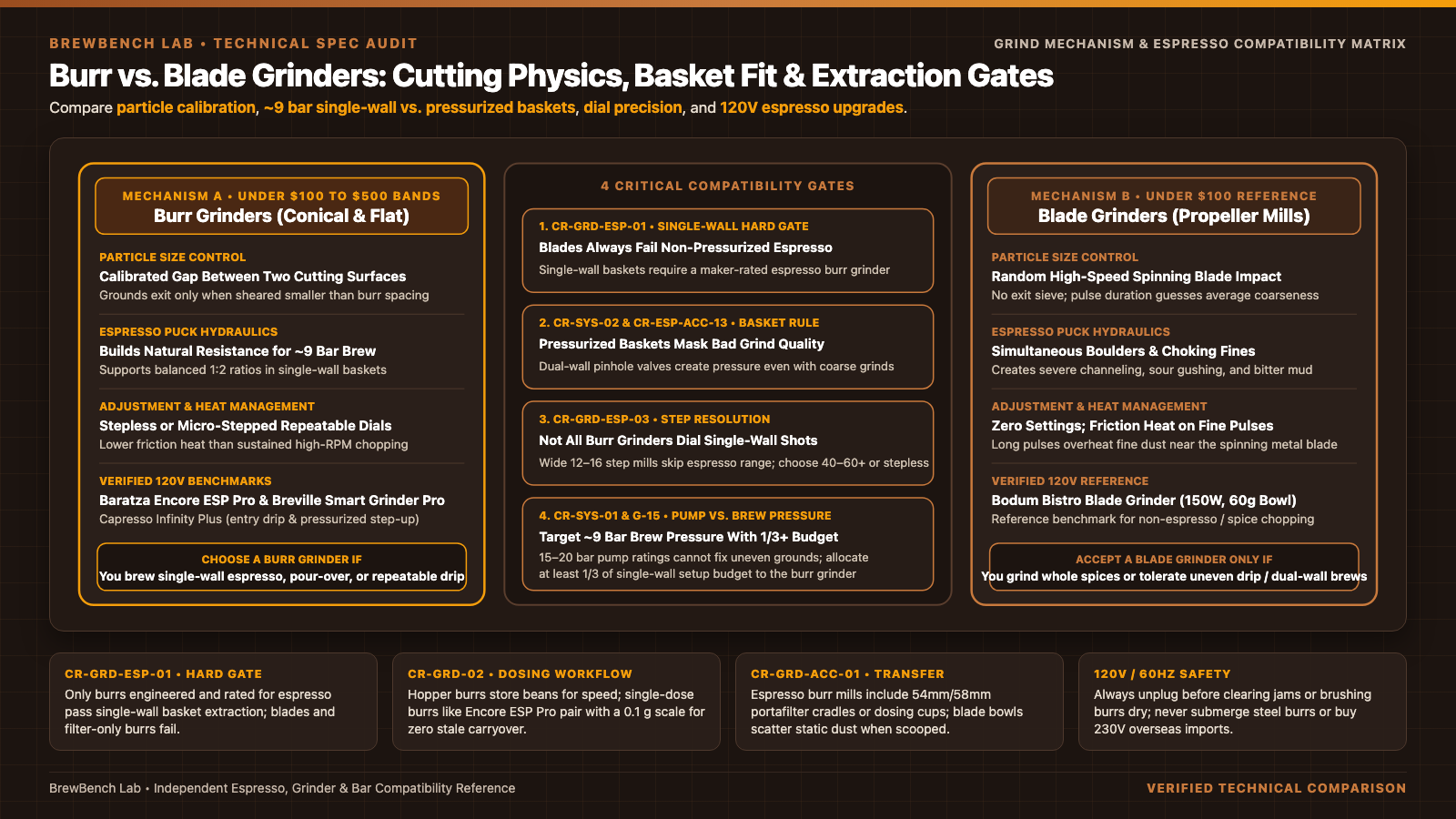
Debating a burr vs blade grinder is the single most consequential fork in the road for anyone building a home coffee station, especially if espresso is on your daily menu. A burr grinder crushes roasted coffee beans through a calibrated, repeatable gap between two machined cutting rings, whereas a blade grinder uses a high-speed spinning propeller to chop beans randomly inside an enclosed bowl. Inside our best espresso grinders hub, burr construction is not a luxury upgrade—it is the mechanical entry gate for pulling balanced espresso.
The short verdict: You strictly need an espresso-capable burr grinder if you pull shots through a single-wall (non-pressurized) portafilter basket at ~9 bar of brew pressure, because the compacted coffee puck itself must generate uniform hydraulic resistance (CR-GRD-ESP-01). A blade grinder always fails single-wall espresso extraction by generating large boulders alongside choking powder in the same batch; it is viable only for chopping whole spices or making rough drip and pressurized-basket coffee when budget strictly prohibits a burr mill.
In This Comparison
- Winner-by-Use-Case Quick Verdict Matrix
- Side-by-Side Mechanism, Spec & Compatibility Table
- Battleground 1: Cutting Physics, Particle Scatter & ~9 Bar Puck Hydraulics
- Battleground 2: Pressurized vs. Single-Wall Baskets & The Blade Illusion
- Battleground 3: Why Not Every Burr Grinder Can Pull Single-Wall Espresso
- Battleground 4: Friction Heat, Dosing Workflow & Portafilter Transfer
- Battleground 5: 120V Power, Cabinet Height, Setup Budget & Safe Cleaning
- Choose a Burr Grinder If vs. Stick With a Blade Grinder Only If
- Verified 120V Amazon US Burr & Blade Benchmarks Compared
- Grinders Excluded From Single-Wall Espresso Recommendations
- Authoritative Technical References
- Frequently Asked Questions
Quick Verdict Matrix: Burr vs. Blade Grinders by Coffee Use Case
Coffee grinding mechanics interact directly with your espresso basket type, roast profile, and morning routine. Use the matrix below to see where calibrated burrs are mandatory and where entry burr or blade hardware hits hard compatibility limits.
| Use Case & Coffee Profile | Recommended Mechanism | Deciding Compatibility Rule & Rationale |
|---|---|---|
| Best for Single-Wall Espresso & Daily Lattes | Espresso-Rated Burr Grinder | CR-GRD-ESP-01: Stepless or fine-stepped 40mm+ conical or flat burrs build uniform ~9 bar puck resistance. |
| Best for Light Roasts & Fine Ratio Dialing | Stepless Burr Grinder | CR-GRD-ESP-03: Continuous stepless dials avoid between-click jumps when balancing longer 1:2.2–1:3 extractions. |
| Best Value Entry Espresso ($100–$200) | 60-Step Conical Burr (120V) | CR-SYS-01 / CR-GRD-ACC-01: Sub-$200 espresso burrs with portafilter cradles unlock fresh single-wall shots affordably. |
| Best Under-$100 Drip & Pressurized Step-Up | 16-Step Conical Burr | CR-SYS-02 / CR-GRD-ESP-03: Far cleaner than blades for drip, pour-over, and dual-wall baskets despite wider clicks. |
| Best Compact Footprint Under Low Cabinets | Compact Conical Burr or Blade | CR-GRD-SYS-01: Short conical mills (~10.5–13.4 in tall) fit below 18-inch US upper cabinets without losing grind control. |
| Whole Spices or Ultra-Tight Non-Espresso Budget | Stainless Blade Grinder | Fails CR-GRD-ESP-01: Viable only for spices or rough immersion/drip brews when a burr mill is out of reach. |
Side-by-Side Mechanism, Spec & Compatibility Table
The table below compares burr and blade architectures across verified mechanical principles and North American 120V/60Hz ownership criteria. Because particle-size distribution curves, retention grams, and operating decibels vary widely across individual grinders, bean densities, and measuring instruments, blanket class-wide numbers are never fabricated—where no single cross-model figure applies, we state no verified data available yet.
| Engineering / Ownership Dimension | Burr Grinders (Conical & Flat) | Blade Grinders (Spinning Propeller) |
|---|---|---|
| Mechanical Cutting Principle | Two machined surfaces (inner cone + outer ring, or parallel flat discs) shear beans through a fixed exit gap | Single flat two-wing metal blade spins at high speed inside a cup, shattering beans by random impact |
| Particle Size Uniformity | Controlled by burr gap; grounds exit only after fitting through the calibrated spacing (exact spread: no verified data available yet) | Wide bimodal/multimodal scatter combining large unground chunks and powdery dust (exact spread: no verified data available yet) |
Single-Wall Espresso Fit (CR-GRD-ESP-01) | Pass when maker-rated for espresso (stepless or micro-stepped espresso range) | Hard Fail—cannot hold uniform ~9 bar puck resistance without severe channeling |
Pressurized Dual-Wall Basket Fit (CR-SYS-02) | Works cleanly; uniform grounds still improve sweetness over erratic chopping | Marginal—pressurized pinhole valve creates artificial resistance, though harsh bitterness persists |
| Grind Setting Repeatability | Numbered stepped collars (12–60+ steps) or continuous stepless dials | Zero mechanical settings; users estimate grind fineness by pulse-button hold duration |
| Heat Buildup During Grinding | Brief burr contact plus low-RPM gear reduction on many conical units limits friction heat | Extended pulses trap fine dust against fast-spinning blades, warming oils and volatile aromatics |
| Blanket Grind Retention (g) | No verified data available yet (varies by single-dose bellows, ionizer, or hopper chute) | No verified data available yet (static powder clings heavily to plastic lids and bowl walls) |
| Noise Level Under Load (dB) | No verified data available yet (depends on motor type, gear reduction, and housing mass) | No verified data available yet (high-pitched blade whine amplified by thin plastic lids) |
| 120V US Electrical Profile | Typically 70W–300W on 120V/60Hz NEMA 5-15P residential circuits | Typically ~150W on 120V/60Hz NEMA 5-15P residential circuits |
| Budget Tiers (Amazon US) | Under $100 (entry filter/pressurized) to $100–$500 (TIER-GRD-ENTRY & TIER-GRD-MID espresso) | Under $100 (typically entry impulse-buy price tier) |
| Verified 120V Amazon US Benchmarks | Baratza Encore ESP Pro, Breville Smart Grinder Pro, Capresso Infinity Plus | Bodum Bistro Electric Blade Coffee Grinder (non-espresso comparison reference) |
Battleground 1: Cutting Physics, Particle Scatter & ~9 Bar Puck Hydraulics
To see why a blade grinder collapses under espresso pressure, look at what happens inside a portafilter basket during a 25-to-30-second shot. Whether your espresso machine advertises a 15-bar or 20-bar maximum deadhead pump rating on its retail box, an over-pressure valve (OPV) or hydraulic system targets roughly 9 bar of actual brew pressure against the coffee bed. That pressurized hot water follows the path of least resistance.
How a Burr Grinder Controls Flow: Inside a burr mill, coffee beans drop into a tapered funnel or center hub and pass through a physical bottleneck between two precision-cut metal or ceramic teeth. No coffee fragment can escape the grinding chamber until it has been sheared small enough to clear the exact spacing between the rotating and stationary burrs. Turning the adjustment collar narrows or widens that physical gap in repeatable increments, letting you tune how tightly the tamped coffee puck packs together—a foundational concept mapped in our espresso grind size chart.
Why a Blade Grinder Creates Simultaneous Sourness and Bitterness: A blade grinder has no exit sieve and no calibrated gap. When you press the pulse button on a blade chopper, the spinning propeller strikes beans at random angles. Fragments tossed toward the outer lid stay coarse like sea salt, while grounds caught near the blade shaft are pulverized repeatedly into flour-like dust. When hot ~9 bar water hits that uneven puck inside a single-wall basket, water blasts through the coarse boulder pockets in seconds (under-extracting sharp, grassy sourness) while choking against pockets of fine dust (over-extracting dry, ash-like bitterness). Shaking the blade grinder mid-pulse improves average particle size visually, but it never creates the narrow particle uniformity that single-wall espresso requires.
Battleground 2: Pressurized vs. Single-Wall Baskets & The Blade Illusion
Many new home baristas wonder why an entry espresso machine seems to produce foamy tan crema from blade-chopped beans on day one, only to gush violently the moment they switch to a non-pressurized basket. The explanation lies in compatibility rules CR-SYS-02 and CR-ESP-ACC-13.
- Pressurized (Dual-Wall) Baskets Mask Grind Errors: Budget and entry espresso machines often ship with pressurized dual-wall baskets featuring dozens of holes inside the top floor, but only a single tiny pinhole underneath. Because all brewed liquid must squeeze through that pinhole valve, the basket itself generates ~9 bar of artificial backpressure—even if the coffee grounds inside are coarse or unevenly chopped by a blade grinder. While pressurized baskets keep shots from spraying out in 5 seconds, they produce aerated foam rather than true dissolved-oil crema and cannot rescue the muddy flavor caused by blade-generated dust and boulders.
- Single-Wall (Non-Pressurized) Baskets Expose Every Flaw: A single-wall basket has hundreds of open perforations straight through the bottom metal floor. With zero artificial pinhole valve, the tamped coffee puck provides 100% of the resistance against the pump. Under rule
CR-GRD-ESP-01, pairing a blade grinder with a single-wall basket is a HARD failure: shots immediately channel and gush too fast or stall unevenly. - Avoid Value Mismatches (
CR-GRD-ESP-02): Just as a blade grinder bottlenecks a single-wall machine, buying a prosumer espresso burr grinder while continuing to brew exclusively through pressurized dual-wall baskets wastes the burr set’s uniformity. Upgrade to a single-wall basket sized to your portafilter’s lug pattern (CR-ESP-ACC-01,CR-ESP-ACC-02) as soon as you step up to an espresso-rated burr mill.
Battleground 3: Why Not Every Burr Grinder Can Pull Single-Wall Espresso
Buying a grinder simply because the box says “burr grinder” does not automatically guarantee single-wall espresso compatibility. Two distinct traps catch first-time shoppers upgrading from a blade chopper:
1. Filter-Only Burrs Fail CR-GRD-ESP-01
Several respected coffee burr grinders are engineered strictly for pour-over, drip, and French press brewing rather than espresso. Under rule CR-GRD-ESP-01, espresso capability must come from the manufacturer’s own rating and range design. For example, Fellow designs the stock 64mm flat-burr Ode Gen 2 exclusively for filter brewing, Baratza positions the standard Encore (non-ESP) for drip and pour-over, and OXO builds the Brew Conical Burr Grinder for filter methods. None of those filter-only burrs are engineered to sustain the ultra-fine, repeatable micro-range needed for single-wall espresso.
2. Wide Stepped Burrs vs. Micro-Step & Stepless Espresso Control (CR-GRD-ESP-03)
Even among conical burr grinders that include an “Extra Fine” label, step spacing determines whether you can actually dial in fresh-roasted beans. Budget 12-to-16-step conical mills like the Capresso Infinity Plus excel at drip, French press, and pressurized dual-wall baskets under $100, yet each click moves the burr gap relatively far—causing a single-wall shot to pull too fast at one setting and choke on the adjacent click.
By contrast, true entry-to-mid espresso burr grinders solve CR-GRD-ESP-03 by adding fine micro-steps or continuous stepless collars. The Breville Smart Grinder Pro divides its range into 60 stepped settings (plus an adjustable inner upper burr), while the Baratza Encore ESP Pro steps up to continuous stepless adjustment with a digital half-step readout—making it simple to land exact 1:2 espresso ratios. Once you commit to an espresso-capable burr grinder, choosing between conical and flat burr shapes becomes the next step, which we break down in our flat vs conical burr grinder guide.
Battleground 4: Friction Heat, Dosing Workflow & Portafilter Transfer
Beyond particle geometry, burr and blade grinders behave very differently during your 7:00 AM workflow:
- Friction Heat & Bean Geometry: Holding down a blade grinder’s pulse button for 15 to 25 seconds to chase espresso fineness forces the metal blade to whip fine powder repeatedly against warm chamber walls. Low-RPM gear-reduced conical burrs (such as the Capresso Infinity Plus) and dedicated 40mm espresso conical burrs move beans steadily through the cutting teeth once, keeping friction heat lower during normal single-shot grinding.
- Hopper vs. Single-Dose Architecture (
CR-GRD-02&CR-SCALE-GRD-01): Blade grinders only hold one small batch per cycle (typically 60 g / ~2.1 oz) and require scooping static-charged grounds out of an open bowl. Burr grinders split cleanly into timed hopper models (like the Breville Smart Grinder Pro, holding 18 oz of beans for fast push-button mornings) and single-dose workflows (like the Baratza Encore ESP Pro in auto-stop single-dose mode). UnderCR-SCALE-GRD-01, pairing a single-dose burr grinder with a 0.1 g coffee scale ensures your exact 18 g dose matches your basket’s rated capacity (CR-ESP-ACC-12). - Portafilter Cradles vs. Messy Bowls (
CR-GRD-ACC-01): Dedicated espresso burr grinders route grounds cleanly into a portafilter fork or anti-static dosing cup. The Breville Smart Grinder Pro ships with direct cradles for both 50–54mm and 58mm portafilters, and the Baratza Encore ESP Pro includes a 54mm dosing cup, 58mm adapter ring, and integrated ion-generation anti-static tech. - Flavored & Glossy Oily Beans (
CR-DRINK-GRD-02): Neither steel burrs nor blade bowls handle sugary flavored beans cleanly, and glossy dark oils can coat burr flutes and anti-static chutes. Always consult your grinder’s manual before running flavored coffee through precision burrs.
Battleground 5: 120V Power, Cabinet Height, Setup Budget & Safe Cleaning
Before ordering an upgrade off Amazon US, verify four practical kitchen compatibility gates:
120V/60Hz North American Electrical Compliance (CR-ESP-SYS-01 & CR-ESP-SYS-02): Always confirm the Amazon listing specifies a 110–120V/60Hz North American model fitted with a standard NEMA 5-15P plug—never buy 230V/50Hz overseas units or attempt to run high-draw kitchen equipment through improvised plug adapters. Entry and mid-tier burr grinders draw modest current (70W on the Baratza Encore ESP Pro; 100W on the Capresso Infinity Plus; 165W on the Breville Smart Grinder Pro), comparable to the 150W draw of a Bodum blade chopper. On a standard 15A 120V branch circuit (1,800W peak / 1,440W continuous limit), a grinder’s brief 10-to-15-second cycle will not overload a breaker alone, though you should never run a 1,500W espresso boiler and a 1,500W electric kettle simultaneously on the same shared circuit.
Under-Cabinet Height Clearance (CR-GRD-SYS-01): Standard US upper kitchen cabinets typically sit around 18 inches (457 mm) above the countertop—measure your actual clearance before ordering. The Capresso Infinity Plus (~10.5–11.25 in / 267–286 mm tall) and Baratza Encore ESP Pro (~13.4 in / 340 mm tall) slide easily beneath standard cabinets with loading space to spare, while the taller Breville Smart Grinder Pro (~15.5 in / 394 mm tall) leaves ~2.5 inches (63 mm) below an 18-inch cabinet, meaning you may pull it slightly forward when refilling its 18 oz hopper.
The 1/3 Espresso Setup Budget Rule (CR-SYS-01): If you are assembling a single-wall espresso bar from scratch, allocate at least roughly one-third (30% or more) of your combined machine-plus-grinder budget to the burr grinder. Pairing a $500 espresso machine with a sub-$30 blade grinder completely bottlenecks extraction; stepping into proven sub-$200 options covered in our best espresso grinders under $200 audit protects your machine investment immediately.
Safe Cleaning & Maintenance (G-17): Always unplug any burr or blade grinder from the wall outlet before clearing a bean jam, wiping a blade bowl, or unlocking an upper burr carrier. Brush hardened steel burrs dry with a stiff bristle brush and dry cloth—never submerge steel burrs in water, as moisture causes surface corrosion. Only run grinder cleaning tablets if explicitly approved in your manufacturer’s manual.
Head-to-Head Summary: Burr vs. Blade Coffee Grinders
Choose a Burr Grinder If…
- You pull espresso through single-wall (non-pressurized) baskets at ~9 bar (
CR-GRD-ESP-01). - You want repeatable numbered or stepless grind settings instead of guessing pulse times.
- You brew pour-over, AeroPress, or drip and want clean sweetness without bitter dust and sour boulders.
- You want hands-free 54mm/58mm portafilter cradles or anti-static dosing cups (
CR-GRD-ACC-01).
Stick With a Blade Grinder Only If…
- You need a compact electric mill strictly for chopping whole culinary spices, seeds, or dry herbs.
- Your coffee budget sits firmly under $50 and you brew casual drip or pressurized dual-wall pods/baskets.
- You have tiny drawer-only storage space and accept inconsistent extraction flavors.
- You plan to upgrade to a dedicated espresso burr grinder before switching to single-wall espresso.
Verified 120V Amazon US Burr & Blade Benchmarks Compared
To illustrate the real-world hardware gap across budget tiers, we audited four verified 120V/60Hz Amazon US benchmarks: one stepless mid-tier espresso burr upgrade, one sub-$200 portafilter-ready burr benchmark, one under-$100 entry conical burr mill, and one stainless blade grinder comparison reference. Confirm 120V US voltage and seller identity before ordering.
1. Baratza Encore ESP Pro (ZCG595BLK) — Best Stepless Single-Wall Espresso Upgrade

Quick Specs: 40mm hardened steel M2 conical burrs | Stepless adjustment with digital half-step display | 0.1-second digital timer + single-dose auto-stop | Ion-generation anti-static tech & flow-control disc | 300 g (10.6 oz) hopper / 45 g (1.6 oz) single-dose cap | 120V/60Hz, 70W (NEMA 5-15P) | ~5.1 in W × 6.0 in D × 13.4 in H (~130 × 150 × 340 mm) | Price Tier: $200–$500 (TIER-GRD-MID)
For home baristas upgrading out of a blade grinder into serious single-wall espresso, the Baratza Encore ESP Pro (ZCG595BLK) removes every major entry-level compromise. Its continuous stepless adjustment and digital half-step readout satisfy both CR-GRD-ESP-01 and CR-GRD-ESP-03 without forcing between-click dose workarounds. Dual hands-free dosing modes let you choose between a 0.1-second programmable timer for hopper mornings or auto-stop single-dosing paired with a 0.1 g scale (CR-SCALE-GRD-01), while integrated ion generation tames static chaff.
Pros
- Stepless 40mm M2 conical adjustment eliminates between-click espresso dialing dead zones (
CR-GRD-ESP-03) - Dual 0.1s timer and single-dose auto-stop workflow with built-in anti-static ionizer
- Compact 13.4-inch height easily clears standard 18-inch US upper kitchen cabinets (
CR-GRD-SYS-01)
Cons
- Sits in the $200–$500 mid tier rather than sub-$200 entry budgets
- Proprietary 40mm conical burrs lack aftermarket 64mm flat-burr swap flexibility (
CR-GRD-01)
2. Breville BCG820BSS Smart Grinder Pro — Best Sub-$200 Portafilter-Ready Burr Benchmark

Quick Specs: Hardened stainless steel conical burrs | 60 stepped settings + adjustable upper burr | Backlit LCD 0.2-second shot timer | 18 oz (~510 g) locking bean hopper | 50–54mm & 58mm portafilter cradles + grounds container | 110–120V/60Hz, 165W (NEMA 5-15P) | ~8.5 in W × 6.0 in D × 15.5 in H (~215 × 152 × 394 mm) | ~6.4 lbs (~2.9 kg) | Price Tier: $100–$200 (TIER-GRD-ENTRY)
Positioned right inside the sub-$200 entry band, the Breville BCG820BSS Smart Grinder Pro is a classic first real espresso burr upgrade for 54mm Breville and 58mm home machines. Sixty stepped settings paired with an adjustable inner upper burr allow single-wall espresso grinding (CR-GRD-ESP-01), while the 0.2-second LCD timer and included 54mm/58mm portafilter cradles deliver effortless push-button workflow (CR-GRD-ACC-01). Because its steps are fixed rather than stepless, occasional 0.5 g dose tweaks help bridge clicks (CR-GRD-ESP-03).
Pros
- Includes direct hands-free cradles for both 50–54mm and 58mm portafilters (
CR-GRD-ACC-01) - 0.2-second backlit LCD timer simplifies repeatable daily espresso dosing
- 60 stepped settings plus adjustable inner burr cover pressurized and entry single-wall baskets
Cons
- Stepped collar can land between clicks on dense light roasts, requiring small dose adjustments (
CR-GRD-ESP-03) - 15.5-inch height leaves tight vertical clearance when refilling the hopper under 18-inch cabinets (
CR-GRD-SYS-01)
3. Capresso Infinity Plus Conical Burr Grinder — Best Under-$100 Drip & Pressurized Step-Up
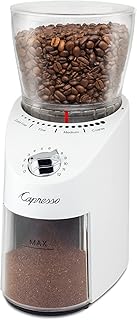
Quick Specs: Commercial-grade solid steel conical burrs | 16 stepped settings (Extra Fine to Coarse) | Low-RPM gear-reduction motor | 8.8 oz (~250 g) hopper + built-in cup timer | 120V/60Hz, 100W (NEMA 5-15P) | ~7.75 in W × 5.0 in D × 10.75 in H (~197 × 127 × 273 mm) | Price Tier: Under $100 (TIER-GRD-ENTRY)
If your main goal is replacing a noisy blade chopper under $100 for drip coffee, pour-over, moka pot, or a pressurized dual-wall espresso machine (CR-SYS-02), the Capresso Infinity Plus demonstrates the massive leap even an entry conical burr delivers. Its low-RPM gear-reduction motor pulls beans gently through solid steel conical burrs without scorching grounds. However, be realistic about its ceiling under CR-GRD-ESP-03: 16 broad stepped clicks span the entire coffee spectrum, leaving too few fine increments to dial in fresh single-wall espresso reliably.
Pros
- Low-RPM gear-reduced solid steel conical burrs dramatically outperform blade choppers under $100
- Compact ~10.75-inch height fits effortlessly beneath low upper cabinets (
CR-GRD-SYS-01) - Minimal friction heat keeps filter, French press, and pressurized-basket brews cleaner
Cons
- Only 16 stepped settings total—too coarse between clicks for reliable single-wall espresso dialing (
CR-GRD-ESP-03) - Plastic catch bin can build static cling without light RDT moisture management
4. Bodum Bistro Electric Blade Coffee Grinder — Blade Grinder Comparison Reference (Non-Espresso)

Quick Specs: Stainless steel spinning chopping blade (non-burr reference) | 60 g (~2.1 oz) bowl capacity | Pulse push-button lid operation | Brushed stainless steel housing + cord storage | 120V/60Hz, 150W (NEMA 5-15P) | Price Tier: Under $100
Included strictly as our real-world blade comparison benchmark, the Bodum Bistro Electric Blade Coffee Grinder illustrates why propeller mills remain popular for kitchen spice grinding yet fail single-wall espresso rules. Its 150W motor spins a stainless blade inside a 60 g cup with transparent pulse control—convenient for peppercorns or coarse casual drip in a pinch. Because it lacks calibrated burrs or particle sizing controls, it fails CR-GRD-ESP-01 outright for non-pressurized espresso baskets.
Pros
- Ultra-compact countertop and drawer footprint with tidy base cord storage
- Useful secondary kitchen chopper for whole dried spices, flaxseeds, or peppercorns
Cons
- Fails
CR-GRD-ESP-01: spinning blade creates erratic boulders and fines that channel single-wall espresso - Zero repeatable settings and high static clinging around the transparent plastic lid
- Sustained pulse cycles generate friction heat against fine dust near the spinning shaft
Grinders Excluded From Single-Wall Espresso Recommendations
To prevent Amazon US buyers from wasting budget on incompatible hardware, we explicitly excluded four grinder categories from our single-wall espresso recommendations:
- Generic Coffee Blade Choppers: Disqualified under
CR-GRD-ESP-01andCR-SYS-02. Spinning propeller blades cannot calibrate particle size for ~9 bar single-wall puck resistance. - Filter-Only Burr Grinders (Baratza Encore Non-ESP, Stock Fellow Ode Gen 2, OXO Brew Conical): Disqualified under
CR-GRD-ESP-01. Even precision 64mm flat burrs on the stock Fellow Ode Gen 2 are engineered exclusively for filter coffee and cannot grind fine enough for non-pressurized espresso. - Off-Amazon Dealer-Only Grinders (Niche Zero, Timemore Sculptor 064): Excluded as Amazon US buy-intent picks because they rely on direct or specialty dealer channels rather than primary Amazon US fulfillment.
- 230V / 50Hz Overseas Imports: Excluded under
CR-ESP-SYS-01. Never purchase European or UK 230V grinder listings for 120V/60Hz North American kitchens, and never bypass plug requirements with adapters.
Authoritative Technical References
- Baratza — Encore ESP Pro (ZCG595BLK) Official Support & Specifications (40mm M2 conical burrs, stepless adjustment, 0.1s timer & auto-stop single-dose modes, ionizer, and 120V 70W electrical rating).
- Breville USA — Smart Grinder Pro (BCG820BSS) Official Product Specifications (110–120V 165W spec, 60 stepped settings, 0.2s LCD timer, 18 oz hopper, and 50–54mm/58mm portafilter cradles).
- Capresso — Infinity Conical Burr Grinder Official Specifications (Solid steel conical burrs, 16 stepped settings, low-RPM gear reduction, 8.8 oz hopper, and 120V/60Hz 100W rating).
- Specialty Coffee Association (SCA) — Coffee Brewing & Extraction Standards (Particle uniformity principles governing simultaneous under-extraction and over-extraction).
- National Fire Protection Association (NFPA) — Residential Kitchen Branch Circuit Context (15A and 20A 120V countertop circuit load planning under
CR-ESP-SYS-02).
How We Audited This Guide
- Burr grinders were checked for maker-stated espresso adjustment fineness, burr geometry and size, single-dose vs hopper workflow, retention caveats, and kitchen height clearance.
- Every espresso machine, burr grinder, accessory, and scale specification was cross-checked against official manufacturer 120V manuals, SCA water guidance, and verified Amazon US listings.
- Recommendations were evaluated against our weighted espresso-gear scoring rubrics and documented CR-* compatibility rules; we never invent heat-up seconds, PID variance, or micron claims.
Continue Your Audit
Frequently Asked Questions
Can you make real espresso with a blade coffee grinder?
No—a blade grinder fails compatibility rule CR-GRD-ESP-01 for single-wall espresso. Spinning blades create a chaotic mix of coarse boulders and fine dust, causing ~9 bar water to channel unevenly. You can only pull rough shots through a pressurized dual-wall basket, which hides poor grind consistency behind a pinhole valve.
Why do burr grinders taste cleaner than blade grinders even for drip coffee?
Burr grinders shear beans to a consistent target size through a calibrated exit gap. Because most grounds share a similar diameter, hot water extracts sweetness and aromatics evenly without simultaneously over-extracting bitter dust and under-extracting sour chunks—a major upgrade over blade chopping for drip, pour-over, and AeroPress.
Can any burr grinder pull single-wall espresso?
No—both filter-only burrs and wide-stepped budget burrs fall short for single-wall baskets. Under rules CR-GRD-ESP-01 and CR-GRD-ESP-03, filter-focused mills like the standard Baratza Encore or stock Fellow Ode Gen 2 lack fine espresso capability, while 16-step mills lack micro-steps between clicks.
Does a 15-bar or 20-bar espresso machine fix a blade grinder?
No—higher pump ratings cannot compensate for uneven blade-chopped coffee grounds. Remember that 15-bar and 20-bar labels describe maximum deadhead pump capability, whereas espresso brews near ~9 bar. Without calibrated burr uniformity, higher pressure simply forces water faster through the weakest channels in the puck.
How much should I spend on my first espresso burr grinder?
Plan on the $100–$200 entry tier or higher, allocating at least one-third of your setup budget. Under rule CR-SYS-01, pairing a capable burr grinder like the Breville Smart Grinder Pro ($100–$200) or Baratza Encore ESP Pro ($200–$500) with a basic machine outperforms an expensive machine starved by a cheap mill.
How do you safely clean steel burrs versus a blade grinder bowl?
Always unplug the grinder before touching the grinding chamber or clearing bean jams. Brush hardened steel burrs strictly dry using a stiff brush and dry cloth—never submerge steel burrs in water, which causes rust. Wipe blade bowls with a slightly damp cloth only while unplugged, then dry completely.


