
Disclosure: As an Amazon Associate, I earn from qualifying purchases. If you buy through links on this page, we may earn a small commission at no extra cost to you.
Finding the best espresso grinder for your home bar matters more to cup quality than upgrading your espresso machine. When you pull shots through a single-wall (non-pressurized) basket, coffee puck resistance alone generates brewing pressure around nine bars—meaning an inconsistent burr grinder with coarse steps or sloppy burr alignment causes immediate channeling, sour shots, or gushing extractions regardless of your boiler hardware.
We audited nine distinct espresso-capable electric and manual grinders actively stocked on Amazon US across entry (espresso grinders under $200), mid-tier (mid-range espresso grinders under $500), and prosumer classes. Whether you are pairing a dedicated grinder with one of the best espresso machines for home or checking our espresso grinder vs machine budget split, every pick below passes maker-verified espresso capability and US 120V/60Hz compatibility gates.
In This Guide
- Quick Picks: Best Espresso Grinders at a Glance
- Side-by-Side Comparison of All 9 Audited Models
- Match Your Use Case: Scenario & Setup Guide
- Detailed Grinder Audits (Ranks #1–#9)
- Buying Guide: How to Choose the Best Espresso Grinder
- Scoring Methodology & Models We Excluded
- Frequently Asked Questions
- Final Verdict
Quick Picks: Best Espresso Grinders at a Glance
#1 Best Overall Espresso Grinder
Turin DF64 Gen 2
Stepless 64mm burrs, plasma ionizer, and full aftermarket SSP burr compatibility in a mid-range single-dose grinder. (Jump to audit)
#2 Best Value Entry Electric
Baratza Encore ESP (ZCG495BLK)
Dedicated steps 1–20 dial single-wall espresso reliably while steps 21–40 serve morning drip under $200. (Jump to audit)
#3 Best Prosumer Flat-Burr
MiiCoffee DF83V Variable RPM
83 mm DLC flat burrs with a 300–1,600 RPM brushless motor built for dense light roasts and prosumer bars. (Jump to audit)
Side-by-Side Comparison: Best Espresso Grinders Audited
| Product & Award | Best For | Burr & Adjustment | Dosing & 120V Power | Link |
|---|---|---|---|---|
| Turin DF64 Gen 2 Best Overall | Single-dose flat-burr dialing & burr upgrades | 64 mm DLC flat burrs; stepless collar | Single-dose bellows + ionizer; 250W (110–120V) | Check Price on Amazon |
| Baratza Encore ESP Best Budget Electric | Starter espresso + filter dual setups under $200 | 40 mm M2 conical burrs; 40 steps (1–20 esp.) | Hopper + 54/58 mm dosing cup; 70W (120V) | Check Price on Amazon |
| MiiCoffee DF83V Best Prosumer Flat | Light-roast flow control & variable RPM | 83 mm DLC flat burrs; stepless + 300–1,600 RPM | Auger single-dose + knocker; 680W (120V) | Check Price on Amazon |
| Baratza Encore ESP Pro Best Stepless Conical | Stepless dialing + 0.1 s timer in small footprint | 40 mm M2 conical burrs; stepless encoder | 0.1 s timer + auto-stop single-dose; 70W (120V) | Check Price on Amazon |
| Eureka Mignon Libra Best Grind-by-Weight | Hands-free daily milk drinks without scale prep | 55 mm hardened steel flat burrs; stepless dial | 300 g hopper + GBW fork; 310W (110–120V) | Check Price on Amazon |
| Fellow Opus 2 Best Compact Entry | Low-cabinet single-dosing under 11 inches | 48 mm steel conical burrs; stepless side dial | 100 g auto-stop bin + magnetic cup; 300W (120V) | Check Price on Amazon |
| Breville Smart Grinder Pro Best Cradle Convenience | Hands-free 54 mm / 58 mm portafilter cradles | Stainless conical burrs; 60 steps + upper burr | 450 g hopper + 0.2 s Dosing IQ; 165W (110–120V) | Check Price on Amazon |
| 1Zpresso J-Ultra Best Espresso Hand | Maximum manual espresso step precision | 48 mm Ti-coated conical; 8 μm/click ring | Manual 35–40 g + magnetic cup; 0W (manual) | Check Price on Amazon |
| KINGrinder K6 Best Value Manual | Dual espresso + pour-over manual versatility | 48 mm heptagonal conical; 16 μm/click ring | Manual 30–35 g + threaded cup; 0W (manual) | Check Price on Amazon |
Match Your Use Case: Which Grinder Fits Your Home Bar?
| Buyer Scenario | Best Match | Why & Expected Outcome |
|---|---|---|
| Straight Single-Wall Espresso & Light-Roast Exploration | Turin DF64 Gen 2 | Stepless 64mm burrs and optional aftermarket burr sets let you extract bright acidity cleanly without swapping grinders later. |
| Starter Espresso Setup Under $200 Grinder Budget | Baratza Encore ESP | Dedicated fine steps 1–20 choke non-pressurized 54 mm or 58 mm baskets while preserving easy morning filter switching. |
| Prosumer Variable-Speed Dialing & High Throughput | MiiCoffee DF83V | 83 mm DLC flat burrs and 300–1,600 RPM motor control handle back-to-back shots and dense light roasts on 120V power. |
| Hands-Free Hopper Workflow for Daily Milk Drinks | Eureka Mignon Libra | Integrated grind-by-weight scale doses straight into your portafilter without weighing beans before every pull. |
| Tight Under-Cabinet Countertop & Minimal Static | Fellow Opus 2 | At 10.5 inches tall with a stepless side dial and ionizer, it fits low cabinets while handling 54 mm and 58 mm cups cleanly. |
| Travel-Ready Precision Without Outlet Constraints | 1Zpresso J-Ultra | 8-micron external ring clicks beat entry electric steps for straight espresso when you prefer quiet manual cranking. |
Detailed Espresso Grinder Audits (Ranks #1–#9)
1. Turin DF64 Gen 2 Single Dose Coffee Grinder — Best Overall Espresso Grinder

Quick Specs: 64 mm DLC steel flat burrs | Stepless dial | Single-dose bellows + plasma ionizer | 250W (110–120V/60Hz, listed by US distributors) | ~5.2 x 10.0 x 12.0 in (132 x 254 x 305 mm) | Price Tier: Mid-range (between $200 and $500)
Audit Score: 9.3 / 10
- Burr Geometry, Espresso Range & Dialing Precision (35%): 9.5 / 10
- Retention, Alignment & Single-Dose vs Hopper Flow (25%): 9.2 / 10
- Build Quality, Noise & Kitchen Footprint (20%): 8.8 / 10
- Value for Tier, Upgradeability & Compatibility (20%): 9.6 / 10
The Turin DF64 Gen 2 earns our top overall rank because it pairs commercial-standard 64mm burrs and true stepless adjustment with practical Gen 2 hardware fixes in the mid-range bracket. Positioned by Turin Grinders as an all-purpose single-dose grinder capable of fine single-wall espresso (CR-GRD-ESP-01), the Gen 2 platform upgrades the original chassis with an integrated plasma generator (ionizer) at the exit chute and an anti-popcorn collar inside the bellows throat. That plasma emitter cuts static chaff scatter noticeably when dosing dry medium or light roasts without requiring heavy water misting, while the silicone bellows clears residual grounds between back-to-back bean swaps (CR-GRD-02).
From a compatibility and longevity standpoint, few grinders in this tier match its aftermarket ceiling. Its 64 mm carrier accepts widely sold SSP flat-burr profiles listed specifically for the DF64 platform—just remember that swapping burrs requires re-zeroing the collar indicator and checking burr alignment with a dry-erase marker (CR-GRD-01), as alignment variance can occur on flat-burr single-dosers. Standing roughly 12.0 inches (305 mm) tall, it leaves clear vertical access under standard 18-inch US upper kitchen cabinets even while compressing the bellows (CR-GRD-SYS-01). Compared against the conical Baratza Encore ESP Pro (#4) in the same budget tier, the DF64 Gen 2 delivers sharper flavor separation and burr upgrade headroom, though it lacks the Encore ESP Pro’s digital timer and runs louder at a fixed ~1,400 RPM. Remember to pair any true single-dose grinder with a 0.1 g coffee scale (CR-SCALE-GRD-01) and check portafilter funnel fit (CR-GRD-ACC-01) when transferring from its 58 mm dosing cup into 54 mm baskets.
Buyer Verification Alert: Multiple resellers list DF64 variations on Amazon US. Confirm the seller ships the 110–120V/60Hz North American Gen 2 configuration with the plasma ionizer rather than legacy Gen 1 inventory or a 230V export unit.
Pros
- 64 mm DLC flat burrs support aftermarket SSP burr swaps listed for DF64
- Stepless top collar gives continuous dialing freedom for single-wall baskets
- Plasma ionizer and bellows curb static scatter and grind retention
- 12-inch height clears standard 18-inch US upper cabinets easily
Cons
- Fixed ~1,400 RPM AC motor emits a sharp, high-pitched grinding tone
- Requires weighing every dose on a separate 0.1 g scale
- Burr swaps demand manual zero-point calibration and alignment verification
Verdict: Buy it if you want a versatile, upgradeable 64 mm flat-burr single-doser that outperforms entry conical grinders across light and medium roasts. Skip it if you prefer quiet insulated hopper grinding or want hands-free timed dosing without weighing beans. Pair it with a 0.1 g scale and a matching 54 mm or 58 mm dosing funnel to keep transfers spill-free.
2. Baratza Encore ESP Coffee Grinder (ZCG495BLK) — Best Value Entry Electric Grinder

Quick Specs: 40 mm M2 hardened steel conical burrs | 40 stepped settings (1–20 espresso; 21–40 filter) | Hopper + 54/58 mm dosing cup | 70W, 100–120V/50–60Hz | ~5.1 x 5.9 x 13.4 in (130 x 150 x 340 mm) | Price Tier: Entry-level (between $100 and $200)
Audit Score: 8.9 / 10
- Burr Geometry, Espresso Range & Dialing Precision (35%): 8.6 / 10
- Retention, Alignment & Single-Dose vs Hopper Flow (25%): 8.5 / 10
- Build Quality, Noise & Kitchen Footprint (20%): 8.7 / 10
- Value for Tier, Upgradeability & Compatibility (20%): 9.7 / 10
For home baristas building a starter single-wall setup under $200, the Baratza Encore ESP (ZCG495BLK) delivers the cleanest entry balance between price, US support, and genuine espresso range. According to Baratza’s official US ZCG495 specifications, its redesigned dual-range adjustment mechanism dedicates settings 1 through 20 to fine espresso steps while reserving settings 21 through 40 for coarser pour-over and drip methods (CR-GRD-ESP-01, CR-GRD-03). Unlike the filter-only standard Encore, the ESP includes Baratza’s upgraded 40 mm M2 conical burr and quick-release burr holder, plus a 54 mm dosing cup fitted with a removable 58 mm adapter ring that aligns directly over Breville, De’Longhi, or E61 baskets (CR-GRD-ACC-01).
Its electrical and spatial footprint makes it effortless to place in compact US apartments. Drawing just 70W on 100–120V circuits (0.8A), it places virtually zero extra load on shared 15-amp kitchen branch circuits alongside a thermoblock espresso machine (CR-ESP-SYS-02), and its 13.4-inch (340 mm) height fits neatly beneath standard 18-inch cabinetry (CR-GRD-SYS-01). Under rule CR-SYS-01, pairing an Encore ESP with an entry thermoblock machine puts roughly a third of total setup spending into the grinder—exactly where single-wall extraction rewards it. Compared to the stepped 60-setting Breville Smart Grinder Pro (#7), the Encore ESP feels far tighter inside the espresso window and produces cleaner single-dose cup transfers, though its fixed clicks (CR-GRD-ESP-03) still lack the continuous travel of the stepless Encore ESP Pro (#4).
Buyer Verification Alert: Never confuse the Encore ESP (ZCG495BLK) with the standard filter-only Baratza Encore (ZCG485BLK) or the higher-tier Encore ESP Pro (ZCG595BLK). Verify the “ESP” badge and model number before clicking checkout.
Pros
- 20 dedicated fine espresso steps choke single-wall baskets cleanly
- Includes both 54 mm and 58 mm dosing cup adapter geometry
- Ultra-low 70W 120V draw preserves kitchen circuit headroom
- 1-year US warranty with widely stocked OEM spare parts
Cons
- Stepped clicks can force 0.5–1 g dose adjustments when dialing tricky roasts
- Polycarbonate enclosure transmits audible motor and gear noise
- Lacks built-in timed dosing and active anti-static ionization
Verdict: Buy it if you want a dependable entry electric grinder under $200 for a Breville Bambino or starter single-boiler machine plus occasional drip coffee. Skip it if you drink mostly dense Nordic light roasts or want stepless adjustment without touching dose weight. Add a compact 0.1 g scale to lock in your favorite single-dose recipes.
3. MiiCoffee DF83V Variable Speed Single Dose Grinder — Best Prosumer Flat-Burr Grinder

Quick Specs: 83 mm DLC steel flat burrs | Stepless dial + 300–1,600 RPM variable brushless motor | Auger-fed single-dose + ionizer + knocker | 680W, 120V/60Hz | ~5.0 x 12.0 x 15.75 in (127 x 305 x 400 mm) | Price Tier: Prosumer (between $500 and $1,000)
Audit Score: 9.1 / 10
- Burr Geometry, Espresso Range & Dialing Precision (35%): 9.6 / 10
- Retention, Alignment & Single-Dose vs Hopper Flow (25%): 9.2 / 10
- Build Quality, Noise & Kitchen Footprint (20%): 8.6 / 10
- Value for Tier, Upgradeability & Compatibility (20%): 8.7 / 10
Home baristas running PID dual boilers or heat-exchanger machines who want big-burr speed and variable-RPM control without leaving Amazon US will gravitate straight to the MiiCoffee DF83V. Listed in the MiiCoffee official US catalog with 83 mm diamond-like carbon (DLC) flat burrs and a 680W brushless DC motor, the DF83V lets you dial motor speed continuously from 300 to 1,600 RPM alongside a stepless grind collar. Lower RPM settings feed beans horizontally via an internal pre-breaker auger to reduce fines generation on bright light roasts, whereas faster RPM delivers brisk throughput when pulling back-to-back shots.
Because it sits firmly in our prosumer price tier (between $500 and $1,000), compatibility rules CR-GRD-ESP-02 and CR-SYS-01 apply clearly: pairing an 83 mm variable-speed flat-burr grinder with a pressurized-only starter machine wastes capability the basket cannot resolve. Before ordering, check your kitchen geometry under CR-GRD-SYS-01—at 15.75 inches (400 mm) tall and 12.0 inches (305 mm) deep, the DF83V requires open counter depth and generous upper-cabinet headroom to pour beans into the angled chute comfortably. Compared against the Eureka Mignon Libra (#5), the DF83V trades automated hopper grind-by-weight for ultra-low-retention bean swapping, plasma static control, a spring-loaded chute knocker, and dramatically larger 83 mm flat burrs—though aftermarket 83 mm burr swaps must specify compatibility with the DF83V carrier (CR-GRD-01).
Buyer Verification Alert: Measure your under-cabinet height carefully (15.75 inches tall plus hopper access requires near-standard 18-inch clearance with minimal lip overhang) and confirm 120V/60Hz US specification on the Amazon listing.
Pros
- 83 mm DLC flat burrs and 680W brushless motor handle dense light roasts
- Continuous 300–1,600 RPM variable speed expands dialing flexibility
- Horizontal auger, plasma ionizer, and chute knocker keep retention low
- Magnetic front chute simplifies routine burr inspection and brushing
Cons
- 15.75-inch height and 12-inch depth demand substantial counter space
- Prosumer pricing makes no sense with pressurized dual-wall baskets
- Aftermarket 83 mm burrs cost considerably more than 64 mm sets
Verdict: Buy it if you brew single-wall espresso on a capable PID single-boiler or dual-boiler machine and want variable-RPM control on 83 mm flat burrs. Skip it if you have tight upper cabinets or prioritize push-button hopper dosing over bean rotation. Pair it with a 0.1 g scale and dedicated WDT distribution tool to minimize channeling.
4. Baratza Encore ESP Pro Coffee Grinder (ZCG595BLK) — Best Stepless Conical All-Purpose Grinder

Quick Specs: 40 mm M2 conical steel burrs | Stepless adjustment + digital encoder | 0.1-second timer + auto-stop single-dose + ionizer | 70W, 120V/60Hz | ~5.1 x 6.0 x 13.4 in (130 x 152 x 340 mm) | Price Tier: Mid-range (between $200 and $500)
Audit Score: 8.9 / 10
- Burr Geometry, Espresso Range & Dialing Precision (35%): 9.1 / 10
- Retention, Alignment & Single-Dose vs Hopper Flow (25%): 9.0 / 10
- Build Quality, Noise & Kitchen Footprint (20%): 8.6 / 10
- Value for Tier, Upgradeability & Compatibility (20%): 8.7 / 10
Built on the compact footprint of the entry ESP while fixing its biggest espresso bottleneck, the Baratza Encore ESP Pro (ZCG595BLK) transitions from stepped detents to full stepless adjustment. On Baratza’s official Encore ESP Pro product page, the Pro model combines those familiar 40 mm M2 steel conical burrs with a digital encoder display, an integrated 0.1-second timed-dosing mode, an auto-stop single-dose mode, LED illumination over the dosing area, and active ionization to tame static mess.
That dual workflow makes the ESP Pro unusually adaptable in households where one drinker prefers effortless timed espresso shots while another weighs single doses for pour-over (CR-GRD-02, CR-GRD-03). Because the 40 mm burrs lift out cleanly for brushing without tools, routine cleanouts do not disrupt your zero calibration, and Baratza backs the US 120V/60Hz unit (70W draw) with a 1-year limited warranty. Still, sitting between $200 and $500 puts the Encore ESP Pro head-to-head with the Turin DF64 Gen 2 (#1): pick the Baratza if you want conical chocolate-leaning body, a built-in timer, and Baratza US parts simplicity, or choose the DF64 Gen 2 if you want 64mm burrs and third-party SSP upgrade flexibility (CR-GRD-01).
Buyer Verification Alert: Check the exact SKU (ZCG595BLK / “Encore ESP Pro”) rather than the standard stepped Encore ESP (ZCG495BLK)—only the Pro carries stepless adjustment, the digital display, and auto-stop single-dose electronics.
Pros
- True stepless adjustment fixes step-gap limitations on single-wall espresso
- 0.1-second timer plus auto-stop single-dose mode covers two workflows
- Built-in ionizer, LED task light, and tool-free burr removal
- Low 70W 120V draw and compact 5.1-inch counter width
Cons
- Proprietary 40 mm conical carrier prevents flat-burr upgrades
- Competes in the same price bracket as the 64 mm Turin DF64 Gen 2
- Lighter housing carries more gearbox vibration than Italian metal grinders
Verdict: Buy it if you want conical espresso character with stepless precision, a digital timer, and clean single-dose auto-stop in a narrow footprint. Skip it if you want 64 mm flat-burr flavor clarity or aftermarket SSP burr paths at the same budget level. Pair it with a 0.1 g scale if you regularly rotate single-origin beans.
5. Eureka Mignon Libra Espresso Grinder (Chrome) — Best Grind-by-Weight Hopper Grinder

Quick Specs: 55 mm hardened steel flat burrs | Stepless micrometric bottom-burr dial | 300 g hopper + integrated Grind-by-Weight fork | 310W, 110–120V/60Hz, 1,350 RPM | ~4.8 x 7.3 x 13.8 in (124 x 192 x 350 mm) | Price Tier: Prosumer (between $500 and $1,000)
Audit Score: 9.0 / 10
- Burr Geometry, Espresso Range & Dialing Precision (35%): 9.1 / 10
- Retention, Alignment & Single-Dose vs Hopper Flow (25%): 9.0 / 10
- Build Quality, Noise & Kitchen Footprint (20%): 9.4 / 10
- Value for Tier, Upgradeability & Compatibility (20%): 8.4 / 10
Not everyone wants to weigh out 18 grams of whole beans before every morning latte, and the Italian-built Eureka Mignon Libra removes that chore without surrendering dose accuracy. Feature specs from Eureka’s 1920 prosumer catalog highlight the Libra’s Instant Grind Weighing technology: an integrated load cell inside the portafilter fork tares your portafilter automatically and stops grinding at your programmed gram weight within roughly +/- 0.2 g per Eureka, supported by anti-vibration software and a quick-stop safety trigger.
Because Eureka’s stepless micrometric system moves the bottom burr while leaving the top burr carrier stationary, brushing out the 55 mm flat burrs never wipes out your espresso zero setting, and the insulated metal body keeps sound levels subdued via Eureka’s Silent Technology and ACE anti-clumping chute. Compared to timed-dosing Mignon siblings like the Mignon Specialita, the Libra eliminates shot-weight drift whenever you adjust grind fineness or beans age across the week. Its primary trade-off comes from CR-GRD-03 and CR-GRD-02: the small multi-turn micrometric knob makes daily switching between espresso and pour-over cumbersome, and a 300 g hopper keeps stored beans sitting over the chamber—so keep the Libra dedicated to espresso. At 13.8 inches (350 mm) tall and 4.8 inches wide, check upper-cabinet clearance (CR-GRD-SYS-01) for lifting the hopper lid and confirm fork alignment (CR-GRD-ACC-01) with 54 mm or 58 mm portafilters.
Buyer Verification Alert: Confirm the 110–120V/60Hz North American model from an authorized Eureka US reseller, and note that bumping the portafilter mid-grind can halt the weight cycle early.
Pros
- Integrated grind-by-weight portafilter fork doses by target grams without pre-weighing
- Silent Technology enclosure keeps operation substantially quieter than open single-dosers
- Bottom-burr stepless adjustment retains grind calibration during chamber cleaning
- Narrow 4.8-inch cast-metal chassis fits cramped espresso stations
Cons
- Small micrometric dial is slow and frustrating for daily espresso-to-filter switches
- Hopper storage holds more grind retention than bellows single-dose mills
- Requires gentle portafilter placement so the load cell is not disturbed
Verdict: Buy it if you stick to one favorite espresso blend for daily milk drinks or straight pulls and want quiet, hands-free weight accuracy directly in your portafilter. Skip it if you rotate decaf and single-origin light roasts every morning. Keep a compact 0.1 g brew scale on your espresso drip tray to measure liquid shot output.
6. Fellow Opus 2 Conical Burr Grinder — Best Compact Single-Dose Entry Grinder

Quick Specs: 48 mm stainless steel conical burrs | Stepless single side dial | 100 g auto-stop bin + ionizer + magnetic cup | 300W (120V US model) | 5.1 x 8.1 x 10.5 in (130 x 206 x 267 mm) | Price Tier: Entry-level (between $100 and $200)
Audit Score: 8.8 / 10
- Burr Geometry, Espresso Range & Dialing Precision (35%): 8.9 / 10
- Retention, Alignment & Single-Dose vs Hopper Flow (25%): 8.9 / 10
- Build Quality, Noise & Kitchen Footprint (20%): 8.7 / 10
- Value for Tier, Upgradeability & Compatibility (20%): 8.6 / 10
The second-generation Fellow Opus 2 directly addresses the complaints buyers raised about the original stepped Opus. Detailed on Fellow’s official Opus 2 page, this redesign steps up from 40 mm to 48 mm stainless steel conical burrs driven by a 300W motor and trades the first-gen outer/inner ring puzzle for one smooth stepless side dial. That single control immediately simplifies dialing across fine espresso (CR-GRD-ESP-01, CR-GRD-ESP-03) and coarser pour-over or cold brew recipes without memorizing micro-ring offsets.
Apartment espresso setups gain two ergonomic advantages here: at 10.5 inches (267 mm) tall, the Opus 2 is the shortest electric grinder in our entire lineup, sliding cleanly beneath even tight 14- to 16-inch upper kitchen cabinets (CR-GRD-SYS-01). Its 100 g load bin automatically halts once grinding finishes, while anti-static ionization and a magnetic dosing cup built for 54 mm and 58 mm portafilters cut countertop clutter (CR-GRD-ACC-01). Compared against the Baratza Encore ESP (#2), the Opus 2 offers stepless dialing and a lower profile, whereas the Encore ESP carries a lower 70W electrical draw and slightly simpler bulk-hopper capacity for morning filter batches. Weigh doses carefully on a 0.1 g scale (CR-SCALE-GRD-01) since the Opus 2 omits a timed-dosing screen.
Buyer Verification Alert: Amazon sells both the older 40 mm stepped Fellow Opus (B0BV96VPSR) and the newer 48 mm stepless Opus 2 (B0FPCHNSX2). Confirm “Opus 2” and ASIN B0FPCHNSX2 before purchasing so older-generation inventory does not arrive instead.
Pros
- 48 mm conical burrs and stepless side dial remove inner-ring dialing friction
- Compact 10.5-inch height fits comfortably beneath low cabinets
- Auto-stop single-dose bin, jam detection, and ionizer reduce mess
- Magnetic dosing cup fits both 54 mm and 58 mm portafilters cleanly
Cons
- Proprietary 48 mm conical burrs offer no third-party burr upgrade path
- 100 g load bin suits single-dosing rather than full-bag hopper storage
- Requires an external 0.1 g scale for repeatable espresso doses
Verdict: Buy it if you want a stepless, low-height single-dose grinder under $200 that looks tidy beside a compact espresso machine. Skip it if you need bulk hopper storage or aftermarket 64 mm flat burrs down the road. Pair it with a 0.1 g espresso scale to lock in consistent brew ratios.
7. Breville BCG820BSS Smart Grinder Pro — Best Cradle-Dosing Convenience Grinder

Quick Specs: Hardened stainless steel conical burrs (diameter not published by maker) | 60 digital settings + adjustable upper burr | 450 g (18 oz) hopper + 0.2 s Dosing IQ timer + 50–54/58 mm cradles | 165W (110–120V US model) | ~8.5 x 6.3 x 15.3 in (214 x 160 x 389 mm) | Price Tier: Entry-level (between $100 and $200)
Audit Score: 8.4 / 10
- Burr Geometry, Espresso Range & Dialing Precision (35%): 8.2 / 10
- Retention, Alignment & Single-Dose vs Hopper Flow (25%): 8.2 / 10
- Build Quality, Noise & Kitchen Footprint (20%): 8.6 / 10
- Value for Tier, Upgradeability & Compatibility (20%): 8.8 / 10
For household bars anchored around a Breville Bambino or Bambino Plus where multiple family members make morning milk drinks, convenience often outranks single-dose tinkering. Per Breville’s official US Smart Grinder Pro page, the BCG820BSS pairs stainless steel conical burrs with 60 digital grind steps, an internal adjustable upper burr to extend fine range, a spacious 450 g (18 oz) locking bean hopper, and an LCD display running 0.2-second Dosing IQ time increments. Best of all, Breville includes snap-in portafilter cradles for both 50–54 mm and 58 mm handles (CR-GRD-ACC-01), enabling direct hands-free portafilter grinding straight from the box.
Honest audit limitations explain why it sits seventh behind the Fellow Opus 2 (#6) and Baratza Encore ESP (#2). Breville does not publish an official millimeter diameter for the BCG820 burrs, and its 60 broad settings span everything from Turkish-fine through French press, leaving wider gaps between consecutive espresso steps (CR-GRD-ESP-03). Because the hopper-and-chute architecture holds more residual coffee than bellows single-dosers (CR-GRD-02), purists who change grind sizes daily will purge several grams between switches. Standing 15.3 inches (389 mm) tall with its hopper mounted, verify under-cabinet clearance (CR-GRD-SYS-01) before placing it beneath low 18-inch cabinetry, and verify the 110–120V US model (165W, 1-year limited warranty).
Buyer Verification Alert: At 15.3 inches tall with its locking hopper attached, verify under-cabinet height (CR-GRD-SYS-01) so you do not have to slide the machine out every time you refill whole beans.
Pros
- Dedicated 50–54 mm and 58 mm cradles enable hands-free portafilter dosing
- 0.2-second Dosing IQ LCD timer simplifies repeatable family workflow
- Large 450 g locking hopper removes cleanly for storage or bean swaps
- Adjustable upper burr extends fine espresso calibration lifespan
Cons
- 60 full-range steps feel coarser inside single-wall espresso than Encore ESP
- Higher chute grind retention than modern single-dose grinders
- 15.3-inch hopper height crowds tight upper kitchen cabinetry
Verdict: Buy it if hands-free 54 mm or 58 mm cradle grinding and a 450 g timed hopper matter more to your household than stepless single-dosing. Skip it if you experiment with light-roast single origins or switch grind methods frequently. Add a 54 mm or 58 mm magnetic dosing funnel to prevent overflow when dosing 18 g mounds directly into the cradle.
8. 1Zpresso J-Ultra Manual Coffee Grinder — Best Espresso Hand Grinder

Quick Specs: 48 mm titanium-coated conical burrs | External top ring (100 clicks/rotation, 8 microns/click per maker) | Manual single-dose (35–40 g capacity) + magnetic cup | 0W (manual) | ~2.2 x 7.1 in body (56 x 180 mm), 670 g (23.6 oz) | Price Tier: Entry-level (between $100 and $200)
Audit Score: 8.7 / 10
- Burr Geometry, Espresso Range & Dialing Precision (35%): 9.3 / 10
- Retention, Alignment & Single-Dose vs Hopper Flow (25%): 8.5 / 10
- Build Quality, Noise & Kitchen Footprint (20%): 8.8 / 10
- Value for Tier, Upgradeability & Compatibility (20%): 8.0 / 10
If countertop space or noise forbids an electric motor, the 1Zpresso J-Ultra proves a dedicated manual espresso hand grinder can match stepless electric dialing resolution under $200. Per 1Zpresso’s official J-Ultra specifications, its external numbered adjustment collar packs 100 clicks per full turn at just 8 microns of vertical burr travel per click—giving you unusually tight control over single-wall shot flow (CR-GRD-ESP-01, CR-GRD-ESP-03). Inside, 48 mm titanium-coated conical burrs are tuned by 1Zpresso specifically for classic, heavy-bodied espresso extraction, feeding a quick-release magnetic catch cup that holds 35–40 g.
Because it operates purely by hand (CR-GRD-SYS-01 and CR-ESP-SYS-02 electrical limits become non-issues), you get near-silent early morning grinding, negligible grind retention, and compact portability. Still, manual grinding imposes real ergonomic ceilings: turning 18 grams of dense light-roast beans at espresso fineness demands steady grip strength, making the J-Ultra a poor match for multi-guest entertaining. Against the budget KINGrinder K6 (#9), the J-Ultra cuts step spacing in half (8 microns vs 16 microns per click) and upgrades to a magnetic catch cup, justifying the extra outlay if straight espresso is your primary daily drink. Like every single-dose mill, budget for a 0.1 g scale (CR-SCALE-GRD-01) to measure bean doses accurately.
Buyer Verification Alert: Check that the Amazon listing specifically names the 1Zpresso J-Ultra (8 microns/click) rather than the all-purpose K-Ultra or filter-only ZP6 Special (CR-GRD-ESP-01).
Pros
- 8 microns per click external dial rivals stepless electrics for single-wall espresso
- 48 mm titanium-coated burrs and magnetic catch cup streamline daily prep
- Near-silent manual operation with zero counter-outlet footprint
- Foldable crank handle tucks neatly into drawers or travel packs
Cons
- Fine espresso settings demand noticeable arm torque on light roasts
- Slow for pulling three or more back-to-back drinks for guests
- Requires an external 0.1 g coffee scale for dose consistency
Verdict: Buy it if you want maximum espresso dialing resolution per dollar in a quiet, portable hand grinder. Skip it if you pull multiple consecutive milk drinks daily or want motorized convenience. Pair it with a 0.1 g scale and a 54 mm or 58 mm dosing ring matching your portafilter.
9. KINGrinder K6 Manual Coffee Grinder — Best Budget All-Purpose Hand Grinder

Quick Specs: 48 mm stainless steel heptagonal conical burrs | External ring (60 clicks/rotation, 16 microns/click per maker) | Manual single-dose (30–35 g capacity) | 0W (manual) | ~2.17 x 6.89 in (55 x 175 mm), 630 g (22.2 oz) | Price Tier: Entry-level (between $100 and $200)
Audit Score: 8.4 / 10
- Burr Geometry, Espresso Range & Dialing Precision (35%): 8.3 / 10
- Retention, Alignment & Single-Dose vs Hopper Flow (25%): 8.3 / 10
- Build Quality, Noise & Kitchen Footprint (20%): 8.6 / 10
- Value for Tier, Upgradeability & Compatibility (20%): 8.6 / 10
Brewers splitting mornings evenly between pour-over drip and weekend single-wall espresso find unmatched value in the KINGrinder K6. Detailed on the KINGrinder official product lineup, the K6 pairs 48 mm seven-core heptagonal stainless steel conical burrs with an external 60-click-per-turn adjustment collar moving 16 microns per click. Unlike internal bottom-dial hand grinders that force you to count clicks backwards from zero, the K6’s exterior numbered collar makes jumping back and forth between pour-over settings and espresso numbers fast and repeatable (CR-GRD-03).
Under our audit criteria, the K6 clears CR-GRD-ESP-01 while carrying a mild CR-GRD-ESP-03 caveat compared to the 1Zpresso J-Ultra (#8). At 16 microns per click—twice the step spacing of the J-Ultra’s 8-micron ring—some single-wall espresso roasts fall directly between two notches, meaning you fine-tune extraction speed by shifting your dose by 0.5 to 1 gram (CR-SCALE-GRD-01). Its threaded catch cup also takes slightly longer to unscrew than the J-Ultra’s magnetic cup, and fine manual grinding still demands wrist effort. Yet for anyone chasing capable dual-method burrs under an entry budget, the machined aluminum K6 outperforms every sub-$100 electric mill on Amazon US.
Buyer Verification Alert: Confirm the listing specifies the 48 mm K6 model (B0GKFDZ725) rather than smaller 38 mm travel-tier P-series models if daily espresso dialing is on your schedule.
Pros
- 48 mm heptagonal burrs produce crisp clarity across both espresso and pour-over
- Numbered external 60-click ring tracks multi-brew settings effortlessly
- Machined aluminum chassis requires zero electricity or cabinet height
- Entry-level cost beats comparable electric mills on grind consistency
Cons
- 16-micron steps occasionally require 0.5–1 g dose tweaks for espresso
- Manual effort makes back-to-back espresso rounds tiring
- Threaded catch cup is slower than magnetic designs like the J-Ultra
Verdict: Buy it if you brew pour-over or AeroPress alongside espresso and want an affordable, durable manual all-rounder. Skip it if straight espresso is your sole focus and you prefer 8-micron steps (choose the J-Ultra) or electric speed (choose the Encore ESP). Keep a 0.1 g scale nearby for repeatable dose tweaks.
Buying Guide: How to Choose the Best Espresso Grinder for Home
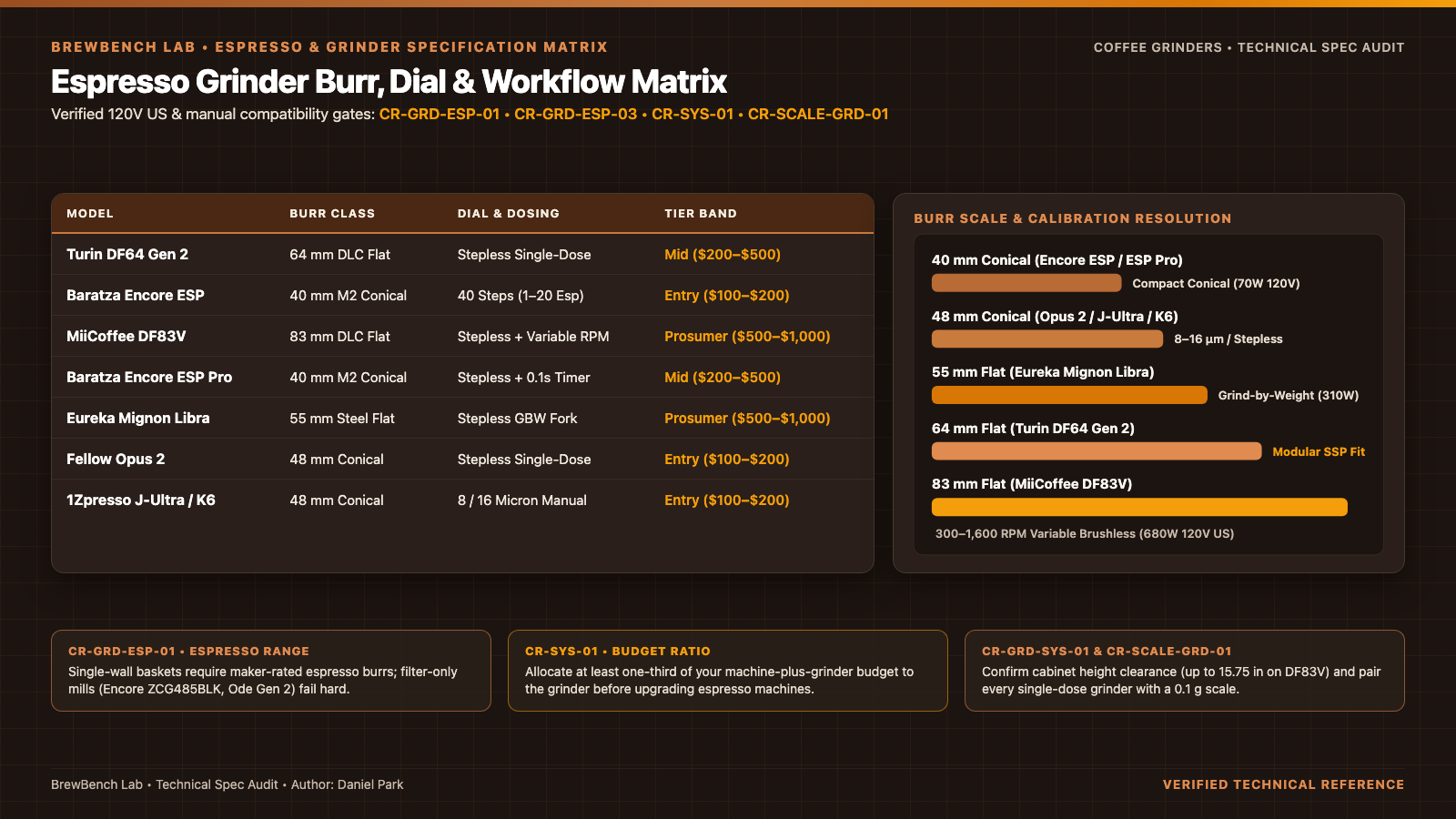
Picking the right espresso grinder comes down to matching burr capability, adjustment resolution, and daily workflow to the espresso basket inside your portafilter. Instead of chasing marketing horsepower claims, check these five compatibility gates before spending your budget.
1. Single-Wall vs. Pressurized Basket Gate (CR-GRD-ESP-01 & CR-SYS-02)
Every true portafilter machine extracts coffee using either a pressurized (dual-wall) basket or a non-pressurized single-wall basket. Dual-wall baskets restrict flow through a tiny pinpoint orifice, masking coarse grinds—which means spending prosumer money (CR-GRD-ESP-02) on an 83 mm grinder delivers wasted precision if you stay on pressurized baskets. Conversely, once you switch to a single-wall basket, only the tamped coffee puck creates ~9-bar brewing resistance; standard filter-only burr mills and blade choppers fail CR-GRD-ESP-01 immediately and trigger severe channeling.
2. Flat Burrs vs. Conical Burrs: Flavor Tendencies Without Myths
Many shoppers assume flat burrs automatically beat conical burrs across every drink, yet geometry simply nudges particle distribution along two distinct paths (CR-DRINK-GRD-01). Conical burrs (such as the 40 mm M2 set in the Baratza Encore ESP or 48 mm cones in the Fellow Opus 2 and 1Zpresso J-Ultra) yield rich, chocolate-forward body and forgiving dialing across medium-dark roasts and milk drinks. Conversely, 55 mm to 83 mm flat burrs (like the Turin DF64 Gen 2, MiiCoffee DF83V, and Eureka Mignon Libra) highlight crisp acidity and flavor clarity in light-to-medium roasts—provided factory burr alignment holds true across both carrier faces.
3. Stepless Adjustment vs. Micro-Step Dials (CR-GRD-ESP-03)
Espresso extraction reacts dramatically to tiny burr-gap changes. Stepless adjustment systems—found on the Turin DF64 Gen 2, MiiCoffee DF83V, Baratza Encore ESP Pro, Fellow Opus 2, and Eureka Mignon Libra—let you move the collar continuously to land on any target shot time without detents. Stepped dials like the Encore ESP’s 20-step espresso range, Breville Smart Grinder Pro’s 60 steps, or a 16-micron micro-step dial on the KINGrinder K6 work reliably, though you will occasionally compensate by shifting dose weight by 0.5 to 1 gram when one notch runs fast and the next chokes the puck.
4. Single-Dose Grinder vs. Hopper Workflow (CR-GRD-02 & CR-GRD-03)
Decide early whether you value bean variety or push-button morning speed. A low-retention single-dose coffee grinder pairs bellows, anti-static ionizers, and near-zero grind retention so you can switch seamlessly between regular espresso, decaf, and pour-over—just remember you must weigh every dose on a 0.1 g scale (CR-SCALE-GRD-01). By contrast, a hopper grinder like the Eureka Mignon Libra keeps 300 g of beans ready for instant grind-by-weight portafilter dosing while retaining slightly more stale coffee inside the chamber when sitting overnight. If you brew pour-over and espresso daily (CR-GRD-03), stepless bottom-burr Mignon hoppers are slow to reset compared to numbered single-dose collars.
5. Counter Height, Portafilter Compatibility & 120V US Electrical Fit
Standard US upper kitchen cabinets hang roughly 18 inches (457 mm) above countertops (CR-GRD-SYS-01). Measure your exact gap before ordering tall hopper or auger units: the Breville Smart Grinder Pro reaches 15.3 inches (389 mm) and the MiiCoffee DF83V stands 15.75 inches (400 mm), leaving slim room for bean pouring under low trim, whereas the Fellow Opus 2 sits comfortably at 10.5 inches (267 mm). Check portafilter compatibility (CR-GRD-ACC-01) too: Breville 54 mm portafilters pair naturally with the Breville cradles, Encore ESP dosing cup adapter, or Fellow magnetic cup, while 58 mm dosing cups benefit from a matching funnel. Every powered grinder listed here operates on standard North American 110–120V/60Hz NEMA 5-15P outlets between 70W and 680W, staying well within kitchen branch limits unless paired simultaneously with a high-draw boiler and electric kettle (CR-ESP-SYS-02). Follow each maker’s cleaning manual and consult Specialty Coffee Association (SCA) Coffee Standards for water and extraction fundamentals.
Upgrade Roadmap & Hidden Ownership Costs
Under rule CR-SYS-01, reserve at least one-third of your combined machine-plus-grinder budget for your burr grinder so extraction consistency keeps pace with boiler stability. Beyond the grinder box itself, plan modest extra headroom for three practical accessories: a compact 0.1 g drip-tray coffee scale (CR-SCALE-GRD-01) required by every single-doser and manual grinder, a size-matched 54 mm or 58 mm magnetic dosing funnel + WDT needle tool to prevent stray grounds and reduce channeling, and eventual replacement burrs after high kilogram throughput. If you start on a 64 mm flat-burr chassis like the Turin DF64 Gen 2, upgrading later to aftermarket SSP burrs (CR-GRD-01) transforms flavor clarity without replacing your motor base—though always confirm whether burr swaps affect the seller’s warranty terms before opening the chamber.
How We Audited, Scored & Excluded These Espresso Grinders
At BrewBench Lab, every product evaluation follows our transparent Editorial Evaluation Methodology grounded strictly in manufacturer documentation, verified 120V US retail specifications, and cross-compatibility gates (CR-*). We never publish unverified micron-dispersion charts, fabricated retention grams, or unconfirmed decibel readings. Each grinder below is scored out of 10 across four weighted pillars totaling 100%:
| Evaluation Criterion | Weight | What We Audited |
|---|---|---|
| Burr Geometry, Espresso Range & Dialing Precision | 35% | Maker espresso positioning (CR-GRD-ESP-01), burr diameter/geometry, and stepless vs micro-step granularity (CR-GRD-ESP-03). |
| Retention, Alignment & Single-Dose vs Hopper Flow | 25% | Bellows, ionizers, grind retention ergonomics (CR-GRD-02), and timed/grind-by-weight repeatability. |
| Build Quality, Noise & Kitchen Footprint | 20% | Chassis rigidity, 120V/60Hz power draw, cleanout ease, and under-cabinet height clearance (CR-GRD-SYS-01). |
| Value for Tier, Upgradeability & Compatibility | 20% | Budget-share parity (CR-SYS-01), 54/58 mm fork or dosing cup fit (CR-GRD-ACC-01), US warranty, and burr upgrade path (CR-GRD-01). |
Models We Audited & Excluded (And Why)
- Niche Zero & Niche Duo: Sold direct-to-consumer and via specialty dealers rather than Amazon US; Amazon searches surface only third-party compatible bellows and dosing accessories, so we never pitch them as Amazon buy-intent picks.
- Timemore Sculptor 064 / 064S: Absent from active Amazon US retail inventory during our verification pass (Amazon US carries only the larger Sculptor 078S and 078 Turbo models).
- Baratza Encore (Standard ZCG485BLK): HARD FAIL on CR-GRD-ESP-01. Baratza builds and positions the classic non-ESP Encore for filter and drip brewing; it lacks the ESP’s fine-stepped 1–20 espresso cam range.
- Fellow Ode Gen 2 (Stock 64 mm Flat Burrs): HARD FAIL on CR-GRD-ESP-01. Fellow engineers the stock Ode Gen 2 strictly for filter brewing, leaving stock burrs unable to grind fine enough for non-pressurized single-wall espresso baskets.
- Generic Blade Grinders & Unrated Amazon-Native Mills: HARD FAIL on CR-GRD-ESP-01. Spinning blade choppers and unrated budget mills produce inconsistent boulder-and-dust distributions incompatible with single-wall espresso extraction.
Frequently Asked Questions About the Best Espresso Grinders
How much should I spend on the best espresso grinder compared to my espresso machine?
Plan at least one-third of your total machine-plus-grinder budget for your burr grinder whenever you pull single-wall espresso (CR-SYS-01). An entry grinder paired with a prosumer dual boiler creates uneven extraction and channeling, whereas a capable grinder priced between $200 and $500 elevates entry machines like a Breville Bambino immediately.
Are flat burrs better than conical burrs for home espresso?
Neither geometry wins across every roast and drink style. Conical burrs (40 mm to 48 mm) emphasize syrupy body and forgiving dialing for medium-dark milk drinks, while 55 mm to 83 mm flat burrs favor crisp flavor separation and faster throughput—though burr alignment and particle consistency matter more than shape alone.
Can I use a standard filter coffee grinder for single-wall espresso baskets?
No—filter-only grinders such as the standard Baratza Encore (ZCG485BLK) or stock Fellow Ode Gen 2 fail CR-GRD-ESP-01 for non-pressurized espresso. Their burrs and adjustment threads lack fine steps near zero, causing shots to gush in seconds unless you switch to a dual-wall pressurized basket.
Should I buy a single-dose grinder or a hopper grinder for espresso?
Choose a single-dose grinder (like the Turin DF64 Gen 2 or Fellow Opus 2) if you rotate beans or switch between espresso and pour-over, budgeting for a 0.1 g scale. Choose a hopper grinder (like the Eureka Mignon Libra) if you stick to one roast and prefer push-button convenience.
What does stepless vs. stepped adjustment mean when dialing in espresso?
Stepped grinders lock into fixed notches, which can leave your ideal shot time sitting between two clicks and force small 0.5-gram dose tweaks (CR-GRD-ESP-03). Stepless grinders let the burr collar move continuously without detents, giving unrestricted micro-control over espresso extraction flow.
Do espresso grinders require a special 20-amp kitchen outlet in the US?
No—all nine grinders audited here operate either manually or on standard 110–120V/60Hz North American NEMA 5-15P circuits drawing between 70W and 680W. Only watch total simultaneous circuit wattage (CR-ESP-SYS-02) if you run a high-wattage dual boiler, grinder, and electric kettle on the exact same 15-amp branch circuit.
Final Verdict: Choosing the Best Espresso Grinder for Your Bar
Choosing the best espresso grinder starts with matching your daily beverage routine rather than buying the biggest burrs on Amazon. For most home baristas pulling single-wall shots and rotating specialty beans, the Turin DF64 Gen 2 stands out as our #1 pick thanks to its stepless collar, plasma ionizer, and modular 64mm burrs. On an entry budget under $200, the Baratza Encore ESP gives beginners dedicated 1–20 espresso resolution with dual 54 mm/58 mm cup support, while the Fellow Opus 2 adds stepless side-dial ergonomics under low cabinets.
Step up to the MiiCoffee DF83V if you pull light-roast shots on a prosumer PID machine and want 83 mm variable-RPM versatility, or lock in the Eureka Mignon Libra when quiet, hands-free grind-by-weight dosing beats weighing beans every morning. Prefer zero electrical noise and compact travel? The 1Zpresso J-Ultra delivers 8-micron espresso precision by hand. Whichever tier you pick, pair your grinder with a 0.1 g scale and fresh whole beans for consistent shots every morning.


