
Disclosure: As an Amazon Associate, I earn from qualifying purchases. If you buy through links on this page, we may earn a small commission at no extra cost to you.
Figuring out how much to spend on espresso grinder hardware versus your espresso machine is the single highest-impact financial decision in a home coffee bar. Spend 85% of your cash on a gleaming stainless boiler and leave pennies for a blade mill or coarse filter grinder, and every non-pressurized shot will gush sour and watery in seconds. Spend heavily on a prosumer flat-burr grinder while staying locked inside a pressurized dual-wall basket, and the basket’s pinhole hides the very grind uniformity you paid for.
Inside our home espresso setup guide pillar, budget balance comes before brand badges or pump bar claims. By pairing BrewBench Lab’s compatibility gates (CR-SYS-01, CR-SYS-02, and CR-GRD-ESP-02) with verified 120V/60Hz North American hardware tiers, you can split your setup dollars accurately—whether your ceiling is under $700 or above $3,000.
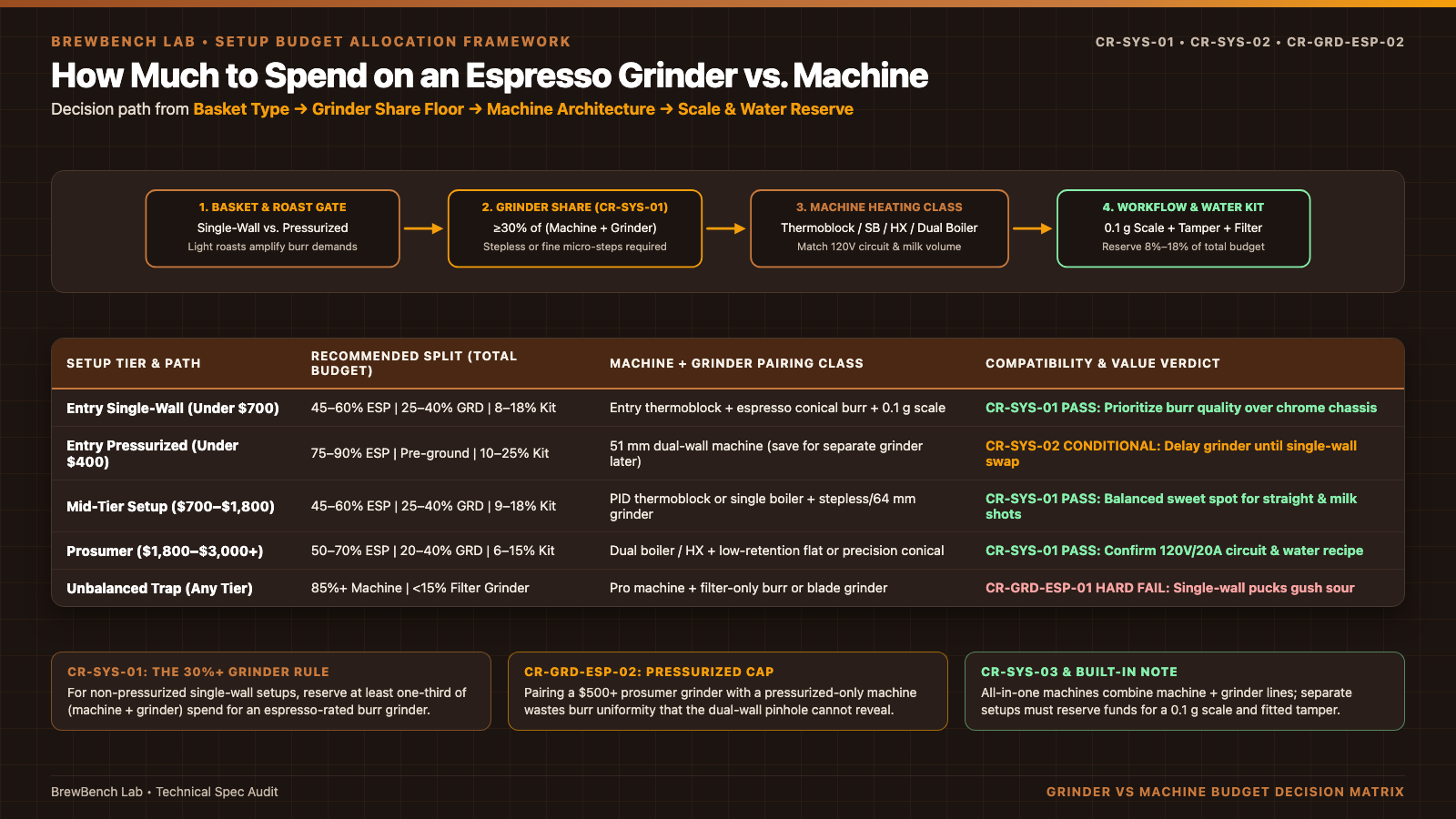
Direct Answer: For single-wall (unpressurized) espresso setups, allocate at least 30% to 45% of your combined machine-plus-grinder budget to an espresso-capable burr grinder (CR-SYS-01), and reserve 8% to 18% of your total setup budget for a 0.1 g scale, fitted tamper, and water filtration. Only pressurized-basket, capsule, or super-automatic buyers can safely shift nearly all spend into the machine (CR-SYS-02).
In This Guide
- Why Particle Uniformity Governs Espresso Extraction (CR-SYS-02)
- The 30%+ Grinder Floor & Whole-Setup Tier Splits (CR-SYS-01)
- Setup Budget Allocation Matrix Across All 4 Tiers
- Pressurized Baskets, Built-In Grinders & Super-Automatics (CR-GRD-ESP-02)
- The Missing 8%–18%: Scales, Tools, 120V Power & Water Reserve
- Myth vs. Engineering Reality: 4 Espresso Budget Misconceptions
- Verified Amazon US Reference Hardware by Budget Tier
- 60-Second Budget & Compatibility Pre-Checkout Checklist
- Authoritative Manufacturer & Standards Citations
- Frequently Asked Questions
Why Particle Uniformity Governs Espresso Extraction (CR-SYS-02)
To understand how much to spend on espresso grinder hardware, start inside the portafilter basket. Traditional espresso extracts when hot water—conventionally regulated near ~9 bar (~130.5 psi) at the coffee bed, regardless of whether a machine’s box advertises a 15-bar (~217.6 psi) or 20-bar (~290.1 psi) maximum dead-head pump rating—meets even hydraulic resistance across a compacted puck of finely ground coffee.
In a single-wall (non-pressurized) basket, the basket floor contains hundreds of open holes. Nothing except the coffee puck itself slows the water down. That places two strict mechanical demands on your grinder under compatibility rule CR-GRD-ESP-01:
- Fine, Repeatable Burr Range: The burrs must crush beans uniformly into fine espresso territory without wobbling or stalling under load. Blade mills chop inconsistently, and filter-only burr grinders—such as the standard Baratza Encore (non-ESP) or stock Fellow Ode Gen 2—cannot reach fine enough single-wall settings. Under
CR-SYS-02, pairing a filter-only grinder with a single-wall basket is a HARD compatibility fail. - Micro-Step or Stepless Dialing (
CR-GRD-ESP-03): Between choking a machine (zero drops) and gushing a sour shot in 10 seconds lies a remarkably narrow adjustment window. Coarse stepped collars frequently land “between clicks,” forcing baristas to compensate by changing dose weight, whereas stepless collars or fine micro-step rings let you dial target brew ratios smoothly.
Once particle size and adjustment resolution are dialed in, an entry 120V/60Hz thermoblock or stainless boiler can extract balanced, syrupy espresso. Conversely, even a PID-controlled dual boiler cannot rescue an uneven bed of boulders and dust from an inadequate grinder—which is why our best espresso grinders guide prioritizes adjustment granularity and burr alignment ahead of machine chassis upgrades.
The 30%+ Grinder Floor & Whole-Setup Tier Splits (CR-SYS-01)
When auditing home setups, BrewBench Lab separates budget planning into two complementary rules: the Machine-Plus-Grinder Pair Floor (CR-SYS-01) and the Whole-Setup Tier Allocation.
Under CR-SYS-01, any single-wall espresso setup should allocate at least 30% (roughly one-third or more) of the combined machine-plus-grinder budget to the grinder. Why does that percentage swing slightly higher at entry budgets and slightly lower at high-end budgets?
- Mechanical Floor at Entry Level (35%–50% Grinder Share): Building rigid metal burr carriers, low-tolerance adjustment threads, and a high-torque 120V motor carries a fixed manufacturing floor. In practice, entry espresso-capable electric grinders sit in the
$100–$200tier (TIER-GRD-ENTRY), while capable quality hand grinders offer high burr precision per dollar if you do not mind manual effort per dose. When paired with an entry sub-$200 or $200–$400 thermoblock machine, the grinder naturally consumes 35% to 50% of the hardware pair. - Mid-Tier Sweet Spot (30%–40% Grinder Share): Around a $1,000 home espresso setup (inside
TIER-SETUP-MID,$700–$1,800total), allocating$200–$500(TIER-GRD-MID) to a low-retention conical or 54 mm/64 mm flat-burr single-doser alongside a PID thermoblock or classic 58 mm single boiler hits the sweet spot for both straight shots and daily milk drinks. - Prosumer & High-End Scaling (25%–35% Grinder Share): Above
$1,800(TIER-SETUP-PROSUMERandTIER-SETUP-HIGHEND), machine costs climb rapidly because you are paying for dual boilers, heat-exchanger brass groups, rotary or quiet pumps, and PID steam boilers for simultaneous brewing and steaming (CR-DRINK-ESP-03). A$500+(TIER-GRD-PROSUMER) large-flat or precision conical grinder represents a smaller share of a$3,000+system while still delivering top-tier particle uniformity.
Equally important: never spend 100% of your cash on just the machine and grinder. Across every tier, our whole-setup model reserves 8% to 18% of total funds for essential workflow gear—a 0.1 g digital scale (3%–8%), a fitted tamper and dosing funnel (3%–10%), and water hardness filtration or recipe minerals (1%–5%).
Setup Budget Allocation Matrix Across All 4 Tiers
Use the matrix below to map your total ceiling against verified machine, grinder, and workflow allocations without crossing into compatibility bottlenecks.
| Setup Tier & Total Ceiling | Whole-Setup Split (ESP / GRD / Kit) | Target Hardware Class | Critical Compatibility Gate |
|---|---|---|---|
| Entry Single-Wall ( TIER-SETUP-ENTRY: Under $700) | Machine: 45%–60% Grinder: 25%–40% Scale/Tools/Water: 8%–18% | Under-$200 or $200–$400 thermoblock + $100–$200 espresso conical grinder (or espresso hand grinder) + 0.1 g scale | CR-SYS-01 PASS when grinder ≥30% of (ESP + GRD). Confirm single-wall basket inclusion or add separately (CR-ESP-ACC-13). |
| Entry Pressurized Starter (Under $400) | Machine: 75%–90% Grinder: Optional ($0 start) Scale/Tools/Water: 10%–25% | 51 mm dual-wall entry machine + pre-ground espresso coffee (upgrade to separate burr grinder later) | CR-SYS-02 CONDITIONAL PASS only while using pressurized baskets; CR-GRD-ESP-02 warns against buying a $500+ grinder here. |
| Mid-Tier Enthusiast ( TIER-SETUP-MID: $700–$1,800) | Machine: 45%–60% Grinder: 25%–40% Scale/Tools/Water: 9%–18% | PID thermoblock or 58 mm single boiler + $200–$500 stepless conical or 54/64 mm flat single-doser + fitted tamper & 0.1 g scale | CR-GRD-ESP-03 & CR-SCALE-GRD-01: pair single-dose grinders with a 0.1 g scale; single boilers brew and steam sequentially (CR-DRINK-ESP-03). |
| Prosumer Multi-Drink ( TIER-SETUP-PROSUMER: $1,800–$3,000) | Machine: 50%–65% Grinder: 25%–40% Scale/Tools/Water: 7%–15% | Dual boiler or dual thermoblock + $500+ low-retention flat or grind-by-weight espresso grinder + water recipe | CR-ESP-SYS-01 & CR-ESP-SYS-07: verify 120V/15A vs. 20A NEMA 5-20R receptacle and 120V boiler-priority behavior. |
| High-End Countertop ( TIER-SETUP-HIGHEND: $3,000+) | Machine: 55%–70% Grinder: 20%–35% Scale/Tools/Water: 6%–13% | PID dual boiler or premium dual thermoblock + $500+ large-burr flat grinder + precision basket & water plan | CR-WTR-ESP-01/02: check hardness with strips; never run un-remineralized distilled water in conductive-probe boilers. |
Pressurized Baskets, Built-In Grinders & Super-Automatics (CR-GRD-ESP-02)
Not every home espresso buyer uses two separate plug-in appliances on day one. Three structural exceptions alter how CR-SYS-01 applies to your shopping cart.
1. The Pressurized Basket Cap (CR-GRD-ESP-02)
Entry machines under $200 frequently ship only with pressurized (dual-wall) baskets, where a small single exit hole generates artificial backpressure regardless of coffee fineness. Under CR-SYS-02, that design lets beginners brew drinkable shots with pre-ground coffee while saving up for a dedicated grinder.
However, rule CR-GRD-ESP-02 flags the opposite mistake: pairing a prosumer $500+ grinder with a pressurized-basket-only machine. Because the pressurized pinhole dominates resistance and caps flow control, spending prosumer dollars on burrs without upgrading to a compatible single-wall basket (CR-ESP-ACC-13) wastes money the machine cannot show in the cup. Always check whether your machine supports a single-wall basket—and verify exact portafilter ear geometry before ordering aftermarket bottomless handles (CR-ESP-ACC-01).
2. Built-In Grinder All-in-One Machines (CR-GRD-ESP-04)
Semi-automatic portafilter machines with integrated burr grinders—such as Breville’s Barista series or entry all-in-one units like the CASABREWS MARENZA—combine machine and grinder onto one budget line, making CR-SYS-01 technically not_applicable. They simplify countertop clutter and cover most medium and dark roasts cleanly. Still, under CR-GRD-ESP-04, readers who eventually pivot toward bright, dense light roasts often outgrow built-in stepped collars and add a separate external grinder later while keeping the machine—a trade-off detailed in our built in grinder vs separate grinder breakdown.
3. Super-Automatic & Capsule Alternatives (CR-DRINK-ESP-04 & CR-DRINK-ESP-07)
If your priority is push-button speed rather than manual dialing, a super-automatic bean-to-cup unit (such as the Philips 4400 Series LatteGo in the $500–$1,000 tier) integrates grinding, dosing, tamping, and milk texturing inside one chassis, reducing external grinder budget to zero. Note under CR-DRINK-ESP-04 that super-automatic chutes require dry-surface medium roasts rather than glossy oily or flavored beans that clog internal burr paths. Capsule machines remain a separate convenience category (CR-DRINK-ESP-07) rather than a portafilter-and-grinder benchmark.
The Missing 8%–18%: Scales, Tools, 120V Power & Water Reserve
Buyers who spend 100% of their budget on a machine and grinder immediately hit physical, electrical, and workflow friction on morning one. Review our what do you need for home espresso checklist and protect these four budget lines before clicking checkout:
- 0.1 g Scale & Cup Clearance Math (
CR-SCALE-ESP-01,CR-SCALE-GRD-01,CR-SYS-03): Dialing adose : yieldbrew ratio—typically starting near1:2(e.g.,18 g / 0.63 ozdry coffee yielding36 g / 1.27 ozliquid espresso), shifting toward1:2.2–1:3at~93–96 °C (199–205 °F)for light roasts or1:1.5–1:2.2for medium-dark roasts—is guesswork without a0.1 gscale. Single-dose grinders specifically depend on weighing beans in and grounds out. Verify vertical fit with the clearance formula:scale_height_mm + cup_height_mm + 5 mm (0.20 in) <= machine_cup_clearance_mm. For instance, an ultra-thin~19 mm (0.75 in)scale under a76 mm (3.0 in)espresso cup requires100 mm (3.94 in)of spout clearance. - Fitted Tamper & Basket Match (
CR-ESP-ACC-03,CR-SYS-03): Lightweight plastic scoop-tampers included in budget boxes flex and leave untamped edges. Budget for a metal tamper sized to your basket’s actual inner diameter—around51 mm,53.3–54 mm, or58.0–58.5 mm—within1.0 mm (0.04 in)of the basket wall. - Cabinet Height & 120V/60Hz Electrical Limits (
CR-GRD-SYS-01,CR-ESP-SYS-01/02): Measure your counter-to-cabinet gap (typical US kitchens measure around~457 mm / 18 in) and confirmgrinder_height_mm + 50 mm (1.97 in)access room for hopper lids. Electrically, applyP = V × A: a standard North American15 A / 120 Vcircuit supplies1,800 Wpeak (1,440 W80% continuous), while a20 A / 120 Vcircuit supplies2,400 Wpeak (1,920 Wcontinuous). Never run a 1,350W–1,600W espresso heater alongside a microwave or electric kettle on the same 15A breaker, keep kitchen GFCI protection intact, and if a prosumer machine ships with a horizontal-bladeNEMA 5-20Pplug, have a licensed electrician install a matchingNEMA 5-20Rreceptacle on a 20A circuit—never use a 15A-to-20A adapter. - Water Hardness & Boiler Protection (
CR-WTR-ESP-01/02/06): Mineral scale and corrosion void warranties faster than mechanical wear (CR-WTR-ESP-03). Check local tap water with hardness strips (1 gpg = 17.1 mg/L CaCO3) against Specialty Coffee Association targets (~68 mg/L CaCO3 / ~4 gpg, acceptable17–85 mg/L; TDS~150 mg/L, range75–250 mg/L) and your machine manual’s limits. Never pour pure un-remineralized distilled water into boilers with conductive water-level probes (CR-WTR-ESP-02)—it causes “fill water” errors and metal corrosion—and always use manufacturer-approved descaling solutions, especially on aluminum boilers sensitive to non-approved acid concentrations (CR-WTR-ESP-06).
Myth vs. Engineering Reality: 4 Espresso Budget Misconceptions
Myth #1: “Spend 90% on the espresso machine and grab any cheap burr grinder.”
Engineering Reality: Under CR-SYS-01, a single-wall basket relies on uniform coffee particles to regulate flow at ~9 bar. Pairing a prosumer boiler with a coarse-stepped or filter-only grinder produces rapid channeling and sour shots that no PID controller can fix.
Myth #2: “A 20-bar pump machine extracts fine espresso even with coarse grounds.”
Engineering Reality: A 15-bar or 20-bar label is the pump’s maximum dead-head ceiling against a blocked outlet—not brew pressure. Without a pressurized pinhole or fine espresso grounds, water flows straight through the bed at low pressure regardless of pump rating.
Myth #3: “Flat burrs always beat conical burrs, so entry conical grinders are a waste.”
Engineering Reality: Burr alignment, adjustment resolution (CR-GRD-ESP-03), and roast profile matter more than burr geometry labels alone. Quality conical burrs deliver rich body for medium/dark roasts and milk drinks at accessible entry tiers without requiring prosumer flat-burr spend.
Myth #4: “Zero-mineral distilled water is free boiler insurance.”
Engineering Reality: Pure distilled water lacks ions needed by conductive autofill probes (CR-WTR-ESP-02) and can leach metals over time. Always budget 1%–5% of setup funds for maker reservoir cartridges or mineral remineralization packets.
Verified Amazon US Reference Hardware by Budget Tier
To translate percentage splits into real 120V/60Hz North American hardware, here are five verified Amazon US reference components spanning entry grinders, mid-tier single-wall grinders, sub-$200 entry machines, and low-profile workflow scales.
1. Fellow Opus 2 Conical Burr Grinder (Black) — Entry Stepless Single-Dose Benchmark

Quick Specs: 48 mm (1.89 in) conical burrs | Stepless adjustment | Single-dose + anti-static design | Electric 120V / 60Hz | Price Tier: Entry Grinder ($100–$200 tier / TIER-GRD-ENTRY)
The updated Fellow Opus 2 Conical Burr Grinder solves the two biggest entry-tier budget headaches at once: burr diameter and step granularity. Stepping up to 48 mm (1.89 in) conical burrs with a true stepless adjustment mechanism lets entry single-wall espresso buyers fine-tune shot times without getting trapped between coarse clicks (CR-GRD-ESP-03). Positioned inside the $100–$200 bracket, it keeps your CR-SYS-01 grinder share healthy alongside sub-$200 or $200–$400 thermoblock machines.
Compatibility Gate (CR-SCALE-GRD-01 & CR-SYS-01): Because the Opus 2 is a single-dose grinder rather than a hopper-timed unit, reserve $20–$30 in your setup budget for a 0.1 g coffee scale to weigh every bean dose consistently.
Pros
- Stepless adjustment and 48 mm (1.89 in) conical burrs overcome coarse-step dialing limits in the entry bracket
- Single-dose + anti-static engineering minimizes stale retention when switching beans (
CR-GRD-02) - Meets the 30%+
CR-SYS-01grinder floor even inside under-$700 entry setups
Cons
- Single-dosing requires weighing beans manually before each shot rather than pressing a timed button
- Conical burr profile favors medium and dark roasts over ultra-high-clarity light roasts (
CR-DRINK-GRD-01)
2. Baratza Sette 270 Conical Burr Coffee Grinder — Mid-Tier Single-Wall Benchmark

Quick Specs: 40 mm (1.57 in) conical burrs | 30 macro steps + stepless micro ring | Straight-through low-retention drop | Electric 120V / 60Hz | Price Tier: Mid-Tier Grinder ($200–$500 tier / TIER-GRD-MID)
When your total budget climbs into the $700–$1,800 bracket (TIER-SETUP-MID), stepping up to a $200–$500 grinder like the Baratza Sette 270 delivers dedicated espresso geometry without overspending into prosumer flat-burr pricing. Its straight-through vertical burr drop keeps grind retention low, while 30 macro steps paired with a stepless micro-adjustment collar let you hit exact extraction flow rates on 54 mm or 58 mm single-wall baskets.
Compatibility Gate (CR-GRD-03 & CR-GRD-SYS-01): Built strictly as an espresso-focused grinder—daily back-and-forth switching to coarse French press or pour-over is less fluid than all-purpose dial grinders. Measure under-cabinet hopper clearance before placement.
Pros
- 30 macro steps plus stepless micro ring provide pinpoint single-wall dialing precision (
CR-GRD-ESP-03) - Vertical drop path keeps internal grounds retention low between doses
- Cleanly satisfies the 30%–40% grinder share in $700–$1,800 single-boiler and thermoblock setups (
CR-SYS-01)
Cons
- Narrow espresso-focused adjustment makes frequent coarse filter switching inconvenient (
CR-GRD-03) - 40 mm (1.57 in) conical burrs emphasize classic texture rather than large flat-burr clarity on light roasts
3. Breville BCG820BSS Smart Grinder Pro — Hopper-Timed Entry All-Purpose Reference

Quick Specs: Stainless steel conical burrs | 60 stepped settings | LCD programmable shot timer | 54 mm & 58 mm portafilter cradles | Electric 120V / 60Hz | Price Tier: Entry Grinder ($100–$200 tier / TIER-GRD-ENTRY)
For households prioritizing timed hopper convenience and direct portafilter cradle dosing under $200, the Breville Smart Grinder Pro pairs neatly with 54 mm (2.13 in) and 58 mm (2.28 in) espresso machines. Its LCD timer dispenses repeatable approximate doses directly into included cradles, keeping counter workflow tidy when preparing daily lattes with medium-to-dark roasts.
Compatibility Gate (CR-GRD-ESP-03 & CR-GRD-ACC-01): With 60 fixed all-purpose steps, dialing in demanding single-wall baskets can occasionally land between clicks—adjust dose slightly when needed. Note that 51 mm (2.01 in) entry portafilters do not fit the 54/58 mm cradles hands-free; grind into a dosing cup instead.
Pros
- Includes both 54 mm (2.13 in) and 58 mm (2.28 in) portafilter cradles for direct dosing (
CR-GRD-ACC-01) - Backlit LCD timer simplifies morning hopper routines for milk-drink households
- Sits in the $100–$200 band, leaving headroom for a 54 mm thermoblock machine and 0.1 g scale
Cons
- 60-step all-purpose adjustment lacks stepless micro-control for sensitive single-wall light roasts (
CR-GRD-ESP-03) - 51 mm portafilter owners must use a dosing cup rather than the included cradles
4. De’Longhi ECP3420 15-Bar Espresso Machine — Sub-$200 Stainless Boiler Reference

Quick Specs: Stainless steel boiler | 15-bar (~217.6 psi) max pump rating | 51 mm (2.01 in) portafilter | Manual adjustable frother | 120V / 60Hz | Price Tier: Budget Machine (Under $200 tier / TIER-ESP-BUDGET)
The De’Longhi ECP3420 illustrates how a disciplined budget allocation unlocks real espresso under $500 total. Instead of spending an entire entry budget on a machine alone, pairing an under-$200 stainless steel boiler platform with a $100–$200 stepless grinder hits roughly a 40%–50% grinder share (CR-SYS-01). Out of the box, its pressurized 51 mm (2.01 in) baskets also let new owners pull pre-ground coffee immediately while budgeting for a future single-wall basket and burr grinder upgrade (CR-SYS-02).
Compatibility Gate (CR-ESP-ACC-13 & CR-GRD-ESP-02): Remember that “15-bar” is the pump’s maximum dead-head ceiling, not brew pressure. To benefit from a dedicated burr grinder on this platform, add a compatible 51 mm single-wall basket (verifying exact De’Longhi lug geometry per CR-ESP-ACC-01) rather than leaving pressurized baskets installed.
Pros
- Under-$200 tier preserves substantial room in an entry budget for a real espresso grinder (
CR-SYS-01) - Stainless steel boiler avoids aluminum-boiler descaling chemistry caveats while running on 120V/60Hz
- Pressurized 51 mm baskets support pre-ground coffee if you stage your grinder purchase later (
CR-SYS-02)
Cons
- Single boiler requires sequential switching between brewing espresso and steaming milk (
CR-DRINK-ESP-03) - Pressurized stock workflow hides fine burr gains until you add a compatible 51 mm single-wall basket (
CR-GRD-ESP-02)
5. WEIGHTMAN Espresso Scale with Timer 1000g x 0.1g — Essential Workflow Reserve
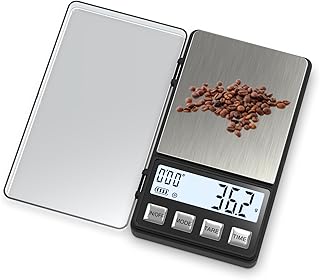
Quick Specs: 0.1 g (0.0035 oz) resolution | 1,000 g (35.27 oz) capacity | ~0.75 in (~19 mm) ultra-thin profile | Built-in timer + silicone mat | Price Tier: Budget Scale (Under $30 tier / TIER-SCALE-ENTRY)
Every separate-grinder setup requires a 0.1 g scale to avoid wasting expensive coffee beans during dial-in (CR-SYS-03 & CR-SCALE-GRD-01). The ultra-thin WEIGHTMAN Espresso Scale preserves vertical clearance beneath low-slung 51 mm and 54 mm spouted portafilters while providing an integrated shot timer under $30—ensuring your workflow kit fits without stealing dollars from your grinder.
Compatibility Gate (CR-SCALE-ESP-01 & CR-SCALE-ESP-05): Always verify ~19 mm (0.75 in) + cup height + 5 mm (0.20 in) <= spout clearance before pulling shots on compact drip trays, and wipe the platform dry after spills since budget scales carry no published waterproof IP rating.
Pros
- 0.1 g precision and integrated timer cover both single-dose bean weighing and shot ratio tracking (
CR-SYS-03) - ~0.75 in (~19 mm) thin chassis clears compact spouted portafilters cleanly (
CR-SCALE-ESP-01) - Under-$30 bracket leaves virtually the entire hardware budget focused on burrs and boiler stability
Cons
- Compact platform is sized for espresso cups and dosing cups rather than wide pour-over carafes
- No published IP water-resistance rating; keep clear of standing drip-tray puddles (
CR-SCALE-ESP-05)
60-Second Budget & Compatibility Pre-Checkout Checklist
Run these six verification checks before ordering your machine and grinder together:
- Confirm Basket Type (
CR-SYS-02&CR-ESP-ACC-13): Verify whether your machine ships with single-wall baskets. If it includes pressurized baskets only, add a compatible single-wall basket to your accessories line before investing in an espresso grinder. - Check the 30%+ Grinder Floor (
CR-SYS-01): Divide your grinder budget by(machine + grinder). For single-wall setups, stay at or above0.30(ideally0.35–0.45in entry/mid tiers), and confirm the maker explicitly markets the grinder as espresso-capable (CR-GRD-ESP-01). - Verify Portafilter & Cradle Fit (
CR-ESP-ACC-01&CR-GRD-ACC-01): Match51 mm,54 mm, or58 mmnominal sizes by exact ear/lug pattern for aftermarket portafilters, and confirm whether your grinder cradles your portafilter or requires a dosing cup. - Reserve Workflow Dollars (
CR-SYS-03): Carve out8%–18%of your total budget for a0.1 glow-profile scale (checkingscale_h + cup_h + 5 mm <= clearance), a metal tamper matched to the basket’s inner diameter, and a dosing funnel. - Check Cabinet Height & 120V/60Hz Outlets (
CR-GRD-SYS-01&CR-ESP-SYS-01): Confirm US120V/60Hzspecs, verify15Avs.20Acircuit sharing (P = V × A), and measure upper-cabinet clearance above the grinder hopper. - Plan Water Chemistry on Day One (
CR-WTR-ESP-01/02): Check tap water with hardness strips against the~68 mg/L CaCO3 (~4 gpg)target and your machine manual’s rules—never feed un-remineralized distilled water into conductive-probe boilers.
Authoritative Manufacturer & Standards Citations
Every grinder capability rule, basket standard, electrical formula, and water chemistry guideline in this budget framework is grounded in official manufacturer documentation and industry standards:
- Baratza Official Support & Grinder Documentation — Espresso-capable burr sizing, fine step resolution (settings 1–20 on Encore ESP and stepless micro adjustment on Sette 270), and single-wall dialing mechanics.
- Fellow Official Product Specifications — Clear use-class separation between espresso-rated conical grinders and filter-focused stock flat-burr grinders.
- Breville US Official Espresso Specifications — Single-wall vs. dual-wall basket kits on 54 mm platforms, ~9 bar OPV regulation, and 54 mm/58 mm portafilter cradle compatibility.
- De’Longhi US Official Support & Espresso Documentation — 15-bar maximum pump rating framing, stainless steel boiler care, and 51 mm pressurized basket operation.
- Specialty Coffee Association (SCA) Standards & Water Quality — Conventional espresso brew ratio standards and boiler-safe water hardness targets (
~68 mg/L CaCO3 / ~4 gpg). - National Fire Protection Association (NFPA / NEC) — North American 120V/60Hz 15A and 20A kitchen branch-circuit power budgeting (
P = V × A).
How We Audited This Guide
- Home bar blueprints, upgrade roadmaps, water chemistry guides, and Amazon listing audits were verified against CR-SYS circuit, water-probe, and budget balance rules.
- Every espresso machine, burr grinder, accessory, and scale specification was cross-checked against official manufacturer 120V manuals, SCA water guidance, and verified Amazon US listings.
- Recommendations were evaluated against our weighted espresso-gear scoring rubrics and documented CR-* compatibility rules; we never invent heat-up seconds, PID variance, or micron claims.
Frequently Asked Questions: Espresso Grinder vs. Machine Budget
How much should I spend on an espresso grinder compared to the machine?
For single-wall (unpressurized) espresso setups, spend at least 30% to 45% of your combined machine-plus-grinder budget on an espresso-capable burr grinder (CR-SYS-01). At entry budgets under $700, an espresso grinder often equals 35% to 50% of the pair because quality burrs carry a mechanical cost floor.
Can I spend more on the espresso grinder than the espresso machine?
Yes—if you pull single-wall shots, spending equal or slightly higher dollars on an espresso grinder paired with a sub-$200 or $200–$400 thermoblock often beats buying an expensive boiler with a weak grinder. Just avoid pairing a $500+ grinder with a pressurized-only machine (CR-GRD-ESP-02).
Can I use a regular drip coffee grinder for espresso to save money?
Only if you stay on a pressurized (dual-wall) basket (CR-SYS-02). Filter-only burr grinders and blade mills cannot grind uniformly fine enough for single-wall espresso baskets (CR-GRD-ESP-01), causing shots to gush rapidly and taste sour and watery.
Should I buy an espresso machine with a built-in grinder instead?
All-in-one machines combine machine and grinder onto one budget line, simplify counter space, and handle medium-to-dark roasts well. However, under CR-GRD-ESP-04, readers who explore light roasts often add a dedicated external grinder later while keeping the espresso brewer.
How much extra budget should I save for espresso accessories and water?
Reserve 8% to 18% of your total setup budget for workflow essentials (CR-SYS-03): a 0.1 g digital scale with timer, a metal tamper sized to your basket’s inner diameter, a dosing funnel, and water hardness strips plus maker-approved filtration or remineralization.


