
Disclosure: As an Amazon Associate, I earn from qualifying purchases. If you buy through links on this page, we may earn a small commission at no extra cost to you.
Debating a built in grinder vs separate grinder is the single highest-impact architectural choice when assembling a home espresso bar. Should you buy an all-in-one machine that houses conical burrs inside the espresso chassis, or split your budget between a standalone burr grinder and a dedicated brewer? As our best espresso grinders hub emphasizes, grind uniformity governs single-wall extraction far more than boiler price. Yet integrated machines like those in our best espresso machines with built-in grinders guide continue to dominate beginner kitchens for one practical reason: one-box simplicity.
The short verdict: Choose a built-in grinder machine (such as the Breville Barista Express or Barista Express Impress) if you drink mostly medium or dark roasts, want a single 120V power cord on a narrow kitchen counter, and prefer push-button hopper dosing without buying multiple appliances. Choose a separate standalone grinder (paired with a compact brewer) if you brew light roasts, switch between espresso and pour-over, want stepless or micro-step dialing precision, or plan to upgrade your burrs and espresso machine independently over time.
In This Comparison
- Winner-by-Use-Case Quick Verdict Matrix
- Side-by-Side Architecture, Spec & Compatibility Table
- Battleground 1: Dial Resolution, Burr Geometry & Light Roasts
- Battleground 2: Thermal Exposure, Retention & Multi-Brew Workflow
- Battleground 3: The One-Third Budget Rule (CR-SYS-01) & Upgrade Math
- Battleground 4: Countertop Footprint, 120V Power, Water & Serviceability
- Choose a Built-In Grinder If vs. Choose a Separate Grinder If
- Verified Amazon US Contenders & Excluded Alternatives
- Frequently Asked Questions
Quick Verdict Matrix: Built-In vs. Separate Grinder by Use Case
Because built-in grinders live inside the espresso machine card rather than as standalone GRD appliances, comparing both setups requires mapping your daily drink profile, roast preference, and kitchen constraints against real compatibility gates. Here is how each architecture wins across six common home-barista use cases.
| Use Case & Drink Profile | Winner | Why It Wins (Verified Spec & Rule Fit) |
|---|---|---|
Best for One-Box Beginner Mornings (UC-BEGINNER-ONE-BOX) | Built-In Grinder Machine | Bundles single-wall and pressurized baskets, a matched portafilter fork, and one 120V plug so CR-SYS-02 passes out of the box with minimal counter clutter. |
Best for Daily Milk Drinks (UC-MILK-DRINKS-DAILY, Medium/Dark Roasts) | Tie (Workflow Dependent) | Built-in conical burrs deliver chocolatey, full-bodied shots that pair naturally with steamed milk (CR-GRD-ESP-04); separate setups gain speed only if paired with dual-heater brewers. |
Best for Straight Espresso & Light Roasts (UC-LIGHT-ROAST-ENTHUSIAST) | Separate Standalone Grinder | Stepless flat-burr grinders like the MiiCoffee DF54 unlock finer adjustment resolution and cleaner particle uniformity for dense, high-altitude light roasts (CR-DRINK-GRD-01). |
Best for Espresso + Pour-Over Switching (UC-FILTER-AND-ESPRESSO) | Separate Standalone Grinder | Built-in hoppers trap espresso settings under stored beans; all-purpose standalone grinders like the Baratza Encore ESP (settings 21–40) or DF54 switch brew methods cleanly (CR-GRD-03). |
Best Compact Footprint & Single Outlet (UC-SMALL-KITCHEN) | Built-In Grinder Machine | Consolidating machine and grinder into a ~13 in (330 mm) wide footprint saves lateral counter space and uses a single NEMA 5-15P wall receptacle. |
Best Long-Term Value & Upgrade Freedom (UPGRADE_PATH_TO) | Separate Standalone Grinder | Follows CR-SYS-01 (at least one-third budget to the grinder) and lets you swap burrs, single-dose grinders, or boilers independently without scrapping a working unit. |
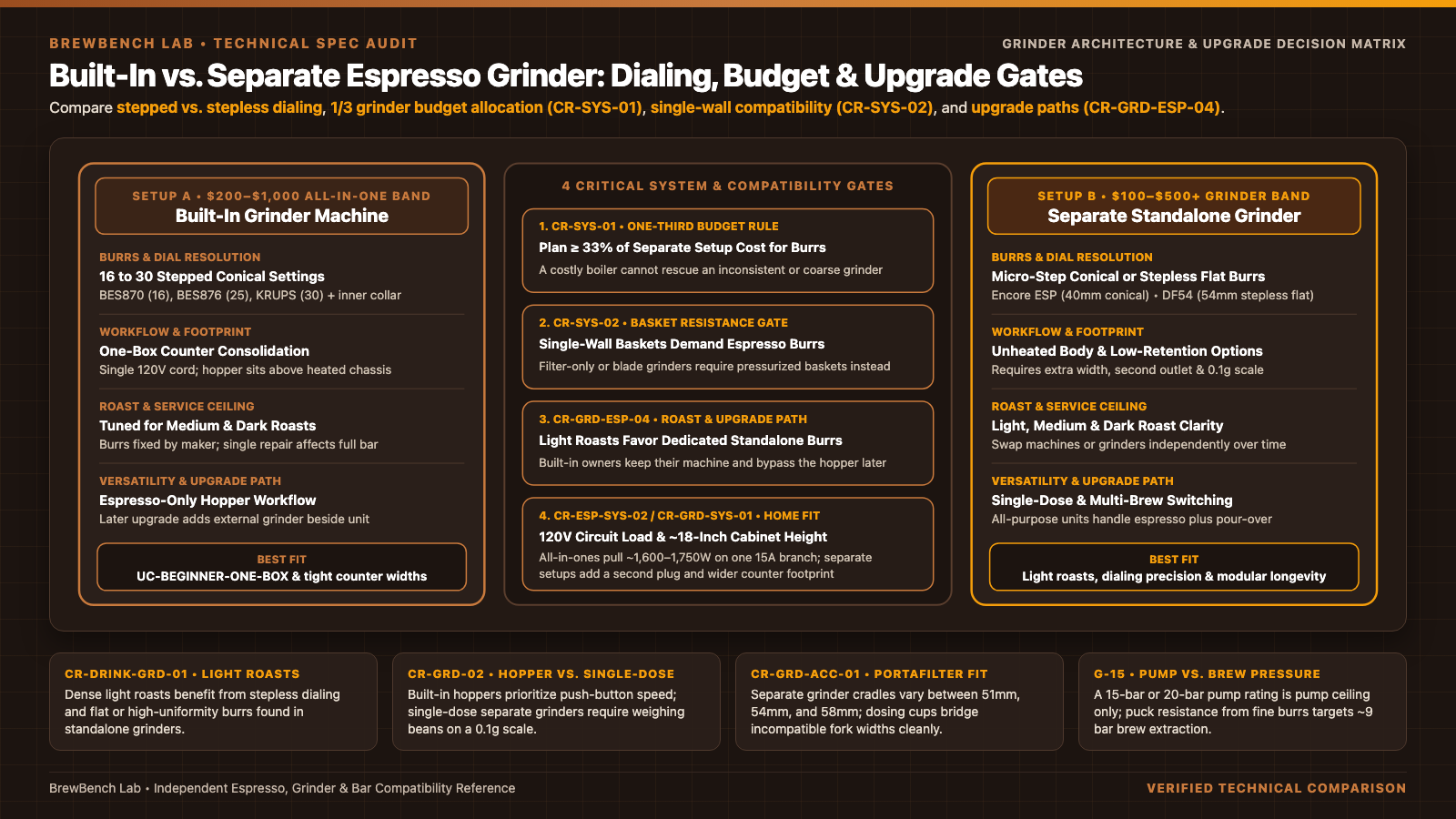
Side-by-Side Architecture, Spec & Compatibility Table (120V US)
The table below contrasts verified 120V/60Hz North American built-in grinder machines—led by the Breville Barista Express (BES870BSXL), Breville Barista Express Impress (BES876BSS), and KRUPS Barista 30-Setting benchmark—against two verified Amazon US standalone espresso grinders: the entry conical Baratza Encore ESP and the stepless flat-burr MiiCoffee DF54. Where manufacturers do not publish verified laboratory metrics (such as retention in grams, operating decibels, or internal bean-hopper temperature rise), we state no verified data available yet.
| Architecture & Compatibility Axis | Built-In Grinder (All-in-One Benchmark) | Separate Standalone Grinder (Modular Benchmark) |
|---|---|---|
| Representative Amazon US Models | Breville Barista Express BES870BSXL, Barista Express Impress BES876BSS, KRUPS Barista | Baratza Encore ESP (40mm conical), MiiCoffee DF54 (54mm flat), Baratza Sette 270 |
| Burr Geometry & Diameter | Integrated stainless steel conical burrs (exact diameter unpublished by Breville/KRUPS) | 40mm M2 steel conical (Encore ESP / Sette 270) or 54mm flat steel burrs (DF54) |
| Grind Adjustment Resolution | Stepped external dial: 16 steps (BES870), 25 steps (BES876), 30 steps (KRUPS) + inner upper burr collar | 20 fine espresso steps (Encore ESP 1–20), 270 macro/micro steps (Sette 270), or true stepless dial (DF54) |
Dosing Workflow (CR-GRD-02) | Timed hopper dosing directly into portafilter fork (250 g / 8.8 oz hopper on Breville) | Hopper timed/manual (Encore ESP) or low-retention single-dose with bellows (DF54) |
Single-Wall Basket Compliance (CR-SYS-02) | Pass out of the box (both single-wall and dual-wall 54mm baskets supplied on Breville) | Pass when maker rates grinder espresso-capable (CR-GRD-ESP-01); filter-only mills fail HARD |
| Pump Ceiling vs. Brew Pressure | 15-bar pump ceiling with OPV targeting ~9 bar extraction pressure at the puck | Paired machine supplies ~9 bar target; standalone burrs control puck resistance directly |
| Retention & Thermal Exposure | Hopper sits above warm thermocoil housing; exact retention grams & temp rise: no verified data available yet | Unheated standalone motor housing; exact retention grams: no verified data available yet |
Multi-Method Versatility (CR-GRD-03) | Espresso-only practical range; switching to drip/pour-over loses dialed position | High versatility: Encore ESP covers settings 1–40 (espresso to filter); DF54 covers espresso through filter |
Scale Requirement (CR-SCALE-GRD-01) | Recommended 0.1 g scale for shot yield; BES876 auto-corrects grind dose level | Essential 0.1 g scale for weighing every single-dose bean input and liquid espresso yield |
120V US Power & Circuit Load (CR-ESP-SYS-02) | Single NEMA 5-15P plug (~1,600W BES870 / 1,750W BES876 at 120V/60Hz) | Two NEMA 5-15P plugs (standalone grinder + standalone machine; avoid kettle on same 15A branch) |
Upgrade Path & Service Risk (CR-GRD-ESP-04) | Fixed burrs; later upgrade requires bypassing hopper; single repair halts entire machine | Independent upgrades: swap burrs, upgrade grinder, or replace brewer separately |
Amazon US Budget Tier (G-08) | $200–$500 (BES870BSXL / KRUPS) to $500–$1,000 (BES876BSS Impress) | $100–$200 (Encore ESP) or $200–$500 (DF54 / Sette 270), plus separate espresso machine tier |
Battleground 1: Dial Resolution, Burr Geometry & Light-Roast Capability
The clearest technical divide in a built in grinder vs separate grinder audit appears the moment you lock a single-wall (non-pressurized) basket into your portafilter. Unlike dual-wall (pressurized) baskets—which force coffee through a single tiny pinhole to simulate crema even with coarse pre-ground coffee—a single-wall basket relies entirely on uniform coffee particle size and compacted puck resistance to build roughly ~9 bar of extraction pressure against your machine’s pump (regardless of whether the pump box boasts a 15-bar or 20-bar maximum rating).
Under compatibility rule CR-SYS-02, pulling authentic single-wall espresso demands a grinder that the manufacturer explicitly engineers for espresso. Both built-in all-in-ones and dedicated standalone espresso grinders pass that baseline gate—provided you avoid filter-only grinders under CR-GRD-ESP-01—but they handle fine adjustments very differently:
- Stepped Built-In Conical Dials (
CR-GRD-ESP-03): Classic all-in-one machines use fixed external notches. The Breville Barista Express (BES870BSXL) provides 16 external steps, the upgraded Barista Express vs. Barista Express Impress (BES876BSS) expands to 25 external steps, and the KRUPS Barista offers 30 settings. With 16 coarse steps, baristas occasionally discover their ideal shot speed falls squarely between two clicks—forcing manual half-gram dose adjustments or removing the hopper to shift the internal upper burr ring. - Micro-Step & Stepless Standalone Dials: Dedicated standalone grinders compress step spacing dramatically. The entry-level Baratza Encore ESP splits its 40-step collar so settings 1 through 20 focus exclusively on fine espresso steps using 40mm hardened steel M2 conical burrs. Stepping up to the MiiCoffee DF54 gives you a stepless adjustment collar and 54mm flat steel burrs, allowing infinite micro-tweaks anywhere along the dial with zero click gaps.
- Roast Profile Ceiling (
CR-GRD-ESP-04,CR-DRINK-GRD-01): As documented in ruleCR-GRD-ESP-04, built-in conical burr grinders handle medium and dark roasts cleanly, producing traditional syrupy body suited to lattes and cappuccinos. Dense, lightly roasted single-origin coffees, however, resist extraction and magnify particle-size inconsistency. Standalone flat-burr grinders (like the 54mm DF54) or high-uniformity conical grinders let light-roast drinkers pull sweet, balanced 1:2.2 to 1:3 ratios without hitting the choke-or-gush wall common on entry built-in burrs.
Battleground 2: Thermal Exposure, Retention & Multi-Brew Workflow
Beyond burr geometry, separating the grinder from the espresso boiler changes bean freshness, static behavior, and daily versatility across rules CR-GRD-02, CR-GRD-03, and CR-SCALE-GRD-01.
- Chassis Heat & Bean Hopper Storage: In an all-in-one machine, the bean hopper sits directly atop the metal casing housing a 1,600W–1,750W thermocoil or thermoblock heater. Keeping half a pound (~250 g / 8.8 oz) of beans in a hopper perched above a warm espresso chassis exposes whole beans to ambient warmth and kitchen humidity—though exact internal bean-chamber temperature differentials have no verified data available yet from manufacturer manuals. A standalone grinder isolates its motor and burrs from boiler heat entirely, and a single-dose grinder like the DF54 keeps beans sealed in an airtight bag until seconds before extraction.
- Retention, Static & Chaff Control (
CR-GRD-02): Built-in grinders rely on horizontal or angled internal chutes that naturally hold some residual grounds between pulls (exact retention grams: no verified data available yet). In humid or dry winter kitchens, static cling can scatter fine grounds around an open cradle like the BES870BSXL unless you use a 54mm dosing funnel, whereas the BES876BSS Impress encloses the chute to contain mess. Standalone single-dose grinders like the MiiCoffee DF54 integrate a plasma anti-static ionizer and silicone bellows to purge grounds vertically, delivering lower daily waste at the cost of requiring a 0.1 g coffee scale (CR-SCALE-GRD-01) to weigh every bean dose. - Espresso-to-Pour-Over Switching (
CR-GRD-03): If your household brews drip, AeroPress, or V60 pour-over alongside morning espresso, a built-in grinder fails practicality. Emptying a full bean hopper and cranking a 16-step collar across its full span risks losing your dialed espresso setting and grinding stale transition coffee. Standalone all-purpose grinders such as the Baratza Encore ESP (settings 21–40 for filter) or MiiCoffee DF54 adjust cleanly between espresso and filter—though ruleCR-GRD-03notes that frequent daily range switching still adds routine friction compared with keeping a second filter grinder.
Battleground 3: The One-Third Budget Rule (CR-SYS-01) & Upgrade Math
When comparing total cost in broad TIER-* brackets, buyers often make a costly arithmetic mistake: spending 85% of their budget on a gleaming stainless espresso machine and leaving scraps for the grinder. Compatibility rule CR-SYS-01 exists specifically to prevent that bottleneck.
Under CR-SYS-01, any separate-component espresso setup using single-wall baskets should allocate at least roughly one-third (~33% or more) of the combined machine-plus-grinder budget to the grinder. A flagship dual-boiler or PID single-boiler machine cannot rescue uneven, clumpy grounds from an undersized grinder. On Amazon US, pairing an entry compact thermoblock brewer (such as a Breville Bambino in the $200–$500 tier) with a dedicated grinder from our best grinders for the Breville Bambino audit—like the Baratza Encore ESP ($100–$200 tier) or MiiCoffee DF54 ($200–$500 tier)—hits or exceeds that one-third ratio cleanly while outperforming most built-in grinders on dial resolution.
What if you already own—or buy—a built-in grinder machine? Under rule CR-GRD-ESP-04, a built-in grinder is never a permanent trap. As detailed in our upgrading from a Breville Barista Express roadmap, you can leave the integrated bean hopper empty and place a standalone grinder directly beside your Barista Express. Because the BES870 and BES876 already provide a PID-controlled thermocoil, ~9-bar OPV extraction, and three-way solenoid valve, adding a standalone stepless grinder immediately removes the stepped-burr bottleneck without forcing you to replace your brewer.
Battleground 4: Countertop Footprint, 120V Power, Water & Serviceability
In real US kitchens, physics and electrical codes often settle the debate faster than taste notes:
- Counter Width vs. Under-Cabinet Clearance (
CR-ESP-SYS-04,CR-GRD-SYS-01): Standard US upper kitchen cabinets hang roughly 18 inches (457 mm) above the countertop. Integrated machines like the Barista Express stand ~15.9 to 16.2 inches (405–411 mm) tall to the hopper lid, leaving narrow vertical clearance to pour beans or lift the rear 67 fl oz (2.0 L) water tank, though their ~13-inch (330 mm) single-chassis width saves horizontal space. Separate setups require roughly 4 to 6 inches (100–150 mm) of extra side-by-side counter width for the grinder, and tall hopper grinders must also clear upper cabinets underCR-GRD-SYS-01. - Portafilter Forks & Dosing Cups (
CR-GRD-ACC-01,CR-ESP-ACC-01): Built-in grinders hold the machine’s OEM 54mm portafilter hands-free under the chute. Standalone grinders vary: some cradles fit 54mm and 58mm portafilters, while single-dose grinders like the DF54 grind into a dosing cup that fits cleanly into both 54mm and 58mm baskets (using a dosing funnel if diameters differ). Remember underCR-ESP-ACC-01that aftermarket portafilters must match exact lug geometry—not just 54mm or 58mm diameter. - 120V/60Hz North American Power & Circuit Load (
CR-ESP-SYS-01,CR-ESP-SYS-02): Always confirm 120V/60Hz North American listings with standard NEMA 5-15P plugs—never import 220V–240V Sage/EU units or use plug adapters. While a separate setup uses two wall outlets instead of one, grinders draw modest power briefly while grinding; the main breaker hazard comes from running a 1,600W–1,750W espresso thermocoil simultaneously with a kettle or toaster on a shared 15A (1,800W peak / 1,440W continuous) branch circuit. - Water Chemistry, Descaling & Single-Point Failure (
CR-WTR-ESP-01,CR-WTR-ESP-02,CR-WTR-ESP-06,CR-DRINK-GRD-02): Hard water scale buildup is the leading threat to thermoblock and boiler longevity. Use the manufacturer’s tank filter cartridge (such as Breville ClaroSwiss filters) or SCA-balanced remineralized water (~68 mg/L CaCO3 target; 17–85 mg/L range)—never pure un-remineralized distilled water, which tastes flat and can trip conductive water-level sensors. Descale strictly using the product and intervals specified in your manual (never DIY vinegar or unapproved acids that can pit aluminum boilers or seals). Also avoid oily or flavored beans in built-in chutes per maker manuals (CR-DRINK-GRD-02). Finally, note service independence: if a built-in grinder jams or its thermocoil fails, the entire machine leaves your counter for repair; with separate units, a grinder service never stops your brewer (or vice versa).
Head-to-Head Decision Summary: Choose Built-In or Separate?
Choose a Built-In Espresso Grinder Setup If…
- You want one box, one 120V power cord, and an immediate start with matched 54mm single-wall and pressurized baskets (
UC-BEGINNER-ONE-BOX). - Your household drinks mostly medium or dark roasts—especially lattes, flat whites, and cappuccinos where conical body shines.
- Your kitchen counter has limited side-by-side width for two separate appliances and a dosing workflow.
- You appreciate guided features like the BES876 Impress’s intelligent dose correction and 22 lb assisted lever tamper.
Choose a Separate Espresso Grinder Setup If…
- You enjoy light or Nordic-style roasts and want stepless flat-burr clarity or tighter micro-step dialing precision (
CR-DRINK-GRD-01). - You switch between espresso and pour-over/drip coffee regularly (
UC-FILTER-AND-ESPRESSO) or single-dose different beans daily. - You want beans stored away from espresso boiler heat and prefer lower retention with static control.
- You want modular longevity so upgrading your burrs or servicing one appliance never sidelines your entire coffee bar.
Verified Amazon US Contenders & Excluded Alternatives
All four verified 120V North American listings below represent the strongest Amazon US benchmarks on each side of the built in grinder vs separate grinder decision—two integrated-grinder all-in-one machines and two dedicated standalone espresso grinders spanning conical and flat burrs.
1. Breville Barista Express BES870BSXL (Black Sesame) — Built-In Grinder Benchmark

Quick Specs: Thermocoil PID heating | Integrated stainless steel conical burrs (16 external steps + adjustable inner upper burr) | 54mm Breville portafilter (STD-GROUP-BREVILLE-54) with single-wall & dual-wall baskets | Three-way solenoid valve | Manual steam wand | ~250 g hopper & 67 fl oz (2.0 L) tank | 120V/60Hz, NEMA 5-15P | Price Tier: $200–$500
Buyer Verification Alert: Confirm the SKU suffix ends in XL (BES870BSXL or BES870XL) for 120V/60Hz North American power. Under CR-GRD-ESP-04, you can empty the integrated hopper later and add an external grinder alongside the machine.
Pros
- Consolidates PID thermocoil espresso machine, 16-setting conical grinder, and steam wand on one 120V cord
- Includes both single-wall and pressurized 54mm baskets so beginners pass
CR-SYS-02on day one - Allows bypassing the built-in hopper later to pair an external standalone grinder without replacing the machine
Cons
- 16 external grind clicks leave wider jumps between settings, occasionally requiring dose tweaks
- Integrated conical burrs cannot be swapped for flat burrs when chasing dense light-roast clarity
- Grinder or boiler repair takes the entire all-in-one appliance off your counter simultaneously
2. Breville Barista Express Impress (BES876BSS) — Guided Built-In Grinder All-in-One

Quick Specs: Thermocoil PID heating | Integrated stainless steel conical burrs (25 external steps + adjustable inner burr) | Intelligent dose auto-correction + assisted ~22 lb (10 kg) lever tamper with 7° twist | 54mm stainless portafilter (single-wall & dual-wall baskets) | Three-way valve | 120V/60Hz, 1,750W (NEMA 5-15P) | 2-year US warranty | Price Tier: $500–$1,000
Buyer Verification Alert: At $500–$1,000, compare the BES876BSS directly against a separate compact brewer plus a dedicated DF54 or Encore ESP grinder; you pay here for enclosed zero-mess dosing and assisted tamping convenience (CR-SYS-03).
Pros
- 25 external grind steps smooth out single-wall dialing compared with the BES870BSXL’s 16 clicks
- Enclosed chute, intelligent dose level memory, and 22 lb assisted lever tamper cut counter scatter
- Includes Breville USA’s 2-year limited warranty alongside all four 54mm baskets
Cons
- Stepped conical burrs still lag standalone flat-burr grinders on dense light roasts
- Hopper sits above the warm thermocoil body and lacks quick switching for pour-over brewing
- Requires manual 0.1 g scale tracking for shot yield despite automated dose height sensing
3. Baratza Encore ESP (ZCG495BLK) — Best Entry Separate Espresso Grinder

Quick Specs: 40mm M2 hardened steel conical burrs | 40 stepped settings (1–20 dedicated fine espresso steps; 21–40 filter/drip steps) | Hopper + included 54mm/58mm-friendly dosing cup | Electric 120V/60Hz US model | Price Tier: $100–$200 (TIER-GRD-ENTRY)
Buyer Verification Alert: Verify the exact model reads Encore ESP (ZCG495) rather than the standard filter-only Baratza Encore. Under CR-GRD-ESP-01, the standard non-ESP Encore fails single-wall espresso compatibility.
Pros
- 20 fine espresso steps (clicks 1–20) offer tighter single-wall dialing than coarse 16-step all-in-ones
- All-purpose range (21–40) handles pour-over, drip, and French press alongside espresso (
CR-GRD-03) - Hits the
CR-SYS-01one-third grinder budget rule effortlessly under $200 beside an entry machine
Cons
- Stepped adjustment collar still trails stepless grinders on ultra-finicky light roasts
- Requires a second 120V outlet and dedicated counter space next to your espresso machine
- Grinding into a dosing cup adds one transfer step before tamping your portafilter
4. MiiCoffee DF54 Single Dose Coffee Grinder — Best Mid-Tier Flat-Burr Separate Upgrade

Quick Specs: 54mm flat steel burrs | True stepless adjustment dial | Single-dose bellows + low-retention chute | Built-in anti-static plasma generator | Dosing cup included | Electric 120V/60Hz US model | Price Tier: $200–$500 (TIER-GRD-MID)
Buyer Verification Alert: Single-dose grinders like the DF54 do not store beans in a hopper; under CR-SCALE-GRD-01, budget for a 0.1 g coffee scale to weigh every dose before grinding.
Pros
- Stepless adjustment dial removes between-click compromises when dialing in single-wall baskets
- 54mm flat burrs and unheated single-dose path bring cleaner flavor separation on light and medium roasts
- Plasma anti-static ionizer and bellows curb grounds cling in a compact footprint
Cons
- Single-dose weighing adds hands-on prep time compared with push-button hopper timers
- 54mm flat burr carrier offers fewer third-party SSP burr options than 64mm platforms (
CR-GRD-01) - Requires a dosing cup transfer into 51mm, 54mm, or 58mm portafilters rather than direct fork grinding
Alternatives Excluded From This Amazon US Comparison
- Off-Amazon Specialty Dealer Brands (Niche Zero, Niche Duo, Timemore Sculptor 064, Lelit, Profitec, ECM): Excluded as Amazon buy-intent picks because these models rely on direct or specialty espresso dealer fulfillment rather than primary Amazon US storefront availability.
- Filter-Only Burr Grinders & Blade Mills (Standard Baratza Encore, Stock Fellow Ode Gen 2, OXO Brew Conical): Disqualified under
CR-GRD-ESP-01andCR-SYS-02for single-wall espresso baskets because their makers position them for filter brewing or lack uniform fine burr adjustment. - 220V–240V / 50Hz European Grinder & Sage Imports: Disqualified under
CR-ESP-SYS-01and North American electrical compliance; 230V editions require step-up converters and void US warranty support.
Authoritative Technical References
- Breville USA — The Barista Express (BES870) Specifications & Manual (110–120V/60Hz 1,600W thermocoil PID, 16 external conical burr steps, 54mm single-wall and dual-wall baskets, and 67 fl oz tank).
- Breville USA — The Barista Express Impress (BES876) Specifications & Manual (120V/60Hz 1,750W thermocoil PID, 25 external grind steps, intelligent dosing, 22 lb assisted lever tamper, and 2-year US warranty).
- Baratza — Encore ESP Burr Grinder Specifications & Manual (40mm hardened steel M2 conical burrs, 40 total settings with 1–20 espresso range and 21–40 filter range, 120V US model).
- Specialty Coffee Association (SCA) — Water Quality Standards (Target total hardness, alkalinity, and TDS guidelines for espresso equipment longevity and balanced extraction).
How We Audited This Guide
- Burr grinders were checked for maker-stated espresso adjustment fineness, burr geometry and size, single-dose vs hopper workflow, retention caveats, and kitchen height clearance.
- Every espresso machine, burr grinder, accessory, and scale specification was cross-checked against official manufacturer 120V manuals, SCA water guidance, and verified Amazon US listings.
- Recommendations were evaluated against our weighted espresso-gear scoring rubrics and documented CR-* compatibility rules; we never invent heat-up seconds, PID variance, or micron claims.
Frequently Asked Questions
Is a separate grinder always better than a built-in espresso grinder?
Not for every household. A separate standalone grinder wins on stepless or micro-step adjustment, light-roast clarity, multi-brew versatility, and modular upgrades. However, a built-in grinder machine wins for beginners who value one 120V power cord, compact counter width, and streamlined hopper dosing on medium or dark roasts.
Can I use a separate grinder alongside a Breville Barista Express later?
Yes—under rule CR-GRD-ESP-04, you never have to discard your brewer. Simply empty the Barista Express’s integrated bean hopper and grind with a standalone conical or flat-burr grinder into your 54mm portafilter or dosing cup while keeping the PID thermocoil and steam wand.
How much of my budget should go toward a separate espresso grinder?
Under rule CR-SYS-01, plan at least roughly one-third (~33% or more) of your machine-plus-grinder budget for the grinder when using single-wall baskets. A capable espresso boiler cannot compensate for coarse, uneven burrs, whereas an entry brewer paired with a strong grinder pulls consistently better shots.
Can I use a standard filter coffee grinder with an espresso machine?
Only with pressurized (dual-wall) baskets—never with single-wall baskets. Under rules CR-GRD-ESP-01 and CR-SYS-02, filter-only grinders (like the standard non-ESP Baratza Encore or stock Fellow Ode Gen 2) lack the fine adjustment needed to build ~9 bar puck resistance.
Do built-in grinders overheat coffee beans in the hopper?
Built-in hoppers sit directly above warm heating blocks, though exact internal bean-temperature rise has no verified data available yet. Keeping only one or two days of beans in the hopper—or choosing an unheated single-dose separate grinder—minimizes warm storage exposure.
Does a built-in or separate grinder affect 120V kitchen outlets?
Separate setups require two NEMA 5-15R receptacles instead of one. Because 120V espresso machines already draw up to 1,600W–1,750W on a standard 15A (1,800W peak) circuit, avoid running kettles or toasters simultaneously on that same branch circuit per rule CR-ESP-SYS-02.


