
Disclosure: As an Amazon Associate, I earn from qualifying purchases. If you buy through links on this page, we may earn a small commission at no extra cost to you.
Finding the best grinder for light roast espresso solves the single toughest extraction bottleneck on a home coffee bar. Lightly roasted specialty beans retain dense cellular structure and lower solubility than traditional medium or dark roasts, meaning uneven particle distributions trigger immediate channeling, sharp sourness, or hollow astringency inside a single-wall portafilter basket. When you extract at ~9 bars without a pressurized valve to mask grind flaws, your burr geometry, alignment, and adjustment resolution decide whether bright floral and stone-fruit aromatics shine cleanly or collapse in the cup.
We audited nine espresso-capable flat-burr grinders actively stocked on Amazon US across mid-range (between $200 and $500), prosumer (between $500 and $1,000), and high-end (over $1,000) brackets. Building on our best espresso grinders hub—and complementing our technical audits of the best flat burr espresso grinders and flat vs conical burr grinders—this guide focuses strictly on 120V/60Hz North American units engineered for high-clarity extraction, repeatable dialing, and clean single-dose or grind-by-weight workflows.
In This Guide
- Quick Picks: Best Grinders for Light Roast Espresso at a Glance
- Side-by-Side Comparison of All 9 Audited Models
- Match Your Use Case: Scenario & Setup Guide
- Detailed Grinder Audits (Ranks #1–#9)
- Buying Guide: How to Choose a Grinder for Light Roast Espresso
- Scoring Methodology & Models We Excluded
- Frequently Asked Questions
- Final Verdict
Quick Picks: Best Grinders for Light Roast Espresso at a Glance
#1 Best Overall Light Roast Grinder
TIMEMORE Sculptor 078S
78 mm flat steel burrs, 800–1,400 RPM brushless drive, stepless dial, and magnetic rotary knocker in an 11.6-inch chassis. (Jump to audit)
#2 Best 83 mm Variable-RPM Prosumer
MiiCoffee DF83V Variable Speed
83 mm DLC flat burrs powered by a 680W brushless DC motor spanning 300–1,600 RPM for Nordic light roasts. (Jump to audit)
#3 Best Value 64 mm Modular Platform
Turin DF64 Gen 2
Stepless 64 mm DLC flat-burr single-doser with plasma ionizer and full aftermarket SSP burr compatibility under $500. (Jump to audit)
Side-by-Side Comparison: Top 9 Light Roast Espresso Grinders
| Product & Award | Best For | Burr & Adjustment | Dosing, Speed & 120V Power | Link |
|---|---|---|---|---|
| TIMEMORE Sculptor 078S Best Overall | Variable-RPM light-roast clarity in compact footprint | 78 mm steel flat burrs; stepless front dial | Single-dose + rotary knocker; 800–1,400 RPM; 400W (110–120V) | Check Price on Amazon |
| MiiCoffee DF83V Best 83 mm Variable-RPM | High-torque Nordic light roasts & 300–1,600 RPM control | 83 mm DLC flat burrs; stepless collar | Auger single-dose + knocker; 300–1,600 RPM; 680W (120V) | Check Price on Amazon |
| Turin DF64 Gen 2 Best Value 64 mm | Mid-range 64 mm platform & SSP burr upgrades | 64 mm DLC steel flat burrs; stepless dial | Single-dose bellows + ionizer; 1,400 RPM; 250W (110–120V) | Check Price on Amazon |
| MAHLKÖNIG E64 WS Best High-End GBW | Motorized micron telemetry & 0.1 g Sync workflow | 64 mm hardened steel flat burrs; electric DDD | 250 g hopper + 0.1 g GBW fork; 1,950 RPM; 200W (110–120V) | Check Price on Amazon |
| Baratza Vario W+ Best 54 mm Steel Clarity | Light-roast espresso, turbo shots & pour-over under $500 | 54 mm Ditting steel flat burrs; 220 steps | 0.1 g integrated bin GBW; 130W DC (120V) | Check Price on Amazon |
| Eureka Mignon Libra Best Quiet GBW Hopper | Hands-free portafilter weight dosing for daily roasts | 55 mm hardened steel flat burrs; stepless dial | 300 g hopper + GBW fork; 1,350 RPM; 310W (110–120V) | Check Price on Amazon |
| Eureka Mignon Specialita Best Digital Timed | Quiet touchscreen timed dosing for medium-light beans | 55 mm hardened steel flat burrs; stepless dial | 300 g hopper + 2-dose timer; 1,350 RPM; 260–310W (110–120V) | Check Price on Amazon |
| Baratza Forte AP Best Heavy-Duty Dual-Mode | All-metal commercial build w/ GBW & PortaHolder | 54 mm ceramic flat burrs; 260 metal steps | Bin GBW + PortaHolder timer; 130W DC (120V) | Check Price on Amazon |
| Eureka Mignon Notte Best Entry Flat-Burr | Budget stepless Italian flat-burr starter under $500 | 50 mm hardened steel flat burrs; stepless dial | 150 g hopper + manual fork switch; 1,350 RPM; 210–310W (120V) | Check Price on Amazon |
Match Your Use Case: Which Light Roast Grinder Fits Your Bar?
| Buyer Scenario | Best Match | Why & Expected Outcome |
|---|---|---|
| Balanced Light-Roast Clarity & Compact Cabinets (UC-LIGHT-ROAST-ENTHUSIAST) | TIMEMORE Sculptor 078S | 78 mm steel burrs and 800–1,400 RPM speed control dial clean, sweet shots while fitting easily beneath low kitchen cabinets. |
| Dense Nordic Roasts & Experimental Low-RPM Shots (UC-LIGHT-ROAST-ENTHUSIAST) | MiiCoffee DF83V | 83 mm DLC burrs and a 680W brushless motor handle 300 RPM slow grinding without stalling on hard, high-elevation beans. |
| Aftermarket SSP Unimodal Upgrade Path Under $500 (UC-STRAIGHT-ESPRESSO) | Turin DF64 Gen 2 | Standard 64 mm flat-burr mount lets you step up to specialized SSP burrs later without replacing the grinder chassis. |
| Connected Micron Telemetry & 0.1 g Automated Dosing (UC-STRAIGHT-ESPRESSO) | MAHLKÖNIG E64 WS | Motorized Disc Distance Detection and 0.1 g Grind-by-Weight remove manual scale prep when dialing single-origin hoppers. |
| Dual Pour-Over & Light-Roast Espresso Under $500 (UC-FILTER-AND-ESPRESSO) | Baratza Vario W+ | 54 mm Ditting steel burrs and 220 lever steps switch cleanly between bright espresso ratios and high-clarity pour-over brews. |
| Budget Stepless Flat-Burr Entry for Small Counters (UC-SMALL-KITCHEN) | Eureka Mignon Notte | 50 mm steel burrs and stepless bottom-burr regulation deliver flat-burr separation without digital complexity under $500. |
Detailed Light Roast Espresso Grinder Audits (Ranks #1–#9)
1. TIMEMORE Sculptor 078S Flat Burr Coffee Bean Grinder — Best Overall Light Roast Espresso Grinder

Quick Specs: 78 mm stainless steel flat burrs | Stepless front dial + 800–1,400 RPM variable brushless motor | Single-dose hopper with magnetic rotary knocker & magnetic catch cup | 400W (110–120V/60Hz) | ~4.6 x 10.3 x 11.6 in (118 x 261 x 294 mm) | ~14.3–15.0 lb (6.5–6.8 kg) | Price Tier: Prosumer (between $500 and $1,000)
Audit Score: 9.4 / 10
- Light-Roast Clarity & Burr Architecture (35%): 9.6 / 10
- Dialing Precision, RPM Control & Repeatability (25%): 9.5 / 10
- Retention, Workflow & Dosing Ergonomics (20%): 9.3 / 10
- Build Quality, 120V Power & Upgradeability (20%): 9.0 / 10
The TIMEMORE Sculptor 078S earns our top recommendation because it brings large-format 78mm burrs (specifically 78 mm stainless steel flat burrs) and a PID-regulated variable brushless drive into a remarkably compact, counter-friendly chassis. Detailed on the Timemore official Sculptor product lineup, the 078S uses a sensory brushless motor adjustable continuously from 800 to 1,400 RPM paired with a stepless front-facing dial. For dense light roasts that turn harsh when over-fined or sour when under-extracted, tuning motor speed alongside burr gap gives home baristas practical leverage over particle uniformity and shot resistance without adding bulky bellows on top of the grinder (CR-DRINK-GRD-01).
Workflow polish separates the Sculptor 078S from almost every competitor in the between $500 and $1,000 tier. Instead of silicone bellows that add height and dust, Timemore builds a patented magnetic rotary knocker right onto the exit chute and snaps a magnetic dosing cup securely onto the aluminum alloy base—keeping grind retention negligible while standing just 11.6 inches (294 mm) tall under standard 18-inch US upper cabinets (CR-GRD-SYS-01). Compared with the 83 mm MiiCoffee DF83V (#2), the 078S gives up ultra-low 300 RPM capability and four inches of stature, yet delivers quieter, cleaner daily ergonomics; compared with the mid-range Turin DF64 Gen 2 (#3), it trades 64 mm aftermarket burr modularity for larger 78 mm factory burrs and integrated variable RPM.
Buyer Verification Alert: Verify that the Amazon US listing explicitly identifies the espresso-capable Sculptor 078S (B0DNZ3SKCN, 110–120V/60Hz) rather than the filter-leaning 078 Turbo variant, which targets pour-over rather than traditional single-wall espresso pressure (CR-GRD-ESP-01).
Pros
- 78 mm flat burrs engineered for bright light-roast espresso clarity and filter versatility (CR-DRINK-GRD-01)
- 800–1,400 RPM variable brushless motor with PID control balances fines and flow rate
- Patented magnetic rotary knocker and magnetic catch cup keep retention low without bellows
- Compact 11.6-inch height fits comfortably beneath standard US kitchen cabinetry (CR-GRD-SYS-01)
Cons
- 78 mm burr carrier offers far fewer third-party burr swap options than 64 mm platforms (CR-GRD-01)
- Compact single-dose hopper requires steady feeding when weighing larger batches
- Requires a separate 0.1 g scale for weighing every bean dose (CR-SCALE-GRD-01)
Verdict: Buy it if you want a refined, low-retention single-dose grinder with 78 mm flat burrs and variable-RPM control for light-to-medium espresso and pour-over. Skip it if you want to swap through multiple aftermarket 64 mm SSP burr sets (choose the Turin DF64 Gen 2 instead). Pair with a 0.1 g espresso scale and a 58 mm dosing funnel for clean catch-cup transfers.
2. MiiCoffee DF83V Variable Speed Single Dose Coffee Grinder — Best 83 mm Variable-RPM Prosumer Grinder

Quick Specs: 83 mm DLC steel flat burrs | Stepless dial + 300–1,600 RPM variable brushless DC motor | Horizontal auger single-dose with plasma ionizer, bellows & knocker | 680W (120V/60Hz) | ~5.0 x 12.0 x 15.75 in (127 x 305 x 400 mm) | Price Tier: Prosumer (between $500 and $1,000)
Audit Score: 9.3 / 10
- Light-Roast Clarity & Burr Architecture (35%): 9.5 / 10
- Dialing Precision, RPM Control & Repeatability (25%): 9.5 / 10
- Retention, Workflow & Dosing Ergonomics (20%): 9.1 / 10
- Build Quality, 120V Power & Upgradeability (20%): 8.9 / 10
If your morning routine centers on dense, ultra-light Nordic or high-elevation single-origin beans, the MiiCoffee DF83V brings unmatched motor torque and burr diameter to the between $500 and $1,000 class. Listed on the MiiCoffee official US grinder catalog, the DF83V pairs 83 mm Diamond-Like Carbon (DLC) flat burrs with a 680W brushless DC motor spanning 300 to 1,600 RPM. That wide speed envelope lets you slow the burrs down to 300–600 RPM to curb excess fines on brittle light roasts or ramp up toward 1,400–1,600 RPM when pulling traditional higher-resistance shots—while the horizontal auger pre-breaker feeds beans evenly into the cutting chamber.
In daily bar layout, the DF83V trades compactness for mechanical muscle. Standing 15.75 inches (400 mm) tall and 12 inches (305 mm) deep, it leaves minimal overhead room for pressing the top bellows beneath standard 18-inch US upper cabinets (CR-GRD-SYS-01)—making the 11.6-inch TIMEMORE Sculptor 078S (#1) far easier to tuck under low shelving. Yet the DF83V answers back with faster 83 mm grinding throughput, a spring-loaded exit-chute knocker, built-in plasma static reduction, and tool-free magnetic chute access for quick brushing. Just remember that prosumer 83 mm precision is wasted if paired with pressurized starter baskets (CR-GRD-ESP-02).
Buyer Verification Alert: Measure your counter-to-cabinet clearance before ordering—at 15.75 inches tall before hand clearance for the bellows, the DF83V may require pulling forward under standard 18-inch cabinets (CR-GRD-SYS-01). Verify 120V/60Hz US voltage and compatible 83 mm carrier patterns before purchasing aftermarket burrs (CR-GRD-01).
Pros
- Massive 83 mm DLC flat burrs powered by a high-torque 680W brushless DC motor
- Ultra-wide 300–1,600 variable RPM range tunes clarity and puck resistance across light roasts
- Horizontal auger feed, plasma ionizer, and spring knocker minimize static and retention
- Tool-free magnetic exit chute speeds up routine maintenance
Cons
- Tall 15.75-inch height and 12-inch depth demand generous counter and cabinet clearance (CR-GRD-SYS-01)
- Aftermarket 83 mm burr sets are pricier and must match the DF83V screw pattern (CR-GRD-01)
- Single-dose workflow requires a 0.1 g coffee scale for every shot (CR-SCALE-GRD-01)
Verdict: Buy it if you brew dense light-roast espresso on a PID single-boiler or dual-boiler machine and want 83 mm flat burrs with 300–1,600 RPM control. Skip it if your kitchen has tight under-cabinet height or you prefer a quieter, screen-equipped hopper. Pair with a 0.1 g scale and WDT tool for uniform puck prep.
3. Turin DF64 Gen 2 Single Dose Coffee Grinder — Best Value 64 mm Modular Light-Roast Grinder

Quick Specs: 64 mm DLC steel flat burrs (STD-BURR-64-FLAT) | Stepless top micrometric collar | Single-dose bellows, anti-popcorn collar & plasma ionizer | 250W AC (1,400 RPM, 110–120V/60Hz) | ~5.2 x 10.0 x 12.0 in (132 x 254 x 305 mm) | ~15 lb (6.8 kg) | Price Tier: Mid-range (between $200 and $500)
Audit Score: 9.1 / 10
- Light-Roast Clarity & Burr Architecture (35%): 8.9 / 10
- Dialing Precision, RPM Control & Repeatability (25%): 8.9 / 10
- Retention, Workflow & Dosing Ergonomics (20%): 9.0 / 10
- Build Quality, 120V Power & Upgradeability (20%): 9.6 / 10
The Turin DF64 Gen 2 remains the most versatile sub-$500 gateway into dedicated light-roast espresso because it builds around the industry-standard 64mm burrs platform. Documented on the Turin Grinders official US lineup, the Gen 2 adds a plasma generator inside the chute, an anti-popcorn disc, and a redesigned stepless collar onto a 250W 110–120V/60Hz metal body standing 12 inches (305 mm) tall. Stock 64 mm DLC flat burrs pull clean, balanced single-origin shots right out of the box—and whenever you want to push deeper into unimodal clarity for Nordic roasts or turbo shots, the carrier accepts specialized aftermarket 64 mm SSP burr sets (CR-GRD-01).
Compared with the prosumer TIMEMORE Sculptor 078S (#1) and MiiCoffee DF83V (#2), the Turin DF64 Gen 2 runs at a fixed 1,400 RPM AC motor speed with a sharper acoustic pitch rather than variable brushless RPM. However, spending between $200 and $500 instead of prosumer pricing leaves substantial budget room for aftermarket burrs, a 0.1 g scale, or a PID machine upgrade (CR-SYS-01). Compared with the 54 mm Baratza Vario W+ (#5) in the same price band, the DF64 Gen 2 trades integrated grind-by-weight convenience for true stepless dialing, near-zero single-dose retention, and broader 64 mm upgrade paths.
Buyer Verification Alert: Confirm the Amazon US seller specifies the 110–120V/60Hz Gen 2 unit (with built-in plasma ionizer) rather than older Gen 1 inventory or 230V export units (G-06, G-21). If installing aftermarket 64 mm burrs later, verify warranty terms and inspect burr alignment before setting zero.
Pros
- 64 mm flat-burr standard unlocks aftermarket SSP High-Uniformity and Multipurpose burrs (CR-GRD-01)
- Stepless adjustment dial handles fine 1:2.5 to 1:3 light-roast ratios cleanly (CR-GRD-ESP-03)
- Built-in plasma ionizer and bellows keep grind retention and chaff static low
- 12-inch height clears standard 18-inch US upper cabinets easily (CR-GRD-SYS-01)
Cons
- Fixed 1,400 RPM AC drive is noticeably louder than brushless or insulated Italian grinders
- Aftermarket burr swaps require careful zero-point calibration and alignment checks
- Single-dose workflow requires weighing beans on a 0.1 g scale before every pull (CR-SCALE-GRD-01)
Verdict: Buy it if you want the best mid-range value in 64 mm flat-burr espresso with an open upgrade runway into specialized light-roast burrs. Skip it if you want quiet variable-RPM speed out of the box (choose the Sculptor 078S) or hands-free hopper dosing. Pair with a 0.1 g scale and size-matched dosing funnel.
4. MAHLKÖNIG E64 WS Grind-by-Weight & Sync Home Espresso Grinder — Best High-End Grind-by-Weight Grinder

Quick Specs: 64 mm glass-bead-blasted hardened steel flat burrs | Motorized electric burr spacing with Disc Distance Detection (DDD) | 250 g hopper, 0.1 g Grind-by-Weight & Wi-Fi Grind-by-Sync | 200W (1,950 RPM, 110–120V/60Hz) | ~6.1 x 8.6 x 15.4 in (154 x 218 x 390 mm with hopper) | ~12.8 lb (5.8 kg) | Price Tier: High-end (over $1,000)
Audit Score: 9.1 / 10
- Light-Roast Clarity & Burr Architecture (35%): 9.3 / 10
- Dialing Precision, RPM Control & Repeatability (25%): 9.5 / 10
- Retention, Workflow & Dosing Ergonomics (20%): 9.0 / 10
- Build Quality, 120V Power & Upgradeability (20%): 8.4 / 10
For home baristas who refuse to weigh individual beans every morning yet still demand tight micron repeatability on light-to-medium single origins, the MAHLKÖNIG E64 WS brings commercial-inspired precision to a 110–120V/60Hz home counter. Outlined in Mahlkönig’s official E64 WS technical specifications, this compact hopper unit combines 64 mm glass-bead-blasted special hardened steel flat burrs with Disc Distance Detection (DDD)—an electronic sensor that tracks true burr-to-burr spacing in microns via motorized adjustment. Paired with an integrated 0.1 g Grind-by-Weight scale and Wi-Fi Grind-by-Sync app control, returning to an exact light-roast dial position takes seconds rather than guesswork.
Placed beside the Eureka Mignon Libra (#6), the E64 WS upgrades both burr geometry (64 mm Mahlkönig steel vs 55 mm Eureka burrs) and adjustment precision (digital micron telemetry vs manual bottom-burr knob), delivering a notably cleaner cup profile on lighter roasts. That convenience comes with clear trade-offs: sitting in the over $1,000 bracket, it is built around a 250 g bean hopper rather than quick single-dose bean swaps (CR-GRD-02), and Mahlkönig specifies a 6-second ON / 54-second OFF home duty cycle—plenty for single or double morning shots, though not intended for back-to-back commercial service.
Buyer Verification Alert: Confirm the 110–120V/60Hz North American SKU (available in Black B0GFXD4R98 or White B0GPM841K8) and verify full hopper height (~15.4 inches / 390 mm) against your upper kitchen cabinets (CR-GRD-SYS-01, G-06).
Pros
- 64 mm glass-bead-blasted hardened steel burrs yield crisp, balanced light-to-medium extractions
- Motorized adjustment with Disc Distance Detection (DDD) gives exact micron repeatability
- Integrated 0.1 g Grind-by-Weight scale doses straight into the portafilter without pre-weighing
- Wi-Fi Grind-by-Sync and toolless software zero calibration simplify daily dialing
Cons
- High-end price tier over $1,000 demands an equally capable PID espresso machine (CR-SYS-01)
- Hopper workflow suits one coffee at a time rather than rotating multiple single-dose bags (CR-GRD-02)
- 6-second ON / 54-second OFF thermal cycle limits continuous multi-round grinding
Verdict: Buy it if you stick to one light-to-medium single-origin coffee at a time and want 64 mm Mahlkönig clarity with automated 0.1 g Grind-by-Weight and micron readout. Skip it if you rotate three coffees daily or prefer variable-RPM single-dosing (choose the Sculptor 078S or DF83V). Keep a 0.1 g brew scale under your cup to verify liquid yield.
5. Baratza Vario W+ Flat Steel Burr Grinder — Best 54 mm Steel-Burr Clarity Grinder Under $500

Quick Specs: 54 mm precision-milled Ditting flat steel burrs | 10 macro x 22 micro stepped levers (220 settings) | Integrated 0.1 g load-cell Grind-by-Weight into grounds bin (3 presets) | 130W DC (120V/60Hz) | ~5.1 x 7.1 x 14.6 in (130 x 180 x 370 mm) | Price Tier: Mid-range (between $200 and $500)
Audit Score: 8.9 / 10
- Light-Roast Clarity & Burr Architecture (35%): 9.1 / 10
- Dialing Precision, RPM Control & Repeatability (25%): 8.8 / 10
- Retention, Workflow & Dosing Ergonomics (20%): 8.7 / 10
- Build Quality, 120V Power & Upgradeability (20%): 8.9 / 10
Among mid-range grinders between $200 and $500, the Baratza Vario W+ occupies a unique niche thanks to its 54 mm European-milled Ditting flat steel burrs. According to Baratza’s official US specifications, those precision steel burrs emphasize crisp flavor separation and low fines across both espresso and manual filter brewing—making the Vario W+ a longtime favorite for high-clarity light-roast espresso, fast turbo shots, and morning pour-over on one counter footprint (CR-DRINK-GRD-01, CR-GRD-03). Unlike multi-turn micrometric collars that lose reference when switched coarse, its 10 macro by 22 micro lever layout gives 220 repeatable positions you can snap between in seconds.
Workflow caveats explain why the Vario W+ ranks behind the Turin DF64 Gen 2 (#3) for strict espresso-only bars. Baratza builds the Vario W+ around an integrated 0.1 g load-cell scale that weighs directly into the supplied grounds bin rather than a portafilter fork—meaning you transfer grounds from bin to basket using a dosing funnel (CR-GRD-ACC-01). Additionally, because its 220 steps are detented rather than stepless, stubborn light roasts occasionally sit between two micro notches, requiring 0.5 g dose adjustments (CR-GRD-ESP-03). Still, if you split mornings between pour-over clarity and light-roast espresso without wanting to weigh beans before grinding, the Vario W+ punches far above its footprint.
Buyer Verification Alert: Do not confuse the 54 mm steel-burr Vario W+ (B09JBC6V6F, bin Grind-by-Weight, no portafilter holder) with the 54 mm ceramic-burr Vario+ (B09JB4K7SM, timed dosing with PortaHolder) when choosing for light-roast clarity (G-05, G-21).
Pros
- 54 mm Ditting flat steel burrs deliver exceptional light-roast clarity and pour-over balance
- Built-in 0.1 g digital scale weighs directly into the catch bin with three programmable presets
- 220 macro/micro lever positions make switching between espresso and drip fast (CR-GRD-03)
- Low-draw 130W DC motor runs quietly and comfortably on shared 120V circuits
Cons
- No portafilter fork or cradle—grounds must be transferred from the catch bin (CR-GRD-ACC-01)
- Stepped 220-position levers occasionally require 0.5 g dose tweaks between micro clicks (CR-GRD-ESP-03)
- Steel burrs demand thorough WDT distribution to prevent channeling on traditional 9-bar shots
Verdict: Buy it if you brew both light-roast espresso (including longer 1:2.5 or turbo ratios) and pour-over under $500 and want 54 mm steel-burr clarity with 0.1 g bin weighing. Skip it if you want direct portafilter fork dosing (choose the Mignon Libra) or stepless 64 mm burr swaps (choose the DF64 Gen 2). Pair with a dosing funnel and WDT needle tool.
6. Eureka Mignon Libra Espresso Grinder — Best Quiet Grind-by-Weight Hopper Grinder

Quick Specs: 55 mm hardened steel flat burrs | Stepless micrometric bottom-burr regulation | 300 g hopper + Instant Grind Weighing portafilter fork | 310W (1,350 RPM, 110–120V/60Hz) | ~4.8 x 7.3 x 13.8 in (124 x 192 x 350 mm) | Price Tier: Prosumer (between $500 and $1,000)
Audit Score: 8.8 / 10
- Light-Roast Clarity & Burr Architecture (35%): 8.6 / 10
- Dialing Precision, RPM Control & Repeatability (25%): 9.0 / 10
- Retention, Workflow & Dosing Ergonomics (20%): 9.0 / 10
- Build Quality, 120V Power & Upgradeability (20%): 8.8 / 10
Light-roast espresso requires frequent micro-adjustments as beans degas over a week—and on a traditional timed hopper grinder, every grind-size nudge alters how many grams fall into your basket. Detailed in the Eureka 1920 prosumer catalog, the Eureka Mignon Libra solves that drift by building an Instant Grind Weighing load cell directly into the portafilter fork, keeping dose weight consistent even as you tighten your stepless micrometric dial. Its 55 mm hardened steel flat burrs and ACE anti-clumping system balance gentle sweetness with clean extraction, while Silent Technology sound damping keeps dawn grinding noticeably quieter than uninsulated single-dosers.
Compared with the MAHLKÖNIG E64 WS (#4), the Mignon Libra lands in the between $500 and $1,000 bracket rather than over $1,000, sacrificing motorized micron telemetry and 64 mm burrs while delivering nearly identical hands-free portafilter convenience in an ultra-slim 4.8-inch width. However, like all Mignon hoppers, its small multi-turn micrometric knob is poorly suited to daily switching between espresso and pour-over (CR-GRD-03), and chamber retention means single-dosers rotating multiple light roasts per day will still prefer the Sculptor 078S (#1) or DF64 Gen 2 (#3).
Buyer Verification Alert: Confirm the 110–120V/60Hz North American model backed by authorized Eureka US support rather than 220–240V imports (G-06). Check portafilter fork spacing if you pull shots on 51 mm portafilters (CR-GRD-ACC-01).
Pros
- Instant Grind Weighing fork locks dry dose weight automatically when dialing finer or coarser
- 55 mm hardened steel flat burrs and stepless bottom-burr regulation preserve zero during cleaning
- Silent Technology acoustic dampening cuts motor noise dramatically in quiet kitchens
- Slim 4.8-inch width pairs neatly beside prosumer espresso machines
Cons
- Small micrometric dial is tedious to move between espresso and filter ranges daily (CR-GRD-03)
- Hopper chamber holds more residual grounds than bellows single-dose grinders (CR-GRD-02)
- Bumping the portafilter mid-grind interrupts the load cell’s weighing cycle
Verdict: Buy it if you stick to one medium-light or light espresso roast per bag and want quiet, hands-free weight accuracy directly in your portafilter. Skip it if you rotate beans every morning or brew filter coffee on the same grinder. Add a 0.1 g drip-tray scale to track 1:2.5 liquid yields.
7. Eureka Mignon Specialita Espresso Grinder — Best Digital Timed 55 mm Flat-Burr Grinder

Quick Specs: 55 mm hardened steel flat burrs | Stepless micrometric bottom-burr regulation | 300 g hopper + touchscreen 2-dose timer & continuous mode | 260–310W (1,350 RPM, 110–120V/60Hz) | ~4.7 x 5.5 x 13.8 in (120 x 140 x 350 mm) | ~12.3 lb (5.6 kg) | Price Tier: Prosumer (between $500 and $1,000)
Audit Score: 8.6 / 10
- Light-Roast Clarity & Burr Architecture (35%): 8.6 / 10
- Dialing Precision, RPM Control & Repeatability (25%): 8.6 / 10
- Retention, Workflow & Dosing Ergonomics (20%): 8.4 / 10
- Build Quality, 120V Power & Upgradeability (20%): 8.9 / 10
The Eureka Mignon Specialita shares the same 55 mm hardened steel flat burrs, Silent Technology sound-insulated cast chassis, and ACE anti-clumping exit chute as the Mignon Libra (#6), swapping load-cell weighing for a clean touchscreen two-dose timer. Per the Eureka 1920 technical lineup, its bottom-burr micrometric system keeps your exact grind zero intact whenever you lift the top plate to brush out the chamber—an underrated advantage when swapping from medium-light blends to denser single origins. Its compact 4.7-by-5.5-inch footprint tucks effortlessly beside tight home bars.
Against the newer Mignon Libra (#6), the Specialita’s timed dosing is simpler mechanically (no sensitive fork scale to bump) yet less forgiving when dialing finicky light roasts, because tightening the burr gap slightly reduces grams-per-second output until you adjust the timer by 0.1–0.3 seconds. And compared to 64 mm and 78 mm single-dosers higher on this list, the 55 mm Eureka burrs favor balanced sweetness and texture over extreme high-clarity separation—making the Specialita strongest for medium-light single origins and milk-based drinks rather than ultra-bright Nordic pours.
Buyer Verification Alert: Check the Amazon product specifications carefully to ensure you are buying the 110–120V/60Hz North American unit with US warranty coverage rather than gray-market 220–240V European stock (G-06).
Pros
- 55 mm hardened steel flat burrs and ACE system produce fluffy, low-clump espresso grounds
- Stepless bottom-burr adjustment retains dial setting across chamber cleanouts
- Silent Technology sound insulation keeps early-morning grinding noticeably muted
- Compact 4.7-inch width with durable cast-metal Italian build quality
Cons
- Time-based dosing requires re-checking weight on a scale after every grind adjustment
- Small micrometric knob is slow to reset between espresso and filter brew sizes (CR-GRD-03)
- 55 mm burrs emphasize balanced sweetness rather than maximum unimodal separation
Verdict: Buy it if you want a whisper-quiet, proven 55 mm Italian flat-burr hopper grinder for medium-light daily espresso without load-cell sensitivity. Skip it if you prefer automated weight dosing (choose the Mignon Libra) or frequent single-dose bean swaps (choose the DF64 Gen 2 or Sculptor 078S). Keep a 0.1 g scale on the counter to spot-check timed weights.
8. Baratza Forte AP Ceramic Flat Burr Commercial Grinder — Best Heavy-Duty Dual-Mode Grinder

Quick Specs: 54 mm flat ceramic burrs | 10 macro x 26 micro metal levers (260 settings) | Touchscreen 0.1 g Grind-by-Weight (bin) + Grind-by-Time (PortaHolder) | 130W commercial DC (120V/60Hz) | ~5.1 x 7.1 x 14.6 in (130 x 180 x 370 mm) | Price Tier: Prosumer (between $500 and $1,000)
Audit Score: 8.5 / 10
- Light-Roast Clarity & Burr Architecture (35%): 8.1 / 10
- Dialing Precision, RPM Control & Repeatability (25%): 8.6 / 10
- Retention, Workflow & Dosing Ergonomics (20%): 8.8 / 10
- Build Quality, 120V Power & Upgradeability (20%): 8.9 / 10
The Baratza Forte AP (All-Purpose) takes the compact footprint of the Vario series and reinforces it with an all-metal housing, threaded burr chamber, higher gear-to-belt reduction, and 260 metal macro/micro adjustment positions. Detailed on Baratza’s official US lineup, it is the rare compact grinder that includes both an integrated 0.1 g Grind-by-Weight bin scale and a heavy-duty cast-metal PortaHolder for timed hands-free portafilter dosing. That dual-mode versatility makes it remarkably resilient in busy multi-drinker homes that pull medium-light espresso in the morning and drip coffee in the afternoon.
Why does the Forte AP rank #8 here rather than competing with the Vario W+ (#5) or Sculptor 078S (#1) for pure light-roast clarity? Out of the box, the Forte AP ships with 54 mm flat ceramic burrs engineered for richer, chocolate-toned body and broader espresso forgiveness—whereas the Vario W+ uses 54 mm Ditting steel burrs that yield sharper acidity and cleaner flavor separation on Nordic roasts (CR-DRINK-GRD-01). Its 260 stepped metal positions still offer tighter spacing than entry stepped grinders, though true stepless collars remain smoother for dialing dense single-origin coffees (CR-GRD-ESP-03).
Buyer Verification Alert: Confirm the espresso-oriented Forte AP (B00F9BVDVK, 54 mm ceramic burrs + PortaHolder) rather than the filter-positioned Forte BG (B00LMH1R0M, 54 mm steel brew burrs without PortaHolder) unless you strictly brew filter and experimental turbo shots (G-21).
Pros
- Supports both 0.1 g Grind-by-Weight (into bin) and timed dosing (into included PortaHolder)
- 260 metal macro/micro steps provide finer espresso increments than the 220-step Vario W+
- All-metal commercial chassis, threaded burr chamber, and belt-driven DC motor built for durability
- 54 mm ceramic burrs yield forgiving puck resistance and syrupy body on medium-light blends
Cons
- Stock ceramic burrs generate more fines and less high-clarity separation than steel burrs on ultra-light roasts
- Grind-by-Weight operates only with the grounds bin, not directly on the portafilter fork
- Stepped levers offer slightly less continuous control than stepless collars (CR-GRD-ESP-03)
Verdict: Buy it if you want commercial-grade all-metal construction, dual weight/time dosing, and fuller-bodied medium-light espresso with effortless filter switching. Skip it if crisp light-roast clarity is your #1 goal—choose the Vario W+ (#5) for 54 mm steel burrs or the Turin DF64 Gen 2 (#3) for 64 mm modularity.
9. Eureka Mignon Notte Espresso Grinder — Best Entry-Mid Stepless Flat-Burr Grinder

Quick Specs: 50 mm hardened steel flat burrs | Stepless micrometric bottom-burr regulation | ~5.5 oz (150 g) hopper + manual push-button portafilter switch | 210W operational / 310W motor spec (1,350 RPM, 120V/60Hz) | ~5.0 x 5.5 x 13.8 in (127 x 140 x 350 mm) | ~12.3–15.0 lb (5.6–6.8 kg) | Price Tier: Mid-range (between $200 and $500)
Audit Score: 8.4 / 10
- Light-Roast Clarity & Burr Architecture (35%): 8.2 / 10
- Dialing Precision, RPM Control & Repeatability (25%): 8.6 / 10
- Retention, Workflow & Dosing Ergonomics (20%): 8.1 / 10
- Build Quality, 120V Power & Upgradeability (20%): 8.7 / 10
If you want Italian flat-burr precision in the between $200 and $500 tier without paying for digital screens or automated timers, the Eureka Mignon Notte strips the Mignon chassis down to mechanical essentials. Backed by Eureka’s 1920 Mignon architecture, it pairs 50 mm hardened steel flat burrs with the same stepless bottom-burr micrometric dial used on pricier Mignon models. Pressing your portafilter against the front switch activates grinding on demand—making it straightforward to run either from its compact ~5.5 oz (150 g) hopper or by feeding pre-weighed single doses measured on a 0.1 g scale.
Positioned beside the 64 mm Turin DF64 Gen 2 (#3) in the same mid-range bracket, the Mignon Notte delivers heavy cast-metal durability and a convenient portafilter fork, whereas the DF64 Gen 2 provides larger 64 mm flat burrs, aftermarket SSP compatibility (CR-GRD-01), and built-in plasma static control. Note also that unlike the Eureka Mignon Specialita (#7) or Libra (#6), the Notte omits acoustic Silent Technology insulation—so expect brisk mechanical grind noise alongside its compact 5-inch footprint.
Buyer Verification Alert: Verify the 120V/60Hz North American version and confirm whether you prefer the manual-switch Notte or the sound-dampened Eureka Mignon Facile (B095Z4XBV2) if acoustic insulation matters on your kitchen counter (G-06).
Pros
- 50 mm hardened steel flat burrs and true stepless micrometric dialing under $500
- Bottom-burr adjustment keeps zero intact during routine upper-burr cleanouts
- Simple manual portafilter switch eliminates digital timer drift when single-dosing
- Narrow 5-inch width fits compact entry espresso setups cleanly
Cons
- 50 mm burrs grind slower and offer narrower light-roast separation than 64 mm or 78 mm burrs
- Omits the Silent Technology sound-dampening insulation of pricier Mignon models
- No built-in timer or ionizer—requires a 0.1 g scale and careful WDT puck prep (CR-SCALE-GRD-01)
Verdict: Buy it if you want a solid cast-metal stepless flat-burr starter grinder under $500 with a direct portafilter switch for medium-light espresso. Skip it if you want aftermarket 64 mm SSP burr modularity (choose the Turin DF64 Gen 2) or quiet sound insulation (step up to the Mignon Specialita). Pair with a 0.1 g scale and dosing funnel.
Buying Guide: How to Choose the Best Grinder for Light Roast Espresso
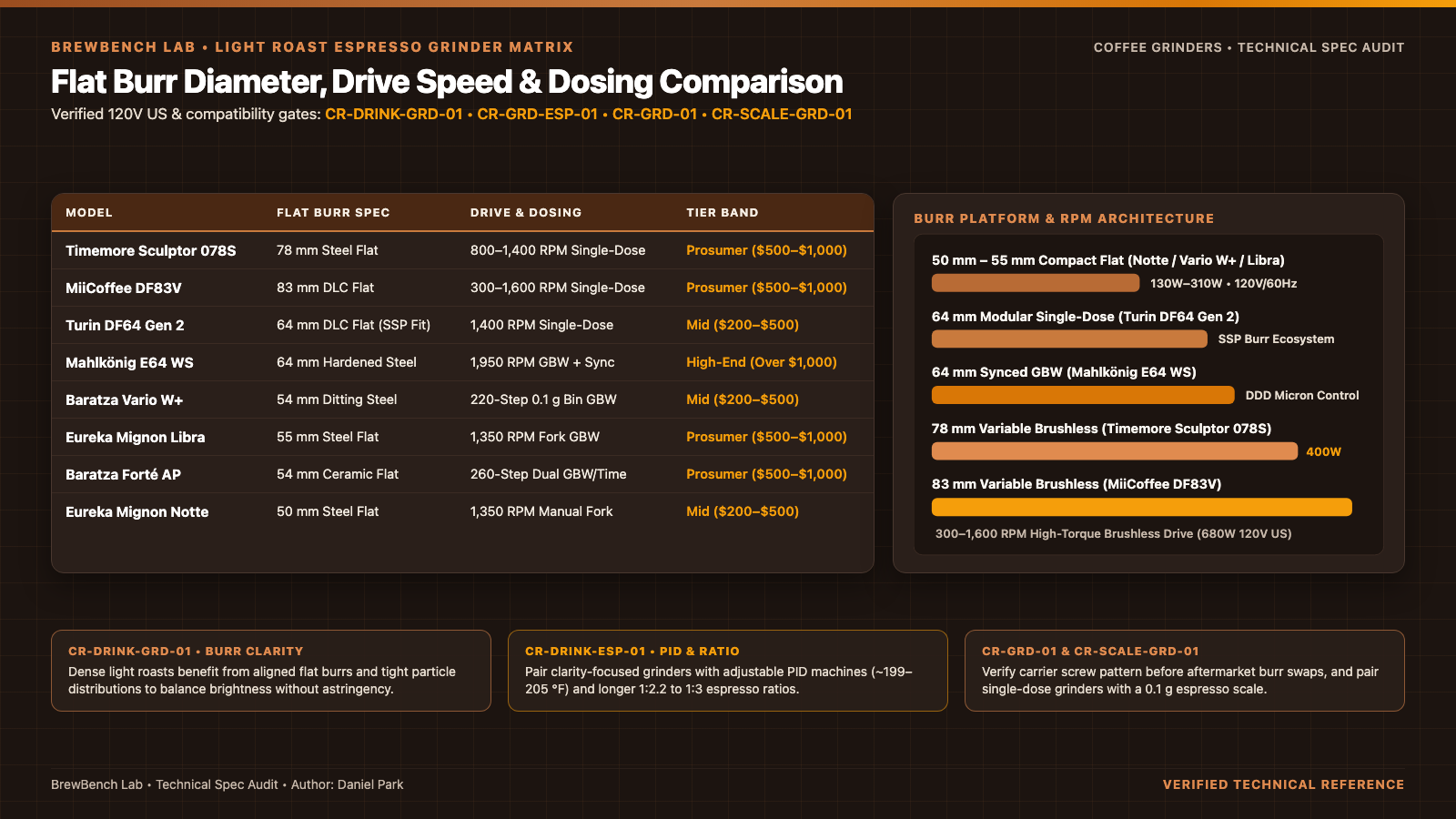
Dialing in lightly roasted coffee on a single-wall espresso basket demands far tighter control over particle geometry and extraction setup than pulling traditional dark Italian blends. Before ordering a grinder on Amazon US, run through these five engineering compatibility gates so your hardware matches both your beans and your espresso machine.
1. Why Dense Light Roasts Challenge Standard Grinders (CR-DRINK-GRD-01 & CR-GRD-ESP-01)
Roasting coffee lightly leaves behind denser bean walls and lower porosity, meaning hot water extracts soluble compounds more slowly during a 25-to-35-second shot. To avoid sour, under-extracted espresso without choking the puck into bitter astringency, light-roast baristas look for narrower, more unimodal particle peaks rather than wide bimodal spreads heavy in microscopic dust. That is why every top pick in this guide uses maker-verified espresso-capable flat burrs—spanning 50 mm to 83 mm—rather than coarse stepped conical mills or filter-only burrs that fail CR-GRD-ESP-01. That said, remember that burr alignment and carrier precision matter just as much as shape; never assume any flat burr automatically beats a well-aligned conical burr across medium-dark milk drinks, a trade-off we unpack in our flat vs conical burr grinders breakdown.
2. Variable RPM Brushless Motors vs. Fixed-Speed AC Drives
One of the biggest shifts in home grinders is the arrival of brushless DC drives with adjustable rotational speed. Units like the TIMEMORE Sculptor 078S (800–1,400 RPM) and MiiCoffee DF83V (300–1,600 RPM) let you tune variable RPM independently of grind gap. Lowering RPM generally feeds beans more gently between the burr teeth and reduces brittle shattering on dense light roasts, producing cleaner, tea-like shots at faster flow rates—whereas bumping RPM upward increases fines slightly to build puck resistance when a stubborn ultra-light bean runs too fast. Fixed-speed AC and DC grinders such as the Turin DF64 Gen 2 (1,400 RPM) and MAHLKÖNIG E64 WS (1,950 RPM) remain completely capable for light roasts, though they rely strictly on burr geometry, grind setting, and puck prep rather than motor speed tuning.
3. Burr Diameter (54 mm to 83 mm), Alignment & Aftermarket SSP Paths (CR-GRD-01)
Larger burr diameters (like 78mm burrs on the Sculptor 078S or 83 mm on the DF83V) cut faster at lower temperatures and offer long cutting edges, yet 64mm burrs remain the undisputed aftermarket customization king under rule CR-GRD-01. If you buy a 64 mm chassis such as the Turin DF64 Gen 2, you can keep its factory DLC steel burrs for balanced daily shots or install specialized third-party SSP High-Uniformity or Multipurpose burrs later. Keep two technical cautions in mind before swapping burrs: always confirm the aftermarket listing explicitly matches your exact grinder’s screw-hole pattern and carrier height, and check burr alignment while re-zeroing after installation—plus verify whether opening the chamber affects your US distributor warranty.
4. Single-Dose Weighing vs. Grind-by-Weight Workflows (CR-GRD-02 & CR-SCALE-GRD-01)
Light-roast drinkers frequently rotate washed Ethiopian, anaerobic Kenyan, and honey-processed Colombian bags within the same week. A low-retention single-dose grinder (Sculptor 078S, DF83V, DF64 Gen 2) uses a rotary knocker or bellows plus plasma ionization to purge nearly all grounds per shot so flavors never cross-contaminate—just budget for a 0.1 g scale to weigh every dry dose (CR-SCALE-GRD-01) and a tall dosing cup or funnel to keep transfers tidy. Conversely, if you finish one 12 oz bag before opening the next, integrated grind-by-weight hoppers like the MAHLKÖNIG E64 WS and Eureka Mignon Libra weigh each dose automatically to 0.1–0.2 g, removing morning scale prep while accepting slightly higher chamber grind retention between bag changes (CR-GRD-02).
5. Espresso Machine Pairing, Pre-Infusion, Brew Ratios & Water Chemistry
Even the sharpest flat-burr grinder cannot rescue light-roast espresso if your espresso machine lacks thermal stability or your water flattens acidity. Under compatibility rule CR-DRINK-ESP-01, pair clarity-focused grinders with an adjustable PID espresso machine set toward the upper brew window—roughly 199 to 205 degrees F (93 to 96 degrees C)—alongside gentle low-pressure pre-infusion and longer brew ratio targets around 1:2.2 to 1:3 by weight (for example, 18 g in to 40–54 g out). Avoid confusing marketing “15-bar” or “20-bar” maximum pump ratings with actual ~9-bar brewing pressure at the puck, and check your 120V/60Hz kitchen circuit wattage (CR-ESP-SYS-02) before running a 680W DF83V simultaneously with a dual boiler and electric kettle on the same 15A branch. Finally, consult the Specialty Coffee Association (SCA) Coffee Standards for balanced, low-alkalinity recipe water (CR-DRINK-WTR-01) so excessive carbonate hardness never mutes delicate light-roast aromatics or scales your machine’s boiler.
Upgrade Roadmap & Hidden Ownership Costs
Under our setup budget guideline (CR-SYS-01), dedicate at least one-third of your machine-plus-grinder budget to your burr grinder—and even up to half if light-roast straight espresso is your daily priority. Beyond the grinder box itself, plan modest extra headroom for three ownership essentials: a fast 0.1 g drip-tray brew scale (mandatory for tracking 1:2.5 light-roast yields and single-dose input weights under CR-SCALE-GRD-01), a precision 54 mm or 58 mm WDT needle tool + dosing funnel to eliminate clumps before tamping, and optional aftermarket 64 mm SSP burrs if you start on a Turin DF64 Gen 2. Check under-cabinet height too (CR-GRD-SYS-01): tall hopper or bellows setups like the 15.75-inch DF83V and 15.4-inch E64 WS need extra headroom under standard 18-inch US upper cabinets.
How We Audited, Scored & Excluded These Grinders
Every ranking at BrewBench Lab follows our transparent Editorial Evaluation Methodology, cross-referencing official 120V/60Hz North American spec sheets, manufacturer espresso-capability statements, and cross-compatibility rules (`CR-*`) without inventing synthetic lab particle curves, unverified retention grams, or fabricated extraction telemetry. Each grinder is scored out of 10 across four weighted pillars totaling 100%:
| Evaluation Criterion | Weight | What We Audited |
|---|---|---|
| Light-Roast Clarity & Burr Architecture | 35% | Flat-burr geometry, diameter (50 mm to 83 mm), steel vs ceramic metallurgy, and suitability for dense light-roast extraction (CR-DRINK-GRD-01). |
| Dialing Precision, RPM Control & Repeatability | 25% | Stepless adjustment vs dense micro-step resolution (CR-GRD-ESP-03), variable-RPM brushless tuning, and electronic Disc Distance Detection. |
| Retention, Workflow & Dosing Ergonomics | 20% | Low-retention single-dose paths, rotary knockers, plasma ionizers, or integrated 0.1 g grind-by-weight convenience (CR-GRD-02, CR-SCALE-GRD-01). |
| Build Quality, 120V Power & Upgradeability | 20% | Motor torque on 120V/60Hz circuits, under-cabinet clearance (CR-GRD-SYS-01), US warranty support, and aftermarket burr fitment (CR-GRD-01). |
Models We Audited & Excluded (And Why)
- Niche Zero, Niche Duo & Timemore Sculptor 064 / 064S: Direct-sale and specialty-dealer grinders with no active Amazon US grinder listing (Amazon carries only third-party accessories or the larger Sculptor 078S).
- Baratza Forte BG (B00LMH1R0M) & Eureka Filtro Silent (B0CBNGVJ4V): HARD FAIL on CR-GRD-ESP-01 for primary espresso ranking. While some enthusiasts experiment with Forte BG steel burrs for low-pressure turbo shots, both Baratza and Eureka engineer and position these stock brew/filter models for pour-over and drip rather than traditional single-wall espresso.
- MAHLKÖNIG Guatemala 2.0 Shop Grinder (B0G26LTM1Z): Excluded for home espresso bars under CR-GRD-SYS-01 and workflow limits—standing 24.4 inches (62 cm) tall at 62 lb (28 kg) with 20 coarse shop steps, a 1,100W commercial motor, and a retail-bag clamp rather than stepless portafilter dosing.
- Generic 64mm 100-Step Entry Grinders (B0GVFFS688) & Filter-Only Mills (Baratza Encore ZCG485BLK, Fellow Ode Gen 2): Excluded under CR-GRD-ESP-01 and CR-DRINK-GRD-01 because dense light-roast espresso requires verified factory burr alignment and stepless or dense micro-step dialing rather than filter-only or coarse stepped carriers.
Continue Your Audit
- Best Espresso Grinders Under $200 2026: Entry Picks Audited
- Best Espresso Grinders Under $500 2026: Mid-Range Compared
Frequently Asked Questions About Light Roast Espresso Grinders
Why does light roast espresso need a specialized burr grinder?
Light-roast coffee beans retain denser cell structure and lower solubility than dark roasts, making them harder to extract evenly at nine bars. A high-clarity flat-burr grinder with tight particle distribution and stepless adjustment helps you grind fine enough without creating excessive astringent fines (CR-DRINK-GRD-01).
Does variable RPM actually matter for light roast espresso?
Variable-RPM brushless motors (like the 800–1,400 RPM Timemore Sculptor 078S and 300–1,600 RPM MiiCoffee DF83V) let you alter bean feed rate and particle fines generation. Slower RPM often reduces fines for cleaner, sweeter light-roast shots, while higher RPM boosts puck resistance when beans resist choking.
Are 64 mm, 78 mm, or 83 mm flat burrs better than 54 mm steel burrs?
Larger burrs (64 mm to 83 mm) grind faster and open broader geometry options—especially 64 mm platforms like the Turin DF64 Gen 2 that accept aftermarket SSP burrs (CR-GRD-01). However, 54 mm Ditting steel burrs on the Baratza Vario W+ still deliver crisp unimodal clarity at a lower entry cost.
Can I pull light roast espresso with a stepped grinder?
Stepped dials with dense micro-steps (such as the 220-step Vario W+ or 260-step Forte AP) can dial light roasts effectively, though you may occasionally shift dose weight by 0.5 grams between clicks (CR-GRD-ESP-03). True stepless grinders remove that gap constraint altogether.
What espresso machine and water setup pair best with a light-roast grinder?
Pair a light-roast grinder with an adjustable PID espresso machine capable of holding roughly 199 to 205 degrees F (93 to 96 degrees C) and longer 1:2.2 to 1:3 brew ratios (CR-DRINK-ESP-01). Use balanced, low-alkalinity recipe water per SCA guidance so mineral hardness neither mutes acidity nor scales boilers (CR-DRINK-WTR-01).
Should I choose single-dose or grind-by-weight for light roast espresso?
Single-dose grinders (Sculptor 078S, DF83V, DF64 Gen 2) excel if you rotate multiple light-roast coffees daily and want near-zero retention, though they require a 0.1 g scale (CR-SCALE-GRD-01). Grind-by-weight hoppers (Mahlkonig E64 WS, Eureka Mignon Libra) speed up mornings when you stick to one bean at a time.
Final Verdict: Which Grinder for Light Roast Espresso Should You Buy?
Choosing the best grinder for light roast espresso comes down to matching burr architecture and dosing workflow to the way you rotate specialty beans. For most enthusiasts chasing vibrant clarity, sweet balance, and variable-RPM control under standard kitchen cabinets, the TIMEMORE Sculptor 078S takes #1 overall with its 78 mm steel flat burrs, 800–1,400 RPM brushless motor, and bellows-free rotary knocker. If you want maximum 83 mm throughput and ultra-low 300 RPM slow feeding with tall counter headroom, step up to the MiiCoffee DF83V.
Shoppers working in the mid-range tier between $200 and $500 should look straight at the Turin DF64 Gen 2 for its stepless 64 mm platform and unmatched SSP upgradeability—or choose the Baratza Vario W+ if 54 mm Ditting steel burrs and integrated bin weighing fit your espresso-plus-pour-over mornings. Prefer hands-free hopper dosing? Lock in the MAHLKÖNIG E64 WS for motorized micron telemetry above $1,000, or the quiet Eureka Mignon Libra between $500 and $1,000. Whichever flat-burr grinder lands on your bench, pair it with a 0.1 g scale, a PID espresso machine, and balanced SCA-aligned recipe water to unlock clean light-roast extractions every morning.


