
Disclosure: As an Amazon Associate, I earn from qualifying purchases. If you buy through links on this page, we may earn a small commission at no extra cost to you.
Comparing the baratza encore esp vs fellow opus comes down to one practical workflow choice in entry-level 120V espresso grinding: a dual-range stepped hopper grinder engineered for effortless daily switching and long-term parts repairability versus a low-profile single-dose grinder built around anti-static catch-cup convenience and timed auto-stop. Both 40mm conical burr grinders anchor the sub-$200 entry class in our best espresso grinders hub and our best espresso grinders under $200 roundup, yet their adjustment mechanisms, vertical heights, and successor models serve distinct home bar setups.
The short verdict: Choose the Baratza Encore ESP (ZCG495) if you alternate between espresso and pour-over daily, want a single visible outer adjustment scale (1–20 espresso, 21–40 filter), or value user-replaceable gears and calibration shims. Choose the Fellow Opus (40mm Gen 1) if you strictly single-dose with a 0.1 g scale, need a shorter 10.5-inch grinder under low kitchen cabinets, or want timed auto-stop—while noting that Fellow’s newer Fellow Opus 2 adds 48mm burrs and stepless control inside the same entry price bracket.
In This Comparison
- Winner-by-Use-Case Quick Verdict Matrix
- Side-by-Side 120V Spec & Compatibility Table
- Battleground 1: Espresso Capability & Generation Separation
- Battleground 2: 40mm Conical Burrs, Adjustment Steps & Light Roasts
- Battleground 3: Hopper vs. Single-Dose & Espresso/Filter Switching
- Battleground 4: Dosing Cups, Portafilter Fit & Setup Budget
- Battleground 5: Cabinet Clearance, 120V Power, Maintenance & Warranty
- Choose Encore ESP If vs. Choose Fellow Opus If
- Verified Amazon US Contenders & Next-Gen Stepless Options
- Grinders Excluded From This Amazon US Comparison
- Frequently Asked Questions
Quick Verdict Matrix: Which Entry Conical Grinder Wins by Use Case?
Both the Baratza Encore ESP and the Fellow Opus sit inside the TIER-GRD-ENTRY (under $200) Amazon US bracket and carry official manufacturer espresso capability ratings. However, their ergonomics diverge sharply once you consider how often you change brew methods, how tall your upper kitchen cabinets sit, and whether you want hopper storage or weighed single doses.
| Use Case & Coffee Workflow | Winner | Why It Wins (Verified Spec & Rule Fit) |
|---|---|---|
| Best for Switching Between Espresso & Pour-Over Daily | Baratza Encore ESP (ZCG495) | Single outer collar separates 20 fine espresso steps (1–20) from 20 filter steps (21–40) with zero inner-ring mental math (CR-GRD-03). |
| Best for Dedicated Single-Dosing & Anti-Static Prep | Fellow Opus (40mm Gen 1) | Built around a 110 g single-dose load bin, magnetic catch cup, anti-static technology, and 30/60/90/120-second auto-stop (CR-GRD-02). |
| Best for Low Upper Cabinets & Compact Footprint | Fellow Opus (40mm Gen 1) | At 10.5 in (268 mm) tall, the Opus clears tight cabinets 2.9 in (72 mm) easier than the 13.4 in (340 mm) Encore ESP (CR-GRD-SYS-01). |
| Best for Long-Term Parts & DIY Serviceability | Baratza Encore ESP (ZCG495) | Baratza supplies modular replacement burr carriers, paddle wheels, gears, and calibration shims directly to US owners. |
| Best for Daily Milk Drinks (Medium to Dark Roasts) | Tie (Workflow Preference) | Both 40mm conical burr sets excel at rich medium-to-dark espresso bases for lattes; choose hopper ease (ESP) or auto-stop single dosing (Opus). |
| Best Stepless Upgrade Without Leaving Entry Pricing | Fellow Opus 2 (48mm) | Replaces the Gen 1 inner micro-ring with a continuous stepless dial, larger 48mm conical burrs, and an active ionizer (CR-GRD-ESP-03). |
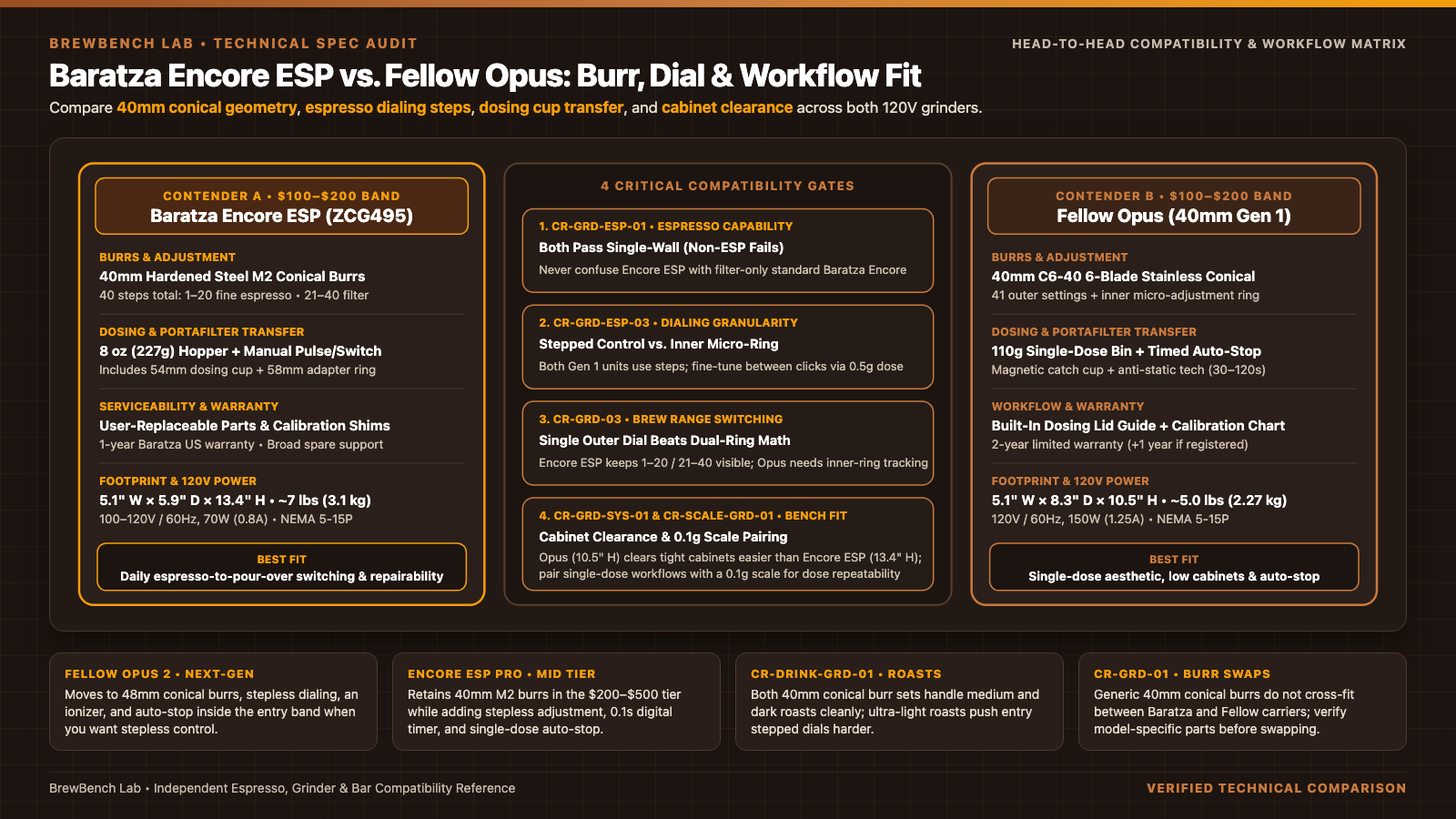
Side-by-Side Verified Spec & Compatibility Table (120V US Models)
Every specification below reflects North American 120V/60Hz retail units documented in Baratza and Fellow official product manuals. Where neither manufacturer publishes a standardized lab figure—such as micron movement per click, decibel sound pressure under load, or exact gram retention without external bellows—we report no verified data available yet rather than guessing.
| Specification / Compatibility Metric | Baratza Encore ESP (ZCG495) | Fellow Opus (40mm Gen 1) |
|---|---|---|
Maker Espresso Positioning (CR-GRD-ESP-01) | Espresso-capable all-purpose (espresso + filter) | Espresso-capable all-purpose (espresso to cold brew) |
| Burr Geometry & Diameter | 40mm hardened steel M2 conical burrs (European-made) | 40mm C6-40 Burly Burrs (6-blade stainless steel conical) |
Adjustment Mechanism (CR-GRD-ESP-03) | Stepped outer collar: 40 total steps (1–20 fine espresso, 21–40 filter) | Stepped outer dial (41 settings) + inner micro-adjustment ring |
| Micron Shift Per Step | No verified data available yet (maker states finer 1–20 espresso resolution) | No verified data available yet (inner ring subdivides outer macro clicks) |
Dosing Architecture (CR-GRD-02) | Hopper-fed (front pulse button + side ON/OFF switch) | Single-dose load bin with timed auto-stop (30s, 60s, 90s, 120s) |
| Bean Capacity | ~8 oz (227 g) hopper capacity | ~3.9 oz (110 g) single-dose load bin (100 g catch capacity) |
Portafilter & Dosing Cup Fit (CR-GRD-ACC-01) | 54mm dosing cup + 58mm adapter ring included (no fork cradle) | Magnetic catch cup with built-in portafilter dosing collar (no fork cradle) |
| Static Mitigation & Retention Data | Anti-static dosing cup design; exact retention grams: no verified data available yet | Integrated anti-static tech + lid grind guide; exact retention grams: no verified data available yet |
| 120V US Electrical Draw & Plug | 100–120VAC / 50–60Hz, 70W (0.8A), NEMA 5-15P | 120V / 60Hz, 150W (1.25A), NEMA 5-15P |
| Dimensions (W × D × H) | ~5.1 × 5.9 × 13.4 in (~130 × 150 × 340 mm) | ~5.1 × 8.3 × 10.5 in (~129 × 210 × 268 mm) |
| Weight | ~7.0 lbs (3.1 kg) with weighted base | ~5.0 lbs (2.27 kg) |
| Noise Level (dB) | No verified data available yet | No verified data available yet |
| US Manufacturer Warranty | 1-year limited warranty (Baratza USA) + broad spare parts | 2-year limited warranty (+1 year upon Fellow USA registration) |
| Amazon US Budget Tier | $100–$200 (TIER-GRD-ENTRY) | $100–$200 (TIER-GRD-ENTRY) |
Battleground 1: Espresso Capability & Critical Generation Separation
Before comparing burrs or catch cups, rule CR-GRD-ESP-01 enforces a hard compatibility gate: pairing a single-wall (non-pressurized) espresso basket with a filter-only burr grinder causes shots to gush in seconds with sour, under-extracted results. Both the Baratza Encore ESP (ZCG495) and the Fellow Opus carry explicit manufacturer ratings for single-wall espresso extraction, whereas two closely named siblings in their own brand catalogs fail or alter that equation:
- Baratza Encore (ZCG485) vs. Encore ESP (ZCG495) vs. Encore ESP Pro (ZCG595): Never confuse the classic Baratza Encore with the Encore ESP. Although both use 40mm conical burrs inside a visually similar housing, Baratza positions the standard non-ESP Encore for drip and pour-over brewing; it lacks the ESP’s high-resolution 1–20 espresso cam mechanism and quick-release burr carrier. Meanwhile, the newer Baratza Encore ESP Pro (ZCG595) steps up into the
TIER-GRD-MID($200–$500) bracket with stepless adjustment, a digital half-step readout, single-dose auto-stop, a 0.1-second timer, and an ionizer. Read our full Baratza Encore ESP review for a deeper single-SKU inspection. - Fellow Opus (40mm Gen 1) vs. Fellow Opus 2 (48mm) vs. Fellow Ode Gen 2: Fellow explicitly designs the 64mm flat-burr Ode Gen 2 for filter and pour-over brewing—stock Ode burrs fail
CR-GRD-ESP-01for single-wall espresso. For espresso, Fellow launched the 40mm Opus (Gen 1) and later introduced the Fellow Opus 2, which upgrades to 48mm conical burrs, replaces the inner micro-ring with a continuous stepless side dial, and adds an active ionizer. Check our dedicated Fellow Opus 2 review if you are deciding between Gen 1 inventory and the 48mm stepless update.
Battleground 2: 40mm Conical Burrs, Dialing Precision & Light-Roast Limits
Inside the grind chamber, both entry contenders rely on 40mm stainless/hardened steel conical burrs (`STD-BURR-40-CONICAL`). Baratza equips the Encore ESP with European-manufactured 40mm M2 hardened steel conical burrs, matching the upgraded burr profile enthusiasts previously installed in legacy Virtuoso grinders. Fellow equips the Gen 1 Opus with proprietary 40mm C6-40 Burly Burrs featuring a 6-blade geometry driven by a higher-wattage 150W motor. Neither burr carrier shares mounting geometry with the other or with generic 40mm aftermarket burrs, so under rule CR-GRD-01, aftermarket flat or conical burr swaps are not plug-and-play across these models.
Where day-to-day dialing diverges is how each machine splits those fine adjustments under rule CR-GRD-ESP-03:
- Baratza Encore ESP Dual-Range Collar: Twisting the bean hopper rotates through 40 detented clicks. Settings 1 through 20 compress the burr travel into tight espresso increments, while settings 21 through 40 open up in wider jumps for AeroPress, pour-over, drip, and cold brew. Everything stays visible on one numbered collar. The limitation of any stepped 1–20 design is that an ideal 1:2 espresso extraction can occasionally fall halfway between two clicks—say setting 14 runs slightly fast while setting 13 chokes the puck. Under
CR-GRD-ESP-03, you bridge that gap by adjusting your dry dose by 0.5 g to 1.0 g inside your basket’s rated capacity rather than hunting for an invisible half-click. - Fellow Opus Outer Macro Dial + Inner Micro-Adjustment Ring: The Gen 1 Opus displays 41 outer settings numbered 1 through 11 (with quarter-tick detents between whole numbers). Because those outer clicks alone can feel coarse for single-wall espresso, Fellow hides a secondary inner micro-adjustment ring directly underneath the removable load bin. Rotating that inner ring shifts the burr gap by smaller sub-steps between macro ticks. While this inner ring technically provides finer resolution than a simple macro collar, adjusting it requires lifting the lid, checking the inner blue/white orientation chart, and remembering your inner offset.
Under drink-pairing rule CR-DRINK-GRD-01, both 40mm conical burr sets favor classic medium, medium-dark, and dark espresso roasts that deliver syrupy body in lattes and traditional 1:2 straight shots. If you predominantly brew very dense, light Nordic-style single-origin espresso at 1:2.5 to 1:3 ratios, stepped 40mm entry conicals require careful puck prep (WDT needle distribution and a 0.1 g scale) and still offer less extraction clarity and stepless flexibility than the newer Fellow Opus 2, Baratza Encore ESP Pro, or 64mm flat-burr grinders in the $200–$500 tier.
Battleground 3: Hopper vs. Single-Dose & Daily Brew-Method Switching
If your household brews both morning espresso and afternoon pour-over from one grinder (UC-FILTER-AND-ESPRESSO), rule CR-GRD-03 becomes the deciding factor in daily satisfaction—far more than subtle burr flavor nuances.
On the Baratza Encore ESP, switching from setting 15 (espresso) to setting 28 (V60 pour-over) takes one smooth twist of the hopper collar, and returning to 15 the next morning lands on the exact same mechanical index. The catch is that Baratza ships an 8 oz (227 g) hopper designed for storing beans. If you keep the hopper full of espresso roast, you cannot easily swap to a filter roast mid-day without emptying the hopper—so dual-brew households usually weigh individual doses into the hopper (or add an aftermarket silicone single-dose bellows) and run the motor briefly until empty. Note also that the Encore ESP has no automatic shutoff timer; you either flip the side rocker switch manually or hold the front pulse button.
On the Fellow Opus, Fellow embraces dedicated single-dosing (CR-GRD-02) with a compact 110 g load bin, a lid printed with brew-range guides, and a front button that activates a 30-second run (double-press for 60s, triple-press for 90s, or hold for 120s) with timed auto-stop. Under rule CR-SCALE-GRD-01, pairing the Opus with a 0.1 g coffee scale is practically mandatory so you weigh 18.0 g of whole beans before dropping them in. However, returning to your dialed espresso setting after grinding coarse pour-over coffee can feel less intuitive if you adjusted the Opus’s inner micro-ring, because two variables (outer dial + inner ring) determine your exact zero point.
Regarding pattern-level grind retention and static (ISS-GRD-STATIC), Fellow builds anti-static technology into the Opus chute, yet community reports frequently note that fine espresso grinds still cling inside the chute on Gen 1 units unless you lightly mist beans (RDT, following caution around moisture) or tap the lid—prompting many owners to add silicone bellows. Baratza relies on a straight-drop chute and anti-static dosing cup on the Encore ESP without an active ionizer; because neither brand publishes verified lab retention-gram averages across standardized roast/humidity conditions, we list exact retention grams as no verified data available yet. For more dual-method options across price tiers, inspect our best grinders for espresso and pour-over guide.
Battleground 4: Dosing Cups, Portafilter Compatibility & Setup Budget
Under accessory compatibility rule CR-GRD-ACC-01, neither the Baratza Encore ESP nor the Fellow Opus includes a hands-free portafilter fork/cradle under the chute. Instead, both grinders solve portafilter transfer cleanly using dedicated dosing cups:
- Baratza Encore ESP (54mm Cup + 58mm Adapter Ring): Baratza supplies a tailored 54mm dosing cup that mates flush against 54mm Breville Bambino/Barista portafilters for a clean flip-and-tap transfer. Snap the included 58mm adapter ring onto the rim, and the exact same cup seats securely inside 58mm Gaggia, Rancilio, or E61 baskets. Owners running narrower 51mm De’Longhi portafilters should pair the cup with a 51mm dosing funnel to avoid spilling grounds around the rim.
- Fellow Opus (Magnetic Catch Cup + Portafilter Collar): Fellow includes a self-centering magnetic catch cup with a removable inner collar designed to funnel grounds directly into 54mm and 58mm portafilters without needing a separate loose ring—though 51mm portafilters still benefit from a dosing funnel during transfer.
Finally, check whole-setup budget balance under rules CR-SYS-01 and CR-GRD-ESP-02. When building a single-wall espresso setup from scratch, allocate at least roughly one-third of your combined machine-plus-grinder budget toward the grinder. Dropping either the Encore ESP or Fellow Opus next to a Breville Bambino, Bambino Plus, or De’Longhi Dedica Arte (upgraded with a 51mm single-wall basket) lands squarely inside the sweet spot of CR-SYS-01. Conversely, if you plan to brew solely with pressurized dual-wall baskets using pre-ground coffee indefinitely, neither grinder is necessary—and spending $500+ on a prosumer flat-burr mill would waste grind precision the pressurized valve cannot showcase (CR-GRD-ESP-02).
Battleground 5: Cabinet Clearance, 120V Power, Maintenance & Warranty
Physical footprint and electrical draw complete the real-world US kitchen check:
- Under-Cabinet Height Clearance (
CR-GRD-SYS-01): Standard US kitchen wall cabinets sit roughly 18 in (457 mm) above the countertop. The Baratza Encore ESP measures ~13.4 in (340 mm) tall with its standard hopper installed—leaving ~4.6 in (117 mm) of overhead room, which passes our 50 mm access margin on standard 18-inch counters, though lower-hung cabinets or tall aftermarket bellows may force you to slide the grinder forward before pouring beans. The Fellow Opus stands only ~10.5 in (268 mm) tall, leaving generous vertical clearance even beneath tight 15-inch apartment cabinets. - 120V/60Hz Electrical Load (
CR-ESP-SYS-02): Both North American models plug into standard 120V/60Hz NEMA 5-15P outlets with modest motor draw—70W (0.8A) for the Encore ESP and 150W (1.25A) for the Opus. Even on a shared 15A (1,800W peak / 1,440W continuous) kitchen branch circuit, running either grinder briefly while a 1,450W–1,560W thermoblock espresso machine idles poses minimal circuit strain compared with running two high-wattage heaters simultaneously, though keeping high-draw kettles and toasters on separate circuits remains best practice. - Flavored Beans, Cleaning & Warranty Support (
CR-DRINK-GRD-02): Both Baratza and Fellow advise brushing burrs dry with a stiff brush (never submerging steel burrs in water) and checking maker manuals before running oily dark or syrup-flavored beans that glaze burr flutes. Baratza includes a 1-year US limited warranty paired with its industry-leading spare-parts catalog and removable upper ring burr carrier (plus factory shim kits if espresso range drifts over time). Fellow provides a longer 2-year standard warranty (extendable to 3 years upon registration), though fewer internal drivetrain parts are sold individually for DIY repair.
Head-to-Head Decision Summary: Choose Encore ESP or Fellow Opus?
Choose the Baratza Encore ESP (ZCG495) if…
- You switch between espresso and pour-over/drip frequently (
UC-FILTER-AND-ESPRESSO/CR-GRD-03) and want one straightforward outer numbered collar. - You want Baratza’s modular US spare-parts support, calibration shims, and straightforward burr-carrier cleaning access.
- You alternate between filling a 227 g hopper for morning convenience and occasionally single-dosing with the included 54mm/58mm dosing cup.
- Your kitchen has standard ~18-inch upper cabinets that comfortably clear the 13.4-inch hopper height.
Choose the Fellow Opus (40mm Gen 1) if…
- You weigh every espresso dose on a 0.1 g scale (
CR-SCALE-GRD-01) and prefer a dedicated single-dose workflow with timed auto-stop. - You have low upper cabinets or limited vertical clearance where a compact 10.5-inch silhouette fits cleaner than a 13.4-inch hopper mill.
- You appreciate a magnetic catch cup with an integrated portafilter collar, anti-static chute engineering, and a 2-year (+1 registered) warranty.
- You want Fellow’s design language—though also compare the newer Fellow Opus 2 below before clicking buy.
Verified Amazon US Contenders & Next-Gen Stepless Upgrades
All four listings below are verified 120V/60Hz North American models fulfilled on Amazon US. Watch listing titles carefully under guardrail G-21 (ISS-GRD-GENERATION): confirm you are selecting the espresso-capable Encore ESP (not the filter-only standard Encore) and verify whether a Fellow listing is the 40mm Opus Gen 1 or the 48mm stepless Opus 2.
1. Baratza Encore ESP (ZCG495BLK) — Best Entry All-Purpose Switcher & Repairable Design

Quick Specs: 40mm hardened steel M2 conical burrs | 40 stepped settings (1–20 espresso, 21–40 filter) | 8 oz (227 g) hopper + 54mm dosing cup & 58mm adapter ring | 120V/60Hz, 70W (NEMA 5-15P) | ~5.1 in W × 5.9 in D × 13.4 in H | ~7.0 lbs | 1-year US warranty | Price Tier: $100–$200 (TIER-GRD-ENTRY)
Pros
- Dual-range outer dial separates 20 fine espresso steps from 20 filter steps cleanly with zero hidden rings
- Includes both a 54mm dosing cup and 58mm adapter ring for spill-free portafilter transfer
- Modular Baratza chassis backed by widely stocked replacement parts and calibration shims
Cons
- Stepped 1–20 espresso adjustment can land between clicks, requiring 0.5 g dose tweaks (
CR-GRD-ESP-03) - Tall 13.4-inch hopper height and manual switch omit timed auto-stop and active ionizer tech
2. Fellow Opus (40mm Gen 1) — Best Compact Single-Dose Height & Timed Auto-Stop

Quick Specs: 40mm C6-40 6-blade stainless conical burrs | 41 outer settings + inner micro-adjustment ring | 110 g single-dose load bin + timed auto-stop (30–120s) + magnetic catch cup | Anti-static tech | 120V/60Hz, 150W (NEMA 5-15P) | ~5.1 in W × 8.3 in D × 10.5 in H | ~5.0 lbs | 2-year warranty (+1 yr registered) | Price Tier: $100–$200 (TIER-GRD-ENTRY)
Pros
- Compact 10.5-inch profile fits cleanly under low kitchen cabinets with zero hopper overhang
- Timed auto-stop (30/60/90/120s) and magnetic catch cup with dosing collar streamline single-dose prep
- 2-year standard warranty (extendable to 3 years upon Fellow USA registration)
Cons
- Hidden inner micro-adjustment ring makes daily espresso-to-filter switching less intuitive
- Community reports cite Gen 1 chute retention that often prompts lid tapping or aftermarket silicone bellows
3. Next-Gen Upgrade: Fellow Opus 2 — Stepless 48mm Conical Evolution Under $200

Quick Specs: 48mm stainless steel conical burrs | Continuous stepless grind adjustment dial | 100 g single-dose load bin + auto-stop + active anti-static ionizer | 120V/60Hz, 300W (NEMA 5-15P) | ~5.1 in W × 8.1 in D × 10.5 in H | Price Tier: $100–$200 (TIER-GRD-ENTRY)
If you like the Fellow Opus footprint but dislike the Gen 1 inner micro-ring, the Fellow Opus 2 directly resolves both CR-GRD-ESP-03 and Gen 1 static complaints while remaining inside the sub-$200 entry band. Moving to a continuous stepless dial removes click-gap compromises on single-wall espresso baskets, while larger 48mm conical burrs and an active ionizer streamline single-dose workflow. Just remember that stepless dials require logging your visual tick mark before switching out to pour-over, and a 0.1 g scale remains essential (CR-SCALE-GRD-01).
4. Step-Up Alternative: Baratza Encore ESP Pro (ZCG595BLK) — Stepless 40mm M2 + Digital Timer

Quick Specs: 40mm M2 conical burrs | Stepless adjustment with digital half-step display | Single-dose auto-stop + 0.1s digital timer + 300 g hopper | Integrated ionizer & flow-control disk | 120V/60Hz, 70W (NEMA 5-15P) | ~5.1 in W × 5.9 in D × 13.4 in H | Price Tier: $200–$500 (TIER-GRD-MID)
For Baratza fans willing to step up into the TIER-GRD-MID ($200–$500) bracket, the Baratza Encore ESP Pro (ZCG595BLK) keeps the proven 40mm M2 burr lineage and repairable architecture while replacing the 40-click collar with stepless adjustment, a digital half-step readout, an integrated anti-static ionizer, and both single-dose auto-stop and 0.1-second timed dosing modes. Note that it retains the 13.4-inch vertical height of the standard Encore chassis (CR-GRD-SYS-01).
Grinders Excluded From This Amazon US Comparison
- Standard Baratza Encore (Non-ESP, ZCG485): Excluded under
CR-GRD-ESP-01; Baratza positions the standard Encore for filter brewing and omits the Encore ESP’s finer 1–20 espresso cam steps. - Fellow Ode Gen 2 (Stock 64mm Burrs): Excluded under
CR-GRD-ESP-01; Fellow markets stock Ode Gen 2 burrs exclusively for pour-over and drip rather than single-wall espresso. - Generic Blade Grinders: Excluded under
CR-GRD-ESP-01andCR-SYS-02because chopping blades produce wide particle scatter incompatible with single-wall espresso extraction. - Niche Zero & Timemore Sculptor 064: Excluded as Amazon buy-intent picks because both models rely on direct or specialty dealer channels without primary Amazon US storefront fulfillment.
- 230V / 50Hz European & UK Imports: Excluded under
CR-ESP-SYS-01and North American 120V/60Hz safety standards; 230V units cannot safely plug into 120V US outlets without step-up transformers and forfeit US warranty coverage.
Authoritative Technical References
- Baratza — Encore ESP (ZCG495) Official Operations Manual & Specifications (40mm M2 burrs, 1–20 espresso / 21–40 filter steps, 54mm/58mm dosing cup workflow, 120V/60Hz 70W draw, and 1-year US warranty).
- Baratza — Encore ESP Pro (ZCG595) Official Product Specifications (Stepless adjustment, digital half-step readout, single-dose auto-stop, 0.1s timer, and anti-static ionizer).
- Fellow Products — Opus Conical Burr Grinder Manual & Registration Warranty (40mm C6-40 burrs, 41 outer + inner micro-ring, 110 g load bin, 120V/60Hz 150W spec, and 2+1 year warranty).
- Fellow Products — Opus 2 Conical Burr Grinder Specifications (48mm conical burrs, continuous stepless dial, anti-static ionizer, and auto-stop shutoff).
- National Fire Protection Association (NFPA) — Residential Kitchen Branch Circuit Context (15A/20A 120V kitchen branch-circuit load planning alongside espresso heaters under CR-ESP-SYS-02).
How We Audited This Guide
- Burr grinders were checked for maker-stated espresso adjustment fineness, burr geometry and size, single-dose vs hopper workflow, retention caveats, and kitchen height clearance.
- Every espresso machine, burr grinder, accessory, and scale specification was cross-checked against official manufacturer 120V manuals, SCA water guidance, and verified Amazon US listings.
- Recommendations were evaluated against our weighted espresso-gear scoring rubrics and documented CR-* compatibility rules; we never invent heat-up seconds, PID variance, or micron claims.
Frequently Asked Questions
Can the standard Baratza Encore grind fine enough for single-wall espresso like the Encore ESP?
No—Baratza positions the standard Encore for filter brewing, whereas the Encore ESP adds a dedicated 1–20 fine-step espresso range and M2 burrs. Under rule CR-GRD-ESP-01, standard non-ESP units lack sufficient micro-resolution for single-wall espresso baskets and will cause shots to gush rapidly.
Which is easier to switch daily between espresso and pour-over: Encore ESP or Fellow Opus?
The Baratza Encore ESP switches faster and more predictably because every espresso (1–20) and filter (21–40) position sits on one visible outer collar. On the Gen 1 Fellow Opus, tracking offsets on the hidden inner micro-adjustment ring adds extra steps when returning from coarse pour-over.
Should I buy the Fellow Opus Gen 1 or step up to the Fellow Opus 2?
Choose the Fellow Opus 2 if both sit near the same entry price on Amazon US. The Opus 2 upgrades from 40mm to 48mm conical burrs, replaces the Gen 1 inner micro-ring with a continuous stepless dial, and adds an active anti-static ionizer with auto-stop.
Do the Baratza Encore ESP and Fellow Opus fit 54mm and 58mm portafilters?
Yes—via their dosing cups rather than a portafilter fork. The Encore ESP ships with a 54mm dosing cup and 58mm adapter ring for invert-transfer, while the Fellow Opus uses a magnetic catch cup with a built-in dosing collar sized for 54mm and 58mm baskets.
How do you fine-tune espresso if a stepped Encore ESP or Opus setting lands between clicks?
Adjust your dry coffee dose by 0.5 g to 1.0 g within your basket’s rated capacity. Increasing the dose slows flow slightly when a click runs fast, while trimming the dose speeds up a tight setting—a standard workaround under compatibility rule CR-GRD-ESP-03.
Will either grinder fit under standard 18-inch upper kitchen cabinets?
Yes, though the Fellow Opus leaves much more overhead room. The Opus stands ~10.5 in (268 mm) tall, easily clearing low cabinets, whereas the Encore ESP stands ~13.4 in (340 mm) tall and needs pulling forward slightly if you add tall single-dose bellows.


