
Disclosure: As an Amazon Associate, I earn from qualifying purchases. If you buy through links on this page, we may earn a small commission at no extra cost to you.
Direct Answer — Can You Use Distilled Water in an Espresso Machine? No—never run pure, unremineralized distilled water (0 mg/L TDS) inside an espresso machine. Under compatibility rule CR-WTR-ESP-02, ion-free water prevents conductive level probes from detecting full boilers or tanks, risks unbuffered metal corrosion (CR-WTR-ESP-04), and produces flat, hollow shots. Treat distilled water strictly as a clean base ingredient and remineralize it first.
Home baristas routinely ask can you use distilled water in an espresso machine after discovering hard tap water leaves chalky limescale inside heating blocks, solenoid valves, and group dispersion screens. On the surface, swapping tap water for a gallon jug of steam-distilled water looks like a foolproof shortcut to zero scale. In practice, stripping out 100% of dissolved solids solves one mechanical problem while creating three new failures across electronics, metallurgy, and extraction chemistry.
Within our best water for espresso machines pillar hub, every 120V/60Hz North American espresso setup is audited across boiler protection, sensor compatibility, manufacturer warranty alignment, and roast buffering rather than simplistic zero-TDS myths. Below, we break down the engineering physics behind conductive autofill probes, present dual-unit water-chemistry formulas from the Specialty Coffee Association (SCA), map compatibility across thermoblock, single-boiler, dual-boiler, and super-automatic machines, and verify four Amazon US remineralization tools built specifically for espresso boilers.
In This Guide
- Why Pure Distilled Water Fails in Espresso Machines
- Water Hardness, Alkalinity & TDS Math (Dual Units)
- Machine-by-Machine Distilled Water Compatibility Matrix
- How to Remineralize Distilled Water Safely (5-Step Workflow)
- Myth vs. Engineering Reality: Distilled Water Traps
- 4 Verified Remineralization & 0-TDS Base Tools on Amazon US
- Frequently Asked Questions
Why Pure 0-TDS Distilled Water Fails in Espresso Machines
Every water decision in espresso engineering must balance scale prevention against electrical sensing, metal stability, and flavor chemistry (discussed strictly for machine longevity and beverage extraction—never drinking-water or health claims). Pure distilled water sits at roughly 0 mg/L (0 ppm) Total Dissolved Solids (TDS), which introduces three immediate technical conflicts inside pressurized 120V espresso hardware.
1. Conductive Level-Probe Blindness (CR-WTR-ESP-02)
Dual-boiler espresso machines (such as the 120V Breville Dual Boiler BES920 and Rancilio Silvia Pro X), heat-exchanger boilers, and several reservoir sensing circuits monitor water height using conductive metal probes. In a boiler autofill circuit, a stainless-steel probe projects downward to the target water line while the metal boiler shell serves as the ground reference. When mineral-bearing water rises to touch the probe tip, dissolved calcium, magnesium, potassium, and bicarbonate ions carry a tiny microamp sensing current across the water gap, signaling the control board to shut off the fill pump and energize the heating element.
Chemically pure distilled water lacks free ions and behaves as an electrical insulator. When you pour unremineralized 0-TDS distilled water—or output straight from a 5-stage deionizing pitcher—into a conductive-probe machine, the board reads an open circuit even when the boiler or reservoir is completely full. That fault triggers an endless espresso machine fill water error, locks out heaters to protect dry elements, or forces the autofill solenoid to overfill the steam boiler continuously until pressure relief valves vent water into the drip tray.
2. Unbuffered Corrosion Risk & Warranty Conflicts (CR-WTR-ESP-03 & CR-WTR-ESP-04)
Even on entry thermoblocks or compact single boilers that rely on mechanical magnetic reed floats instead of conductive probes, pure distilled water remains a poor long-term fluid choice. Without dissolved carbonate/bicarbonate alkalinity to buffer pH, freshly exposed distilled water absorbs ambient carbon dioxide from room air to form weak carbonic acid, dropping below neutral pH 7.0. Inside heated copper, brass, aluminum, and stainless-steel fluid paths cycling near 93–135 °C (199–275 °F), unbuffered ion-hungry water lacks passive mineral buffering and accelerates metal surface wear over repeated thermal cycles.
Just as critical, compatibility rule CR-WTR-ESP-03 highlights that machine warranties tie coverage directly to manufacturer water instructions. Leading North American manuals—including documentation from Breville US and De’Longhi US—specify filtered, low-hardness water or OEM reservoir cartridges and explicitly advise against pure distilled or demineralized water. Using unapproved water chemistries can complicate warranty claims if corrosion, level-sensor faults, or seal leaks develop.
3. Flat, Under-Buffered Shot Extraction (CR-DRINK-WTR-01)
Coffee brewing depends on specific dissolved ions acting as extraction partners during the 25–35 second high-pressure pass through your coffee puck. Positively charged magnesium (Mg2+) and calcium (Ca2+) ions bind selectively with aromatic flavor compounds and fruit-forward acids inside roasted coffee cells, while bicarbonate (HCO3−) buffers excess sharpness into balanced sweetness. Brewing espresso with 0-TDS distilled water leaves aromatic volatiles poorly extracted and acidity completely unbuffered—delivering hollow, thin, or aggressively sour shots, particularly on medium-light and light-roast specialty beans.
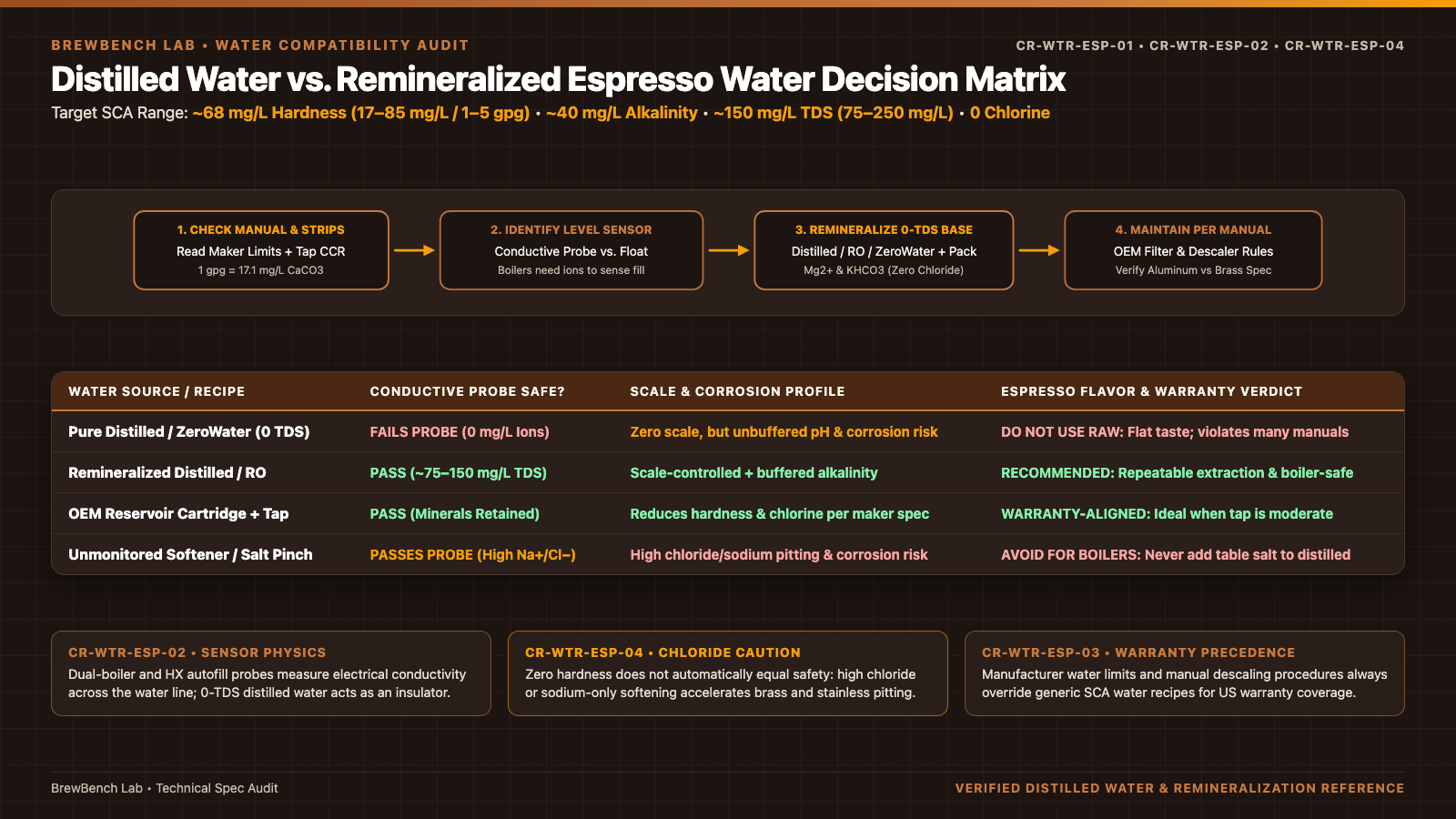
Espresso Water Chemistry Math: SCA Targets & Dual-Unit Conversions
Before adjusting distilled water or auditing your kitchen faucet, standardize your units. US municipal Consumer Confidence Reports (CCRs), aquarium-style hardness strips, and European espresso machine manuals mix four different concentration scales. Under BrewBench Lab’s dual-unit standard, convert every measurement into mg/L as CaCO3 (equivalent to parts per million, or ppm) alongside US grains per gallon (gpg):
- US Grains per Gallon (gpg):
1 gpg = 17.1 mg/L as CaCO3(for example, 4.0 gpg equals 68.4 mg/L CaCO3). - German Degrees (°dH):
1 °dH = 17.8 mg/L as CaCO3(4.0 °dH equals 71.2 mg/L CaCO3). - French Degrees (°fH):
1 °fH = 10.0 mg/L as CaCO3(7.0 °fH equals 70.0 mg/L CaCO3). - Parts per Million (ppm as CaCO3):
1 ppm ≈ 1 mg/L(120 ppm equals 120 mg/L).
The table below summarizes the SCA Water Standard reference parameters alongside machine-protection limits. Always note rule CR-WTR-ESP-03: whenever your espresso machine manufacturer’s US manual states a stricter hardness, TDS, or chloride ceiling, the machine maker’s limit supersedes general SCA targets for warranty protection.
| Water Parameter | SCA Target & Acceptable Range | Dual-Unit Equivalent | Engineering & Extraction Role |
|---|---|---|---|
| Total Hardness (as CaCO3) | ~68 mg/L target (17–85 mg/L range) | ~4.0 gpg target (1.0–5.0 gpg / ~1.0–4.8 °dH) | Calcium and magnesium drive flavor extraction; excess hardness forms boiler limescale (CR-WTR-ESP-01). |
| Total Alkalinity (as CaCO3) | ~40 mg/L target | ~2.3 gpg equivalent (~2.2 °dH) | Bicarbonate buffers sour organic acids; too high flattens light roasts and promotes calcium carbonate precipitation (CR-DRINK-WTR-01). |
| Total Dissolved Solids (TDS) | ~150 mg/L target (75–250 mg/L range) | ~150 ppm (75–250 ppm) | Provides minimum electrical conductivity for boiler autofill probes; 0 mg/L distilled water fails conductive sensing (CR-WTR-ESP-02). |
| Chlorine & Chloride | 0 mg/L free chlorine; low chloride per maker | 0 ppm chlorine; follow OEM boiler limits | Free chlorine taints aroma; elevated chloride ions pit stainless steel and brass boilers even in soft water (CR-WTR-ESP-04). |
| Sodium (Na+) | ~10 mg/L reference | ~10 ppm | Whole-house ion-exchange softeners swap hardness for sodium without cutting TDS, introducing taste and corrosion caveats (CR-WTR-ESP-04). |
Machine-by-Machine Compatibility: Can You Use Distilled Water Safely?
Not every 120V/60Hz espresso machine reacts identically to low-TDS water. Sensor architecture (conductive pin vs. magnetic reed float vs. flow turbine), boiler metallurgy (stainless steel, brass, aluminum, or cast thermoblock), and OEM filter holders determine both immediate operational faults and long-term maintenance rules.
| Machine Architecture (120V US Examples) | Typical Level Sensor | Raw 0-TDS Distilled Verdict | Recommended Water & Maintenance Strategy |
|---|---|---|---|
| Dual-Boiler & HX Machines (Breville Dual Boiler BES920, Rancilio Silvia Pro X) | Conductive boiler autofill probes (plus reservoir float or sensor) | CONDITIONAL FAIL: Probe may stay open, triggering false empty alerts or element lockout (CR-WTR-ESP-02). | Run remineralized distilled/RO water (potassium bicarbonate + magnesium sulfate) to ~75–150 mg/L TDS; follow Rancilio or Breville boiler descaling rules strictly (CR-WTR-ESP-06). |
| Compact Thermojet & Thermoblock Machines (Breville Bambino / Plus, Barista Express, De’Longhi Dedica Arte, Ascaso Steel Duo PID) | Magnetic reed float, optical prism, or flow-meter tracking | NOT RECOMMENDED RAW: Float may register, yet 0-TDS water lacks buffering and conflicts with maker manuals (CR-WTR-ESP-03/04). | Use OEM reservoir cartridges (e.g., ClaroSwiss BES008 or BWF100 charcoal on Breville) with moderate tap water, or remineralized distilled water within manual limits. |
| Single-Boiler Reservoir Machines (Gaggia Classic Evo Pro, Rancilio Silvia) | Manual visual reservoir or basic float; no steam-boiler autofill pin | NOT RECOMMENDED RAW: Flat espresso, zero alkalinity buffer, and heightened sensitivity to unbuffered thermal cycling. | Use remineralized distilled water or filtered soft water (~35–65 mg/L CaCO3); follow exact maker-approved descaler chemistry for aluminum vs. brass boilers (CR-WTR-ESP-06). |
| Super-Automatic Espresso Machines (Philips LatteGo, De’Longhi Magnifica, Jura E8/J8) | Magnetic float or capacitive tank sensor + flow meter | NOT RECOMMENDED RAW: Bypasses OEM cartridge calibration; manuals specify filtered tap water within programmed hardness tiers. | Check tap hardness with strips, set the machine’s hardness menu, and install shape-locked OEM filters (AquaClean, DLSC002, CLARIS per CR-WTR-ESP-05). |
Pay special attention to boiler metallurgy when pairing water treatment with routine descaling under rule CR-WTR-ESP-06. Aluminum-boiler machines require manufacturer-approved proprietary descaling liquids containing corrosion inhibitors—never improvise DIY vinegar ratios or generic citric acid solutions that can pit bare aluminum or violate manual warnings. Equally important, never open a hot or pressurized sealed boiler to inspect mineral buildup; let any machine depressurize and cool completely, and contact an authorized service center for internal boiler descaling on dual-boiler machines whose manuals prohibit owner-run acid cycles.
How to Remineralize Distilled Water Safely: 5-Step Workflow
If your municipal tap water arrives hard (above 120–170 mg/L CaCO3, or 7–10 gpg) or tastes heavily of chlorine, building custom recipe water from a 0-TDS base is one of the cleanest ways to protect internal valves while achieving consistent extraction. Follow this five-step protocol rather than pouring raw distilled jugs into your reservoir:
- Check Your Tap Water & Manual First (
CR-WTR-ESP-01&CR-WTR-ESP-03): Before buying jugs or mineral sachets, check your tap water with water-hardness measurement strips or read your local US utility’s annual Consumer Confidence Report. If your tap sits between 35 and 85 mg/L CaCO3 (2–5 gpg) with low chloride, a fresh OEM reservoir cartridge—such as a Breville ClaroSwiss BES008 or BWT Bestsave pad—may already meet your maker’s spec without hauling distilled gallons. - Start With a Verified 0-TDS Base: Purchase steam-distilled water labeled clearly as distilled (avoid “drinking water” or “spring water” jugs with added sodium chloride), draw from a properly maintained home Reverse Osmosis (RO) tap, or filter municipal water through a 5-stage ion-exchange deionizing pitcher (such as a ZeroWater 12-Cup pitcher) verified with a handheld TDS meter reading
000–002 ppm. - Dissolve Pre-Measured Espresso Mineral Packets: Add one single-gallon or five-gallon espresso remineralization stick—such as Third Wave Water Espresso Profile or COFFEE WATER sachets—into the exact water volume printed on the pouch. Shake thoroughly for 30–60 seconds until every crystal dissolves completely before pouring into your espresso tank. Avoid doubling packets: over-concentrating minerals defeats scale protection.
- Verify Probe Detection & Remove Redundant Resin Filters: If you use remineralized recipe water specifically formulated to avoid calcium carbonate scale (for example, potassium bicarbonate and magnesium sulfate recipes), check your manual before stacking an in-tank ion-exchange resin cartridge on top. An ion-exchange softener cartridge can strip beneficial magnesium out of your carefully balanced recipe water, altering alkalinity and flavor.
- Maintain Scheduled Cleaning & Backflushing (
CR-WTR-ESP-06): Remineralized recipe water dramatically slows hard calcium scale buildup, yet coffee oils, fines, and mild thermal deposits still accumulate. Backflush three-way solenoid machines with espresso detergent tablets per manual schedule (CR-ESP-ACC-11), wipe steam wands immediately after texturing milk, and follow only your manufacturer’s documented descaling policy.
Myth vs. Engineering Reality: Distilled Water Espresso Traps
Myth #1: “Pure 0-TDS distilled water is the safest possible water for every espresso boiler because it leaves zero scale.”
Engineering Reality: Zero scale is only half the equation. Under CR-WTR-ESP-02, pure distilled water lacks conductive ions, causing autofill level probes in dual-boiler and heat-exchanger machines to misread full tanks as empty. Even in float-sensor machines, unbuffered 0-TDS water provides zero alkalinity protection (CR-WTR-ESP-04) and under-extracts coffee aromatics (CR-DRINK-WTR-01).
Myth #2: “Adding a pinch of ordinary table salt makes distilled water conductive enough for boiler probes.”
Engineering Reality: Never put table salt (sodium chloride, NaCl) into an espresso machine. While chloride ions restore electrical conductivity, rule CR-WTR-ESP-04 explicitly warns that chloride aggressively pits stainless steel boilers, brass fittings, and heating elements at elevated temperatures. Always remineralize with chloride-free brewing buffers such as potassium bicarbonate and magnesium sulfate.
Myth #3: “A ZeroWater pitcher makes espresso-safe water straight out of the spout.”
Engineering Reality: Unlike standard carbon-and-resin pitchers (such as Brita or BWT) that leave conductive minerals intact, a 5-stage ZeroWater pitcher uses mixed-bed deionizing resin to strip dissolved solids down to 0 mg/L TDS—chemically behaving just like distilled water. Pouring raw ZeroWater output straight into a conductive-probe boiler triggers the exact same sensor blindness (CR-WTR-ESP-02) unless you remineralize it first.
Myth #4: “A 15-bar or 20-bar pump rating forces water smoothly through any mineral buildup or flat recipe.”
Engineering Reality: Per editorial guideline G-15, “15 bar” or “20 bar” printed on machine cartons refers solely to the vibratory pump’s maximum dead-head pressure—not espresso brewing pressure, which over-pressure valves and puck resistance hold near ~9 bar. High pump pressure cannot compensate for flat 0-TDS extraction chemistry, nor can it clear chalked-up solenoid orifices caused by untreated hard tap water.
4 Verified Remineralization & 0-TDS Base Tools on Amazon US
If you decide to build controlled espresso water from a 0-TDS starting point rather than relying on tap filtration alone, verify two items before ordering: exact gallon dilution yield per sachet and whether you already own a home RO or deionizing pitcher. The four verified Amazon US products below pair cleanly with 120V home espresso machines—converting flat distilled or deionizing pitcher output into conductive, flavor-balanced brew water.
| Water Solution | Best Workflow Role | Yield / Capacity | Chemistry & Probe Note | Amazon Link |
|---|---|---|---|---|
| Third Wave Water Espresso Profile (1-Gal) | Daily 1-Gallon Jug Remineralization | 12 × 1-Gallon Sticks (12 gal) | Potassium bicarbonate & magnesium sulfate; conductive probe safe | View on Amazon |
| Third Wave Water Espresso Profile (5-Gal) | High-Volume 5-Gallon Carboys | 12 × 5-Gallon Sticks (60 gal) | Bulk espresso profile; cuts per-gallon sachet cost | View on Amazon |
| COFFEE WATER Mineral Packs | Budget SCA-Aligned Remineralization | 25 Gallons Total Yield | Balanced magnesium/calcium/bicarbonate buffer; Under $30 tier | View on Amazon |
| ZeroWater 12-Cup Filter Pitcher | At-Home 0-TDS Base Generator | 12-Cup Pitcher + TDS Meter | Outputs 0 TDS base water; must remineralize before boiler use | View on Amazon |
1. Third Wave Water Espresso Profile (12-Pack 1-Gallon Sticks) — Best 1-Gallon Espresso Remineralizer

Quick Specs: Subtype: Pre-measured mineral sticks | Yield: 12 × 1-gallon bottles (12 gal / ~45.4 L total) | Chemistry: Potassium bicarbonate & magnesium sulfate (maker-described scale-safe espresso profile) | Compatibility: Distilled, RO, or 0-TDS water | Price Tier: Under $100 tier
Rather than adding calcium carbonate—which precipitates as hard boiler scale above 60 °C (140 °F)—Third Wave Water formulates its Espresso Profile around magnesium sulfate and potassium bicarbonate. Pouring one pre-measured stick directly into a single-gallon jug of store-bought distilled water supplies plenty of dissolved ions for dual-boiler conductive probes (CR-WTR-ESP-02) while delivering balanced acidity buffering without calcium scaling. For 1-to-2 drink daily home setups, single-gallon sticks keep mixed water fresh inside the pantry without needing heavy carboy storage.
- Pros: Zero guesswork dosing per standard 1-gallon US distilled water bottle; chloride-free potassium/magnesium chemistry satisfies conductive autofill probes safely; avoids calcium carbonate scale buildup on heating elements.
- Cons: Costs more per gallon over time than bulk 5-gallon sticks; relies on purchasing plastic distilled jugs unless paired with an RO tap or deionizing pitcher.
2. Third Wave Water Espresso Profile (12 Five-Gallon Sticks) — Best Bulk 5-Gallon Carboy Option

Quick Specs: Subtype: Bulk remineralization sticks | Yield: 12 × 5-gallon carboys (60 gal / ~227 L total) | Profile: Espresso machine potassium/magnesium formula | Compatibility: 5-gallon RO or distilled jugs | Price Tier: Under $100 tier
If your household pulls multiple lattes, Americanos, and steam purges every day on a larger 2.3–2.5 L reservoir dual boiler, single-gallon bottles vanish quickly. The Third Wave Water 5-Gallon Espresso Profile delivers the exact same probe-safe, low-scale mineral balance scaled for refillable 5-gallon water cooler jugs filled at local RO water stations or home RO systems—cutting recurring per-gallon running costs (CR-SYS-04) substantially compared with single-gallon sachets.
- Pros: Generates 60 gallons of consistent espresso-profile water per box; ideal match for refillable 5-gallon RO carboys and multi-drink households; maintains identical conductivity and buffering across batches.
- Cons: Requires lifting and storing heavy 5-gallon jugs plus a manual dispenser pump; do not split a 5-gallon stick into smaller 1-gallon bottles by eye, as uneven powder distribution skews TDS.
3. COFFEE WATER Mineral Packs (25-Gallon Yield) — Best Under-$30 Remineralization Pack

Quick Specs: Subtype: Remineralization sachets | Yield: 25 gallons (~94.6 L) total | Chemistry: Balanced magnesium, calcium & bicarbonate buffer | Compatibility: Distilled or RO base water | Price Tier: Under $30 tier
Home baristas looking for an affordable Under $30 tier entry into custom water recipes—especially if you pull classic medium-to-dark roasts or split water between espresso and morning pour-over—will appreciate COFFEE WATER Mineral Packs. By pairing magnesium and calcium hardness with bicarbonate buffering inside SCA-aligned hardness limits, these 25-gallon sachets restore essential extraction ions and conductive-probe readability to flat distilled water while staying comfortably below severe hard-water scaling thresholds (CR-WTR-ESP-01). Because the formula includes modest calcium alongside magnesium, still follow your machine manufacturer’s routine inspection and descaling intervals (CR-WTR-ESP-06).
- Pros: Budget-friendly Under $30 tier entry yielding 25 gallons of balanced brew water; works seamlessly for both remineralized espresso and filter coffee; prevents 0-TDS probe blindness and flat shots.
- Cons: Contains mild calcium hardness alongside magnesium, so it still requires standard manual-guided descaling cadence rather than acting as a calcium-free recipe; confirm exact dilution vessel volume before mixing.
4. ZeroWater 12-Cup Water Filter Pitcher — Best Countertop 0-TDS Base Generator
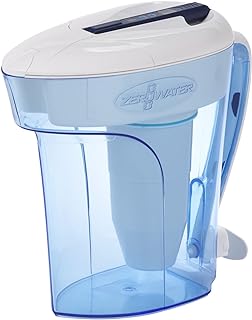
Quick Specs: Type: 5-stage ion-exchange deionizing pitcher | Capacity: 12 cups (~2.8 L / 96 fl oz) | Included Accessory: Digital handheld TDS meter | Role: Replaces store-bought distilled jugs prior to remineralizing | Price Tier: Under $100 tier
Hauling single-use plastic gallons of distilled water home from the grocery store every week adds clutter and recurring trips. The ZeroWater 12-Cup Water Filter Pitcher solves the supply side by running municipal tap water through five stages of activated carbon and mixed-bed ion-exchange resin until the included digital TDS meter reads 000 ppm. Critical Compatibility Condition (CR-WTR-ESP-02): Treat ZeroWater output identically to distilled water—never pour raw 0-TDS ZeroWater directly into a conductive-probe espresso boiler. Always dissolve your measured remineralization packet into the filtered ZeroWater pitcher or storage bottle first, then verify the meter climbs into your recipe’s target TDS window.
- Pros: Eliminates weekly plastic distilled-water jugs; bundled digital TDS meter lets you verify both 0-ppm base exhaustion and final remineralized TDS concentration; generous 12-cup pitcher volume refills full espresso tanks cleanly.
- Cons: Output sits near 0 TDS and must be remineralized before entering conductive-probe machines; cartridge lifespan drops rapidly in areas with very high tap TDS (>300 ppm), increasing replacement filter frequency (
CR-SYS-04).
How We Audited This Guide
- Home bar blueprints, upgrade roadmaps, water chemistry guides, and Amazon listing audits were verified against CR-SYS circuit, water-probe, and budget balance rules.
- Every espresso machine, burr grinder, accessory, and scale specification was cross-checked against official manufacturer 120V manuals, SCA water guidance, and verified Amazon US listings.
- Recommendations were evaluated against our weighted espresso-gear scoring rubrics and documented CR-* compatibility rules; we never invent heat-up seconds, PID variance, or micron claims.
Continue Your Audit
- Home Espresso Setup Guide 2026: Machine, Grinder and Tools
- Espresso Setup Under $700 2026: Entry Machine and Grinder Plan
- $1,000 Home Espresso Setup 2026: Balanced Machine and Grinder
Frequently Asked Questions About Distilled Water in Espresso Machines
What happens if I accidentally put pure distilled water in my espresso machine once?
One tank of distilled water will not instantly ruin a machine, though conductive-probe boilers may trigger a false “fill water” alert or erratic pump cycling. Drain or siphon the reservoir, refill with remineralized water or maker-approved filtered water, and purge a few ounces through the group and hot-water tap.
Can I mix half tap water and half distilled water for my espresso machine?
Blending tap and distilled water lowers total hardness proportionally—for instance, mixing equal parts 140 mg/L tap water and 0 mg/L distilled water yields ~70 mg/L (~4 gpg). However, tap chlorine and chloride remain present, so pass municipal tap water through an activated-carbon filter first and verify hardness with strips.
Is Reverse Osmosis (RO) water the same as distilled water for espresso?
Unremineralized RO water typically measures 5–25 mg/L TDS—very close to distilled water—and often lacks sufficient conductivity and alkalinity buffering for dual-boiler probes and balanced espresso extraction. Unless your RO system includes an active remineralization stage within maker limits, treat RO output as a base and remineralize it.
Can I use distilled water for descaling my espresso machine instead of tap water?
Always follow your machine manufacturer’s exact descaling instructions first (CR-WTR-ESP-06). Many manuals call for dissolving proprietary descaling powder or liquid in ordinary cold tap or filtered water and prohibit running unapproved cycles on dual-boiler machines; verify whether your manual specifies filtered tap water or demineralized water for mixing.
Does using remineralized distilled water mean I never need to descale?
Not necessarily. Potassium- and magnesium-based recipes without calcium carbonate dramatically reduce hard limescale formation, yet manufacturers still tie warranty compliance to documented maintenance routines (CR-WTR-ESP-03). Follow your manual’s cleaning schedule and check your boiler or group screen periodically rather than skipping maintenance indefinitely.


