
Disclosure: As an Amazon Associate, I earn from qualifying purchases. If you buy through links on this page, we may earn a small commission at no extra cost to you.
Quick Answer (12 oz vs 20 oz Milk Pitcher): Choose a 12 oz (350–360 ml) pitcher for single cortados, flat whites, and 6–8 oz lattes, especially on 120V thermoblock wands. Choose a 20 oz (600 ml) pitcher only when steaming 8–11 oz of milk at once for two drinks or pairing with higher-output single, heat-exchanger, or dual-boiler steam wands.
Deciding between a 12 oz vs 20 oz milk pitcher shapes your microfoam texture far more than latte-art wrist technique alone. When a steaming jug is too wide for a single-drink milk pour, the steam wand tip barely clears the bottom and blows coarse bubbles across a shallow puddle. When a jug is too narrow for back-to-back drinks, expanded foam crests the spout lip before dairy reaches its sweet spot between 55°C and 65°C (130°F to 150°F).
In this technical sizing guide—part of our broader best espresso accessories hub—we break down the volume math, steam-wand clearance boundaries, and heating-architecture constraints codified under compatibility rule CR-ESP-ACC-08. Whether you own a compact 120V thermoblock or a dedicated two-group home bar from our best espresso machines for lattes audit, matching pitcher capacity to steam power turns erratic froth into repeatable, glossy microfoam.
In This Guide
- Core Sizing Physics & Rule CR-ESP-ACC-08
- Beverage Volume Math: 12 oz vs. 15–17 oz vs. 20 oz
- Matching Pitcher Size to Espresso Machine Steam Power
- Milk Pitcher Sizing & Wand Compatibility Table
- Spout Geometry, 1.0 mm Steel & Handle Ergonomics
- Myth vs. Engineering Reality
- 5-Step Countertop Wand Clearance Checklist
- Verified Amazon US Milk Pitchers by Size Class
- Authoritative Manufacturer & Industry References
- Frequently Asked Questions
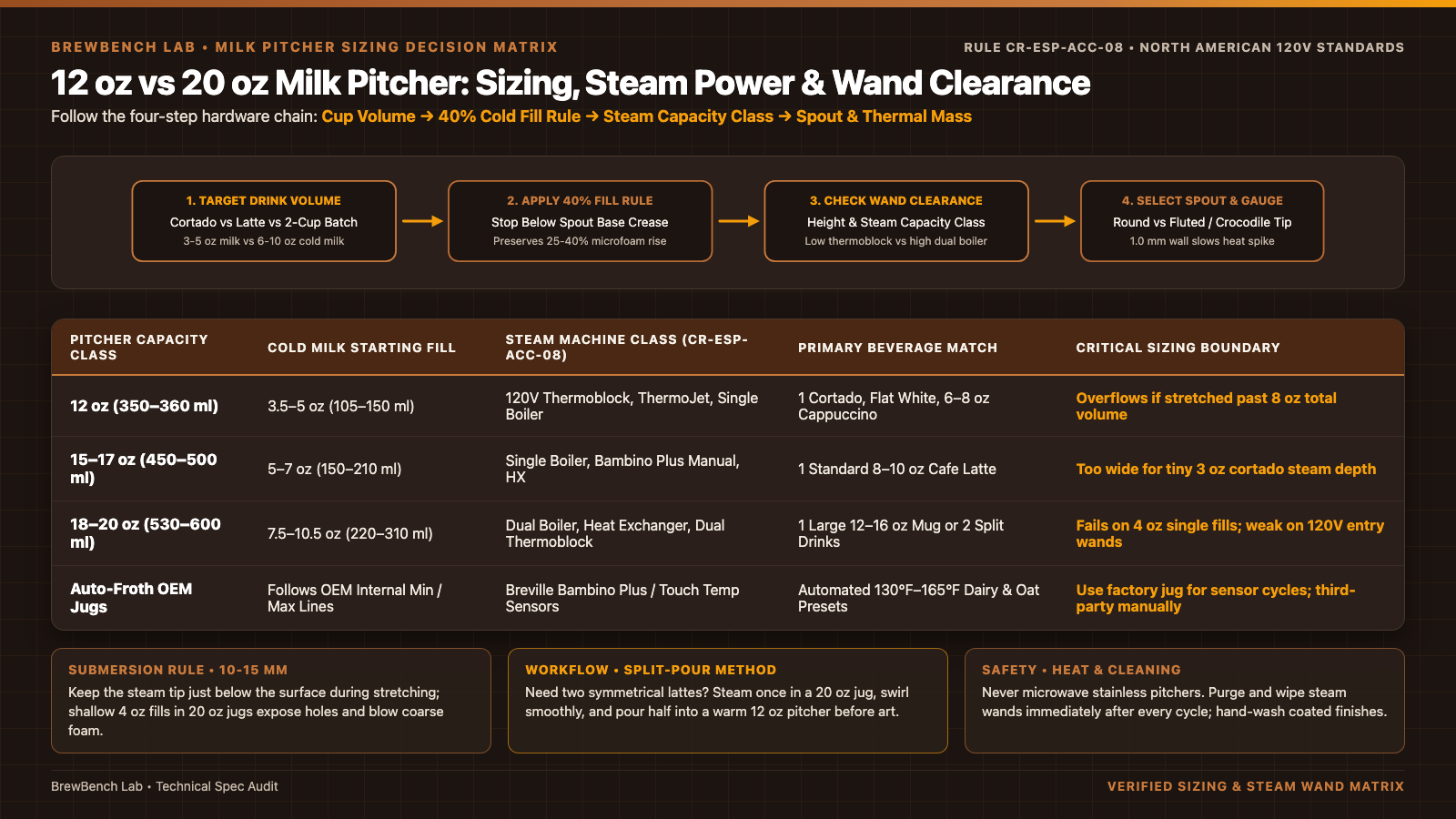
Core Sizing Physics & Compatibility Rule CR-ESP-ACC-08
Every steaming session obeys two physical constraints documented in BrewBench Lab compatibility rule CR-ESP-ACC-08: physical wand clearance and hydrodynamic steam capacity. Formally, a compatible pairing satisfies both conditions:
- Physical Clearance Check:
pitcher.height_mm <= esp.steam_wand_clearance_mm— the vertical rim of your pitcher must clear the articulated steam wand tip comfortably over the drip tray so you can insert and remove the jug without scraping the spout or bending the wand angle. - Steam Capacity Match:
pitcher.volume_ml within esp.steam_capacity_class— the barrel diameter and liquid mass must match what your heater can heat and spin before milk over-dilutes with condensed steam water or overheats unevenly.
Unlike measuring cups used strictly to hold finished liquid, a milk frothing pitcher must leave generous vertical headroom above the cold dairy surface. During the initial stretching (aeration) phase, you position the steam tip just below the milk meniscus to introduce micro-bubbles, increasing total liquid volume by roughly 25% to 40% depending on whether you are building silky flat-white texture or thicker cappuccino foam. Immediately afterward, during the texturing (whirlpool) phase, the steam jet must stay submerged roughly 10 mm to 15 mm (0.4 in to 0.6 in) beneath the surface to fold those bubbles into uniform microfoam.
That dual requirement locks in the universal 40% Cold Fill Baseline: your cold milk starting line should sit right below the bottom crease where the pouring spout begins, roughly one-third to one-half of the pitcher’s total rated capacity. Fill far below one-third and the steam tip lacks depth to submerge cleanly; fill much past halfway and the rising foam column crests the rim before the milk reaches 60°C (140°F).
Beverage Volume Math: 12 oz vs. 15–17 oz vs. 20 oz
Working backward from your espresso cup reveals immediately why a single 20 oz jug struggles on single-drink morning routines—and why a 12 oz jug runs out of headroom when guests visit. Taking a standard double espresso yield of roughly 1.25 oz to 1.5 oz (36 ml to 45 ml) as the base, here is how cold starting milk translates into finished drinks:
- Cortado / Gibraltar (4 oz to 4.5 oz / 120 ml to 135 ml cup): Requires only 2.5 oz to 3 oz (75 ml to 90 ml) of cold milk, expanding lightly (~20% stretch) to fill the glass. A 12 oz (350–360 ml) pitcher is the practical maximum; in a 20 oz pitcher, 80 ml of milk covers barely half an inch of the wide base, making tip submersion nearly impossible.
- Flat White or Traditional Cappuccino (5 oz to 6 oz / 150 ml to 180 ml cup): Needs 3.5 oz to 4.5 oz (105 ml to 135 ml) of cold milk. Inside a 12 oz (350 ml) pitcher, 4 oz sits right around the 35% to 40% sweet spot below the spout crease, giving you deep tip immersion and rapid vortex rotation.
- Standard Café Latte (8 oz to 10 oz / 240 ml to 300 ml cup): Demands 6 oz to 7.5 oz (180 ml to 220 ml) of cold milk before stretching. A 12 oz jug gets dangerously tight near 7 oz of starting dairy once foam expands, whereas a 15 oz to 18 oz (450 ml to 530 ml) pitcher handles a single large latte effortlessly with safe rim margin.
- Large Travel Mug or Two Split Cappuccinos (12 oz to 16 oz / 355 ml to 475 ml total): Requires 8.5 oz to 11 oz (250 ml to 325 ml) of cold starting milk. Here, a 20 oz (600 ml) jug hits its ideal 42% to 54% working fill zone, leaving ample wall height to roll dense foam without spilling.
What if you drink mostly single drinks on weekdays, yet routinely make two 6 oz cappuccinos on weekends? Rather than forcing a 20 oz pitcher to do single-cortado duty, experienced home baristas use the Two-Pitcher Split-Pour Technique: steam roughly 9 oz (265 ml) of cold milk in a 20 oz jug, swirl to homogenize the microfoam, and immediately transfer half into a pre-warmed 12 oz pouring pitcher. Both drinks receive uniform texture, and the smaller pouring spout sits much closer to the espresso crema for symmetric heart or tulip art.
Matching Pitcher Size to Espresso Machine Steam Power
Cup volume tells only half the story. Under rule CR-ESP-ACC-08, espresso machines divide into three qualitative steam-capacity classes based on their 120V North American heating architecture:
1. Low Steam-Capacity Class: 120V Thermoblocks, ThermoJets & Entry Thermocoils
Compact single-path machines such as the Breville Bambino, Breville Bambino Plus, Breville Barista Express, De’Longhi Dedica Arte, and De’Longhi Stilosa heat water on demand through an aluminum block or stainless coil rather than storing pressurized steam in a large vessel. Because steam flow rate and continuous pressure are modest—and because compact machines often have shorter steam wands sitting closer to the drip tray—pairing them with a 12 oz (350–360 ml) pitcher gives the steam jet a smaller thermal mass and tighter cylinder diameter to spin quickly.
Trying to steam 10 oz (300 ml) of cold dairy inside a 20 oz pitcher on an entry 120V thermoblock lengthens the steaming cycle, increases water dilution from wet steam condensation, and makes maintaining a vigorous whirlpool noticeably harder.
Auto-Froth Wand Exception (Bambino Plus & Barista Touch): Per manufacturer guidance from Breville US and rule CR-ESP-ACC-08, machines equipped with drip-tray temperature sensors and automatic microfoam wands are calibrated specifically around the OEM supplied stainless pitcher’s base diameter, internal fill markings, and thermal conductivity. Use your factory jug whenever running automated temperature presets; reserve aftermarket 12 oz, 16 oz, or 18 oz pitchers strictly for manual wand control.
2. Medium Steam-Capacity Class: Single-Boiler Espresso Machines
Traditional single-boiler machines like the Gaggia Classic Evo Pro and Rancilio Silvia switch one shared boiler from brew temperature up to steam temperature sequentially. Once heated to steam pressure, a single boiler delivers brisker dry steam bursts than an entry thermoblock—capable of spinning both 12 oz (350 ml) single-drink jugs and 15 oz to 18 oz (450–530 ml) latte pitchers with confidence. A 20 oz pitcher works for two cappuccinos if you purge wet condensation from the wand tip first, though smaller single boilers gradually lose steam pressure toward the end of large 10 oz dairy batches.
3. High Steam-Capacity Class: Heat Exchangers, Dual Boilers & Dual Thermoblocks
Prosumer machines with dedicated steam capacity—including the Breville Dual Boiler, Rancilio Silvia Pro X, Rocket Appartamento, and 120V dual-thermoblock platforms such as the Ascaso Steel Duo PID (note that 120V 20A models requiring a NEMA 5-20P plug must connect to a matching 5-20R receptacle on a 20A circuit installed by a licensed electrician, never via a plug adapter)—deliver vigorous, sustained dry steam velocity. On these high-output wands, tiny 3.5 oz milk fills inside a narrow 12 oz jug can spin uncontrollably and overheat in seconds unless you throttle the steam valve slightly open. Stepping up to a 15–18 oz pitcher for single lattes or a 20 oz (600 ml) pitcher for multi-drink entertaining restores calm, predictable vortex control.
Milk Pitcher Sizing & Wand Compatibility Decision Table
| Pitcher Size Class | Cold Milk Fill Range | Ideal Espresso Machine & Wand Class | Best Drink Scenarios | Critical Compatibility Caveat |
|---|---|---|---|---|
| 11.8–12 oz (350–360 ml) | 3.5–5 oz (105–150 ml) | 120V thermoblocks (Bambino, Dedica, Barista Express) & single boilers | 1 cortado, 1 flat white, or 1 traditional 6 oz cappuccino | Overflows past ~7 oz cold milk; feather steam valve on multi-hole dual-boiler tips. |
| 15–17 oz (450–500 ml) | 5–7.5 oz (150–220 ml) | Single boilers, Bambino Plus (manual mode), HX & dual boilers | 1 standard 8–10 oz café latte or iced latte topper | Less ideal for tiny 3 oz cortado portions; check vertical clearance under short wands. |
| 18–20 oz (530–600 ml) | 7.5–10.5 oz (220–310 ml) | Dual boilers, heat exchangers (HX), dual thermoblocks | 1 large 12–16 oz mug or 2 split 6–8 oz drinks | Fails on 4 oz single pours (tip too shallow); strains entry 120V thermoblocks. |
| 25.4 oz+ (750 ml+) | 11–14 oz (325–415 ml) | Commercial-style HX & dedicated dual-boiler steam wands | Batch steaming 3–4 drinks or pouring-transfer source | Exceeds drip-tray wand clearance on many compact home espresso machines. |
| OEM Auto-Froth Jug | Maker internal Min/Max marks | Breville Bambino Plus & Barista Touch automatic sensor trays | Hands-free automated temperature & foam presets | Sensor calibration depends on factory base diameter and wall gauge (CR-ESP-ACC-08). |
Spout Geometry, 1.0 mm Steel & Handle Ergonomics
Once capacity matches your wand and cup, three physical design details separate forgiving everyday jugs from specialized latte-art vessels—and you can explore nine full models side-by-side in our best milk frothing pitchers roundup:
- Round vs. Sharp / Fluted / Crocodile Spouts: Classic round spouts (found on Rhinowares Pro and traditional Motta Europa jugs) release a broader, cohesive flow stream that excels at foundational monks-head bases, high-contrast hearts, and stacked tulips. Sharp, fluted, or double-diversion crocodile spouts (like Fellow Eddy and MHW-3BOMBER) tighten and accelerate the thin foam ribbon, giving practiced hands crisp separation on multi-leaf rosettas and swans—though beginners sometimes find sharp tips twitchy when cutting through thick crema.
- Wall Gauge & Thermal Buffering: Food-grade 304 (18/8 or 18/10) stainless steel walls around 1.0 mm thick absorb heat steadily rather than spiking instantaneously. That extra thermal mass buys a beginner two or three critical extra seconds to incorporate microfoam smoothly before the milk approaches 65°C (149°F), whereas thin stamped foil pitchers overheat rapidly and warp easily if bumped.
- Handled vs. Handleless Silicone Sleeves & Internal Scales: Welded loop or open ribbon handles give solid wrist leverage on heavy 20 oz batches, while handleless jugs wrapped in silicone collars allow a close-to-spout pinch grip that exposes bare stainless steel near the bottom for tactile palm temperature sensing. Laser-etched or stamped internal oz/ml markings also eliminate cold-milk guesswork so you waste less dairy each morning.
Myth vs. Engineering Reality: 4 Milk Pitcher Myths Exposed
Myth #1: “Buying one 20 oz pitcher covers every drink from a 4 oz cortado to two lattes.”
Engineering Reality: Spreading 3.5 oz (105 ml) of milk across the wide base of a 20 oz (600 ml) vessel leaves the liquid too shallow to submerge a steam wand tip properly during rolling. Under rule CR-ESP-ACC-08, an oversized pitcher for single drinks forces awkward tilting, splashes coarse air pockets, and wastes dairy.
Myth #2: “Any 12 oz or 20 oz stainless pitcher works interchangeably with automatic temperature-sensing wands.”
Engineering Reality: Auto-froth systems like the Breville Bambino Plus and Barista Touch rely on a base contact thermistor calibrated to the thermal conductivity and diameter of the factory jug. Swapping in a thicker or handleless third-party pitcher during automatic cycles can skew shutoff accuracy; use aftermarket pitchers strictly in manual steaming mode.
Myth #3: “A 15-bar or 20-bar espresso pump rating delivers stronger steam for a 20 oz pitcher.”
Engineering Reality: Pump bar ratings printed on entry-machine boxes describe the maximum dead-head output of a vibratory water pump—completely distinct from the conventional ~9 bar espresso brewing target and unrelated to steam boiler pressure or thermoblock steam flow. Heating architecture (thermoblock vs. single boiler vs. dual boiler) dictates pitcher capacity, not pump bar labels.
Myth #4: “Stainless steel milk pitchers can be pre-warmed in a microwave or placed directly on any stove.”
Engineering Reality: Never place any stainless steel pitcher inside a microwave. For stovetop milk warming prior to handheld whisking, only handled stainless jugs rated by their maker for low gas or electric burners belong on a cooktop; standard 304 steel pitchers require an induction diffuser plate on induction ranges, and handleless silicone-sleeve jugs should never meet open flames.
5-Step Countertop Wand Clearance & Sizing Checklist
Because many espresso machine makers do not publish an exact vertical steam-wand clearance spec (where manufacturer clearance is unpublished, BrewBench Lab records no verified data available yet rather than guessing), run this quick 60-second physical check at your own espresso bar before ordering:
- Measure Your Wand-Tip Height: Swing your steam wand outward to its natural 45-degree steaming angle and measure from the drip tray surface (or countertop beside the machine if your wand pivots past the tray) up to the steam tip. Verify your chosen pitcher’s height (for instance, 114 mm / 4.5 in on an 18 oz Fellow Eddy) clears the wand tip comfortably when tilted slightly.
- Check Your Daily Cup Capacity: Fill your favorite morning mug with cold water, pour out roughly 1.5 oz (45 ml) for the double shot, and measure the remaining volume. Multiply by ~0.75 to account for 25–35% microfoam stretch—that gives your exact cold milk starting dose.
- Double-Check the 40% Fill Window: Confirm your cold milk starting dose sits between 35% and 50% of the pitcher’s total rated capacity (4–5 oz inside a 12 oz jug; 6–7.5 oz inside a 16–18 oz jug; 8–10.5 oz inside a 20 oz jug).
- Verify Your Heater’s Steam Class: Match 120V thermoblocks to 12 oz jugs for single drinks; reserve 18–20 oz jugs for single boilers, heat exchangers, dual boilers, or two-drink batches.
- Follow Manufacturer Steam & Hygiene Care: Always purge condensed water before steaming, keep hands clear of live steam jets and hot metal barrels, wipe the wand tip immediately with a dedicated damp cloth after shutting off the valve, and follow your machine manual’s descaling schedule to protect steam valves from mineral scale.
Verified Amazon US Milk Pitchers by Size Class (12 oz to 20 oz)
The four verified Amazon US stainless steel pitchers below represent distinct benchmark sizes across the 12 oz vs 20 oz milk pitcher spectrum, spanning the Under $30 and $30–$60 tiers (`TIER-ACC-BUDGET` and `TIER-ACC-PREMIUM` boundaries).
1. Rhinowares Professional Milk Pitcher 12 oz (RHMJ12OZ) — Best 12 oz Benchmark for 120V Thermoblocks

Verified Specs: 12 oz (360 ml) capacity | 1.0 mm thick food-grade stainless steel | Dual-sided etched internal oz and ml markings | Classic pro spout | Welded handle | Price Tier: Under $30 tier
According to Rhino Coffee Gear’s commercial pitcher specifications, the 12 oz Rhinowares Pro pairs thick 1.0 mm stainless walls with dual-sided etched measurement scales visible to both left- and right-handed baristas. That heavy wall gauge absorbs heat evenly on compact 120V thermoblocks like the Breville Bambino and De’Longhi Dedica, making single 4–5 oz cortado and flat-white pours consistent without scorching.
Pros
- 1.0 mm stainless walls provide forgiving thermal buffering
- Dual-sided etched internal scales cut cold-milk waste
- Compact 12 oz geometry engages low-output thermoblock wands cleanly
Cons
- Limited to single servings up to roughly 8 oz total drink volume
- Classic rounded spout favors hearts and tulips over razor-thin rosettas
2. Breville BES003XL Temp Control Milk Jug (16 oz / 480 ml) — Best Mid-Size Bridge with Temp Strip

Verified Specs: 16 fl oz (480 ml) capacity | Brushed stainless steel | Integrated color-changing temperature strip (130°F to 165°F+ / 55°C to 75°C) | Latte-art spout | Price Tier: Under $30 tier
Positioned squarely between 12 oz and 20 oz vessels, Breville’s BES003XL Temp Control Milk Jug gives manual-steaming learners an integrated temperature indicator strip spanning 130°F to 165°F+ (55°C to 75°C) right on the exterior wall. Its 16 oz (480 ml) barrel comfortably handles single 8–10 oz café lattes without forcing you into a bulky 20 oz jug—just remember to keep auto-froth Bambino Plus runs on the machine’s OEM sensor jug.
Pros
- Built-in 130°F–165°F+ indicator strip removes milk-temperature guesswork
- 16 oz middle size fits 8–10 oz single lattes without crowding
- Wide handle accommodates thumb-on-top or full-hand grips
Cons
- Hand-wash recommended to protect the laminated temperature indicator strip
- Manual steaming only; auto-froth wands still prefer the factory OEM jug
3. Fellow Eddy Milk Frothing Pitcher 18 oz (530 ml) — Best 18 oz Precision Spout for Boiler Wands

Verified Specs: 18 oz (530 ml) capacity | 304 18/8 stainless steel | Fluted spout with sharp front crease | Open-ended ribbon handle | Internal volume dots up to 12 oz | Dimensions: 4.5 in (114 mm) H × 3.5 in (89 mm) W | Price Tier: $30–$60 tier
According to Fellow’s official Eddy Steaming Pitcher specifications, the tapered body, sharp front crease, and fluted spout channel microfoam cleanly from first pour to crisp finish lines. At 18 oz (530 ml), it sits right below full 20 oz jugs—offering superior control for single 8–12 oz lattes on single-boiler and dual-boiler espresso machines without dragging down a smaller wand.
Pros
- Continuous front crease and fluted spout deliver balanced flow control
- Open ribbon handle supports pen, pinch, and classic pouring holds
- Internal measurement dots up to 12 oz aid repeatable portioning
Cons
- 18 oz barrel is oversized for tiny 3–4 oz cortado portions
- Priced in the $30–$60 tier above entry stamped stainless pitchers
4. MHW-3BOMBER 20 oz (600 ml) Crocodile Spout Pitcher — Best 20 oz Multi-Drink & Fine-Line Jug

Verified Specs: 20 oz (600 ml) capacity | Seamless SUS304 stainless steel | Double-diversion crocodile precision spout | Wide welded handle | Price Tier: $30–$60 tier
When your household pulls two cappuccinos back to back—or operates a high-velocity dual boiler or heat exchanger—MHW-3BOMBER’s 20 oz Crocodile Spout Pitcher combines 600 ml of batch capacity with a seamless SUS304 interior and double-curved diversion trench. That narrow trench keeps delicate rosetta lines centered even when pouring from a heavier two-drink volume.
Pros
- 600 ml barrel steams 8–10 oz of milk cleanly for two split drinks
- Crocodile spout diversion trench tightens fine-line latte art flow
- Seamless SUS304 interior prevents trapped milk residue at weld joints
Cons
- No internal oz/ml scale lines for quick beginner dosing
- Too wide and tall for 4 oz single-drink fills on 120V thermoblocks (CR-ESP-ACC-08)
Authoritative Manufacturer & Industry References
- Breville US — Official ThermoJet/thermocoil machine manuals, BES003XL Temp Control Milk Jug specs (16 oz, 130°F–165°F+ indicator strip), and OEM sensor-jug guidance for Auto MilQ wands.
- De’Longhi US — 120V Dedica and Stilosa thermoblock steam-wand clearance context and manual steaming care procedures.
- Fellow Products — Official Eddy 18 oz (530 ml) 304 18/8 stainless steel geometry, dimensions (4.5 in H × 3.5 in W), and fluted spout specs.
- Rhino Coffee Gear (Rhinowares) — 12 oz (360 ml) and 20 oz (600 ml) 1.0 mm heavy-gauge stainless steel metallurgy and dual-sided internal scale documentation.
- Specialty Coffee Association (SCA) — Beverage size standards and espresso-milk proportion context (no caffeine or health claims).
How We Audited This Guide
- Portafilters, precision baskets, tampers, coffee scales, and water filters were audited for basket inner-diameter matching, drip-tray cup clearance, OEM cartridge locks, and 0.1g accuracy.
- Every espresso machine, burr grinder, accessory, and scale specification was cross-checked against official manufacturer 120V manuals, SCA water guidance, and verified Amazon US listings.
- Recommendations were evaluated against our weighted espresso-gear scoring rubrics and documented CR-* compatibility rules; we never invent heat-up seconds, PID variance, or micron claims.
Continue Your Audit
- Best Bottomless Portafilters for Breville 54 mm 2026: Fit Audited
- Best Espresso Tampers 2026: Sized to Your Basket, Compared
Frequently Asked Questions
1. Should I buy a 12 oz or 20 oz milk pitcher first?
Start with a 12 oz (350–360 ml) pitcher if you mostly make one cortado, flat white, or 6–8 oz cappuccino at a time—especially on a 120V thermoblock machine. Choose a 20 oz (600 ml) pitcher only if you routinely steam two milk drinks together or run a higher-output boiler wand.
2. Can I steam a single 4 oz cortado in a 20 oz milk pitcher?
Steaming 3 to 4 oz (90 to 120 ml) of cold milk in a 20 oz pitcher produces poor results because the milk spreads too thinly across the wider base. Without enough depth to submerge the steam tip 10 to 15 mm (0.4 to 0.6 in), the wand injects coarse bubbles instead of rolling glossy microfoam.
3. Is a 15 oz, 16 oz, or 18 oz pitcher better than owning both 12 oz and 20 oz?
If your daily drink is a single 8 to 10 oz café latte using 6 oz (180 ml) of cold milk, a mid-sized 15 oz to 18 oz (450–530 ml) jug hits the 40% fill sweet spot without overflowing a 12 oz cup or feeling cavernous like a 20 oz barrel.
4. Why do dual-boiler espresso machines prefer 18 oz or 20 oz pitchers?
Dedicated steam boilers and heat exchangers push high-velocity dry steam that spins small 4 oz volumes inside a 12 oz pitcher too rapidly, leaving little time to stretch before milk hits 65°C (149°F). A wider 18 oz or 20 oz pitcher accommodates that steam power smoothly.
5. Will an aftermarket 12 oz or 20 oz pitcher work on Breville auto-froth wands?
No—for automatic temperature-sensing cycles on machines like the Breville Bambino Plus or Barista Touch, stick with the OEM supplied jug calibrated to the tray thermistor. You can still use any aftermarket 12 oz, 16 oz, or 20 oz pitcher whenever steaming in manual wand mode.


