
Disclosure: As an Amazon Associate, I earn from qualifying purchases. If you buy through links on this page, we may earn a small commission at no extra cost to you.
Searching for cheap espresso machines on amazon drops shoppers straight into the loudest corner of the North American coffee market. Across Amazon US Best Sellers, more than half of the machines priced under $200 come from Amazon-native brands—including CASABREWS, AMZCHEF, COWSAR, Neretva, AAOBOSI, Mecity, Gevi, and CHULUX—positioned directly beside entry De’Longhi thermoblock units. This marketplace audit separates legitimate 120V/60Hz budget machines from white-label clones, pooled variant traps, and misleading basket claims before you buy.
Within our buying espresso gear on Amazon pillar hub, sub-$200 machines are evaluated differently than prosumer boilers. Instead of expecting café-grade temperature profiling from a budget thermoblock, we verify electrical compliance (CR-ESP-SYS-01), pressurized versus single-wall basket inclusions (CR-ESP-ACC-13), and espresso grinder compatibility (CR-GRD-ESP-01) so your first setup works cleanly on a real US countertop.
Urgent Amazon Budget Espresso Alert — Verify These 4 Signals Before Checkout:
- 120V/60Hz North American Power (
CR-ESP-SYS-01): Confirm explicit 120V / 60Hz specs and a NEMA 5-15P plug. Reject 220V–240V/50Hz grey-market imports—never use plug adapters or voltage converters. - Pressurized Basket Lock-In (
CR-ESP-ACC-13&CR-GRD-ESP-01): Most sub-$200 machines ship with dual-wall pressurized baskets. Switching to a single-wall basket fails unless paired with an espresso-capable burr grinder. - Brand Identity vs. Shared OEM Clones: Dozens of sub-$150 stainless listings share near-identical chassis designs under different brand names while omitting replacement gaskets, lug specs, and US support channels.
- Pooled Variants & Seller Fulfillment: Color and style swatches often combine older revisions, touchscreen versions, and carafe bundles under one star rating. Check Visit the Brand Store and Ships from / Sold by before ordering.
In This Marketplace Audit
- Amazon Budget Espresso Listing Inspection Matrix
- Axes 1, 7 & 9: Budget Brand Tiers, OEM Clones & Pooled Variant Reviews
- Axes 4 & 6: 20-Bar Marketing vs. ~9 Bar Extraction & Pressurized Baskets
- Axis 5 & Grinder Pairing: CR-GRD-ESP-01, Budget Splits & 51 mm Lug Claims
- Axes 2, 3, 8 & 10: 120V/60Hz Circuits, Sellers, Safety Marks & Water Care
- Listings to Skip: 4 Audited Budget Red-Flag Profiles
- 60-Second Pre-Checkout Amazon Verification Checklist
- Verified 120V Cheap Espresso Machines on Amazon & Step-Up Benchmark
- Authoritative Manufacturer & Standards Citations
- Frequently Asked Questions
Amazon Budget Espresso Listing Inspection Matrix
Before comparing individual brand pages, review how the most common red flags on sub-$200 Amazon listings translate into real extraction, compatibility, and safety outcomes on your kitchen counter.
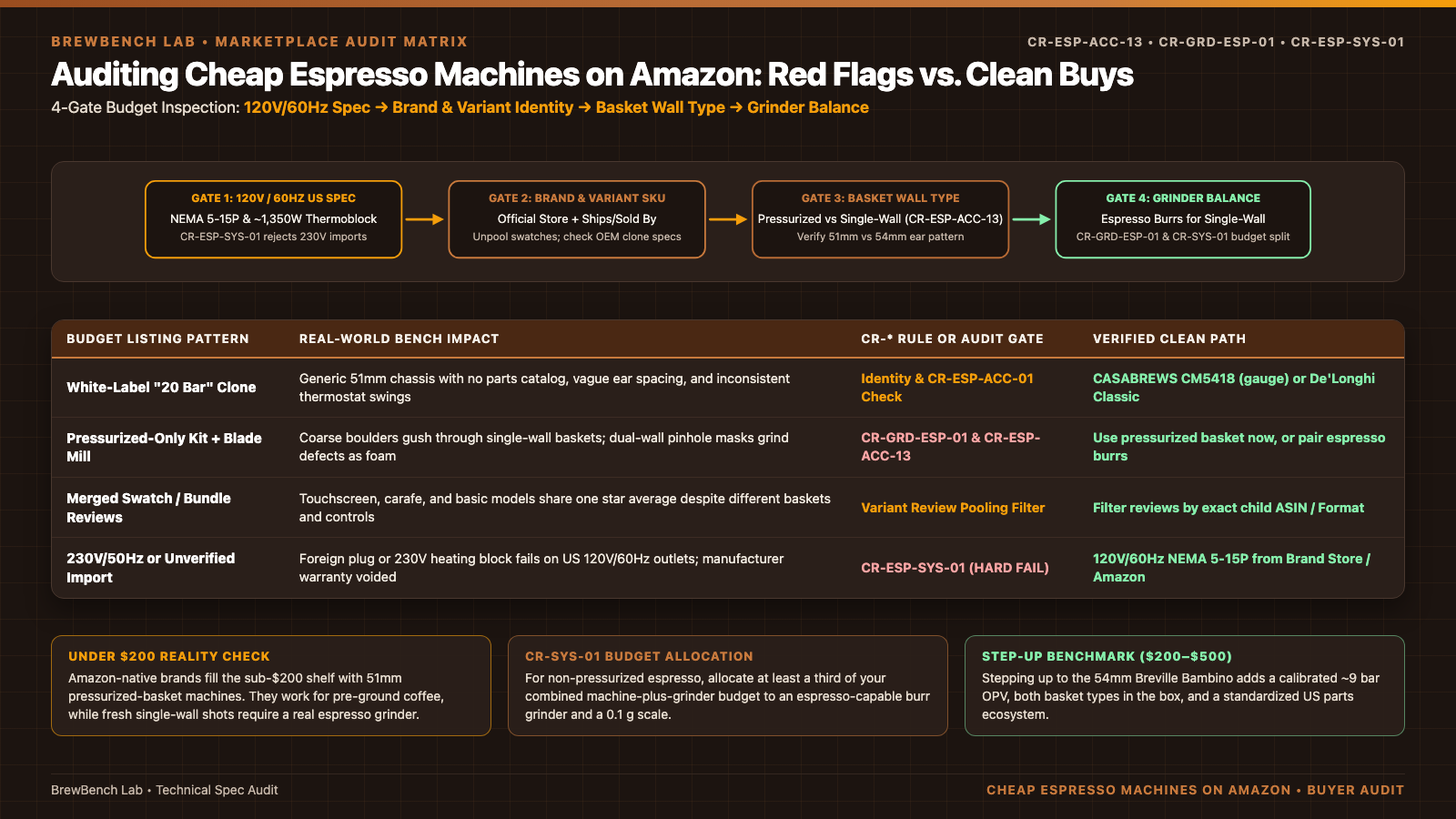
| Listing Red Flag | What Happens on Your Bench | CR-* Rule or Audit Check | Verified Clean Alternative |
|---|---|---|---|
| White-Label Sub-$100 Clone | No model SKU, missing spare group gaskets, and unverified 51 mm portafilter lug spacing stall upgrades | Brand Identity & CR-ESP-ACC-01 Check | CASABREWS CM5418 (gauge) or De’Longhi Classic (US support) |
| “20 Bar = Cafe Crema” Claim | Dead-head pump limit (~290.1 psi) is mistaken for ~9 bar (~130.5 psi) brew pressure; fine pucks choke or channel | Pump Rating Separation & Gauge Check | Gauge-equipped 20-bar unit or 9-bar OPV Breville Bambino |
| Pressurized-Only + Blade Mill | Dual-wall pinhole whips coarse coffee into airy foam, while single-wall baskets gush thin, sour shots | CR-ESP-ACC-13 & CR-GRD-ESP-01 | Run pressurized baskets with pre-ground, or add espresso burrs |
| Merged Color / Bundle Swatches | Touchscreen, manual-dial, and auto-carafe models share one review score despite different internals | Variant Pooling & Child ASIN Filter | Filter reviews by exact Format/Color and check spec table |
| Missing 120V/60Hz or 230V Import | Wrong plug (Type F/G) or 230V/50Hz element fails on US receptacles; voided North American warranty | CR-ESP-SYS-01 (HARD FAIL) | Explicit 120V/60Hz NEMA 5-15P sold via Brand Store / Amazon |
| Overpriced Grinder Mismatch | Pairing a $500+ prosumer flat-burr grinder with a pressurized-only 51 mm machine wastes burr precision | CR-GRD-ESP-02 & CR-SYS-01 | Reserve ~1/3+ setup budget for an entry espresso burr grinder |
Axes 1, 7 & 9: Budget Brand Tiers, OEM Clones & Pooled Variant Reviews
Understanding who actually builds and supports the hardware behind an Amazon storefront is the fastest way to audit budget listings. In the North American under-$200 tier (TIER-ESP-BUDGET), shoppers encounter three distinct brand categories rather than one uniform “cheap espresso” shelf.
1. Established Appliance Brands vs. Amazon-Native Labels vs. Anonymous Clones
At the top of the budget trust ladder sit legacy appliance manufacturers such as De’Longhi (Classic Matte Black, Stilosa) and, one tier higher in the $200–$500 bracket, Breville (Bambino BES450BSS). These brands publish downloadable US owner manuals, list specific North American replacement water filters and gaskets, and maintain dedicated US customer support desks.
The second group consists of high-volume Amazon-native brands such as CASABREWS, AMZCHEF, Gevi, and CHULUX. While these brands manufacture compact 1,350W thermoblock machines in high-output OEM factories, they maintain official Amazon Brand Stores, publish clear model numbers (such as CM5418), respond to warranty claims within US return windows, and ship standardized 120V/60Hz retail cartons. For a wider look at how these budget contenders stack up side by side, check our best espresso machines under $200 roundup.
The third group—anonymous white-label clones under rotating storefront names—creates the majority of marketplace friction. Multiple sub-$100 listings (including unverified generic variations alongside low-cost AAOBOSI, COWSAR, Neretva, and Mecity-style housings) share near-identical stainless wrappers, pump layouts, and 51 mm plastic-lined portafilters. When a silicone group gasket hardens after a year, white-label listings rarely offer an exact replacement part number.
2. How Pooled Parent ASINs Distort Star Ratings (Axis 7 & 9)
Amazon allows sellers to attach multiple child ASINs under a single parent product page using Color, Size, or Style swatches. On budget espresso pages, that feature routinely combines completely different machines under one shared review badge:
- Different Control Hardware: One swatch may feature a mechanical dial and front analog pressure gauge (such as CASABREWS CM5418), while a sibling swatch on the same page drops the gauge or swaps in a capacitive touchscreen (like Mecity-style touch tops) with preset drink timers.
- Different Milk Systems: A manual steam wand variant and an automatic detachable milk-carafe variant (such as 3700 Essential vs. 3700MAX configurations) often share a combined review pool, even though automatic milk carafes require stricter daily milk-tube flushing.
- Bundled Grinder Editions: Some parent pages mix standalone sub-$200 machines with $200–$500 built-in-grinder configurations, making older five-star reviews appear to endorse a newly launched budget SKU.
Always click your exact colorway or style swatch first, scroll down to Customer Reviews, and select Filter by: Format/Color so you only read feedback belonging to that specific child ASIN.
Axes 4 & 6: 20-Bar Marketing vs. ~9 Bar Extraction & Pressurized Baskets
Nearly every sub-$200 listing on Amazon leads with “20 Bar” or “15 Bar” in bold title copy. Before letting that spec dictate your shortlist, separate pump marketing from real espresso hydraulics and basket physics.
1. Dead-Head Pump Rating vs. ~9 Bar Puck Pressure (Axis 6)
Entry-level home machines use compact electromagnetic vibratory pumps. A 20-bar (~290.1 psi) or 15-bar (~217.6 psi) label states the pump’s maximum dead-head ceiling when pushing against a completely sealed blockage—not the pressure applied across coffee grounds during a shot. As we detail in our 20 bar espresso machines on Amazon audit, conventional espresso extracts around ~9 bar (~130.5 psi) at the coffee puck.
Mid-tier machines like the Breville Bambino regulate line pressure internally using a calibrated Over-Pressure Valve (OPV) tuned near ~9 bar, bleeding excess flow before it compacts the coffee bed. Most sub-$200 Amazon brands skip a calibrated 9-bar brew OPV altogether. If you choose a sub-$200 machine, prioritize models with a front analog pressure gauge (such as the CASABREWS CM5418) so you can observe when a shot lands cleanly in the central espresso band versus spiking into over-pressurized channeling.
2. Pressurized (Dual-Wall) Baskets and Box Contents (Axis 4, CR-ESP-ACC-13)
Almost every cheap espresso machine under $200 ships with pressurized (dual-wall) 51 mm baskets. Flip the basket upside down and you will see a solid outer plate with a single tiny exit pinhole instead of hundreds of open perforations. That pinhole creates artificial backpressure, allowing coarse, pre-ground supermarket coffee to emerge with bubbly golden foam on top.
Under BrewBench Lab rule CR-ESP-ACC-13, pressurized baskets are not a flaw for true beginners who buy pre-ground espresso tins and want simple weekday milk drinks (CR-SYS-02 conditional path). The hidden trap appears when listings fail to state clearly whether a non-pressurized single-wall basket is included in the box. If a sub-$200 kit ships only pressurized baskets—plus a lightweight plastic scoop-tamper—moving up to freshly ground coffee requires budgeting separately for a metal tamper matched to the basket’s inner diameter (CR-ESP-ACC-03) and a compatible 51 mm single-wall basket.
Axis 5 & Grinder Pairing: CR-GRD-ESP-01, Budget Splits & 51 mm Lug Claims
Budget buyers often assume a new espresso machine is the only hardware required to pull rich shots at home. On Amazon, two compatibility rules—CR-GRD-ESP-01 and CR-ESP-ACC-01—expose why cheap machines generate so many frustrated one-star returns.
1. Why Grinder Capability Decides Single-Wall Success (CR-GRD-ESP-01 & CR-SYS-01)
Under CR-GRD-ESP-01, using a single-wall (non-pressurized) basket triggers a hard compatibility fail unless your grinder is explicitly rated for espresso by its manufacturer. Whirling blade mills and filter-only burr grinders (such as the standard Baratza Encore non-ESP or stock Fellow Ode Gen 2) cannot grind fine or consistently enough to create natural puck resistance. Water blasts through coarse grounds in a few seconds, yielding sour, watery shots.
Equally important is avoiding the opposite mistake flagged by CR-GRD-ESP-02: pairing a pressurized-basket-only machine with a $500+ prosumer flat-burr grinder. Because the pressurized pinhole dominates flow resistance, it masks the particle uniformity of expensive burrs. Under our whole-setup budget balance guideline (CR-SYS-01), anyone planning to pull single-wall shots should reserve at least one-third of their combined machine-plus-grinder budget for an entry espresso-rated conical burr grinder (such as the Baratza Encore ESP or an espresso-focused hand grinder) and a compact 0.1 g coffee scale.
2. “Fits All 51 mm Machines” Accessory Claims (Axis 5, CR-ESP-ACC-01)
Once buyers own a sub-$200 51 mm (2.01 in) machine, Amazon search feeds them aftermarket bottomless portafilters claiming universal fit across “De’Longhi, CASABREWS, Gevi, AAOBOSI, COWSAR, and Neretva.” Under CR-ESP-ACC-01, treat third-party compatibility lists as unverified retailer claims (Confidence C) until you inspect your OEM portafilter physically. Some 51 mm groups use two opposing locking ears, others use three ears spaced at specific angles, and ear thickness varies by machine generation. Buying an unverified 51 mm portafilter risks leaking around the group gasket—or failing to lock in altogether.
Also keep drip-tray scale fitment in mind (CR-SCALE-ESP-01 and CR-SCALE-ESP-02). Compact sub-$200 stainless machines typically have narrow drip trays and limited spout-to-tray clearance, meaning tall travel mugs combined with a standard 15–20 mm (0.6–0.8 in) coffee scale often require switching to a low-profile mini espresso scale or a shorter espresso cup.
Axes 2, 3, 8 & 10: 120V/60Hz Circuits, Sellers, Safety Marks & Water Care
Before clicking Buy Now on any budget espresso listing, run four practical North American ownership checks covering electrical safety, seller accountability, return windows, and mineral maintenance.
1. 120V/60Hz NEMA 5-15P Compliance & Branch-Circuit Limits (Axis 2, CR-ESP-SYS-01 & 02)
Every machine operated in a standard US kitchen must state 120V / 60Hz and ship with a North American NEMA 5-15P plug (CR-ESP-SYS-01). International 220V–240V / 50Hz listings occasionally slip into third-party Amazon marketplace offers; never attempt to run a 230V import using plug adapters or step-up voltage converters. Most verified 120V budget thermoblocks are rated between 1,100W and 1,350W (~9.2A to 11.25A), staying safely below the 1,440W continuous threshold (80% of 1,800W) on a standard 15A receptacle. However, under CR-ESP-SYS-02, do not run an electric kettle, air fryer, or toaster simultaneously on the same 15A branch circuit, or the breaker may trip.
2. Seller Fulfillment, Return Windows & Safety Certifications (Axes 3, 8 & 10)
Inspect the Visit the [Brand] Store link and the Ships from / Sold by lines directly under the price box. For budget Amazon-native brands, Amazon-fulfilled orders provide an easier 30-day return path if a pump arrives dead-on-arrival or leaks from the steam valve. For legacy brands like De’Longhi and Breville, buying from Amazon.com or an authorized storefront protects your North American manufacturer warranty—whereas unverified third-party liquidators often void OEM warranty coverage.
On electrical certification marks (Axis 10), rely solely on what the manufacturer explicitly documents (such as UL or ETL listing on the spec sheet or rating plate) rather than assuming every sub-$80 bargain model holds identical third-party safety certification. Note also that single-thermoblock budget machines operate sequentially (CR-DRINK-ESP-03): you pull your shot first, switch to steam mode, purge condensation, texture milk for one or two drinks, and vent or cool down before pulling another espresso.
3. Water Hardness & Descaling Rules (CR-WTR-ESP-01, CR-WTR-ESP-02 & CR-WTR-ESP-06)
Hard tap water quickly clogs narrow thermoblock passages and three-way valves, while overly soft or pure un-remineralized distilled water can cause inaccurate level sensing in machines equipped with conductive water probes (CR-WTR-ESP-02) and fails to balance coffee extraction. Target moderate water hardness near SCA guidelines (~68 mg/L CaCO3, or ~4 gpg) using filtered or remineralized water. When descaling (CR-WTR-ESP-06), follow the machine manual exclusively—never improvise household vinegar ratios or unmeasured citric acid strengths, especially in aluminum-lined heating blocks or boilers where aggressive acids can pit internal surfaces.
Listings to Skip: 4 Audited Budget Red-Flag Profiles
During our Amazon US catalog audit, four recurring budget listing profiles failed technical or marketplace safeguards and should be skipped in favor of transparent 120V models:
- Unverified 220V–240V / 50Hz Marketplace Imports: Any listing missing explicit 120V/60Hz North American specs or showing Type F/G plugs fails
CR-ESP-SYS-01immediately. - Sub-$80 White-Label Clones Without Model Codes or Spare Parts: Listings that hide the actual model identifier, omit single-wall basket specs (
CR-ESP-ACC-13), and provide no replacement gasket or Brand Store contact path leave buyers stranded on the first repair. - “Espresso Machine + Blade Mill” Starter Bundles: Combo cartons pairing a 51 mm machine with a spinning-blade chopper fail
CR-GRD-ESP-01for single-wall espresso and waste money better spent on an entry conical burr grinder. - Suspicious Third-Party Offers for Dealer-Only Specialty Brands: Prosumer espresso brands such as Lelit, Profitec, ECM, and La Marzocco do not operate official Amazon US machine storefronts—skip unavailable or oddly priced third-party placeholder listings.
60-Second Pre-Checkout Amazon Verification Checklist
Run these six quick checks on any budget espresso product page before clicking Add to Cart:
- Verify 120V / 60Hz US Specs: Confirm 120V / 60Hz power, wattage (typically 1,100W–1,560W), and a US NEMA 5-15P plug in the product details table.
- Audit the Brand Store & Seller: Click Visit the [Brand] Store and check Ships from / Sold by to verify Amazon fulfillment or an authorized brand storefront.
- Unpool Child Variant Reviews: Select your exact finish/model swatch, open Reviews, and filter by Format/Color so older revisions do not skew ratings.
- Inspect Basket Wall Types (
CR-ESP-ACC-13): Check the “What’s in the Box” bullet for dual-wall pressurized vs. single-wall baskets and whether a real metal tamper is included. - Check Gauge & Thermal Controls: Favor models offering a front pressure gauge or PID/NTC temperature control over unverified “20 Bar” headline claims.
- Reserve Grinder & Scale Budget (
CR-SYS-01): If you plan to brew fresh beans in a single-wall basket, budget for an espresso-rated burr grinder and a 0.1 g scale alongside the machine.
Verified 120V Cheap Espresso Machines on Amazon & Step-Up Benchmark
Below are four verified 120V/60Hz Amazon US listings that clear our marketplace safeguards—three transparent sub-$200 options representing distinct budget brand tiers, plus one calibrated ~9 bar step-up benchmark in the $200–$500 bracket.
1. CASABREWS CM5418 Compact Espresso Machine — Best Gauge-Equipped Budget Brand Pick

Verified Specs: 120V / 60Hz US model | 1,350W Thermoblock | 20-bar (~290.1 psi max) vibratory pump | Front analog pressure gauge | 51 mm (2.01 in) portafilter + manual steam wand | Price Tier: Budget (Under $200 tier)
Among Amazon-native budget brands, the CASABREWS CM5418 stands out for pairing a transparent 120V/60Hz specification with a built-in front pressure gauge. While its 20-bar pump rating reflects dead-head capacity rather than a calibrated ~9 bar OPV, the dial lets you monitor puck resistance directly on your counter—spotting overly coarse gushes or choked shots immediately. Its 1,350W draw stays safely below the 1,440W continuous threshold on a solo 15A circuit (CR-ESP-SYS-02).
Listing Audit Note (CR-ESP-ACC-01 & CR-ESP-ACC-13): Confirm you select the CM5418 variant rather than sibling swatches without a pressure gauge, and inspect your OEM 51 mm lug ear count before ordering any aftermarket bottomless portafilter or single-wall basket.
Pros
- Front analog pressure gauge makes over-pressure spikes and fast-gushing pucks visible during extraction
- Verified 120V/60Hz 1,350W thermoblock sits safely below the 1,440W continuous threshold on a solo 15A circuit
- Compact stainless footprint clears standard 18-inch US upper kitchen cabinets with easy front dial access
Cons
- 20-bar pump rating denotes dead-head pump ceiling rather than a calibrated ~9 bar brew OPV
- Aftermarket 51 mm bottomless portafilters and single-wall baskets must match the exact lug ear pattern (
CR-ESP-ACC-01)
2. De’Longhi Classic Matte Black Espresso Machine — Best Established-Brand Sub-$200 Pick

Verified Specs: 120V / 60Hz US model | Rapid Heat-Up Thermoblock | 51 mm (2.01 in) portafilter | Manual milk frother | Price Tier: Budget (Under $200 tier)
If you want the predictability of a legacy espresso manufacturer inside the sub-$200 tier, the De’Longhi Classic Matte Black avoids the parts-and-support uncertainty of rotating Amazon-only labels. De’Longhi publishes clear 120V/60Hz North American documentation, specifies compatible descaling procedures, and supports a well-mapped 51 mm accessory ecosystem where third-party sellers explicitly list De’Longhi ear patterns.
Listing Audit Note (CR-DRINK-ESP-03 & CR-ESP-ACC-13): Verify Ships from / Sold by Amazon.com or an authorized retailer to protect De’Longhi’s US warranty. Sequential thermoblock heating suits one or two milk drinks per session rather than back-to-back entertaining.
Pros
- Backed by De’Longhi US documentation, replacement parts availability, and brand-specific descaling guidance
- Rapid heat-up 120V/60Hz thermoblock avoids long boiler wait times on busy weekday mornings
- 51 mm pressurized portafilter ecosystem has clearer model-specific aftermarket documentation than anonymous clones
Cons
- Sequential thermoblock heating requires waiting between pulling espresso and steaming milk (
CR-DRINK-ESP-03) - Upgrading to non-pressurized single-wall extraction requires an espresso-capable burr grinder and matching 51 mm basket (
CR-ESP-ACC-13)
3. AMZCHEF Compact 20 Bar Espresso Machine — Compact Amazon-Native Budget Contender

Verified Specs: 120V US model | Quick-heat thermoblock | 20-bar (~290.1 psi max) pump rating | Espresso, Americano, Latte & Cappuccino modes | Manual steam wand | Price Tier: Budget (Under $200 tier)
AMZCHEF’s compact 120V unit represents the streamlined, small-kitchen branch of Amazon-native espresso makers. Built around a narrow countertop footprint with quick-heat thermoblock operation and straightforward drink presets, it targets apartment kitchens where counter depth is tight (CR-ESP-SYS-04) while leaving room in a starter budget for a 0.1 g scale and entry conical burr grinder.
Listing Audit Note (CR-ESP-ACC-13 & CR-SCALE-ESP-02): Treat this listing as a pressurized-basket starter kit out of the box, and check drip-tray depth before placing wide pour-over scales under the spouts.
Pros
- Verified 120V North American specification in a narrow countertop chassis suited for small apartments
- Quick-heat thermoblock and intuitive drink preset layout lower the learning curve for first-time buyers
- Low sub-$200 entry tier preserves budget for a 0.1 g scale and entry conical burr grinder (
CR-SYS-01)
Cons
- Relies on 20-bar marketing and pressurized baskets that mask grind consistency until upgraded
- Third-party portafilter lug geometry and long-term gasket sourcing are less standardized than De’Longhi or Breville
4. Breville Bambino BES450BSS — Best Calibrated 9-Bar Step-Up Benchmark

Verified Specs: 120V / 60Hz US BES450BSS | ThermoJet heating system | Calibrated ~9 bar OPV + low-pressure pre-infusion | 54 mm (2.13 in) Breville group (STD-GROUP-BREVILLE-54) | Single-wall + dual-wall baskets included | Price Tier: Entry ($200–$500 tier)
When your budget stretches slightly past the under-$200 shelf, the Breville Bambino BES450BSS illustrates exactly what stepping up buys you: calibrated ~9 bar extraction pressure, low-pressure pre-infusion, rapid ThermoJet heating, and both 54 mm single-wall and dual-wall baskets included inside the carton (CR-ESP-ACC-13 pass). Combined with Breville’s standardized 54 mm accessory ecosystem and US service backing, it eliminates the guesswork of budget 51 mm lug matching.
Listing Audit Note (STD-GROUP-BREVILLE-54 & CR-GRD-ESP-01): Confirm the US BES450BSS SKU sold via the Breville Store or an authorized seller. To unlock the included 54 mm single-wall baskets, pair the Bambino with an espresso-capable burr grinder.
Pros
- Calibrated ~9 bar OPV with low-pressure pre-infusion avoids the pressure spikes of unregulated sub-$200 pumps
- Ships with both 54 mm single-wall and dual-wall baskets in the box (
CR-ESP-ACC-13pass) - Standardized Breville 54 mm accessory ecosystem (
STD-GROUP-BREVILLE-54) and established US warranty support
Cons
- Sits in the $200–$500 tier rather than the sub-$200 impulse-buy shelf
- Compact chassis and sequential ThermoJet heating still alternate between brewing and manual steaming
Authoritative Manufacturer & Standards Citations
Every electrical safety boundary, hydraulic distinction, basket rule, and water-care guideline in this marketplace audit traces directly to official manufacturer documentation and standards bodies:
- De’Longhi US Official Support & Espresso Manuals — 120V/60Hz North American entry thermoblock specs, 51 mm pressurized basket design, and manufacturer-specified descaling rules.
- Breville US Official Espresso Machine Specifications — Calibrated ~9 bar OPV extraction, 54 mm single-wall and dual-wall basket inclusion, and 120V US ThermoJet documentation.
- Baratza Official Grinder Documentation — Why espresso-rated burr step resolution is required when upgrading from pressurized dual-wall baskets to single-wall extraction.
- Specialty Coffee Association (SCA) Water & Extraction Standards — Conventional ~9 bar espresso extraction target and ~68 mg/L CaCO3 (~4 gpg) water hardness guidance.
- National Fire Protection Association (NFPA / NEC) — North American 120V/60Hz 15A (1,800W max / 1,440W continuous) and 20A kitchen small-appliance branch-circuit load limits.
How We Audited This Guide
- Home bar blueprints, upgrade roadmaps, water chemistry guides, and Amazon listing audits were verified against CR-SYS circuit, water-probe, and budget balance rules.
- Every espresso machine, burr grinder, accessory, and scale specification was cross-checked against official manufacturer 120V manuals, SCA water guidance, and verified Amazon US listings.
- Recommendations were evaluated against our weighted espresso-gear scoring rubrics and documented CR-* compatibility rules; we never invent heat-up seconds, PID variance, or micron claims.
Continue Your Audit
- Home Espresso Setup Guide 2026: Machine, Grinder and Tools
- Espresso Setup Under $700 2026: Entry Machine and Grinder Plan
Frequently Asked Questions: Cheap Espresso Machines on Amazon
Are cheap espresso machines on Amazon safe to plug into US kitchen outlets?
Verified 120V/60Hz models with a NEMA 5-15P plug and published UL or ETL certification run safely alone on a 15A kitchen circuit under 1,440W. Avoid unverified 220V–240V/50Hz grey-market imports and never use plug adapters or run a kettle on the same breaker.
Why do so many sub-$200 Amazon brands look identical under different names?
Many Amazon-native brands source shared 51 mm thermoblock platforms from high-volume OEM factories and customize exterior bezels, buttons, or gauges. Favor established names like De’Longhi or transparent Amazon-native stores like CASABREWS over anonymous clones lacking spare gaskets or model codes.
Can I use pre-ground coffee in a budget Amazon espresso machine?
Yes, provided you use the supplied dual-wall pressurized basket. Under CR-ESP-ACC-13, pressurized baskets use a single exit pinhole to build backpressure with coarse pre-ground coffee. Switching to a single-wall basket fails unless paired with an espresso-capable burr grinder (CR-GRD-ESP-01).
Is a 20-bar budget machine better than a 9-bar Breville Bambino?
No. A 20-bar (~290.1 psi) rating measures maximum dead-head pump capability, not brew pressure. Real espresso extracts around ~9 bar (~130.5 psi), which the Breville Bambino regulates with an internal OPV while shipping both single-wall and dual-wall 54 mm baskets.
What is the biggest hidden cost after buying a sub-$200 espresso machine?
Upgrading out of pressurized baskets requires an espresso-capable burr grinder, a properly sized 51 mm tamper, a 0.1 g coffee scale, and compatible single-wall baskets. Under rule CR-SYS-01, reserving at least one-third of your setup budget for the grinder prevents early bottlenecks.


