
Disclosure: As an Amazon Associate, I earn from qualifying purchases. If you buy through links on this page, we may earn a small commission at no extra cost to you.
Shopping for a 20 bar espresso machine on Amazon US immediately exposes one of the loudest spec-sheet traps in entry-level coffee hardware. Across Amazon’s best-seller shelves under $200, dozens of compact stainless steel machines advertise “20-Bar High-Pressure Italian Pump” right in the product title—often alongside pooled color variants, vague 51 mm accessory bundles, and inconsistent seller fulfillment details. This marketplace audit decodes what those listings actually ship, how they behave on a North American kitchen counter, and which signals separate clean 120V/60Hz buys from return-desk headaches.
Inside our buying espresso gear on Amazon hub, we treat headline pump numbers as a starting point for listing verification rather than a performance promise. Understanding how a 20-bar dead-head pump rating interacts with pressurized dual-wall baskets (CR-ESP-ACC-13), espresso grinder pairing limits (CR-GRD-ESP-02), and 120V/60Hz household branch circuits keeps budget buyers from overspending on marketing badges.
Urgent Amazon 20-Bar Buyer Alert — Check These 4 Signals Before Checkout:
- 20 Bar ≠ Brew Pressure: “20 bar” (~290.1 psi) is the pump’s maximum dead-head ceiling against a blocked pipe, not the ~9 bar (~130.5 psi) target at the coffee puck.
- Pressurized Basket Lock-In (
CR-ESP-ACC-13&CR-GRD-ESP-02): Most sub-$200 20-bar listings ship with dual-wall pressurized baskets; pairing a pressurized-only unit with a prosumer grinder wastes grinder capability until you add a matching single-wall basket. - 120V/60Hz US Voltage & Seller Identity: Verify explicit 120V/60Hz NEMA 5-15P specs, the official Visit the Brand Store byline, and Ships from / Sold by fields to avoid 230V grey-market imports.
- Pooled Variants & 51 mm Lug Traps: Color swatches often merge different model revisions and review pools, while aftermarket 51 mm portafilter “compatible with” claims remain unconfirmed unless ear count and thickness match (
CR-ESP-ACC-01).
In This Marketplace Audit
- Amazon 20-Bar Listing Inspection Matrix
- Axis 6: Why “20 Bar” Dominates Amazon Titles (And What Happens at ~9 Bar)
- Axis 4 & 5: Pressurized Baskets, 51 mm Lug Claims & Grinder Mismatches
- Axis 1, 7 & 9: OEM Chassis Clones, Pooled Variants & Merged Reviews
- Axis 2, 3, 8 & 10: 120V/60Hz Circuits, Sellers, Safety Marks & Water Care
- Listings to Skip: 4 Audited Red-Flag Profiles
- 60-Second Pre-Checkout Amazon Verification Checklist
- Verified 120V Amazon US 20-Bar Machines & 9-Bar OPV Alternative
- Authoritative Manufacturer & Standards Citations
- Frequently Asked Questions
Amazon 20-Bar Listing Inspection Matrix
Before dissecting individual product pages, use the matrix below to map the most frequent Amazon listing red flags directly to what happens on your kitchen bench, which BrewBench Lab compatibility rule catches the issue, and which clean alternative path avoids it.
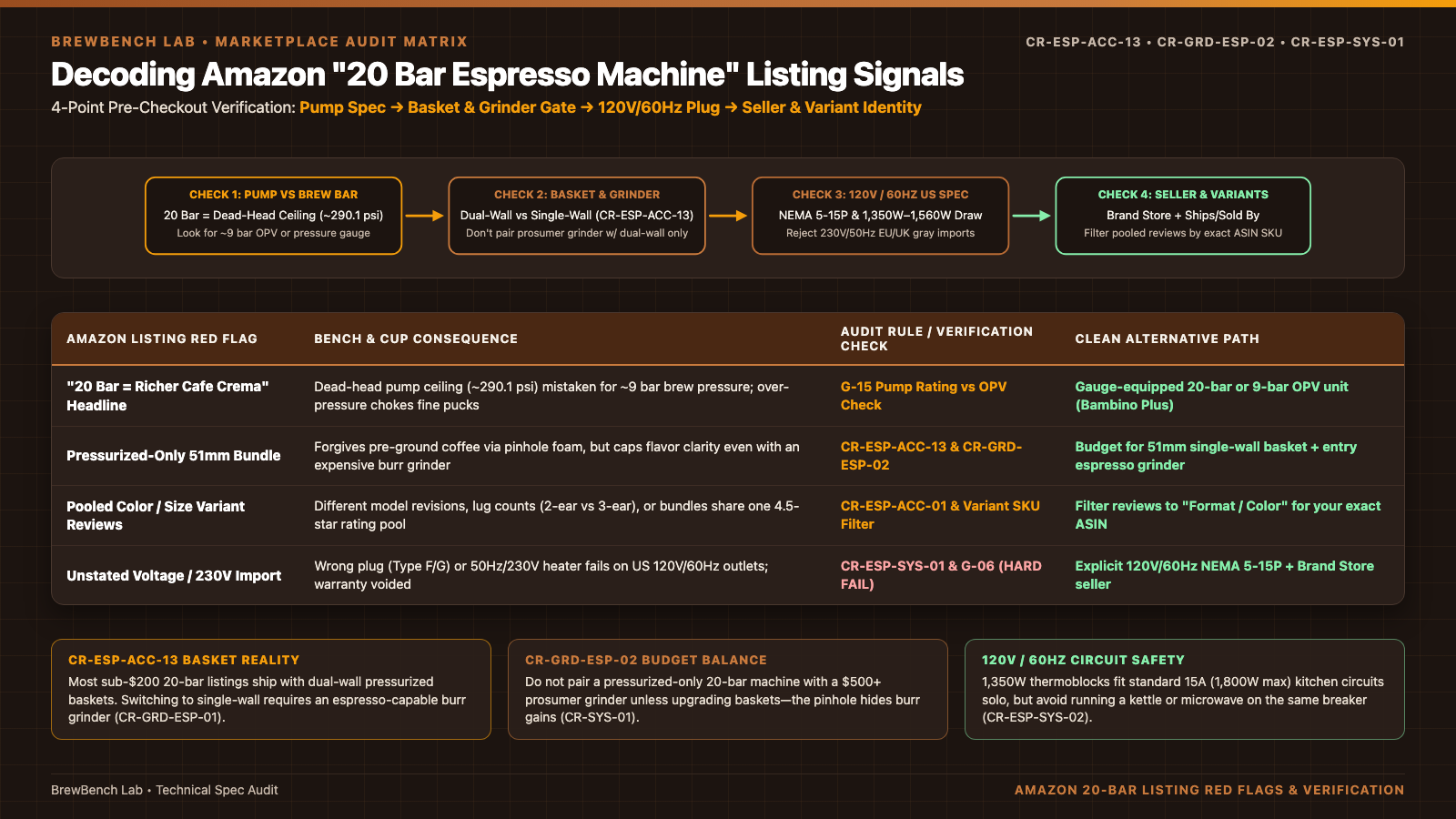
| Listing Red Flag | What Happens on Your Bench | CR-* Rule or Audit Check | Verified Clean Alternative |
|---|---|---|---|
| “20 Bar = Richer Crema” Headline | Pump dead-head rating (~290.1 psi) is mistaken for brew pressure; without a calibrated ~9 bar OPV, fine pucks compress and channel | Pump Rating Separation & OPV Presence Check | Gauge-equipped 20-bar units (CASABREWS CM5418 / CHULUX) or 9-bar OPV Breville Bambino Plus |
| Pressurized-Only Basket Bundle | Dual-wall pinhole whips air into foam from coarse coffee, but masks burr upgrades and caps flavor clarity | CR-ESP-ACC-13 & CR-GRD-ESP-02 | Confirm 51 mm single-wall basket availability or pick a kit shipping both basket types |
| “Fits All 51 mm Machines” Claims | Aftermarket bottomless portafilter fails to lock or leaks at the group gasket because 2-ear vs. 3-ear lug spacing differs | CR-ESP-ACC-01 (Confidence C listing check) | Buy OEM-matched or model-listed 51 mm / 54 mm portafilter assemblies only |
| Pooled Color / Size Variants | Different wattage, PID/NTC revisions, or milk-carafe bundles share one combined star rating and Q&A thread | Listing Identity & Variant Review Filter | Filter reviews to “Format / Color” and verify exact model code on the spec table |
| Missing 120V/60Hz or 230V Import | EU/UK Type F/G plug or 230V/50Hz heating element fails on US 120V receptacles; voided North American support | CR-ESP-SYS-01 & US Voltage Gate (HARD FAIL) | Explicit 120V/60Hz NEMA 5-15P spec sold via Brand Store or Amazon fulfillment |
| 20-Bar + Blade Grinder Combo | Included blade or false-burr mill produces uneven boulders and dust that choke or gush in single-wall baskets | CR-GRD-ESP-01 & CR-SYS-01 | Keep machine budget under $200 and allocate funds to an espresso-rated burr grinder |
Axis 6: Why “20 Bar” Dominates Amazon Titles (And What Happens at ~9 Bar)
Open an Amazon US search for espresso machine or espresso machine under 200 and nearly half of the first-page results—dominated by Amazon-native brands such as CASABREWS, AMZCHEF, Gevi, CHULUX, Neretva, COWSAR, AAOBOSI, and Mecity—place “20 Bar” in the first five words of the listing title. That naming pattern exists because Amazon shoppers frequently sort unfamiliar countertop appliances by big round numbers, assuming 20 bar automatically outperforms a 15-bar De’Longhi or a 9-bar Breville.
From a hydraulic standpoint, that assumption reverses how espresso extraction works. As we break down in detail inside our 15 bar vs 20 bar espresso machine technical explainer, consumer machines in this class rely on oscillating electromagnetic vibratory pumps rather than commercial rotary vane pumps. A “20 bar” rating (~290.1 psi) measures the pump’s dead-head ceiling—the peak pressure reached when the outlet is completely blocked and zero milliliters of water are flowing. It is not the operating pressure applied across a healthy espresso puck.
Across specialty coffee standards, conventional espresso extracts around 8 to 9 bar (~116 to 130.5 psi) at the coffee bed, with many lighter-roast profiles running cleanly between 6 and 9 bar. Mid-tier and prosumer machines—including Breville’s 120V ThermoJet platforms—pair a standard vibratory pump with an internal Over-Pressure Valve (OPV) calibrated near ~9 bar. Whenever puck resistance pushes line pressure above ~9 bar, the OPV bleeds excess water back toward the pump intake or drip tray.
Most sub-$200 20-bar Amazon machines do not include a calibrated 9-bar brew OPV (containing only high-pressure thermal or plumbing safety relief valves). Instead, brew pressure settles wherever the coffee basket or puck resistance restricts flow. If your listing includes a front analog pressure gauge—such as the CASABREWS CM5418 or CHULUX 20-Bar Creamy—you can actually watch the needle on your own bench: balanced shots still land in the central ~9 bar zone, whereas overly fine single-wall pucks spike past 12 to 15 bar, compacting the coffee bed and triggering sour, astringent channeling.
Axis 4 & 5: Pressurized Baskets, 51 mm Lug Claims & Grinder Mismatches
The second major blind spot on Amazon 20-bar listings sits inside the portafilter box—specifically how basket construction, grinder resolution, and aftermarket portafilter fitment interact under BrewBench Lab rules CR-ESP-ACC-13, CR-GRD-ESP-02, and CR-ESP-ACC-01.
1. The Pressurized Basket Lock-In (CR-ESP-ACC-13)
Nearly every sub-$200 20-bar Amazon espresso machine ships with pressurized (dual-wall) 51 mm filter baskets. Look underneath a pressurized basket and you will find a solid outer floor punctured by a single microscopic exit pinhole. That pinhole—not the coffee bed—creates hydraulic backpressure, allowing coarse supermarket pre-ground coffee to build resistance and jet out as thick, bubbly foam.
Under CR-ESP-ACC-13, pressurized baskets are genuinely useful for true beginners who do not yet own a burr grinder. However, if a listing omits non-pressurized single-wall baskets from the box (or uses a proprietary basket lip height that rejects standard 51 mm replacements), you cannot evaluate real espresso texture or sweetness until you purchase a compatible single-wall basket separately. See our pressurized vs non pressurized basket breakdown for how pinhole turbulence differs from natural puck extraction.
2. The Grinder Diminishing-Returns Trap (CR-GRD-ESP-02 & CR-GRD-ESP-01)
Two opposite mistakes appear in Amazon buyer bundles and “Frequently Bought Together” carousels:
- Spending Prosumer Grinder Money on a Pressurized-Only Machine (
CR-GRD-ESP-02): Pairing a pressurized-only sub-$200 20-bar machine with a $500+ prosumer flat-burr grinder wastes burr geometry you cannot taste. Because the dual-wall pinhole dominates resistance and masks particle distribution nuances, either budget for a compatible single-wall basket first or reallocate funds toward a 9-bar OPV machine in the $200–$500 bracket. - Pairing a Single-Wall Upgrade with a Filter or Blade Mill (
CR-GRD-ESP-01): Conversely, dropping an aftermarket 51 mm single-wall basket into a 20-bar machine while using a blade mill or filter-only burr grinder triggers a hard compatibility fail. Without espresso-rated fine steps, water blasts straight through the puck in seconds, leaving thin, sour shots regardless of the 20-bar badge on the chassis.
3. Confidence-C “Compatible With” 51 mm Portafilter Claims (CR-ESP-ACC-01)
Amazon accessory listings frequently advertise “51 mm Bottomless Portafilter Fits CASABREWS, Gevi, De’Longhi, Neretva” in a single title. Under CR-ESP-ACC-01, diameter alone never proves fitment. While these entry machines share a nominal 51 mm (2.01 in) basket seat, locking ear geometry varies across brands and even across model years—some groups use two symmetrical ears, others use three ears, and ear thickness varies by fractions of a millimeter. Treat third-party compatibility lists as unverified retailer claims (Confidence C) until you visually compare the ear count, ear width, and lug orientation against your machine’s OEM portafilter.
Axis 1, 7 & 9: OEM Chassis Clones, Pooled Variants & Merged Reviews
When auditing Amazon 20-bar listings, three marketplace catalog behaviors—identity overlap (Axis 1), variant merging (Axis 7), and review pooling (Axis 9)—routinely distort what star ratings appear to say.
First, many sub-$200 Amazon-native 20-bar machines are built around shared OEM thermoblock platforms with minor cosmetic bezel changes, swapped button labels (Touchscreen vs. Push-Button vs. Dial), or different steam wand sleeves. Two listings at different prices may share identical 1,350W thermoblock internals while differing sharply in whether they include a pressure gauge, PID/NTC thermal sensing, a full-size metal tamper versus a plastic scoop-tamper, or an extra single-wall basket.
Second, Amazon parent ASINs frequently nest multiple distinct SKUs under color or “Style” swatches—for example, grouping a basic manual-wand model alongside an automatic milk-carafe version (such as 3700 Essential vs. 3700MAX or 5418 BASIC vs. CM5418 with gauge) or mixing a standalone machine with a grinder-bundled kit. Because Amazon pools customer reviews and star averages across all child ASINs on a parent page, a 4.4-star rating from 5,000 buyers may belong mostly to an older discontinued revision or a completely different colorway bundle.
Third, watch cup clearance and drip tray dimensions across compact variants (CR-SCALE-ESP-01 and CR-SCALE-ESP-02). Slim sub-$200 stainless chassis units often leave narrow drip tray grates that cannot hold wider pour-over scales without overhanging, and spouted 51 mm portafilters leave tight vertical clearance for tall travel mugs plus a 15–20 mm (~0.6–0.8 in) coffee scale.
Axis 2, 3, 8 & 10: 120V/60Hz Circuits, Sellers, Safety Marks & Water Care
Beyond pressure and baskets, four practical ownership checks govern whether an Amazon 20-bar machine runs safely and reliably in a US kitchen.
1. 120V/60Hz North American Electrical & Circuit Load (CR-ESP-SYS-01 & CR-ESP-SYS-02)
Confirm the product spec table explicitly states 120V / 60Hz with a North American NEMA 5-15P three-prong plug. Occasional third-party marketplace offers import 220V–240V / 50Hz European or UK variants onto US ASINs; those machines fail CR-ESP-SYS-01 (HARD fail) and should never be paired with plug adapters or voltage converters. Most verified 120V 20-bar thermoblocks draw roughly 1,350W (~11.25A), sitting safely below the 1,440W continuous threshold (80% of 1,800W) on a dedicated 15A kitchen receptacle. However, under CR-ESP-SYS-02, running a 1,350W espresso machine simultaneously with an electric kettle or toaster on the same 15A branch circuit will trip the breaker.
2. Seller Fulfillment, Warranty Boundaries & Return Windows (Axis 3 & 8)
Check two lines directly beneath the Buy Box before purchasing: the “Visit the [Brand] Store” link above the title, and the Ships from / Sold by rows. Listings fulfilled by Amazon.com or the brand’s official Amazon storefront offer straightforward 30-day return windows if a thermoblock leaks or a pump arrives dead-on-arrival. Conversely, unverified third-party drop-shippers on established brands like Breville or De’Longhi can void authorized North American manufacturer warranties—a risk covered in our best espresso machines under $500 buying guide.
3. Safety Certifications, Sequential Steam & Boiler Descaling (Axis 10, CR-DRINK-ESP-03 & CR-WTR-ESP-06)
Inspect listing specifications and product-bottom labels only for officially stated electrical safety marks (such as UL or ETL certification as published by the manufacturer) rather than assuming every sub-$100 unit carries identical third-party certification. On workflow, note that single-thermoblock 20-bar machines heat sequentially (CR-DRINK-ESP-03): you pull espresso first, press the steam button to raise block temperature, purge condensed water, texture milk for one or two drinks, and cool down before pulling another shot.
For longevity, follow CR-WTR-ESP-01, CR-WTR-ESP-02, and CR-WTR-ESP-06 strictly from the machine manual. Never run pure un-remineralized distilled water in machines with conductive level sensors, and never use improvised vinegar or unmeasured DIY citric acid concentrations. Check whether the machine uses an aluminum thermoblock/boiler or stainless steel water path, because aluminum components can pit if exposed to unauthorized acids—use only the descaling solution and cycle interval specified by the manufacturer, paired with balanced low-scale water (~68 mg/L CaCO3 / ~4 gpg target per SCA guidance).
Listings to Skip: 4 Audited Red-Flag Profiles
During our Amazon US catalog audit, four recurring 20-bar listing patterns failed technical or marketplace verification and should be skipped in favor of clean 120V SKUs:
- Unverified 220V–240V / 50Hz Gray-Market Imports: Any listing lacking explicit 120V/60Hz North American electrical specifications or shipping with an EU/UK cord fails
CR-ESP-SYS-01immediately. - No-Name Sub-$100 “20-Bar” Listings With Zero Parts Ecosystem: Ultra-cheap white-label listings that provide no model code, no Brand Store, and obscure 51 mm 2-ear/3-ear lug spacing trap buyers when gaskets wear out or when upgrading baskets (
CR-ESP-ACC-01,CR-ESP-ACC-13). - 20-Bar Machine + Blade/False-Burr Grinder Bundles: Combo listings that pair a 20-bar brewer with an uncalibrated blade grinder fail
CR-GRD-ESP-01for single-wall espresso and encourage pressurized-only stagnation. - Off-Amazon Dealer-Only Brands Listed by Unofficial Third Parties: Specialty prosumer brands such as Lelit, Profitec, ECM, and La Marzocco are sold through authorized espresso dealers rather than official Amazon US storefronts—ignore suspicious or unavailable third-party Amazon placeholder offers.
60-Second Pre-Checkout Amazon Verification Checklist
Run these six quick checks on any Amazon 20-bar product page before clicking Add to Cart:
- Confirm Voltage & Plug: Verify
120V / 60Hzand a US NEMA 5-15P cord in the manufacturer spec table—never guess from photos alone. - Audit the Brand Store & Seller: Click Visit the [Brand] Store and check Ships from / Sold by to confirm Amazon fulfillment or an authorized brand seller.
- Separate Child Variants: Click your exact colorway/style swatch, then open Reviews and filter by Format/Color so older revisions do not mask current feedback.
- Verify Basket Wall Types (
CR-ESP-ACC-13): Check “What’s in the Box” for single-wall vs. dual-wall pressurized baskets, plus whether a metal tamper or plastic scoop is supplied. - Check Pressure Feedback & Thermal Tech: Prefer a front pressure gauge and PID/NTC electronic temperature control over raw “20 Bar” headline text.
- Plan the Grinder Split (
CR-SYS-01): If buying a sub-$200 20-bar machine, reserve budget for an espresso-capable burr grinder and 0.1 g scale rather than overspending on cosmetics.
Verified 120V Amazon US 20-Bar Machines & 9-Bar OPV Alternative
Below are four verified 120V/60Hz Amazon US listings that illustrate the cleanest options across the 20-bar marketplace—three transparent sub-$200 20-bar machines with clear US specs, plus one OPV-regulated 9-bar step-up alternative for buyers ready to skip 20-bar marketing altogether.
1. CASABREWS CM5418 Compact Espresso Machine — Best Gauge-Equipped 20-Bar Audit Pick

Verified Specs: 120V / 60Hz US model | 1,350W Thermoblock | 20-bar (~290.1 psi max) vibratory pump | Front analog pressure gauge | 51 mm portafilter + manual steam wand | Price Tier: Budget (Under $200 tier)
Among Amazon’s highest-volume 20-bar listings, the CASABREWS CM5418 stands out because its front analog pressure dial eliminates the guesswork around extraction pressure. Rather than trusting the “20 Bar” box label blindly, you can watch the needle climb into the central espresso zone during a balanced shot—or spot when overly fine coffee chokes the puck toward the upper red band. Its 1,350W 120V/60Hz thermoblock fits safely below the 1,440W continuous threshold on a solo 15A receptacle (CR-ESP-SYS-02).
Listing Audit Note (CR-ESP-ACC-01 & CR-ESP-ACC-13): Verify the exact CM5418 child variant (standard vs. Pro/Ultra) so you know which 51 mm baskets ship in the carton. Confirm 51 mm ear count before ordering any third-party bottomless portafilter.
Pros
- Front analog pressure gauge makes over-pressure spikes and under-extracted gushing visible on the dial
- Verified 120V/60Hz 1,350W thermoblock fits safely below the 1,440W continuous threshold on a solo 15A circuit
- Compact stainless footprint fits under standard 18-inch US upper kitchen cabinets
Cons
- 20-bar pump rating reflects maximum dead-head ceiling rather than a calibrated ~9 bar brew OPV
- Aftermarket 51 mm bottomless portafilters and single-wall baskets must be matched carefully to the exact ear pattern (
CR-ESP-ACC-01)
2. CHULUX 20-Bar Stainless Steel Espresso Machine (Creamy) — Best PID/NTC Thermal Pick

Verified Specs: 120V / 60Hz US model | 1,350W Thermoblock with PID/NTC sensing | 20-bar (~290.1 psi max) pump | Built-in pressure gauge | Price Tier: Budget (Under $200 tier)
The CHULUX 20-Bar Creamy edition demonstrates what actually separates better sub-$200 Amazon listings from generic clones: thermal regulation. While the 20-bar pump rating is still a dead-head limit, pairing the 1,350W 120V/60Hz thermoblock with PID/NTC temperature sensing helps curb extreme hot-and-cold water swings compared with crude bimetallic thermostats, while the front pressure gauge gives immediate visual feedback on puck resistance.
Listing Audit Note (CR-ESP-SYS-02 & CR-DRINK-ESP-03): Rated at 1,350W on 120V/60Hz—keep kettles and microwaves off the same 15A breaker during operation. Sequential thermoblock steaming suits one or two milk drinks per session.
Pros
- PID/NTC temperature sensing helps stabilize brew water better than basic mechanical thermostats
- Integrated front pressure gauge shows whether puck resistance lands near the target ~9 bar zone
- 1,350W 120V/60Hz thermoblock avoids tripping dedicated 15A kitchen branch circuits when run alone
Cons
- 20-bar marketing rating still cannot fix coarse pre-ground coffee without a pressurized basket
- Sequential brew-to-steam thermoblock workflow slows back-to-back milk drinks (
CR-DRINK-ESP-03)
3. Gevi 20 Bar Compact Espresso Machine for Home — Pressurized 51 mm Starter Benchmark
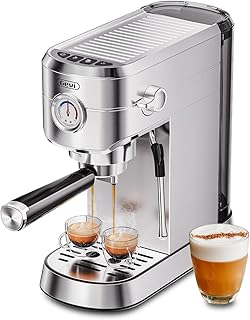
Verified Specs: 120V US model | 20-bar (~290.1 psi max) pump rating | 51 mm pressurized portafilter | Stainless housing + manual steam wand | Price Tier: Budget (Under $200 tier)
Gevi’s 120V 20-bar compact home machine represents the classic entry pressurized-portafilter archetype on Amazon US. Sold through Gevi’s own Amazon storefront presence rather than an anonymous white-label shell, it is straightforward about what it delivers: quick weekday drinks using 51 mm pressurized baskets that forgive pre-ground supermarket espresso blends while preserving budget for a 0.1 g scale and entry conical burr grinder.
Listing Audit Note (CR-ESP-ACC-13 & CR-GRD-ESP-02): Treat this machine as a pressurized starter setup unless you add an espresso-capable burr grinder and verify compatible 51 mm single-wall baskets. Do not overspend on a $500+ prosumer grinder while running dual-wall baskets.
Pros
- Explicitly specified for 120V US households with a compact stainless chassis for small kitchens
- Pressurized 51 mm basket forgives coarse pre-ground coffee and entry grinders out of the box
- Low entry cost leaves budget room for a 0.1 g scale and espresso-capable burr grinder (
CR-SYS-01)
Cons
- Pressurized-first design limits flavor clarity until upgraded with a compatible 51 mm single-wall basket and espresso grinder (
CR-ESP-ACC-13) - Pairing this tier with a $500+ prosumer grinder hits
CR-GRD-ESP-02diminishing returns unless baskets are upgraded
4. Breville Bambino Plus BES500DBL (Damson Blue) — Best 9-Bar OPV Regulated Alternative

Verified Specs: 120V / 60Hz US BES500DBL | ThermoJet rapid-heat system | Calibrated 9-bar OPV extraction | 54 mm Breville group (STD-GROUP-BREVILLE-54) | Single-wall + dual-wall baskets included | Automatic milk wand | Price Tier: Entry / Mid ($200–$500 tier)
If your goal is authentic café-style extraction rather than a big pump badge on a sub-$200 carton, the Breville Bambino Plus shows why stepping up out of the 20-bar budget shelf changes ownership completely. Breville pairs low-pressure pre-infusion with a calibrated 9-bar over-pressure valve, includes both 54 mm single-wall and dual-wall baskets in the box (CR-ESP-ACC-13 pass), and backs the machine with a standardized 54 mm accessory ecosystem and US warranty support.
Listing Audit Note (STD-GROUP-BREVILLE-54 & CR-WTR-ESP-05): Confirm the BES500 model suffix for 120V North American retail and purchase from the Breville Store or an authorized seller. Uses Breville 54 mm portafilters and Breville reservoir water filters.
Pros
- Calibrated 9-bar OPV regulates extraction pressure cleanly without chasing 20-bar dead-head marketing numbers
- Ships with both 54 mm single-wall and dual-wall baskets in the box (
CR-ESP-ACC-13pass) - Automatic milk temperature and texture sensing plus Breville US warranty and 54 mm accessory ecosystem (
STD-GROUP-BREVILLE-54)
Cons
- Sits well above the Under $200 20-bar shelf in the $200–$500 / mid-tier bracket
- Sequential ThermoJet heating still alternates between brewing and steaming rather than running simultaneously
Authoritative Manufacturer & Standards Citations
Every hydraulic distinction, 120V/60Hz electrical safety rule, basket compatibility gate, and water chemistry guideline in this audit traces to official manufacturer documentation and industry standards:
- Breville US Official Espresso Machine Specifications — 9-bar OPV-regulated extraction architecture, 54 mm single-wall and dual-wall basket kits, and 120V US ThermoJet documentation.
- De’Longhi US Official Support & Espresso Manuals — Vibratory pump specifications, 51 mm pressurized basket behavior, and manufacturer-approved descaling procedures.
- Specialty Coffee Association (SCA) Water & Extraction Standards — Conventional ~9 bar espresso extraction targets and ~68 mg/L CaCO3 (~4 gpg) water hardness guidance.
- National Fire Protection Association (NFPA / NEC) — North American 120V/60Hz 15A (1,800W max / 1,440W continuous) and 20A kitchen small-appliance branch-circuit load limits.
- Baratza Official Support & Grinder Documentation — Why espresso-rated burr step resolution is required when moving from dual-wall pressurized baskets to single-wall baskets.
How We Audited This Guide
- Home bar blueprints, upgrade roadmaps, water chemistry guides, and Amazon listing audits were verified against CR-SYS circuit, water-probe, and budget balance rules.
- Every espresso machine, burr grinder, accessory, and scale specification was cross-checked against official manufacturer 120V manuals, SCA water guidance, and verified Amazon US listings.
- Recommendations were evaluated against our weighted espresso-gear scoring rubrics and documented CR-* compatibility rules; we never invent heat-up seconds, PID variance, or micron claims.
Continue Your Audit
Frequently Asked Questions: 20 Bar Espresso Machines on Amazon
Does a 20 bar espresso machine on Amazon actually brew at 20 bar?
No. A 20-bar (~290.1 psi) label describes the vibratory pump’s maximum dead-head pressure against a sealed blockage. Real espresso extracts near ~9 bar (~130.5 psi) at the coffee puck, controlled either by an internal over-pressure valve, a pressurized basket pinhole, or finely ground coffee resistance.
Why do so many sub-$200 Amazon espresso machines advertise 20 bar?
Amazon-native budget brands lead with “20 Bar” in product titles because shoppers often assume higher numbers mean thicker crema. In practice, OPV regulation, PID/NTC temperature stability, included single-wall baskets, and an espresso-capable burr grinder determine shot quality far more than the pump’s ceiling.
Can I buy any 51 mm bottomless portafilter on Amazon for a 20-bar machine?
Not automatically. Under rule CR-ESP-ACC-01, a 51 mm diameter label does not guarantee group head fitment. Ear count (2-ear vs. 3-ear) and ear thickness differ across CASABREWS, Gevi, De’Longhi, and white-label machines, so match the exact listed model before ordering.
Should I pair a $500+ grinder with a budget 20-bar Amazon machine?
Not if you stay on pressurized dual-wall baskets. Under rule CR-GRD-ESP-02, a pressurized pinhole masks burr uniformity and wastes prosumer grinder money. Either confirm a compatible 51 mm single-wall basket upgrade first or step up to a 9-bar OPV machine.
How do I avoid 230V grey-market listings when buying on Amazon US?
Always verify explicit 120V / 60Hz specifications and a US NEMA 5-15P plug in the listing details, confirm the Visit the Brand Store link, and check Ships from / Sold by fields. Never rely on plug adapters or step-up transformers for unverified imports.


