
Disclosure: As an Amazon Associate, I earn from qualifying purchases. If you buy through links on this page, we may earn a small commission at no extra cost to you.
Comparing a 15 bar vs 20 bar espresso machine is the fastest way to encounter one of the most persistent marketing numbers in home coffee gear. Scroll through budget countertop espresso listings and you will see “20-Bar High-Pressure Italian Pump” stamped across product titles as if higher bar ratings guarantee thicker crema, sweeter shots, or café-grade extraction. In reality, neither 15 bar (~217.6 psi) nor 20 bar (~290.1 psi) is the pressure used to brew espresso at the coffee bed.
Inside our best espresso machines hub, separating pump engineering from retail badge claims is our first evaluation gate before recommending any 120V/60Hz home brewer. Whether you are shopping in the sub-$200 entry tier or stepping into OPV-regulated mid-range setups, understanding how vibratory pump curves, over-pressure valves, pressurized baskets (CR-ESP-ACC-13), and espresso grinders interact prevents wasted upgrades.
Direct Answer: A 15 bar (~217.6 psi) or 20 bar (~290.1 psi) label describes the vibratory pump’s maximum dead-head rating against a sealed blockage—not brewing pressure. Conventional espresso extracts around ~9 bar (~130.5 psi) at the puck. Without an over-pressure valve (OPV), a 20-bar pump offers zero cup-quality advantage over 15 bar and can actually compact fine pucks and worsen channeling.
In This Guide
- Pump Physics: Dead-Head Rating vs. ~9 Bar Brew Pressure
- How Pressure Actually Forms: OPVs, Baskets & Puck Resistance
- Why Brands Advertise 20 Bar (And Why Prosumer Units Say 9 Bar)
- Decision Matrix: 15 Bar vs. 20 Bar vs. 9-Bar Regulated Systems
- Myth vs. Engineering Reality: 4 Pump-Pressure Misconceptions
- 5 Technical Specs That Matter More Than Pump Bar Rating
- 60-Second Buyer & Machine Verification Checklist
- Verified 15-Bar & 20-Bar Amazon US Reference Machines
- Authoritative Manufacturer & Standards Citations
- Frequently Asked Questions
Pump Physics: Dead-Head Pump Rating vs. ~9 Bar Brew Pressure
To decode a 15 bar vs 20 bar espresso machine spec sheet, start with how pressure works in fluid dynamics. A pump does not create pressure on its own; a pump creates flow. Pressure only rises when water moving out of the pump meets hydraulic resistance downstream—either from a narrow pinhole in a pressurized filter basket, a tightly compacted bed of finely ground coffee, or a calibrated valve.
Most consumer espresso machines sold for US 120V/60Hz kitchens under $1,000 use an oscillating electromagnetic vibratory pump (commonly patterned after Ulka-style solenoid piston pumps) rather than a large commercial rotary vane pump. In a vibratory pump, an AC electromagnetic coil pulses a small spring-loaded piston back and forth 60 times per second (60 Hz in North America), pushing small bursts of water toward the thermoblock or boiler.
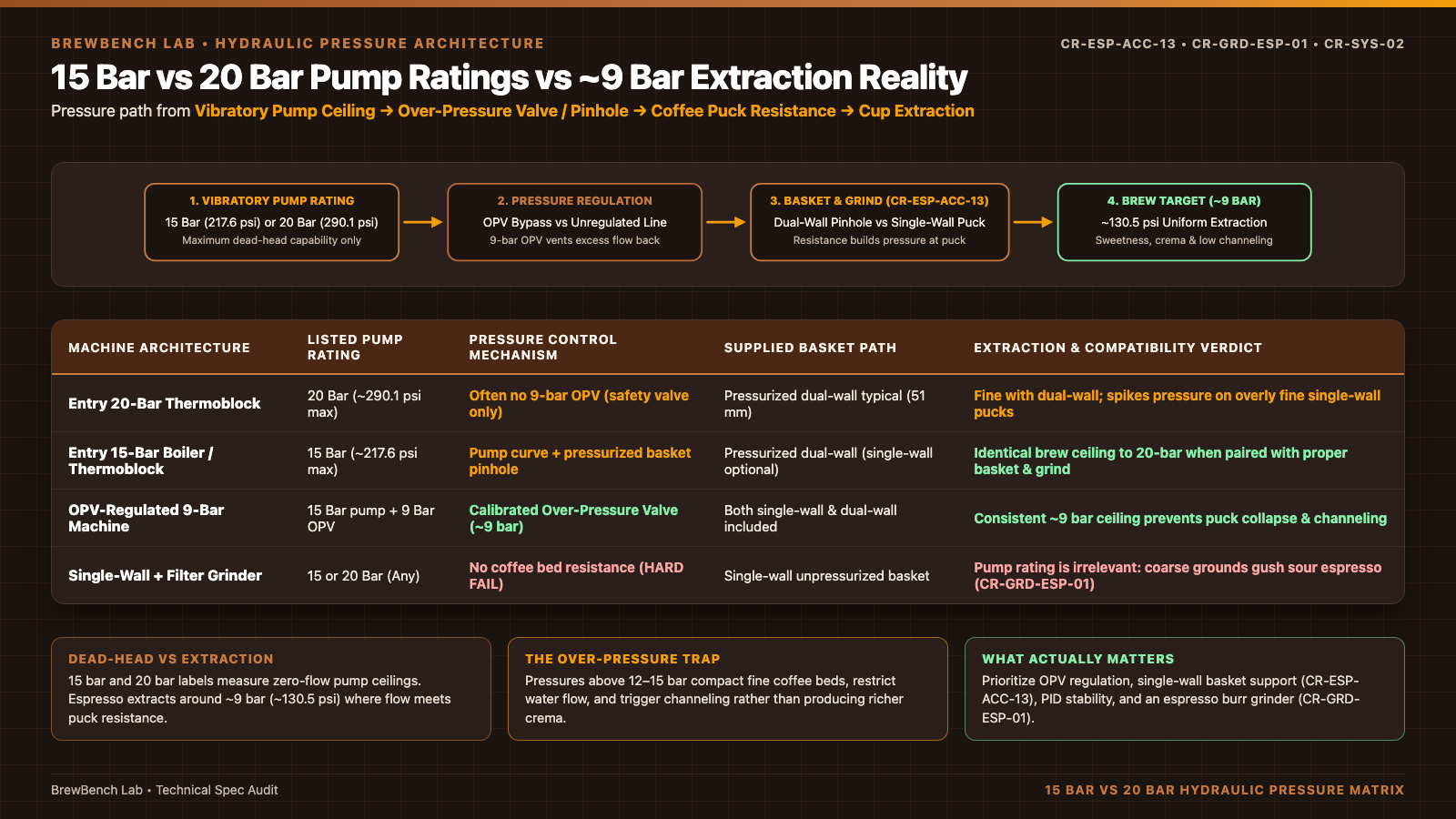
Every vibratory pump follows a steep inverse pressure-flow curve:
- At Zero Resistance (Open Group Head): Water exits freely at roughly 0 bar (0 psi) at maximum flow rate—typically several hundred milliliters per minute.
- At Espresso Extraction Flow (~1 to 2 ml/s or 0.03 to 0.07 oz/s): As coffee puck resistance slows flow down to typical espresso shot speeds—say, 18 g (0.63 oz) dry coffee yielding 36 g (1.27 oz) liquid espresso in roughly 25 to 30 seconds—operating pressure climbs up the pump’s curve.
- At Complete Blockage (Dead-Head Rating): If you seal the outlet completely so zero drops of water can escape, piston pressure peaks at the pump’s rated maximum: 15 bar (~217.6 psi) for a 15-bar coil/spring assembly, or 20 bar (~290.1 psi) for a stiffer 20-bar spring and coil specification.
That single engineering reality explains why “15 bar” and “20 bar” are boundary ceiling specifications—similar to the top number on a car speedometer—rather than the speed at which you actually drive. Across specialty espresso standards, conventional extraction targets roughly 9 bar (~130.5 psi) at the coffee puck, with modern profiles often running between 6 and 9 bar (~87 to 130.5 psi) to balance sweetness, body, and uniform water flow.
How Pressure Actually Forms: OPVs, Pressurized Baskets & Puck Resistance
Because both a 15-bar and a 20-bar vibratory pump can exceed 9 bar if unobstructed flow is throttled down, what happens between the pump and your cup depends on which of three hydraulic architectures your machine uses.
1. OPV-Regulated Machines (Capped Near ~9 Bar)
Well-engineered espresso machines—including Breville’s Bambino, Bambino Plus, and Barista series, as well as prosumer single-boiler and dual-boiler platforms—use a 15-bar vibratory pump paired with an Over-Pressure Valve (OPV). An OPV is a precision spring-loaded bypass valve placed between the pump and the group head. Whenever downstream resistance drives pressure above ~9 bar (~130.5 psi), the OPV cracks open and diverts excess water back into the intake line or drip tray. As a result, a 15-bar pump behind a 9-bar OPV delivers steady ~9 bar brewing pressure even if you grind slightly too fine.
2. Pressurized (Dual-Wall) Basket Machines (Rule CR-ESP-ACC-13)
Most entry-level 15-bar and 20-bar machines in the under-$200 and $200–$400 classes lack a calibrated 9-bar brew OPV (often including only a high-pressure safety relief valve to protect plumbing hoses). Instead, under compatibility rule CR-ESP-ACC-13, these units rely on a pressurized (dual-wall) filter basket. Flip a dual-wall basket upside down and you will see one tiny exit pinhole beneath an inner perforated floor.
Even if you load coarse supermarket pre-ground coffee that offers almost zero natural resistance, water backs up inside the sealed dual-wall chamber until pressure forces coffee out through that single pinhole. As liquid jets through the pinhole at high velocity, it whips air into a thick, pale-colored foam. In this setup, the pinhole geometry—not whether the pump is rated at 15 bar or 20 bar—dictates how the shot behaves.
3. Unregulated Pump + Single-Wall Basket (The Over-Pressure Risk)
When owners of an unregulated 15-bar or 20-bar machine upgrade to a non-pressurized single-wall basket (CR-ESP-ACC-13) and pair it with an espresso-capable burr grinder (CR-GRD-ESP-01), the compacted coffee puck itself becomes the pressure regulator. Here, an unregulated 20-bar pump can actually become a liability rather than an advantage.
If your grind is slightly too fine or uneven, an unregulated 20-bar pump pushes pressure well past 12 to 15 bar (~174 to 217.6 psi). Instead of extracting faster, excessive pressure crushes the bottom of the wet coffee bed against the steel basket holes—a phenomenon known as puck compression. Water then blasts through the weakest micro-crack in the puck (channeling), leaving you with a shot that tastes simultaneously hollow, sour, and astringently bitter.
Why Brands Advertise “20 Bar” While Prosumer Machines Highlight “9 Bar”
If 9 bar is the hydraulic sweet spot, why do dozens of Amazon US espresso makers under $200 prominently advertise “20 Bar” in their headlines while established machines like the Breville Bambino Plus or Rancilio Silvia advertise “9-bar extraction” or do not lead with pump bar numbers at all?
The gap comes down to component sourcing and shopper expectations. Vibratory pumps rated for 15 bar and 20 bar cost virtually the same to manufacture at scale. Because first-time shoppers scanning search results often assume a bigger number works like megapixels or horsepower—and may also compare machines against high-pressure capsule brewers—budget OEM brands specify a 20-bar vibratory pump purely to print “20 Bar” on the box.
Established specialty brands take the opposite approach because serious espresso buyers know that capping pressure near 9 bar is harder—and tastes cleaner—than letting an unregulated pump spike to 20 bar. If you are browsing budget listings specifically to spot marketing traps, see our dedicated breakdown of 20 bar espresso machines on Amazon.
Decision Matrix: 15 Bar vs. 20 Bar vs. 9-Bar Regulated Systems
Use this architectural comparison to separate pump marketing badges from real-world brewing behavior, basket requirements, and grinder pairing rules.
| Scenario / Spec Class | Pump Rating & Regulation | Compatible Basket & Grinder Path | Critical Caveat |
|---|---|---|---|
| Entry 20-Bar Thermoblock (Under $200 TIER-ESP-BUDGET) | 20 bar (~290.1 psi) dead-head pump; usually safety relief only (no 9-bar brew OPV) | Ships with 51 mm pressurized baskets; single-wall upgrade needs fine burr grinder (CR-ESP-ACC-13) | Front pressure gauge often climbs past 12–15 bar on fine single-wall grinds, increasing channeling risk. |
| Entry 15-Bar Boiler / Thermoblock (Under $200 to $200–$400) | 15 bar (~217.6 psi) dead-head pump; relies on pressurized basket pinhole or puck resistance | 51 mm pressurized baskets standard; single-wall baskets available separately (CR-ESP-ACC-13) | Identical real-world espresso potential to 20-bar entry units; never skip grinder capability for single-wall shots. |
| 9-Bar OPV-Regulated Consumer ($200–$1,000 TIER-ESP-ENTRY / MID) | 15 bar pump governed by calibrated ~9 bar (~130.5 psi) Over-Pressure Valve | Includes both single-wall and dual-wall baskets (e.g., 54 mm Breville); requires espresso burr grinder for single-wall | Delivers repeatable puck pressure without crushing fine coffee beds; PID thermal stability varies by model. |
| Single-Wall + Filter-Only Grinder (Any 15-Bar or 20-Bar Machine) | Pump rating irrelevant—cannot build pressure without puck resistance | HARD FAIL under CR-GRD-ESP-01 & CR-SYS-02 | Pre-ground coffee or blade/filter grinders produce pale, sour, 5-second gushers regardless of 15 vs. 20 bar pump. |
Myth vs. Engineering Reality: 4 Pump-Pressure Misconceptions
Myth #1: “A 20-bar espresso machine produces thicker crema and stronger coffee than a 15-bar machine.”
Engineering Reality: False (G-15). Genuine espresso crema depends on freshly roasted coffee’s trapped carbon dioxide, soluble oils, fine grind uniformity, and stable ~9 bar extraction around 90–96 °C (194–205 °F). On dual-wall pressurized baskets, foam comes from forcing liquid through a single pinhole—which occurs identically on 15-bar and 20-bar pumps.
Myth #2: “Higher 20-bar pump pressure compensates for coarse pre-ground coffee or a cheap blade grinder.”
Engineering Reality: Completely backwards under CR-GRD-ESP-01 and CR-SYS-02. Coarse grounds leave wide gaps between particles, so water rushes straight through at near-zero resistance. A stronger pump simply pushes water through faster unless a pressurized dual-wall basket restricts the exit—and even then, cup body stays thinner than fresh single-wall espresso.
Myth #3: “Watching the pressure gauge needle hit the top of the dial (15–20 bar) means peak extraction.”
Engineering Reality: On machines with a front pressure gauge, the green “Espresso” sweet spot sits centered around 8 to 10 bar (~116 to 145 psi). If the needle slams into the upper red zone past 12 to 15 bar with a slow drip or choked spout, your coffee bed is over-tamped or ground too fine—causing puck compression and harsh channeling.
Myth #4: “All 15-bar and 20-bar machines handle single-wall non-pressurized baskets out of the box.”
Engineering Reality: False under CR-ESP-ACC-13. Many budget 15-bar and 20-bar machines under $200 ship exclusively with pressurized dual-wall baskets. Switching to single-wall extraction requires buying a model-matched single-wall basket (typically 51 mm or 54 mm) and pairing it with a maker-rated espresso burr grinder (CR-GRD-ESP-02).
5 Technical Specs That Matter Far More Than 15 vs. 20 Bar
If you ignore the 15-bar vs. 20-bar headline badge and evaluate machines like an equipment auditor, five concrete engineering specs determine what lands in your cup every morning:
- Over-Pressure Valve (OPV) & Pre-Infusion Control: Look for documented ~9 bar regulation or gentle low-pressure pre-infusion wetting before full pressure engages. Regulated pressure protects puck integrity far more effectively than a raw 20-bar pump ceiling.
- Thermal Stability (PID vs. Mechanical Thermostat): Espresso extraction is sensitive to brew water swings. A 15-bar machine equipped with electronic PID or NTC temperature control—or a solid brass/stainless thermal mass—holds 90–96 °C (194–205 °F) more consistently than an uncalibrated mechanical thermostat on a 20-bar unit (
CR-DRINK-ESP-01). - Supplied Basket Types & Portafilter Standard (
CR-ESP-ACC-13): Verify whether the box includes both pressurized and single-wall baskets, and check whether the machine uses a 51 mm (2.01 in), 54 mm (2.13 in), or 58 mm (2.28 in) portafilter. Remember that portafilter locking lugs are group-specific (CR-ESP-ACC-01). - Grinder Budget Allocation (
CR-SYS-01&CR-GRD-ESP-01): Under our setup allocation rule, at least 30% of a single-wall espresso setup budget belongs in an espresso-capable burr grinder with fine stepless or micro-stepped adjustments (CR-GRD-ESP-03). Spending extra on a 20-bar badge while using pre-ground coffee yields worse espresso than a modest 15-bar machine paired with a real burr grinder. For balanced value picks, see our best espresso machines under $500 audit. - US 120V/60Hz Circuit Budget & Water Care (
CR-ESP-SYS-01/02&CR-WTR-ESP-01): Using P = V × A, a standard North American 15A / 120V kitchen circuit handles 1,800 W peak (1,440 W continuous at 80%), while a 20A / 120V small-appliance branch handles 2,400 W peak (1,920 W continuous). Most 15-bar and 20-bar thermoblocks pull 1,100 W to 1,560 W via a standardNEMA 5-15Pplug—so avoid running a 1,500 W electric kettle simultaneously on the same breaker.
60-Second Buyer & Machine Verification Checklist
Before buying any 15-bar or 20-bar espresso machine on Amazon US, run these five verification steps on the product manual and listing details:
- Confirm US 120V/60Hz Voltage & Receptacle Match (
CR-ESP-SYS-01): Verify the machine carries a North American 120V/60Hz label and aNEMA 5-15P(orNEMA 5-20Pfor select high-wattage dual-heater prosumer machines). Never buy 220–240V European imports for US outlets, and never use ungrounded plug adapters or defeat GFCI outlet protection. - Audit Basket Types & Portafilter Diameter (
CR-ESP-ACC-13): Confirm whether single-wall baskets are included or available separately in your exact 51 mm or 54 mm portafilter size, and size your tamper to the basket’s inner diameter (CR-ESP-ACC-03). - Match Your Grinder Before Going Single-Wall (
CR-GRD-ESP-01): If you only own a blade mill, filter-only grinder, or buy supermarket pre-ground coffee, stick to pressurized baskets until you add an espresso-rated burr grinder. - Check Steam Workflow for Milk Drinks (
CR-DRINK-ESP-03): Thermoblock and single-boiler machines brew and steam sequentially. That works comfortably for one or two daily lattes (using a 12 oz / 350 ml pitcher underCR-ESP-ACC-08), while 4+ back-to-back milk drinks take noticeable transition wait time. - Verify Water Hardness & Descaling Chemistry (
CR-WTR-ESP-01/CR-WTR-ESP-02/CR-WTR-ESP-06): Check your tap water with hardness strips (1 gpg = 17.1 mg/L CaCO3) against the SCA ~68 mg/L (~4 gpg) guideline and your maker’s limit. Never fill machines—especially boiler designs with conductive water-level probes—with un-remineralized distilled water, and always follow the manufacturer’s manual for descaler type (aluminum boilers can pit if exposed to unapproved citric or harsh acids).
Verified 15-Bar & 20-Bar Amazon US Reference Machines
To show how 15-bar and 20-bar pump ratings translate into real US retail hardware, below are four verified 120V/60Hz Amazon US machines spanning both pump labels. Rather than choosing by bar badge, compare their heating architecture, pressure feedback, and portafilter ecosystem.
1. De’Longhi ECP3620 15-Bar Espresso & Cappuccino Machine (Silver) — 15-Bar Stainless Boiler Reference

Quick Specs: 15-bar (~217.6 psi max) Italian vibratory pump | Stainless steel boiler | 51 mm (2.01 in) portafilter | 120V / 60Hz North American spec | Adjustable manual cappuccino frother | Price Tier: Entry ($200–$500 tier)
De’Longhi’s ECP3620 demonstrates why an established 15-bar machine needs no inflated “20-bar” badge to brew dependable entry-level espresso. Its stainless steel boiler avoids aluminum-boiler descaling sensitivities while maintaining durable thermal mass, and its 15-bar pump pairs with 51 mm pressurized baskets for forgiving extraction from pre-ground coffee or entry-level burr grinders. An adjustable sleeve on the steam wand lets beginners switch between textured milk and cappuccino foam.
Compatibility Gate (CR-ESP-ACC-13 & CR-DRINK-ESP-03): Oriented around 51 mm pressurized baskets out of the box—if you upgrade to a 51 mm single-wall basket, pair it with a maker-rated espresso burr grinder (CR-GRD-ESP-01) and confirm exact De’Longhi lug geometry before ordering aftermarket portafilters.
Pros
- Stainless steel boiler handles manufacturer-approved descaling cleanly without aluminum pitting concerns
- 15-bar Italian pump delivers consistent flow through 51 mm pressurized baskets
- Backed by De’Longhi’s broad North American replacement parts and manual support
Cons
- Single-boiler architecture requires sequential waiting between brewing espresso and steaming milk
- Single-wall basket upgrades and an external espresso grinder must be budgeted separately
2. Neretva 15-Bar Espresso Machine with Pressure Gauge — 15-Bar Visual Feedback Reference
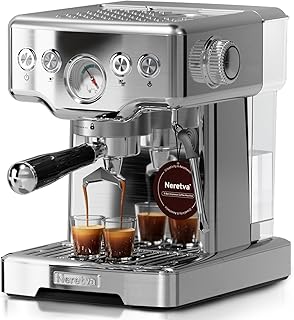
Quick Specs: 15-bar (~217.6 psi max) vibratory pump | Rapid thermoblock heater | 51 mm (2.01 in) portafilter | Integrated front pressure dial | 120V / 60Hz | Price Tier: Budget (Under $200 tier)
The Neretva 15-Bar unit pairs a rapid-heating thermoblock and a 15-bar pump with a front-mounted analog pressure gauge—giving new baristas direct visual feedback on whether their coffee bed is hitting the central ~9 bar zone or stalling out. Sitting comfortably inside the TIER-ESP-BUDGET bracket, it leaves meaningful headroom in an entry-level budget to invest in a dedicated espresso burr grinder (CR-SYS-01).
Compatibility Gate (CR-ESP-ACC-01 & CR-ESP-ACC-13): Uses a 51 mm portafilter ecosystem. Confirm exact ear count and model compatibility before purchasing aftermarket 51 mm bottomless handles, and plan a 12 oz (350 ml) pitcher for its compact steam wand clearance (CR-ESP-ACC-08).
Pros
- Front pressure gauge shows real-time extraction resistance vs. the target ~9 bar zone
- Compact thermoblock warms quickly for small apartment counters
- Under-$200 tier pricing preserves budget for an espresso-capable burr grinder
Cons
- Sequential brew-to-steam thermoblock operation slows multi-drink milk prep
- Lacks user-adjustable PID brew temperature tuning for light-roast beans (
CR-DRINK-ESP-01)
3. CASABREWS CM5418 Compact Espresso Machine — 20-Bar Compact Thermoblock Reference

Quick Specs: 20-bar (~290.1 psi max) vibratory pump | 1,350W thermoblock | 51 mm (2.01 in) portafilter | Integrated pressure gauge | 120V / 60Hz | Price Tier: Budget (Under $200 tier)
The CASABREWS CM5418 is one of the highest-volume 20-bar compact espresso makers on Amazon US—and a textbook illustration of pump ceiling versus actual brewing pressure. While its pump carries a 20-bar rating, its built-in analog dial makes it immediately obvious when you brew: balanced shots still land in the central ~9 bar zone, whereas choking a fine single-wall puck drives the needle into the upper red range. At 1,350 W on 120V/60Hz, it stays comfortably under the 1,440 W continuous load limit on a dedicated 15A receptacle (CR-ESP-SYS-02).
Compatibility Gate (CR-ESP-ACC-13 & CR-GRD-ESP-01): Verify included basket wall types in the current US retail bundle. If switching to an aftermarket 51 mm single-wall basket, pair it with a stepless or micro-stepped espresso grinder so puck resistance lands near ~9 bar rather than spiking toward the pump’s ceiling.
Pros
- Integrated pressure gauge reveals over-pressure spikes and channeling tendencies clearly
- 1,350W 120V/60Hz draw sits safely below 15A continuous circuit limits when run alone
- Slim stainless steel chassis fits compact apartment counters (
UC-SMALL-KITCHEN)
Cons
- 20-bar pump rating is a maximum dead-head spec and does not elevate cup quality over 15-bar equivalents
- Narrow drip tray and modest cup clearance require checking low-profile scale dimensions (
CR-SCALE-ESP-01/02)
4. CHULUX 20-Bar Stainless Steel Espresso Machine (Creamy) — 20-Bar PID/NTC Reference

Quick Specs: 20-bar (~290.1 psi max) vibratory pump | 1,350W thermoblock with PID/NTC temperature control | Integrated pressure gauge | 120V / 60Hz semi-automatic | Price Tier: Budget (Under $200 tier)
CHULUX’s 20-bar Creamy model highlights why thermal electronics matter far more than the pump bar number on the box. Rather than relying solely on a coarse bimetallic thermostat, this 1,350 W thermoblock incorporates PID/NTC temperature sensing to reduce hot-and-cold swings during extraction, paired with a front pressure dial to monitor shot resistance on 120V/60Hz kitchen outlets.
Compatibility Gate (CR-ESP-SYS-02 & CR-DRINK-ESP-03): Rated at 1,350 W on 120V/60Hz—avoid sharing the same 15A breaker with a microwave or electric kettle during heat-up. Verify supplied basket type and portafilter fitment in the owner’s manual before buying aftermarket accessories.
Pros
- PID/NTC temperature sensing improves thermal consistency compared with basic mechanical thermostats
- Built-in front pressure gauge lets owners monitor extraction resistance in real time
- 1,350W 120V/60Hz thermoblock warms rapidly without tripping dedicated 15A kitchen circuits
Cons
- 20-bar pump label does not overcome pre-ground coffee or coarse grinder limitations
- Single thermoblock requires sequential mode switching between brewing and milk steaming
Authoritative Manufacturer & Standards Citations
Every hydraulic principle, voltage limit, and basket compatibility rule in this guide is grounded in official manufacturer documentation and industry technical standards:
- Breville US Official Espresso Specifications — 9-bar regulated extraction via over-pressure valves versus 15-bar vibratory pump ratings, plus single-wall and dual-wall basket architectures.
- De’Longhi US Official Support & Espresso Specifications — 15-bar pump specifications, stainless steel boiler vs. thermoblock operation, and 51 mm pressurized basket guidance.
- Specialty Coffee Association (SCA) Standards & Water Quality — Conventional espresso extraction fundamentals and water hardness targets (~68 mg/L CaCO3 / ~4 gpg) for boiler longevity.
- National Fire Protection Association (NFPA / NEC) — North American 120V/60Hz 15A and 20A kitchen small-appliance branch-circuit load budgeting (P = V × A).
- Baratza Official Support & Grinder Documentation — Why espresso-capable conical burrs with fine steps are required to build natural puck resistance in single-wall baskets.
How We Audited This Guide
- Espresso machines were audited across heating architecture, simultaneous brew and steam flow, 51mm/54mm/58mm portafilter lugs, NEMA 5-15P/5-20P circuit draw, and US warranty terms.
- Every espresso machine, burr grinder, accessory, and scale specification was cross-checked against official manufacturer 120V manuals, SCA water guidance, and verified Amazon US listings.
- Recommendations were evaluated against our weighted espresso-gear scoring rubrics and documented CR-* compatibility rules; we never invent heat-up seconds, PID variance, or micron claims.
Continue Your Audit
- Best Espresso Machines Under $1,000 2026: Mid-Range Audited
- Best Prosumer Espresso Machines on Amazon 2026: Picks Audited
Frequently Asked Questions: 15 Bar vs. 20 Bar Espresso Machines
Is a 20 bar espresso machine better than a 15 bar machine?
No—neither number describes brewing pressure. Both 15 bar (~217.6 psi) and 20 bar (~290.1 psi) measure a vibratory pump’s maximum dead-head output against a blocked line. Because espresso brews best near ~9 bar (~130.5 psi), an OPV, PID temperature control, and an espresso grinder matter far more.
What pressure does real espresso actually brew at?
Conventional espresso extracts around 8 to 9 bar (~116 to 130.5 psi) at the coffee puck, with many modern light-roast profiles pulling cleanly around 6 to 9 bar. Higher pressures above 12 to 15 bar compress the coffee bed, choke flow, and trigger sour or bitter channeling.
Why do commercial cafés and prosumer machines advertise 9 bar instead of 20 bar?
Commercial rotary pumps and OPV-equipped prosumer machines deliberately regulate group pressure to ~9 bar because consistent hydraulic resistance yields even extraction and sweeter crema. Only entry consumer brands emphasize raw 15-bar or 20-bar dead-head pump ratings as a retail marketing badge.
Can a 15-bar or 20-bar machine use pre-ground coffee?
Yes, provided it uses a pressurized (dual-wall) basket under compatibility rule CR-ESP-ACC-13. The basket’s tiny single exit pinhole creates artificial backpressure for coarse pre-ground coffee. Single-wall non-pressurized baskets will gush pale, watery shots unless paired with an espresso-capable burr grinder (CR-GRD-ESP-01).
What should I upgrade first on a 15-bar or 20-bar entry machine?
Prioritize an espresso-capable burr grinder and a 0.1 g coffee scale before changing machines (CR-SYS-01 and CR-SYS-03). Once you grind fresh beans finely enough to build natural ~9 bar puck resistance, adding a compatible 51 mm or 54 mm single-wall basket transforms flavor clarity.


