
Disclosure: As an Amazon Associate, I earn from qualifying purchases. If you buy through links on this page, we may earn a small commission at no extra cost to you.
Finding the best espresso machine under $200 means sorting real extraction hardware from budget appliances built around inflated “20-bar” pump stickers and plastic pressurized-only portafilters. In our wider best espresso machines for home audit, the sub-$200 shelf stood out as the sharpest dividing line between machines that can grow alongside a real burr grinder and disposable brewers that stall out on pre-ground coffee.
For this focused evaluation, we audited 18 released Amazon US models under $200 and narrowed the field to 10 verified picks—nine plugged-in 120V/60Hz countertop machines plus one labeled USB-C portable espresso-only alternative. From rare 58mm PID thermocoils and dual-thermoblock frames to narrow 5.9-inch studio brewers and sub-$100 stainless boilers, every pick below is verified against official manufacturer manuals, basket standards, and North American electrical specs.
In This Guide
Quick Picks: Best Espresso Machine Under $200 at a Glance
#1 Best Overall
HiBREW H10A 58mm (Black Stainless)
Brings commercial 58mm geometry, adjustable 90–95 °C PID brew temperatures, 0–10s pre-infusion, and a front pressure gauge under $200. (Jump to audit)
#2 Best Dual-Thermoblock
HiBREW H13 Dual Thermoblock 58mm PID
Uses dual thermoblocks, touchscreen PID presets, 3 steam levels, and a 58mm portafilter to slash milk recovery delays. (Jump to audit)
#4 Best Under-$100 Boiler
De’Longhi Stilosa EC260BK
Pairs a real 1,100W stainless-steel boiler and manual steam wand under $100, leaving cash for a capable espresso burr grinder. (Jump to audit)
Side-by-Side Comparison: 10 Verified Espresso Machines Under $200
| Product & Award | Best For | Heating & Portafilter | Power & Tier | Link |
|---|---|---|---|---|
| HiBREW H10A 58mm Best Overall | 58mm PID & gauge tuning | Thermocoil PID • 58mm | 120V ~1,380W Under $200 | View on Amazon |
| HiBREW H13 Dual Thermoblock Best Dual-Thermoblock | Fast brew-to-steam lattes | Dual Thermoblock PID • 58mm | 120V ~1,350W Under $200 | View on Amazon |
| De’Longhi Dedica Duo Best Slim & Iced | 5.9-inch counters & cold brew | Thermoblock • 51mm | 120V 1,450W Under $200 | View on Amazon |
| De’Longhi Stilosa EC260BK Best Under-$100 Boiler | First setup + grinder budget | Stainless Boiler • 51mm | 120V 1,100W Under $200 | View on Amazon |
| CASABREWS CM5418 Compact Best Budget Gauge | 5.5-inch stainless + gauge | Thermoblock • 51mm | 120V 1,350W Under $200 | View on Amazon |
| CASABREWS 3700MAX Best One-Touch Milk Carafe | Push-button lattes & 1.8 L tank | Thermoblock + Carafe • 51mm | 120V 1,350W Under $200 | View on Amazon |
| HiBREW H10B 51mm PID Best 51mm PID Under $150 | Digital PID on tight budget | Thermoblock PID • 51mm | 120V 1,350W Under $200 | View on Amazon |
| De’Longhi ECP3420 Best Classic Mug Clearance | Tall mugs & stainless boiler | Stainless Boiler • 51mm | 120V 1,100W Under $200 | View on Amazon |
| Chefman CaféMaster Pro Best XL-Tank Auto Station | 1.8 L tank & 500 ml frother | Thermoblock + Carafe • 51mm | 120V 1,350W Under $200 | View on Amazon |
| Wacaco Pixapresso Best Portable Espresso-Only | Travel, dorms & straight shots | Battery Block (No Steam) • 40mm | USB-C 3S Pack Under $200 | View on Amazon |
Match Your Use Case: Choosing a Budget Espresso Setup
No sub-$200 espresso machine ships with a capable integrated burr grinder, so deciding how you will grind coffee comes first. If you plan to step up to fresh whole-bean single-wall extraction, pair any grinderless machine below with an entry unit from our best espresso grinders under $200 audit—or, if your household prefers built-in grinders and three-second ThermoJet convenience, compare step-up models in our best espresso machines under $500 and best espresso machines for beginners guides.
| Buyer Scenario | Best Match | Why & Expected Outcome |
|---|---|---|
| 58mm hobbyist tuning & PID control | HiBREW H10A 58mm (Black Stainless) | Adjustable 90–95 °C PID brew temperatures, 0–10s pre-infusion, pressure gauge feedback, and standard 58mm basket upgrades. |
| Fastest back-to-back latte workflow | HiBREW H13 Dual Thermoblock 58mm | Dual thermoblocks cut wait delays between brewing and steaming while offering three steam temperature levels on a touchscreen. |
| Ultra-narrow 6-inch studio counter & iced drinks | De’Longhi Dedica Duo Compact | Slim ~5.9-inch stainless frame pulls hot espresso and cold-brew shots while leaving space for a compact conical grinder. |
| Lowest machine cost to fund a real grinder | De’Longhi Stilosa EC260BK | Reliable 1,100W stainless-steel boiler under $100 frees budget immediately for an espresso-rated burr grinder and 51mm single-wall basket. |
| Push-button milk carafe convenience | CASABREWS 3700MAX Auto Frother | Detachable automatic milk carafe and 61 oz water reservoir pour one-touch lattes and cappuccinos with minimal steam-wand skill. |
| Travel, dorm desk & espresso-only portability | Wacaco Pixapresso Portable | USB-C self-heating battery brews 88–96 °C ground or NS-capsule shots anywhere; pair with a standalone frother for milk drinks. |
Detailed Audits: 10 Verified Espresso Machines Under $200
1. HiBREW H10A 58mm Espresso Machine (Black Stainless) — Best Overall Espresso Machine Under $200

Quick Specs: Thermocoil + PID temperature control (90–95 °C / 194–203 °F brew range; sequential steam) | 58mm commercial-diameter portafilter | 0–10s pre-infusion, volumetric dosing & front pressure gauge | 120V/60Hz, ~1,380W (NEMA 5-15P) | 61 fl oz (1.8 L) removable tank | 270° manual steam wand | Price Tier: Under $200
Audit Score: 9.1 / 10
- Thermal & Pressure Control (35%): 9.2 / 10
- Portafilter & Basket Ecosystem (25%): 9.3 / 10
- Steaming & Daily Workflow (20%): 8.6 / 10
- Value (20%): 9.2 / 10
Most espresso makers under $200 lock buyers into small 51mm pressurized portafilters and fixed thermostat swings. The HiBREW H10A breaks both habits right around $200. According to HiBREW’s official specifications, the 120V/60Hz North American H10A pairs a ~1,380W fast-heating thermocoil with digital PID temperature control (adjustable between 90 °C and 95 °C / 194 °F and 203 °F), customizable 0–10 second pre-infusion, and programmable single- and double-shot volumes.
In daily use, the combination of a 58mm commercial-size portafilter and a front-mounted extraction pressure gauge gives developing home baristas real diagnostic clarity. While the sibling HiBREW H13 (#2) trims wait times between brewing and steaming via dual thermoblocks, the H10A wins #1 overall thanks to its larger 61 fl oz (1.8 L) reservoir, analog pressure feedback, and tactile controls. Keep rule CR-GRD-ESP-01 front of mind: extracting rich espresso through a 58mm non-pressurized basket requires an espresso-capable burr grinder rather than pre-ground grocery coffee.
Buyer Verification Alert: Confirm the selected Amazon US listing specifies 120V/60Hz North American voltage, and verify which 58mm baskets (single-wall vs. pressurized) ship inside your chosen colorway bundle. Before purchasing aftermarket E61-labeled bottomless portafilters, confirm ear/lug compatibility for HiBREW 58mm group heads under rule CR-ESP-ACC-01.
Pros
- Commercial-diameter 58mm portafilter paired with digital PID temperature steps (90–95 °C / 194–203 °F) under $200
- Adjustable 0–10s pre-infusion, volumetric presets, and live front pressure gauge simplify grinder dial-in
- Generous 61 fl oz (1.8 L) removable water tank and 270° swivel steam wand cover daily household use
Cons
- Sequential single-thermocoil heating requires switching modes and waiting briefly between espresso extraction and steaming
- Demands an espresso-rated external burr grinder to unlock 58mm single-wall extraction cleanly
- Thinner North American brick-and-mortar warranty presence than De’Longhi or Chefman
Verdict: Buy it if you want the highest extraction ceiling under $200, complete with 58mm baskets, PID brew temperatures, pre-infusion, and pressure feedback. Skip it if you refuse to buy an espresso burr grinder or want push-button milk automation. Pair it with a 58.5mm metal tamper and a compact 0.1 g espresso scale.
2. HiBREW H13 Dual Thermoblock 58mm PID Espresso Machine — Best Dual-Thermoblock Under $200

Quick Specs: Dual thermoblock + PID temperature control | 58mm stainless-steel portafilter | LED touchscreen with 6 presets (incl. Cold Brew & Hot Water) + 3 steam levels | 110V–120V / 60Hz, ~1,350W US spec (NEMA 5-15P) | 44 fl oz (1.3 L) removable tank | Price Tier: Under $200
Audit Score: 8.9 / 10
- Thermal & Pressure Control (35%): 9.0 / 10
- Portafilter & Basket Ecosystem (25%): 9.0 / 10
- Steaming & Daily Workflow (20%): 9.1 / 10
- Value (20%): 8.6 / 10
Single-heater budget machines force a pause after every espresso pull while the block climbs up to steam temperature—and another cool-down purge before the next shot. The HiBREW H13 solves that bottleneck at a sub-$200 tier by incorporating dual thermoblock heating elements under PID regulation alongside a 58mm stainless-steel portafilter.
Through its top LED touchscreen, the H13 provides six presets (Espresso, Americano, Black Coffee, Cold Brew, Hot Water, and Steam) plus three selectable steam intensity levels. Compared directly with the #1 HiBREW H10A, the H13 recovers noticeably faster for two-latte mornings and adds a cold-brew option, though it trims water tank volume from 61 oz down to 44 fl oz (1.3 L) and omits an analog front pressure gauge. Note an important North American electrical distinction: 220–240V international H13 spec sheets list 2,100W heating, whereas the 110V–120V US model operates near ~1,350W on a standard household plug.
Buyer Verification Alert: Check the Amazon listing title and electrical badge to confirm 110V–120V / 60Hz North American support before checkout, and never run 230V gray-market appliances on plug adapters or undersized transformers.
Pros
- True dual-thermoblock design slashes brew-to-steam transition time compared with single-block rivals under $200
- Commercial 58mm portafilter, PID regulation, cold-brew mode, and dedicated hot-water tap for Americanos
- Three adjustable steam intensity settings adapt cleanly to small 12 oz milk pitchers
Cons
- 44 fl oz (1.3 L) reservoir requires more frequent refills than the 61 oz H10A or CASABREWS 3700MAX
- Touchscreen interface omits an analog pressure gauge for real-time extraction diagnostics
- 120V ~1,350W North American wattage yields gentler multi-cup steam output than 220–240V international specs
Verdict: Buy it if back-to-back lattes, hot-water Americanos, and a 58mm portafilter under $200 top your wish list. Skip it if you prefer a mechanical pressure gauge, tactile switches, or a 1.8 L tank. Pair it with an entry espresso burr grinder and a 12 oz stainless frothing pitcher.
3. De’Longhi Dedica Duo Compact Espresso Machine — Best Slim & Iced Espresso Under $200

Quick Specs: Rapid 1,450W thermoblock (sequential brew/steam + cold-brew extraction) | 51mm De’Longhi portafilter | Manual steam wand for microfoam | 120V/60Hz, 1,450W (NEMA 5-15P) | 37 fl oz (1.1 L) tank | ~5.9 in wide slim footprint | Price Tier: Under $200
Audit Score: 8.7 / 10
- Thermal & Pressure Control (35%): 8.5 / 10
- Portafilter & Basket Ecosystem (25%): 8.4 / 10
- Steaming & Daily Workflow (20%): 9.0 / 10
- Value (20%): 8.9 / 10
Counter width kills more apartment espresso plans than budget does. At roughly 5.9 inches wide, the De’Longhi Dedica Duo leaves generous clearance for a dedicated conical burr grinder beside it while bringing rapid 1,450W thermoblock heating down under $200. According to De’Longhi US product documentation, the 120V/60Hz Dedica Duo expands the classic slim Dedica formula with dedicated cold-brew extraction alongside hot espresso and manual steaming.
Compared with the sub-$100 De’Longhi Stilosa EC260BK (#4), the Dedica Duo shaves more than two inches off cabinet width, steps up heater power from 1,100W to 1,450W, and swaps chunky housings for a refined stainless-clad frame. Like most compact thermoblocks in this bracket, it omits a three-way solenoid valve, so give spent pucks a few seconds to depressurize before unlocking the 51mm handle.
Buyer Verification Alert: Check the Amazon US bundle contents for single-wall vs. pressurized 51mm baskets under CR-ESP-ACC-13, and confirm whether aftermarket 51mm bottomless portafilters specify 2-ear or 3-ear lugs matching your Dedica Duo model.
Pros
- Ultra-slim ~5.9-inch footprint preserves counter space for a companion grinder on cramped apartment bars
- Dual hot espresso and cold-brew extraction modes plus manual steam wand cover year-round iced and hot drinks
- Established De’Longhi North American warranty, manuals, and widespread 51mm replacement parts
Cons
- Lacks a three-way solenoid valve, leaving wet coffee pucks that drip if unlocked too quickly
- Narrow drip tray overhangs full-sized pour-over scales and requires a compact mini espresso scale
- 37 fl oz (1.1 L) reservoir empties quickly during multi-drink weekend hosting
Verdict: Buy it if you need a major-brand, sub-6-inch machine under $200 that pulls both hot lattes and iced coffee drinks cleanly. Skip it if you want a 58mm portafilter, PID degree readouts, or dry solenoid pucks. Pair it with a slim 0.1 g mini scale and a 51mm single-wall basket if adding a burr grinder.
4. De’Longhi Stilosa EC260BK — Best Under-$100 Stainless Boiler

Quick Specs: Stainless-steel single boiler (thermostat-controlled; sequential brew/steam) | 51mm 2-ear portafilter (pressurized single & double baskets) | Manual stainless steam wand | 120V/60Hz, 1,100W (NEMA 5-15P) | 33.8 fl oz (1.0 L) tank | 8.1 in W × 13.5 in D × 11.2 in H | Price Tier: Under $200 (typically under $100)
Audit Score: 8.5 / 10
- Thermal & Pressure Control (35%): 8.2 / 10
- Portafilter & Basket Ecosystem (25%): 8.3 / 10
- Steaming & Daily Workflow (20%): 8.4 / 10
- Value (20%): 9.4 / 10
If your entire espresso budget sits near $200–$250 total, spending under $100 on the De’Longhi Stilosa EC260BK is one of the smartest hardware allocations in entry coffee. Unlike disposable plastic thermoblocks in the same sub-$100 tier, the Stilosa uses a genuine 1,100W stainless-steel boiler backed by De’Longhi’s North American support manuals and a simple mechanical rotary selector.
Why does keeping the machine under $100 matter so much? Under compatibility rule CR-SYS-01 and CR-GRD-ESP-01, pairing a sub-$100 Stilosa with an entry espresso burr grinder produces dramatically sweeter, more consistent espresso than pairing an around-$200 machine with pre-ground grocery coffee or a blade grinder. Under rule CR-ESP-ACC-13, remember that the Stilosa ships with pressurized dual-wall 51mm baskets out of the box—once you add a capable grinder, plan on buying an inexpensive 51mm 2-ear single-wall basket.
Buyer Verification Alert: Do not read De’Longhi’s “15-bar” pump badge as ideal brew pressure—that figure describes maximum pump capacity. Also remember the Stilosa uses manual rotary shutoff rather than volumetric presets, so watch your cup or scale during extraction.
Pros
- True 1,100W stainless-steel boiler under $100 frees maximum cash for an espresso-rated burr grinder
- Bare manual steam wand with removable outer sleeve handles real microfoam practice better than chunky auto-froth sleeves
- Removable lower drip cover clears ~4.3-inch mugs cleanly for Americanos or lattes
Cons
- Ships strictly with pressurized 51mm baskets; advancing to fresh-ground single-wall shots requires buying a separate basket (CR-ESP-ACC-13)
- No volumetric auto-stop, pressure gauge, or three-way solenoid valve
- Lightweight 6.8 lb housing shifts unless braced with your free hand when locking the 51mm portafilter
Verdict: Buy it if you want a dependable stainless-boiler starter under $100 so you can invest heavily in a real espresso burr grinder right away. Skip it if you expect programmable shot volumes, PID stability, or dry solenoid knock-out pucks. Add a 51mm single-wall basket and 0.1 g scale for instant repeatability.
5. CASABREWS CM5418 Compact Espresso Machine — Best Budget Gauge & Slim Stainless

Quick Specs: 1,350W Thermoblock with low-pressure pre-infusion | 51mm portafilter (1-cup & 2-cup stainless baskets) | Front analog pressure gauge + preset shot buttons | 120V/60Hz, 1,350W (NEMA 5-15P) | 34 fl oz (1.0 L) tank | ~5.5 in wide stainless housing | Price Tier: Under $200
Audit Score: 8.4 / 10
- Thermal & Pressure Control (35%): 8.3 / 10
- Portafilter & Basket Ecosystem (25%): 8.2 / 10
- Steaming & Daily Workflow (20%): 8.3 / 10
- Value (20%): 9.0 / 10
Shoppers wanting a brushed stainless front panel and a live extraction pressure gauge under $150 keep returning to the CASABREWS CM5418. According to CASABREWS specifications, the 120V/60Hz CM5418 packs a 1,350W thermoblock, low-pressure pre-infusion, and programmable single/double buttons into an ultra-narrow ~5.5-inch width—even slimmer than the De’Longhi Dedica Duo (#3).
Watching the front manometer needle climb into the espresso zone gives beginners immediate feedback on whether coffee grounds are coarse enough to gush or fine enough to build proper puck resistance. Compared with the De’Longhi Stilosa (#4), the CM5418 looks cleaner on modern countertops and adds volumetric buttons plus that pressure gauge, though De’Longhi holds the edge in long-term parts serviceability and boiler durability.
Buyer Verification Alert: Ignore “20-bar pump” marketing banners—that number reflects dead-head pump rating, not extraction pressure. Use the front gauge to confirm shots brew smoothly inside the ~9 bar espresso range rather than pegging past the red zone.
Pros
- Visible front analog pressure gauge makes troubleshooting under-extracted vs. choked shots intuitive
- Ultra-narrow ~5.5-inch brushed stainless body fits practically any kitchen counter gap
- Rapid 1,350W thermoblock heats faster than 1,100W entry boilers and offers preset 1-cup/2-cup buttons
Cons
- Lacks a three-way solenoid valve, leaving wet pucks if unlocked immediately after brewing
- Included plastic scoop-tamper tool feels light and flexes during firm tamping
- 34 fl oz (1.0 L) reservoir needs frequent refills when steaming daily milk drinks
Verdict: Buy it if you want a slim stainless finish, preset shot buttons, and a live pressure gauge around $120–$150. Skip it if you want PID degree control or a 58mm commercial basket. Upgrade the flimsy plastic tamper to a weighted 51mm stainless tamper immediately.
6. CASABREWS 3700MAX 20-Bar with Automatic Milk Frother — Best One-Touch Milk Carafe Under $200

Quick Specs: 1,350W Thermoblock rapid heating | 51mm portafilter with stainless baskets | Detachable automatic milk carafe with one-touch latte & cappuccino buttons | 120V/60Hz, 1,350W (NEMA 5-15P) | 61 fl oz (1.8 L) water tank | Price Tier: Under $200
Audit Score: 8.3 / 10
- Thermal & Pressure Control (35%): 8.1 / 10
- Portafilter & Basket Ecosystem (25%): 8.0 / 10
- Steaming & Daily Workflow (20%): 8.8 / 10
- Value (20%): 8.5 / 10
Not everyone wants to learn pitcher angles and steam-tip depth at 6:30 a.m. The CASABREWS 3700MAX solves morning milk drinks by pairing a 1,350W thermoblock and 51mm portafilter with an integrated detachable milk carafe. Press latte or cappuccino, and the machine pulls the shot and dispenses frothed milk directly into your mug—no manual steaming required.
Just as useful for daily convenience is the oversized 61 fl oz (1.8 L) rear water reservoir, which nearly doubles the capacity of the 34 oz CM5418 (#5) and 33.8 oz Stilosa (#4). Compared with the Chefman CaféMaster Pro (#9), the 3700MAX offers a similar automated carafe workflow with cleaner stainless fascia styling. The trade-off for push-button foam is cleaning discipline: internal milk siphon tubes must be purged after every session to stay sanitary.
Buyer Verification Alert: Check that you are ordering the 3700MAX automatic milk-carafe variant rather than the 3700 Essential manual-wand model, and always run the carafe flush cycle after each milk drink.
Pros
- One-touch latte and cappuccino presets automate milk frothing completely via a detachable carafe
- Large 61 fl oz (1.8 L) water tank drastically reduces daily refills compared with 1.0 L budget models
- Removable milk tank stores inside the refrigerator between coffee sessions
Cons
- Milk carafe foam is thicker and frothier rather than silky free-pour latte-art microfoam
- Carafe tubes demand consistent post-brew rinsing to prevent clogged dairy residue
- 51mm pressurized-oriented design offers less dial-in feedback than the HiBREW H10A (#1)
Verdict: Buy it if you drink daily lattes or cappuccinos and prioritize one-button milk automation over manual steaming skill. Skip it if you want to pour latte art or dial in single-origin light roasts on 58mm baskets. Pair with medium-dark beans and a dedicated carafe cleaning brush.
7. HiBREW H10B Programmable 51mm Espresso Machine — Best Programmable 51mm PID Under $150

Quick Specs: 1,350W Thermoblock + PID temperature display | 51mm aluminum-alloy portafilter | Adjustable pre-infusion, volumetric dosing & front pressure gauge | 120V/60Hz, 1,350W (NEMA 5-15P) | 44 fl oz (1.3 L) tank | Manual steam wand | Price Tier: Under $200 (typically under $150)
Audit Score: 8.3 / 10
- Thermal & Pressure Control (35%): 8.6 / 10
- Portafilter & Basket Ecosystem (25%): 8.0 / 10
- Steaming & Daily Workflow (20%): 8.1 / 10
- Value (20%): 8.6 / 10
Think of the HiBREW H10B as the compact, sub-$150 sibling to our #1 HiBREW H10A. It keeps the digital LED temperature display, PID stability, adjustable pre-infusion, programmable shot volumes, and front-facing pressure gauge, while scaling the group down to a 51mm portafilter and a 44 fl oz (1.3 L) removable tank.
Against the CASABREWS CM5418 (#5) in the same sub-$150 budget bracket, the H10B adds true PID temperature adjustment and a 30% larger water reservoir (1.3 L vs. 1.0 L). However, swapping from the H10A’s stainless 58mm hardware to the H10B’s lighter 51mm aluminum-alloy portafilter lowers thermal mass at the group—so preheating the handle with a quick blank water flush makes a noticeable difference in shot temperature consistency.
Buyer Verification Alert: Confirm the listing states 120V/60Hz North American power, and inspect your included 51mm filter baskets upon arrival so you know whether single-wall baskets are already supplied or need a separate order under CR-ESP-ACC-13.
Pros
- Rare PID temperature control, adjustable pre-infusion, and pressure gauge packed under $150
- 44 fl oz (1.3 L) removable tank outlasts 1.0 L entry competitors between refills
- Lower upfront cost preserves budget for an espresso-capable conical burr grinder
Cons
- Lighter 51mm aluminum-alloy portafilter holds less heat than the H10A’s 58mm assembly
- Sequential single-thermoblock heating pauses briefly when switching from espresso to steam
- Smaller US customer support footprint than major brands like De’Longhi
Verdict: Buy it if you want PID temperature control and pre-infusion tuning under $150 to leave room for a dedicated burr grinder. Skip it if you can stretch up to the 58mm H10A (#1) or prefer established US retail support. Always run a warm-up blank shot through the 51mm handle before dosing.
8. De’Longhi ECP3420 15-Bar Espresso Machine — Best Classic Boiler With Mug Clearance

Quick Specs: Stainless-steel boiler (1,100W; sequential brew/steam) | 51mm portafilter (pressurized single, double & ESE pod baskets) | Two-tier drip tray for tall mugs + adjustable Panarello frother | 120V/60Hz, 1,100W (NEMA 5-15P) | 37 fl oz (1.1 L) tank | 7.25 in W × 9.62 in D × 11.87 in H | Price Tier: Under $200
Audit Score: 8.2 / 10
- Thermal & Pressure Control (35%): 8.1 / 10
- Portafilter & Basket Ecosystem (25%): 8.2 / 10
- Steaming & Daily Workflow (20%): 8.1 / 10
- Value (20%): 8.4 / 10
Shallow kitchen counters and tall morning coffee mugs trip up many entry-level machines. Measuring only 9.62 inches deep, the De’Longhi ECP3420 leaves ample workspace in front of the drip tray and incorporates a removable second-tier tray so travel mugs fit cleanly beneath the spouts without tilting.
Inside, the ECP3420 shares the same dependable 1,100W stainless-steel boiler architecture as the Stilosa (#4), adding a slightly larger 37 fl oz (1.1 L) water reservoir, a passive cup-warming top plate, and integrated top storage for spare baskets. Its main trade-off is the Panarello-style outer milk sleeve, which injects larger bubbles automatically rather than giving you the Dedica Duo’s (#3) smoother manual microfoam control.
Buyer Verification Alert: The ECP3420 ships with pressurized 51mm baskets and a Panarello frothing sleeve; budget separately for a 51mm 2-ear single-wall basket if pairing an espresso burr grinder under CR-ESP-ACC-13.
Pros
- Shallow 9.62-inch depth and two-tier drip tray clear tall mugs easily on compact counters
- Proven 1,100W stainless-steel boiler, passive cup warmer, and internal top storage for spare 51mm baskets
- Includes single-shot, double-shot, and ESE pod baskets in North American retail kits
Cons
- Panarello steam sleeve produces fluffier cappuccino foam rather than glossy latte-art microfoam
- Lacks volumetric shot shutoff, PID controls, pressure gauge, and three-way solenoid valve
- Pressurized stock baskets require aftermarket 51mm single-wall baskets for serious burr-grinder upgrades
Verdict: Buy it if you brew into tall mugs, want shallow 9.6-inch counter depth, and trust De’Longhi’s classic stainless boiler longevity. Skip it if you want manual microfoam control (choose the Dedica Duo #3) or lower upfront cost (choose the Stilosa #4). Pair with a slim 0.1 g scale if pulling into travel tumblers.
9. Chefman CaféMaster Pro Espresso Machine — Best XL-Tank Beginner Latte Station

Quick Specs: 1,350W Thermoblock rapid heating | 51mm portafilter (1-cup & 2-cup baskets) | 500 ml detachable automatic milk frother + 6-in-1 digital presets | 120V/60Hz, 1,350W (NEMA 5-15P) | 61 fl oz (1.8 L) water tank | 11 in W × 8.3 in D × 12.6 in H | Price Tier: Under $200
Audit Score: 8.0 / 10
- Thermal & Pressure Control (35%): 7.9 / 10
- Portafilter & Basket Ecosystem (25%): 7.8 / 10
- Steaming & Daily Workflow (20%): 8.4 / 10
- Value (20%): 8.1 / 10
Households upgrading from pod brewers often want bigger tanks and push-button simplicity rather than manual dials. According to Chefman’s RJ54 CaféMaster Pro product specs, this 120V/1,350W machine pairs a 61 fl oz (1.8 L) water reservoir with a 500 ml removable milk carafe and a clean 6-in-1 capacitive panel for single/double espresso, cappuccino, and latte presets.
Notice the footprint geometry compared with the CASABREWS 3700MAX (#6): at 8.3 inches deep by 11 inches wide, the CaféMaster Pro sits flatter against a kitchen backsplash, freeing front counter edge space. Just like the 3700MAX, its pressurized 51mm baskets and automated milk reservoir reward fresh medium-dark grounds and disciplined post-use milk-line rinsing rather than specialty light-roast tinkering.
Buyer Verification Alert: Check that the Amazon listing specifies RJ54-I-SV 120V/60Hz North American power and always run the carafe’s steam-flush cleaning button right after foaming dairy or oat milk.
Pros
- XL 61 fl oz (1.8 L) water reservoir and 500 ml milk carafe minimize constant weekday refilling
- Shallow 8.3-inch depth keeps front counter workspace open beneath wall cabinets
- Approachable 6-in-1 digital presets streamline lattes and cappuccinos for first-time buyers
Cons
- Wider 11-inch side-to-side footprint leaves less lateral room beside an external grinder
- Automated carafe produces thicker foam instead of fine free-pour microfoam
- No PID temperature readout, pressure gauge, or 58mm commercial basket compatibility
Verdict: Buy it if you want a shallow-depth, large-tank one-touch latte maker backed by Chefman’s US warranty. Skip it if you want hands-on steaming, 58mm baskets, or a narrow 6-inch chassis. Pair with fresh medium-dark espresso beans and routine descaling per the RJ54 manual.
10. Wacaco Pixapresso Electric Portable Espresso Machine — Best Portable Espresso-Only Alternative (No Steam)
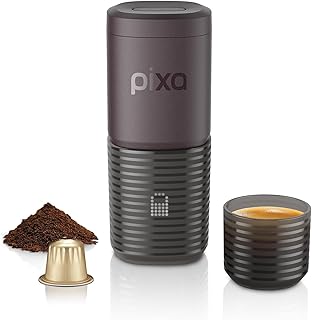
Quick Specs: Self-heating battery thermoblock (88 °C / 92 °C / 96 °C presets; ~180s from cold) | Adjustable 8–16 g ground coffee basket + Nespresso Original (NS) capsule adapter | Milk System: None (espresso-only; CR-DRINK-ESP-02) | USB-C 3,000 mAh 3S rechargeable battery | 120 ml stainless water chamber | 74 × 74 × 181 mm (755 g) | Price Tier: Under $200
Audit Score: 7.9 / 10
- Thermal & Pressure Control (35%): 8.2 / 10
- Portafilter & Basket Ecosystem (25%): 7.5 / 10
- Steaming & Daily Workflow (20%): 7.4 / 10
- Value (20%): 8.5 / 10
Labeled strictly as a specialized portable alternative rather than a full countertop station, the Wacaco Pixapresso solves espresso extraction where wall outlets or counter space do not exist. According to Wacaco’s official Pixapresso specifications, its 755 g cylindrical body houses a 3,000 mAh 3S USB-C rechargeable battery capable of heating 120 ml of room-temperature water to 88 °C, 92 °C, or 96 °C in roughly 180 seconds—yielding up to five shots per charge from cold water or over 200 pulls when starting with hot kettle water.
It handles both an adjustable 8–16 g ground-coffee basket and Nespresso Original-format capsules, giving dorm students, travelers, and RV owners flexible brewing. However, rule CR-DRINK-ESP-02 draws a hard boundary here: the Pixapresso has zero steam wand or milk frothing system. If you drink daily lattes or cappuccinos, countertop picks #1–#9 remain far more practical unless you pack a separate handheld or countertop frother.
Buyer Verification Alert: Under rule CR-DRINK-ESP-02, the Pixapresso makes straight espresso only—budget for a standalone milk frother if you drink lattes. Under rule CR-ESP-ACC-09, its capsule module accepts Nespresso OriginalLine (NS) capsules only, never VertuoLine pods.
Pros
- USB-C self-heating battery with selectable 88 / 92 / 96 °C targets runs completely cord-free
- Brew either 8–16 g fresh ground coffee or Nespresso Original capsules on trips or office desks
- Compact 755 g travel-mug footprint takes virtually zero permanent counter space
Cons
- No steam wand or milk frother built in—fails milk-drink workflows without a separate frother (CR-DRINK-ESP-02)
- 120 ml tank and 3-minute cold-water heat-up lag behind plugged-in 120V countertop machines
- Proprietary compact basket rejects 51mm, 54mm, and 58mm standard espresso tools
Verdict: Buy it if you want cord-free USB-C straight espresso or capsule convenience for dorms, travel, or tiny desks. Skip it if you make daily hot lattes on a kitchen counter—choose the De’Longhi Stilosa (#4) or HiBREW H10A (#1) instead. Pair with a compact hand burr grinder for fresh travel shots.
Buying Guide: How to Choose the Best Espresso Machine Under $200
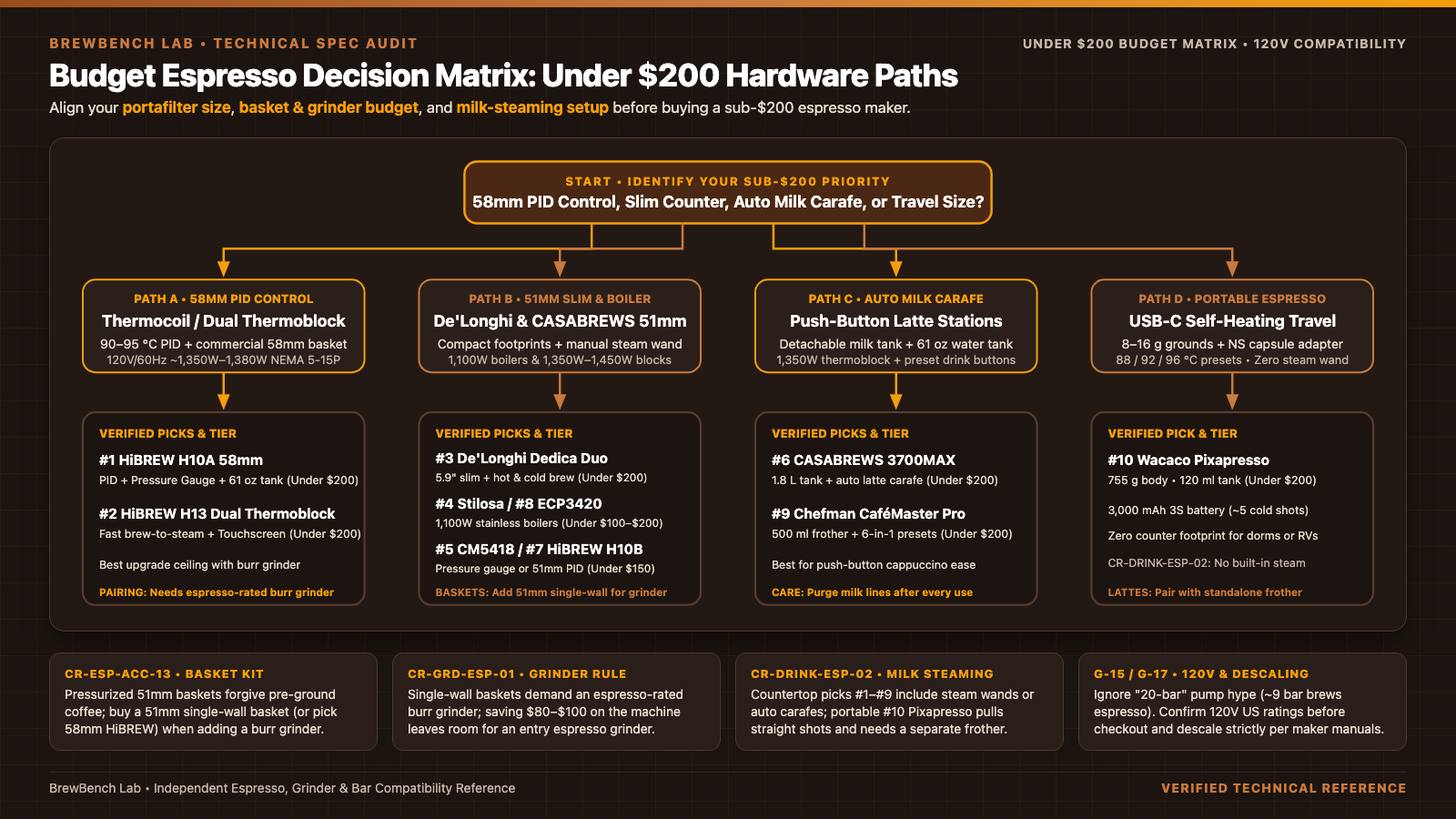
Shopping for the best espresso machine under $200 rewards buyers who ignore marketing bar numbers and focus instead on basket walls, grinder pairing math, heating topology, and North American 120V electrical parity. Use the six technical checkpoints below before placing an order.
1. Single-Wall vs. Pressurized Baskets (CR-ESP-ACC-13)
Almost every sub-$200 51mm machine—including the De’Longhi Stilosa EC260BK, De’Longhi ECP3420, CASABREWS CM5418, and Chefman CaféMaster Pro—ships primarily with pressurized (dual-wall) baskets. Those baskets force coffee through a tiny bottom pinhole so pre-ground coffee still builds faux crema and resistance. While pressurized baskets are helpful training wheels, they mask subtle roast sweetness and cap extraction clarity.
Under compatibility rule CR-ESP-ACC-13, stepping up to true espresso requires a single-wall (non-pressurized) basket where finely ground coffee alone creates resistance. The HiBREW H10A and HiBREW H13 give you a commercial-style 58mm ecosystem ready for single-wall extraction, whereas 51mm De’Longhi and CASABREWS owners should verify bundle contents and budget for a compatible 51mm single-wall basket once they own an espresso grinder.
2. The Mandatory Grinder Rule (CR-GRD-ESP-01)
No machine under $200 includes a built-in grinder. Under compatibility rule CR-GRD-ESP-01, pairing a single-wall basket with a blade grinder or a filter-only burr grinder (such as the standard non-ESP Baratza Encore or stock Fellow Ode Gen 2) results in fast, sour, under-extracted shots that gush in seconds.
If your overall budget sits near $250–$300, saving money on a sub-$100 stainless boiler like the De’Longhi Stilosa or sub-$150 HiBREW H10B so you can afford an entry conical or hand grinder from our best espresso grinders under $200 guide will transform cup quality far more than spending every dollar on a prettier machine shell.
3. Milk Steaming vs. Espresso-Only Hardware (CR-DRINK-ESP-02)
Decide honestly how you drink coffee daily. Under rule CR-DRINK-ESP-02, espresso-only brewers without steam capability—like the USB-C Wacaco Pixapresso (#10)—cannot make lattes or cappuccinos without buying a separate milk frother. Among countertop machines with steam (#1–#9), choose your texture workflow:
- Dual-Thermoblock Speed: The HiBREW H13 (#2) trims brew-to-steam recovery delays when pulling two lattes back-to-back.
- Manual Steam Wands: The HiBREW H10A (#1), De’Longhi Dedica Duo (#3), Stilosa (#4), and CASABREWS CM5418 (#5) let you learn real silky microfoam with a 12 oz stainless pitcher.
- One-Touch Milk Carafes: The CASABREWS 3700MAX (#6) and Chefman CaféMaster Pro (#9) automate frothy lattes at the press of a button if you prioritize convenience over manual latte art (and commit to rinsing the milk lines after each drink).
4. Separating “20-Bar” Pump Marketing From ~9 Bar Extraction
Every week, shoppers compare a “15-bar” De’Longhi against a “20-bar” CASABREWS or HiBREW assuming higher numbers pull richer espresso. They do not. Both figures advertise the maximum dead-head ceiling of a vibration pump when water flow is blocked, whereas espresso conventionally extracts near ~9 bar at the coffee puck via an internal over-pressure valve (OPV). Focus on PID temperature stability (HiBREW H10A, H13, H10B), boiler durability (De’Longhi Stilosa, ECP3420), and grind precision instead.
5. US 120V/60Hz Electrical Checks & Counter Clearance
Always confirm that any Amazon US espresso listing explicitly states 120V / 60Hz North American power with a standard household plug—never buy cheaper 220–240V international variants expecting plug adapters or undersized voltage converters to work safely, and never overload a shared 15-amp kitchen branch circuit by running a 1,500W kettle or toaster at the exact same moment you pull shots. If you ever step up to heavier 20-amp commercial machines carrying a horizontal-blade NEMA 5-20P plug, hire a licensed electrician rather than using adapters.
6. Water Chemistry & Manufacturer Descaling Rules
Hard tap water scales narrow thermoblock passages quickly, yet pure un-remineralized distilled water causes flat taste and can interfere with water-level sensing in certain machines. Following Specialty Coffee Association (SCA) water standards, aim for balanced low-mineral water near ~68 ppm (mg/L as CaCO3, roughly 4 grains per gallon) hardness, ~40 ppm alkalinity, 75–250 ppm TDS, and zero chlorine. When scale maintenance alerts appear, descale strictly using the solution and procedure specified in your owner’s manual—never improvise DIY vinegar or unapproved acid ratios that can damage aluminum thermoblocks or boiler seals.
7. Post-Purchase Upgrade Roadmap & Budget Tie-Breakers
Set aside modest post-purchase headroom for three essentials that immediately improve shots on any sub-$200 setup: an espresso-capable burr grinder (under CR-GRD-ESP-01), a 0.1 g digital scale slim enough for your machine’s drip tray to hit consistent 1:2 brew ratios, and a proper flat metal tamper sized precisely to your basket (51mm or 58.5mm) to replace flimsy plastic starter scoops. Still deciding whether to spend under $200 or stretch higher? Choose under $200 if you want a solid entry machine alongside a separate grinder right now; step up to our best espresso machines under $500 guide only if you want three-second ThermoJet startup, a three-way solenoid valve, or an automated milk-temperature sensor.
Methodology, Weighted Scoring Rubric & Excluded Models
Every score and award in this guide comes from a structured 120V technical specification and compatibility audit conducted by Daniel Park and the BrewBench Lab team—zero paid placements and zero invented temperature or extraction graphs. We cross-checked manufacturer North American manuals, wattage and NEMA 5-15P plug parity, portafilter diameters and lug compatibility, supplied pressurized vs. single-wall baskets, tank capacities, and milk-steaming workflows. Brand diversity is capped at three picks per manufacturer (three HiBREW, three De’Longhi, two CASABREWS, one Chefman, and one Wacaco portable alternative) so different architectures receive fair comparison. Read our complete standards on the Editorial Evaluation Methodology page.
| Evaluation Criterion | Weight | What We Audited |
|---|---|---|
| Thermal & Pressure Control | 35% | Heating architecture (dual thermoblock, PID thermocoil, thermoblock, or stainless boiler), pre-infusion, and ~9 bar OPV regulation. |
| Portafilter & Basket Ecosystem | 25% | 58mm vs. 51mm lug standards, single-wall vs. pressurized basket inclusions (CR-ESP-ACC-13), and chassis durability. |
| Steaming & Daily Workflow | 20% | Manual steam wand vs. automatic milk carafe vs. espresso-only limits (CR-DRINK-ESP-02), recovery lag, and tank size. |
| Value | 20% | Hardware completeness under $200, room left for an entry espresso burr grinder, and North American warranty coverage. |
Models We Audited & Excluded
Models We Audited & Excluded (And Why)
- De’Longhi Classic Signature EM450.M (220–240V Marketplace Listings): Excluded from our primary US recommendations because cross-checking turned up 220–240V / 50–60Hz international electrical specs on marketplace listings rather than guaranteed 120V North American certification.
- Lelit, Profitec, ECM & Flair 58 Hardware: Excluded as Amazon buy-intent picks because these specialty brands distribute primarily through off-Amazon espresso dealers and sit well above the sub-$200 bracket.
- Blade Grinders & Filter-Only Grinders Paired With Single-Wall Baskets (CR-GRD-ESP-01): Explicitly flagged as an incompatible pairing—standard non-ESP Baratza Encore units, stock Fellow Ode Gen 2 grinders, and blade choppers cannot grind fine enough to pressurize single-wall baskets.
- Sub-$60 Steam-Driven Moka-Style Carafe Makers: Excluded because low-pressure steam brewers push water near 1.5–3 bar rather than regulated ~9 bar espresso extraction.
Authoritative Manufacturer & Technical References
- HiBREW — Official Specifications Portal (120V/60Hz H10A, H13 dual-thermoblock, and H10B PID temperature, 58mm/51mm portafilter, and tank specs)
- De’Longhi US — Official Product Manuals Portal (120V 1,100W Stilosa & ECP3420 boilers, 1,450W Dedica Duo specs, 51mm baskets, and EcoDecalk descaling)
- CASABREWS — Official Espresso Product Portal (120V 1,350W thermoblock specs, CM5418 gauge, and 3700 series reservoir ratings)
- Chefman — Official CaféMaster Pro Support Portal (RJ54-I-SV 120V 1,350W ratings, 1.8 L tank, 500 ml milk carafe, and 51mm baskets)
- Wacaco — Official Pixapresso Technical Specifications (3,000 mAh 3S USB-C battery, 120 ml chamber, 88–96 °C presets, and NS capsule adapter)
- Specialty Coffee Association (SCA) — Coffee & Water Standards (hardness, alkalinity, TDS, and corrosion boundaries)
Continue Your Audit
Frequently Asked Questions: Best Espresso Machine Under $200
What is the best espresso machine under $200 for most buyers?
The HiBREW H10A 58mm Espresso Machine is the strongest overall pick under $200 because it combines a commercial-diameter 58mm portafilter, adjustable 90–95 °C (194–203 °F) PID brew temperatures, 0–10s pre-infusion, and a front pressure gauge. For faster multi-latte transitions, choose the dual-thermoblock HiBREW H13.
Does a 20-bar pump make better espresso than a 15-bar machine under $200?
No—15-bar and 20-bar labels describe a vibration pump’s maximum dead-head pressure ceiling, not optimal brew pressure. Quality espresso extracts around 9 bar at the puck via an internal over-pressure valve (OPV). Temperature stability, basket type, and grind consistency matter far more than pump bar ratings.
Do I need a separate coffee grinder for an espresso machine under $200?
Yes whenever you brew with single-wall (non-pressurized) baskets. Pressurized dual-wall baskets work temporarily with pre-ground coffee by restricting flow through one pinhole, whereas single-wall baskets require an espresso-rated burr grinder under rule CR-GRD-ESP-01 to generate proper puck resistance.
Should I buy a 51mm or 58mm espresso machine under $200?
Choose 58mm (HiBREW H10A or HiBREW H13) if you want standard cafe-width baskets and long-term precision accessory upgrades, confirming lug ears first. Choose 51mm (De’Longhi Dedica Duo, Stilosa EC260BK, or CASABREWS CM5418) when narrow counter width or sub-$100 entry pricing matters most.
Can any espresso machine under $200 brew and steam at the same time?
Most machines under $200 use a single thermoblock or single stainless boiler and run sequentially, extracting espresso first and steaming milk second. The standout exception is the HiBREW H13, which uses dual thermoblocks for near-immediate brew and steam transitions without long recovery waits.
Can I use pure distilled water in a budget espresso machine under $200?
No—avoid un-remineralized pure distilled water in espresso machines because zero-mineral water produces flat extraction and can disrupt water-level sensing on certain designs. Use filtered low-hardness water (~68 ppm CaCO3 per SCA guidance) or remineralized recipes, and descale strictly according to your manual.
Final Verdict: Choosing the Best Espresso Machine Under $200
Picking the best espresso machine under $200 comes down to matching your portafilter goals, grinder budget, and milk routine rather than chasing 20-bar marketing stickers. For maximum control and 58mm upgrade potential right around $200, the HiBREW H10A 58mm takes #1 overall with PID brew temperatures, pre-infusion, and a front pressure gauge, while the HiBREW H13 adds dual-thermoblock speed for back-to-back lattes. Need major-brand polish on a cramped 6-inch counter? Choose the De’Longhi Dedica Duo—or grab the sub-$100 De’Longhi Stilosa EC260BK and put your savings straight into an espresso-capable burr grinder and 51mm single-wall basket.


