
Disclosure: As an Amazon Associate, I earn from qualifying purchases. If you buy through links on this page, we may earn a small commission at no extra cost to you.
Evaluating the 1zpresso j-ultra vs kingrinder k6 comes down to one sharp engineering tradeoff in the 48mm manual conical burr category: ultra-fine 8-micron espresso click precision with a magnetic catch cup versus 16-micron all-purpose versatility at a noticeably lower entry tier. Both grinders stand near the top of our best espresso grinders pillar guide and our best hand grinders for espresso roundup, yet their thread pitches, burr coatings, and catch-cup hardware reward very different daily coffee routines.
The short verdict: Choose the 1Zpresso J-Ultra if espresso is your primary daily brew and you want 8 microns (0.008 mm) per click across 100 clicks per rotation, a twist-off magnetic catch cup, a folding crank handle, and a hard carrying case out of the box. Choose the KINGrinder K6 if you split your week between single-wall espresso and pour-over coffee, want faster range switching via a 60-click external dial, and prefer saving cash inside the $100–$200 bracket for a 0.1 g espresso scale or precision portafilter basket.
In This Comparison
- Winner-by-Use-Case Quick Verdict Matrix
- Side-by-Side Verified Spec & Compatibility Table
- Battleground 1: 8-Micron vs. 16-Micron Step Resolution & 9-Bar Dialing
- Battleground 2: 48mm Burr Geometry, Roast Profiles & Method Switching
- Battleground 3: Catch Cups, Handles, Dual O-Rings & Box Contents
- Battleground 4: Scale Pairing, Espresso Machine Fit & Budget Balance
- Battleground 5: Zero-Point Calibration, Cleaning & Durability Rules
- Choose J-Ultra If vs. Choose KINGrinder K6 If
- Verified Amazon US Grinders & Excluded Models
- Frequently Asked Questions
Quick Verdict Matrix: Which 48mm Hand Grinder Wins by Use Case?
Both models sit inside the $100–$200 Amazon US bracket (spanning the top of TIER-GRD-ENTRY into TIER-GRD-MID positioning), yet they diverge cleanly depending on whether you pull straight espresso exclusively or rotate between espresso and drip or pour-over. Match your brewing habits to the verified verdict grid below.
| Use Case & Brew Profile | Winner | Why It Wins (Verified Spec & Rule Fit) |
|---|---|---|
| Best for Dedicated Daily Espresso (single-wall 9-bar shots) | 1Zpresso J-Ultra | Moves just 8 microns (0.008 mm) per click across 100 clicks per rotation, letting you lock in shot times without changing dose weight (CR-GRD-ESP-03). |
| Best for Espresso & Pour-Over Switching | KINGrinder K6 | All-purpose 48mm heptagonal burrs and a 60-click external ring jump cleanly from ~40–44 espresso clicks to ~100 filter clicks without losing zero reference (CR-GRD-03). |
| Best Value Under $200 | KINGrinder K6 | Lower price tier inside the $100–$200 band delivers 48mm heptagonal stainless burrs and dual-bearing shaft stability, leaving budget for a 0.1 g scale (CR-SYS-01). |
| Best Daily Benchtop Ergonomics & Travel Kit | 1Zpresso J-Ultra | Twist-off magnetic catch cup, folding crank arm, included carrying case, and air blower speed up morning prep and clean-up. |
| Best Compact Dual-Purpose Magnetic Alternative | 1Zpresso K-Ultra | Bridges the gap in the $200–$500 tier by pairing K6-style all-purpose heptagonal clarity with a 100-click single-turn ring and magnetic catch cup. |
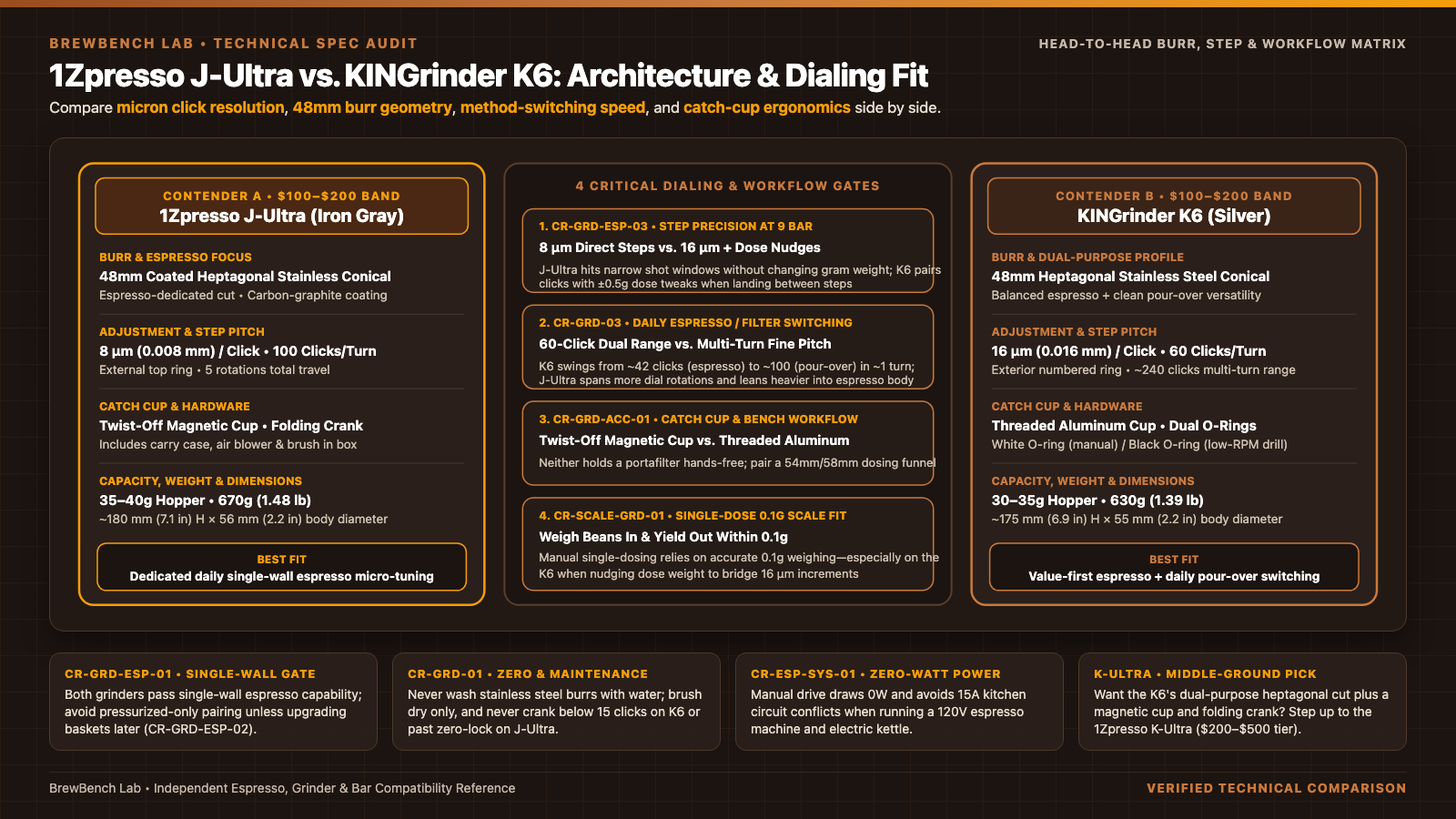
Side-by-Side Verified Spec & Compatibility Table
Every specification below is cross-checked against official 1Zpresso and KINGrinder manuals and US product pages. Neither manufacturer publishes standardized third-party acoustic decibel ratings, retention gram averages under uniform bean conditions, or exact grind-duration benchmarks in seconds; per our audit rules, those unconfirmed figures are flagged as having no verified data available yet rather than estimated.
| Specification / Compatibility Metric | 1Zpresso J-Ultra (Iron Gray) | KINGrinder K6 (Silver) |
|---|---|---|
| Maker Positioning / Use Class | Espresso-focused manual burr grinder (passes CR-GRD-ESP-01) | All-purpose manual burr grinder, espresso-capable (passes CR-GRD-ESP-01) |
| Burr Diameter & Geometry | 48 mm (1.89 in) coated heptagonal stainless steel conical | 48 mm (1.89 in) heptagonal (7-blade) stainless steel conical |
| Burr Surface Treatment | Carbon-graphite coated stainless steel | Uncoated machined stainless steel |
| Adjustment Location | External numbered top ring | External numbered top ring |
| Vertical Travel per Click | 8 microns (0.008 mm) per click | 16 microns (0.016 mm) per click |
| Clicks per Full Rotation | 100 clicks (10 numbers, 10 clicks per number) | 60 clicks |
| Total Adjustment Travel | 5 rotations (500 total clicks) | Multi-rotation (~240 clicks / 4 rotations across dial) |
| Published Espresso Range | ~0.7.4 to 1.5.4 (74–154 clicks from zero, roast dependent) | ~25 to 60 clicks (~40–44 clicks typical starting window) |
| Bean / Catch-Cup Capacity | 35–40 g | 30–35 g |
| Catch-Cup Attachment | Twist-off magnetic cup | Threaded screw-on aluminum cup |
| Crank Handle Design | Foldable crank arm | Removable crank (straight or bent handle depending on Amazon batch) |
| Shaft Support | Dual ball-bearing central shaft | Dual ball-bearing central shaft |
| Dimensions (Body) | ~180 mm (7.1 in) H × 56 mm (2.2 in) body diameter | ~175 mm (6.9 in) H × 55 mm (2.2 in) body diameter; ~160 mm (6.3 in) crank |
| Weight | ~670 g (1.48 lb / 23.6 oz) | ~630 g (1.39 lb / 22.2 oz) |
| Included Accessories | Carry case, cleaning brush, air blower | Cleaning brush, white manual O-ring, black drill-use O-ring |
| Power Draw / 120V Circuit Load | Manual drive (0W; zero circuit load) | Manual drive (0W; optional low-RPM screwdriver note in manual) |
| Retention & Noise Benchmarks | No verified data available yet (manual single-dose; varies with RDT/beans) | No verified data available yet (manual single-dose; varies with RDT/beans) |
| US Warranty Context | 1-year limited warranty (excludes normal burr wear & foreign objects) | 1-year limited support (retain Amazon proof of purchase per manual) |
| Amazon US Budget Tier | $100–$200 (TIER-GRD-ENTRY upper band) | $100–$200 (TIER-GRD-ENTRY lower-to-mid band) |
Battleground 1: 8-Micron vs. 16-Micron Step Resolution & 9-Bar Espresso Dialing
Before comparing aesthetics or catch cups, every espresso buyer must clear two foundational compatibility gates: CR-GRD-ESP-01 (can the grinder grind fine enough to build real puck resistance inside a non-pressurized single-wall basket?) and CR-GRD-ESP-03 (are the adjustment increments tight enough to dial in shot time without jumping straight from choking to gushing?).
Both the 1Zpresso J-Ultra and the KINGrinder K6 pass CR-GRD-ESP-01 decisively. Unlike blade choppers or filter-only mills that hit their minimum burr gap long before achieving ~9 bar extraction resistance, both 48mm grinders can grind fine enough to stall a 9-bar pump machine completely (remember that a “15-bar” or “20-bar” label on an entry machine refers to maximum pump rating, whereas balanced espresso brews near ~9 bar at the puck). Where the two grinders separate sharply is CR-GRD-ESP-03—vertical burr displacement per click:
- 1Zpresso J-Ultra (8 Microns / Click): Each click shifts the inner burr vertically by 0.008 mm across a wide 100-click circle. When dialing in a single-wall 18 g basket, one or two clicks on the J-Ultra nudges shot flow gently—keeping your coffee dose constant while fine-tuning extraction speed or compensating for beans aging day by day.
- KINGrinder K6 (16 Microns / Click): Each click moves the burr twice as far—0.016 mm across a 60-click ring. Sixteen microns per step is still dramatically finer than general-purpose 30-click entry hand grinders, and works smoothly for medium and dark roasts. However, with dense light roasts or precision high-extraction baskets, one K6 click can occasionally bracket your target 25–30 second window. Under rule
CR-GRD-ESP-03, the clean workaround is pairing the nearest click with a ±0.5 g dose adjustment (or slight ratio shift) using a 0.1 g scale.
In short, if you hate adjusting dose weight and prefer fixing every shot purely on the dial, the J-Ultra’s 8-micron granularity earns its premium. If you already weigh every dose to 0.1 g and don’t mind bumping from 18.0 g to 18.5 g when needed, the K6’s 16-micron pitch remains thoroughly espresso-capable.
Battleground 2: 48mm Burr Geometry, Roast Profiles & Method Switching
On paper, both grinders use 48 mm (1.89 in) stainless steel conical burrs supported by dual ball bearings on the central drive shaft. That large 48 mm diameter gives both mills substantially higher surface area and faster bean intake per crank turn than 38 mm entry hand grinders profiled in our best espresso grinders under $200 guide. Yet their internal flute geometry and surface finishing target slightly different flavor priorities under rule CR-DRINK-GRD-01:
- 1Zpresso J-Ultra Burr Profile: 1Zpresso builds the J-Ultra around an espresso-optimized 48 mm burr finished with a dark carbon-graphite coating designed for wear resistance and low friction. Its cut philosophy prioritizes classic espresso body, syrupy mouthfeel, and forgiving extraction across medium, dark, and medium-light blends.
- KINGrinder K6 Burr Profile: KINGrinder machines the K6 with an uncoated 48 mm heptagonal (7-blade) stainless steel burr set engineered to minimize excessive fines at coarser filter settings while still grinding finely enough for 9-bar espresso. Under
CR-DRINK-GRD-01, that heptagonal geometry shines if you enjoy brighter, cleaner pour-over brews alongside espresso.
Avoid falling for blanket claims that flat burrs automatically beat conical burrs in every cup—as we examine in our flat vs conical burr grinder comparison, burr alignment, roast level, and step resolution matter just as much as geometry. Also note compatibility rule CR-GRD-01: unlike 64 mm electric single-dosers, neither the J-Ultra nor the K6 accepts standardized aftermarket burrs, and 1Zpresso does not sell standalone replacement burr sets separately.
Where burr geometry meets daily workflow is rule CR-GRD-03 (switching between espresso and pour-over). Both grinders place their numbered adjustment rings externally near the top collar, so you never lose your zero reference or count blindly from burr lock like internal-dial budget grinders. Still, the KINGrinder K6 wins daily switching convenience: jumping from a ~42-click espresso setting to a ~100-click V60 pour-over setting takes roughly one full rotation of its 60-click dial. On the 1Zpresso J-Ultra, moving from espresso (~1.0.0, or 100 clicks) out to coarse filter coffee requires spinning through multiple full rotations of its fine 8-micron thread pitch—completely doable thanks to the rotation indicator scale, just noticeably slower when switching every morning.
Battleground 3: Catch Cups, Crank Handles, Dual O-Rings & Box Contents
When you grind 18 g to 20 g of coffee by hand every morning, mechanical ergonomics quickly separate an enjoyable ritual from an irritating chore:
- Magnetic vs. Threaded Catch Cup (
CR-GRD-ACC-01): Neither hand grinder uses a portafilter fork; both drop grounds into a removable metal catch cup, so transferring grounds cleanly into a 51 mm, 54 mm, or 58 mm basket benefits from a matching dosing funnel. The 1Zpresso J-Ultra features a quick-release twist-off magnetic catch cup (35–40 g capacity) that detaches with a smooth quarter-twist—just remember 1Zpresso’s manual guidance to twist rather than yank straight down so magnets don’t pull violently against the burr collar. The KINGrinder K6 uses a traditional screw-on threaded aluminum cup (30–35 g capacity). Threaded cups never pop loose mid-grind, but unscrewing and cleaning fine coffee chaff out of exposed threads takes extra seconds every shot. - Crank Handle & O-Ring Setup: The J-Ultra ships with a hinged, spring-assisted folding handle that tucks snugly along the 56 mm barrel, making it effortless to slide into its included zippered carrying case alongside the bundled brush and rubber air blower. The K6 skips a carrying case and ships with a detachable crank arm (note that KINGrinder Amazon US batches vary between straight and bent crank arms; inspect listing photos if you strongly prefer a bent ergonomic arm). Uniquely, KINGrinder includes two top-cap O-rings: a white O-ring for standard hand grinding and a black O-ring designed for driving the shaft with a slow-speed electric screwdriver set to 15–25 torque. Never mix both O-rings or use the black O-ring for hand cranking, or the lid and handle can work loose mid-grind.
- Weight & Grip Feel: At ~670 g (1.48 lb) versus ~630 g (1.39 lb), both grinders feel dense and solid in hand. Both share an almost identical ~55–56 mm (2.2 in) barrel diameter, though the J-Ultra’s textured grip sleeve provides slightly surer traction when grinding dense light-roast beans at fine espresso settings.
Battleground 4: Scale Pairing, Machine Fit & True Setup Budget
Because both the J-Ultra and K6 are single-dose cup grinders (CR-GRD-02), neither stores beans in a hopper or doses by timer. Under rule CR-SCALE-GRD-01, pairing either grinder with a 0.1 g digital coffee scale is effectively mandatory. Weighing beans to 0.1 g before grinding guarantees repeatable espresso recipes, and on the KINGrinder K6 it enables reliable ±0.5 g dose tweaks whenever you fall between two 16-micron clicks.
Also consider your espresso machine’s basket architecture and kitchen electrical setup:
- Single-Wall vs. Pressurized Baskets (
CR-GRD-ESP-02): Both 48 mm grinders are built for single-wall (non-pressurized) baskets. If your espresso machine only shipped with pressurized dual-wall baskets, neither grinder’s micron precision can shine until you upgrade to a compatible single-wall basket for your exact portafilter diameter and lug pattern. - Setup Budget Allocation (
CR-SYS-01): Our setup rule recommends dedicating at least roughly a third of your machine-plus-grinder budget to the grinder when pulling single-wall espresso. Because the KINGrinder K6 sits near the lower end of the $100–$200 tier, it unlocks true 48 mm espresso grinding even inside tight $400–$600 total starter setups—leaving room for a 0.1 g scale and a single-wall basket upgrade without sacrificing burr size. - Zero-Watt Kitchen Compatibility (
CR-ESP-SYS-01/CR-ESP-SYS-02): Manual grinders draw zero watts. If you live in an older North American apartment with a shared 15A (1,800 W peak / 1,440 W continuous guidance) 120V/60Hz kitchen branch circuit, a hand grinder eliminates simultaneous electrical load from an electric grinder while your espresso machine heats—leaving circuit headroom intact.
Battleground 5: Zero-Point Calibration, Cleaning & Long-Term Care
Both grinders disassemble completely by hand without special hex wrenches, yet ignoring two manufacturer rules can damage precision-cut stainless steel burrs:
- Never Wash Steel Burrs With Water: Both 1Zpresso and KINGrinder manuals explicitly forbid rinsing the burrs, bearings, or grinder body with water. Moisture causes rust on high-hardness steel burrs and ruins lubricated ball bearings. Clean routinely with the supplied dry brush (and air blower on the J-Ultra). If using optional water-droplet static control (RDT) in dry climates, use only a tiny mist on beans prior to grinding—never wet the inner chamber directly.
- Respect Burr Lock & Minimum Click Limits: On the 1Zpresso J-Ultra, turn counter-clockwise gently until the burrs kiss and the crank stops spinning freely to verify your true zero mark (#0). On the KINGrinder K6, rotate clockwise gently to true zero, and strictly obey KINGrinder’s manual rule: never rotate the crank handle at 0 or below 15 clicks, as metal-on-metal burr contact can dull or score the heptagonal flutes permanently.
- Re-Zeroing After Deep Cleaning (
CR-GRD-01): After removing the circlip or knurled nut for deep dry brushing, reassemble components in exact order and re-verify your zero point before grinding your next espresso dose so your saved dial numbers stay accurate.
Head-to-Head Decision Summary: Choose J-Ultra or Choose K6?
Choose the 1Zpresso J-Ultra if…
- Espresso is 80–100% of your daily brewing (
UC-STRAIGHT-ESPRESSO/UC-MILK-DRINKS-DAILY) and you want 8-micron dial control without tweaking dose weight. - You want premium daily quality-of-life touches: a twist-off magnetic catch cup, folding crank arm, air blower, and protective travel case.
- You favor syrupy body and coated-burr durability across dark, medium, and medium-light espresso roasts.
- You occasionally grind larger 35–40 g batches in one load.
Choose the KINGrinder K6 if…
- You switch regularly between weekday single-wall espresso and weekend pour-over or AeroPress (
UC-FILTER-AND-ESPRESSO/CR-GRD-03). - You want maximum 48 mm heptagonal burr performance at the lowest price inside the $100–$200 bracket, freeing budget for a 0.1 g scale or single-wall basket.
- You enjoy cleaner, brighter cup clarity from uncoated 7-blade burrs and don’t mind ±0.5 g dose tweaks when bridging 16-micron clicks.
- You prefer the security of a threaded screw-on catch cup (or want the manual’s optional low-RPM drill O-ring setup).
Verified Amazon US Grinders & Excluded Alternatives
All three hand grinders below are verified North American Amazon US listings backed by official manufacturer manuals. If you want the K6’s dual-purpose heptagonal clarity paired with the J-Ultra’s magnetic catch cup and folding crank, inspect the 1Zpresso K-Ultra listed third as a worthy step-up alternative.
1. 1Zpresso J-Ultra Manual Coffee Grinder (Iron Gray) — Espresso Precision Winner

Quick Specs: 48 mm coated heptagonal stainless steel conical burr | 8 microns (0.008 mm) per click, 100 clicks per rotation (5 rotations total) | Twist-off magnetic catch cup (35–40 g capacity) | Foldable crank handle | ~670 g (1.48 lb) | Includes carrying case, brush & air blower | Price Tier: $100–$200 (TIER-GRD-ENTRY upper band)
Pros
- Ultra-fine 8-micron external adjustment dial prevents landing between two 9-bar espresso shot times
- Twist-off magnetic catch cup, folding crank arm, carry case, and blower deliver best-in-class daily workflow
- 48 mm coated conical burr and 35–40 g hopper grind double shots smoothly with rich espresso texture
Cons
- Multi-rotation 8-micron thread pitch takes more dial turns when jumping back and forth to coarse pour-over
- Costs noticeably more inside the $100–$200 tier than the KINGrinder K6 and weighs slightly more at 670 g
2. KINGrinder K6 Manual Coffee Grinder (Silver) — Best Value & All-Purpose Winner

Quick Specs: 48 mm heptagonal stainless steel conical burr | 16 microns (0.016 mm) per click, 60 clicks per rotation | Threaded aluminum catch cup (30–35 g capacity) | Dual-bearing shaft + white manual & black drill O-rings | ~630 g (1.39 lb) | Price Tier: $100–$200 (TIER-GRD-ENTRY)
Pros
- 48 mm heptagonal burrs produce sweet single-wall espresso alongside bright, clean pour-over cups
- 60-click external top ring swings rapidly between ~40–44 espresso clicks and ~100 pour-over clicks
- Exceptional value inside the $100–$200 bracket frees budget for a 0.1 g scale or single-wall basket upgrade
Cons
- 16-micron steps occasionally call for ±0.5 g dose adjustments on finicky light-roast espresso
- Threaded catch cup takes longer to remove and brush clean than a magnetic cup, and no carrying case is included
3. Worth Considering: 1Zpresso K-Ultra Manual Coffee Grinder — Dual-Purpose Magnetic Upgrade

Quick Specs: 48 mm K-burr heptagonal stainless steel conical burr | 20 microns per click, 100 clicks per rotation | Twist-off magnetic catch cup (35–40 g capacity) | Foldable crank handle + carrying case | Price Tier: $200–$500 (TIER-GRD-MID)
If you love the KINGrinder K6’s clean all-purpose heptagonal flavor profile for espresso and pour-over yet want the 1Zpresso J-Ultra’s magnetic catch cup, folding crank arm, and travel case, the 1Zpresso K-Ultra bridges both designs. Its single-revolution 100-click external dial makes switching between filter and espresso effortless, though at 20 microns per click it relies slightly more on ±0.5 g dose adjustments for espresso than either the J-Ultra (8 microns) or K6 (16 microns), and its $200–$500 tier positioning enters entry electric grinder territory.
Models Excluded From This Amazon US Comparison
- Off-Amazon Dealer-Only Grinders (Niche Zero, Niche Duo, Timemore Sculptor 064): Excluded as Amazon buy-intent picks because these models rely on direct or specialty dealer distribution without primary Amazon US storefront fulfillment, and operate as electric benchtop units outside the manual grinder class.
- Filter-Focused Manual Mills (1Zpresso Q Air, 1Zpresso ZP6 Special): Excluded under
CR-GRD-ESP-01andCR-GRD-ESP-03because their burr geometries and click ranges are tuned for clean filter percolation rather than high-resistance 9-bar single-wall espresso. - Generic Ceramic-Burr Mills & Blade Choppers: Disqualified under
CR-GRD-ESP-01; wide stepped detents and uneven crushing make repeatable single-wall espresso extraction impossible.
Authoritative Technical References
- 1Zpresso — Official J-Ultra & K-Ultra Specifications and User Manuals (48 mm conical burr specs, 8-micron and 20-micron external dials, magnetic catch cups, and 1-year limited warranty).
- KINGrinder — Official K6 Specifications and Maintenance Manual (48 mm heptagonal burr specs, 16-micron 60-click dial, 15-click minimum lock warning, dual O-ring system, and dry-brush cleaning rules).
- Specialty Coffee Association (SCA) — Coffee Brewing & Grinding Standards (Particle control, dose-to-yield ratios, and dry grinder care guidelines).
How We Audited This Guide
- Burr grinders were checked for maker-stated espresso adjustment fineness, burr geometry and size, single-dose vs hopper workflow, retention caveats, and kitchen height clearance.
- Every espresso machine, burr grinder, accessory, and scale specification was cross-checked against official manufacturer 120V manuals, SCA water guidance, and verified Amazon US listings.
- Recommendations were evaluated against our weighted espresso-gear scoring rubrics and documented CR-* compatibility rules; we never invent heat-up seconds, PID variance, or micron claims.
Continue Your Audit
Frequently Asked Questions
Is the 1Zpresso J-Ultra worth the extra cost over the KINGrinder K6?
Yes if espresso is your primary daily drink. The J-Ultra halves vertical step size to 8 microns per click, adds a twist-off magnetic catch cup and folding crank handle, and includes a hard carrying case—eliminating dose-weight compromises when dialing single-wall shots.
Can the KINGrinder K6 grind fine enough for non-pressurized 9-bar espresso?
Yes—the KINGrinder K6 clears CR-GRD-ESP-01 easily for single-wall baskets. Its 48 mm heptagonal stainless steel burrs and 16-micron external steps (starting near 40–44 clicks) choke a 9-bar espresso machine cleanly, though light roasts occasionally benefit from a ±0.5 g dose tweak.
Which grinder is faster to switch between espresso and pour-over daily?
The KINGrinder K6 switches faster under rule CR-GRD-03. Moving from ~42 espresso clicks to ~100 pour-over clicks requires roughly one full turn of its 60-click external ring, whereas the J-Ultra’s finer 8-micron thread pitch requires counting multiple rotations between brew methods.
Do I need a 0.1 g coffee scale with the J-Ultra or KINGrinder K6?
Yes—under rule CR-SCALE-GRD-01, both are single-dose cup grinders. Neither stores beans in a hopper or doses by timer, so weighing whole beans to 0.1 g before grinding ensures shot-to-shot consistency and enables ±0.5 g dose tuning on the K6.
Can I wash the 1Zpresso J-Ultra or KINGrinder K6 burrs with water?
No—both manufacturers forbid washing burrs or bearings with water. Moisture promotes corrosion on high-hardness steel burrs and damages sealed ball bearings. Disassemble tool-free and clean only with the supplied dry brush and air blower.
Can I attach a power drill to the KINGrinder K6?
KINGrinder’s manual documents an optional electric screwdriver setup using the black O-ring. Set torque to 15–25 at slow speed to protect the central shaft, never crank below 15 clicks, and always swap back to the white O-ring for manual grinding.


