
Disclosure: As an Amazon Associate, I earn from qualifying purchases. If you buy through links on this page, we may earn a small commission at no extra cost to you.
Choosing the right water filter for espresso machine reservoirs or water lines is the single highest-leverage step for preventing boiler limescale, preserving flow rate, and protecting factory warranty coverage. Tap water varies wildly across North American municipalities: too much dissolved calcium chokes narrow thermoblock passages and solenoid valves, while un-remineralized distilled or zero-mineral water can cause conductive boiler level probes to report false empty-tank errors.
To eliminate cartridge mismatch mistakes and guesswork, we audited ten verified Amazon US filtration options spanning shape-locked OEM reservoir pods, universal drop-in pads, countertop magnesium pitchers, zero-TDS base pitchers, and plumbed-in inline cartridges. Every pick below is evaluated strictly for machine care and flavor consistency rather than drinking-water claims. Pair this cartridge audit with our best water for espresso machines pillar hub and check your tap profile using our water hardness for espresso machines reference before ordering.
In This Guide
- Quick Picks at a Glance
- Side-by-Side Specs Comparison
- Match Your Machine & Tap Profile
- Detailed Audits of the Best Water Filters for Espresso Machines (1–10)
- Cartridge Slot, Probe & Warranty Compatibility Reference
- Buying Guide: Choosing a Water Filter for Your Espresso Machine
- Weighted Scoring Rubric & Excluded Products
- Frequently Asked Questions
- Final Verdict
Quick Picks: Best Water Filter for Espresso Machine Setups
#1 Best Overall OEM Cartridge
Breville BES008 ClaroSwiss Water Filter
True ion-exchange resin and activated carbon clip straight into modern Breville ClaroSwiss tank docks for 90-day scale and chlorine protection. (Jump to audit)
#2 Best Magnesium Softening Pitcher
BWT AQUAlizer Home 2.7L Filtration Jug
Exchanges scale-forming calcium for magnesium across 120-liter cartridges while keeping enough conductive minerals for boiler probes. (Jump to audit)
#3 Best Universal Drop-In Tank Pad
BWT Bestsave M Limescale Protection Pad
Passive 100-liter ion-exchange pillow sits inside non-cartridge tanks like Gaggia, Rancilio, or Bambino with zero counter footprint. (Jump to audit)
Side-by-Side Comparison: 10 Audited Espresso Water Filters
| Filter & Award | Best For | Format & Mechanism | Rated Capacity / Interval | Amazon Link |
|---|---|---|---|---|
| Breville BES008 ClaroSwiss Best Overall OEM Cartridge | Modern Breville ClaroSwiss machines | In-tank resin + carbon pod | ~40–60 L / 90 days | View on Amazon |
| BWT AQUAlizer 2.7L Jug Best Magnesium Pitcher | Non-cartridge tanks & multi-brewer bars | 2.7 L Mg2+ ion-exchange pitcher | 120 L per cartridge | View on Amazon |
| BWT Bestsave M Pad Best Universal Tank Pad | Small kitchens & non-dock reservoirs | Drop-in cation-exchange pad | 100 L / ~2 months | View on Amazon |
| De’Longhi DLSC002 Filter Best OEM De’Longhi Filter | Dedica, La Specialista & ECAM | In-tank resin + carbon softener | ~50 L / 2 months | View on Amazon |
| Breville BWF100 (6-Pack) Best Legacy Breville Pack | BES870, BES840 & early BES920 | In-tank activated charcoal pods | 6 pods (~12 months total) | View on Amazon |
| Jura Claris Smart+ (24234) Best RFID Super-Auto Cartridge | Jura I.W.S. RFID automatic machines | Up-flow stabilizer + RFID chip | 40–65 L (hardness-indexed) | View on Amazon |
| Philips AquaClean CA6903 Best Long-Interval Filter | Philips LatteGo & Saeco super-autos | Ion-exchange + micro-porous pod | Up to 625 cups (~3 months) | View on Amazon |
| BWT Bestmax S Cartridge Best Plumbed Inline Filter | Plumbed-in prosumer espresso lines | 5-stage inline w/ bypass (0–3) | ~750–1,200 L typical | View on Amazon |
| ZeroWater 12-Cup Pitcher Best 0-TDS Recipe Base | Remineralized custom espresso recipes | 5-stage deionization + TDS meter | ~15–40 gal (swap at 006 ppm) | View on Amazon |
| Brita 10-Cup Elite Pitcher Best Soft-Tap Chlorine Pitcher | Soft municipal tap (<68 mg/L CaCO3) | NSF 42/53/401 carbon media | 120 gal / ~6 months | View on Amazon |
Match Your Bar: Which Espresso Water Filter Fits Your Setup?
| Buyer Scenario | Best Match | Why & Expected Outcome |
|---|---|---|
| Newer Breville Barista Pro, Barista Touch, Oracle Jet, or 2018+ Dual Boiler | Breville BES008 ClaroSwiss | OEM resin + carbon cartridge snaps straight into the ClaroSwiss reservoir dock for 90-day scale and chlorine protection. |
| Gaggia Classic Evo Pro, Rancilio Silvia, or Bambino on moderately hard tap water | BWT AQUAlizer 2.7L Jug | Magnesium ion-exchange removes scale-forming calcium while preserving conductive minerals for safe boiler operation. |
| Tight apartment espresso counter with no proprietary filter clip | BWT Bestsave M Pad | Zero-footprint drop-in pad softens up to 100 L right inside the machine reservoir without occupying fridge space. |
| De’Longhi Dedica, La Specialista, or ECAM super-automatic brewer | De’Longhi DLSC002 Filter | Shape-locked OEM softener installs directly in the tank and satisfies De’Longhi two-month maintenance alerts. |
| Light-roast dual boiler owner building custom mineral recipes at home | ZeroWater 12-Cup Pitcher | Generates 0-TDS base water on tap for remineralization packets—eliminating plastic jugs while honoring probe safety. |
| Plumbed-in prosumer machine fed by a dedicated cold-water supply line | BWT Bestmax S Inline | Five-stage inline filtration with adjustable 0–3 bypass prevents scale and balances alkalinity across ~1,000 L runs. |
Detailed Audits: Best Water Filters for Espresso Machines (1–10)
1. Breville BES008 ClaroSwiss Espresso Machine Water Filter — Best Overall OEM Reservoir Cartridge

Quick Specs: Ion-exchange resin & activated carbon | ~40–60 L (10.5–15.8 gal) or 90-day interval | Fits BES878, BES880, BES881, BES920 (2018+), BES980, BES985, BES990, BES995 | Probe-safe balanced output | Price Tier: Under $100 tier (TIER-WTR-BASIC)
Audit Score: 9.3 / 10
- Machine Protection & Probe Safety (35%): 9.3 / 10
- Verified Fit & Installation (25%): 9.5 / 10
- Warranty & Maintenance Alignment (20%): 9.6 / 10
- Flavor Balance, Convenience & Tier Value (20%): 8.9 / 10
If you brew on a recent-generation Breville thermojet or dual-boiler espresso machine, selecting the right OEM cartridge protects both internal flow paths and factory warranty standing. According to Breville US official water-filter guidance, the BES008 ClaroSwiss combines activated carbon with ion-exchange resin inside a single cylindrical housing rated for roughly 40 to 60 liters (10.5 to 15.8 gal) or 90 days of service—actively lowering calcium hardness and chlorine taste without stripping water down to zero conductivity.
That dual-media design separates the ClaroSwiss decisively from Breville’s older BWF100 charcoal pods (#5). While charcoal alone primarily improves tap flavor, the ClaroSwiss resin bed tackles limescale formation before water ever reaches your machine’s heating element or three-way solenoid valve. Under CR-WTR-ESP-05, the ClaroSwiss snaps tightly into compatible Breville tank docks, eliminating the gasket bypass leaks that plague generic clone cartridges.
Buyer Verification Alert: Breville changed reservoir filter interfaces mid-production on several flagship lines. Verify your tank dock and manufacturing batch code before ordering: legacy BES870 Barista Express, BES840 Infuser, and BES920 Dual Boiler units from batch 1800 and earlier take the two-piece BWF100 holder (#5), whereas 2018+ Dual Boilers, Barista Pro (BES878), Barista Touch (BES880/BES881), and Oracle Jet (BES985) accept the BES008 ClaroSwiss. Standard Bambino machines lack a tank filter holder entirely.
Pros
- Combines true ion-exchange hardness softening with activated carbon chlorine reduction in one OEM pod
- Clips directly into newer Breville ClaroSwiss tank docks with zero bypass leakage (CR-WTR-ESP-05)
- 90-day / 40–60 L replacement cadence stretches further than typical 60-day carbon-only pods
- Aligns directly with Breville US maintenance schedules and warranty documentation (CR-WTR-ESP-03)
Cons
- Shape-locked strictly to ClaroSwiss-equipped Breville batches—verify batch codes before checkout
- Cannot indefinitely neutralize extreme well-water hardness above typical municipal ranges
Verdict: Buy it if you own a ClaroSwiss-compatible Breville machine and want zero-guesswork OEM hardness and taste protection. Skip it if your Breville reservoir holds a BWF100 two-piece basket or has no filter dock at all. Maintenance Note: Log each 90-day swap in your phone calendar and verify local tap hardness with strips under CR-WTR-ESP-01.
2. BWT AQUAlizer Home 2.7L Water Mineralizer & Filtration Jug — Best Magnesium-Exchange Countertop Pitcher

Quick Specs: Patented BWT Mg2+ magnesium ion-exchange + activated carbon | 2.7 L (11.4 cups) total / ~1.5–1.6 L filtered volume | 120 L (31.7 gal) per cartridge | Probe-safe mineral output | Price Tier: Under $100 tier (TIER-WTR-BASIC)
Audit Score: 9.2 / 10
- Machine Protection & Probe Safety (35%): 9.4 / 10
- Verified Fit & Installation (25%): 9.0 / 10
- Warranty & Maintenance Alignment (20%): 8.9 / 10
- Flavor Balance, Convenience & Tier Value (20%): 9.4 / 10
Many popular home espresso machines—including the Gaggia Classic Evo Pro, Rancilio Silvia, and compact Breville Bambino—ship with open plastic reservoirs that lack proprietary cartridge mounts. The BWT AQUAlizer 2.7L solves that gap externally with commercial-grade chemistry scaled down for home kitchens. Per BWT’s official table-water filtration documentation, its Long Life Mg2+ cartridge binds scale-forming calcium ions via ion exchange and releases balanced magnesium ions in their place while stripping chlorine odors.
Crucially, this magnesium-exchange mechanism differs sharply from two competing pitchers in our roundup. Unlike the #10 Brita Elite—which leaves hard calcium ions intact—the BWT AQUAlizer actively shields boilers from carbonate limescale. Unlike the #9 ZeroWater pitcher—which strips dissolved solids to 0 ppm—BWT preserves conductive minerals, making it safe for machines using conductive boiler level probes (CR-WTR-ESP-02) and avoiding the elevated sodium levels of traditional salt-based softeners (CR-WTR-ESP-04).
Buyer Verification Alert: Standard BWT Mg2+ cartridges are rated for 120 liters (31.7 gal) or roughly 28 days of regular household throughput on moderate tap water. If your municipal supply sits above 250 mg/L CaCO3 (14.6 gpg), replace cartridges sooner based on hardness strips rather than waiting for visual scale inside your kettle.
Pros
- Exchanges calcium for magnesium instead of sodium, limiting boiler scale without muting espresso aromatics
- Retains enough dissolved conductivity for boiler autofill level probes to read tank levels reliably
- Universal compatibility across every reservoir espresso machine, pour-over kettle, and drip brewer
- 120 L cartridge capacity delivers lower ongoing per-liter cost than 50 L in-tank pods
Cons
- Requires countertop or refrigerator shelf space and an extra pitcher-pour step before brewing
- Does not adjust target alkalinity as precisely as a 0-TDS base + mineral packet recipe
Verdict: Buy it if you want the cleanest universal water filter for espresso machine tanks without proprietary cartridge docks, or if you share softened brew water with a pour-over kettle. Skip it if your kitchen lacks pitcher space—in that case, look directly below at the BWT Bestsave M pad. Upgrade Tip: Pair the jug with BWT 6-pack Mg2+ refills for uninterrupted six-month coverage.
3. BWT Bestsave M Limescale Protection Pad — Best Universal Drop-In Tank Pad

Quick Specs: Weak-acid cation-exchange pouch | 100 L (26.4 gal) capacity or ~2 months | Fits non-plumbed open reservoirs | Zero dock required | Price Tier: Under $100 tier (TIER-WTR-BASIC)
Audit Score: 8.9 / 10
- Machine Protection & Probe Safety (35%): 9.0 / 10
- Verified Fit & Installation (25%): 9.2 / 10
- Warranty & Maintenance Alignment (20%): 8.7 / 10
- Flavor Balance, Convenience & Tier Value (20%): 8.7 / 10
Apartment espresso setups often fail the space budget before the dollar budget: adding a 2.7-liter filtration jug beside a grinder, knock box, and espresso machine simply isn’t practical on a cramped counter or packed refrigerator door. The BWT Bestsave M solves limescale inside the machine itself. According to BWT Water + More documentation, this compact fleece pad drops loose onto the bottom of any non-plumbed tank and exchanges hardness-forming calcium over roughly 100 liters (26.4 gal) or two months of typical daily pulls.
Compared directly with the #2 BWT AQUAlizer jug, the Bestsave M pad wins on convenience and zero counter footprint, making it especially smart for Gaggia Classic Evo Pro, Rancilio Silvia, and Breville Bambino tanks. The trade-off is chemistry scope: Bestsave M focuses strictly on limescale ion exchange without an activated carbon stage, so strongly chlorinated city water still benefits from quick carbon pre-filtering.
Buyer Verification Alert: Lay the Bestsave M pouch flat on the reservoir floor clear of bottom check valves, silicone suction hoses (such as on dual-tube machines like Rancilio Silvia), and magnetic float sensors. Because softening occurs passively by diffusion inside the tank, refill the reservoir the night before or allow sitting contact time rather than brewing within seconds of pouring raw hard tap water.
Pros
- Zero proprietary tank brackets, adapters, or extra kitchen counter space required
- 100 L rated scale protection capacity doubles typical 50 L OEM tank cartridges
- Preserves sufficient dissolved ions for conductive boiler water-level probes (CR-WTR-ESP-02)
- Effortless 2-month swap schedule keeps recurring maintenance costs predictable
Cons
- Contains no activated carbon—does not remove municipal chlorine taste or odor
- Passive immersion works more slowly on fresh tank top-ups than flow-through pitchers
Verdict: Buy it if your espresso machine has no factory cartridge dock and you refuse to clutter your counter or fridge with a separate pitcher. Skip it if municipal chlorine taste is your primary complaint without a carbon pre-filter. Workflow Tip: Fill your tank in the evening so the pad softens overnight water before morning espresso.
4. De’Longhi Water Filter Softener DLSC002 (Pack of 1) — Best OEM Filter for De’Longhi Machines

Quick Specs: Ion-exchange resin & activated carbon | ~50 L (13.2 gal) or 2 months | Fits De’Longhi ECAM, ETAM, EC680/EC685/EC885 Dedica & La Specialista | Month dial ring | Price Tier: Under $30 tier (TIER-WTR-BASIC)
Audit Score: 8.9 / 10
- Machine Protection & Probe Safety (35%): 8.9 / 10
- Verified Fit & Installation (25%): 9.3 / 10
- Warranty & Maintenance Alignment (20%): 9.4 / 10
- Flavor Balance, Convenience & Tier Value (20%): 8.1 / 10
Narrow thermoblock heating coils in compact pump and bean-to-cup machines lose thermal efficiency quickly when calcium carbonate builds up inside aluminum or stainless water paths. According to De’Longhi US official filter specifications, the OEM DLSC002 pairs ion-exchange softening resin with activated carbon across a 50-liter (13.2-gallon) or two-month lifespan, sliding cleanly into Dedica EC680/EC685/EC885 reservoirs, La Specialista tanks, and ECAM/ETAM super-automatics.
Measured against the #6 Jura Claris Smart+ and #7 Philips AquaClean, the DLSC002 stands out for spanning both manual pump espresso machines and super-automatic bean-to-cup units under a single part number. Its mechanical top month dial gives manual Dedica owners a visual swap cue, while ECAM super-automatics track filter installation digitally inside the menu so descaling prompts adjust accordingly (CR-WTR-ESP-03).
Buyer Verification Alert: Two critical rules apply to the DLSC002: first, verify your De’Longhi model is ECAM, ETAM, Dedica (EC680/EC685/EC885), or La Specialista—older ESAM bean-to-cup tanks do not accept DLSC002 (CR-WTR-ESP-05). Second, submerge the filter upside down under running tap water until every air bubble escapes before seating it, or trapped air can starve the vibratory pump and trigger false ’empty tank’ alerts.
Pros
- Dual ion-exchange and carbon media curbs calcium scale and chlorine odors across narrow thermoblocks
- Integrated month indicator ring tracks two-month swaps effortlessly on manual Dedica machines
- Precision OEM intake seal prevents air leaks and bypass flow common in generic knockoffs
- Satisfies De’Longhi super-automatic water-care menus and warranty terms under $30
Cons
- Shorter 2-month / 50 L lifespan requires six swaps per year for heavy daily espresso drinkers
- Buying single-pack units costs more per liter over a year than multi-packs or pitchers
Verdict: Buy it if you brew on a De’Longhi Dedica, La Specialista, or ECAM super-automatic and want reliable OEM softening backed by De’Longhi manuals. Skip it if you run an older ESAM machine or non-De’Longhi brewer. Setup Tip: Program your local water-hardness strip reading into ECAM menus so descale reminders stay accurate.
5. Breville BWF100 Charcoal Water Filters (6-Pack) — Best OEM Charcoal Pack for Legacy Breville Tanks

Quick Specs: Activated charcoal pods | 6-pack (~12 months at 2-month swaps) | Fits BES870 Barista Express, BES840 Infuser, BES810, BES920 (batch 1800 & earlier) | Requires two-piece plastic holder | Price Tier: Under $100 tier (TIER-WTR-BASIC)
Audit Score: 8.7 / 10
- Machine Protection & Probe Safety (35%): 8.1 / 10
- Verified Fit & Installation (25%): 9.4 / 10
- Warranty & Maintenance Alignment (20%): 9.2 / 10
- Flavor Balance, Convenience & Tier Value (20%): 8.6 / 10
Because Breville’s iconic Barista Express (BES870) and Infuser (BES840) remain staples on home espresso counters nationwide, the BWF100 remains one of the highest-volume replacement consumables on Amazon. Per Breville US official compatibility tables, these compact activated charcoal pods drop straight into the machine’s two-part snap-together plastic mesh holder—supplying a full year of two-month cartridge swaps in a single six-pack box.
Here is the critical engineering distinction compared with our #1 Breville BES008 ClaroSwiss pick: the BWF100 relies primarily on activated charcoal to adsorb chlorine, off-flavors, and sediment rather than carrying a heavy ion-exchange resin column. On soft-to-moderate municipal water, that keeps espresso tasting clean while retaining healthy mineral conductivity. On hard water exceeding 85 mg/L CaCO3 (5 gpg), however, BWF100 alone will not replace regular descaling or external softening.
Buyer Verification Alert: Never skip soaking a new BWF100 charcoal pod in cold water for at least five minutes and rinsing it under the faucet before snapping it into the two-piece tank holder—dry unsoaked charcoal sheds fine black dust that can discolor reservoir walls or clog pump check valves. Also confirm your tank actually uses the two-piece holder rather than the cylindrical BES008 ClaroSwiss socket (CR-WTR-ESP-05).
Pros
- Six individually sealed OEM charcoal pods supply a full 12 months of two-month swaps in one purchase
- Removes chlorine taste and municipal odor cleanly without starving boiler conductivity
- Exact OEM dimensions seat snugly inside the two-piece Breville holder with month dial
- Very low per-filter recurring cost inside the under-$100 bracket (CR-SYS-04)
Cons
- Activated charcoal provides minimal calcium hardness reduction compared with BES008 ClaroSwiss
- Incompatible with newer ClaroSwiss Breville reservoirs (BES878, BES880, BES985, 2018+ BES920)
Verdict: Buy it if you own a BES870 Barista Express, BES840 Infuser, or pre-2018 Breville Dual Boiler and want an economical full-year supply of OEM charcoal pods. Skip it if your machine takes ClaroSwiss BES008 cartridges. Hard-Water Upgrade: Pre-soften tap water in a #2 BWT AQUAlizer pitcher before pouring into a BWF100 tank.
6. Jura 24234 CLEARYL / Claris Smart+ Water Filter Cartridge, 1 Pack — Best RFID Super-Automatic Cartridge

Quick Specs: Up-flow ion exchange + mineral-stabilizing granules + carbon | RFID Intelligent Water System (I.W.S.) | 40–65 L (10.5–17.2 gal) hardness-indexed capacity or 2 months | Fits Jura I.W.S. machines | Price Tier: Under $30 tier (TIER-WTR-BASIC)
Audit Score: 9.0 / 10
- Machine Protection & Probe Safety (35%): 9.3 / 10
- Verified Fit & Installation (25%): 9.4 / 10
- Warranty & Maintenance Alignment (20%): 9.5 / 10
- Flavor Balance, Convenience & Tier Value (20%): 7.7 / 10
Super-automatic espresso machines pack dozens of narrow fluid pathways, ceramic valve ports, and sealed thermoblocks where mineral scale causes costly bench repairs. Per JURA USA’s official CLARIS Smart+ specifications, the 24234 cartridge integrates an RFID chip that communicates directly with JURA’s Intelligent Water System (I.W.S.), automatically recognizing when a filter is seated and scaling replacement prompts from 65 liters at 1–5 °dH down to 40 liters at 26–30 °dH.
What sets the Smart+ apart from the earlier Claris Smart—and from standard ion-exchange cartridges like De’Longhi DLSC002 (#4)—is its bottom mineral-stabilization depot. As water sits in the tank, natural movement gently stabilizes calcium carbonate before the up-flow resin bed filters the active brew stream, minimizing scale without leaving coffee flat or under-mineralized.
Buyer Verification Alert: JURA produced three incompatible reservoir filter shapes over the years: CLARIS White, CLARIS Blue, and hexagonal gray CLARIS Smart / Smart+ (24234). Confirm your machine’s owner manual lists I.W.S. / Claris Smart+ compatibility before ordering (CR-WTR-ESP-05), as forcing an incorrect filter base snaps plastic tank retainers.
Pros
- Integrated RFID chip pairs automatically with JURA I.W.S. machines to eliminate manual reset errors
- Up-flow mineral stabilization depot protects thermoblocks even when water sits between pulls
- Published 40–65 L capacity table maps cleanly to local water hardness readings
- Follows JURA’s factory maintenance schedule to minimize or avoid manual descaling (CR-WTR-ESP-03)
Cons
- Higher recurring cost per liter than non-RFID cartridges or countertop pitchers (CR-SYS-04)
- Proprietary RFID lockout leaves zero viable non-OEM drop-in replacements for I.W.S. alerts
Verdict: Buy it if you own an RFID-equipped JURA super-automatic and want effortless, manufacturer-backed scale prevention. Skip it if your older JURA uses Blue or White non-RFID slots. Cost Tip: After verifying single-cartridge fit, buy multi-packs to trim annual ownership cost.
7. Philips Saeco AquaClean Original Calc and Water Filter (CA6903/10) — Best Long-Interval Filter for Philips & Saeco

Quick Specs: Ion-exchange resin + micro-porous particulate filter | Up to 625 cups per cartridge (up to 5,000 cups across 8 sequential swaps) / ~3 months | Fits AquaClean-compatible Philips & Saeco machines | Price Tier: Under $30 tier (TIER-WTR-BASIC)
Audit Score: 8.9 / 10
- Machine Protection & Probe Safety (35%): 9.0 / 10
- Verified Fit & Installation (25%): 9.2 / 10
- Warranty & Maintenance Alignment (20%): 9.3 / 10
- Flavor Balance, Convenience & Tier Value (20%): 8.2 / 10
For push-button convenience households running Philips 2200, 3200, 4300, or 5400 LatteGo super-automatics—or compatible Saeco models—stopping to run a multi-step descaling cycle every few months is a major workflow disruption. According to Philips USA official AquaClean CA6903 specifications, each cartridge pairs ion-exchange calcium removal with a micro-porous sediment barrier rated for up to 625 cups (~3 months), and swapping eight filters sequentially suspends the machine’s descaling alarm for up to 5,000 cups.
Compared directly with the #4 De’Longhi DLSC002, Philips AquaClean delivers roughly 50% longer calendar intervals (3 months vs. 2 months) and explicitly integrates descale-alarm deferral into the machine’s firmware when activated on time. Its micro-porous membrane also catches stray mineral grit before it enters ceramic grinder brew circuits.
Buyer Verification Alert: Check for the blue ‘AquaClean’ badge inside your Philips or Saeco water reservoir before buying—older Saeco machines using Intenza+ cartridges will not accept the CA6903 (CR-WTR-ESP-05). Additionally, always soak the cartridge upside down in water until air bubbles stop, seat it firmly, and press/hold the AquaClean activation icon on the control panel so the machine registers the swap.
Pros
- Up to 625 cups (~3 months) per filter extends intervals between tank maintenance swaps
- Sequential activation across 8 filters suspends descaling prompts for up to 5,000 cups per Philips
- Micro-porous stage traps fine suspended particles alongside ion-exchange hardness control
- Straightforward click-and-activate menu workflow keeps OEM warranty compliance intact
Cons
- Descale lockout resumes immediately if you miss the replacement window before the 8th filter
- Shape-locked strictly to AquaClean-badged Philips and Saeco water reservoirs
Verdict: Buy it if you own an AquaClean-compatible Philips LatteGo or Saeco machine and want up to 5,000 cups of uninterrupted push-button espresso before descaling. Skip it if your older Saeco requires Intenza+ cartridges. Ownership Tip: Keep a twin-pack backup ready so you activate replacements promptly when the AquaClean light flashes.
8. BWT Bestmax S Premium 5-Stage Espresso Water Filter Cartridge — Best Plumbed-In Inline Espresso Cartridge

Quick Specs: 5-stage inline decarbonization & activated carbon | ~750–1,200 L typical at 10 °dKH (bypass-dependent) | Adjustable bypass (0–3 on BWT besthead) | Plumbed direct-connect installations only | Price Tier: $100–$200 tier (TIER-WTR-PLUMBED)
Audit Score: 9.1 / 10
- Machine Protection & Probe Safety (35%): 9.5 / 10
- Verified Fit & Installation (25%): 8.4 / 10
- Warranty & Maintenance Alignment (20%): 9.4 / 10
- Flavor Balance, Convenience & Tier Value (20%): 8.9 / 10
Once you step up to a plumbed-in rotary-pump prosumer espresso machine—where owner tank descaling is frequently prohibited by the manufacturer under CR-WTR-ESP-06—preventive inline filtration becomes mandatory. According to BWT’s official Bestmax engineering specs, this 5-stage cartridge filters particles, scrubs chlorine with activated carbon, and selectively strips carbonate hardness across ~750 to 1,200 liters (roughly 200–315 gal) per cartridge depending on incoming hardness and bypass dial setting.
Unlike countertop pitchers (#2, #9) that require manual refilling, the Bestmax S connects directly under the counter via a BWT besthead filter head featuring four bypass positions (0 through 3). Blending a controlled fraction of raw water keeps pH buffered and preserves enough dissolved minerals for conductive autofill probes (CR-WTR-ESP-02) without scaling steam boilers.
Buyer Verification Alert: Under compatibility gate CR-WTR-ESP-07, inline cartridges fit ONLY espresso machines rated for direct plumbing—never force a plumbed feed onto a reservoir-only unit. This ASIN is the replacement cartridge alone; you must separately install a BWT besthead filter head, shutoff valve, and an inline pressure regulator tuned to your machine’s published inlet pressure range, installed by a qualified plumber.
Pros
- Five-stage inline filtration stops sediment, chlorine, and limescale continuously across ~1,000 L runs
- Adjustable 0–3 bypass dial on the matching besthead balances alkalinity and probe conductivity
- Eliminates daily reservoir carrying, pitcher refilling, and plastic water-jug waste
- Matches prosumer dual-boiler warranties that require inline softening on direct water lines
Cons
- Requires purchasing a separate BWT besthead, pressure regulator, and qualified plumbing installation
- Cannot be used on reservoir-only espresso machines without direct-connect inlet hardware
Verdict: Buy it if you run a plumbed-in prosumer espresso bar and want reliable five-stage scale and alkalinity control across a full year of shots. Skip it if your machine uses a removable plastic water tank. Installation Note: Check your local carbonate hardness with a drop kit before setting bypass 0–3.
9. ZeroWater 12-Cup Water Filter Pitcher — Best 0-TDS Base Pitcher for Custom Espresso Recipes
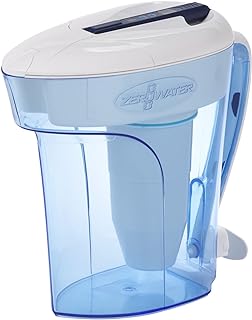
Quick Specs: 5-stage mixed-bed ion-exchange deionization | 12-cup capacity + included digital TDS meter | ~15–40 gal per cartridge (replace at 006 ppm) | Blank-canvas base for remineralization | Price Tier: Under $100 tier (TIER-WTR-BASIC / Base for TIER-WTR-RECIPE)
Audit Score: 8.6 / 10
- Machine Protection & Probe Safety (35%): 8.2 / 10
- Verified Fit & Installation (25%): 9.0 / 10
- Warranty & Maintenance Alignment (20%): 8.5 / 10
- Flavor Balance, Convenience & Tier Value (20%): 8.9 / 10
Light-roast espresso enthusiasts fighting ultra-hard, high-alkalinity, or high-chloride municipal tap water often turn to custom mineral recipes—such as espresso-profile mineral packets or liquid mineral drops—to hit the Specialty Coffee Association’s ~68 mg/L hardness and ~40 mg/L alkalinity targets. Per ZeroWater’s official 5-stage filtration specifications, this 12-cup pitcher strips tap water all the way down to 0 ppm Total Dissolved Solids (TDS) and bundles a calibrated digital TDS meter so you know the exact moment to swap cartridges at 006 ppm.
Why rank ZeroWater below the #2 BWT AQUAlizer for most buyers? Because ZeroWater is a raw ingredient generator, not a finished espresso water filter. While BWT produces balanced, probe-safe magnesium water in one step, ZeroWater demands post-filtration remineralization before entering a boiler machine—making it an eco-friendly replacement for buying plastic distilled water jugs rather than a one-step tap filter.
Buyer Verification Alert: STRICT PROBE SAFETY RULE (CR-WTR-ESP-02): Never pour un-remineralized 0-TDS ZeroWater output directly into an espresso boiler equipped with conductive water-level probes. Water near 0 ppm lacks conductive ions, causing machines to misread a full tank as empty, lock out heaters, or flash ‘Fill Water’ errors. Always stir in calibrated espresso mineral packets or drops first, and keep raw tap TDS in mind—tap feeds above 250 ppm deplete cartridges quickly.
Pros
- Strips tap water to 0 ppm TDS, giving custom mineral recipes an exact repeatable baseline
- Bundled digital TDS meter tracks resin exhaustion precisely down to the 006 ppm swap mark
- Replaces hauling single-use plastic distilled water gallons from grocery stores
- Tackles high-chloride municipal water (CR-WTR-ESP-04) when paired with chloride-free mineral recipes
Cons
- Un-remineralized 0-TDS output triggers conductive probe errors and tastes flat if used straight
- Very hard municipal feeds (>250 ppm) shorten filter life and raise ongoing cartridge spend
Verdict: Buy it if you want repeatable custom recipe water for light-roast straight espresso without buying store-bought distilled jugs. Skip it if you want pour-and-brew simplicity without mixing mineral packets. Recipe Workflow: Fill a separate 1-gallon mixing jug from the ZeroWater pitcher, add your espresso mineral recipe, verify TDS, then fill your machine tank.
10. Brita Large 10-Cup Elite Water Filter Pitcher — Best Budget Chlorine Pitcher for Soft Tap Water

Quick Specs: Activated carbon & contaminant-reduction media (OB06 Elite) | 10-cup capacity | 120 gal (454 L) or ~6 months | Certified NSF/ANSI 42, 53 & 401 | Does NOT soften hard calcium | Price Tier: Under $100 tier (TIER-WTR-BASIC)
Audit Score: 8.0 / 10
- Machine Protection & Probe Safety (35%): 7.2 / 10
- Verified Fit & Installation (25%): 8.8 / 10
- Warranty & Maintenance Alignment (20%): 8.0 / 10
- Flavor Balance, Convenience & Tier Value (20%): 8.6 / 10
Home baristas in naturally soft-water cities—such as Seattle, Portland, Boston, or New York—often already sit inside the Specialty Coffee Association’s 17–85 mg/L CaCO3 hardness target straight out of the faucet, leaving chlorine taste and pipe particulates as their main obstacle. Per Brita’s official Elite performance specifications, the OB06 filter carries NSF/ANSI 42, 53, and 401 certifications across an impressive 120-gallon (454-liter) or six-month rating, clearing chlorine and trace particulates at rock-bottom recurring cost.
We deliberately include the Brita Elite at #10 to highlight a widespread espresso myth: standard carbon pitchers do not soften hard water. Compared with the #2 BWT AQUAlizer, Brita leaves dissolved calcium and magnesium largely untouched. On soft tap water, that keeps probe conductivity intact and preserves sweet espresso extraction; on hard tap water, it leaves your boiler completely exposed to limescale.
Buyer Verification Alert: Check your tap water hardness with strips or your local utility Consumer Confidence Report before trusting a Brita pitcher for espresso equipment (CR-WTR-ESP-01). Because Brita Elite is not certified for water softening or TDS reduction, any supply reading above 85 mg/L CaCO3 (5 gpg) requires switching to the #2 BWT AQUAlizer, adding a #3 BWT Bestsave M pad inside the reservoir, or installing an OEM softening cartridge.
Pros
- 120-gallon / 6-month filter capacity yields the lowest annual running cost among countertop pitchers
- NSF/ANSI 42, 53, and 401 certifications verify chlorine taste/odor and particulate removal
- Preserves beneficial soft-water mineral conductivity so boiler level sensors read reliably
- Replacement OB06 filters are widely stocked in supermarkets and on Amazon
Cons
- Does NOT soften calcium or magnesium hardness—zero protection against hard-water boiler scale
- Slower gravity trickle compared with simple mesh pitchers during busy morning refills
Verdict: Buy it if your tap water is already naturally soft (<68 mg/L CaCO3 / 4 gpg) and you strictly want long-lasting chlorine removal under $100. Skip it if your municipal water leaves white chalky scale on kettles—choose the BWT AQUAlizer (#2) instead. Combo Option: Pair a Brita Elite pitcher with a #3 Bestsave M pad inside your tank when battling both chlorine and moderate hardness.
Cartridge Slot, Probe & Warranty Compatibility Reference
Before clicking buy on any water filter for espresso machine setups, verify three technical compatibility gates: CR-WTR-ESP-05 (OEM reservoir docks are shape-locked by brand and production batch), CR-WTR-ESP-02 (conductive boiler level probes require dissolved minerals above near-zero TDS), and CR-WTR-ESP-03 (manufacturer warranties commonly exclude damage caused by hard-water scale or skipped filter maintenance).
| Machine Group | OEM Cartridge Standard (CR-WTR-ESP-05) | Universal / External Alternatives | Key Probe & Warranty Caveat (CR-WTR-ESP-02 / 03) |
|---|---|---|---|
| Breville Newer Models (Barista Pro, Touch, Oracle Jet, 2018+ Dual Boiler) | Breville BES008 ClaroSwiss (90 days / 40–60 L) | BWT AQUAlizer 2.7L Jug (with dock filter removed) | Check batch code before ordering; BES920 dual boilers use conductive probes—never pour 0-TDS ZeroWater straight in. |
| Breville Legacy Models (Barista Express BES870, Infuser BES840, early BES920) | Breville BWF100 Charcoal 6-Pack (60 days, 2-piece holder) | BWT AQUAlizer 2.7L Jug + BWF100 for taste | BWF100 is primarily charcoal; hard water (>85 mg/L) still needs external softening plus scheduled descaling. |
| De’Longhi Machines (Dedica EC685/EC885, La Specialista, ECAM/ETAM) | De’Longhi DLSC002 Softener (2 months / ~50 L) | BWT AQUAlizer 2.7L Jug (for Dedica / manual) | Purge air bubbles upside down before installing; program hardness setting in ECAM menus to protect thermoblock warranty. |
| Jura & Philips / Saeco Super-Automatics | Jura Claris Smart+ (I.W.S. RFID) or Philips AquaClean CA6903 | Stick strictly to OEM cartridges for sensor lockouts | OEM cartridges communicate with firmware counters; skipping swaps forces descale lockouts and risks warranty disputes. |
| Non-Cartridge Open Tanks (Gaggia Classic Evo Pro, Rancilio Silvia, Bambino) | None (no factory dock) | BWT AQUAlizer 2.7L Jug, BWT Bestsave M Pad, or Remineralized ZeroWater | Follow manual descaling rules carefully (CR-WTR-ESP-06); aluminum-boiler owners must avoid uninhibited bulk acids. |
| Plumbed-In Prosumer Dual Boilers | Direct-line 5-stage inline (BWT Bestmax S + besthead) | None—tank pads do not protect direct water lines | Requires pressure regulator within maker inlet limits and qualified plumbing installation (CR-WTR-ESP-07). |
Buying Guide: How to Choose a Water Filter for Espresso Machine Longevity
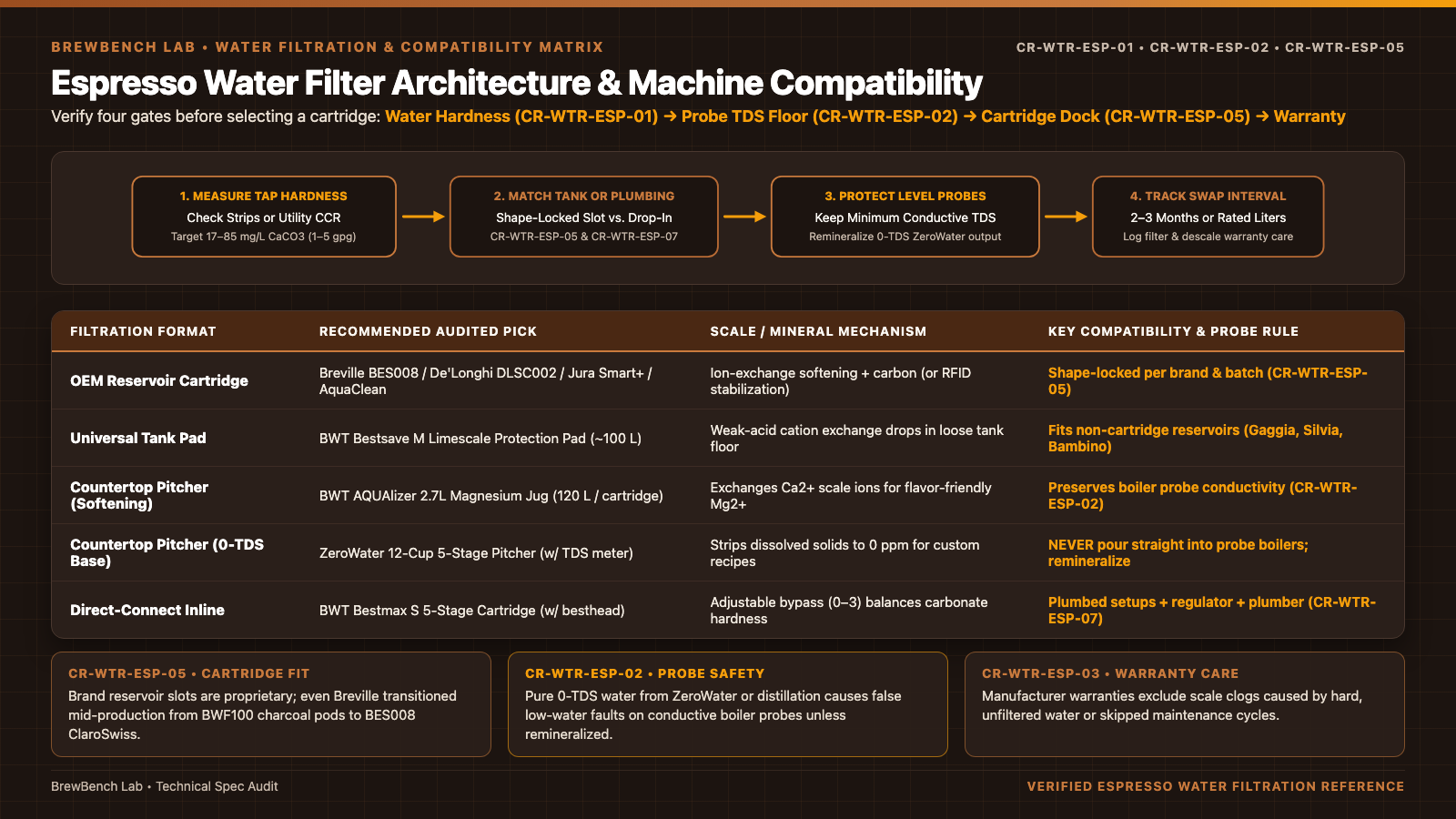
Buying an espresso water filter based on Amazon popularity alone leads to costly mistakes—such as installing a carbon-only pitcher in a hard-water city or pouring pure zero-TDS water into a conductive-probe dual boiler. Walk through these five technical verification steps to protect your hardware and keep every shot balanced.
1. Measure Tap Hardness & Convert Units Before Filtering (CR-WTR-ESP-01)
Every water strategy starts with measuring your incoming supply using hardness strips, a drop kit, or your municipal utility’s annual Consumer Confidence Report (CCR). Specialty Coffee Association (SCA) water guidance points toward a total hardness target near ~68 mg/L as CaCO3 (acceptable range roughly 17–85 mg/L CaCO3), alkalinity near ~40 mg/L as CaCO3, and Total Dissolved Solids (TDS) around ~150 mg/L (75–250 mg/L range). Always verify unit conversions when reading local reports: 1 grain per US gallon (gpg) equals 17.1 mg/L CaCO3, and 1 German degree (°dH) equals 17.8 mg/L CaCO3—so a 5 gpg reading translates to roughly 86 mg/L CaCO3, right at the upper ceiling where scale accelerates inside 93 °C (200 °F) brew paths and steam boilers.
2. Respect Conductive Probe Minimums & Chloride Limits (CR-WTR-ESP-02 & CR-WTR-ESP-04)
One of the most frequent troubleshooting headaches on prosumer heat-exchanger and dual-boiler espresso machines happens when owners pour pure distilled water or un-remineralized ZeroWater output straight into the tank. Many boilers sense water height using stainless steel conductive probes dipped into the boiler; water near 0 ppm TDS lacks enough dissolved ions to carry that micro-current, causing the machine to think the boiler is dry and lock out heating elements. Always keep TDS inside a healthy conductive range—either via magnesium ion-exchange (BWT AQUAlizer), controlled bypass (BWT Bestmax S), or by remineralizing ZeroWater base water with calibrated mineral packets. Equally important under CR-WTR-ESP-04, avoid unmonitored whole-house sodium softeners on high-hardness feeds: swapping calcium for sodium stops white scale, yet elevated sodium and unremoved chloride ions can corrode brass and stainless steel fittings over time.
3. Lock Down OEM Cartridge Shape & Warranty Terms (CR-WTR-ESP-05 & CR-WTR-ESP-03)
Reservoir cartridges are engineered around proprietary tank geometry. Even inside a single brand like Breville, legacy BES870 Barista Express machines require two-piece BWF100 holders while newer BES878/BES880/BES985 units take ClaroSwiss BES008 cartridges. Generic “compatible” multi-brand cartridges frequently carry loose tolerances that let untreated tap water bypass the resin bed. Worse, US manufacturer warranties routinely exclude scale blockages resulting from unapproved water conditions or skipped filter intervals—meaning genuine OEM cartridges (Breville BES008, De’Longhi DLSC002, Jura Claris Smart+, Philips AquaClean) serve as inexpensive insurance during warranty coverage.
4. Flavor Alkalinity Balance & Upgrade Costs (CR-DRINK-WTR-01 & CR-SYS-04)
Beyond protecting boilers, water chemistry shapes shot balance—especially on light-roast single-origin espresso where high carbonate alkalinity neutralizes crisp fruit acidity and leaves shots tasting chalky or flat (CR-DRINK-WTR-01). Magnesium ions in BWT’s Mg2+ cartridges bind flavor compounds nicely while holding scale in check, whereas custom mineral recipes mixed into ZeroWater 0-TDS output let light-roast enthusiasts dial alkalinity precisely. When comparing total cost of ownership under CR-SYS-04, factor in annual cartridge cadence: OEM pods typically run every two to three months, BWT pitcher cartridges span 120 L, and plumbed Bestmax S cartridges last roughly a full year after upfront filter-head and plumber setup.
5. Secondary Intent Resolver: In-Tank Cartridge vs. Countertop Pitcher vs. 0-TDS Recipe
Still deciding which filtration style fits your daily routine? Choose an OEM in-tank cartridge if your machine has a built-in dock (Breville ClaroSwiss, De’Longhi, Jura, Philips) and you want zero extra counter gear. Choose a BWT AQUAlizer pitcher or Bestsave M pad if your machine lacks a filter dock (Gaggia, Rancilio, Bambino) and your tap sits in moderate hardness. Choose ZeroWater + espresso mineral recipes only if your tap water is severely hard/high-chloride or you chase light-roast extraction precision and do not mind mixing batches in a gallon jug. Check our best water for espresso machines guide for complete mineral recipe ratios and our water hardness guide to decode your local utility report.
Evaluation Methodology, Weighted Scoring Rubric & Excluded Products
BrewBench Lab evaluates espresso water treatment gear through manufacturer spec-sheet verification, Safety Data and NSF/ANSI certification audits, OEM warranty reviews, and strict compatibility-rule enforcement rather than fabricated laboratory claims. Each product above was scored out of 10 across four weighted criteria documented in our Editorial Evaluation Methodology.
| Evaluation Criterion | Weight | What We Audited |
|---|---|---|
| Machine Protection & Probe Safety | 35% | Calcium scale control (CR-WTR-ESP-01), conductive boiler probe mineral safety (CR-WTR-ESP-02), and chloride or sodium corrosion balance (CR-WTR-ESP-04). |
| Verified Fit & Installation | 25% | Shape-locked OEM reservoir dock alignment (CR-WTR-ESP-05), production batch accuracy, drop-in tank clearance, or plumbed inlet compliance (CR-WTR-ESP-07). |
| Warranty & Maintenance Alignment | 20% | Alignment with manufacturer warranty water terms (CR-WTR-ESP-03), documented replacement intervals, and descaling schedule support (CR-WTR-ESP-06). |
| Flavor Balance, Convenience & Tier Value | 20% | Chlorine removal, alkalinity/magnesium flavor support (CR-DRINK-WTR-01), daily refill friction, and ongoing replacement cost category (CR-SYS-04). |
Filters & Water Setups We Audited & Excluded (And Why)
- Un-Remineralized Distilled or Raw ZeroWater Output in Boiler Machines: Disqualified as standalone espresso water under CR-WTR-ESP-02 because near-0 ppm TDS fails to trigger conductive boiler water-level probes and risks heater lockouts.
- Generic Unbranded Multi-Fit Reservoir Cartridge Clones on Amazon: Excluded under CR-WTR-ESP-05 because third-party ‘compatible’ O-rings frequently leak around proprietary tank mounts, allowing untreated hard water to bypass the filter bed.
- Unmonitored Whole-House Sodium Softeners Without Bypass Mixing: Flagged and excluded under CR-WTR-ESP-04 because sodium-heavy water paired with untreated chloride poses long-term corrosion risks inside brass and stainless boilers.
- Inline Plumbed Filters Paired With Reservoir-Only Espresso Machines: Disqualified under CR-WTR-ESP-07 because reservoir machines lack direct-connect pressure valves and braided supply inlets.
Continue Your Audit
- Best Espresso Accessories (2026): Tools Worth Buying, Audited
- Best Bottomless Portafilters for Breville 54 mm 2026: Fit Audited
- Best Espresso Tampers 2026: Sized to Your Basket, Compared
Frequently Asked Questions About Espresso Water Filters
Can I use a generic compatible water filter cartridge in my Breville, Jura, or De’Longhi machine?
Generic third-party cartridges rely on unverified compatibility claims and often have looser O-ring tolerances than OEM parts. Under CR-WTR-ESP-05, shape-locked reservoir filters should match the factory dock precisely so hard tap water cannot bypass the resin bed and void scale-related warranty coverage.
Can I pour ZeroWater or pure distilled water straight into my espresso machine?
No—under CR-WTR-ESP-02, pure 0-TDS water from ZeroWater or distillation lacks the dissolved ions required by conductive boiler level probes, causing false low-water errors and heating lockouts. Always remineralize ZeroWater output with espresso mineral packets or drops before filling your machine reservoir.
Does a standard Brita pitcher soften hard water for an espresso machine?
No—Brita Elite and standard carbon pitchers focus on reducing chlorine taste, odor, and listed contaminants, not removing calcium and magnesium hardness. Check your local hardness first under CR-WTR-ESP-01; if your tap exceeds 85 mg/L CaCO3 (5 gpg), choose a BWT magnesium pitcher or OEM softener.
How do I know whether my Breville machine needs the BWF100 or BES008 ClaroSwiss filter?
Inspect your water tank’s bottom filter holder and your machine’s batch code before ordering. Legacy BES870 Barista Express, BES840 Infuser, and pre-2018 BES920 Dual Boiler batches use the two-piece BWF100 holder, whereas newer Barista Pro, Barista Touch, Oracle Jet, and 2018+ Dual Boilers take BES008 ClaroSwiss.
Do I still need to descale my espresso machine if I use an in-tank water filter?
Yes, unless your manufacturer manual explicitly states otherwise (such as Philips AquaClean across eight consecutive filter swaps or Jura Claris Smart+ under strict hardness-indexed intervals). Under CR-WTR-ESP-03 and CR-WTR-ESP-06, follow your machine’s printed descaling prompts and approved solution.
Can I use a BWT Bestmax inline filter on a reservoir-only espresso machine?
No—under CR-WTR-ESP-07, inline cartridges like the BWT Bestmax S are engineered for direct-connect plumbed espresso machines equipped with a compatible filter head, shutoff valve, and inlet pressure regulator. Reservoir-only machines should use an OEM tank cartridge, a BWT Bestsave pad, or a countertop pitcher.
Final Verdict: Picking the Best Water Filter for Espresso Machine Care
Selecting the best water filter for espresso machine longevity starts by matching your filter architecture to your machine’s tank or supply line and your local tap hardness. Owners of modern Breville, De’Longhi, Jura, and Philips machines get seamless warranty-safe scale protection from shape-locked OEM cartridges—led by the Breville BES008 ClaroSwiss at #1, followed by De’Longhi DLSC002, Breville BWF100, Jura Claris Smart+, and Philips AquaClean CA6903.
If your machine has an open non-cartridge reservoir, the BWT AQUAlizer 2.7L Pitcher (#2) delivers the cleanest magnesium-softened, probe-safe brew water on the countertop, while the BWT Bestsave M Pad (#3) protects compact bars with zero extra counter space. Direct-connect prosumer owners should step up to the plumbed BWT Bestmax S (#8), whereas light-roast recipe brewers can pair the ZeroWater 12-Cup Pitcher (#9) with mineral packets—never straight into boiler probes—leaving the Brita 10-Cup Elite (#10) strictly for already-soft municipal tap water.


