
Disclosure: As an Amazon Associate, I earn from qualifying purchases. If you buy through links on this page, we may earn a small commission at no extra cost to you.
Shopping for an espresso grinder under $100 means confronting a hard mechanical reality before clicking buy: most cheap electric hoppers lack fine enough burr steps to choke a non-pressurized single-wall basket, yet spending wisely can still rescue your morning shots from uneven blade grinder dust. Whether your machine pulls through a pressurized basket or an unpressurized 51 mm, 54 mm, or 58 mm portafilter, matching burr pitch to your basket prevents sour channeling and ten-second gushers.
To separate genuine espresso contenders from noisy filter mills, we audited nine manual and 120V/60Hz electric burr grinders actively stocked on Amazon US under $100. If you are comparing entry tiers from our best espresso grinders hub or weighing a step up to the best espresso grinders under $200, the breakdown below shows exactly which sub-$100 mills earn a place on your counter—and which belong strictly with dual-wall pressurized baskets.
In This Guide
- Quick Picks: Best Espresso Grinder Under $100 at a Glance
- Side-by-Side Comparison of All 9 Audited Grinders
- Match Your Use Case: Basket & Budget Matrix
- Detailed Budget Grinder Audits (Ranks #1–#9)
- #1 TIMEMORE Chestnut C3 ESP — Best Overall Under $100
- #2 SHARDOR 48-Setting Conical — Best Electric Under $100
- #3 Capresso Infinity Plus — Best Low-RPM Hopper
- #4 TIMEMORE Chestnut C3S PRO — Best Folding-Handle Travel Mill
- #5 TIMEMORE Chestnut C3S Max — Best 30 g Manual Capacity
- #6 SHARDOR 30-Setting Conical — Best Mid-Step Electric
- #7 Bodum Bistro Conical — Best Glass Catcher Hopper
- #8 KRUPS 18-Setting Flat Burr — Best Budget Flat-Burr Hopper
- #9 Capresso 597.04 Grind Select — Best Under $50 Burr Starter
- Buying Guide: Choosing an Espresso Grinder Under $100
- Scoring Methodology & Models We Excluded
- Frequently Asked Questions
- Final Verdict
Quick Picks: Best Espresso Grinder Under $100 at a Glance
#1 Best Overall Under $100
TIMEMORE Chestnut C3 ESP
38 mm S2C660 conical burrs with a dedicated 0.0233 mm/click espresso pitch (30 clicks/turn) for single-wall dialing. (Jump to audit)
#2 Best Electric Under $100
SHARDOR 48-Setting Conical
40 mm stainless conical burrs, 48 stepped settings, plasma anti-static chute, and 1-second digital timer on 120V power. (Jump to audit)
#3 Best Low-RPM Hopper
Capresso Infinity Plus Conical
Solid steel conical burrs driven below 450 RPM for low-heat pressurized espresso and daily drip brewing. (Jump to audit)
Side-by-Side Comparison: Best Espresso Grinder Under $100 Picks
| Product & Award | Best Basket Match | Burr & Adjustment | Dosing & Power | Link |
|---|---|---|---|---|
| TIMEMORE Chestnut C3 ESP Best Overall | Single-wall & pressurized | 38 mm S2C660 conical; 0.0233 mm/click (30/turn) | 25 g single-dose cup; 0W (manual) | Check Price on Amazon |
| SHARDOR 48-Setting Conical Best Electric | Pressurized + dose-tweaked entry single-wall | 40 mm steel conical; 48 stepped settings | ~275 g hopper + 40 s LCD timer; 150W (120V) | Check Price on Amazon |
| Capresso Infinity Plus Best Low-RPM Hopper | Pressurized + daily filter | Solid steel conical; 16 stepped settings | 8.8 oz hopper + cup timer; 100W <450 RPM (120V) | Check Price on Amazon |
| TIMEMORE Chestnut C3S PRO Best Folding Travel Mill | Pressurized, moka & filter | 38 mm S2C conical; 12 clicks/turn standard | 25 g single-dose + folding handle; 0W (manual) | Check Price on Amazon |
| TIMEMORE Chestnut C3S Max Best 30 g Manual Capacity | Pressurized, moka & batch pour-over | 38 mm S2C660 conical; 12 clicks/turn standard | 30 g single-dose + unibody body; 0W (manual) | Check Price on Amazon |
| SHARDOR 30-Setting Conical Best Mid-Step Electric | Pressurized + moka pot | Steel conical; 30 stepped settings | 2–12 cup selector; 120V US model | Check Price on Amazon |
| Bodum Bistro Conical Best Glass Catcher | Pressurized + drip/French press | Steel conical; 12 stepped settings | Borosilicate glass bin + preset timer; 160W (120V) | Check Price on Amazon |
| KRUPS 18-Setting Flat Burr Best Budget Flat Burr | Pressurized + 2–20 cup drip | Metallic flat burr; 18 stepped settings | 9.5 oz hopper + 2–20 cup chamber; 140W (120V) | Check Price on Amazon |
| Capresso 597.04 Grind Select Best Under $50 Starter | Pressurized + basic drip | Metallic disc/flat burr; 15 stepped settings | 10 oz hopper + 2–12 cup dial; 110W (120V) | Check Price on Amazon |
Match Your Use Case: Which Sub-$100 Grinder Fits Your Basket?
| Buyer Scenario | Best Match | Expected Real-World Outcome |
|---|---|---|
| True Single-Wall Espresso Under $100 | TIMEMORE Chestnut C3 ESP | Fine 0.0233 mm clicks (30 per turn) let you dial non-pressurized 51 mm, 54 mm, and 58 mm baskets without coarse step jumps. |
| Hands-Free 120V Electric Countertop Mill | SHARDOR 48-Setting Conical | 48 settings and plasma anti-static tech give the tightest electric control under $100 for daily milk drinks and pressurized baskets. |
| Low-RPM Durability + Morning Drip | Capresso Infinity Plus | Sub-450 RPM gear-reduction steel conical burrs run cool and quiet while pairing smoothly with pressurized starter machines. |
| Compact Travel Kit & Dorm Counter | TIMEMORE Chestnut C3S PRO | Spring-assisted foldable handle packs slim for luggage while grinding clean moka, AeroPress, and pressurized espresso doses. |
| Large 30 g Batch Manual Grinding | TIMEMORE Chestnut C3S Max | Extended 30 g aluminum barrel covers two-cup filter brews or double-lungo doses in a single load without refilling. |
| Ultra-Budget Blade Chopper Replacement | Capresso 597.04 Grind Select | Moves you onto true metallic disc/flat burrs well under $50 so pressurized starter shots pull more evenly than blade-chopped grounds. |
Detailed Budget Grinder Audits (Ranks #1–#9)
1. TIMEMORE Chestnut C3 ESP Manual Coffee Grinder — Best Overall Espresso Grinder Under $100

Key Specs: 38 mm CNC S2C660 stainless steel conical burrs | Fine-pitch espresso dial: 0.0233 mm per click (30 clicks/rotation) | 25 g capacity | All-metal aluminum unibody | Price Tier: Budget-friendly (under $100)
Audit Score: 9.2 / 10
- Espresso Dialing Resolution & Basket Fit (35%): 9.4 / 10
- Burr Alignment, Retention & Static Control (25%): 9.1 / 10
- Build Quality, Footprint & 120V/Manual Ergonomics (20%): 9.0 / 10
- Value Under $100 & Upgrade Path (20%): 9.3 / 10
Most budget electric grinders under $100 force you into wide stepped clicks that jump straight from choking a machine to gushing in ten seconds. The TIMEMORE Chestnut C3 ESP solves that exact bottleneck by putting your entire budget into CNC machining instead of a cheap motor. Per TIMEMORE’s official C3 series specifications, the ESP variant swaps the standard 12-click filter thread for a fine-pitch dial delivering 30 clicks per rotation—roughly 0.0233 mm of burr travel per click across ten primary increments with three micro-ticks between numbers.
That nearly fourfold jump in adjustment resolution lets the C3 ESP pass CR-GRD-ESP-01 cleanly for non-pressurized single-wall basket espresso, while its dual-bearing central shaft keeps the 38 mm S2C660 conical burrs concentric inside an all-metal aluminum alloy unibody. Compared directly against the folding-handle TIMEMORE C3S PRO (#4) and 30 g C3S Max (#5), the C3 ESP shares identical 38 mm S2C burr cutting geometry yet stands alone as the model engineered to dial in unpressurized 51 mm, 54 mm, and 58 mm portafilters—consistent with our best hand grinders for espresso standards.
Buyer Verification Alert: Verify the exact “C3 ESP” title and ASIN B0C1V1RQDN before checkout—do not substitute the standard 12-click C3 or C3S, which moves ~0.0833 mm per click and lacks fine espresso step density.
Pros
- Dedicated 0.0233 mm/click espresso thread pitch handles single-wall espresso dialing reliably (CR-GRD-ESP-03)
- 38 mm S2C660 CNC stainless burrs and dual bearings minimize wobble and fines
- All-metal unibody aluminum frame avoids plastic internal bearing brackets
- Near-zero grind retention supports quick switching between espresso and filter recipes (CR-GRD-02)
Cons
- Manual hand-cranking takes firm wrist effort on dense light-roast 18 g doses
- Internal bottom-dial click counting is slower to track than an external top ring
- Requires a 0.1 g coffee scale for weighing every single dose consistently (CR-SCALE-GRD-01)
Verdict: Buy it if you want the only true single-wall-ready espresso grinder under $100 and do not mind 35–50 seconds of quiet hand cranking. Skip it if you pull back-to-back milk drinks for multiple people and insist on motorized convenience. Upgrade Note: Pair the C3 ESP with a compact 0.1 g scale and a size-matched magnetic dosing funnel to transfer grounds neatly into your portafilter.
2. SHARDOR Conical Burr Coffee Bean Grinder, Anti-Static, 48 Settings — Best Electric Under $100

Key Specs: 40 mm stainless steel conical burrs | 48 stepped settings | Anti-static plasma tech + 40 s touchscreen timer | ~9.7 oz (275 g) hopper | 150W 120V/60Hz NEMA 5-15P | Price Tier: Budget-friendly (under $100)
Audit Score: 8.6 / 10
- Espresso Dialing Resolution & Basket Fit (35%): 8.4 / 10
- Burr Alignment, Retention & Static Control (25%): 8.8 / 10
- Build Quality, Footprint & 120V/Manual Ergonomics (20%): 8.5 / 10
- Value Under $100 & Upgrade Path (20%): 8.8 / 10
When hand-cranking is off the table, the SHARDOR 48-Setting Anti-Static Conical Burr Grinder delivers the strongest motorized package in the sub-$100 bracket. Whereas legacy budget hoppers top out at 12 to 18 coarse clicks, SHARDOR’s 48-setting platform pairs 40 mm stainless steel conical burrs with a 150W low-speed 120V/60Hz DC motor, an electronic LCD timer adjustable in one-second increments up to 40 seconds, and an active plasma ionizer designed to keep static chaff from clinging to the chute.
Compared to the 16-setting Capresso Infinity Plus (#3) and the 30-setting SHARDOR (#6), these 48 stepped notches shrink the gap between settings in the fine espresso zone—making it far easier to pair with entry 51 mm or 54 mm machines. Even with 48 total steps, however, rule CR-GRD-ESP-03 still applies: because those steps span everything from espresso to French press, dialing a non-pressurized single-wall basket occasionally requires shifting your dry bean dose by 0.5 to 1.0 gram on a 0.1 g scale to hit a ~25-to-30-second extraction.
Buyer Verification Alert: Confirm the listing specifies 120V/60Hz US power and the 48-setting anti-static configuration (B0CKYZLK9B), as SHARDOR sells multiple 16-to-51-setting variants under similar silver product names.
Pros
- 48 stepped settings offer tighter adjustment spacing than 12-to-18-step budget electrics
- Built-in plasma anti-static technology minimizes chute clumping and counter mess
- 1-second LCD timer (up to 40 seconds) streamlines repeatable daily dosing
- 150W 120V/60Hz low-speed DC motor runs comfortably on standard US kitchen circuits
Cons
- Fixed full-range steps can leave single-wall espresso shots between notches without dose compensation (CR-GRD-ESP-03)
- Hopper chute holds more residual grounds between espresso and drip swaps than the manual TIMEMORE C3 ESP (#1)
- Long-term US aftermarket burr availability is narrower than Baratza’s replacement catalog (CR-GRD-01)
Verdict: Buy it if you want a motorized 120V espresso grinder under $100 with low static, digital timing, and enough steps for pressurized baskets or dose-compensated single-wall shots. Skip it if you expect dedicated stepless precision without shifting gram weight. Upgrade Note: Weigh your grounds in the catch cup on a 0.1 g scale rather than trusting time alone when changing bean roasts.
3. Capresso Infinity Plus Conical Burr Grinder — Best Low-RPM Electric Hopper Under $100
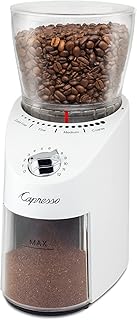
Key Specs: Commercial-grade solid steel conical burrs | 16 stepped settings (4 sub-levels per zone) | 8.8 oz hopper + 4 oz catcher | 100W <450 RPM gear-reduction motor (120V/60Hz) | ~11.25 in H | Price Tier: Budget-friendly (under $100)
Audit Score: 8.4 / 10
- Espresso Dialing Resolution & Basket Fit (35%): 7.9 / 10
- Burr Alignment, Retention & Static Control (25%): 8.5 / 10
- Build Quality, Footprint & 120V/Manual Ergonomics (20%): 8.8 / 10
- Value Under $100 & Upgrade Path (20%): 8.6 / 10
If brand longevity and quiet motor engineering matter more to your kitchen than touchscreen timers, the Capresso Infinity Plus Conical Burr Grinder remains one of the safest electric hoppers under $100. According to Capresso’s North American product specifications, its solid steel conical burrs are driven by a 100W gear-reduction motor turning below 450 RPM—significantly slower than direct-drive budget mills—to keep friction heat and static cling low across 120V/60Hz household circuits.
Standing roughly 11.25 inches tall, it clears standard 18-inch US upper cabinets effortlessly (CR-GRD-SYS-01) and outperforms the faster-spinning Bodum Bistro (#7) and KRUPS Flat Burr (#8) on motor refinement. That said, its 16 stepped settings (divided across four sub-levels per zone) still leave wide gaps inside the fine espresso band (CR-GRD-ESP-03). Pair the Infinity Plus with a starter machine’s dual-wall pressurized basket, moka pot, or morning drip brewer rather than expecting pinpoint single-wall control without stepping up to the SHARDOR 48-Setting (#2) or TIMEMORE C3 ESP (#1).
Buyer Verification Alert: Capresso sells the Infinity Plus in White (B0B3331GP7) and Black (B07N4KTW38) alongside the classic 560.04 Brushed Silver Infinity—all share 16 stepped settings; confirm seller status so your US warranty remains valid.
Pros
- Gear-reduction motor runs under 450 RPM for quieter operation and minimal friction heat
- Compact ~11.25-inch height fits cleanly beneath low kitchen cabinets (CR-GRD-SYS-01)
- Modest 100W 120V/60Hz draw leaves ample headroom on shared kitchen outlets
- Removable upper conical burr and established US brand support ease long-term cleaning
Cons
- 16 total steps are too coarse to dial single-wall espresso baskets reliably (CR-GRD-ESP-03)
- Suited primarily for pressurized baskets and drip/pour-over routines (CR-GRD-ESP-02)
- Cup-marked timer dial lacks digital tenth-of-a-second weight repeatability
Verdict: Buy it if you want a low-RPM 120V conical grinder from an established US maker for pressurized-basket espresso and daily drip coffee. Skip it if your goal is dialing in unpressurized single-wall shots. Upgrade Note: If you eventually upgrade to a bottomless single-wall portafilter, keep the Infinity Plus for filter coffee and move espresso duties to a dedicated fine-stepped grinder.
4. TIMEMORE Chestnut C3S PRO Manual Coffee Grinder — Best Portable Folding-Handle Mill

Key Specs: 38 mm S2C stainless steel conical burrs | Internal click dial (standard 12 clicks/rotation) | 25 g capacity | Spring-assisted foldable handle | All-metal unibody | Price Tier: Budget-friendly (under $100)
Audit Score: 8.3 / 10
- Espresso Dialing Resolution & Basket Fit (35%): 7.7 / 10
- Burr Alignment, Retention & Static Control (25%): 8.8 / 10
- Build Quality, Footprint & 120V/Manual Ergonomics (20%): 8.9 / 10
- Value Under $100 & Upgrade Path (20%): 8.1 / 10
Borrowing the rock-solid aluminum unibody and dual-bearing shaft of Timemore’s updated C3S series, the TIMEMORE Chestnut C3S PRO adds a patented spring-assisted folding crank handle that tucks flush along the barrel for compact drawers and travel kits. Its 38 mm S2C stainless steel conical burrs slice beans cleanly into uniform grounds with remarkably low retention (CR-GRD-02) and zero electrical footprint.
Understanding how it differs from our #1-ranked TIMEMORE Chestnut C3 ESP prevents an expensive mistake: whereas “Pro” denotes the folding handle, “ESP” denotes the fine-pitch 30-click espresso collar. The C3S PRO retains Timemore’s classic 12-clicks-per-rotation internal dial (~0.0833 mm per click), which excels for AeroPress, moka pot, pour-over, and pressurized espresso baskets, yet makes unpressurized single-wall espresso dialing noticeably tighter between clicks (CR-GRD-ESP-03) than the C3 ESP (#1).
Buyer Verification Alert: Check your exact use case before picking B0BZHJ4RLJ: choose C3S PRO if you prioritize a folding travel handle for filter, moka, and pressurized shots, or choose C3 ESP (#1) if you pull single-wall espresso daily.
Pros
- Foldable crank arm shrinks packed footprint for dorms, campers, and travel espresso kits
- All-metal CNC aluminum chassis and dual bearings hold burrs concentric
- 38 mm S2C stainless burrs cut cleanly across filter, moka pot, and pressurized baskets
Cons
- Standard 12-click/rotation dial jumps ~0.0833 mm per click, limiting single-wall espresso fine-tuning (CR-GRD-ESP-03)
- 25 g hopper capacity limits multi-mug batch grinding
- Needs a 0.1 g coffee scale for repeatable single-dosing (CR-SCALE-GRD-01)
Verdict: Buy it if you want a durable folding-handle manual burr grinder for travel, pour-over, moka pot, and pressurized espresso under $100. Skip it if single-wall espresso dialing is your main priority—grab the C3 ESP (#1) instead. Upgrade Note: Use a 0.5 g dose adjustment on a 0.1 g scale whenever a pressurized or moka recipe falls between clicks.
5. TIMEMORE Chestnut C3S Max Manual Coffee Grinder — Best High-Capacity 30 g Manual Grinder

Key Specs: 38 mm CNC S2C660 stainless steel conical burrs | Internal click dial (12 clicks/rotation) | 30 g extended capacity | All-metal unibody aluminum | Price Tier: Budget-friendly (under $100)
Audit Score: 8.1 / 10
- Espresso Dialing Resolution & Basket Fit (35%): 7.6 / 10
- Burr Alignment, Retention & Static Control (25%): 8.6 / 10
- Build Quality, Footprint & 120V/Manual Ergonomics (20%): 8.4 / 10
- Value Under $100 & Upgrade Path (20%): 8.0 / 10
Standard 20–25 g hand grinders force two-person households to reload halfway through morning filter batches or large moka pots. The TIMEMORE Chestnut C3S Max elongates the all-metal aluminum unibody to hold 30 g of whole beans while keeping the same CNC-machined 38 mm S2C660 stainless steel conical burrs and dual-bearing central shaft found across the C3S lineup.
Compared to the 25 g C3S PRO (#4), the C3S Max trades the folding travel arm (on ASIN B0CC51X4WS) for extra barrel capacity, making it ideal if you split duties between two-cup pour-over mornings and pressurized-basket espresso or Americano prep. Just like the C3S PRO, however, its 12-click standard adjustment dial moves too coarsely per notch for finicky single-wall espresso dialing (CR-GRD-ESP-03), so strict single-wall shot chasers should still choose the C3 ESP (#1).
Buyer Verification Alert: TIMEMORE stocks both a rigid-handle C3S Max (B0CC51X4WS) and a foldable-handle C3S Max (B0C2CQ69YF) on Amazon US—confirm which handle configuration fits your counter drawer.
Pros
- 30 g capacity grinds larger double-lungo or two-cup filter recipes in one pass
- Dual-bearing central shaft and unibody aluminum body resist lateral burr flex
- Quiet manual workflow with low grounds retention between roast changes (CR-GRD-02)
Cons
- Standard 12-click pitch lacks fine single-wall espresso resolution compared to C3 ESP (#1)
- Fixed crank arm on B0CC51X4WS takes more storage depth than folding-handle C3S PRO
- Taller aluminum cylinder requires a firmer grip during fine espresso-range cranking
Verdict: Buy it if you want a 30 g all-metal manual mill under $100 for larger pour-over batches, moka pots, and pressurized espresso shots. Skip it if single-wall espresso precision is your top goal. Upgrade Note: Track espresso vs. filter click counts in a phone note so switching back after batch filter brewing stays repeatable (CR-GRD-03).
6. SHARDOR Electric Conical Coffee Bean Grinder (30 Settings) — Best Mid-Step Electric

Key Specs: Stainless steel conical burrs | 30 adjustable grind settings | 2–12 cup quantity selector | 120V/60Hz countertop electric | Price Tier: Budget-friendly (under $100)
Audit Score: 7.9 / 10
- Espresso Dialing Resolution & Basket Fit (35%): 7.8 / 10
- Burr Alignment, Retention & Static Control (25%): 7.8 / 10
- Build Quality, Footprint & 120V/Manual Ergonomics (20%): 7.9 / 10
- Value Under $100 & Upgrade Path (20%): 8.2 / 10
Sitting cleanly between ultra-cheap 15-setting hoppers and our #2-ranked 48-setting SHARDOR, the SHARDOR 30-Setting Electric Conical Burr Grinder gives value-focused shoppers a simpler, lower-cost motorized entry point without dropping back to blade choppers. Its stainless steel conical burrs and 30 stepped increments cover moka pots, drip brewers, and entry pressurized espresso baskets cleanly while using an intuitive 2–12 cup quantity selector.
Compared to the 48-setting SHARDOR (#2), this model drops the digital LCD timer and active plasma anti-static emitter, and official maker wattage/height sheets are not published consistently across retail pages (no verified data available yet for exact watt draw). If your machine uses a dual-wall pressurized basket, 30 settings give noticeably smoother fine-end adjustment than the 12-setting Bodum Bistro (#7) or 15-setting Capresso 597.04 (#9); for unpressurized single-wall shots, however, stepped spacing still limits precision (CR-GRD-ESP-03).
Buyer Verification Alert: Check the seller details and confirm 120V/60Hz North American voltage on ASIN B0BR7QDXPG before checkout, as mid-tier budget conical listings occasionally rotate fulfillment sellers.
Pros
- 30 stepped increments double the fine-end flexibility of 12-to-15-setting hoppers
- Stainless steel conical burrs crush beans far more evenly than spinning blade choppers (CR-GRD-ESP-01)
- Straightforward 2–12 cup selector makes morning filter and pressurized espresso prep simple
Cons
- Omits the plasma anti-static ionizer and 1-second digital timer of the 48-setting SHARDOR (#2)
- 30 full-spectrum clicks remain too stepped for finicky single-wall espresso baskets (CR-GRD-ESP-03)
- Published maker wattage and upper-cabinet height metrics are incomplete (no verified data available yet)
Verdict: Buy it if you want a simple, affordable electric conical burr mill for pressurized espresso, moka pot, and daily drip coffee well under $60–$100. Skip it if you want anti-static plasma tech or plan to dial single-wall baskets. Upgrade Note: Use a 0.1 g scale to weigh grounds out of the bin rather than relying solely on the 2–12 cup dial.
7. Bodum Bistro Electric Conical Burr Coffee Grinder — Best Anti-Static Glass Catcher Hopper

Key Specs: Stainless steel conical burrs | 12 stepped grind settings | Borosilicate glass anti-static grounds catcher | ~7.75–8 oz hopper + preset timer | 160W (120V/60Hz) | 10.9 in H | Price Tier: Budget-friendly (under $100)
Audit Score: 7.7 / 10
- Espresso Dialing Resolution & Basket Fit (35%): 7.0 / 10
- Burr Alignment, Retention & Static Control (25%): 8.4 / 10
- Build Quality, Footprint & 120V/Manual Ergonomics (20%): 8.3 / 10
- Value Under $100 & Upgrade Path (20%): 7.5 / 10
Anyone who has fought static-charged coffee chaff spraying out of a cheap plastic grounds bin will immediately appreciate the Bodum Bistro Electric Conical Burr Coffee Grinder. Per Bodum’s Bistro 10903 specs, it replaces the standard static-prone plastic tub with a heavy borosilicate glass catcher wrapped in a non-slip silicone sleeve—dramatically cutting counter scatter in a compact 10.9 x 6.3 x 4.8-inch chassis powered by a 160W 120V/60Hz motor with a protective gear friction clutch.
However, our compatibility audit draws a sharp boundary on espresso baskets. While Bodum prints an espresso icon on the hopper collar, 12 total stepped settings across French press to espresso leave huge particle jumps at the fine end (CR-GRD-ESP-03). Compared to the 48-setting SHARDOR (#2) or 16-setting Capresso Infinity Plus (#3), the Bodum Bistro should be paired strictly with dual-wall pressurized basket espresso machines, moka pots, or filter brewers rather than non-pressurized single-wall portafilters.
Buyer Verification Alert: Bodum offers identical 12-setting internals in Black (B0043095WW), Red (B00430E94Q), and White (B00430AXLO) on Amazon US; confirm you are selecting the 120V North American model and note its 12-step limit before buying for single-wall espresso.
Pros
- Borosilicate glass catcher dramatically reduces static cling compared to plastic bins
- Slim 4.8-inch width and 10.9-inch height fit tight apartment counters and low cabinets (CR-GRD-SYS-01)
- Built-in friction clutch protects the 160W gear assembly from accidental stone jams
Cons
- 12 stepped grind settings lack fine resolution for single-wall espresso extraction (CR-GRD-ESP-03)
- Practical only for pressurized espresso baskets, drip, and French press duties (CR-GRD-ESP-02)
- Preset push-button timer offers less repeatable gram control than digital timers
Verdict: Buy it if you want a compact, low-static glass-bin conical grinder under $100 for pour-over, drip, and pressurized-basket espresso machines. Skip it if you plan to dial non-pressurized single-wall shots. Upgrade Note: Keep the Bistro on pressurized-basket and morning filter duty, and add a dedicated fine-pitch grinder when moving to bottomless portafilters.
8. KRUPS Flat Burr Coffee Grinder, 18 Settings — Best Budget Flat-Burr Hopper Under $100

Key Specs: Metallic flat burrs (removable upper burr) | 18 stepped settings | 9.5 oz (270 g) bean hopper + 2–20 cup chamber | 140W (120V/60Hz) | ~12.48 in H | Price Tier: Budget-friendly (under $100)
Audit Score: 7.5 / 10
- Espresso Dialing Resolution & Basket Fit (35%): 6.9 / 10
- Burr Alignment, Retention & Static Control (25%): 7.6 / 10
- Build Quality, Footprint & 120V/Manual Ergonomics (20%): 8.0 / 10
- Value Under $100 & Upgrade Path (20%): 7.7 / 10
Large 64 mm specialty flat-burr grinders cost well over $200, yet the KRUPS 18-Setting Flat Burr Coffee Grinder puts basic metallic flat burrs inside a sub-$100 stainless-accented countertop body. According to KRUPS USA specifications, it couples a 140W 120V/60Hz motor with a removable upper flat burr, dual safety micro-switch interlocks on the lid and grounds bin, and an expansive 2–20 cup grounds container fed by a 9.5 oz hopper.
Compared directly against the Capresso 597.04 (#9), the KRUPS adds three more fineness steps and nearly double the maximum cup capacity while standing 12.48 inches tall under US upper cabinets (CR-GRD-SYS-01). Like all 15-to-18-step flat-disc mills in this price band, however, its stepped dial cannot deliver single-wall espresso precision (CR-GRD-ESP-03)—keep it paired with dual-wall pressurized baskets and large drip carafes where flat-burr uniformity cleanly beats blade choppers.
Buyer Verification Alert: Verify ASIN B0DLQ8TD43 (18 settings, 2–20 cups) rather than older 12-setting KRUPS Precision Burr listings (B07Q622YLB), and treat both strictly as pressurized-basket and drip grinders.
Pros
- Metallic flat burrs deliver cleaner particle uniformity than spinning blade mills (CR-GRD-ESP-01)
- Large 9.5 oz hopper and 2–20 cup grounds chamber suit multi-cup drip households
- Dual safety micro-switches prevent accidental operation when the lid or bin is unlatched
- 12.48-inch height fits cleanly beneath standard 18-inch US upper cabinets (CR-GRD-SYS-01)
Cons
- 18 stepped settings do not offer fine enough resolution for single-wall espresso dialing (CR-GRD-ESP-03)
- Plastic grounds container builds static cling unless tapped gently before opening
- Cup-count dial estimates volume rather than weighing repeatable single-dose espresso grams
Verdict: Buy it if you brew large batches of drip coffee alongside pressurized-basket espresso and want metallic flat burrs under $100. Skip it if you use a single-wall espresso basket. Upgrade Note: Tap the plastic chamber lid lightly before removing it to settle static-charged fines back into the bin.
9. Capresso 597.04 Grind Select Coffee Burr Grinder — Best Ultra-Budget Burr Starter Under $50

Key Specs: Metallic disc/flat burrs | 15 stepped grind settings | 10 oz bean hopper + 2–12 cup selector | 110W (120V/60Hz, ETL Listed) | 9.75 in H x 7.25 in W x 5.5 in D | Price Tier: Ultra-budget (under $50)
Audit Score: 7.3 / 10
- Espresso Dialing Resolution & Basket Fit (35%): 6.6 / 10
- Burr Alignment, Retention & Static Control (25%): 7.2 / 10
- Build Quality, Footprint & 120V/Manual Ergonomics (20%): 7.9 / 10
- Value Under $100 & Upgrade Path (20%): 7.9 / 10
If your maximum budget sits strictly under $50 and you want to ditch an erratic blade chopper, the Capresso 597.04 Grind Select puts genuine ETL-listed 110W 120V/60Hz burr grinding onto tiny counters at just 9.75 inches tall. Per Capresso’s Grind Select datasheet, it uses metallic disc/flat burrs across 15 stepped settings with a 10 oz hopper and 2–12 cup auto-stop selector.
Against the Capresso Infinity Plus (#3), the 597.04 cuts retail cost dramatically by dropping the slow-speed gear-reduction conical drive in favor of faster disc/flat burrs—producing louder grinding and more plastic-bin static while still beating blade choppers on particle consistency. Treat the 597.04 strictly as a pressurized-basket starter and morning drip grinder (CR-GRD-ESP-02); anyone using a single-wall basket must step up to the TIMEMORE C3 ESP (#1).
Buyer Verification Alert: Do not expect single-wall espresso extraction from a 15-setting disc burr mill under $50—pair the Capresso 597.04 strictly with dual-wall pressurized baskets or drip coffee makers.
Pros
- True burr grinding under $50 beats spinning blade choppers on particle consistency
- Compact 9.75-inch height tucks effortlessly beneath low apartment cabinets (CR-GRD-SYS-01)
- ETL-listed 110W 120V/60Hz motor runs safely on standard North American outlets
Cons
- 15 disc-burr steps jump far too wide to dial in single-wall espresso baskets (CR-GRD-ESP-03)
- Louder operation and higher static cling than low-RPM conical hoppers like the Infinity Plus (#3)
- Strictly limited to pressurized baskets for espresso machine pairings (CR-GRD-ESP-02)
Verdict: Buy it if you have under $50 to replace a blade mill for a pressurized-basket starter espresso maker and drip pot. Skip it if your budget stretches to the TIMEMORE C3 ESP (#1) or SHARDOR 48-Setting (#2). Upgrade Note: Always unplug the 120V cord before removing the upper disc burr for dry brush cleaning.
Buying Guide: How to Choose an Espresso Grinder Under $100
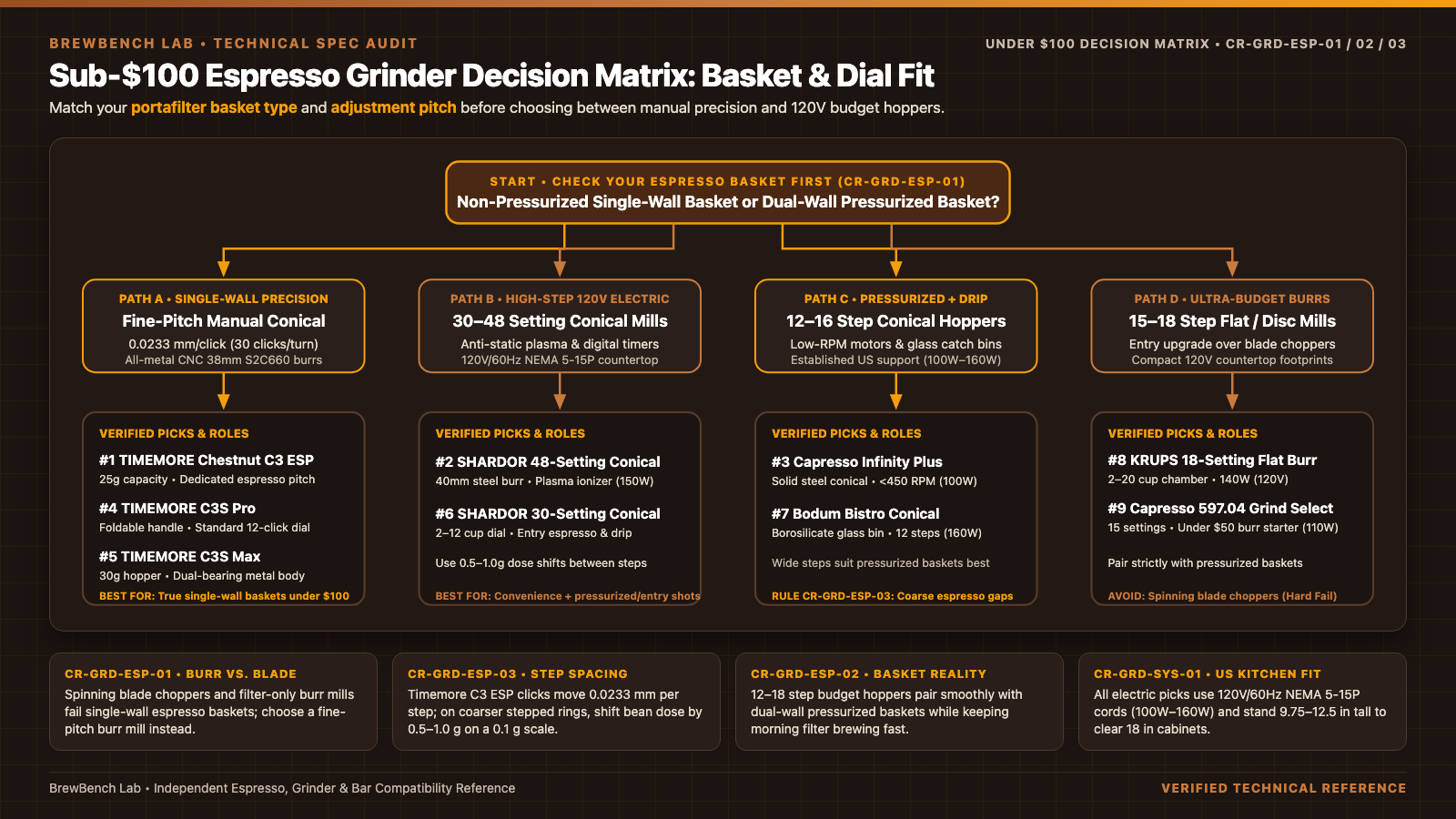
Buying an espresso grinder under $100 is all about avoiding false promises on Amazon product titles. Many cheap mills print “espresso” on the dial even when their burr alignment and step spacing only work inside a pressurized basket. Run your bar through four compatibility checks before ordering.
1. Single-Wall vs. Pressurized Baskets (CR-GRD-ESP-01 & CR-GRD-ESP-02)
Start by inspecting the metal filter basket inside your espresso machine’s portafilter. A dual-wall pressurized basket features dozens of holes on top that funnel into a single tiny pinhole underneath—generating artificial backpressure even from coarser or slightly uneven grounds. A non-pressurized single-wall basket has an open grid of holes across the entire bottom, forcing the finely milled coffee puck itself to hold back roughly nine bars of brew pressure. As detailed in the Specialty Coffee Association coffee standards and our burr vs blade coffee grinders guide, uneven boulders and powdery fines trigger instant channeling in single-wall baskets. Under $100, only fine-pitch manual mills like the TIMEMORE Chestnut C3 ESP—or high-step electrics paired carefully with dose tweaks—can control single-wall resistance reliably.
2. Why Fine-Pitch Clicks Beat Coarse Stepped Hoppers (CR-GRD-ESP-03)
Number of settings alone does not tell the whole story—what matters is how far the burrs move per click inside the espresso window. Most budget electrics spread 12 to 18 notches across the entire span from Turkish coffee to cold brew, leaving only two or three settings near espresso. By contrast, a fine-pitch micro-step dial like the TIMEMORE C3 ESP moves 0.0233 mm per click (30 clicks per turn), giving you nearly four times finer resolution than standard 12-click hand grinders (0.0833 mm per click). Whenever you own a stepped adjustment grinder whose ideal shot lands between two clicks, compensate smoothly by shifting your dry bean dose up or down by 0.5 to 1.0 gram on a 0.1 g scale rather than forcing an awkward tamper pressure change.
3. Single-Dose Retention vs. Timed Hoppers (CR-GRD-02 & CR-SCALE-GRD-01)
Your daily drink routine determines whether a single-dose manual grinder or a timed bean hopper feels better at 7:00 a.m. A hand grinder like the TIMEMORE C3 ESP, C3S PRO, or C3S Max keeps grind retention minimal because every weighed bean passes straight through vertical conical burrs into the catch cup—making espresso-to-pour-over switching painless when paired with a 0.1 g coffee scale (CR-SCALE-GRD-01). Hopper electrics like the SHARDOR 48-Setting, Capresso Infinity Plus, and Bodum Bistro store 7.75 to 10 oz of beans for push-button convenience, though leftover grounds inside the chute require purging one or two grams when changing roast profiles or switching brew methods (CR-GRD-03).
4. 120V/60Hz Kitchen Power, Cabinet Clearance & Pump Pressure Myths (CR-GRD-SYS-01 & G-15)
Every powered pick in this audit runs on standard North American 120V/60Hz NEMA 5-15P outlets drawing just 100W to 160W—never buy 230V import listings or use makeshift plug adapters. All five electric models also stay compact vertically, measuring between 9.75 inches (Capresso 597.04) and 12.48 inches (KRUPS 18-Setting) so they clear standard 18-inch US upper kitchen cabinets without pulling forward (CR-GRD-SYS-01). Finally, ignore “15-bar” or “20-bar” sticker claims on budget espresso machines when shopping for a grinder: those figures describe the maximum pump rating, not the ~9-bar target at the coffee puck that makes fine burr uniformity indispensable. Always unplug electric mills from the wall before disassembling burrs for dry brush cleaning.
Secondary Intent Resolver: Sub-$100 Manual vs. Stepping Up to $100–$200 Electrics
Should you buy a manual espresso grinder under $100 today or save toward the $100–$200 tier? If you pull one or two straight espresso shots or single lattes daily, the TIMEMORE C3 ESP matches far pricier grinders on burr machining and cup clarity without motorized noise. However, if you make back-to-back milk drinks for a household or hate arm effort on dense light roasts, stepping up to our best espresso grinders under $200 guide unlocks motorized 40 mm to 48 mm fine-stepped and stepless countertop units built specifically for single-wall espresso.
Upgrade Roadmap & Hidden Ownership Costs
Budgeting under $100 leaves room for two low-cost accessories that lift shot repeatability immediately. First, add a compact 0.1 g coffee scale (mandatory under CR-SCALE-GRD-01 for weighing single doses into hand mills and verifying cup-timer output on electrics). Second, pick up a 51 mm, 54 mm, or 58 mm dosing funnel matched to your portafilter diameter plus a basic WDT needle tool to break up static clumps before tamping. Routine burr care costs virtually nothing—just a dry cleaning brush and occasional grinder-safe cleaning tablets per the manufacturer manual.
How We Audited, Scored & Excluded These Budget Grinders
Every BrewBench Lab review follows our Editorial Evaluation Methodology, cross-checking official North American manufacturer manuals, 120V/60Hz electrical ratings, burr geometries, and espresso cross-compatibility rules (CR-GRD-ESP-01, CR-GRD-ESP-02, CR-GRD-ESP-03). We never invent micron particle curves, retention gram numbers, or decibel metrics when manufacturers omit them. Each candidate is scored out of 10 across four weighted criteria summing to 100%:
| Evaluation Criterion | Weight | What We Audited |
|---|---|---|
| Espresso Dialing Resolution & Basket Fit | 35% | Maker espresso positioning (CR-GRD-ESP-01), fine-step pitch (CR-GRD-ESP-03), and single-wall vs. pressurized pairing (CR-GRD-ESP-02). |
| Burr Alignment, Retention & Static Control | 25% | CNC steel conical vs. flat/disc burrs, dual-bearing shaft stability, ionizers or glass catchers, and chute retention (CR-GRD-02). |
| Build Quality, Footprint & 120V/Manual Ergonomics | 20% | Metal unibody vs. plastic chassis, 120V/60Hz NEMA 5-15P wattage or crank effort, and cabinet height clearance (CR-GRD-SYS-01). |
| Value Under $100 & Upgrade Path | 20% | Performance-per-dollar under $100, US warranty/parts continuity, and realistic pairing with entry espresso machines. |
Models We Audited & Excluded (And Why)
- Spinning Blade Coffee Grinders (All Brands Under $40): HARD FAIL on CR-GRD-ESP-01. Whirling metal blades chop beans unpredictably into boulders and dust, causing severe channeling and watery shots regardless of grind duration.
- Generic Ceramic-Burr Hand Mills Under $25: HARD FAIL on CR-GRD-ESP-01 & CR-GRD-ESP-03. Loose single-bearing shafts and dull ceramic cones create heavy fines spread and exhausting crank times in the espresso range.
- Baratza Encore (Standard ZCG485BLK) & OXO Brew Conical: HARD FAIL on CR-GRD-ESP-01. Engineered and positioned strictly for drip and pour-over brewing without fine espresso calibration, causing rapid shot gushing in single-wall baskets.
- Off-Amazon Dealer-Only & Over-Budget Grinders: Hardware such as Niche Zero, Niche Duo, Timemore Sculptor 064, and Lelit/Profitec grinders are excluded as off-Amazon dealer-only or prosumer-tier models outside this Amazon US under-$100 scope.
Continue Your Audit
Frequently Asked Questions: Espresso Grinder Under $100
Can an espresso grinder under $100 actually dial in a single-wall basket?
Yes, if you choose a fine-pitch manual burr grinder like the TIMEMORE Chestnut C3 ESP, whose 0.0233 mm clicks (30 per turn) provide enough resolution to hit ~25-to-30-second single-wall extractions. Most 12-to-18-step electric hoppers under $100 lack fine step spacing and work best with pressurized baskets.
Why are manual hand grinders better than cheap electric grinders under $100?
Manual mills put your entire budget into CNC burrs and bearings instead of an electric motor, gear train, and plastic housing. Under $100, that engineering shift delivers tighter 38 mm conical alignment and finer click control than motorized hoppers at the same price.
What happens if I pair a 12-setting electric grinder under $100 with a non-pressurized basket?
Shots usually gush in under 12 seconds or choke completely because consecutive clicks jump too far apart in the fine espresso range (CR-GRD-ESP-03). If you own a 12-to-18-setting hopper, use your machine’s dual-wall pressurized basket or shift dry coffee dose by 0.5 to 1.0 gram.
Can I use a spinning blade grinder for espresso if I grind longer?
No—spinning blade choppers fail CR-GRD-ESP-01 regardless of how long you hold the button. Blades smash beans unevenly into coarse boulders and powdery fines, creating severe channeling and sour, watery shots even inside pressurized baskets compared to entry burr mills.
Do I need a coffee scale with a budget espresso grinder under $100?
Yes—a 0.1 g coffee scale is essential under CR-SCALE-GRD-01 for weighing single doses into hand grinders and verifying output from timed electric hoppers. On stepped grinders, adjusting bean dose by 0.5 gram lets you fine-tune shot speed when your ideal setting sits between clicks.
Should I buy an espresso grinder under $100 or save for the under-$200 tier?
Save for the $100–$200 tier if you want effortless electric single-wall dialing, where dedicated fine-stepped and stepless conical mills simplify milk-drink mornings. If your budget stays strictly capped under $100, the manual TIMEMORE C3 ESP matches entry electrics on extraction quality.
Final Verdict: Picking the Best Espresso Grinder Under $100
Choosing the right espresso grinder under $100 hinges on matching burr step precision to your portafilter basket rather than chasing inflated setting counts or motor claims. For anyone brewing with a non-pressurized single-wall basket on a strict budget, the TIMEMORE Chestnut C3 ESP takes #1 overall because its 0.0233 mm/click espresso pitch and 38 mm S2C660 conical burrs dial in real espresso extractions cleanly.
If motorized convenience beats hand-cranking in your kitchen, the SHARDOR 48-Setting Conical leads electric picks with plasma static control and digital timing, while the Capresso Infinity Plus delivers low-RPM durability for pressurized-basket setups and daily drip. Travelers and batch pour-over fans should look to the TIMEMORE C3S PRO or C3S Max, and ultra-tight budgets under $50 can step away from blade choppers cleanly with the Capresso 597.04 Grind Select.


